driver seat LINCOLN MKS 2016 Owner's Manual
[x] Cancel search | Manufacturer: LINCOLN, Model Year: 2016, Model line: MKS, Model: LINCOLN MKS 2016Pages: 382, PDF Size: 3.81 MB
Page 198 of 382
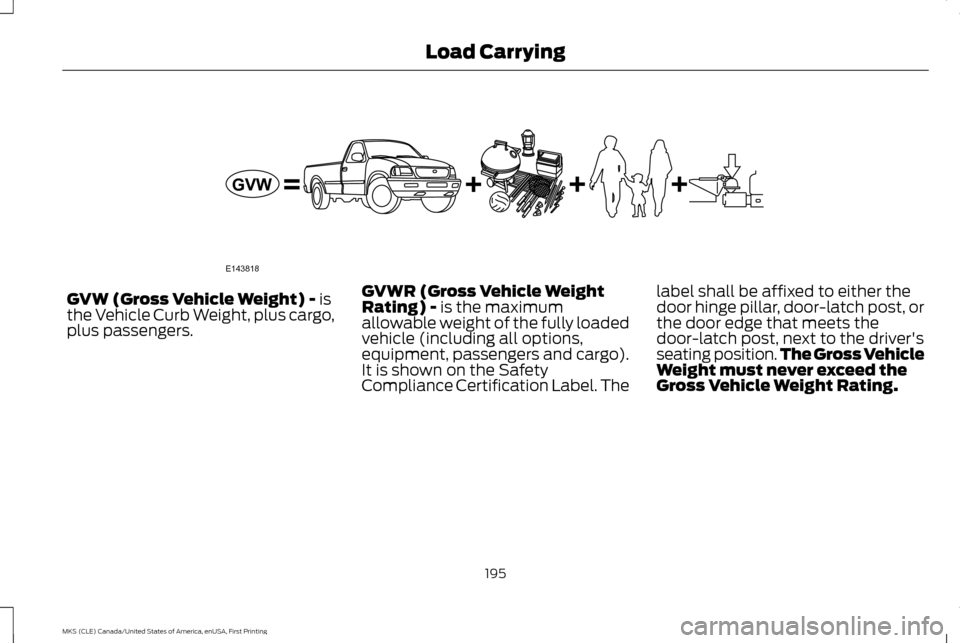
GVW (Gross Vehicle Weight) - is
the Vehicle Curb Weight, plus cargo,
plus passengers. GVWR (Gross Vehicle Weight
Rating) - is the maximum
allowable weight of the fully loaded
vehicle (including all options,
equipment, passengers and cargo).
It is shown on the Safety
Compliance Certification Label. The label shall be affixed to either the
door hinge pillar, door-latch post, or
the door edge that meets the
door-latch post, next to the driver's
seating position.
The Gross Vehicle
Weight must never exceed the
Gross Vehicle Weight Rating.
195
MKS (CLE) Canada/United States of America, enUSA, First Printing Load CarryingE143818GVW
Page 203 of 382
(45-kilogram) cement bags, then
the load calculation would be: 1400
- (2 x 220) - (9 x 100) = 1400 - 440
- 900 = 60 pounds. Now you have
the load capacity to transport the
cement and your friend home. In
metric units, the calculation would
be: 635 kilograms - (2 x 99
kilograms) - (9 x 45 kilograms) =
635 - 198 - 405 = 32 kilograms.
The above calculations also assume
that the loads are positioned in your
vehicle in a manner that does not
overload the Front or the Rear Gross
Axle Weight Rating specified for
your vehicle on the Safety
Compliance Certification Label. The
label shall be affixed to either the
door hinge pillar, door-latch post, or
the door edge that meets the
door-latch post, next to the driver's
seating position.
200
MKS (CLE) Canada/United States of America, enUSA, First Printing Load Carrying
Page 228 of 382
Protected components
Fuse amp rating
Fuse or relay number
Not used.
-
16
Not used.
-
17
Front blower motor relay.
40A 2
18
Starter relay.
30A 2
19
Storage bin power point.
20A 2
20
Rear heated seat module.
20A 2
21
Not used.
-
22
Driver power seat.
30A 2
23
Memory module.
Not used.
-
24
Not used.
-
25
Heated rear window relay.
40A 2
26
Cigar lighter.
20A 2
27
Climate controlled seats.
30A 2
28
Electric fan relay 1.
40A 2
29
225
MKS (CLE) Canada/United States of America, enUSA, First Printing Fuses
Page 236 of 382
Protected components
Fuse amp rating
Fuse or relay number
Left front and right rear smart window motors.
30A
1
Driver seat switch.
15A
2
Right front smart window motor.
30A
3
Demand lamps battery saver relay.
10A
4
Audio amplifier
20A
5
Active noise control module.
Not used (spare).
5A
6
Driver seat module logic.
7.5A
7
Left front door zone module.
Keypad.
Not used (spare).
10A
8
SYNC module.
10A
9
Electronic finish panel.
Radio frequency transceiver module.
Run accessory relay.
10A
10
Wiper relay.
Rain-sense subfuse.
Intelligent access module logic.
10A
11
Heads-up display.
Puddle lamp.
15A
12
233
MKS (CLE) Canada/United States of America, enUSA, First Printing Fuses
Page 275 of 382
•
Standard load: A class of
P-metric or Metric tires designed
to carry a maximum load at set
pressure. For example: For
P-metric tires 35 psi (2.4 bar) or
36 (2.5 bar) depending on tire
size and for Metric tires 36 psi
(2.5 bar). Increasing the inflation
pressure beyond this pressure
will not increase the tire ’s load
carrying capability.
• Extra load:
A class of P-metric
or Metric tires designed to carry
a heavier maximum load at 42
psi (2.9 bar). Increasing the
inflation pressure beyond this
pressure will not increase the
tire ’s load carrying capability.
• kPa:
Kilopascal, a metric unit of
air pressure.
• PSI:
Pounds per square inch, a
standard unit of air pressure. •
Cold tire pressure:
The tire
pressure when the vehicle has
been stationary and out of direct
sunlight for an hour or more and
prior to the vehicle being driven
for 1 mile (1.6 km).
• Recommended inflation
pressure:
The cold inflation
pressure found on the Safety
Compliance Certification Label
(affixed to either the door hinge
pillar, door-latch post, or the door
edge that meets the door-latch
post, next to the driver's seating
position), or Tire Label located
on the B-Pillar or the edge of the
driver ’s door.
• B-pillar:
The structural member
at the side of the vehicle behind
the front door
• Bead area of the tire:
Area of
the tire next to the rim.
• Sidewall of the tire:
Area
between the bead area and the
tread. •
Tread area of the tire:
Area of
the perimeter of the tire that
contacts the road when mounted
on the vehicle.
• Rim:
The metal support (wheel)
for a tire or a tire and tube
assembly upon which the tire
beads are seated.
Information Contained on the
Tire Sidewall
Both United States and Canada
Federal regulations require tire
manufacturers to place
standardized information on the
sidewall of all tires. This information
identifies and describes the
fundamental characteristics of the
tire and also provides a U.S. DOT
Tire Identification Number for safety
standard certification and in case of
a recall.
272
MKS (CLE) Canada/United States of America, enUSA, First Printing Wheels and Tires
Page 278 of 382
K.
Maximum Load: Indicates the
maximum load in kilograms and
pounds that can be carried by the
tire. See the Safety Compliance
Certification Label (affixed to either
the door hinge pillar, door-latch
post, or the door edge that meets
the door-latch post, next to the
driver's seating position), for the
correct tire pressure for your vehicle.
L. Treadwear, Traction and
Temperature Grades:
275
MKS (CLE) Canada/United States of America, enUSA, First Printing Wheels and Tires
Page 279 of 382
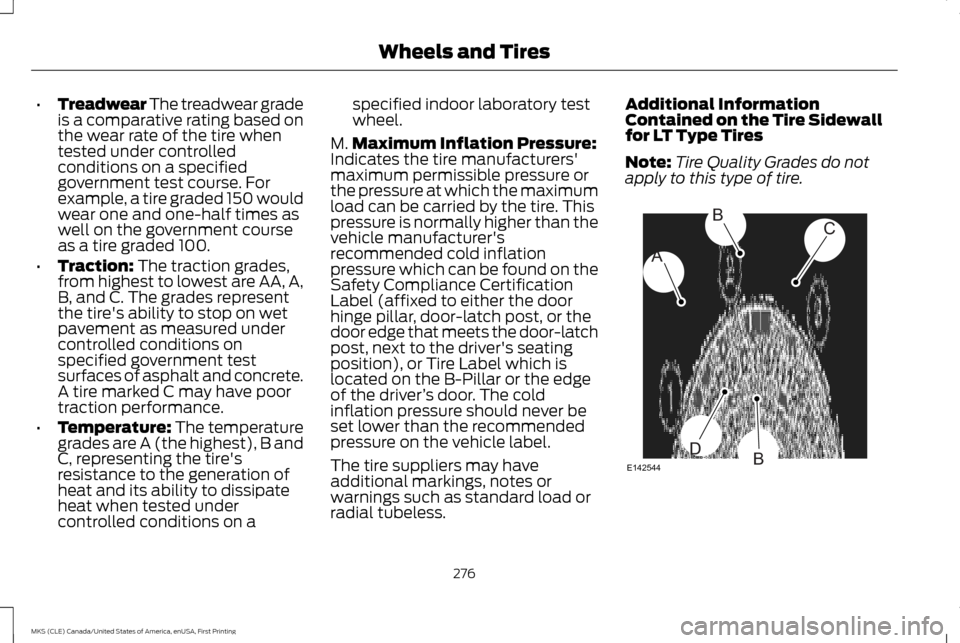
•
Treadwear The treadwear grade
is a comparative rating based on
the wear rate of the tire when
tested under controlled
conditions on a specified
government test course. For
example, a tire graded 150 would
wear one and one-half times as
well on the government course
as a tire graded 100.
• Traction: The traction grades,
from highest to lowest are AA, A,
B, and C. The grades represent
the tire's ability to stop on wet
pavement as measured under
controlled conditions on
specified government test
surfaces of asphalt and concrete.
A tire marked C may have poor
traction performance.
• Temperature:
The temperature
grades are A (the highest), B and
C, representing the tire's
resistance to the generation of
heat and its ability to dissipate
heat when tested under
controlled conditions on a specified indoor laboratory test
wheel.
M. Maximum Inflation Pressure:
Indicates the tire manufacturers'
maximum permissible pressure or
the pressure at which the maximum
load can be carried by the tire. This
pressure is normally higher than the
vehicle manufacturer's
recommended cold inflation
pressure which can be found on the
Safety Compliance Certification
Label (affixed to either the door
hinge pillar, door-latch post, or the
door edge that meets the door-latch
post, next to the driver's seating
position), or Tire Label which is
located on the B-Pillar or the edge
of the driver ’s door. The cold
inflation pressure should never be
set lower than the recommended
pressure on the vehicle label.
The tire suppliers may have
additional markings, notes or
warnings such as standard load or
radial tubeless. Additional Information
Contained on the Tire Sidewall
for LT Type Tires
Note:
Tire Quality Grades do not
apply to this type of tire. 276
MKS (CLE) Canada/United States of America, enUSA, First Printing Wheels and TiresA
BC
BDE142544
Page 282 of 382
WARNING
Under-inflation is the most
common cause of tire failures
and may result in severe tire
cracking, tread separation or
blowout, with unexpected loss of
vehicle control and increased risk of
injury. Under-inflation increases
sidewall flexing and rolling
resistance, resulting in heat buildup
and internal damage to the tire. It
also may result in unnecessary tire
stress, irregular wear, loss of vehicle
control and accidents. A tire can
lose up to half of its air pressure and
not appear to be flat! Always inflate your tires to the Ford
recommended inflation pressure
even if it is less than the maximum
inflation pressure information found
on the tire. The Ford recommended
tire inflation pressure is found on the
Safety Compliance Certification
Label (affixed to either the door
hinge pillar, door-latch post, or the
door edge that meets the door-latch post, next to the driver's seating
position), or Tire Label which is
located on the B-Pillar or the edge
of the driver
’s door. Failure to follow
the tire pressure recommendations
can cause uneven treadwear
patterns and adversely affect the
way your vehicle handles
Maximum Inflation Pressure is
the tire manufacturer's maximum
permissible pressure and the
pressure at which the maximum
load can be carried by the tire. This
pressure is normally higher than the
manufacturer ’s recommended cold
inflation pressure which can be
found on the Safety Compliance
Certification Label (affixed to either
the door hinge pillar, door-latch
post, or the door edge that meets
the door-latch post, next to the
driver's seating position), or Tire
Label which is located on the B-Pillar or the edge of the driver
’s
door. The cold inflation pressure
should never be set lower than the
recommended pressure on the
Safety Compliance Certification
Label or Tire Label.
When weather temperature
changes occur, tire inflation
pressures also change. A 10°F (6°C)
temperature drop can cause a
corresponding drop of 1 psi (7 kPa)
in inflation pressure. Check your tire
pressures frequently and adjust
them to the proper pressure which
can be found on the Safety
Compliance Certification Label or
Tire Label.
To check the pressure in your tire(s):
1. Make sure the tires are cool, meaning they are not hot from
driving even a mile.
279
MKS (CLE) Canada/United States of America, enUSA, First Printing Wheels and Tires
Page 285 of 382
Age
WARNING
Tires degrade over time
depending on many factors
such as weather, storage conditions,
and conditions of use (load, speed,
inflation pressure) the tires
experience throughout their lives.
In general, tires should be replaced
after six years regardless of tread
wear. However, heat caused by hot
climates or frequent high loading
conditions can accelerate the aging
process and may require tires to be
replaced more frequently.
You should replace your spare tire
when you replace the road tires or
after six years due to aging even if it
has not been used. U.S. DOT Tire Identification
Number
Both U.S. and Canada Federal
regulations require tire
manufacturers to place
standardized information on the
sidewall of all tires. This information
identifies and describes the
fundamental characteristics of the
tire and also provides a U.S. DOT
Tire Identification Number for safety
standard certification and in case of
a recall.
This begins with the letters DOT and
indicates that the tire meets all
federal standards. The next two
numbers or letters are the plant
code designating where it was
manufactured, the next two are the
tire size code and the last four
numbers represent the week and
year the tire was built. For example,
the numbers 317 mean the 31st week
of 1997. After 2000 the numbers go
to four digits. For example, 2501
means the 25th week of 2001. The
numbers in between are
identification codes used for
traceability. This information is used
to contact customers if a tire defect
requires a recall.
Tire Replacement Requirements
Your vehicle is equipped with tires
designed to provide a safe ride and
handling capability.
WARNINGS
Only use replacement tires and
wheels that are the same size,
load index, speed rating and type
(such as P-metric versus LT-metric
or all-season versus all-terrain) as
those originally provided by Ford.
The recommended tire and wheel
size may be found on either the
Safety Compliance Certification
Label (affixed to either the door
hinge pillar, door-latch post, or the
door edge that meets the door-latch
post, next to the driver's seating
position), or the Tire Label which is
282
MKS (CLE) Canada/United States of America, enUSA, First Printing Wheels and Tires
Page 286 of 382
WARNINGS
located on the B-Pillar or edge of
the driver ’s door. If this information
is not found on these labels then
you should contact your authorized
dealer as soon as possible. Use of
any tire or wheel not recommended
by Ford can affect the safety and
performance of your vehicle, which
could result in an increased risk of
loss of vehicle control, vehicle
rollover, personal injury and death.
Additionally the use of
non-recommended tires and wheels
could cause steering, suspension,
axle, transfer case or power transfer
unit failure. If you have questions
regarding tire replacement, contact
your authorized dealer as soon as
possible. WARNINGS
To reduce the risk of serious
injury, when mounting
replacement tires and wheels, you
should not exceed the maximum
pressure indicated on the sidewall
of the tire to set the beads without
additional precautions listed below.
If the beads do not seat at the
maximum pressure indicated,
re-lubricate and try again
When inflating the tire for mounting
pressures up to 20 psi (1.38 bar)
greater than the maximum pressure
on the tire sidewall, the following
precautions must be taken to
protect the person mounting the
tire:
1. Make sure that you have the
correct tire and wheel size.
2. Lubricate the tire bead and wheel
bead seat area again. WARNINGS
3. Stand at a minimum of 12 feet
(3.66 meters) away from the wheel
and tire assembly.
4. Use both eye and ear protection.
For a mounting pressure more than
20 psi (1.38 bar) greater than the
maximum pressure, a Ford dealer
or other tire service professional
should do the mounting.
Always inflate steel carcass tires
with a remote air fill with the person
inflating standing at a minimum of
12 feet (3.66 meters) away from the
wheel and tire assembly Important: Remember to replace
the wheel valve stems when the
road tires are replaced on your
vehicle
It is recommended that the two
front tires or two rear tires generally
be replaced as a pair.
283
MKS (CLE) Canada/United States of America, enUSA, First Printing Wheels and Tires