change time LINCOLN MKT 2010 Owner's Manual
[x] Cancel search | Manufacturer: LINCOLN, Model Year: 2010, Model line: MKT, Model: LINCOLN MKT 2010Pages: 430, PDF Size: 3.32 MB
Page 402 of 430
5. Follow one of the simple calculations in order to determine fuel
economy:
Calculation 1:Divide total miles traveled by total gallons used.
Calculation 2:Multiply liters used by 100, then divide by total
kilometers traveled.
Keep a record for at least one month and record the type of driving (city
or highway). This will provide an accurate estimate of the vehicle’s fuel
economy under current driving conditions. Additionally, keeping records
during summer and winter will show how temperature impacts fuel
economy. In general, lower temperatures give lower fuel economy.
Driving style — good driving and fuel economy habits
Give consideration to the lists that follow and you may be able to change
a number of variables and improve your fuel economy.
Habits
•Smooth, moderate operation can yield up to 10% savings in fuel.
•Steady speeds without stopping will usually give the best fuel
economy.
•Idling for long periods of time (greater than one minute) may waste
fuel.
•Anticipate stopping; slowing down may eliminate the need to stop.
•Sudden or hard accelerations may reduce fuel economy.
•Slow down gradually.
•Driving at reasonable speeds (traveling at 55 mph [88 km/h] uses 15%
less fuel than traveling at 65 mph [105 km/h]).
•Revving the engine before turning it off may reduce fuel economy.
•Using the air conditioner or defroster may reduce fuel economy.
•You may want to turn off the speed control in hilly terrain if
unnecessary shifting between the top gears occurs. Unnecessary
shifting of this type could result in reduced fuel economy.
•Warming up a vehicle on cold mornings is not required and may
reduce fuel economy.
•Resting your foot on the brake pedal while driving may reduce fuel
economy.
•Combine errands and minimize stop-and-go driving.
Maintenance and Specifications
402
2010 MKT(mkt)
Owners Guide, 1st Printing
USA(fus)
Page 405 of 430
Do not make any unauthorized changes to your vehicle or engine. By
law, vehicle owners and anyone who manufactures, repairs, services,
sells, leases, trades vehicles, or supervises a fleet of vehicles are not
permitted to intentionally remove an emission control device or prevent
it from working. Information about your vehicle’s emission system is on
the Vehicle Emission Control Information Decal located on or near the
engine. This decal also lists engine displacement.
Please consult yourWarranty Guide/Customer Information Guidefor
complete emission warranty information.
On board diagnostics (OBD-II)
Your vehicle is equipped with a computer that monitors the engine’s
emission control system. This system is commonly known as the On
Board Diagnostics System (OBD-II). The OBD-II system protects the
environment by ensuring that your vehicle continues to meet
government emission standards. The OBD-II system also assists your
authorized dealer in properly servicing your vehicle. When the service
engine soon
indicator illuminates, the OBD-II system has detected
a malfunction. Temporary malfunctions may cause the service engine
soon
indicator to illuminate. Examples are:
1. The vehicle has run out of fuel—the engine may misfire or run poorly.
2. Poor fuel quality or water in the fuel—the engine may misfire or run
poorly.
3. The fuel fill inlet may not have been properly closed. SeeEasy Fuel™
“no cap” fuel systemin this chapter.
4. Driving through deep water—the electrical system may be wet.
These temporary malfunctions can be corrected by filling the fuel tank
with good quality fuel, properly closing the fuel fill inlet or letting the
electrical system dry out. After three driving cycles without these or any
other temporary malfunctions present, the service engine soon
indicator should stay off the next time the engine is started. A driving
cycle consists of a cold engine startup followed by mixed city/highway
driving. No additional vehicle service is required.
If the service engine soon
indicator remains on, have your vehicle
serviced at the first available opportunity. Although some malfunctions
detected by the OBD-II may not have symptoms that are apparent,
continued driving with the service engine soon
indicator on can
result in increased emissions, lower fuel economy, reduced engine and
transmission smoothness, and lead to more costly repairs.
Maintenance and Specifications
405
2010 MKT(mkt)
Owners Guide, 1st Printing
USA(fus)
Page 408 of 430
TRANSMISSION FLUID
Checking automatic transmission fluid
Refer to yourscheduled maintenance informationfor scheduled
intervals for fluid checks and changes. Your transmission does not
consume fluid. However, the fluid level should be checked if the
transmission is not working properly, i.e., if the transmission slips or
shifts slowly or if you notice some sign of fluid leakage.
Automatic transmission fluid expands when warmed. To obtain an
accurate fluid check, drive the vehicle until it is warmed up
(approximately 20 miles [30 km]). If your vehicle has been
operated for an extended period at high speeds, in city traffic
during hot weather or pulling a trailer, the vehicle should be
turned off for about 30 minutes to allow fluid to cool before
checking.
1. Drive the vehicle 20 miles (30 km) or until it reaches normal operating
temperature.
2. Park the vehicle on a level surface and engage the parking brake.
3. With the parking brake engaged and your foot on the brake pedal,
start the engine and move the gearshift lever through all of the gear
ranges. Allow sufficient time for each gear to engage.
4. Latch the gearshift lever in P (Park) and leave the engine running.
5. Remove the dipstick, wiping it clean with a clean, dry lint free rag. If
necessary, refer toIdentifying components in the engine compartment
in this chapter for the location of the dipstick. (For vehicles with the
EcoBoost engine, move the air filter assembly aside to access the
transmission dipstick. SeeChanging the air filter elementfor more
information).
6. Install the dipstick making sure it is fully seated in the filler tube.
7. Remove the dipstick and inspect the fluid level. The fluid should be in
the designated areas for normal operating temperature.
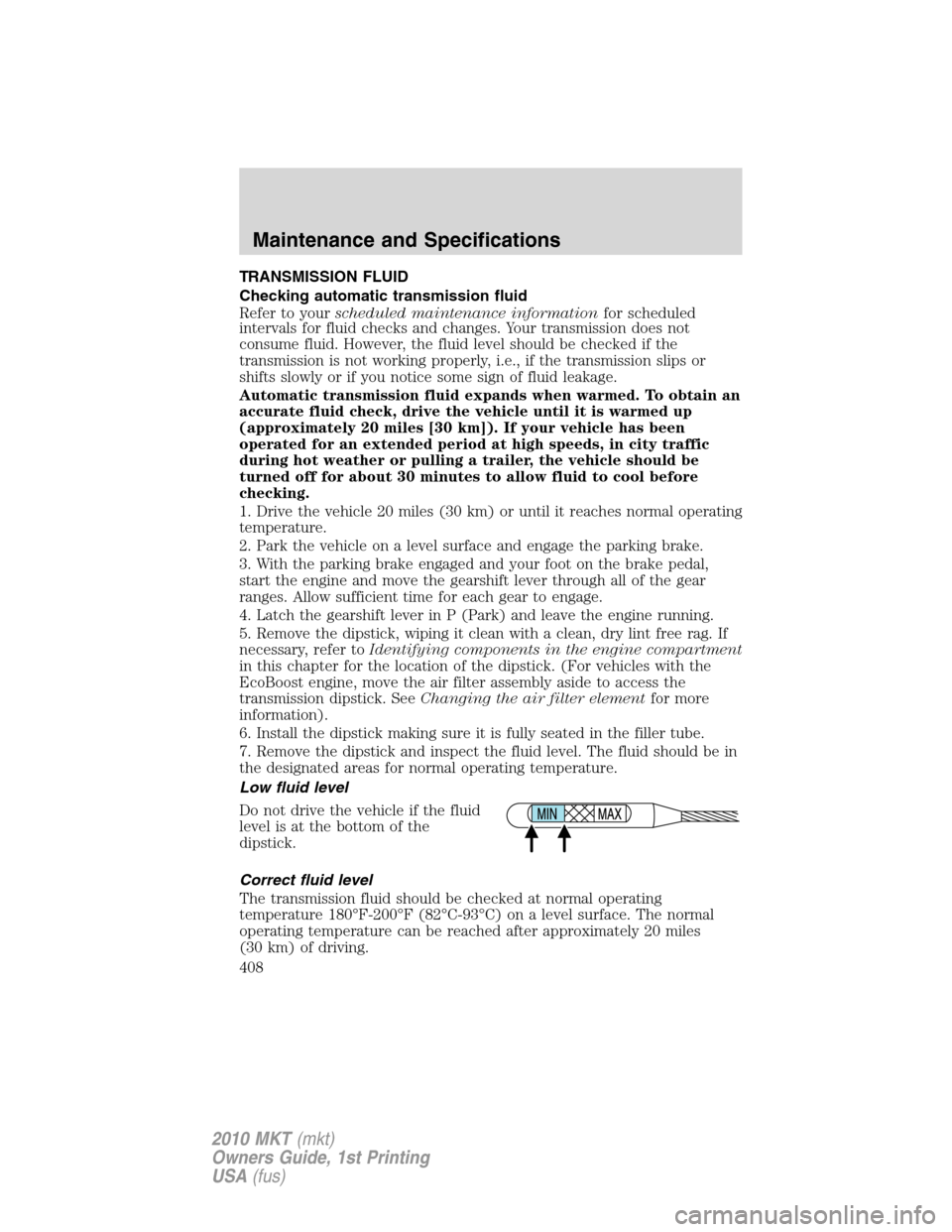
Low fluid level
Do not drive the vehicle if the fluid
level is at the bottom of the
dipstick.
Correct fluid level
The transmission fluid should be checked at normal operating
temperature 180°F-200°F (82°C-93°C) on a level surface. The normal
operating temperature can be reached after approximately 20 miles
(30 km) of driving.
Maintenance and Specifications
408
2010 MKT(mkt)
Owners Guide, 1st Printing
USA(fus)
Page 426 of 430
E
Electronic message center .........18
Emergencies, roadside
jump-starting ..........................353
running out of fuel .........353, 399
Emission control system ..........404
Engine ........................................415
cleaning ...................................370
coolant .....................................388
fail-safe cooling .......................393
idle speed control ...................385
lubrication specifications .......412
refill capacities ........................412
service points ..................378–379
Engine block heater .................284
Engine oil ..................................382
change oil soon warning,
message center .......................382
checking and adding ..............382
dipstick ....................................382
filter, specifications ........384, 411
recommendations ...................384
refill capacities ........................412
specifications ..........................412
Event data recording ....................7
Exhaust fumes ..........................283
F
Fail safe cooling ........................393
Family entertainment system ....67
Fleet MyKey programming ......167
Fluid capacities .........................412
Fog lamps ....................................98
Four-Wheel Drive vehicles
driving off road .......................319
Freezer ......................................113Fuel ............................................394
calculating fuel
economy ............................20, 400
cap ...........................................396
capacity ...................................412
choosing the right fuel ...........397
comparisons with EPA fuel
economy estimates .................403
detergent in fuel .....................399
filler funnel .............................399
filling your vehicle with
fuel ...........................394, 396, 401
filter, specifications ........394, 411
fuel pump shut-off ..................327
improving fuel economy ........400
octane rating ...................398, 415
quality ......................................398
running out of fuel .........353, 399
safety information relating
to automotive fuels ................394
Fuses ..........................................327
G
Garage door opener ..................134
Gas cap (see Fuel cap) ............396
Gas mileage
(see Fuel economy) .................400
Gauges .........................................17
H
Hazard flashers .........................326
Headlamps ...................................96
aiming ......................................102
autolamp system .......................97
bulb specifications ..................106
daytime running lights ...........101
flash to pass ............................101
high beam .................................98
replacing bulbs .......................107
Index
426
2010 MKT(mkt)
Owners Guide, 1st Printing
USA(fus)