tow LINCOLN MKT 2010 Owner's Manual
[x] Cancel search | Manufacturer: LINCOLN, Model Year: 2010, Model line: MKT, Model: LINCOLN MKT 2010Pages: 430, PDF Size: 3.32 MB
Page 192 of 430
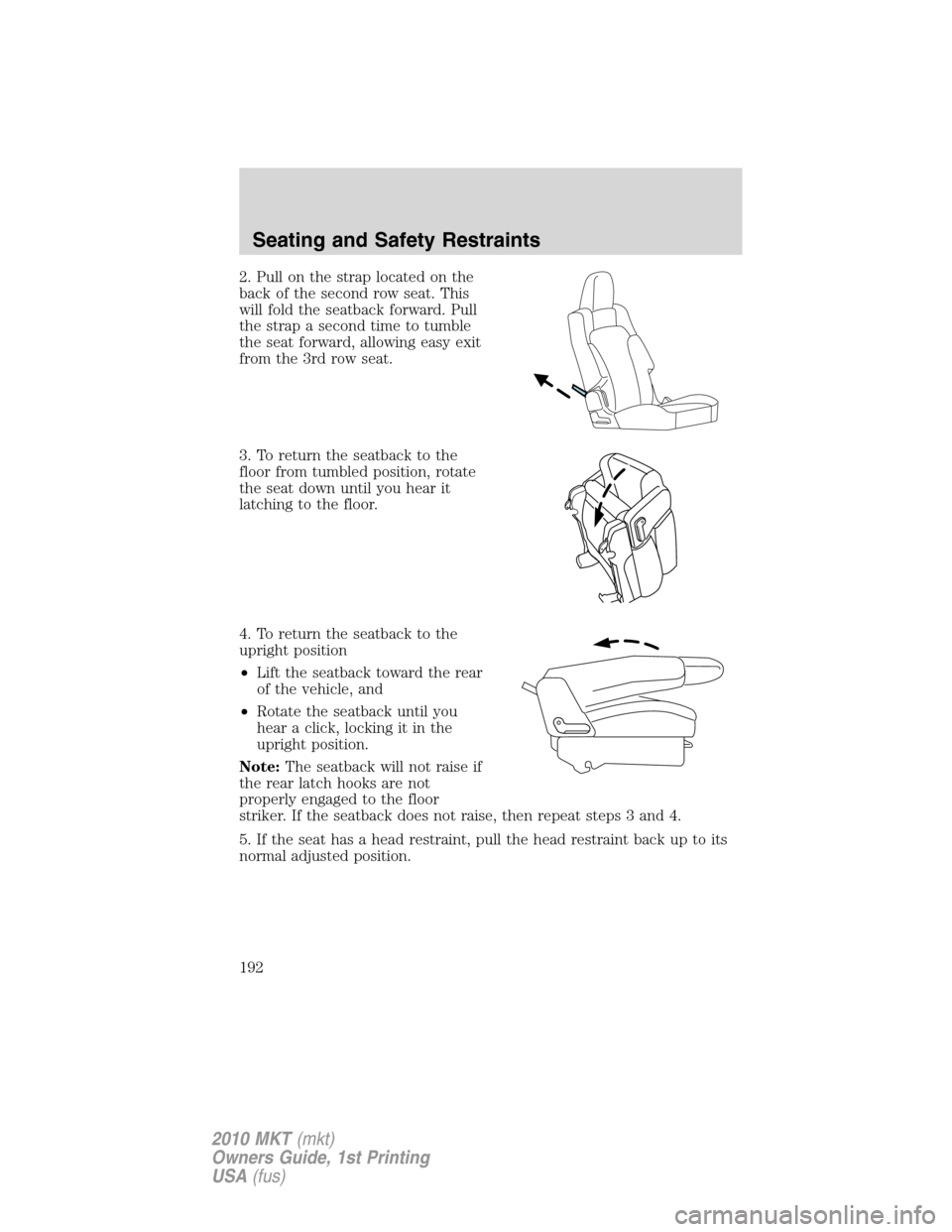
2. Pull on the strap located on the
back of the second row seat. This
will fold the seatback forward. Pull
the strap a second time to tumble
the seat forward, allowing easy exit
from the 3rd row seat.
3. To return the seatback to the
floor from tumbled position, rotate
the seat down until you hear it
latching to the floor.
4. To return the seatback to the
upright position
•Lift the seatback toward the rear
of the vehicle, and
•Rotate the seatback until you
hear a click, locking it in the
upright position.
Note:The seatback will not raise if
the rear latch hooks are not
properly engaged to the floor
striker. If the seatback does not raise, then repeat steps 3 and 4.
5. If the seat has a head restraint, pull the head restraint back up to its
normal adjusted position.
Seating and Safety Restraints
192
2010 MKT(mkt)
Owners Guide, 1st Printing
USA(fus)
Page 194 of 430
The second-row heated and cooled seat controls are located on the rear
of the floor console. They function the same as the front-row heated and
cooled seats. For instructions on how to use refer toFront-row heated
and cooled seatsearlier in this chapter.
Second-row climate controlled seats air filter replacement
The climate controlled seat system includes air filters that must be
replaced periodically. Refer to thescheduled maintenance information
for more information.
There is an air filter located under the rear of each second-row seat. You
can tumble the seat forward to access the filter.
For instructions on how to remove and install the air filter, seeClimate
controlled seats air filter replacementearlier in this chapter.
Stowing the third row seat
1. Remove all objects from the seat and stowage tub.
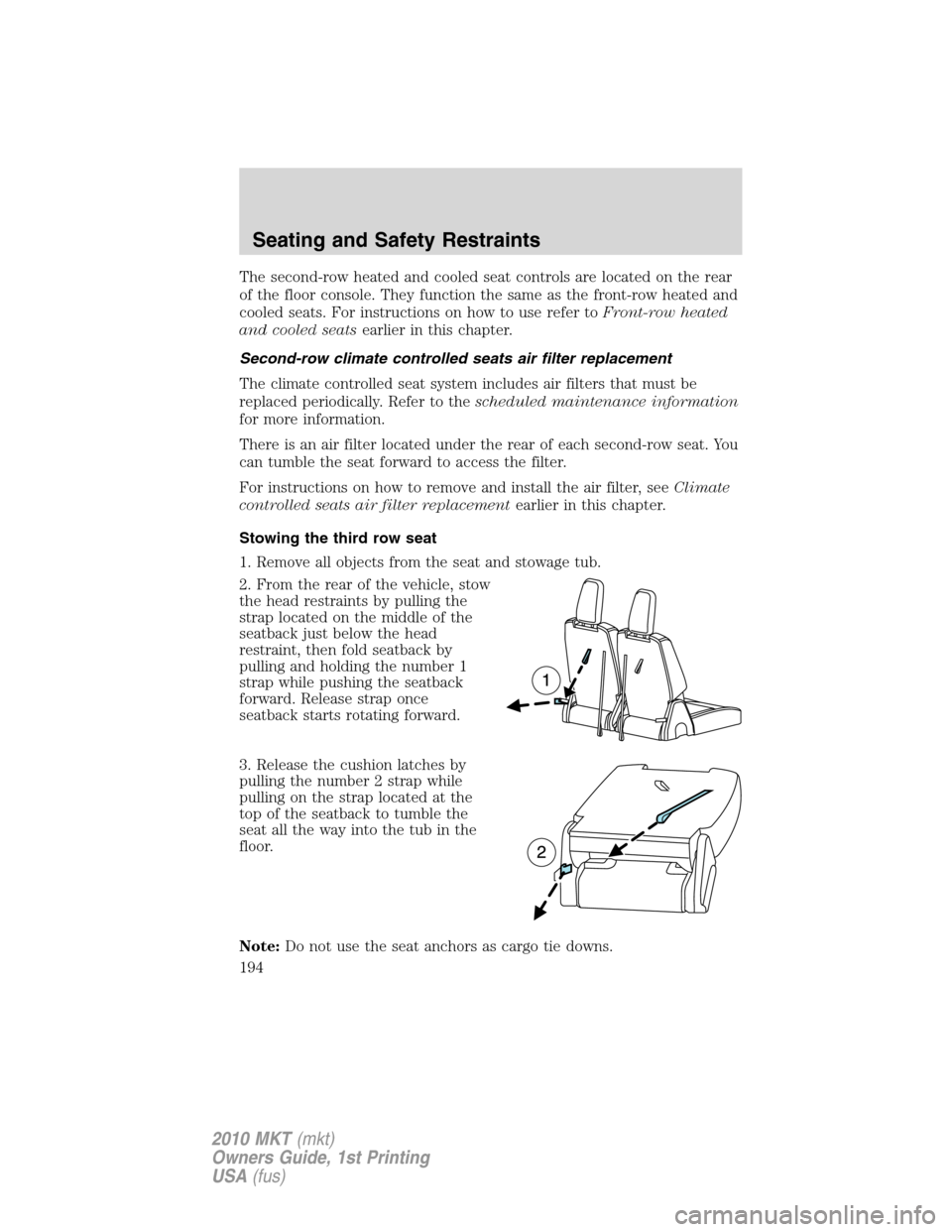
2. From the rear of the vehicle, stow
the head restraints by pulling the
strap located on the middle of the
seatback just below the head
restraint, then fold seatback by
pulling and holding the number 1
strap while pushing the seatback
forward. Release strap once
seatback starts rotating forward.
3. Release the cushion latches by
pulling the number 2 strap while
pulling on the strap located at the
top of the seatback to tumble the
seat all the way into the tub in the
floor.
Note:Do not use the seat anchors as cargo tie downs.
Seating and Safety Restraints
194
2010 MKT(mkt)
Owners Guide, 1st Printing
USA(fus)
Page 195 of 430
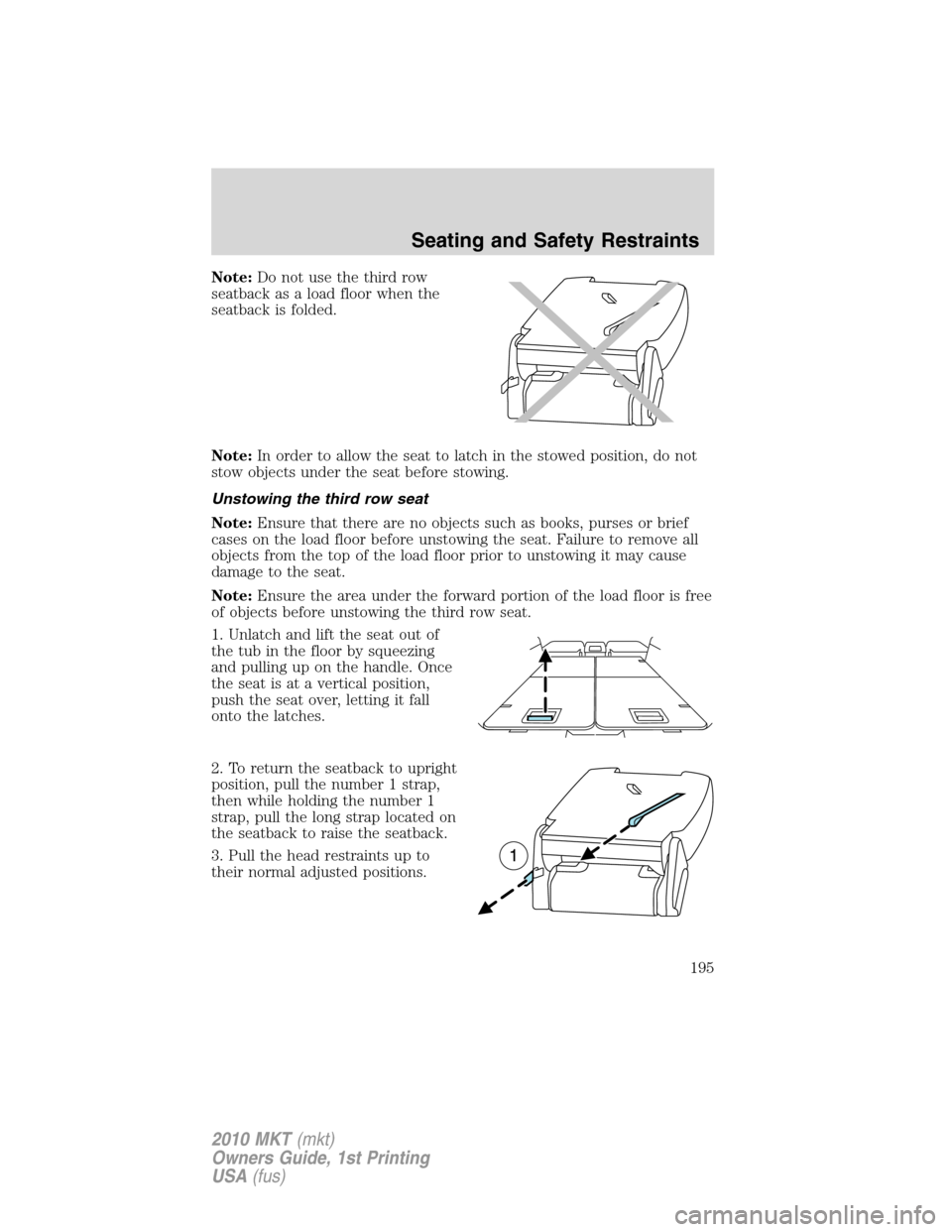
Note:Do not use the third row
seatback as a load floor when the
seatback is folded.
Note:In order to allow the seat to latch in the stowed position, do not
stow objects under the seat before stowing.
Unstowing the third row seat
Note:Ensure that there are no objects such as books, purses or brief
cases on the load floor before unstowing the seat. Failure to remove all
objects from the top of the load floor prior to unstowing it may cause
damage to the seat.
Note:Ensure the area under the forward portion of the load floor is free
of objects before unstowing the third row seat.
1. Unlatch and lift the seat out of
the tub in the floor by squeezing
and pulling up on the handle. Once
the seat is at a vertical position,
push the seat over, letting it fall
onto the latches.
2. To return the seatback to upright
position, pull the number 1 strap,
then while holding the number 1
strap, pull the long strap located on
the seatback to raise the seatback.
3. Pull the head restraints up to
their normal adjusted positions.
Seating and Safety Restraints
195
2010 MKT(mkt)
Owners Guide, 1st Printing
USA(fus)
Page 196 of 430
WARNING:Ensure the seat is latched to vehicle floor by
pushing/pulling on seat. If not latched, the seat may cause injury
during a sudden stop.
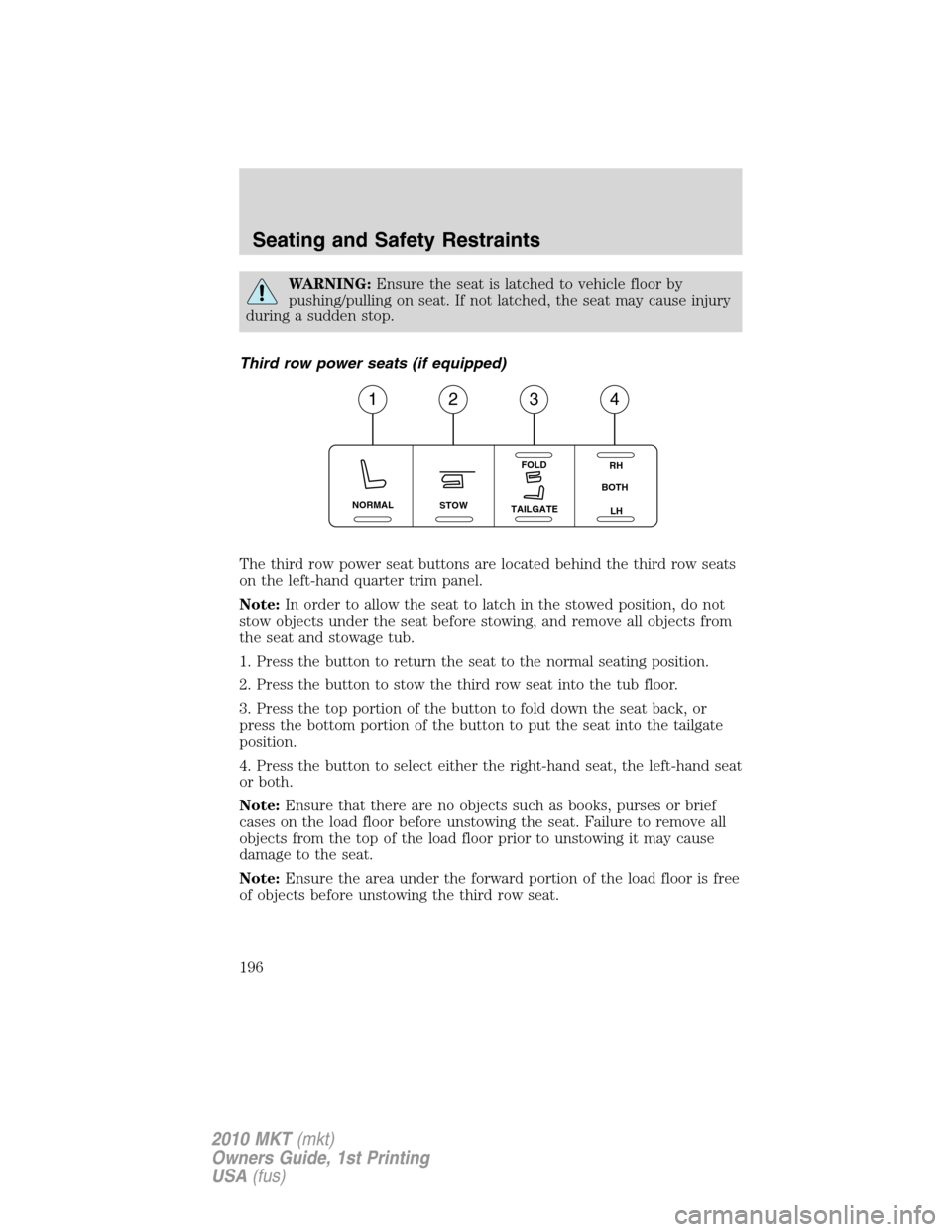
Third row power seats (if equipped)
The third row power seat buttons are located behind the third row seats
on the left-hand quarter trim panel.
Note:In order to allow the seat to latch in the stowed position, do not
stow objects under the seat before stowing, and remove all objects from
the seat and stowage tub.
1. Press the button to return the seat to the normal seating position.
2. Press the button to stow the third row seat into the tub floor.
3. Press the top portion of the button to fold down the seat back, or
press the bottom portion of the button to put the seat into the tailgate
position.
4. Press the button to select either the right-hand seat, the left-hand seat
or both.
Note:Ensure that there are no objects such as books, purses or brief
cases on the load floor before unstowing the seat. Failure to remove all
objects from the top of the load floor prior to unstowing it may cause
damage to the seat.
Note:Ensure the area under the forward portion of the load floor is free
of objects before unstowing the third row seat.
1234
NORMAL
STOWRH
BOTH
LH
FOLD
TAILGATE
Seating and Safety Restraints
196
2010 MKT(mkt)
Owners Guide, 1st Printing
USA(fus)
Page 202 of 430
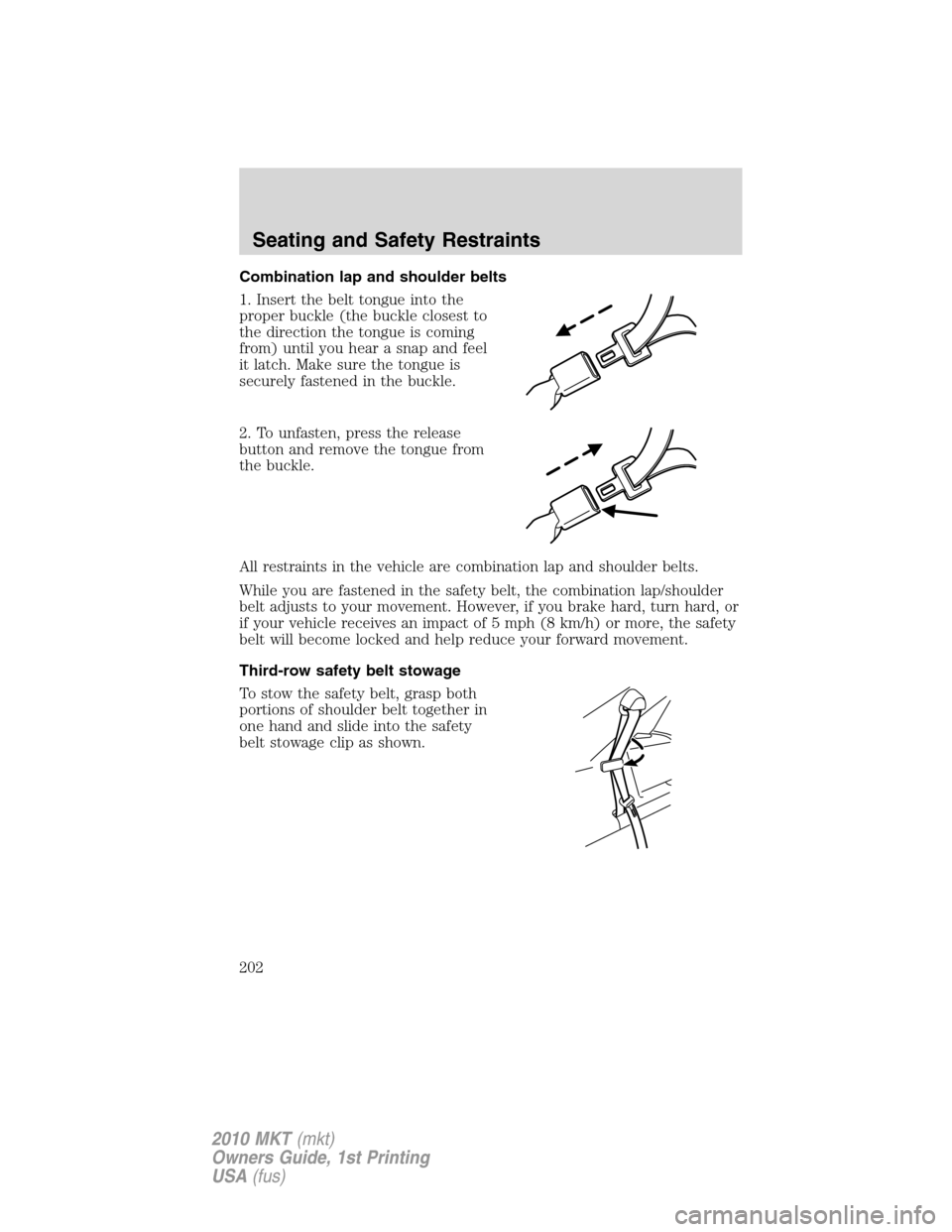
Combination lap and shoulder belts
1. Insert the belt tongue into the
proper buckle (the buckle closest to
the direction the tongue is coming
from) until you hear a snap and feel
it latch. Make sure the tongue is
securely fastened in the buckle.
2. To unfasten, press the release
button and remove the tongue from
the buckle.
All restraints in the vehicle are combination lap and shoulder belts.
While you are fastened in the safety belt, the combination lap/shoulder
belt adjusts to your movement. However, if you brake hard, turn hard, or
if your vehicle receives an impact of 5 mph (8 km/h) or more, the safety
belt will become locked and help reduce your forward movement.
Third-row safety belt stowage
To stow the safety belt, grasp both
portions of shoulder belt together in
one hand and slide into the safety
belt stowage clip as shown.
Seating and Safety Restraints
202
2010 MKT(mkt)
Owners Guide, 1st Printing
USA(fus)
Page 203 of 430
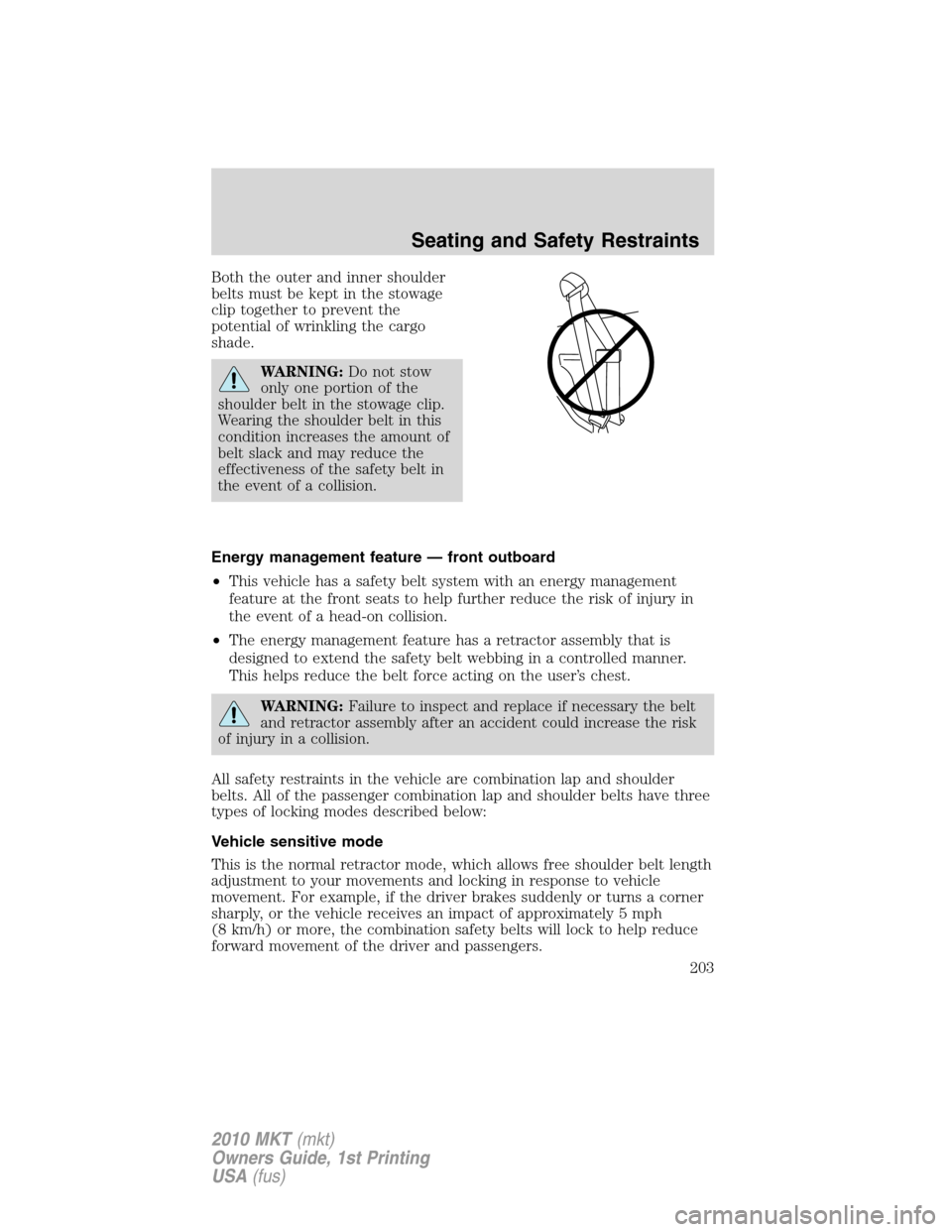
Both the outer and inner shoulder
belts must be kept in the stowage
clip together to prevent the
potential of wrinkling the cargo
shade.
WARNING:Do not stow
only one portion of the
shoulder belt in the stowage clip.
Wearing the shoulder belt in this
condition increases the amount of
belt slack and may reduce the
effectiveness of the safety belt in
the event of a collision.
Energy management feature — front outboard
•This vehicle has a safety belt system with an energy management
feature at the front seats to help further reduce the risk of injury in
the event of a head-on collision.
•The energy management feature has a retractor assembly that is
designed to extend the safety belt webbing in a controlled manner.
This helps reduce the belt force acting on the user’s chest.
WARNING:Failure to inspect and replace if necessary the belt
and retractor assembly after an accident could increase the risk
of injury in a collision.
All safety restraints in the vehicle are combination lap and shoulder
belts. All of the passenger combination lap and shoulder belts have three
types of locking modes described below:
Vehicle sensitive mode
This is the normal retractor mode, which allows free shoulder belt length
adjustment to your movements and locking in response to vehicle
movement. For example, if the driver brakes suddenly or turns a corner
sharply, or the vehicle receives an impact of approximately 5 mph
(8 km/h) or more, the combination safety belts will lock to help reduce
forward movement of the driver and passengers.
Seating and Safety Restraints
203
2010 MKT(mkt)
Owners Guide, 1st Printing
USA(fus)
Page 213 of 430

WARNING:Modifying or adding equipment to the front end of
the vehicle (including frame, bumper, front end body structure
and tow hooks) may affect the performance of the airbag system,
increasing the risk of injury. Do not modify the front end of the
vehicle.
Children and airbags
Children must always be properly
restrained. Accident statistics
suggest that children are safer when
properly restrained in the rear
seating positions than in the front
seating position. Failure to follow
these instructions may increase the
risk of injury in a collision.
WARNING:Airbags can kill
or injure a child in a child
seat.NEVERplace a rear-facing
child seat in front of an active
airbag. If you must use a
forward-facing child seat in the
front seat, move the seat all the
way back.
How does the airbag supplemental restraint system work?
The airbag SRS is designed to
activate when the vehicle sustains
longitudinal deceleration sufficient
to cause the sensors to close an
electrical circuit that initiates airbag
inflation. The fact that the airbags
did not inflate in a collision does not
mean that something is wrong with
the system. Rather, it means the
forces were not of the type
sufficient to cause activation. Front
airbags are designed to inflate in
frontal and near-frontal collisions, not rollover, side-impact, or
rear-impacts unless the collision causes sufficient longitudinal
deceleration.
Seating and Safety Restraints
213
2010 MKT(mkt)
Owners Guide, 1st Printing
USA(fus)
Page 218 of 430
ObjectsPass Airbag Off
Indicator LightPassenger Airbag
Small (i.e. three-ring
binder, small purse,
bottled water)Unlit Disabled
Medium (i.e. heavy
briefcase, fully packed
luggage)Lit Disabled
Empty seat, or small
to medium object with
safety belt buckledLit Disabled
If you think that the status of the passenger airbag off indicator lamp is
incorrect, check for the following:
•Objects lodged underneath the seat
•Objects between the seat cushion and the center console (if
equipped)
•Objects hanging off the seat back
•Objects stowed in the seatback map pocket (if equipped)
•Objects placed on the occupant’s lap
•Cargo interference with the seat
•Other passengers pushing or pulling on the seat
•Rear passenger feet and knees resting or pushing on the seat
The conditions listed above may cause the weight of a properly seated
occupant to be incorrectly interpreted by the passenger sensing system.
The person in the front passenger seat may appear heavier or lighter due
to the conditions described in the list above.
WARNING:To reduce the risk of possible serious injury:
Do not stow objects in seat back map pocket (if equipped) or
hang objects off seat back if a child is in the front passenger seat.
Do not place objects underneath the front passenger seat or between
the seat and the center console (if equipped).
Check the “passenger airbag off” or “pass airbag off” indicator lamp for
proper airbag Status.
Failure to follow these instructions may interfere with the front
passenger seat sensing system.
Seating and Safety Restraints
218
2010 MKT(mkt)
Owners Guide, 1st Printing
USA(fus)
Page 229 of 430
WARNING:Always carefully follow the instructions and
warnings provided by the manufacturer of any child restraint to
determine if the restraint device is appropriate for your child’s size,
height, weight, or age. Follow the child restraint manufacturer’s
instructions and warnings provided for installation and use in
conjunction with the instructions and warnings provided by the vehicle
manufacturer. A safety seat that is improperly installed or utilized, is
inappropriate for your child’s height, age, or weight or does not
properly fit the child may increase the risk of serious injury or death.
WARNING:Never let a passenger hold a child on his or her lap
while the vehicle is moving. The passenger cannot protect the
child from injury in a collision, which may result in serious injury or
death.
WARNING:Never use pillows, books, or towels to boost a child.
They can slide around and increase the likelihood of injury or
death in a collision.
WARNING:Always restrain an unoccupied child seat or booster
seat. These objects may become projectiles in a collision or
sudden stop, which may increase the risk of serious injury.
WARNING:Never place, or allow a child to place, the shoulder
belt under a child’s arm or behind the back because it reduces
the protection for the upper part of the body and may increase the risk
of injury or death in a collision.
WARNING:Do not leave children, unreliable adults, or pets
unattended in your vehicle.
Transporting children
Always make sure your child is secured properly in a device that is
appropriate for their age, height and weight. All children are shaped
differently. The child height, age and weight thresholds provided are
recommendations or the minimum requirements of law. The National
Highway Traffic Safety Administration (NHTSA) provides education and
Seating and Safety Restraints
229
2010 MKT(mkt)
Owners Guide, 1st Printing
USA(fus)
Page 233 of 430
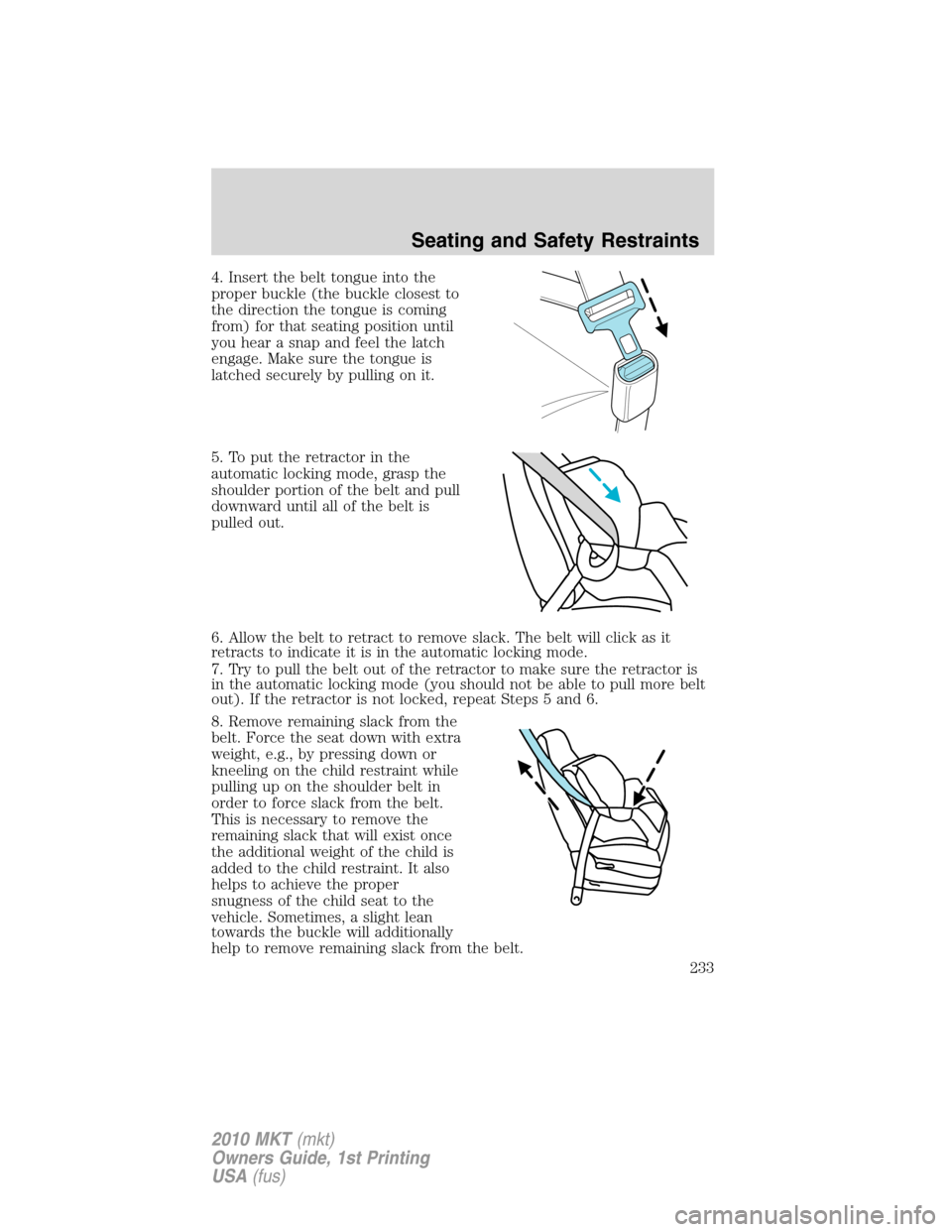
4. Insert the belt tongue into the
proper buckle (the buckle closest to
the direction the tongue is coming
from) for that seating position until
you hear a snap and feel the latch
engage. Make sure the tongue is
latched securely by pulling on it.
5. To put the retractor in the
automatic locking mode, grasp the
shoulder portion of the belt and pull
downward until all of the belt is
pulled out.
6. Allow the belt to retract to remove slack. The belt will click as it
retracts to indicate it is in the automatic locking mode.
7. Try to pull the belt out of the retractor to make sure the retractor is
in the automatic locking mode (you should not be able to pull more belt
out). If the retractor is not locked, repeat Steps 5 and 6.
8. Remove remaining slack from the
belt. Force the seat down with extra
weight, e.g., by pressing down or
kneeling on the child restraint while
pulling up on the shoulder belt in
order to force slack from the belt.
This is necessary to remove the
remaining slack that will exist once
the additional weight of the child is
added to the child restraint. It also
helps to achieve the proper
snugness of the child seat to the
vehicle. Sometimes, a slight lean
towards the buckle will additionally
help to remove remaining slack from the belt.
Seating and Safety Restraints
233
2010 MKT(mkt)
Owners Guide, 1st Printing
USA(fus)