change wheel LINCOLN MKT 2011 User Guide
[x] Cancel search | Manufacturer: LINCOLN, Model Year: 2011, Model line: MKT, Model: LINCOLN MKT 2011Pages: 454, PDF Size: 3.82 MB
Page 321 of 454
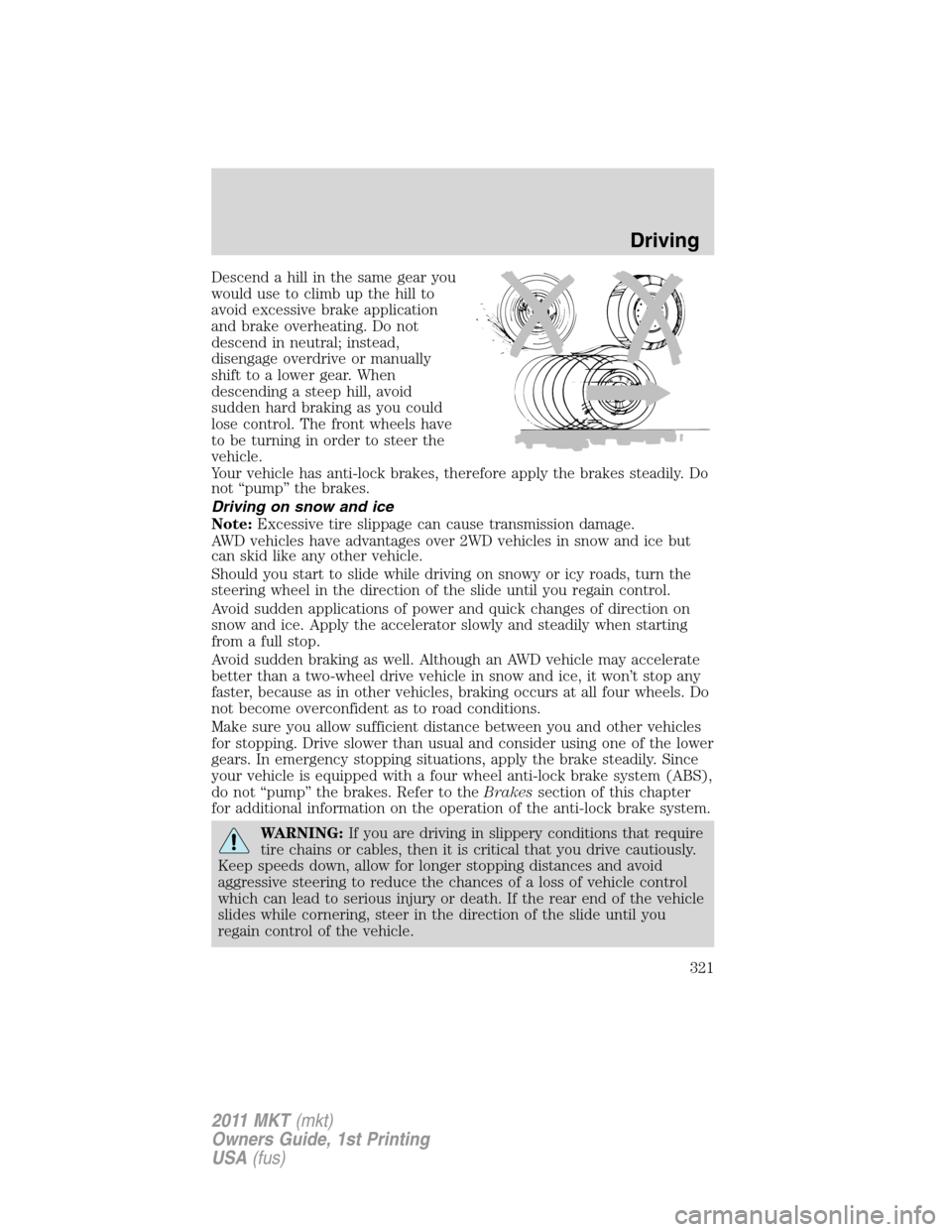
Descend a hill in the same gear you
would use to climb up the hill to
avoid excessive brake application
and brake overheating. Do not
descend in neutral; instead,
disengage overdrive or manually
shift to a lower gear. When
descending a steep hill, avoid
sudden hard braking as you could
lose control. The front wheels have
to be turning in order to steer the
vehicle.
Your vehicle has anti-lock brakes, therefore apply the brakes steadily. Do
not “pump” the brakes.
Driving on snow and ice
Note:Excessive tire slippage can cause transmission damage.
AWD vehicles have advantages over 2WD vehicles in snow and ice but
can skid like any other vehicle.
Should you start to slide while driving on snowy or icy roads, turn the
steering wheel in the direction of the slide until you regain control.
Avoid sudden applications of power and quick changes of direction on
snow and ice. Apply the accelerator slowly and steadily when starting
from a full stop.
Avoid sudden braking as well. Although an AWD vehicle may accelerate
better than a two-wheel drive vehicle in snow and ice, it won’t stop any
faster, because as in other vehicles, braking occurs at all four wheels. Do
not become overconfident as to road conditions.
Make sure you allow sufficient distance between you and other vehicles
for stopping. Drive slower than usual and consider using one of the lower
gears. In emergency stopping situations, apply the brake steadily. Since
your vehicle is equipped with a four wheel anti-lock brake system (ABS),
do not “pump” the brakes. Refer to theBrakessection of this chapter
for additional information on the operation of the anti-lock brake system.
WARNING:If you are driving in slippery conditions that require
tire chains or cables, then it is critical that you drive cautiously.
Keep speeds down, allow for longer stopping distances and avoid
aggressive steering to reduce the chances of a loss of vehicle control
which can lead to serious injury or death. If the rear end of the vehicle
slides while cornering, steer in the direction of the slide until you
regain control of the vehicle.
Driving
321
2011 MKT(mkt)
Owners Guide, 1st Printing
USA(fus)
Page 336 of 454
Stopping and securing the vehicle
1. Park on a level surface, set the
parking brake and activate hazard
flashers.
2. Place gearshift lever in P (Park)
and turn engine off.
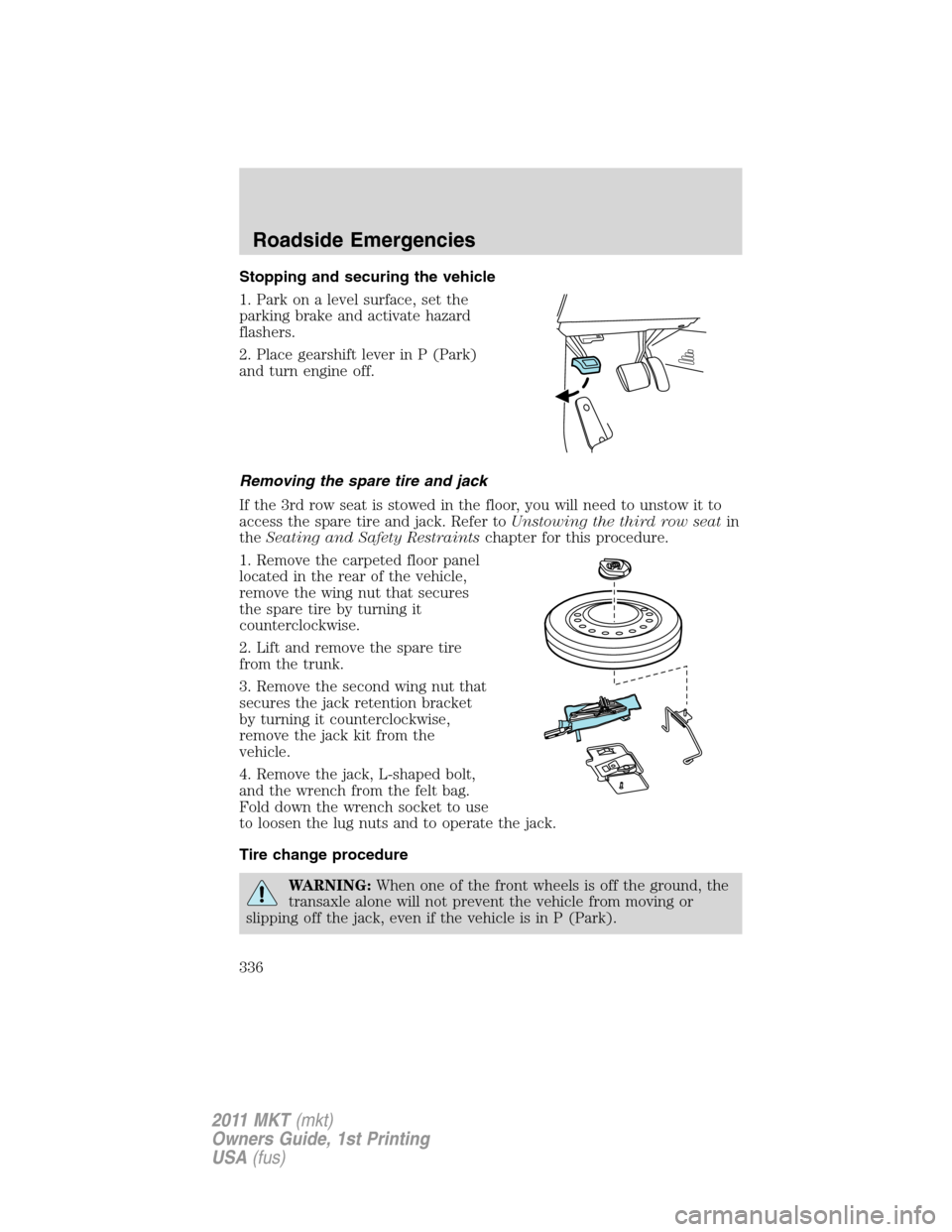
Removing the spare tire and jack
If the 3rd row seat is stowed in the floor, you will need to unstow it to
access the spare tire and jack. Refer toUnstowing the third row seatin
theSeating and Safety Restraintschapter for this procedure.
1. Remove the carpeted floor panel
located in the rear of the vehicle,
remove the wing nut that secures
the spare tire by turning it
counterclockwise.
2. Lift and remove the spare tire
from the trunk.
3. Remove the second wing nut that
secures the jack retention bracket
by turning it counterclockwise,
remove the jack kit from the
vehicle.
4. Remove the jack, L-shaped bolt,
and the wrench from the felt bag.
Fold down the wrench socket to use
to loosen the lug nuts and to operate the jack.
Tire change procedure
WARNING:When one of the front wheels is off the ground, the
transaxle alone will not prevent the vehicle from moving or
slipping off the jack, even if the vehicle is in P (Park).
Roadside Emergencies
336
2011 MKT(mkt)
Owners Guide, 1st Printing
USA(fus)
Page 337 of 454
WARNING:To help prevent the vehicle from moving when you
change a tire, be sure to place the transmission in P (Park), set
the parking brake and block (in both directions) the wheel that is
diagonally opposite (other side and end of the vehicle) to the tire
being changed.
WARNING:If the vehicle slips off the jack, you or someone else
could be seriously injured.
WARNING:Do not attempt to change a tire on the side of the
vehicle close to moving traffic. Pull far enough off the road to
avoid the danger of being hit when operating the jack or changing the
wheel.
Note:Passengers should not remain in the vehicle when the vehicle is
being jacked.
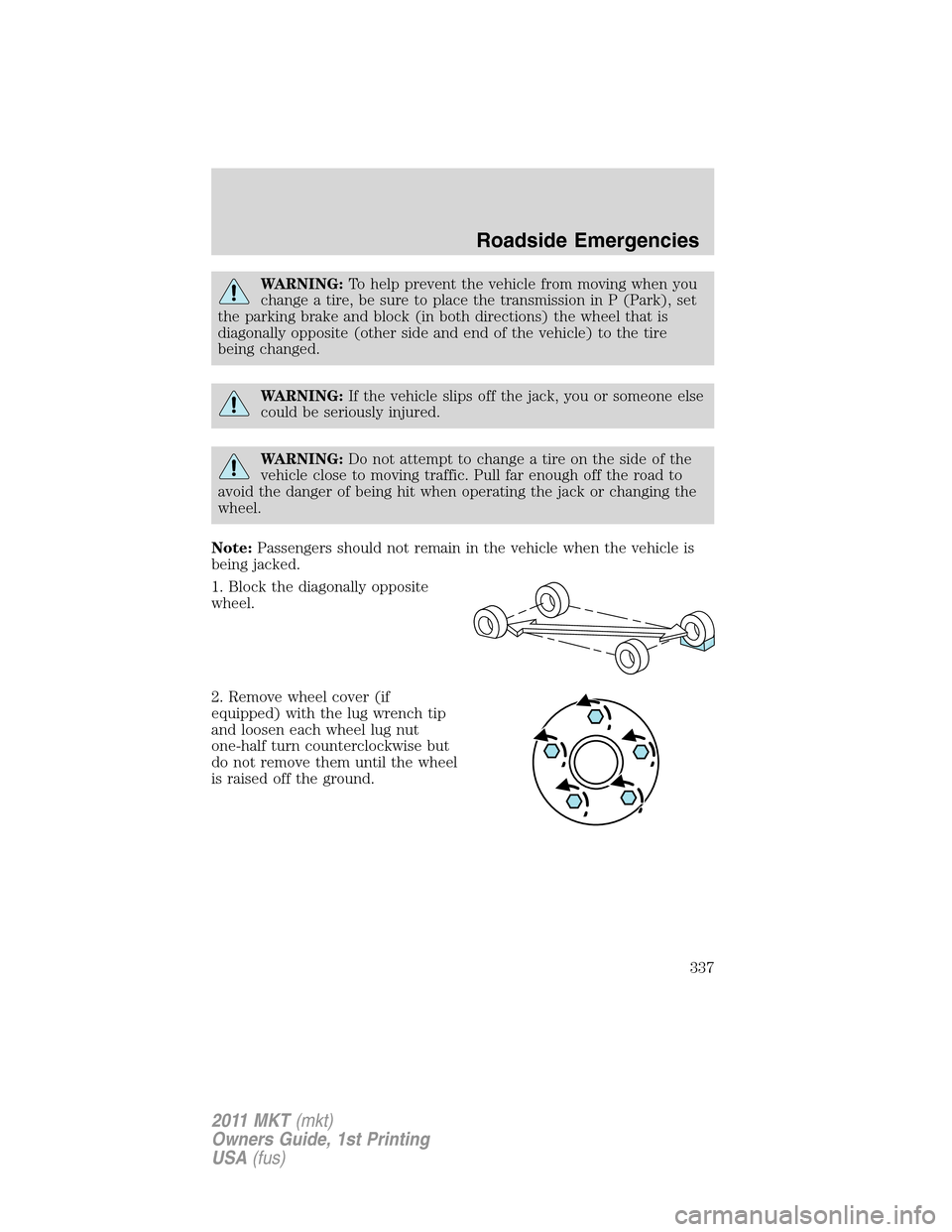
1. Block the diagonally opposite
wheel.
2. Remove wheel cover (if
equipped) with the lug wrench tip
and loosen each wheel lug nut
one-half turn counterclockwise but
do not remove them until the wheel
is raised off the ground.
Roadside Emergencies
337
2011 MKT(mkt)
Owners Guide, 1st Printing
USA(fus)
Page 399 of 454
economy under current driving conditions. Additionally, keeping records
during summer and winter will show how temperature impacts fuel
economy. In general, lower temperatures give lower fuel economy.
Driving style — good driving and fuel economy habits
Give consideration to the lists that follow and you may be able to change
a number of variables and improve your fuel economy.
Habits
•Smooth, moderate operation can yield up to 10% savings in fuel.
•Steady speeds without stopping will usually give the best fuel
economy.
•Idling for long periods of time (greater than one minute) may waste
fuel.
•Anticipate stopping; slowing down may eliminate the need to stop.
•Sudden or hard accelerations may reduce fuel economy.
•Slow down gradually.
•Driving at reasonable speeds (traveling at 55 mph [88 km/h] uses 15%
less fuel than traveling at 65 mph [105 km/h]).
•Revving the engine before turning it off may reduce fuel economy.
•Using the air conditioner or defroster may reduce fuel economy.
•You may want to turn off the speed control in hilly terrain if
unnecessary shifting between the top gears occurs. Unnecessary
shifting of this type could result in reduced fuel economy.
•Warming up a vehicle on cold mornings is not required and may
reduce fuel economy.
•Resting your foot on the brake pedal while driving may reduce fuel
economy.
•Combine errands and minimize stop-and-go driving.
Maintenance
•Keep tires properly inflated and use only recommended size.
•Operating a vehicle with the wheels out of alignment will reduce fuel
economy.
•Use recommended engine oil. Refer toMaintenance product
specifications and capacitiesin this chapter.
•Perform all regularly scheduled maintenance items. Follow the
recommended maintenance schedule and owner maintenance checks
found inscheduled maintenance information.
Maintenance and Specifications
399
2011 MKT(mkt)
Owners Guide, 1st Printing
USA(fus)
Page 434 of 454
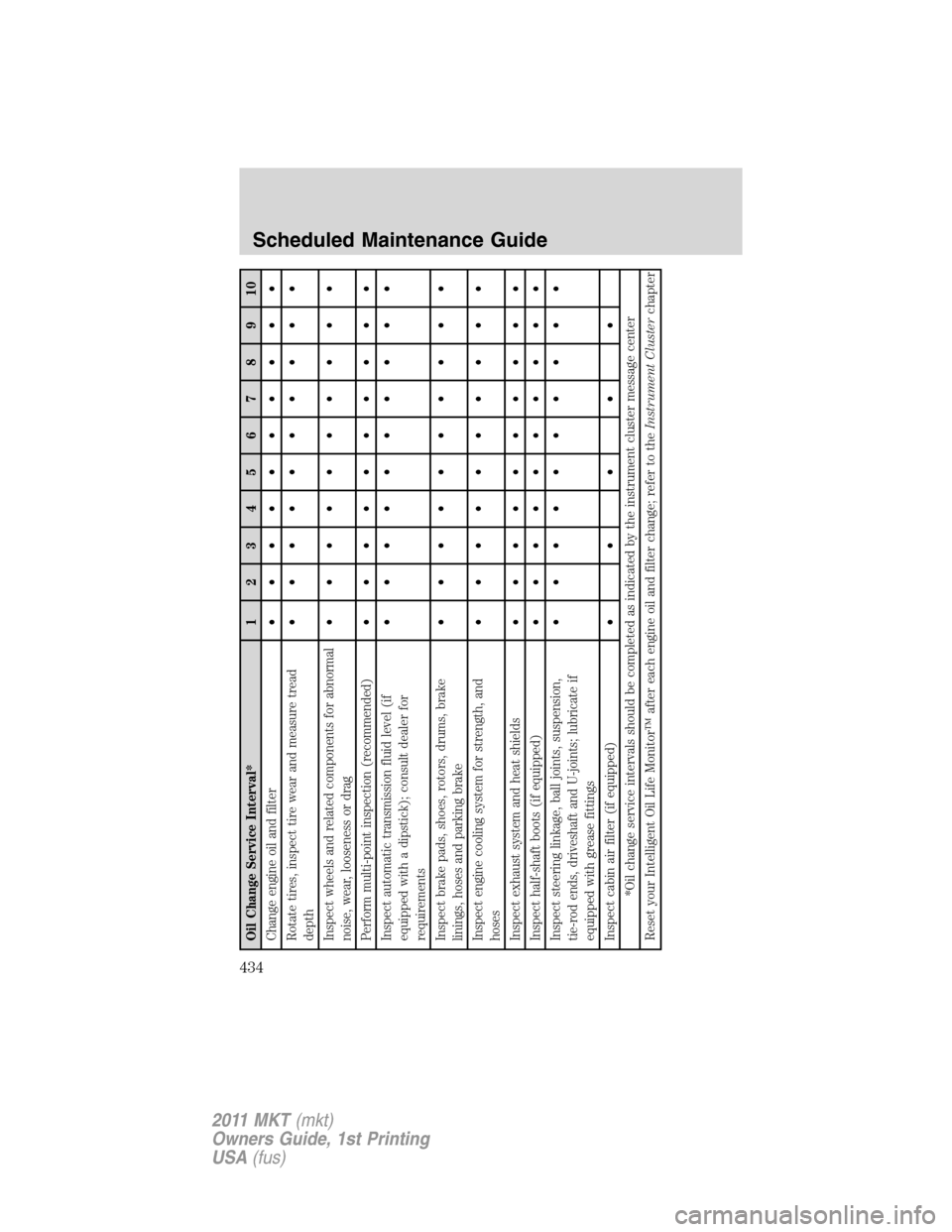
Oil Change Service Interval* 1 2 345678910
Change engine oil and filter• •••••••••
Rotate tires, inspect tire wear and measure tread
depth• •••••••••
Inspect wheels and related components for abnormal
noise, wear, looseness or drag• •••••••••
Perform multi-point inspection (recommended)• •••••••••
Inspect automatic transmission fluid level (if
equipped with a dipstick); consult dealer for
requirements• •••••••••
Inspect brake pads, shoes, rotors, drums, brake
linings, hoses and parking brake• •••••••••
Inspect engine cooling system for strength, and
hoses• •••••••••
Inspect exhaust system and heat shields• •••••••••
Inspect half-shaft boots (if equipped)• •••••••••
Inspect steering linkage, ball joints, suspension,
tie-rod ends, driveshaft and U-joints; lubricate if
equipped with grease fittings• •••••••••
Inspect cabin air filter (if equipped)• ••••
*Oil change service intervals should be completed as indicated by the instrument cluster message center
Reset your Intelligent Oil Life Monitor™ after each engine oil and filter change; refer to theInstrument Clusterchapter
Scheduled Maintenance Guide
434
2011 MKT(mkt)
Owners Guide, 1st Printing
USA(fus)
Page 435 of 454
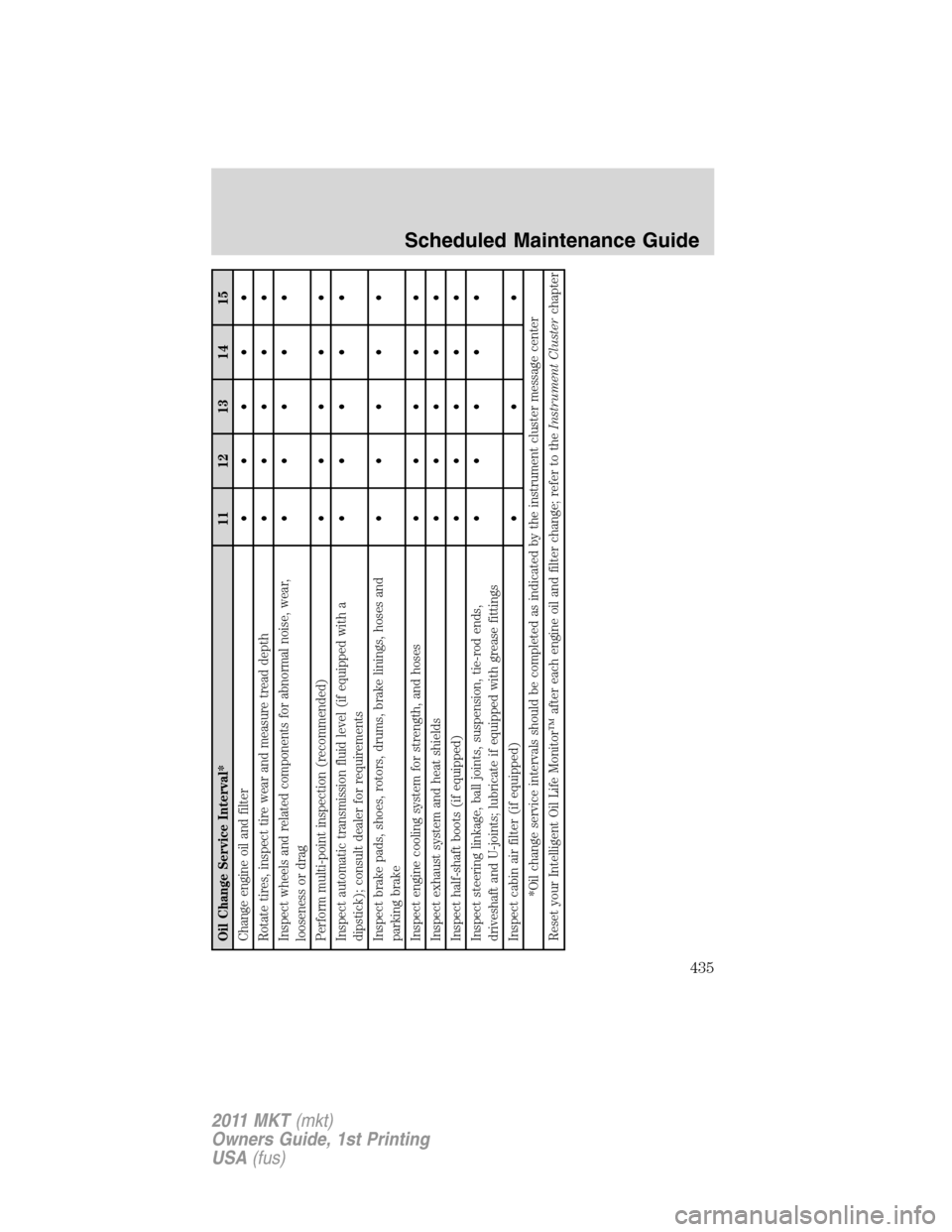
Oil Change Service Interval* 11 12 13 14 15
Change engine oil and filter•••••
Rotate tires, inspect tire wear and measure tread depth•••••
Inspect wheels and related components for abnormal noise, wear,
looseness or drag•••••
Perform multi-point inspection (recommended)•••••
Inspect automatic transmission fluid level (if equipped with a
dipstick); consult dealer for requirements•••••
Inspect brake pads, shoes, rotors, drums, brake linings, hoses and
parking brake•••••
Inspect engine cooling system for strength, and hoses•••••
Inspect exhaust system and heat shields•••••
Inspect half-shaft boots (if equipped)•••••
Inspect steering linkage, ball joints, suspension, tie-rod ends,
driveshaft and U-joints; lubricate if equipped with grease fittings•••••
Inspect cabin air filter (if equipped)•••
*Oil change service intervals should be completed as indicated by the instrument cluster message center
Reset your Intelligent Oil Life Monitor™ after each engine oil and filter change; refer to theInstrument Clusterchapter
Scheduled Maintenance Guide
435
2011 MKT(mkt)
Owners Guide, 1st Printing
USA(fus)
Page 436 of 454
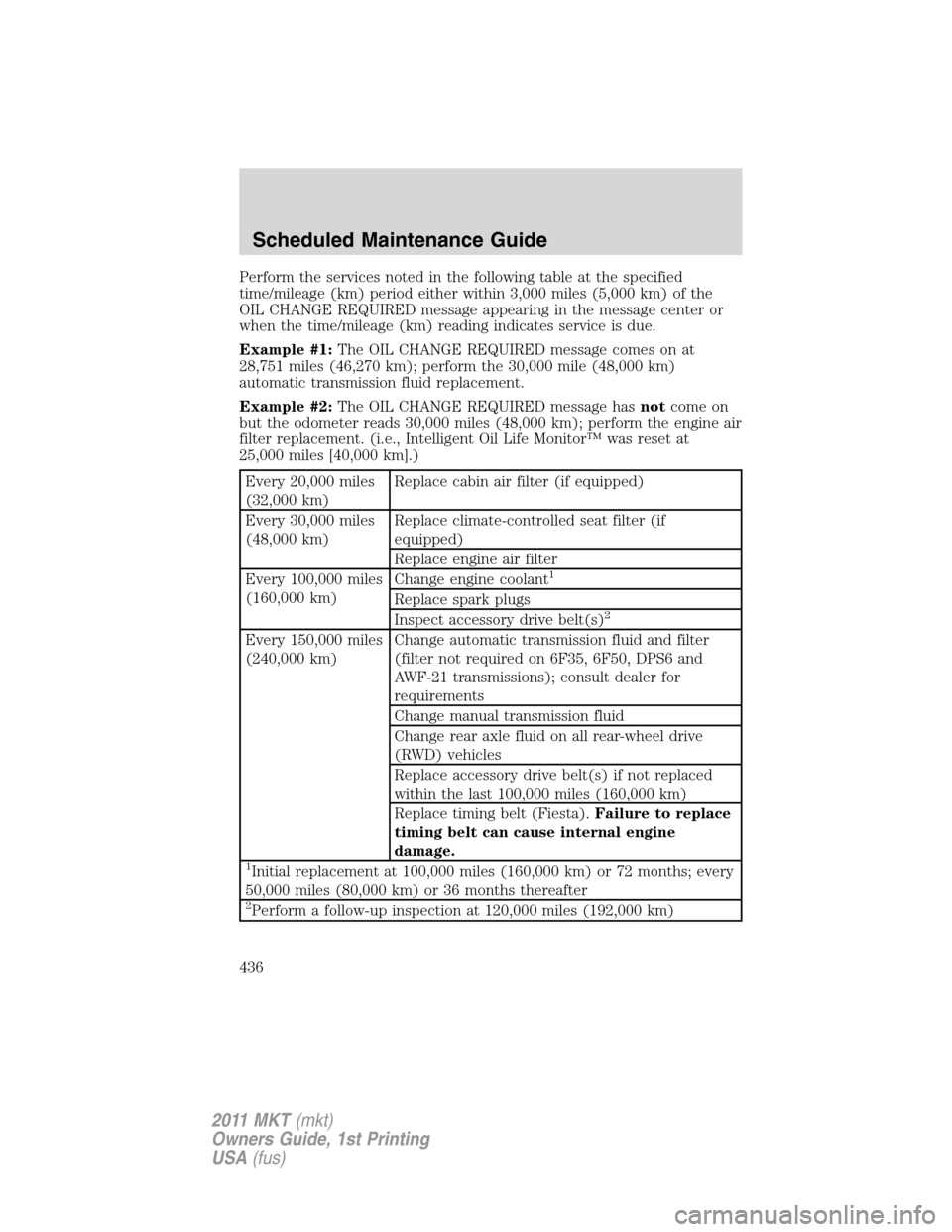
Perform the services noted in the following table at the specified
time/mileage (km) period either within 3,000 miles (5,000 km) of the
OIL CHANGE REQUIRED message appearing in the message center or
when the time/mileage (km) reading indicates service is due.
Example #1:The OIL CHANGE REQUIRED message comes on at
28,751 miles (46,270 km); perform the 30,000 mile (48,000 km)
automatic transmission fluid replacement.
Example #2:The OIL CHANGE REQUIRED message hasnotcome on
but the odometer reads 30,000 miles (48,000 km); perform the engine air
filter replacement. (i.e., Intelligent Oil Life Monitor™ was reset at
25,000 miles [40,000 km].)
Every 20,000 miles
(32,000 km)Replace cabin air filter (if equipped)
Every 30,000 miles
(48,000 km)Replace climate-controlled seat filter (if
equipped)
Replace engine air filter
Every 100,000 miles
(160,000 km)Change engine coolant
1
Replace spark plugs
Inspect accessory drive belt(s)2
Every 150,000 miles
(240,000 km)Change automatic transmission fluid and filter
(filter not required on 6F35, 6F50, DPS6 and
AWF-21 transmissions); consult dealer for
requirements
Change manual transmission fluid
Change rear axle fluid on all rear-wheel drive
(RWD) vehicles
Replace accessory drive belt(s) if not replaced
within the last 100,000 miles (160,000 km)
Replace timing belt (Fiesta).Failure to replace
timing belt can cause internal engine
damage.
1Initial replacement at 100,000 miles (160,000 km) or 72 months; every
50,000 miles (80,000 km) or 36 months thereafter
2Perform a follow-up inspection at 120,000 miles (192,000 km)
Scheduled Maintenance Guide
436
2011 MKT(mkt)
Owners Guide, 1st Printing
USA(fus)
Page 442 of 454
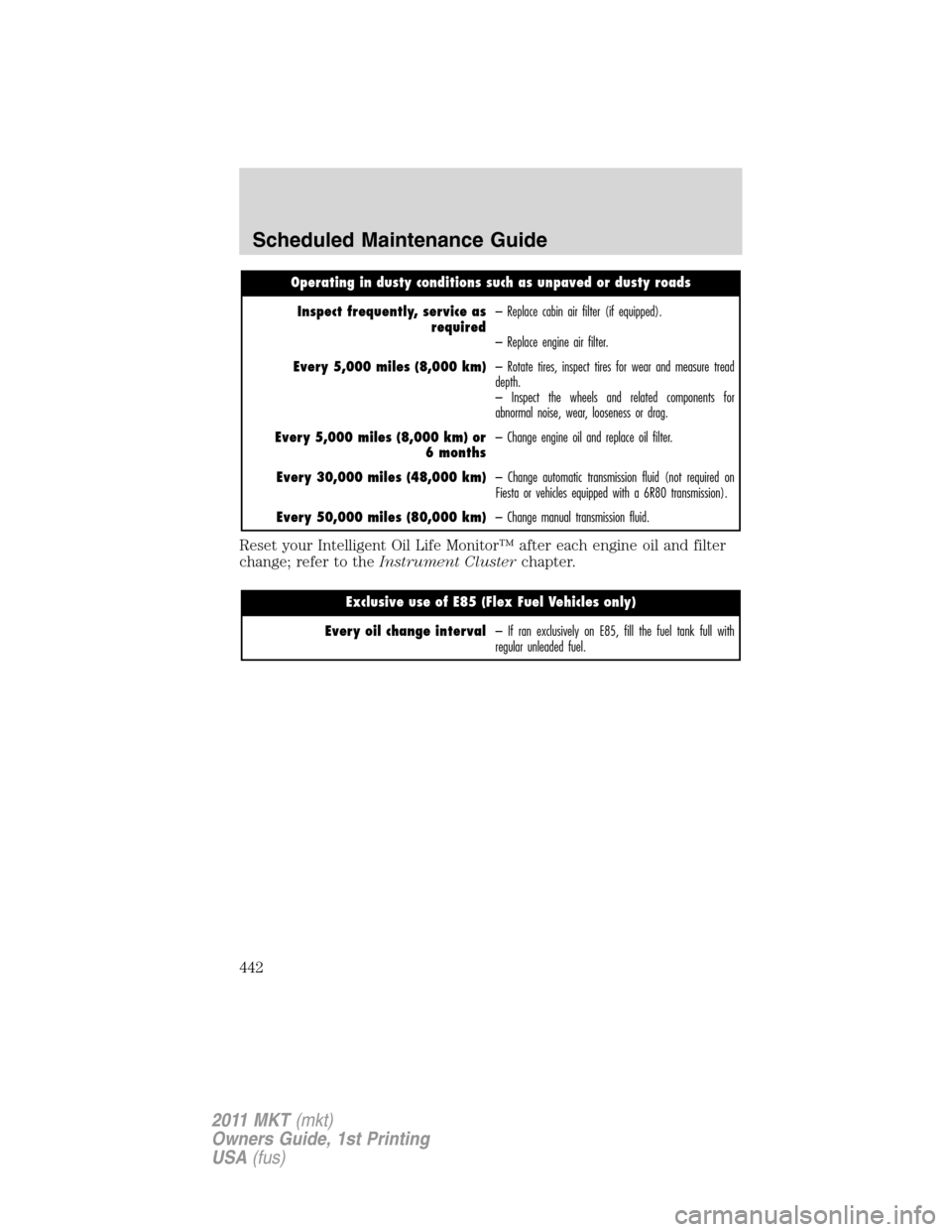
Operating in dusty conditions such as unpaved or dusty roads
Inspect frequently, service as
required– Replace cabin air filter (if equipped).
– Replace engine air filter.
Every 5,000 miles (8,000 km)– Rotate tires, inspect tires for wear and measure tread
depth.
– Inspect the wheels and related components for
abnormal noise, wear, looseness or drag.
Every 5,000 miles (8,000 km) or
6 months– Change engine oil and replace oil filter.
Every 30,000 miles (48,000 km)– Change automatic transmission fluid (not required on
Fiesta or vehicles equipped with a 6R80 transmission).
Every 50,000 miles (80,000 km)– Change manual transmission fluid.
Reset your Intelligent Oil Life Monitor™ after each engine oil and filter
change; refer to theInstrument Clusterchapter.
Exclusive use of E85 (Flex Fuel Vehicles only)
Every oil change interval– If ran exclusively on E85, fill the fuel tank full with
regular unleaded fuel.
Scheduled Maintenance Guide
442
2011 MKT(mkt)
Owners Guide, 1st Printing
USA(fus)