warning lights LINCOLN MKT 2011 User Guide
[x] Cancel search | Manufacturer: LINCOLN, Model Year: 2011, Model line: MKT, Model: LINCOLN MKT 2011Pages: 454, PDF Size: 3.82 MB
Page 261 of 454
Low tire pressure
warning lightPossible cause Customer action required
Flashing warning
lightSpare tire in use Your temporary spare tire is in
use. Repair the damaged road
wheel and re-mount it on the
vehicle to restore system
functionality. For a description
of how the system functions
under these conditions, refer to
When your temporary spare
tire is installedin this section.
TPMS
malfunctionIf your tires are properly
inflated and your spare tire is
not in use and the TPMS
warning light still flashes,
contact your authorized dealer
as soon as possible.
When inflating your tires
When putting air into your tires (such as at a gas station or in your
garage), the tire pressure monitoring system may not respond
immediately to the air added to your tires.
It may take up to two minutes of driving over 20 mph (32 km/h) for the
light to turn off after you have filled your tires to the recommended
inflation pressure.
How temperature affects your tire pressure
The tire pressure monitoring system (TPMS) monitors tire pressure in
each pneumatic tire. While driving in a normal manner, a typical
passenger tire inflation pressure may increase approximately 2 to 4 psi
(14 to 28 kPa) from a cold start situation. If the vehicle is stationary
over night with the outside temperature significantly lower than the
daytime temperature, the tire pressure may decrease approximately 3 psi
(21 kPa) for a drop of 30°F (17°C) in ambient temperature. This lower
pressure value may be detected by the TPMS as being significantly lower
than the recommended inflation pressure and activate the TPMS warning
for low tire pressure. If the low tire pressure warning light is on, visually
check each tire to verify that no tire is flat. (If one or more tires are flat,
repair as necessary.) Check air pressure in the road tires. If any tire is
Tires, Wheels and Loading
261
2011 MKT(mkt)
Owners Guide, 1st Printing
USA(fus)
Page 273 of 454
WARNING:Do not connect a trailer’s hydraulic brake system
directly to your vehicle’s brake system. Your vehicle may not
have enough braking power and your chances of having a collision
greatly increase.
The braking system of the tow vehicle is rated for operation at the
GVWR not GCWR.
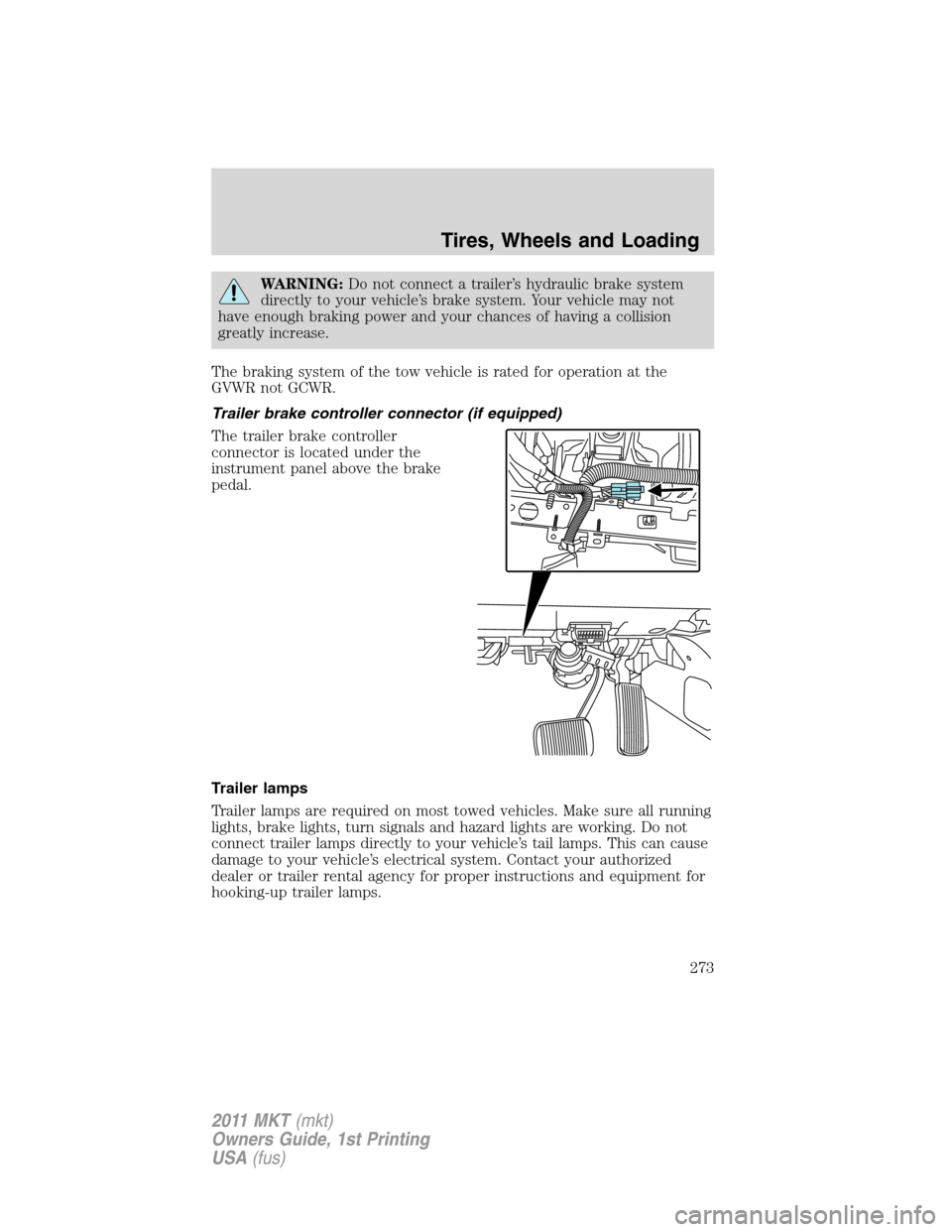
Trailer brake controller connector (if equipped)
The trailer brake controller
connector is located under the
instrument panel above the brake
pedal.
Trailer lamps
Trailer lamps are required on most towed vehicles. Make sure all running
lights, brake lights, turn signals and hazard lights are working. Do not
connect trailer lamps directly to your vehicle’s tail lamps. This can cause
damage to your vehicle’s electrical system. Contact your authorized
dealer or trailer rental agency for proper instructions and equipment for
hooking-up trailer lamps.
Tires, Wheels and Loading
273
2011 MKT(mkt)
Owners Guide, 1st Printing
USA(fus)
Page 276 of 454
STARTING
Ignition modes
1. Off — This position shuts the engine and all electrical accessories off.
Press and release the START/STOP button without applying the brake
pedal when your vehicle is in accessory or on modes or when the engine
is running.Note:When the vehicle is in motion, a single press and
release of the START/STOP button will not switch off the engine. In
order to switch off the engine while the vehicle is in motion, press and
hold the START/STOP button for at least one second.
2. Accessory — This allows electrical accessories such as the radio to
operate while the engine is not running. Press and release the
START/STOP button without applying the brake pedal. ACCESSORY
POWER ACTIVE and PRESS BRAKE TO START will be displayed in the
message center. Refer toMessage centerin theInstrument Cluster
chapter for more information.
3. On — This will power your vehicle’s electrical system and the warning
lights in the instrument cluster will illuminate, but the engine will remain
off. Press and hold the START/STOP button for at least one second
without applying the brake pedal.
4. Start — Cranks the engine. Press the START/STOP button (for any
length of time) while applying the brake pedal.
Starting your vehicle
This system meets all Canadian interference-causing equipment standard
requirements regulating the impulse electrical field strength of radio
noise.
Don’t press the accelerator before or during starting. Only use the
accelerator when you have difficulty starting the engine. For more
information on starting the vehicle, refer toStarting the enginein this
chapter.
To avoid potential transmission damage at extremely cold temperatures
(below -20°F [-30°C]), it is recommended that the vehicle be warmed up
to normal operating temperature before driving at highway speeds above
50 mph (80 km/h). Normal operating temperature is normally reached
after 10 minutes of moderate driving or idling.
WARNING:Extended idling at high engine speeds can produce
very high temperatures in the engine and exhaust system,
creating the risk of fire or other damage.
Driving
276
2011 MKT(mkt)
Owners Guide, 1st Printing
USA(fus)
Page 282 of 454
become very hot and may result in an electrical shock or fire. Be sure
to check for heat anywhere in the electrical hookup once the system
has been operating for approximately a half hour.
•Finally, have the engine block heater system checked during your fall
tune-up to be sure it’s in good working order.
How to use the engine block heater
Ensure the receptacle terminals are clean and dry prior to use. To clean
them, use a dry cloth.
Depending on the type of factory installed equipment, your engine block
heater will use .4 to 1.0 kilowatt-hours of energy per hour of use. Your
factory installed block heater system does not have a thermostat;
however, maximum temperature is attained after approximately three
hours of operation. Block heater operation longer than three hours will
not improve system performance and will unnecessarily use additional
electricity.
Make sure system is unplugged and properly stowed before driving the
vehicle. While not in use, make sure the protective cover seals the
prongs of the engine block heater cord plug.
BRAKES
Occasional brake noise is normal. If a metal-to-metal, continuous grinding
or continuous squeal sound is present, the brake linings may be worn-out
and should be inspected by an authorized dealer. If the vehicle has
continuous vibration or shudder in the steering wheel while braking, the
vehicle should be inspected by an authorized dealer.
Refer toWarning lights and
chimesin theInstrument Cluster
chapter for information on the brake
system warning light.
Four-wheel anti-lock brake system (ABS)
Your vehicle is equipped with an anti-lock braking system (ABS). This
system helps you maintain steering control during emergency stops by
keeping the brakes from locking. Noise from the ABS pump motor and
brake pedal pulsation may be observed during ABS braking and the
brake pedal may suddenly travel a little farther as soon as ABS braking is
done and normal brake operation resumes. These are normal
characteristics of the ABS and should be no reason for concern.
P!
BRAKE
Driving
282
2011 MKT(mkt)
Owners Guide, 1st Printing
USA(fus)
Page 396 of 454
Cleaner air
Ford endorses the use of reformulated “cleaner-burning” gasolines to
improve air quality, per the recommendations in theChoosing the right
fuelsection.
Running out of fuel
Avoid running out of fuel because this situation may have an adverse
effect on powertrain components.
If you have run out of fuel:
•You may need to cycle the ignition from off to on several times after
refueling to allow the fuel system to pump the fuel from the tank to
the engine. On restarting, cranking time will take a few seconds longer
than normal.
•Normally, adding 1 gallon (3.8L) of fuel is enough to restart the
engine. If the vehicle is out of fuel and on a steep grade, more than
1 gallon (3.8L) may be required.
•The service engine soon
indicator may come on. For more
information on the service engine soon indicator, refer toWarning
lights and chimesin theInstrument Clusterchapter.
Refilling with a portable fuel container
With the Easy Fuel™ “no cap” fuel system, use the following directions
when filling from a portable fuel container:
WARNING:Do not insert the nozzle of portable fuel containers
or aftermarket funnels into the Easy Fuel™ system. This could
damage the fuel system and its seal, and may cause fuel to run onto
the ground instead of filling the tank, which could result in serious
personal injury.
WARNING:Do not try to pry open or push open the Easy
Fuel™ system with foreign objects. This could damage the fuel
system and its seal and cause injury to you or others.
When filling the vehicle’s fuel tank from a portable fuel container, use the
funnel included with the vehicle.
Maintenance and Specifications
396
2011 MKT(mkt)
Owners Guide, 1st Printing
USA(fus)
Page 430 of 454
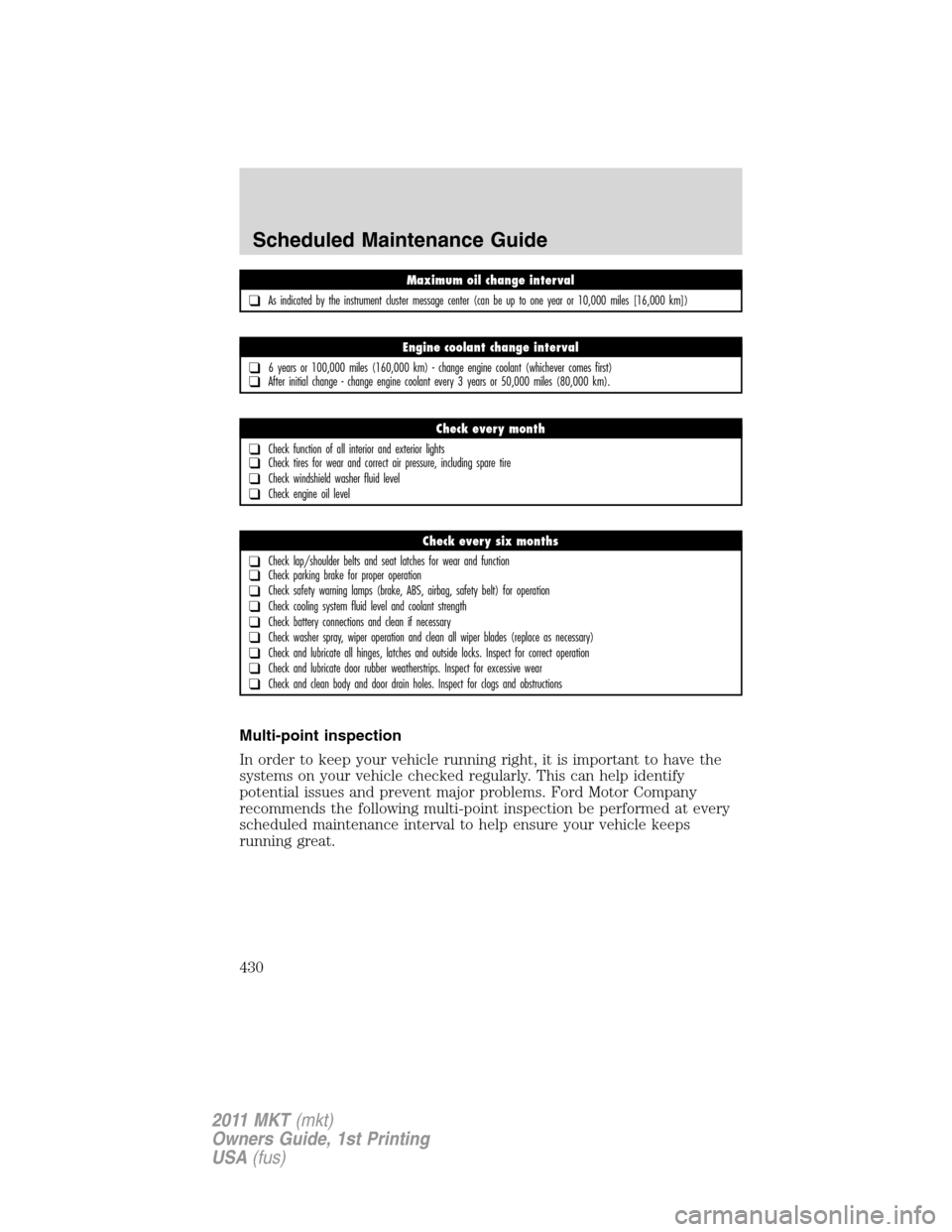
Multi-point inspection
In order to keep your vehicle running right, it is important to have the
systems on your vehicle checked regularly. This can help identify
potential issues and prevent major problems. Ford Motor Company
recommends the following multi-point inspection be performed at every
scheduled maintenance interval to help ensure your vehicle keeps
running great.
Maximum oil change interval
❑As indicated by the instrument cluster message center (can be up to one year or 10,000 miles [16,000 km])
Engine coolant change interval
❑6 years or 100,000 miles (160,000 km) - change engine coolant (whichever comes first)❑After initial change - change engine coolant every 3 years or 50,000 miles (80,000 km).
Check every month
❑Check function of all interior and exterior lights❑Check tires for wear and correct air pressure, including spare tire
❑Check windshield washer fluid level
❑Check engine oil level
Check every six months
❑Check lap/shoulder belts and seat latches for wear and function❑Check parking brake for proper operation
❑Check safety warning lamps (brake, ABS, airbag, safety belt) for operation
❑Check cooling system fluid level and coolant strength
❑Check battery connections and clean if necessary
❑Check washer spray, wiper operation and clean all wiper blades (replace as necessary)
❑Check and lubricate all hinges, latches and outside locks. Inspect for correct operation
❑Check and lubricate door rubber weatherstrips. Inspect for excessive wear
❑Check and clean body and door drain holes. Inspect for clogs and obstructions
Scheduled Maintenance Guide
430
2011 MKT(mkt)
Owners Guide, 1st Printing
USA(fus)
Page 431 of 454
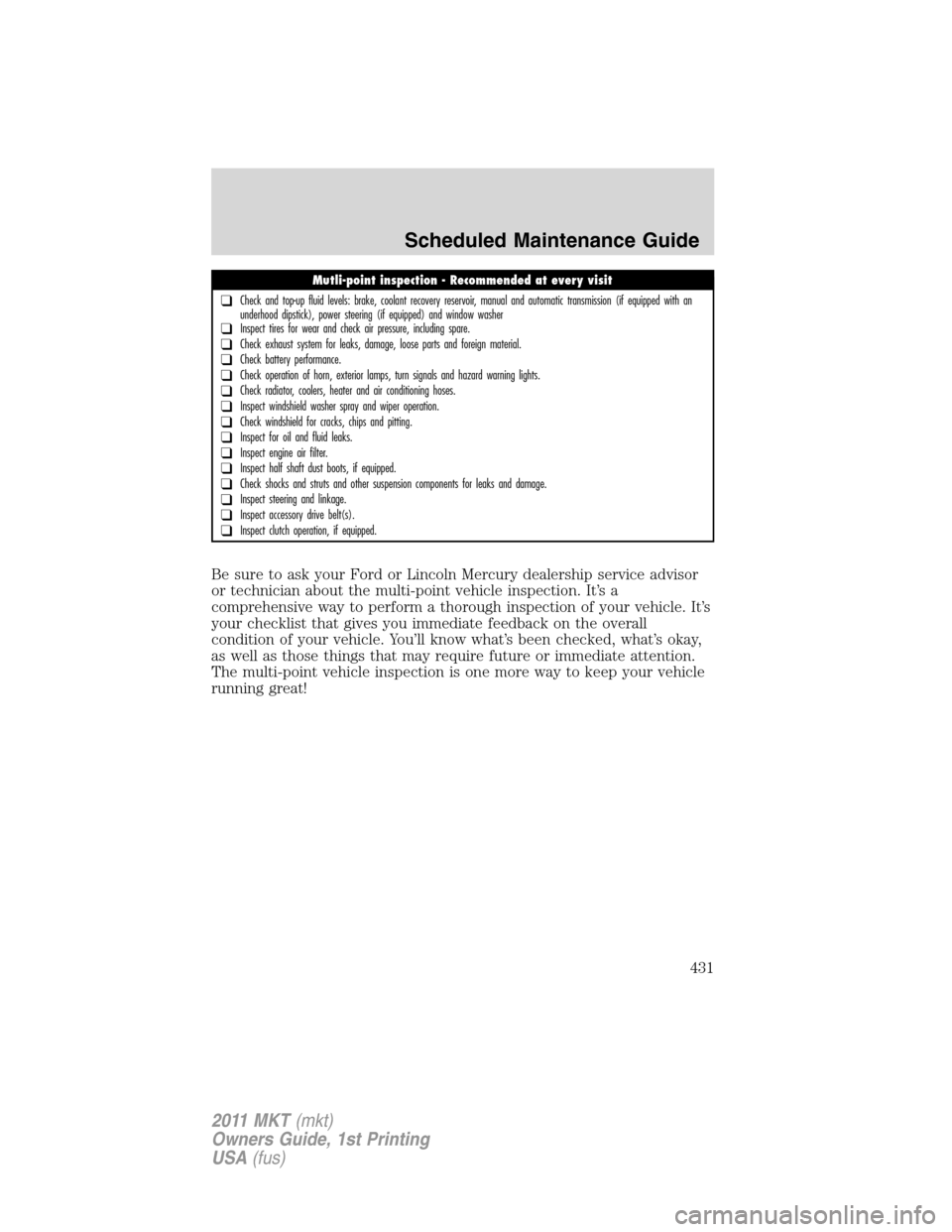
Be sure to ask your Ford or Lincoln Mercury dealership service advisor
or technician about the multi-point vehicle inspection. It’s a
comprehensive way to perform a thorough inspection of your vehicle. It’s
your checklist that gives you immediate feedback on the overall
condition of your vehicle. You’ll know what’s been checked, what’s okay,
as well as those things that may require future or immediate attention.
The multi-point vehicle inspection is one more way to keep your vehicle
running great!
Mutli-point inspection - Recommended at every visit
❑Check and top-up fluid levels: brake, coolant recovery reservoir, manual and automatic transmission (if equipped with an
underhood dipstick), power steering (if equipped) and window washer
❑Inspect tires for wear and check air pressure, including spare.
❑Check exhaust system for leaks, damage, loose parts and foreign material.
❑Check battery performance.
❑Check operation of horn, exterior lamps, turn signals and hazard warning lights.
❑Check radiator, coolers, heater and air conditioning hoses.
❑Inspect windshield washer spray and wiper operation.
❑Check windshield for cracks, chips and pitting.
❑Inspect for oil and fluid leaks.
❑Inspect engine air filter.
❑Inspect half shaft dust boots, if equipped.
❑Check shocks and struts and other suspension components for leaks and damage.
❑Inspect steering and linkage.
❑Inspect accessory drive belt(s).
❑Inspect clutch operation, if equipped.
Scheduled Maintenance Guide
431
2011 MKT(mkt)
Owners Guide, 1st Printing
USA(fus)
Page 451 of 454
Heating
heating and air conditioning
system .......................................88
Home screen ...............................35
Homelink wireless control
system ........................................134
Hood ..........................................373
I
Ignition ...............................276, 417
Illuminated visor mirror ...........110
Infant seats
(see Safety seats) .....................226
Inspection/maintenance (I/M)
testing ........................................402
Instrument panel
cleaning ...................................367
cluster ........................................12
lighting up panel and
interior .....................................101
Intelligent Access Key ..............144
Intelligent Access with push
button start ...............................157
J
Jack ............................................333
positioning ...............................333
storage .....................................333
Jukebox features .........................46
Jump-starting your vehicle ......350
K
Keyless entry system
autolock ...................................152
keypad .....................................163locking and unlocking
doors ........................................164
programming entry code .......163
Keys ...........................................166
positions of the ignition .........276
L
Lamps
autolamp system .......................96
bulb replacement
specifications chart ................106
daytime running light .............100
fog lamps ...................................97
headlamps .................................95
headlamps, flash to pass ........100
instrument panel, dimming ...101
interior lamps .................103, 106
replacing bulbs .......................106
LATCH anchors .........................230
Liftgate ..............................138, 159
Lights, warning and indicator ....12
anti-lock brakes (ABS) ..........283
Load limits .................................263
Loading pictures .........................36
Locks
autolock ...................................152
childproof ................................155
doors ........................................151
Lubricant specifications ...........414
Lug nuts ....................................349
M
Message center .....................18–19
english/metric button ...............24
system check button ................24
warning messages .....................24
Mirrors .......................................118
Index
451
2011 MKT(mkt)
Owners Guide, 1st Printing
USA(fus)
Page 454 of 454
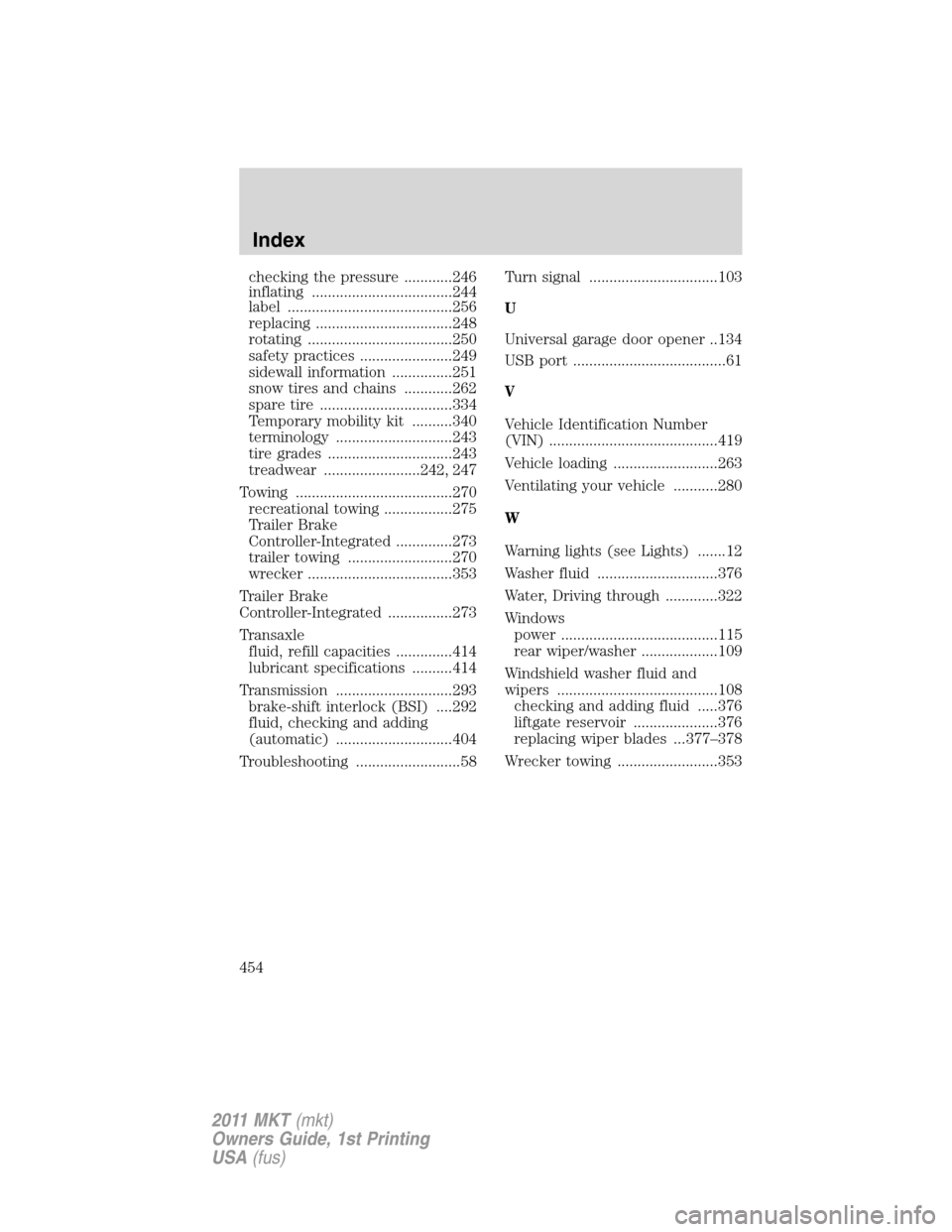
checking the pressure ............246
inflating ...................................244
label .........................................256
replacing ..................................248
rotating ....................................250
safety practices .......................249
sidewall information ...............251
snow tires and chains ............262
spare tire .................................334
Temporary mobility kit ..........340
terminology .............................243
tire grades ...............................243
treadwear ........................242, 247
Towing .......................................270
recreational towing .................275
Trailer Brake
Controller-Integrated ..............273
trailer towing ..........................270
wrecker ....................................353
Trailer Brake
Controller-Integrated ................273
Transaxle
fluid, refill capacities ..............414
lubricant specifications ..........414
Transmission .............................293
brake-shift interlock (BSI) ....292
fluid, checking and adding
(automatic) .............................404
Troubleshooting ..........................58Turn signal ................................103
U
Universal garage door opener ..134
USB port ......................................61
V
Vehicle Identification Number
(VIN) ..........................................419
Vehicle loading ..........................263
Ventilating your vehicle ...........280
W
Warning lights (see Lights) .......12
Washer fluid ..............................376
Water, Driving through .............322
Windows
power .......................................115
rear wiper/washer ...................109
Windshield washer fluid and
wipers ........................................108
checking and adding fluid .....376
liftgate reservoir .....................376
replacing wiper blades ...377–378
Wrecker towing .........................353
Index
454
2011 MKT(mkt)
Owners Guide, 1st Printing
USA(fus)