manual transmission LINCOLN MKT 2011 Owners Manual
[x] Cancel search | Manufacturer: LINCOLN, Model Year: 2011, Model line: MKT, Model: LINCOLN MKT 2011Pages: 454, PDF Size: 3.82 MB
Page 26 of 454
AWD OFF (if equipped)— Displayed when the AWD system has been
automatically disabled to protect itself. This is caused by operating the
vehicle with the compact spare tire installed or if the system is
overheating. The AWD system will resume normal function and clear this
message after driving a short distance with the road tire re-installed or
after the system is allowed to cool.
CHECK AWD (if equipped)— Displayed in conjunction with the
Throttle Control/Transmission/AWD
light when the AWD system is
not operating properly. If the warning stays on or continues to come on,
contact your authorized dealer as soon as possible.
ENGINE OIL CHANGE SOON— Displayed when the engine oil life
remaining is 5% to 1%.
OIL CHANGE REQUIRED— Displayed when the oil life left reaches
0%.
TRAILER SWAY REDUCE SPEED (if equipped)— Displayed when
the trailer sway control has detected trailer sway. For more information,
refer to theDrivingchapter for more information.
INTKEY COULD NOT PROGRAM— Displayed when an attempt is
made to program a fifth integrated key to the remote keyless entry
system. For more information on integrated key, refer to theLocks and
Securitychapter in this manual.
CRUISE ON RADAR READY (if equipped)— Displayed when the
driver pressed the cruise On/Off control and ACC was off.
CRUISE OFF (if equipped)— Displayed when the driver pressed the
Cruise On/Off control and ACC was on.
SET XXX MPH GAP ACC GAP (if equipped)— Displayed when
ACC is active and driver has selected a GAP setting using the steering
wheel control <---> button.
CRUISE OVERRIDE (if equipped)— Displayed when the accelerator
pedal is being pressed while ACC is active.
CRUISE NOT AVAILABLE (if equipped)— Displayed when a system
malfunction is preventing ACC from engaging.
CRUISE MALFUNCTION (if equipped)— Displayed when a radar
malfunction is preventing the ACC from engaging.
CRUISE NOT AVAILABLE SENSOR BLOCKED SEE MANUAL (if
equipped)— Displayed when the radar is blocked because of poor
radar visibility due to bad weather or ice/mud/water in front of radar.
Driver can typically clean the sensor to resolve.
Instrument Cluster
26
2011 MKT(mkt)
Owners Guide, 1st Printing
USA(fus)
Page 37 of 454
•Up to 256 files or folders can be displayed in one folder.
•Not compatible with discs written in Packet Write mode.
•Only the photograph(s) which meet these conditions will be displayed.
Note:When burning a CD, ensure that you ‘close’ or ‘finalize’ the disc
when the CD-burning process finishes (you should select this option
before you start burning). Consult your software manual or the program’s
Help files if you’re not sure how to finalize the disc. Also, write the audio
data into the first session of a multi-session CD as audio systems won’t
be able to sort through other sessions to find more audio tracks.
Rearview camera display (if equipped)
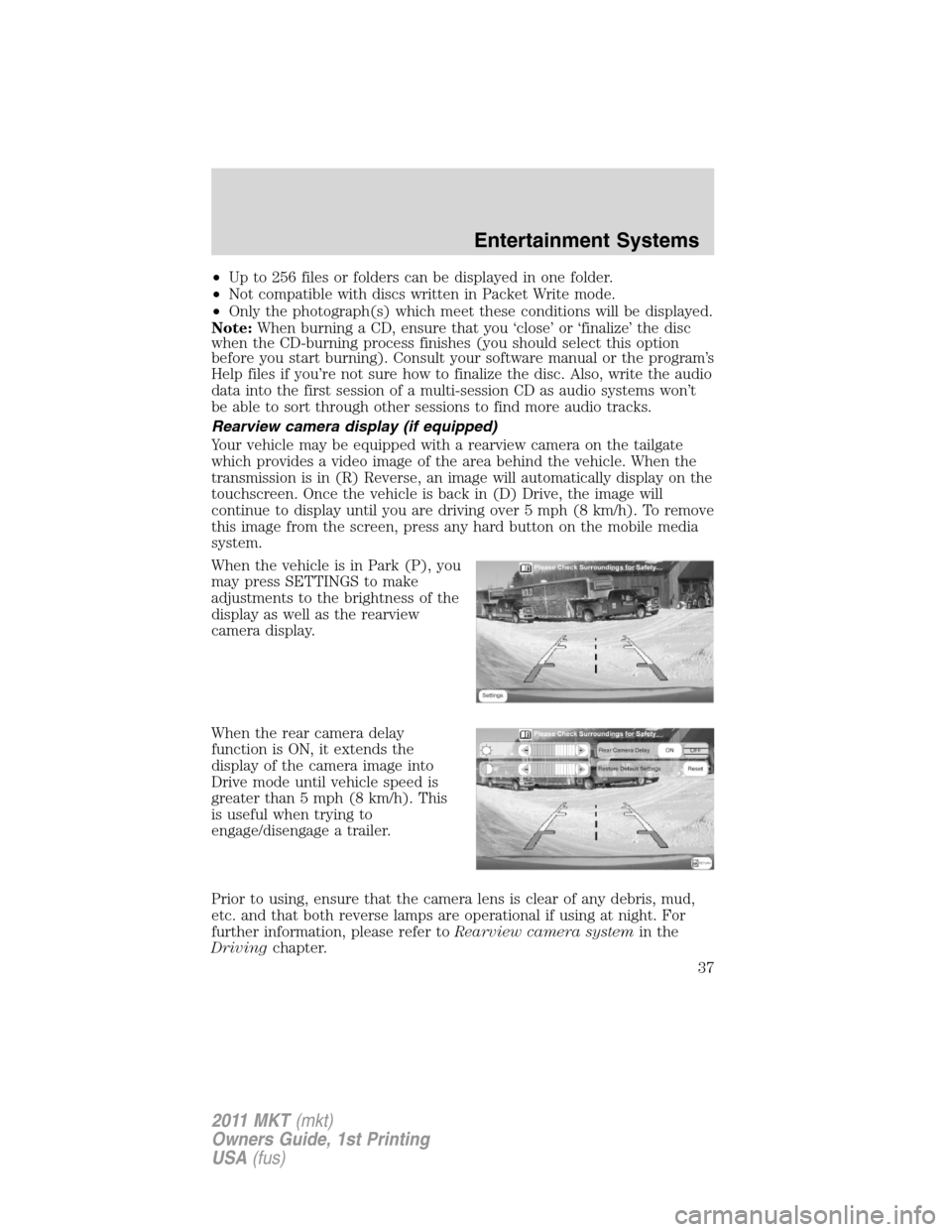
Your vehicle may be equipped with a rearview camera on the tailgate
which provides a video image of the area behind the vehicle. When the
transmission is in (R) Reverse, an image will automatically display on the
touchscreen. Once the vehicle is back in (D) Drive, the image will
continue to display until you are driving over 5 mph (8 km/h). To remove
this image from the screen, press any hard button on the mobile media
system.
When the vehicle is in Park (P), you
may press SETTINGS to make
adjustments to the brightness of the
display as well as the rearview
camera display.
When the rear camera delay
function is ON, it extends the
display of the camera image into
Drive mode until vehicle speed is
greater than 5 mph (8 km/h). This
is useful when trying to
engage/disengage a trailer.
Prior to using, ensure that the camera lens is clear of any debris, mud,
etc. and that both reverse lamps are operational if using at night. For
further information, please refer toRearview camera systemin the
Drivingchapter.
Entertainment Systems
37
2011 MKT(mkt)
Owners Guide, 1st Printing
USA(fus)
Page 294 of 454
N (Neutral)
With the gearshift lever in N (Neutral), the vehicle can be started and is
free to roll. Hold the brake pedal down while in this position.
D (Drive) with Overdrive
The normal driving position for the best fuel economy. Transmission
operates in gears one through six.
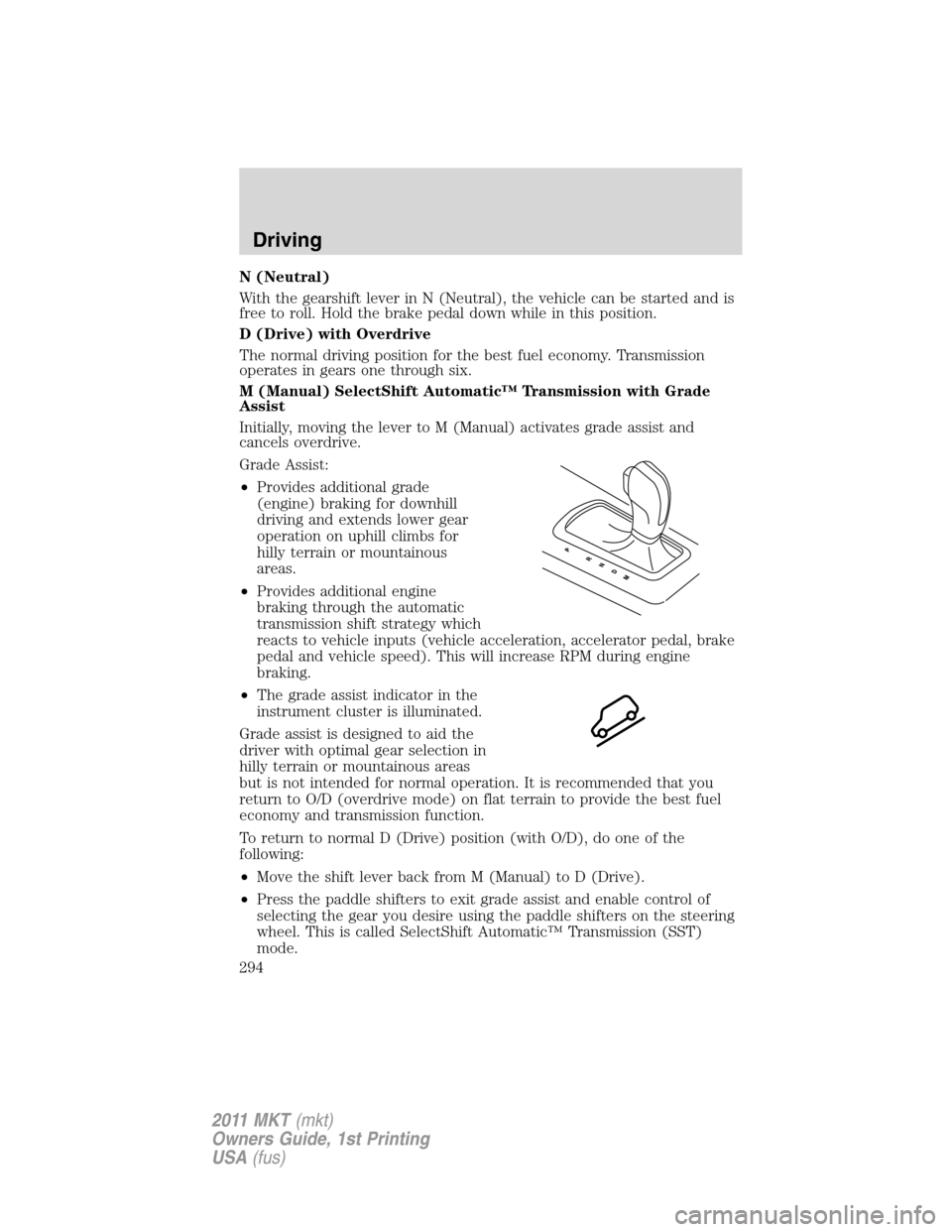
M (Manual) SelectShift Automatic™ Transmission with Grade
Assist
Initially, moving the lever to M (Manual) activates grade assist and
cancels overdrive.
Grade Assist:
•Provides additional grade
(engine) braking for downhill
driving and extends lower gear
operation on uphill climbs for
hilly terrain or mountainous
areas.
•Provides additional engine
braking through the automatic
transmission shift strategy which
reacts to vehicle inputs (vehicle acceleration, accelerator pedal, brake
pedal and vehicle speed). This will increase RPM during engine
braking.
•The grade assist indicator in the
instrument cluster is illuminated.
Grade assist is designed to aid the
driver with optimal gear selection in
hilly terrain or mountainous areas
but is not intended for normal operation. It is recommended that you
return to O/D (overdrive mode) on flat terrain to provide the best fuel
economy and transmission function.
To return to normal D (Drive) position (with O/D), do one of the
following:
•Move the shift lever back from M (Manual) to D (Drive).
•Press the paddle shifters to exit grade assist and enable control of
selecting the gear you desire using the paddle shifters on the steering
wheel. This is called SelectShift Automatic™ Transmission (SST)
mode.
Driving
294
2011 MKT(mkt)
Owners Guide, 1st Printing
USA(fus)
Page 295 of 454
- The grade assist indicator in the instrument cluster will not be
illuminated.
- The transmission will operate in gears one through six.
Understanding your SelectShift Automatic™ Transmission (SST)
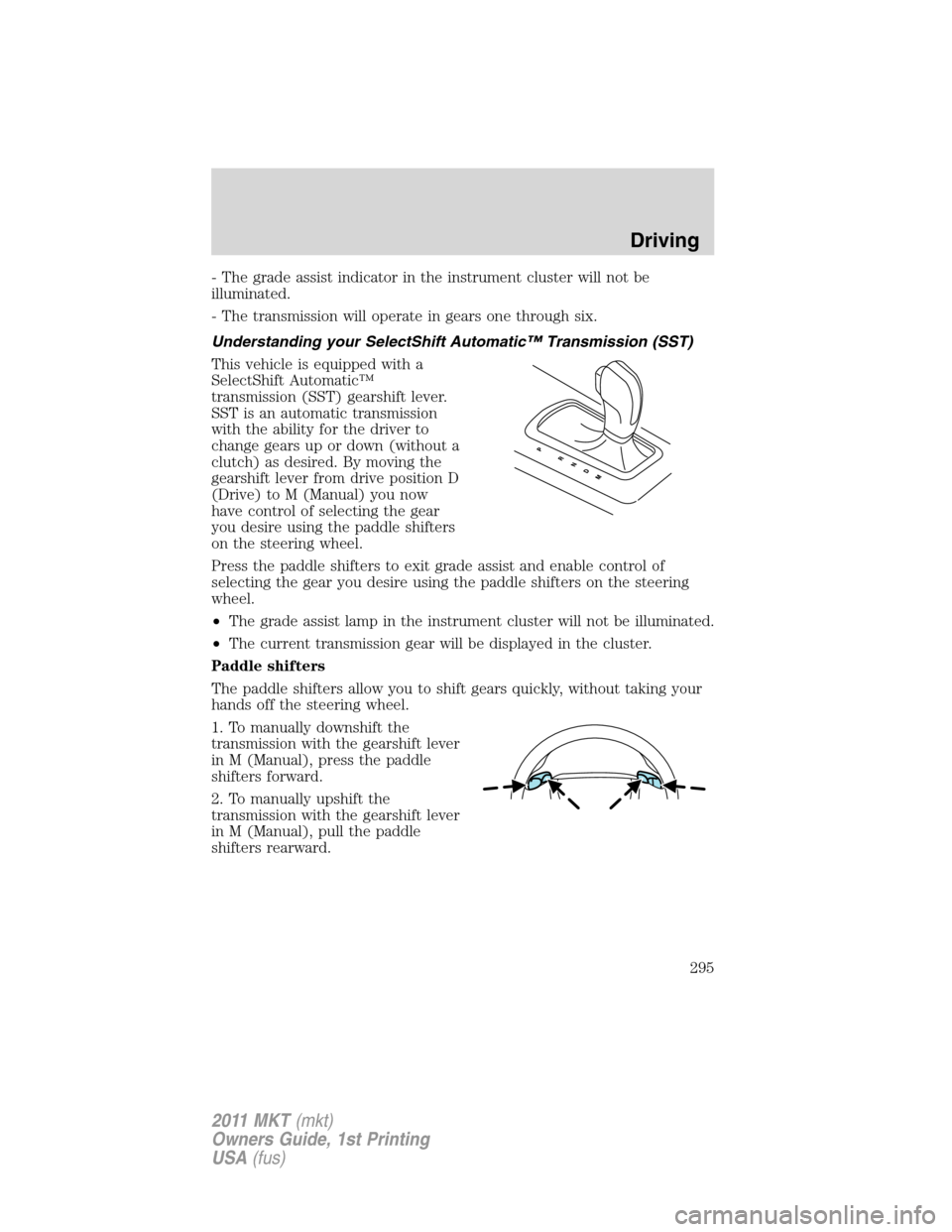
This vehicle is equipped with a
SelectShift Automatic™
transmission (SST) gearshift lever.
SST is an automatic transmission
with the ability for the driver to
change gears up or down (without a
clutch) as desired. By moving the
gearshift lever from drive position D
(Drive) to M (Manual) you now
have control of selecting the gear
you desire using the paddle shifters
on the steering wheel.
Press the paddle shifters to exit grade assist and enable control of
selecting the gear you desire using the paddle shifters on the steering
wheel.
•The grade assist lamp in the instrument cluster will not be illuminated.
•The current transmission gear will be displayed in the cluster.
Paddle shifters
The paddle shifters allow you to shift gears quickly, without taking your
hands off the steering wheel.
1. To manually downshift the
transmission with the gearshift lever
in M (Manual), press the paddle
shifters forward.
2. To manually upshift the
transmission with the gearshift lever
in M (Manual), pull the paddle
shifters rearward.
Driving
295
2011 MKT(mkt)
Owners Guide, 1st Printing
USA(fus)
Page 321 of 454
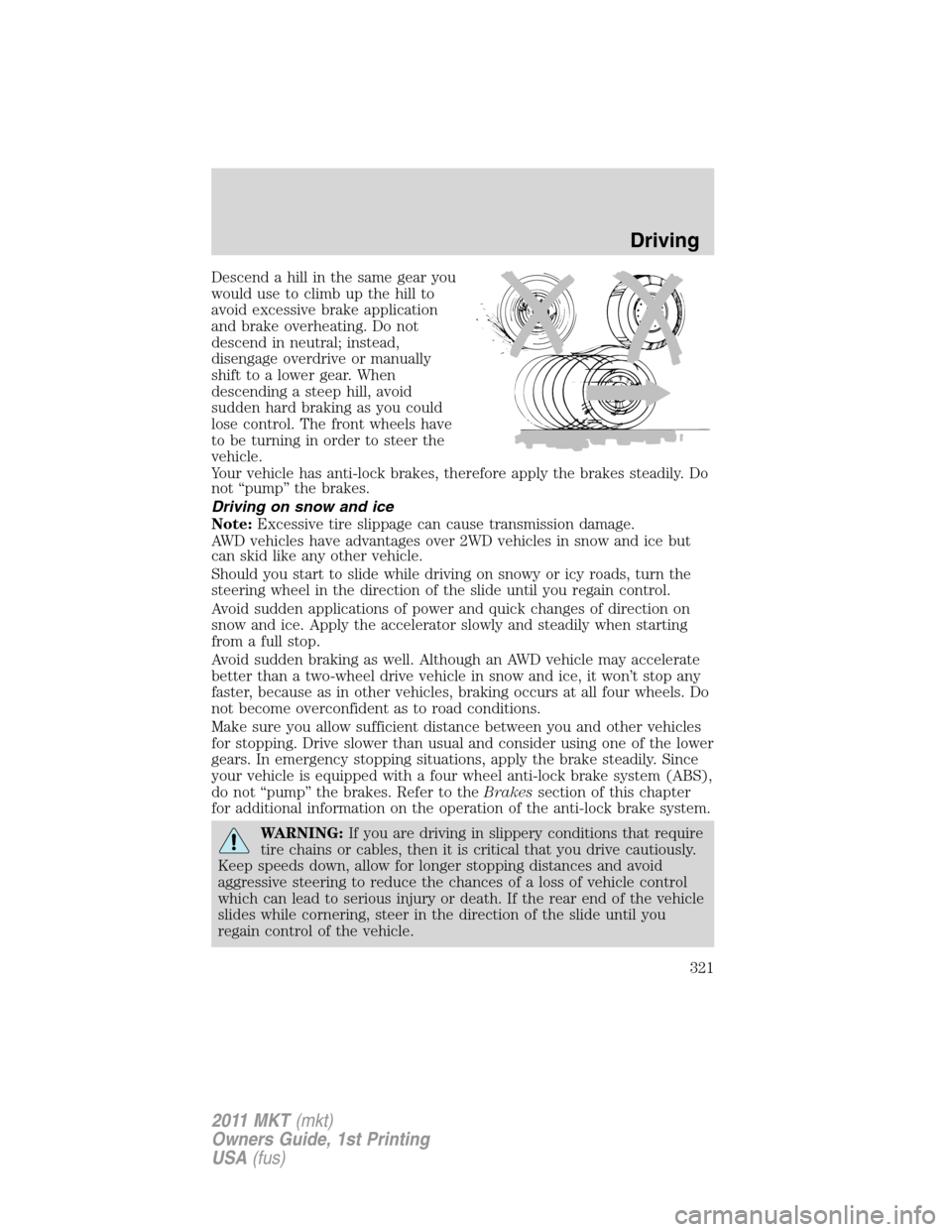
Descend a hill in the same gear you
would use to climb up the hill to
avoid excessive brake application
and brake overheating. Do not
descend in neutral; instead,
disengage overdrive or manually
shift to a lower gear. When
descending a steep hill, avoid
sudden hard braking as you could
lose control. The front wheels have
to be turning in order to steer the
vehicle.
Your vehicle has anti-lock brakes, therefore apply the brakes steadily. Do
not “pump” the brakes.
Driving on snow and ice
Note:Excessive tire slippage can cause transmission damage.
AWD vehicles have advantages over 2WD vehicles in snow and ice but
can skid like any other vehicle.
Should you start to slide while driving on snowy or icy roads, turn the
steering wheel in the direction of the slide until you regain control.
Avoid sudden applications of power and quick changes of direction on
snow and ice. Apply the accelerator slowly and steadily when starting
from a full stop.
Avoid sudden braking as well. Although an AWD vehicle may accelerate
better than a two-wheel drive vehicle in snow and ice, it won’t stop any
faster, because as in other vehicles, braking occurs at all four wheels. Do
not become overconfident as to road conditions.
Make sure you allow sufficient distance between you and other vehicles
for stopping. Drive slower than usual and consider using one of the lower
gears. In emergency stopping situations, apply the brake steadily. Since
your vehicle is equipped with a four wheel anti-lock brake system (ABS),
do not “pump” the brakes. Refer to theBrakessection of this chapter
for additional information on the operation of the anti-lock brake system.
WARNING:If you are driving in slippery conditions that require
tire chains or cables, then it is critical that you drive cautiously.
Keep speeds down, allow for longer stopping distances and avoid
aggressive steering to reduce the chances of a loss of vehicle control
which can lead to serious injury or death. If the rear end of the vehicle
slides while cornering, steer in the direction of the slide until you
regain control of the vehicle.
Driving
321
2011 MKT(mkt)
Owners Guide, 1st Printing
USA(fus)
Page 354 of 454
If the vehicle is towed by other means or incorrectly, vehicle
damage may occur.
Ford Motor Company produces a towing manual for all authorized tow
truck operators. Have your tow truck operator refer to this manual for
proper hook-up and towing procedures for your vehicle.
Emergency towing
In case of a roadside emergency with a disabled vehicle (without access
to wheel dollies, car hauling trailer, or flatbed transport vehicle) your
vehicle (regardless of transmission powertrain configuration) can be flat
towed (all wheels on the ground) under the following conditions:
•Vehicle is facing forward so that it is being towed in a forward
direction.
•Place the transmission in N (Neutral). Refer toBrake-shift interlock
in theDrivingchapter for specific instructions if you cannot move the
gear shift lever into N (Neutral).
•Maximum speed is not to exceed 35 mph (56 km/h).
•Maximum distance is 50 miles (80 km).
Roadside Emergencies
354
2011 MKT(mkt)
Owners Guide, 1st Printing
USA(fus)
Page 431 of 454
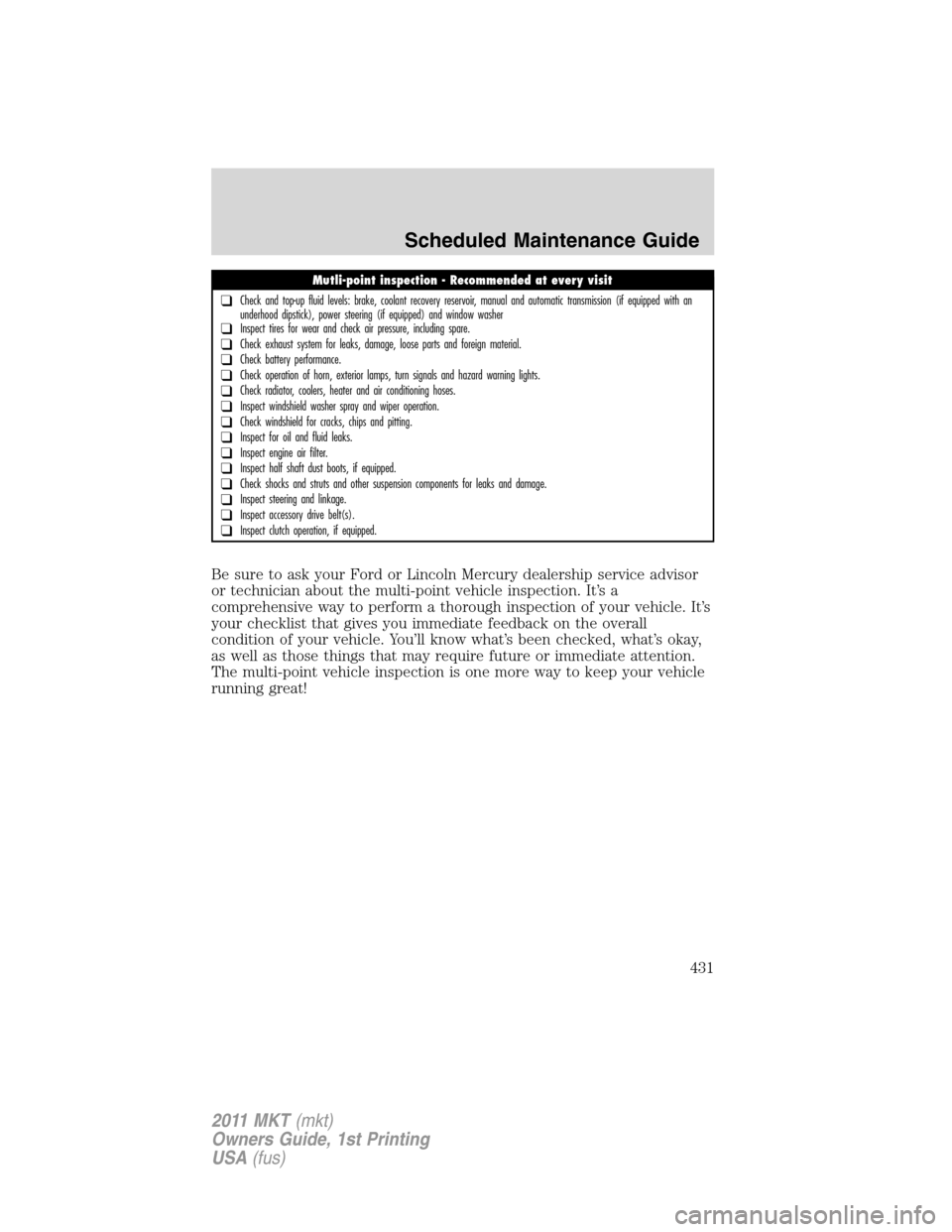
Be sure to ask your Ford or Lincoln Mercury dealership service advisor
or technician about the multi-point vehicle inspection. It’s a
comprehensive way to perform a thorough inspection of your vehicle. It’s
your checklist that gives you immediate feedback on the overall
condition of your vehicle. You’ll know what’s been checked, what’s okay,
as well as those things that may require future or immediate attention.
The multi-point vehicle inspection is one more way to keep your vehicle
running great!
Mutli-point inspection - Recommended at every visit
❑Check and top-up fluid levels: brake, coolant recovery reservoir, manual and automatic transmission (if equipped with an
underhood dipstick), power steering (if equipped) and window washer
❑Inspect tires for wear and check air pressure, including spare.
❑Check exhaust system for leaks, damage, loose parts and foreign material.
❑Check battery performance.
❑Check operation of horn, exterior lamps, turn signals and hazard warning lights.
❑Check radiator, coolers, heater and air conditioning hoses.
❑Inspect windshield washer spray and wiper operation.
❑Check windshield for cracks, chips and pitting.
❑Inspect for oil and fluid leaks.
❑Inspect engine air filter.
❑Inspect half shaft dust boots, if equipped.
❑Check shocks and struts and other suspension components for leaks and damage.
❑Inspect steering and linkage.
❑Inspect accessory drive belt(s).
❑Inspect clutch operation, if equipped.
Scheduled Maintenance Guide
431
2011 MKT(mkt)
Owners Guide, 1st Printing
USA(fus)
Page 436 of 454
Perform the services noted in the following table at the specified
time/mileage (km) period either within 3,000 miles (5,000 km) of the
OIL CHANGE REQUIRED message appearing in the message center or
when the time/mileage (km) reading indicates service is due.
Example #1:The OIL CHANGE REQUIRED message comes on at
28,751 miles (46,270 km); perform the 30,000 mile (48,000 km)
automatic transmission fluid replacement.
Example #2:The OIL CHANGE REQUIRED message hasnotcome on
but the odometer reads 30,000 miles (48,000 km); perform the engine air
filter replacement. (i.e., Intelligent Oil Life Monitor™ was reset at
25,000 miles [40,000 km].)
Every 20,000 miles
(32,000 km)Replace cabin air filter (if equipped)
Every 30,000 miles
(48,000 km)Replace climate-controlled seat filter (if
equipped)
Replace engine air filter
Every 100,000 miles
(160,000 km)Change engine coolant
1
Replace spark plugs
Inspect accessory drive belt(s)2
Every 150,000 miles
(240,000 km)Change automatic transmission fluid and filter
(filter not required on 6F35, 6F50, DPS6 and
AWF-21 transmissions); consult dealer for
requirements
Change manual transmission fluid
Change rear axle fluid on all rear-wheel drive
(RWD) vehicles
Replace accessory drive belt(s) if not replaced
within the last 100,000 miles (160,000 km)
Replace timing belt (Fiesta).Failure to replace
timing belt can cause internal engine
damage.
1Initial replacement at 100,000 miles (160,000 km) or 72 months; every
50,000 miles (80,000 km) or 36 months thereafter
2Perform a follow-up inspection at 120,000 miles (192,000 km)
Scheduled Maintenance Guide
436
2011 MKT(mkt)
Owners Guide, 1st Printing
USA(fus)
Page 440 of 454
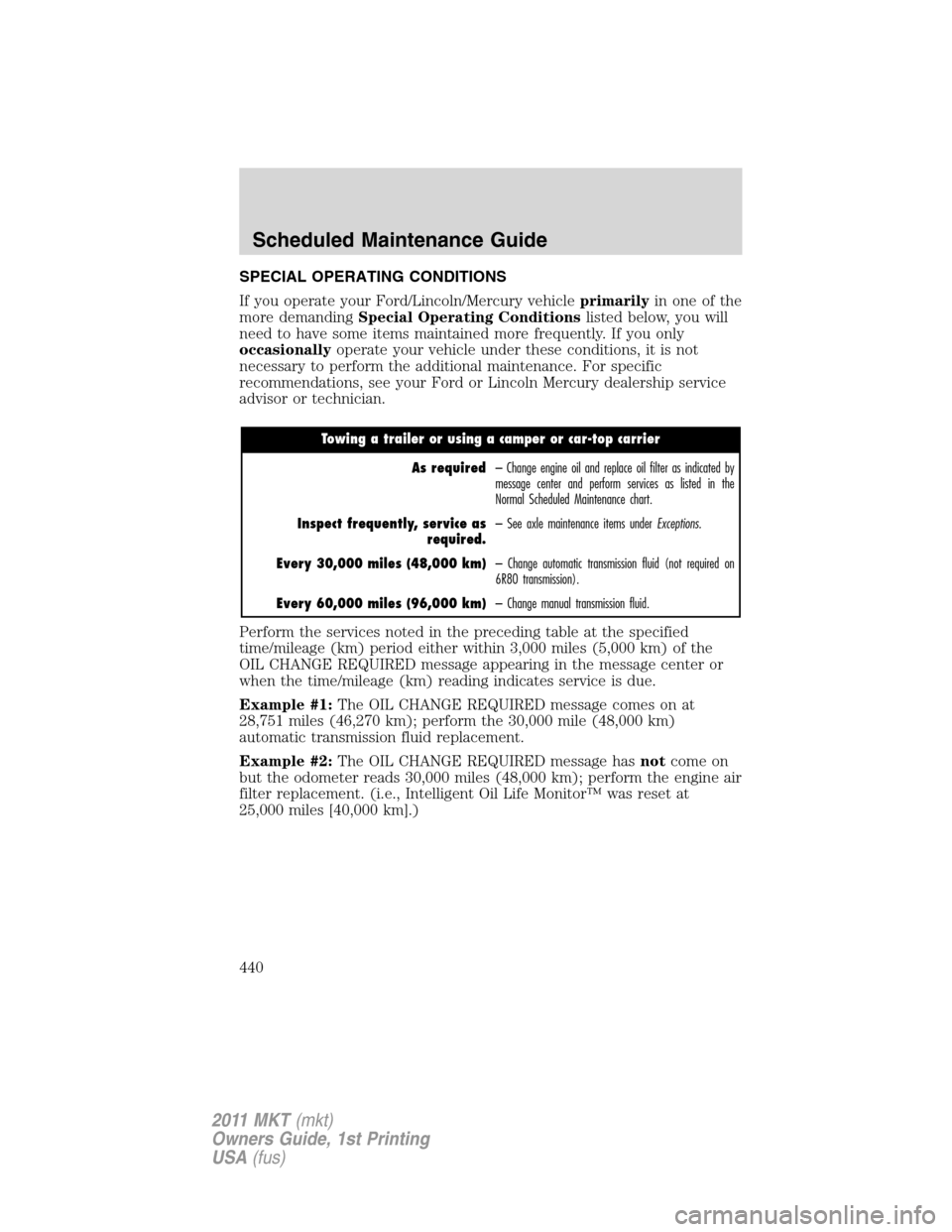
SPECIAL OPERATING CONDITIONS
If you operate your Ford/Lincoln/Mercury vehicleprimarilyin one of the
more demandingSpecial Operating Conditionslisted below, you will
need to have some items maintained more frequently. If you only
occasionallyoperate your vehicle under these conditions, it is not
necessary to perform the additional maintenance. For specific
recommendations, see your Ford or Lincoln Mercury dealership service
advisor or technician.
Towing a trailer or using a camper or car-top carrier
As required– Change engine oil and replace oil filter as indicated by
message center and perform services as listed in the
Normal Scheduled Maintenance chart.
Inspect frequently, service as
required.– See axle maintenance items under
Exceptions.
Every 30,000 miles (48,000 km)– Change automatic transmission fluid (not required on
6R80 transmission).
Every 60,000 miles (96,000 km)– Change manual transmission fluid.
Perform the services noted in the preceding table at the specified
time/mileage (km) period either within 3,000 miles (5,000 km) of the
OIL CHANGE REQUIRED message appearing in the message center or
when the time/mileage (km) reading indicates service is due.
Example #1:The OIL CHANGE REQUIRED message comes on at
28,751 miles (46,270 km); perform the 30,000 mile (48,000 km)
automatic transmission fluid replacement.
Example #2:The OIL CHANGE REQUIRED message hasnotcome on
but the odometer reads 30,000 miles (48,000 km); perform the engine air
filter replacement. (i.e., Intelligent Oil Life Monitor™ was reset at
25,000 miles [40,000 km].)
Scheduled Maintenance Guide
440
2011 MKT(mkt)
Owners Guide, 1st Printing
USA(fus)
Page 442 of 454
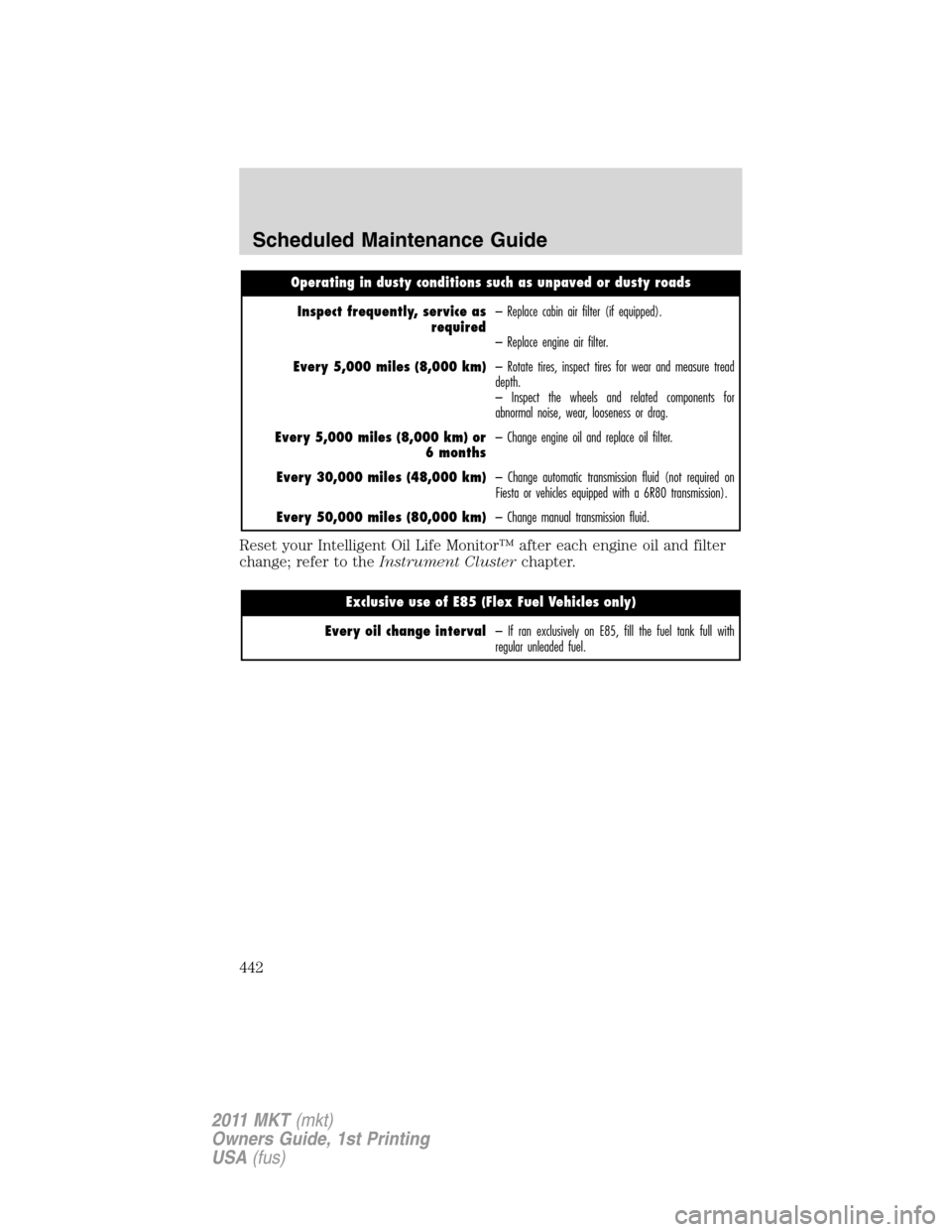
Operating in dusty conditions such as unpaved or dusty roads
Inspect frequently, service as
required– Replace cabin air filter (if equipped).
– Replace engine air filter.
Every 5,000 miles (8,000 km)– Rotate tires, inspect tires for wear and measure tread
depth.
– Inspect the wheels and related components for
abnormal noise, wear, looseness or drag.
Every 5,000 miles (8,000 km) or
6 months– Change engine oil and replace oil filter.
Every 30,000 miles (48,000 km)– Change automatic transmission fluid (not required on
Fiesta or vehicles equipped with a 6R80 transmission).
Every 50,000 miles (80,000 km)– Change manual transmission fluid.
Reset your Intelligent Oil Life Monitor™ after each engine oil and filter
change; refer to theInstrument Clusterchapter.
Exclusive use of E85 (Flex Fuel Vehicles only)
Every oil change interval– If ran exclusively on E85, fill the fuel tank full with
regular unleaded fuel.
Scheduled Maintenance Guide
442
2011 MKT(mkt)
Owners Guide, 1st Printing
USA(fus)