seats LINCOLN MKT 2014 Owner's Manual
[x] Cancel search | Manufacturer: LINCOLN, Model Year: 2014, Model line: MKT, Model: LINCOLN MKT 2014Pages: 498, PDF Size: 7.3 MB
Page 50 of 498
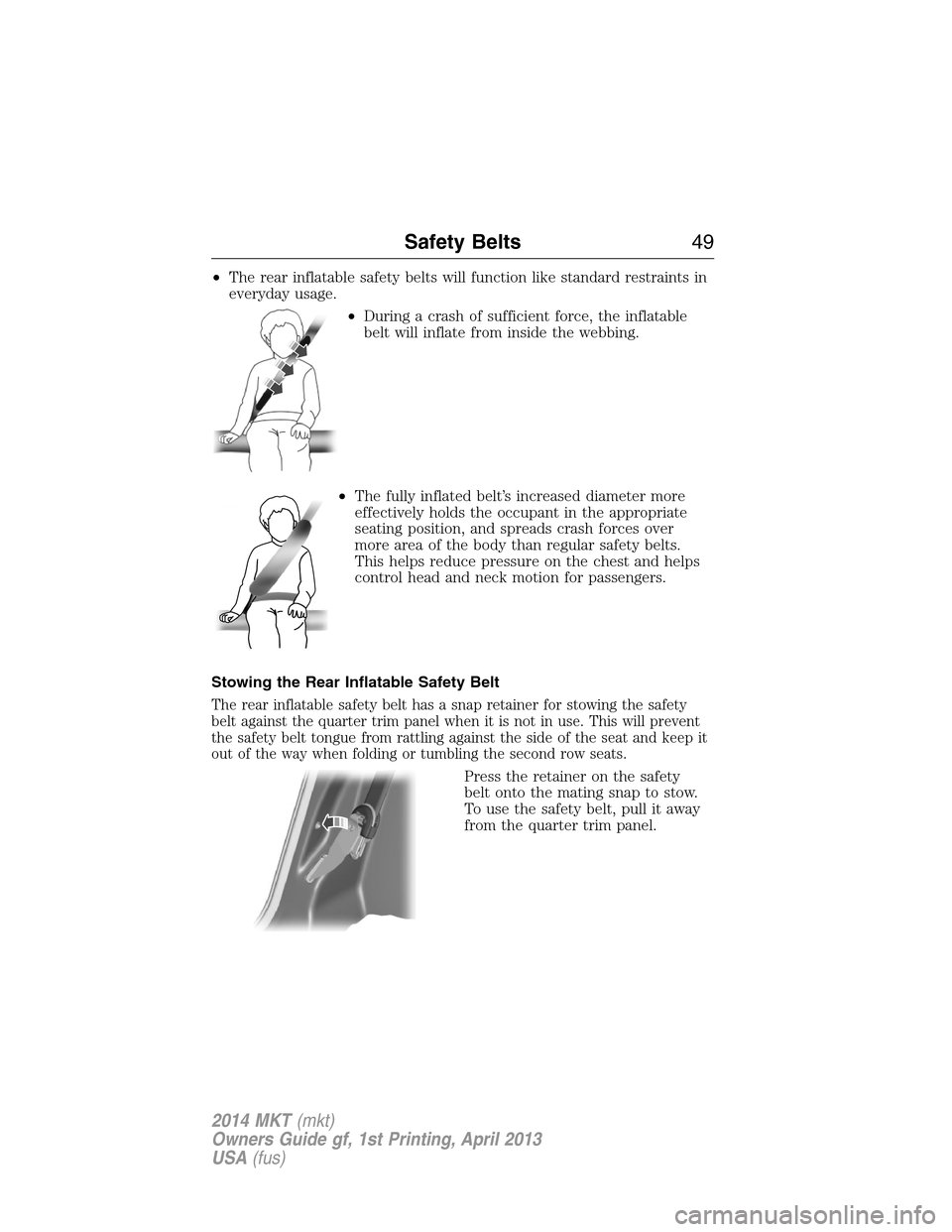
•The rear inflatable safety belts will function like standard restraints in
everyday usage.
•During a crash of sufficient force, the inflatable
belt will inflate from inside the webbing.
•The fully inflated belt’s increased diameter more
effectively holds the occupant in the appropriate
seating position, and spreads crash forces over
more area of the body than regular safety belts.
This helps reduce pressure on the chest and helps
control head and neck motion for passengers.
Stowing the Rear Inflatable Safety Belt
The rear inflatable safety belt has a snap retainer for stowing the safety
belt against the quarter trim panel when it is not in use. This will prevent
the safety belt tongue from rattling against the side of the seat and keep it
out of the way when folding or tumbling the second row seats.
Press the retainer on the safety
belt onto the mating snap to stow.
To use the safety belt, pull it away
from the quarter trim panel.
Safety Belts49
2014 MKT(mkt)
Owners Guide gf, 1st Printing, April 2013
USA(fus)
Page 56 of 498
To properly position yourself away from the airbag:
•Move your seat to the rear as far as you can while still reaching the
pedals comfortably.
•Recline the seat slightly (one or two degrees) from the upright
position.
After all occupants have adjusted their seats and put on safety belts,
it is very important that they continue to sit properly. Properly seated
occupants sit upright, lean against the seat back, and center themselves
on the seat cushion, with their feet comfortably extended on the floor.
Sitting improperly can increase the chance of injury in a crash event.
For example, if an occupant slouches, lies down, turns sideways, sits
forward, leans forward or sideways, or puts one or both feet up, the
chance of injury during a crash is greatly increased.
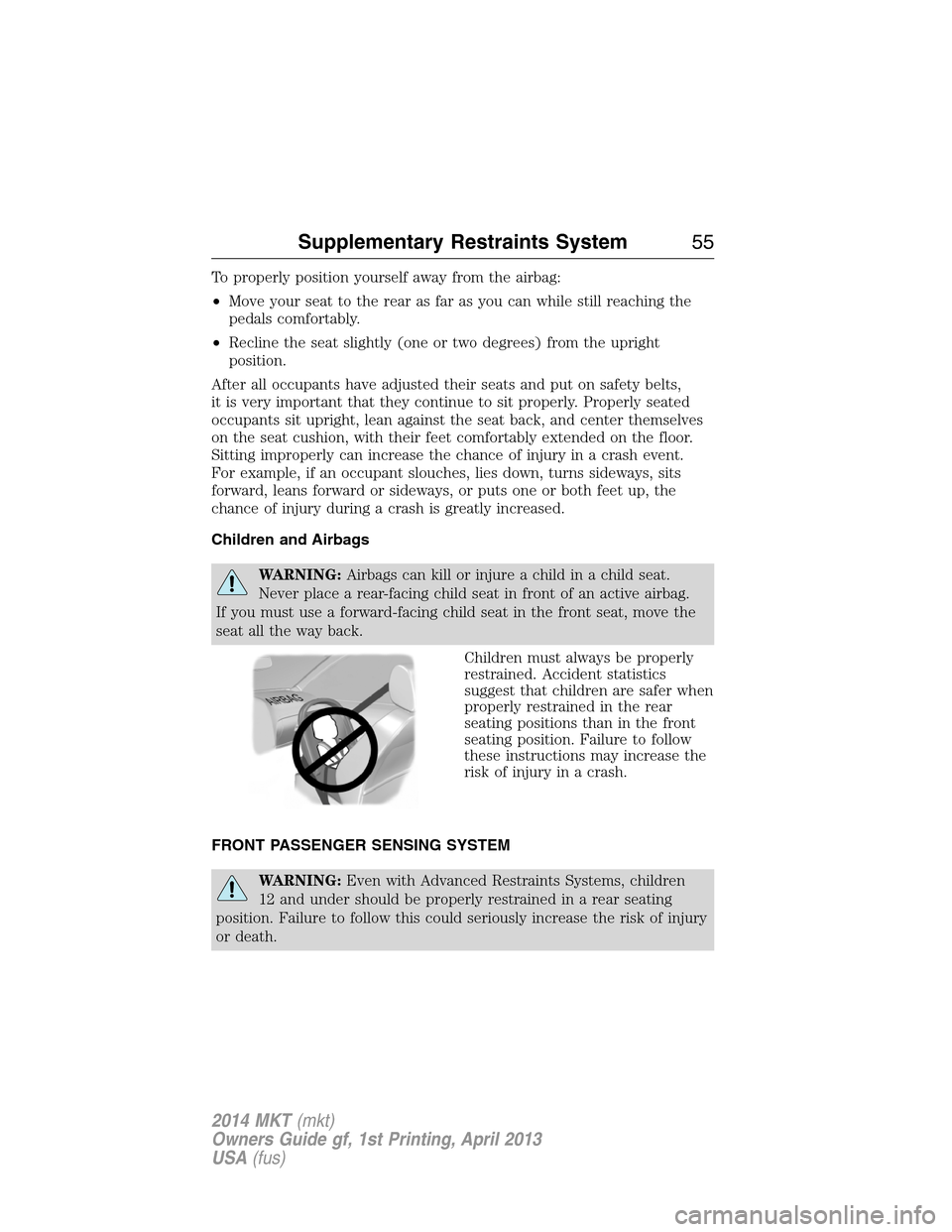
Children and Airbags
WARNING:Airbags can kill or injure a child in a child seat.
Never place a rear-facing child seat in front of an active airbag.
If you must use a forward-facing child seat in the front seat, move the
seat all the way back.
Children must always be properly
restrained. Accident statistics
suggest that children are safer when
properly restrained in the rear
seating positions than in the front
seating position. Failure to follow
these instructions may increase the
risk of injury in a crash.
FRONT PASSENGER SENSING SYSTEM
WARNING:Even with Advanced Restraints Systems, children
12 and under should be properly restrained in a rear seating
position. Failure to follow this could seriously increase the risk of injury
or death.
Supplementary Restraints System55
2014 MKT(mkt)
Owners Guide gf, 1st Printing, April 2013
USA(fus)
Page 59 of 498
Note:When the passenger airbag status indicator OFF lamp is
illuminated, the passenger side airbag (seat mounted) may be disabled to
avoid the risk of airbag deployment injuries.
After all occupants have adjusted their seats and put on safety belts, it’s
very important that they continue to sit properly. A properly seated
occupant sits upright, leaning against the seat back, and centered on the
seat cushion, with their feet comfortably extended on the floor. Sitting
improperly can increase the chance of injury in a crash event. For example,
if an occupant slouches, lies down, turns sideways, sits forward, leans
forward or sideways, or puts one or both feet up, the chance of injury
during a crash is greatly increased.
If you think that the state of the passenger airbag status indicator lamp
is incorrect, check for the following:
•Objects lodged underneath the seat
•Objects between the seat cushion and the center console
•Objects hanging off the seat back
•Objects stowed in the seat back map pocket
•Objects placed on the occupant’s lap
•Cargo interference with the seat
•Other passengers pushing or pulling on the seat
•Rear passenger feet and knees resting or pushing on the seat
The conditions listed above may cause the weight of a properly seated
occupant to be incorrectly interpreted by the front passenger sensing
system. The person in the front passenger seat may appear heavier or
lighter due to the conditions described in the previous list.
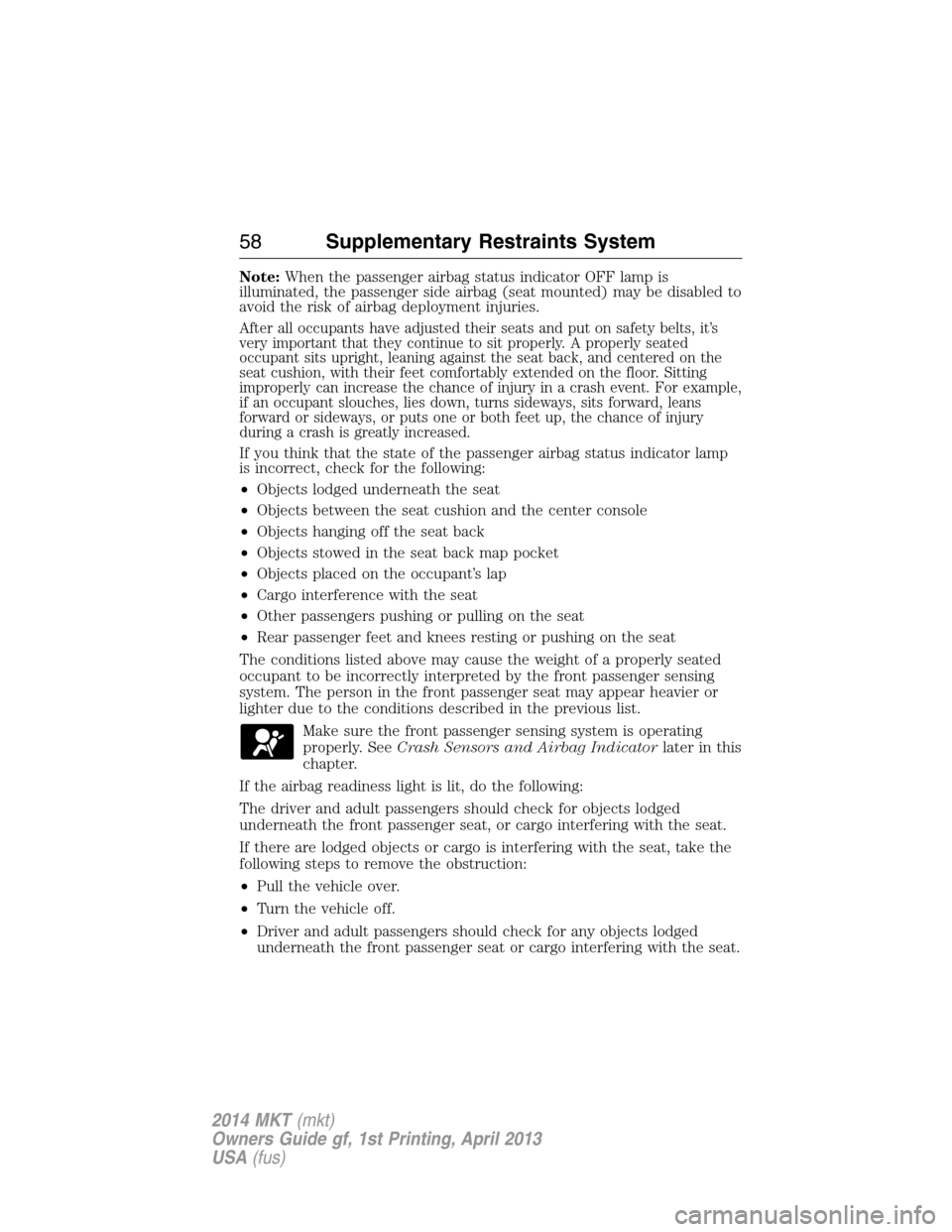
Make sure the front passenger sensing system is operating
properly. SeeCrash Sensors and Airbag Indicatorlater in this
chapter.
If the airbag readiness light is lit, do the following:
The driver and adult passengers should check for objects lodged
underneath the front passenger seat, or cargo interfering with the seat.
If there are lodged objects or cargo is interfering with the seat, take the
following steps to remove the obstruction:
•Pull the vehicle over.
•Turn the vehicle off.
•Driver and adult passengers should check for any objects lodged
underneath the front passenger seat or cargo interfering with the seat.
58Supplementary Restraints System
2014 MKT(mkt)
Owners Guide gf, 1st Printing, April 2013
USA(fus)
Page 60 of 498
•Remove the obstruction(s) (if found).
•Restart the vehicle.
•Wait at least two minutes and verify that the airbag readiness light in
the instrument cluster is no longer illuminated.
•If the airbag readiness light in the instrument cluster remains
illuminated, this may or may not be a problem due to the front
passenger sensing system.
Do not attempt to repair or service the system. Take your vehicle
immediately to an authorized dealer.
If it is necessary to modify an advanced front airbag system to
accommodate a person with disabilities, contact the Ford Customer
Relationship Center at the phone number shown in theCustomer
Assistancesection of this owner’s manual.
SIDE AIRBAGS
WARNING:Do not place objects or mount equipment on or near
the airbag cover, on the side of the seat backs (of the front seats),
or in front seat areas that may come into contact with a deploying airbag.
Failure to follow these instructions may increase the risk of personal
injury in the event of a crash.
WARNING:Do not use accessory seat covers. The use of
accessory seat covers may prevent the deployment of the side
airbags and increase the risk of injury in an accident.
WARNING:Do not lean your head on the door. The side airbag
could injure you as it deploys from the side of the seat back.
WARNING:Do not attempt to service, repair, or modify the
airbag, its fuses or the seat cover on a seat containing an airbag,
as you could be seriously injured or killed. Contact your authorized
dealer as soon as possible.
WARNING:If the side airbag has deployed, the airbag will not
function again. The side airbag system (including the seat) must
be inspected and serviced by an authorized dealer. If the airbag is not
replaced, the unrepaired area will increase the risk of injury in a crash.
Supplementary Restraints System59
2014 MKT(mkt)
Owners Guide gf, 1st Printing, April 2013
USA(fus)
Page 61 of 498
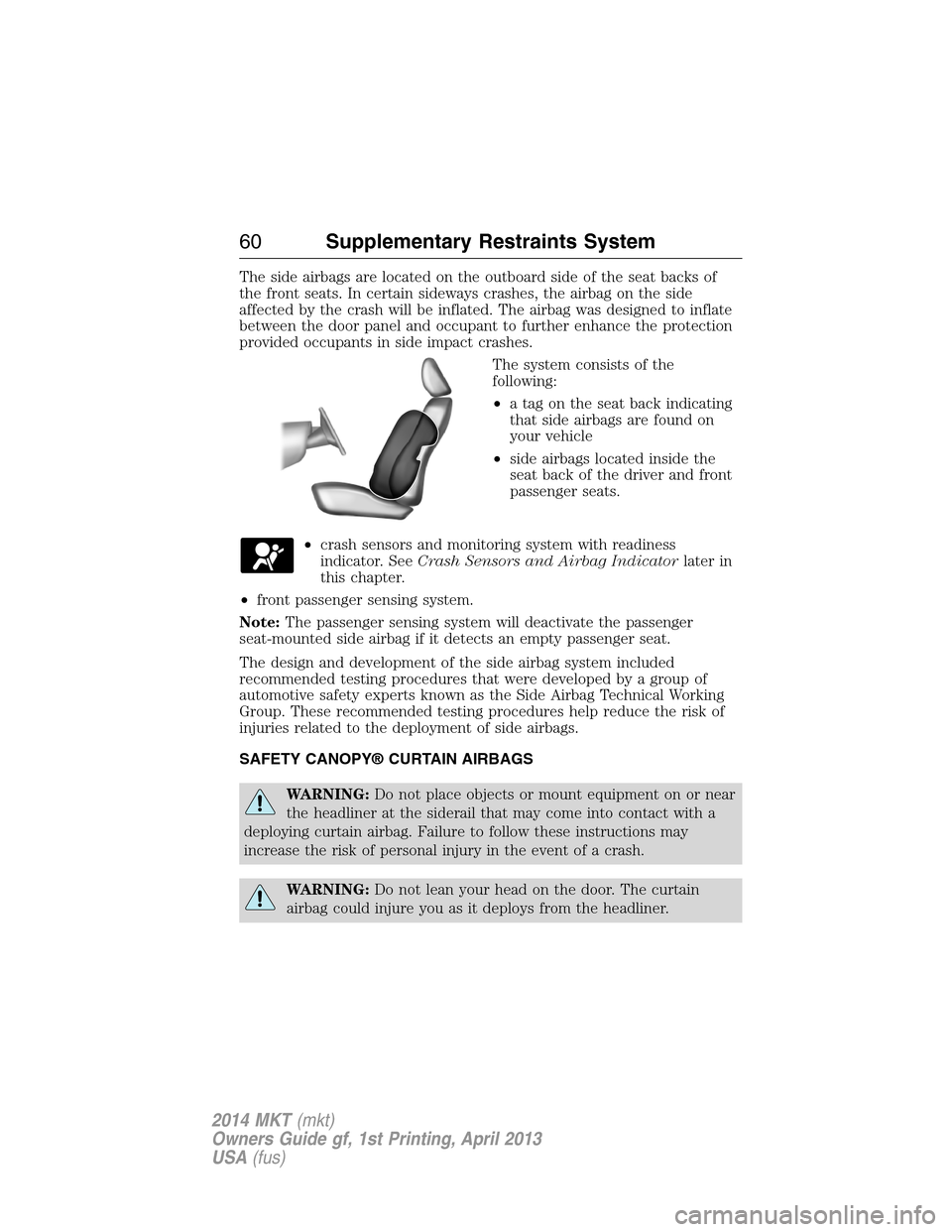
The side airbags are located on the outboard side of the seat backs of
the front seats. In certain sideways crashes, the airbag on the side
affected by the crash will be inflated. The airbag was designed to inflate
between the door panel and occupant to further enhance the protection
provided occupants in side impact crashes.
The system consists of the
following:
•a tag on the seat back indicating
that side airbags are found on
your vehicle
•side airbags located inside the
seat back of the driver and front
passenger seats.
•crash sensors and monitoring system with readiness
indicator. SeeCrash Sensors and Airbag Indicatorlater in
this chapter.
•front passenger sensing system.
Note:The passenger sensing system will deactivate the passenger
seat-mounted side airbag if it detects an empty passenger seat.
The design and development of the side airbag system included
recommended testing procedures that were developed by a group of
automotive safety experts known as the Side Airbag Technical Working
Group. These recommended testing procedures help reduce the risk of
injuries related to the deployment of side airbags.
SAFETY CANOPY® CURTAIN AIRBAGS
WARNING:Do not place objects or mount equipment on or near
the headliner at the siderail that may come into contact with a
deploying curtain airbag. Failure to follow these instructions may
increase the risk of personal injury in the event of a crash.
WARNING:Do not lean your head on the door. The curtain
airbag could injure you as it deploys from the headliner.
60Supplementary Restraints System
2014 MKT(mkt)
Owners Guide gf, 1st Printing, April 2013
USA(fus)
Page 62 of 498
WARNING:Do not attempt to service, repair, or modify the
curtain airbags, its fuses, the A, B, C or D pillar trim, or the
headliner on a vehicle containing curtain airbags, as you could be
seriously injured or killed. Contact your authorized dealer as soon as
possible.
WARNING:All occupants of your vehicle including the driver
should always wear their safety belts even when an airbag
supplemental restraint system and curtain airbag is provided. Failure to
properly wear your safety belt could seriously increase the risk of injury
or death.
WARNING:To reduce risk of injury, do not obstruct or place
objects in the deployment path of the curtain airbag.
WARNING:If the curtain airbags have deployed, the curtain
airbags will not function again. The curtain airbags (including the
A, B, C or D pillar trim and headliner) must be inspected and serviced
by an authorized dealer. If the curtain airbag is not replaced, the
unrepaired area will increase the risk of injury in a crash.
The Safety Canopy will deploy during significant side crashes or when a
certain likelihood of a rollover event is detected by the rollover sensor.
The Safety Canopy is mounted to the roof side-rail sheet metal, behind
the headliner, above each row of seats. In certain sideways crashes or
rollover events, the Safety Canopy will be activated, regardless of which
seats are occupied. The Safety Canopy is designed to inflate between the
side window area and occupants to further enhance protection provided
in side impact crashes and rollover events.
Supplementary Restraints System61
2014 MKT(mkt)
Owners Guide gf, 1st Printing, April 2013
USA(fus)
Page 63 of 498
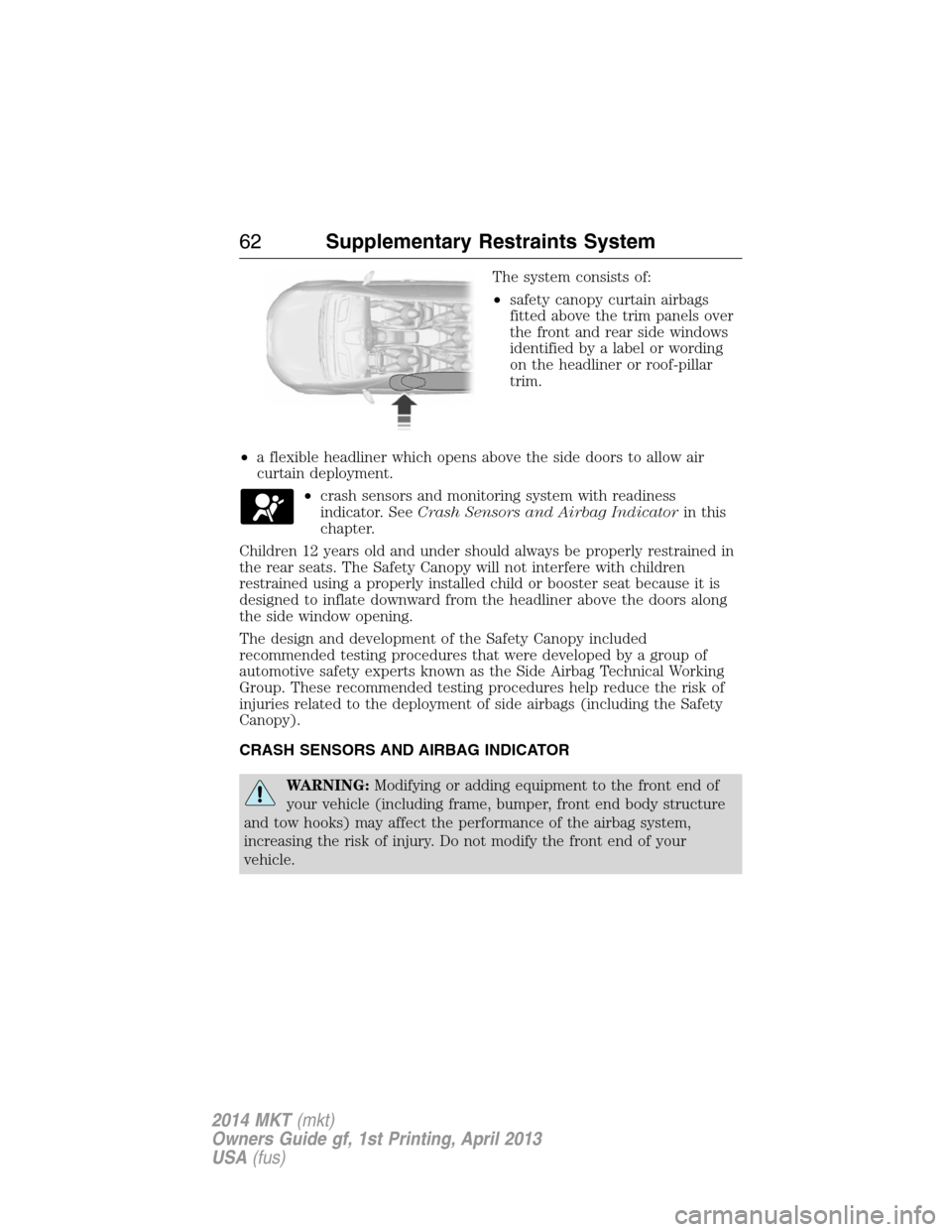
The system consists of:
•safety canopy curtain airbags
fitted above the trim panels over
the front and rear side windows
identified by a label or wording
on the headliner or roof-pillar
trim.
•a flexible headliner which opens above the side doors to allow air
curtain deployment.
•crash sensors and monitoring system with readiness
indicator. SeeCrash Sensors and Airbag Indicatorin this
chapter.
Children 12 years old and under should always be properly restrained in
the rear seats. The Safety Canopy will not interfere with children
restrained using a properly installed child or booster seat because it is
designed to inflate downward from the headliner above the doors along
the side window opening.
The design and development of the Safety Canopy included
recommended testing procedures that were developed by a group of
automotive safety experts known as the Side Airbag Technical Working
Group. These recommended testing procedures help reduce the risk of
injuries related to the deployment of side airbags (including the Safety
Canopy).
CRASH SENSORS AND AIRBAG INDICATOR
WARNING:Modifying or adding equipment to the front end of
your vehicle (including frame, bumper, front end body structure
and tow hooks) may affect the performance of the airbag system,
increasing the risk of injury. Do not modify the front end of your
vehicle.
62Supplementary Restraints System
2014 MKT(mkt)
Owners Guide gf, 1st Printing, April 2013
USA(fus)
Page 80 of 498
The system will turn off the lights if:
•you switch the ignition on
•you press the lock button on the remote control
•you lock the vehicle using the keyless entry keypad
•they have been on for 25 seconds.
The lights will not turn off if:
•you have turned them on with the dimmer control
•any door is open.
Illuminated Exit
The interior dome lamps, parking lamps and puddle lamps (if equipped)
illuminate when all doors are closed and the ignition is turned off.
The lights turn off if all the doors remain closed and:
•25 seconds elapse
•you press theSTART/STOPbutton.
Battery Saver
If you leave the courtesy lamps, dome lamps or headlamps on, the
battery saver shuts them off 10 minutes after you switch the ignition off.
Accessory Mode Battery Saver for Intelligent Access Keys
If you leave your vehicle in the run ignition state, it will shut off once it
detects a certain amount of battery drain or after 45 minutes.
LIFTGATE
WARNING:It is extremely dangerous to ride in a cargo area,
inside or outside of a vehicle. In a crash, people riding in these
areas are more likely to be seriously injured or killed. Do not allow
people to ride in any area of your vehicle that is not equipped with
seats and safety belts. Be sure everyone in your vehicle is in a seat and
using a safety belt properly.
Power Liftgate
WARNING:Make sure all persons are clear of the power liftgate
area before using the power liftgate control.
Locks79
2014 MKT(mkt)
Owners Guide gf, 1st Printing, April 2013
USA(fus)
Page 90 of 498
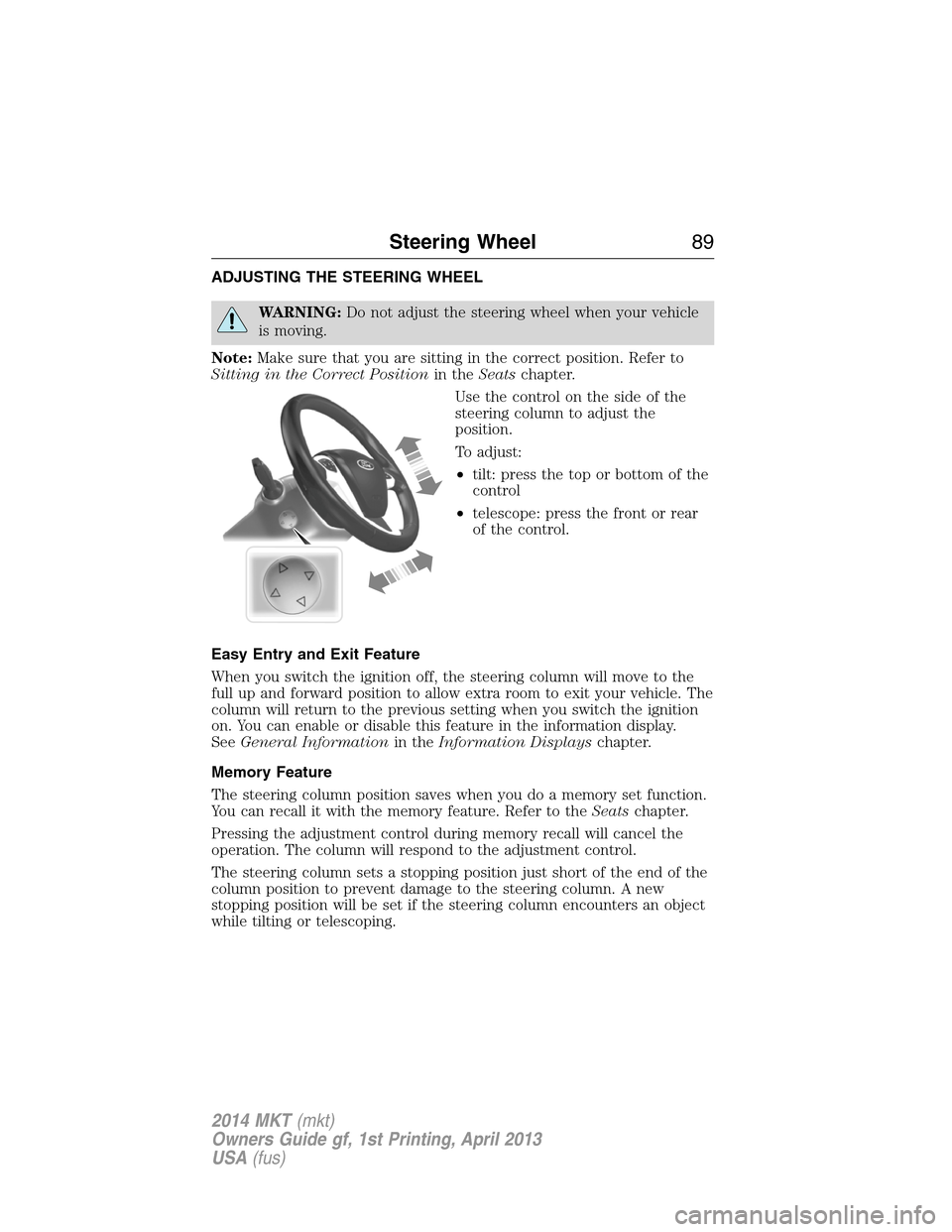
ADJUSTING THE STEERING WHEEL
WARNING:Do not adjust the steering wheel when your vehicle
is moving.
Note:Make sure that you are sitting in the correct position. Refer to
Sitting in the Correct Positionin theSeatschapter.
Use the control on the side of the
steering column to adjust the
position.
To adjust:
•tilt: press the top or bottom of the
control
•telescope: press the front or rear
of the control.
Easy Entry and Exit Feature
When you switch the ignition off, the steering column will move to the
full up and forward position to allow extra room to exit your vehicle. The
column will return to the previous setting when you switch the ignition
on. You can enable or disable this feature in the information display.
SeeGeneral Informationin theInformation Displayschapter.
Memory Feature
The steering column position saves when you do a memory set function.
You can recall it with the memory feature. Refer to theSeatschapter.
Pressing the adjustment control during memory recall will cancel the
operation. The column will respond to the adjustment control.
The steering column sets a stopping position just short of the end of the
column position to prevent damage to the steering column. A new
stopping position will be set if the steering column encounters an object
while tilting or telescoping.
Steering Wheel89
2014 MKT(mkt)
Owners Guide gf, 1st Printing, April 2013
USA(fus)
Page 94 of 498
ADJUSTABLE PEDALS (IF EQUIPPED)
WARNING:Never adjust the accelerator and brake pedal with
feet on the pedals while the vehicle is moving.
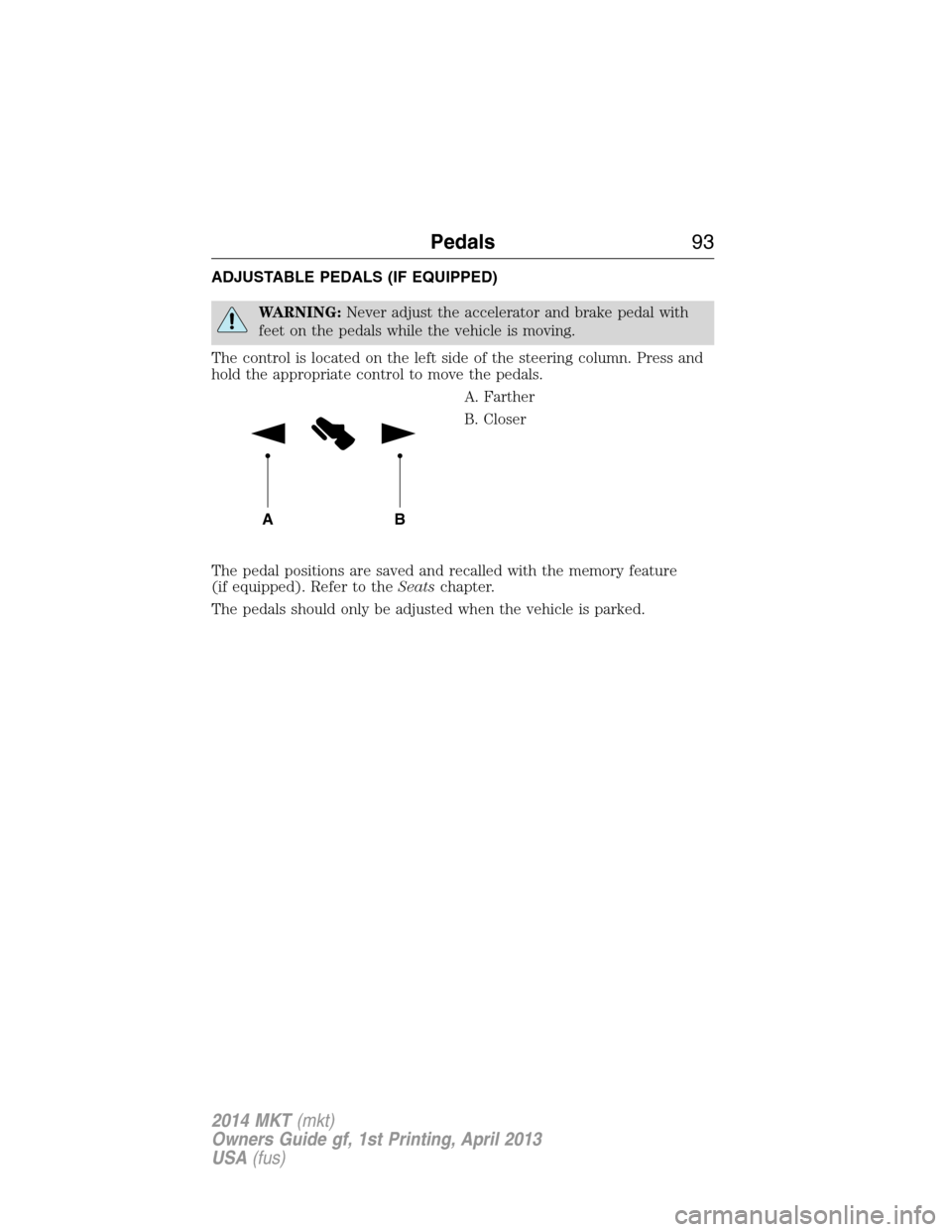
The control is located on the left side of the steering column. Press and
hold the appropriate control to move the pedals.
A. Farther
B. Closer
The pedal positions are saved and recalled with the memory feature
(if equipped). Refer to theSeatschapter.
The pedals should only be adjusted when the vehicle is parked.
AB
Pedals93
2014 MKT(mkt)
Owners Guide gf, 1st Printing, April 2013
USA(fus)