tow LINCOLN MKT 2017 Owners Manual
[x] Cancel search | Manufacturer: LINCOLN, Model Year: 2017, Model line: MKT, Model: LINCOLN MKT 2017Pages: 558, PDF Size: 4.59 MB
Page 5 of 558
Security
Passive Anti-Theft System.............................81
Anti-Theft Alarm..............................................83
Steering Wheel
Adjusting the Steering Wheel......................84
Audio Control
..................................................85
Voice Control
...................................................85
Cruise Control
.................................................85
Information Display Control
.........................86
Heated Steering Wheel................................86
Pedals
Adjusting the Pedals......................................87
Wipers and Washers
Windshield Wipers.........................................88
Autowipers.......................................................88
Windshield Washers
......................................89
Rear Window Wiper and Washers..............89
Lighting
General Information........................................91 Lighting Control
................................................91
Autolamps........................................................92
Instrument Lighting Dimmer........................93
Headlamp Exit Delay.....................................93
Daytime Running Lamps
...............................94
Automatic High Beam Control
....................94
Front Fog Lamps.............................................96
Adaptive Headlamps
.....................................96
Direction Indicators
........................................97
Welcome Lighting
...........................................97
Interior Lamps..................................................97
Ambient Lighting
............................................98
Windows and Mirrors
Power Windows
..............................................99
Global Opening and Closing.....................100
Exterior Mirrors
..............................................100
Interior Mirror.................................................102
Sun Visors
.......................................................102
Moonroof.........................................................103
Instrument Cluster
Gauges............................................................105 Warning Lamps and Indicators..................106
Audible Warnings and Indicators
..............109
Information Displays
General Information
.......................................110
Information Messages
...................................117
Climate Control
Automatic Climate Control
.........................130
Hints on Controlling the Interior Climate.........................................................132
Rear Passenger Climate Controls.............133
Heated Windows and Mirrors....................134
Cabin Air Filter
...............................................134
Remote Start
...................................................135
Seats
Sitting in the Correct Position....................136
Head Restraints
.............................................136
Power Seats
....................................................139
Memory Function...........................................141
Rear Seats.......................................................143
Heated Seats..................................................152
2
MKT (TP4) , enUSA, First Printing Table of Contents
Page 7 of 558
Load Carrying
Rear Under Floor Storage..........................236
Cargo Nets
.....................................................236
Luggage Covers
...........................................236
Load Limit
.......................................................237
Towing
Towing a Trailer.............................................242
Trailer Sway Control....................................243
Recommended Towing Weights...............243
Essential Towing Checks
............................245
Towing the Vehicle on Four Wheels - 3.5L Ecoboost™/3.7L.........................................248
Driving Hints
Breaking-In......................................................251
Economical Driving
.......................................251
Driving Through Water
................................251
Floor Mats
......................................................252
Roadside Emergencies
Roadside Assistance
...................................254
Hazard Warning Flashers
...........................255 Fuel Shutoff...................................................255
Jump Starting the Vehicle
..........................256
Customer Assistance
Getting the Services You Need................259
In California (U.S. Only)...............................260
The Better Business Bureau (BBB) Auto Line Program (U.S. Only)
.........................261
Utilizing the Mediation/Arbitration Program (Canada Only)
...........................................262
Getting Assistance Outside the U.S. and Canada.......................................................263
Ordering Additional Owner's Literature....................................................265
Reporting Safety Defects (U.S. Only)......265
Reporting Safety Defects (Canada Only)............................................................266
Fuses
Fuse Specification Chart............................267
Changing a Fuse..........................................283
Maintenance
General Information
.....................................286 Opening and Closing the Hood...............287
Under Hood Overview - 3.5L
Ecoboost™..................................................288
Under Hood Overview - 3.7L....................290
Engine Oil Dipstick - 3.5L Ecoboost™/ 3.7L..............................................................292
Engine Oil Check.........................................292
Oil Change Indicator Reset
.......................293
Engine Coolant Check................................294
Automatic Transmission Fluid Check - 3.5L Ecoboost™/3.7L.........................................298
Brake Fluid Check.......................................300
Power Steering Fluid Check.......................301
Washer Fluid Check.....................................301
Changing the 12V Battery...........................301
Checking the Wiper Blades.......................303
Changing the Wiper Blades......................303
Adjusting the Headlamps...........................304
Removing a Headlamp
...............................305
Changing a Bulb...........................................305
Bulb Specification Chart.............................307
Changing the Engine Air Filter
..................310
4
MKT (TP4) , enUSA, First Printing Table of Contents
Page 18 of 558
PROTECTING THE ENVIRONMENT
You must play your part in protecting the
environment. Correct vehicle usage and the
authorized disposal of waste, cleaning and
lubrication materials are significant steps
toward this aim.
15
MKT (TP4) , enUSA, First Printing Environment
Page 24 of 558
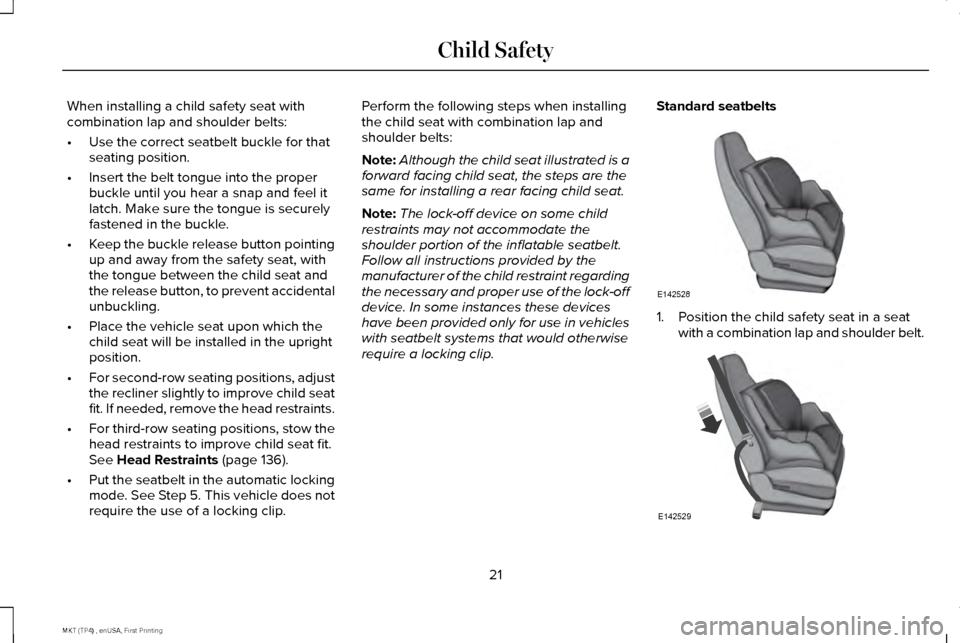
When installing a child safety seat with
combination lap and shoulder belts:
•
Use the correct seatbelt buckle for that
seating position.
• Insert the belt tongue into the proper
buckle until you hear a snap and feel it
latch. Make sure the tongue is securely
fastened in the buckle.
• Keep the buckle release button pointing
up and away from the safety seat, with
the tongue between the child seat and
the release button, to prevent accidental
unbuckling.
• Place the vehicle seat upon which the
child seat will be installed in the upright
position.
• For second-row seating positions, adjust
the recliner slightly to improve child seat
fit. If needed, remove the head restraints.
• For third-row seating positions, stow the
head restraints to improve child seat fit.
See Head Restraints (page 136).
• Put the seatbelt in the automatic locking
mode. See Step 5. This vehicle does not
require the use of a locking clip. Perform the following steps when installing
the child seat with combination lap and
shoulder belts:
Note:
Although the child seat illustrated is a
forward facing child seat, the steps are the
same for installing a rear facing child seat.
Note: The lock-off device on some child
restraints may not accommodate the
shoulder portion of the inflatable seatbelt.
Follow all instructions provided by the
manufacturer of the child restraint regarding
the necessary and proper use of the lock-off
device. In some instances these devices
have been provided only for use in vehicles
with seatbelt systems that would otherwise
require a locking clip. Standard seatbelts 1. Position the child safety seat in a seat
with a combination lap and shoulder belt. 21
MKT (TP4) , enUSA, First Printing Child SafetyE142528 E142529
Page 26 of 558
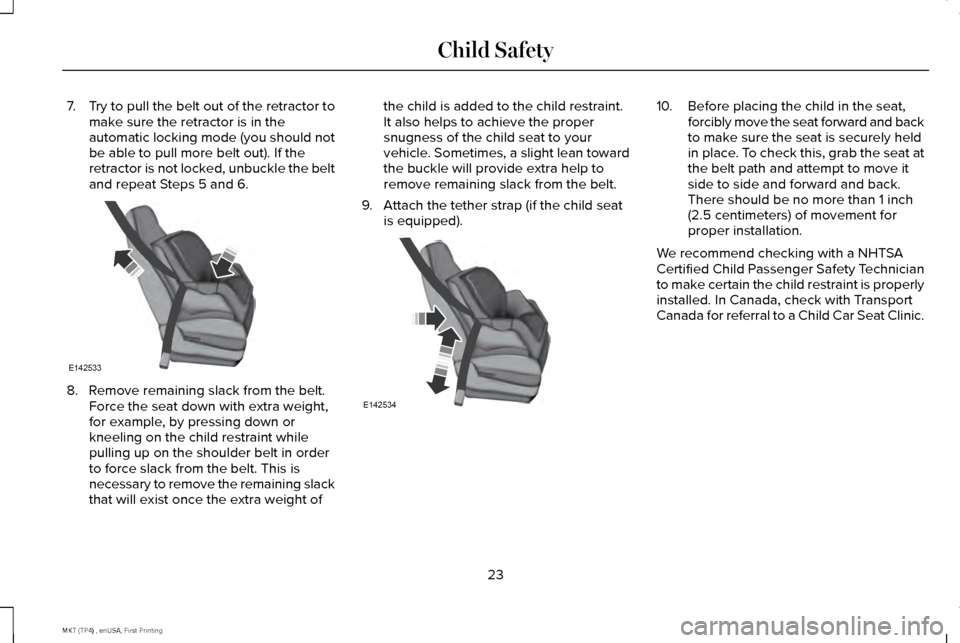
7.
Try to pull the belt out of the retractor to
make sure the retractor is in the
automatic locking mode (you should not
be able to pull more belt out). If the
retractor is not locked, unbuckle the belt
and repeat Steps 5 and 6. 8. Remove remaining slack from the belt.
Force the seat down with extra weight,
for example, by pressing down or
kneeling on the child restraint while
pulling up on the shoulder belt in order
to force slack from the belt. This is
necessary to remove the remaining slack
that will exist once the extra weight of the child is added to the child restraint.
It also helps to achieve the proper
snugness of the child seat to your
vehicle. Sometimes, a slight lean toward
the buckle will provide extra help to
remove remaining slack from the belt.
9. Attach the tether strap (if the child seat is equipped). 10. Before placing the child in the seat,
forcibly move the seat forward and back
to make sure the seat is securely held
in place. To check this, grab the seat at
the belt path and attempt to move it
side to side and forward and back.
There should be no more than 1 inch
(2.5 centimeters) of movement for
proper installation.
We recommend checking with a NHTSA
Certified Child Passenger Safety Technician
to make certain the child restraint is properly
installed. In Canada, check with Transport
Canada for referral to a Child Car Seat Clinic.
23
MKT (TP4) , enUSA, First Printing Child SafetyE142533 E142534
Page 29 of 558
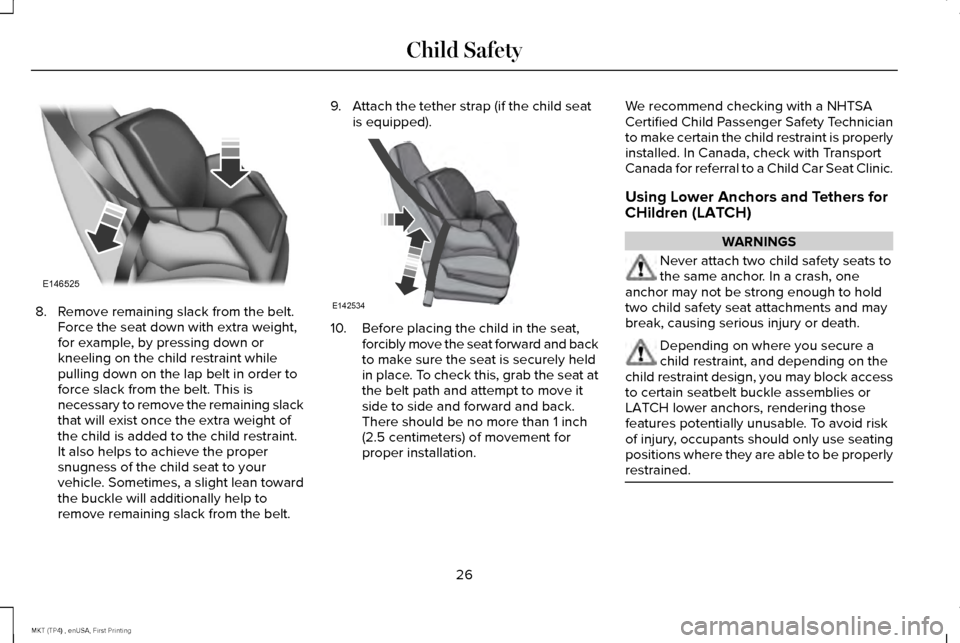
8. Remove remaining slack from the belt.
Force the seat down with extra weight,
for example, by pressing down or
kneeling on the child restraint while
pulling down on the lap belt in order to
force slack from the belt. This is
necessary to remove the remaining slack
that will exist once the extra weight of
the child is added to the child restraint.
It also helps to achieve the proper
snugness of the child seat to your
vehicle. Sometimes, a slight lean toward
the buckle will additionally help to
remove remaining slack from the belt. 9. Attach the tether strap (if the child seat
is equipped). 10. Before placing the child in the seat,
forcibly move the seat forward and back
to make sure the seat is securely held
in place. To check this, grab the seat at
the belt path and attempt to move it
side to side and forward and back.
There should be no more than 1 inch
(2.5 centimeters) of movement for
proper installation. We recommend checking with a NHTSA
Certified Child Passenger Safety Technician
to make certain the child restraint is properly
installed. In Canada, check with Transport
Canada for referral to a Child Car Seat Clinic.
Using Lower Anchors and Tethers for
CHildren (LATCH) WARNINGS
Never attach two child safety seats to
the same anchor. In a crash, one
anchor may not be strong enough to hold
two child safety seat attachments and may
break, causing serious injury or death. Depending on where you secure a
child restraint, and depending on the
child restraint design, you may block access
to certain seatbelt buckle assemblies or
LATCH lower anchors, rendering those
features potentially unusable. To avoid risk
of injury, occupants should only use seating
positions where they are able to be properly
restrained. 26
MKT (TP4) , enUSA, First Printing Child SafetyE146525 E142534
Page 38 of 558
If the booster seat slides on the vehicle seat
upon which it is being used, placing a
rubberized mesh sold as shelf or carpet liner
under the booster seat may improve this
condition. Do not introduce any item thicker
than this under the booster seat. Check with
the booster seat manufacturer's instructions.
CHILD RESTRAINT POSITIONING
WARNINGS
Airbags can kill or injure a child in a
child seat. Never place a rear-facing
child seat in front of an active airbag. If you
must use a forward-facing child seat in the
front seat, move the vehicle seat upon which
the child seat is installed all the way back.
When possible, all children age 12 and under
should be properly restrained in a rear
seating position. If all children cannot be
seated and restrained properly in a rear
seating position, properly restrain the largest
child in the front seat. WARNINGS
Always carefully follow the instructions
and warnings provided by the
manufacturer of any child restraint to
determine if the restraint device is
appropriate for your child's size, height,
weight, or age. Follow the child restraint
manufacturer's instructions and warnings
provided for installation and use in
conjunction with the instructions and
warnings provided by your vehicle
manufacturer. A safety seat that is improperly
installed or utilized, is inappropriate for your
child's height, age, or weight or does not
properly fit the child may increase the risk of
serious injury or death. Never let a passenger hold a child on
his or her lap while your vehicle is
moving. The passenger cannot protect the
child from injury in a crash, which may result
in serious injury or death. WARNINGS
Never use pillows, books, or towels to
boost a child. They can slide around
and increase the likelihood of injury or death
in a crash. Always restrain an unoccupied child
seat or booster seat. These objects
may become projectiles in a crash or sudden
stop, which may increase the risk of serious
injury. Never place, or allow a child to place,
the shoulder belt under a child's arm
or behind the back because it reduces the
protection for the upper part of the body and
may increase the risk of injury or death in a
crash. To avoid risk of injury, do not leave
children or pets unattended in your
vehicle. 35
MKT (TP4) , enUSA, First Printing Child Safety
Page 43 of 558
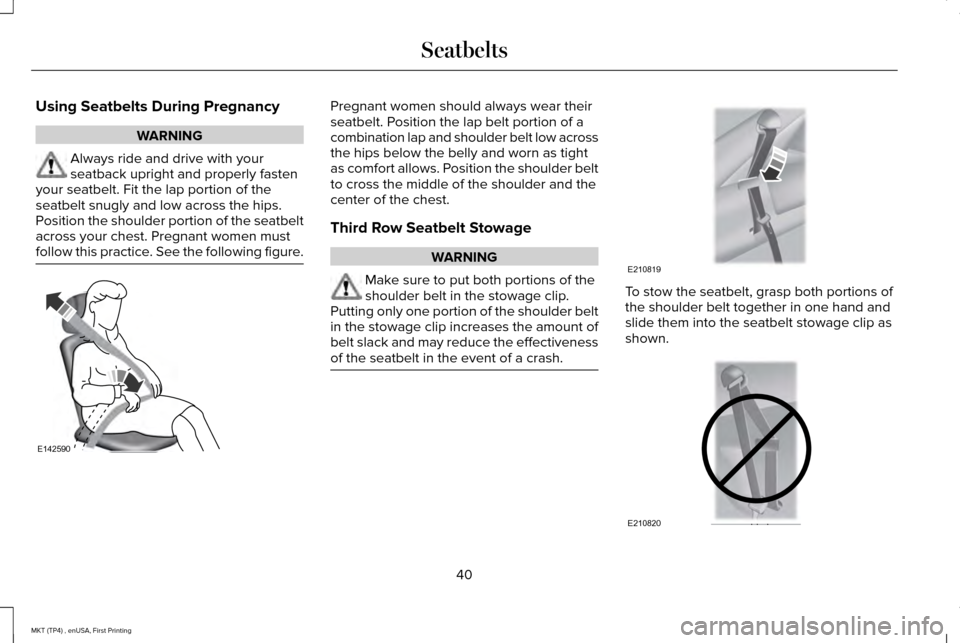
Using Seatbelts During Pregnancy
WARNING
Always ride and drive with your
seatback upright and properly fasten
your seatbelt. Fit the lap portion of the
seatbelt snugly and low across the hips.
Position the shoulder portion of the seatbelt
across your chest. Pregnant women must
follow this practice. See the following figure. Pregnant women should always wear their
seatbelt. Position the lap belt portion of a
combination lap and shoulder belt low across
the hips below the belly and worn as tight
as comfort allows. Position the shoulder belt
to cross the middle of the shoulder and the
center of the chest.
Third Row Seatbelt Stowage
WARNING
Make sure to put both portions of the
shoulder belt in the stowage clip.
Putting only one portion of the shoulder belt
in the stowage clip increases the amount of
belt slack and may reduce the effectiveness
of the seatbelt in the event of a crash. To stow the seatbelt, grasp both portions of
the shoulder belt together in one hand and
slide them into the seatbelt stowage clip as
shown.
40
MKT (TP4) , enUSA, First Printing SeatbeltsE142590 E210819 E210820
Page 44 of 558
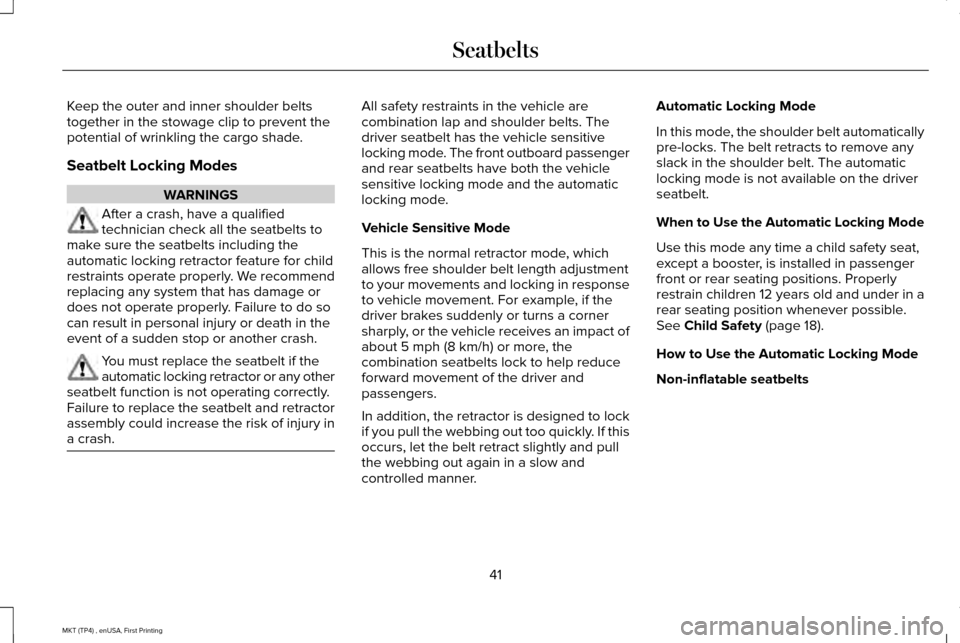
Keep the outer and inner shoulder belts
together in the stowage clip to prevent the
potential of wrinkling the cargo shade.
Seatbelt Locking Modes
WARNINGS
After a crash, have a qualified
technician check all the seatbelts to
make sure the seatbelts including the
automatic locking retractor feature for child
restraints operate properly. We recommend
replacing any system that has damage or
does not operate properly. Failure to do so
can result in personal injury or death in the
event of a sudden stop or another crash. You must replace the seatbelt if the
automatic locking retractor or any other
seatbelt function is not operating correctly.
Failure to replace the seatbelt and retractor
assembly could increase the risk of injury in
a crash. All safety restraints in the vehicle are
combination lap and shoulder belts. The
driver seatbelt has the vehicle sensitive
locking mode. The front outboard passenger
and rear seatbelts have both the vehicle
sensitive locking mode and the automatic
locking mode.
Vehicle Sensitive Mode
This is the normal retractor mode, which
allows free shoulder belt length adjustment
to your movements and locking in response
to vehicle movement. For example, if the
driver brakes suddenly or turns a corner
sharply, or the vehicle receives an impact of
about 5 mph (8 km/h) or more, the
combination seatbelts lock to help reduce
forward movement of the driver and
passengers.
In addition, the retractor is designed to lock
if you pull the webbing out too quickly. If this
occurs, let the belt retract slightly and pull
the webbing out again in a slow and
controlled manner. Automatic Locking Mode
In this mode, the shoulder belt automatically
pre-locks. The belt retracts to remove any
slack in the shoulder belt. The automatic
locking mode is not available on the driver
seatbelt.
When to Use the Automatic Locking Mode
Use this mode any time a child safety seat,
except a booster, is installed in passenger
front or rear seating positions. Properly
restrain children 12 years old and under in a
rear seating position whenever possible.
See
Child Safety (page 18).
How to Use the Automatic Locking Mode
Non-inflatable seatbelts
41
MKT (TP4) , enUSA, First Printing Seatbelts
Page 46 of 558
The rear inflatable seatbelt consists of the
following:
•
An inflatable bag in the shoulder seatbelt
webbing.
• Lap seatbelt webbing with automatic
locking mode.
• Crash sensors and monitoring system
with readiness indicator. See Crash
Sensors and Airbag Indicator (page 57).
How does the rear inflatable seatbelt
system work? WARNING
If the rear inflatable seatbelt has
deployed, it will not function again and
must be replaced immediately. If the seatbelt
is not replaced, the unrepaired area will
increase the risk of injury in a crash. The rear inflatable seatbelts functions like
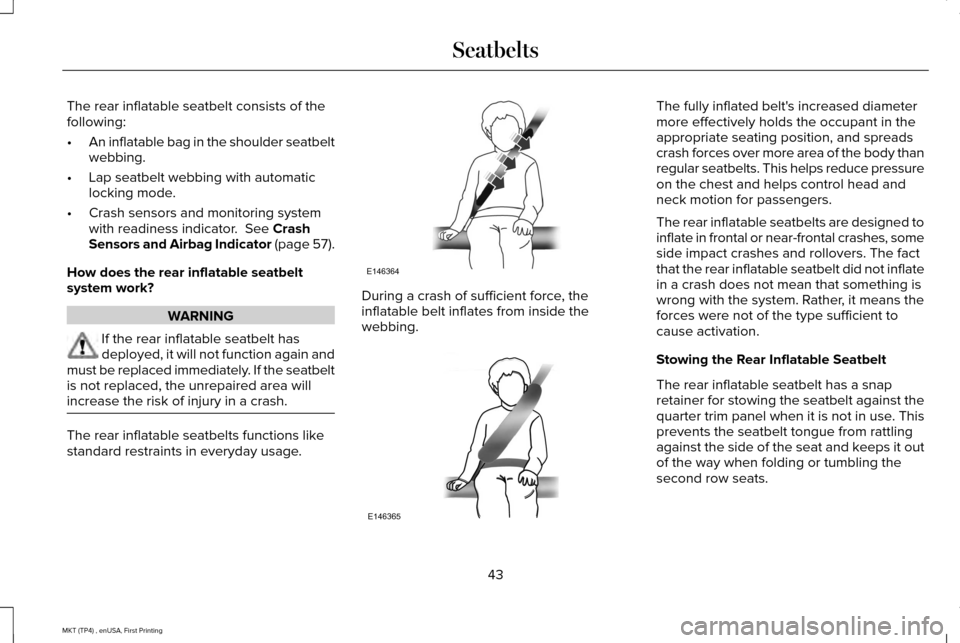
standard restraints in everyday usage. During a crash of sufficient force, the
inflatable belt inflates from inside the
webbing. The fully inflated belt's increased diameter
more effectively holds the occupant in the
appropriate seating position, and spreads
crash forces over more area of the body than
regular seatbelts. This helps reduce pressure
on the chest and helps control head and
neck motion for passengers.
The rear inflatable seatbelts are designed to
inflate in frontal or near-frontal crashes, some
side impact crashes and rollovers. The fact
that the rear inflatable seatbelt did not inflate
in a crash does not mean that something is
wrong with the system. Rather, it means the
forces were not of the type sufficient to
cause activation.
Stowing the Rear Inflatable Seatbelt
The rear inflatable seatbelt has a snap
retainer for stowing the seatbelt against the
quarter trim panel when it is not in use. This
prevents the seatbelt tongue from rattling
against the side of the seat and keeps it out
of the way when folding or tumbling the
second row seats.
43
MKT (TP4) , enUSA, First Printing SeatbeltsE146364 E146365