light LINCOLN MKT 2019 Owners Manual
[x] Cancel search | Manufacturer: LINCOLN, Model Year: 2019, Model line: MKT, Model: LINCOLN MKT 2019Pages: 575, PDF Size: 4.66 MB
Page 319 of 575
Tire Quality Grades apply to newpneumatic passenger car tires. TheQuality grades can be found whereapplicable on the tire sidewall betweentread shoulder and maximum sectionwidth. For example: Treadwear 200Traction AA Temperature A.
These Tire Quality Grades aredetermined by standards that the UnitedStates Department of Transportation hasset.
Tire Quality Grades apply to newpneumatic passenger car tires. They donot apply to deep tread, winter-typesnow tires, space-saver or temporaryuse spare tires, light truck or LT typetires, tires with nominal rim diameters of10 to 12 inches or limited production tires
as defined in Title 49 Code of FederalRegulations Part 575.104 (c)(2).
U.S. Department of Transportation Tirequality grades: The U.S. Department ofTransportation requires Ford MotorCompany to give you the followinginformation about tire grades exactly asthe government has written it.
Treadwear
The treadwear grade is a comparativerating based on the wear rate of the tirewhen tested under controlled conditionson a specified government test course.For example, a tire graded 150 wouldwear 1½ times as well on thegovernment course as a tire graded 100.The relative performance of tiresdepends upon the actual conditions oftheir use, however, and may departsignificantly from the norm due tovariations in driving habits, servicepractices, and differences in roadcharacteristics and climate.
Traction AA A B C
WARNING: The traction gradeassigned to this tire is based onstraight-ahead braking traction tests,and does not include acceleration,cornering, hydroplaning or peaktraction characteristics.
The traction grades, from highest tolowest are AA, A, B, and C. The gradesrepresent the tire’s ability to stop on wetpavement as measured under controlledconditions on specified government testsurfaces of asphalt and concrete. A tiremarked C may have poor tractionperformance.
Temperature A B C
WARNING: The temperaturegrade for this tire is established for atire that is properly inflated and notoverloaded. Excessive speed,underinflation, or excessive loading,either separately or in combination,can cause heat buildup and possibletire failure.
The temperature grades are A (thehighest), B and C, representing the tire’sresistance to the generation of heat andits ability to dissipate heat when testedunder controlled conditions on aspecified indoor laboratory test wheel.Sustained high temperature can cause
316
MKT (TP4) , enUSA, Edition date: 201803, Second-Printing
Wheels and Tires
Page 320 of 575
the material of the tire to degenerateand reduce tire life, and excessivetemperature can lead to sudden tirefailure. The grade C corresponds to alevel of performance which allpassenger car tires must meet under theFederal Motor Vehicle Safety StandardNo. 139. Grades B and A representhigher levels of performance on thelaboratory test wheel than the minimumrequired by law.
Glossary of Tire Terminology
*Tire label: A label showing the originalequipment tire sizes, recommendedinflation pressure and the maximumweight the vehicle can carry.
*Tire Identification Number (TIN): A
number on the sidewall of each tireproviding information about the tirebrand and manufacturing plant, tire sizeand date of manufacture. Also referredto as DOT code.
*Inflation pressure: A measure of theamount of air in a tire.
*Standard load: A class of P-metric orMetric tires designed to carry amaximum load at set pressure. Forexample: For P-metric tires 35 psi(2.4 bar) and for Metric tires 36 psi(2.5 bar). Increasing the inflationpressure beyond this pressure will notincrease the tire’s load carryingcapability.
*Extra load: A class of P-metric or Metrictires designed to carry a heaviermaximum load at 42 psi (2.9 bar).Increasing the inflation pressure beyondthis pressure will not increase the tire’sload carrying capability.
*kPa: Kilopascal, a metric unit of airpressure.
*PSI: Pounds per square inch, a standard
unit of air pressure.
*Cold tire pressure: The tire pressurewhen the vehicle has been stationaryand out of direct sunlight for an hour ormore and prior to the vehicle beingdriven for 1 mi (1.6 km).
*Recommended inflation pressure: Thecold inflation pressure found on theSafety Compliance Certification Label(affixed to either the door hinge pillar,door-latch post, or the door edge thatmeets the door-latch post, next to thedriver's seating position), or Tire Labellocated on the B-Pillar or the edge of thedriver door.
* B-pillar: The structural member at theside of the vehicle behind the front door.
*Bead area of the tire: Area of the tirenext to the rim.
* Sidewall of the tire: Area between thebead area and the tread.
*Tread area of the tire: Area of theperimeter of the tire that contacts the
road when mounted on the vehicle.
*Rim: The metal support (wheel) for atire or a tire and tube assembly uponwhich the tire beads are seated.
317
MKT (TP4) , enUSA, Edition date: 201803, Second-Printing
Wheels and Tires
Page 321 of 575
Information Contained on the TireSidewall
Both United States and Canada Federalregulations require tire manufacturersto place standardized information on thesidewall of all tires. This informationidentifies and describes the fundamentalcharacteristics of the tire and alsoprovides a U.S. DOT Tire IdentificationNumber for safety standard certificationand in case of a recall.
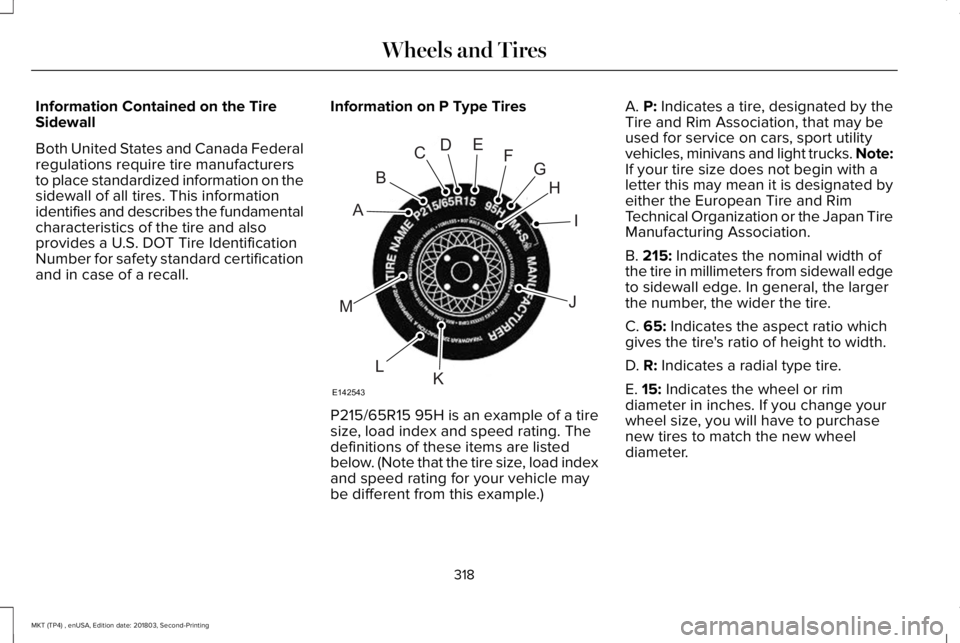
Information on P Type Tires
P215/65R15 95H is an example of a tiresize, load index and speed rating. Thedefinitions of these items are listedbelow. (Note that the tire size, load indexand speed rating for your vehicle maybe different from this example.)
A. P: Indicates a tire, designated by theTire and Rim Association, that may beused for service on cars, sport utilityvehicles, minivans and light trucks. Note:If your tire size does not begin with aletter this may mean it is designated byeither the European Tire and RimTechnical Organization or the Japan TireManufacturing Association.
B. 215: Indicates the nominal width ofthe tire in millimeters from sidewall edgeto sidewall edge. In general, the largerthe number, the wider the tire.
C. 65: Indicates the aspect ratio whichgives the tire's ratio of height to width.
D. R: Indicates a radial type tire.
E. 15: Indicates the wheel or rim
diameter in inches. If you change yourwheel size, you will have to purchasenew tires to match the new wheeldiameter.
318
MKT (TP4) , enUSA, Edition date: 201803, Second-Printing
Wheels and TiresH
I
J
KL
M
A
B
CDEFG
E142543
Page 324 of 575
the driver's seating position), or TireLabel which is located on the B-Pillar orthe edge of the driver’s door. The coldinflation pressure should never be setlower than the recommended pressureon the vehicle label.
The tire suppliers may have additionalmarkings, notes or warnings such asstandard load or radial tubeless.
Additional Information Contained onthe Tire Sidewall for LT Type Tires
Note:Tire Quality Grades do not applyto this type of tire.
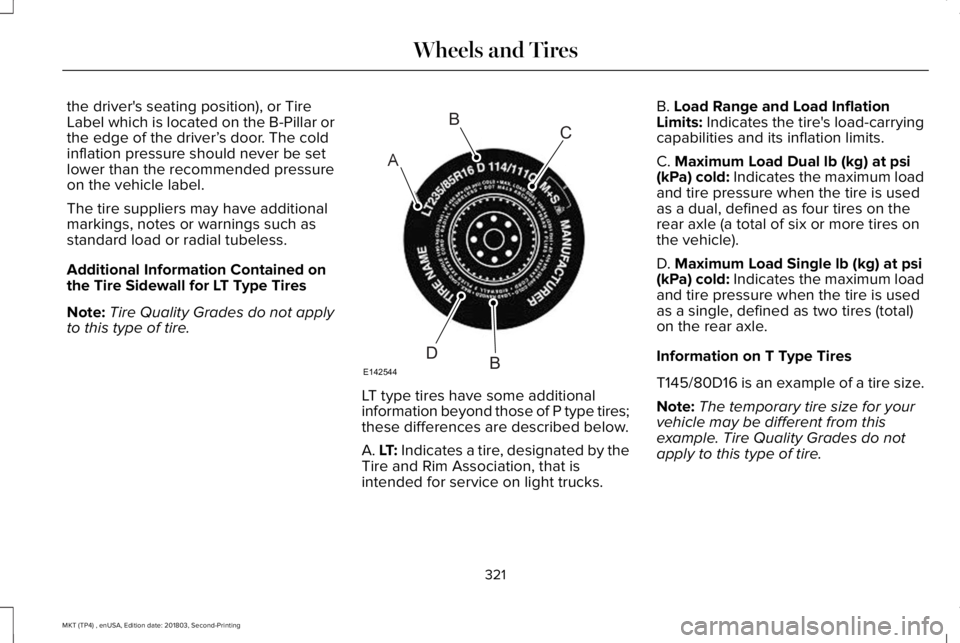
LT type tires have some additional
information beyond those of P type tires;these differences are described below.
A. LT: Indicates a tire, designated by theTire and Rim Association, that isintended for service on light trucks.
B. Load Range and Load InflationLimits: Indicates the tire's load-carryingcapabilities and its inflation limits.
C. Maximum Load Dual lb (kg) at psi(kPa) cold: Indicates the maximum loadand tire pressure when the tire is usedas a dual, defined as four tires on therear axle (a total of six or more tires onthe vehicle).
D. Maximum Load Single lb (kg) at psi(kPa) cold: Indicates the maximum loadand tire pressure when the tire is usedas a single, defined as two tires (total)on the rear axle.
Information on T Type Tires
T145/80D16 is an example of a tire size.
Note:The temporary tire size for yourvehicle may be different from thisexample. Tire Quality Grades do notapply to this type of tire.
321
MKT (TP4) , enUSA, Edition date: 201803, Second-Printing
Wheels and TiresA
BC
BDE142544
Page 325 of 575
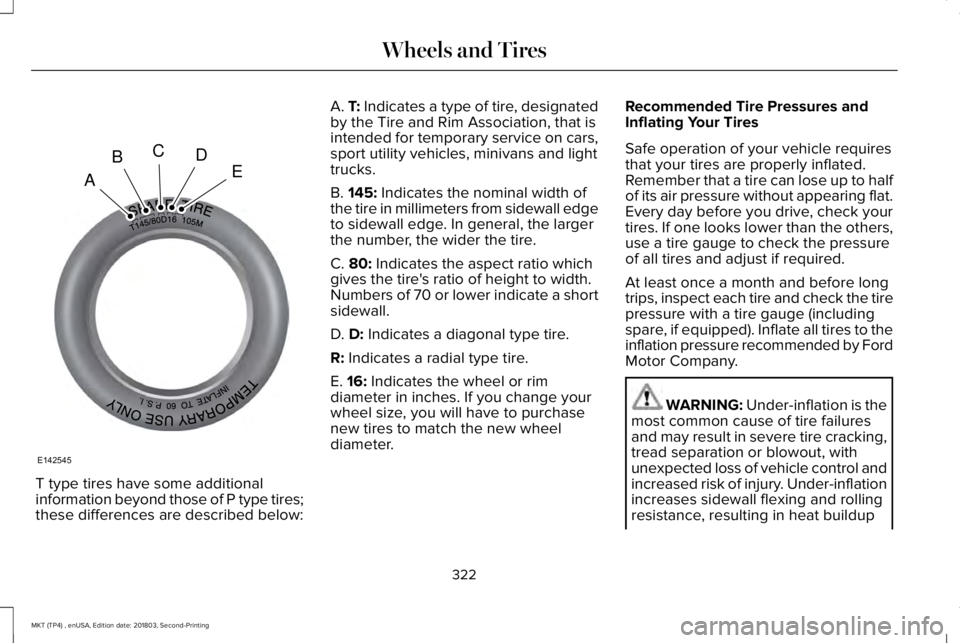
T type tires have some additionalinformation beyond those of P type tires;these differences are described below:
A. T: Indicates a type of tire, designatedby the Tire and Rim Association, that isintended for temporary service on cars,sport utility vehicles, minivans and lighttrucks.
B. 145: Indicates the nominal width ofthe tire in millimeters from sidewall edgeto sidewall edge. In general, the largerthe number, the wider the tire.
C. 80: Indicates the aspect ratio whichgives the tire's ratio of height to width.Numbers of 70 or lower indicate a shortsidewall.
D. D: Indicates a diagonal type tire.
R: Indicates a radial type tire.
E. 16: Indicates the wheel or rimdiameter in inches. If you change your
wheel size, you will have to purchasenew tires to match the new wheeldiameter.
Recommended Tire Pressures andInflating Your Tires
Safe operation of your vehicle requiresthat your tires are properly inflated.Remember that a tire can lose up to halfof its air pressure without appearing flat.Every day before you drive, check yourtires. If one looks lower than the others,use a tire gauge to check the pressureof all tires and adjust if required.
At least once a month and before longtrips, inspect each tire and check the tirepressure with a tire gauge (includingspare, if equipped). Inflate all tires to theinflation pressure recommended by FordMotor Company.
WARNING: Under-inflation is themost common cause of tire failuresand may result in severe tire cracking,tread separation or blowout, withunexpected loss of vehicle control andincreased risk of injury. Under-inflationincreases sidewall flexing and rolling
resistance, resulting in heat buildup
322
MKT (TP4) , enUSA, Edition date: 201803, Second-Printing
Wheels and TiresA
BCDE
E142545
Page 333 of 575
functioning properly. Always check the TPMSmalfunction telltale after replacing one ormore tires or wheels on your vehicle toensure that the replacement or alternate tiresand wheels allow the TPMS to continue tofunction properly.
This device complies with Part 15 of the FCCRules and with Licence exempt RSSStandards of Industry Canada. Operation issubject to the following two conditions:
1. This device may not cause harmfulinterference, and
2.This device must accept any interferencereceived, including interference that maycause undesired operation.
WARNING: Changes or modificationsnot expressively approved by the partyresponsible for compliance could void theuser's authority to operate the equipment.The term "IC:" before the radio certificationnumber only signifies that Industry Canadatechnical specifications were met.
Changing Tires With a Tire PressureMonitoring System
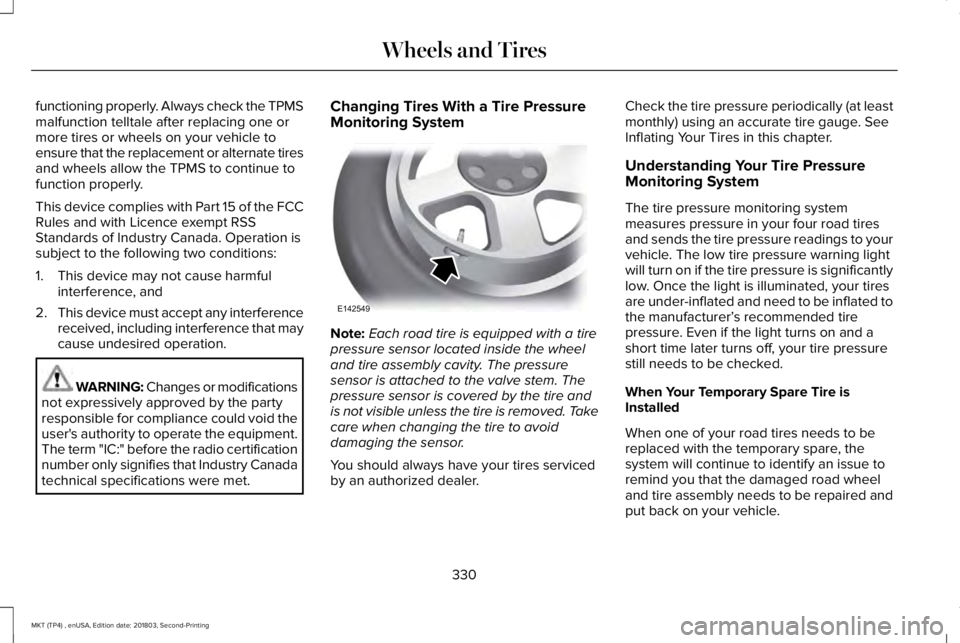
Note:Each road tire is equipped with a tirepressure sensor located inside the wheeland tire assembly cavity. The pressuresensor is attached to the valve stem. Thepressure sensor is covered by the tire andis not visible unless the tire is removed. Takecare when changing the tire to avoiddamaging the sensor.
You should always have your tires servicedby an authorized dealer.
Check the tire pressure periodically (at leastmonthly) using an accurate tire gauge. SeeInflating Your Tires in this chapter.
Understanding Your Tire PressureMonitoring System
The tire pressure monitoring systemmeasures pressure in your four road tiresand sends the tire pressure readings to yourvehicle. The low tire pressure warning lightwill turn on if the tire pressure is significantlylow. Once the light is illuminated, your tiresare under-inflated and need to be inflated tothe manufacturer’s recommended tirepressure. Even if the light turns on and ashort time later turns off, your tire pressurestill needs to be checked.
When Your Temporary Spare Tire isInstalled
When one of your road tires needs to bereplaced with the temporary spare, thesystem will continue to identify an issue toremind you that the damaged road wheeland tire assembly needs to be repaired andput back on your vehicle.
330
MKT (TP4) , enUSA, Edition date: 201803, Second-Printing
Wheels and TiresE142549
Page 335 of 575
Customer action requiredPossible causeLow tire pressure warning light
Make sure tires are at the proper pressure. See Inflating your tiresin this chapter. After inflating your tires to the manufacturer’srecommended pressure as shown on the Tire Label (located onthe edge of driver’s door or the B-Pillar), the vehicle must be drivenfor at least two minutes over 20 mph (32 km/h) before the lightturns off.
Tire(s) under-inflatedSolid warning light
Repair the damaged road wheel and tire assembly and reinstallit on the vehicle to restore system function. For a description onhow the system functions, see When your temporary spare tireis installed in this section.
Spare tire in use
If the tires are properly inflated and the spare tire is not in use butthe light remains on, contact your authorized dealer as soon aspossible.
TPMS malfunction
Repair the damaged road wheel and tire assembly and reinstallit on the vehicle to restore system function. For a description onhow the system functions, see When your temporary spare tireis installed in this section.
Spare tire in useFlashing warning light
If the tires are properly inflated and the spare tire is not in use butthe light remains on, contact your authorized dealer as soon aspossible.
TPMS malfunction
332
MKT (TP4) , enUSA, Edition date: 201803, Second-Printing
Wheels and Tires
Page 336 of 575
When Inflating Your Tires
When putting air into your tires (such as at agas station or in your garage), the tirepressure monitoring system may not respondimmediately to the air added to your tires.
It may take up to two minutes of driving over20 mph (32 km/h) for the light to turn off afteryou have filled your tires to therecommended inflation pressure.
How Temperature Affects Your TirePressure
The tire pressure monitoring system monitorstire pressure in each pneumatic tire. Whiledriving in a normal manner, a typicalpassenger tire inflation pressure mayincrease about 2–4 psi (14–28 kPa) from acold start situation. If the vehicle is stationaryovernight with the outside temperaturesignificantly lower than the daytimetemperature, the tire pressure may decreaseabout 3 psi (21 kPa) for a drop of 30°F (17°C)in ambient temperature. This lower pressurevalue may be detected by the tire pressuremonitoring system as being significantlylower than the recommended inflation
pressure and activate the system warninglight for low tire pressure. If the low tirepressure warning light is on, visually checkeach tire to verify that no tire is flat. If one ormore tires are flat, repair as necessary.Check the air pressure in the road tires. Ifany tire is under-inflated, carefully drive thevehicle to the nearest location where air canbe added to the tires. Inflate all the tires tothe recommended inflation pressure.
CHANGING A ROAD WHEEL
WARNING: Do not use tire sealantsas they may damage the tire pressuremonitoring system.
WARNING: If the tire pressuremonitor sensor becomes damaged it maynot function.
Note:The tire pressure monitoring systemindicator light will illuminate when the sparetire is in use. To restore the full function ofthe monitoring system, all road wheelsequipped with tire pressure monitoringsensors must be mounted on the vehicle.
Note:If your vehicle is equipped with theoptional 5th road wheel and tire assembly,the storage location in the luggagecompartment is for temporary use only. Theoptional full size road wheel and tireassembly should be stored outside thevehicle after delivery.
If you get a flat tire while driving, do not applythe brake heavily. Instead, graduallydecrease your speed. Hold the steeringwheel firmly and slowly move to a safe placeon the side of the road.
333
MKT (TP4) , enUSA, Edition date: 201803, Second-Printing
Wheels and Tires
Page 365 of 575
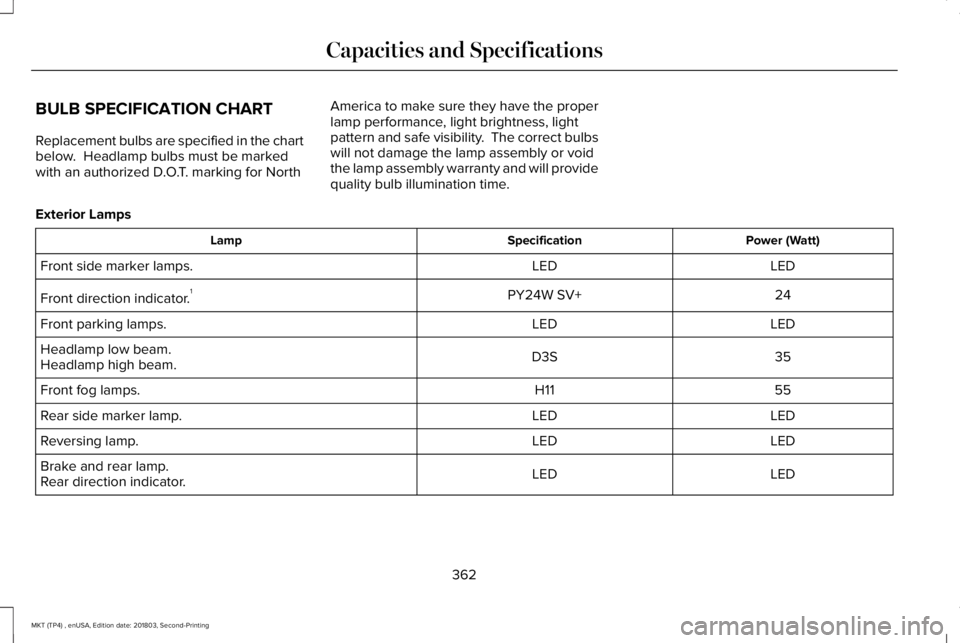
BULB SPECIFICATION CHART
Replacement bulbs are specified in the chartbelow. Headlamp bulbs must be markedwith an authorized D.O.T. marking for North
America to make sure they have the properlamp performance, light brightness, lightpattern and safe visibility. The correct bulbswill not damage the lamp assembly or voidthe lamp assembly warranty and will providequality bulb illumination time.
Exterior Lamps
Power (Watt)SpecificationLamp
LEDLEDFront side marker lamps.
24PY24W SV+Front direction indicator.1
LEDLEDFront parking lamps.
35D3SHeadlamp low beam.Headlamp high beam.
55H11Front fog lamps.
LEDLEDRear side marker lamp.
LEDLEDReversing lamp.
LEDLEDBrake and rear lamp.Rear direction indicator.
362
MKT (TP4) , enUSA, Edition date: 201803, Second-Printing
Capacities and Specifications
Page 366 of 575
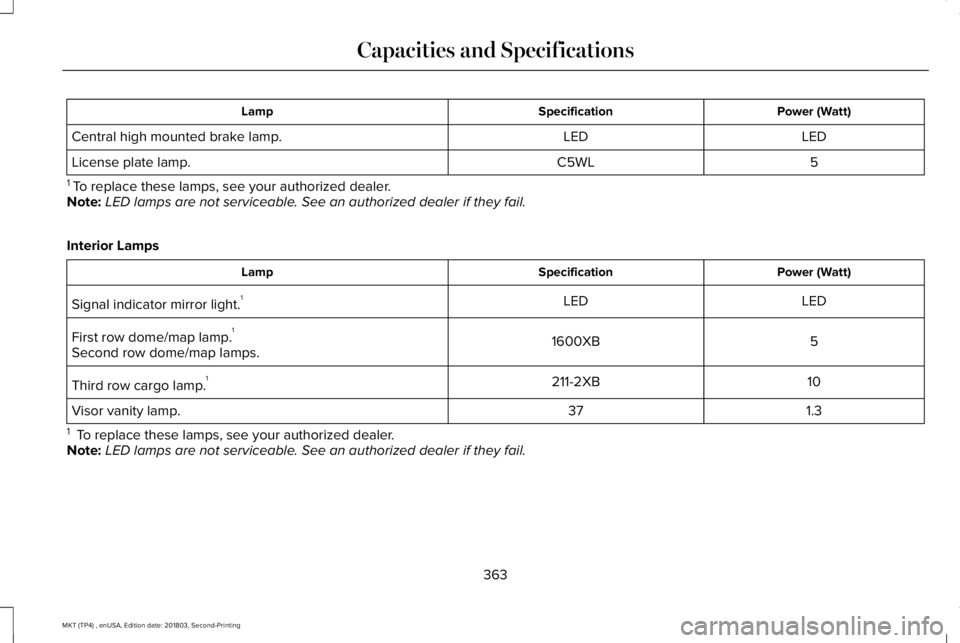
Power (Watt)SpecificationLamp
LEDLEDCentral high mounted brake lamp.
5C5WLLicense plate lamp.
1 To replace these lamps, see your authorized dealer.Note:LED lamps are not serviceable. See an authorized dealer if they fail.
Interior Lamps
Power (Watt)SpecificationLamp
LEDLEDSignal indicator mirror light.1
51600XBFirst row dome/map lamp.1
Second row dome/map lamps.
10211-2XBThird row cargo lamp.1
1.337Visor vanity lamp.
1 To replace these lamps, see your authorized dealer.Note:LED lamps are not serviceable. See an authorized dealer if they fail.
363
MKT (TP4) , enUSA, Edition date: 201803, Second-Printing
Capacities and Specifications