spare wheel LINCOLN MKX 2008 User Guide
[x] Cancel search | Manufacturer: LINCOLN, Model Year: 2008, Model line: MKX, Model: LINCOLN MKX 2008Pages: 328, PDF Size: 2.62 MB
Page 203 of 328
To restore the full functionality of the Tire Pressure Monitoring System,
have the damaged road wheel/tire repaired and remounted on your
vehicle. For additional information, refer toChanging tires with TPMS
in this section.
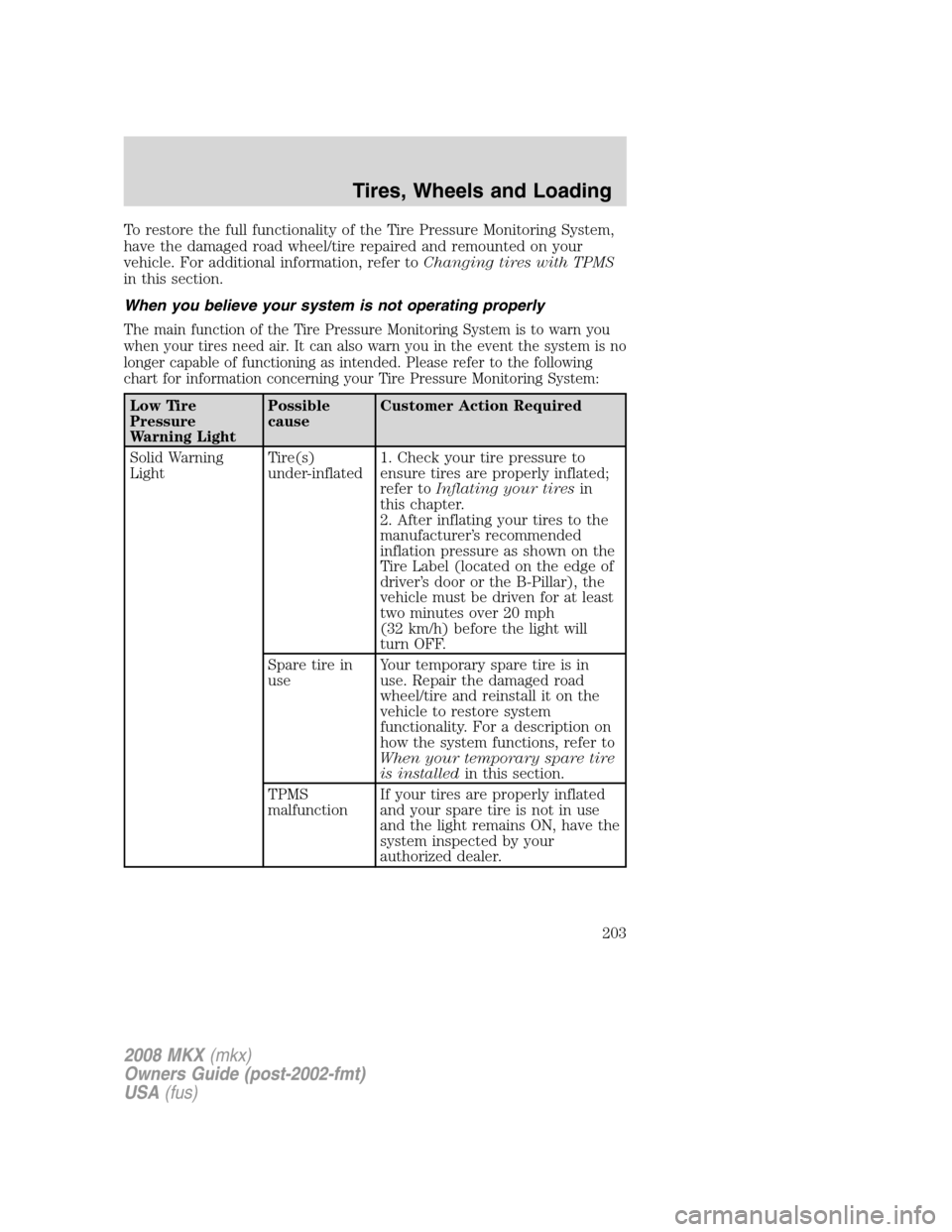
When you believe your system is not operating properly
The main function of the Tire Pressure Monitoring System is to warn you
when your tires need air. It can also warn you in the event the system is no
longer capable of functioning as intended. Please refer to the following
chart for information concerning your Tire Pressure Monitoring System:
Low Tire
Pressure
Warning LightPossible
causeCustomer Action Required
Solid Warning
LightTire(s)
under-inflated1. Check your tire pressure to
ensure tires are properly inflated;
refer toInflating your tiresin
this chapter.
2. After inflating your tires to the
manufacturer’s recommended
inflation pressure as shown on the
Tire Label (located on the edge of
driver’s door or the B-Pillar), the
vehicle must be driven for at least
two minutes over 20 mph
(32 km/h) before the light will
turn OFF.
Spare tire in
useYour temporary spare tire is in
use. Repair the damaged road
wheel/tire and reinstall it on the
vehicle to restore system
functionality. For a description on
how the system functions, refer to
When your temporary spare tire
is installedin this section.
TPMS
malfunctionIf your tires are properly inflated
and your spare tire is not in use
and the light remains ON, have the
system inspected by your
authorized dealer.
2008 MKX(mkx)
Owners Guide (post-2002-fmt)
USA(fus)
Tires, Wheels and Loading
203
Page 204 of 328
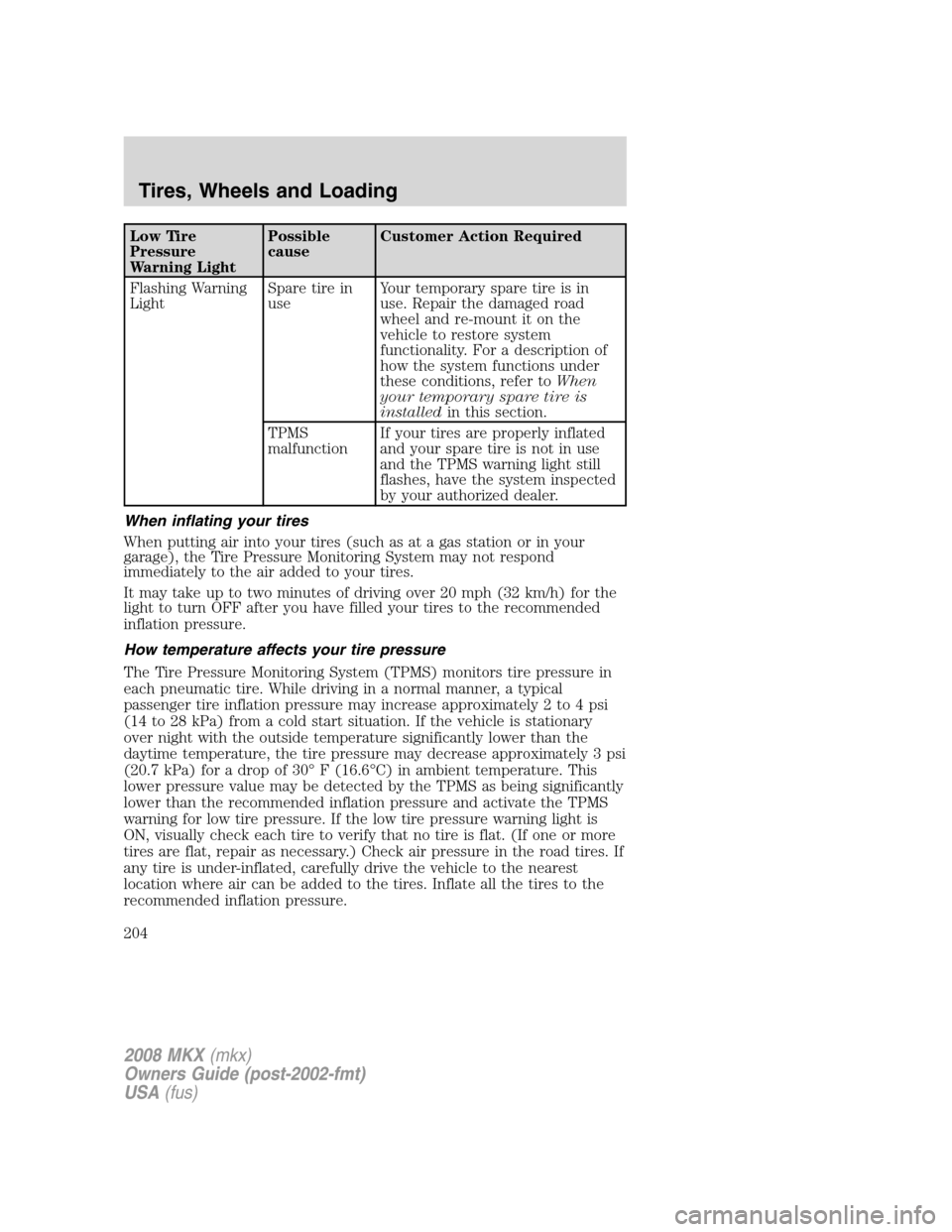
Low Tire
Pressure
Warning LightPossible
causeCustomer Action Required
Flashing Warning
LightSpare tire in
useYour temporary spare tire is in
use. Repair the damaged road
wheel and re-mount it on the
vehicle to restore system
functionality. For a description of
how the system functions under
these conditions, refer toWhen
your temporary spare tire is
installedin this section.
TPMS
malfunctionIf your tires are properly inflated
and your spare tire is not in use
and the TPMS warning light still
flashes, have the system inspected
by your authorized dealer.
When inflating your tires
When putting air into your tires (such as at a gas station or in your
garage), the Tire Pressure Monitoring System may not respond
immediately to the air added to your tires.
It may take up to two minutes of driving over 20 mph (32 km/h) for the
light to turn OFF after you have filled your tires to the recommended
inflation pressure.
How temperature affects your tire pressure
The Tire Pressure Monitoring System (TPMS) monitors tire pressure in
each pneumatic tire. While driving in a normal manner, a typical
passenger tire inflation pressure may increase approximately 2 to 4 psi
(14 to 28 kPa) from a cold start situation. If the vehicle is stationary
over night with the outside temperature significantly lower than the
daytime temperature, the tire pressure may decrease approximately 3 psi
(20.7 kPa) for a drop of 30° F (16.6°C) in ambient temperature. This
lower pressure value may be detected by the TPMS as being significantly
lower than the recommended inflation pressure and activate the TPMS
warning for low tire pressure. If the low tire pressure warning light is
ON, visually check each tire to verify that no tire is flat. (If one or more
tires are flat, repair as necessary.) Check air pressure in the road tires. If
any tire is under-inflated, carefully drive the vehicle to the nearest
location where air can be added to the tires. Inflate all the tires to the
recommended inflation pressure.
2008 MKX(mkx)
Owners Guide (post-2002-fmt)
USA(fus)
Tires, Wheels and Loading
204
Page 233 of 328
the driver to disable the system only when the ignition is ON and the
gear selector is in R (Reverse). Refer toMessage centerin theDriver
Controlschapter for more information.
Keep the RSS sensors (located on the rear bumper/fascia) free
from snow, ice and large accumulations of dirt (do not clean the
sensors with sharp objects). If the sensors are covered, it will
affect the accuracy of the RSS.
If your vehicle sustains damage to the rear bumper/fascia, leaving
it misaligned or bent, the sensing zone may be altered causing
inaccurate measurement of obstacles or false alarms.
ALL WHEEL DRIVE (AWD) SYSTEM (IF EQUIPPED)
Your vehicle may be equipped with a full-time All Wheel Drive (AWD)
system. With the AWD option, power will be delivered to the front
wheels and distributed to the rear wheels as needed. The AWD system is
active all the time and requires no input from the operator.
All components of the AWD system are sealed for life and require no
maintenance.
If your vehicle is equipped with AWD, a spare tire of a different size
other than the tire provided should never be used. A dissimilar spare tire
size (other than the spare tire provided) or major dissimilar tire sizes
between the front and rear axles could cause the AWD system to stop
functioning and default to front wheel drive and could damage the
system.
Note:Your AWD vehicle is not intended for severe off-road use. The
AWD feature gives your vehicle some limited off-road capabilities in
which driving surfaces are relatively level, obstruction-free and otherwise
similar to normal on-road driving conditions. Operating your vehicle
under other than those conditions could subject the vehicle to excessive
stress which might result in damage which is not covered under your
warranty.
Driving off-highway with AWD vehicles
AWD vehicles are equipped for driving on sand, snow, mud and rough
roads and have operating characteristics that are somewhat different
from conventional vehicles, both on and off the highway.
When driving at slow speeds off-highway under high outside
temperatures, use L (Low) gear when possible. L (Low) gear operation
will maximize the engine and transmission cooling capability.
Under severe operating conditions, the A/C may cycle on and off to
protect overheating of the engine.
2008 MKX(mkx)
Owners Guide (post-2002-fmt)
USA(fus)
Driving
233
Page 245 of 328
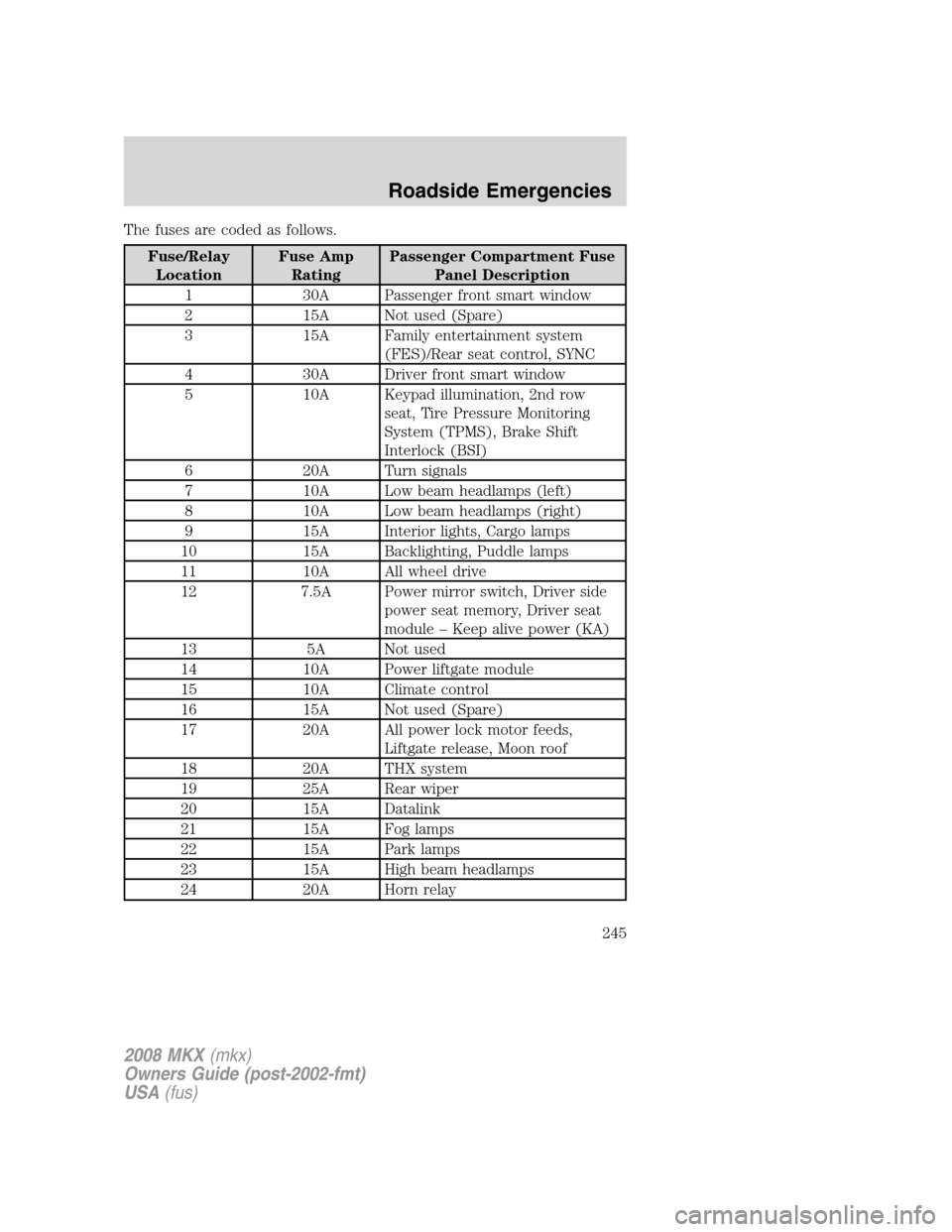
The fuses are coded as follows.
Fuse/Relay
LocationFuse Amp
RatingPassenger Compartment Fuse
Panel Description
1 30A Passenger front smart window
2 15A Not used (Spare)
3 15A Family entertainment system
(FES)/Rear seat control, SYNC
4 30A Driver front smart window
5 10A Keypad illumination, 2nd row
seat, Tire Pressure Monitoring
System (TPMS), Brake Shift
Interlock (BSI)
6 20A Turn signals
7 10A Low beam headlamps (left)
8 10A Low beam headlamps (right)
9 15A Interior lights, Cargo lamps
10 15A Backlighting, Puddle lamps
11 10A All wheel drive
12 7.5A Power mirror switch, Driver side
power seat memory, Driver seat
module – Keep alive power (KA)
13 5A Not used
14 10A Power liftgate module
15 10A Climate control
16 15A Not used (Spare)
17 20A All power lock motor feeds,
Liftgate release, Moon roof
18 20A THX system
19 25A Rear wiper
20 15A Datalink
21 15A Fog lamps
22 15A Park lamps
23 15A High beam headlamps
24 20A Horn relay
2008 MKX(mkx)
Owners Guide (post-2002-fmt)
USA(fus)
Roadside Emergencies
245
Page 250 of 328
Fuse/Relay
LocationFuse Amp
RatingPower Distribution Box
Description
62 — Not used
63 40A** Blower motor
64 20A** Cigar lighter/Power point
65 20A** Cigar lighter/Power point
66 20A** Cigar lighter/Power point
67 — Not used
68 15A* Fuel pump
69 — Not used
70 — Not used
71 10A* Stop lamps
72 — Not used
* Mini Fuses ** Cartridge Fuses
CHANGING THE TIRES
If you get a flat tire while driving, do not apply the brake heavily.
Instead, gradually decrease your speed. Hold the steering wheel firmly
and slowly move to a safe place on the side of the road.
Note:The tire pressure monitoring system (TPMS) indicator light will
illuminate when the spare tire is in use. To restore the full functionality
of the monitoring system, all road wheels equipped with tire pressure
monitoring sensors must be mounted on the vehicle.
Have a flat serviced by an authorized dealer in order to prevent damage
to the TPMS sensors, refer toTire Pressure Monitoring System
(TPMS)in theTires, Wheels and Loadingchapter. Replace the spare
tire with a road tire as soon as possible.
The use of tire sealants may damage your Tire Pressure
Monitoring System and should not be used.
Refer toTire Pressure Monitoring System (TPMS)in the
Tires, Wheels and Loadingchapter for important information. If
the tire pressure monitor sensor becomes damaged, it will no longer
function.
2008 MKX(mkx)
Owners Guide (post-2002-fmt)
USA(fus)
Roadside Emergencies
250
Page 251 of 328
Dissimilar spare tire/wheel information
Failure to follow these guidelines could result in an increased
risk of loss of vehicle control, injury or death.
If you have a dissimilar spare tire/wheel, then it is intended for
temporary use only. This means that if you need to use it, you should
replace it as soon as possible with a road tire/wheel that is the same size
and type as the road tires and wheels that were originally provided by
Ford. If the dissimilar spare tire or wheel is damaged, it should be
replaced rather than repaired.
A dissimilar spare tire/wheel is defined as a spare tire and/or wheel that
is different in brand, size or appearance from the road tires and wheels
and can be one of three types:
1.T-type mini-spare:This spare tire begins with the letter “T” for tire
size and may have “Temporary Use Only” molded in the sidewall
2.Full-size dissimilar spare with label on wheel:This spare tire has
a label on the wheel that states: “THIS TIRE AND WHEEL FOR
TEMPORARY USE ONLY”
When driving with one of the dissimilar spare tires listed above,do not:
•Exceed 50 mph (80 km/h)
•Load the vehicle beyond maximum vehicle load rating listed on the
Safety Compliance Label
•Tow a trailer
•Use snow chains on the end of the vehicle with the dissimilar spare
tire
•Use more than one dissimilar spare tire at a time
•Use commercial car washing equipment
•Try to repair the dissimilar spare tire
Use of one of the dissimilar spare tires listed above at any one wheel
location can lead to impairment of the following:
•Handling, stability and braking performance
•Comfort and noise
•Ground clearance and parking at curbs
•Winter weather driving capability
•Wet weather driving capability
2008 MKX(mkx)
Owners Guide (post-2002-fmt)
USA(fus)
Roadside Emergencies
251
Page 252 of 328
3.Full-size dissimilar spare without label on wheel
When driving with the full-size dissimilar spare tire/wheel,do not:
•Exceed 70 mph (113 km/h)
•Use more than one dissimilar spare tire/wheel at a time
•Use commercial car washing equipment
•Use snow chains on the end of the vehicle with the dissimilar spare
tire/wheel
The usage of a full-size dissimilar spare tire/wheel can lead to
impairment of the following:
•Handling, stability and braking performance
•Comfort and noise
•Ground clearance and parking at curbs
•Winter weather driving capability
•Wet weather driving capability
•All-Wheel driving capability (if applicable)
•Load leveling adjustment (if applicable)
When driving with the full-size dissimilar spare tire/wheel additional
caution should be given to:
•Towing a trailer
•Driving vehicles equipped with a camper body
•Driving vehicles with a load on the cargo rack
Drive cautiously when using a full-size dissimilar spare tire/wheel and
seek service as soon as possible.
Stopping and securing the vehicle
1. Park on a level surface, activate
hazard flashers and set the parking
brake.
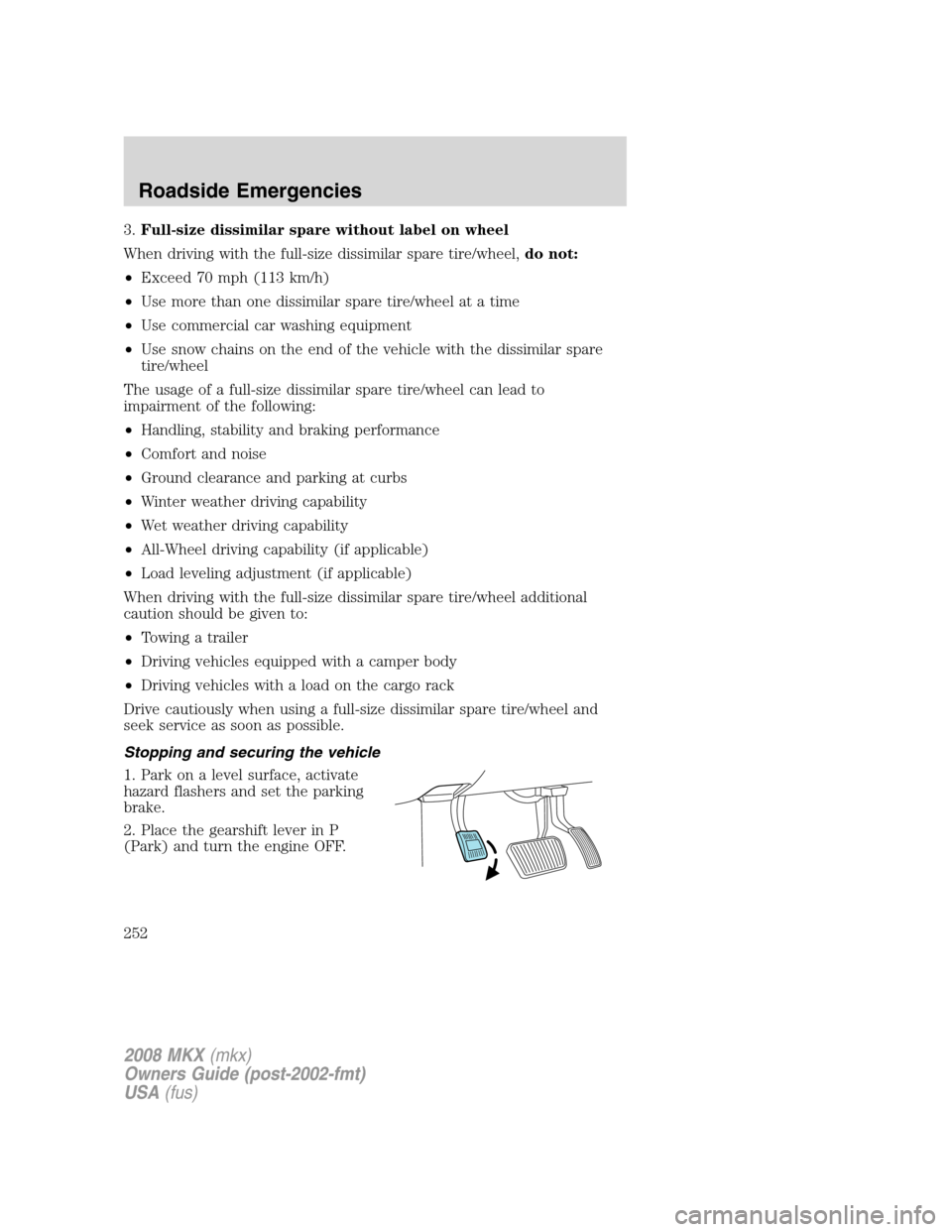
2. Place the gearshift lever in P
(Park) and turn the engine OFF.
2008 MKX(mkx)
Owners Guide (post-2002-fmt)
USA(fus)
Roadside Emergencies
252
Page 253 of 328
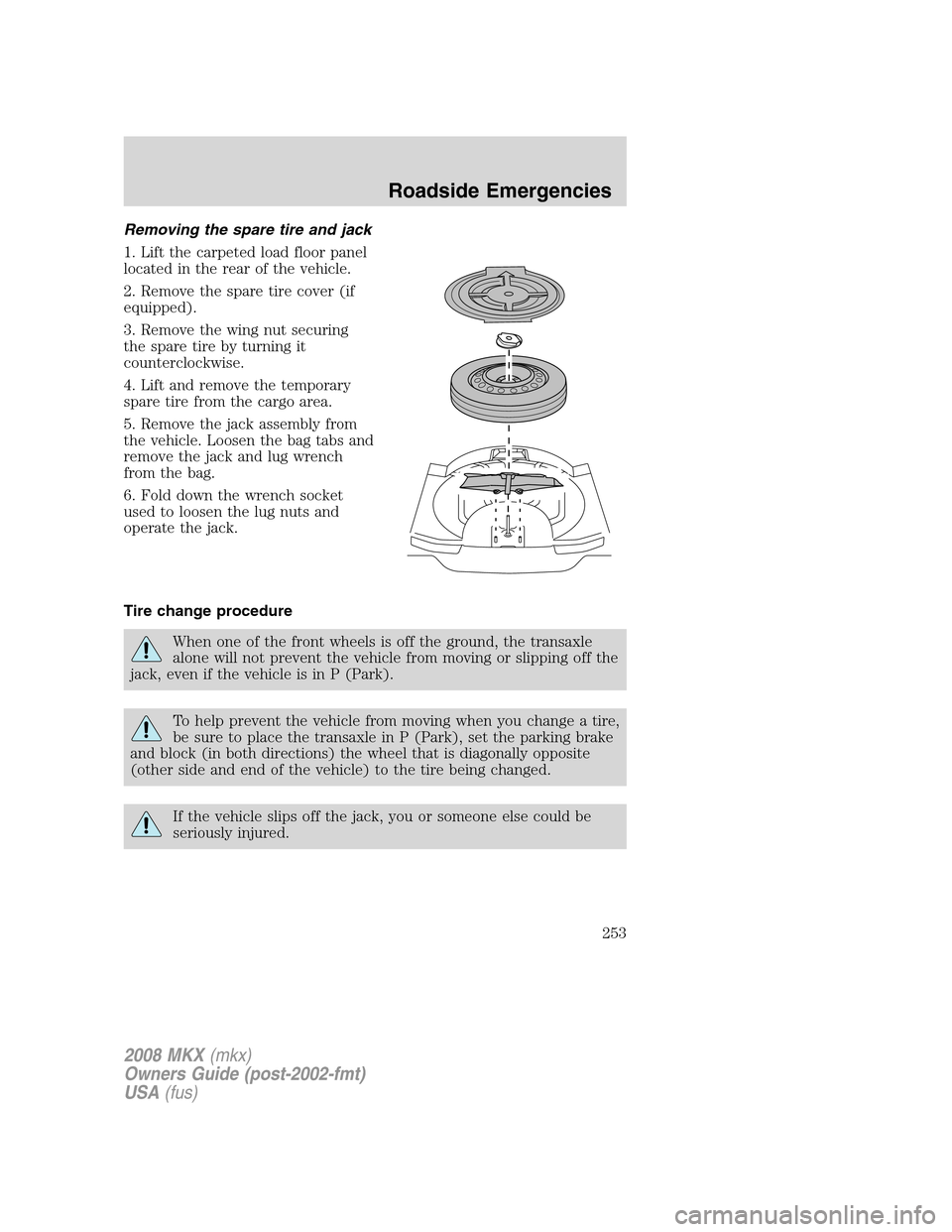
Removing the spare tire and jack
1. Lift the carpeted load floor panel
located in the rear of the vehicle.
2. Remove the spare tire cover (if
equipped).
3. Remove the wing nut securing
the spare tire by turning it
counterclockwise.
4. Lift and remove the temporary
spare tire from the cargo area.
5. Remove the jack assembly from
the vehicle. Loosen the bag tabs and
remove the jack and lug wrench
from the bag.
6. Fold down the wrench socket
used to loosen the lug nuts and
operate the jack.
Tire change procedure
When one of the front wheels is off the ground, the transaxle
alone will not prevent the vehicle from moving or slipping off the
jack, even if the vehicle is in P (Park).
To help prevent the vehicle from moving when you change a tire,
be sure to place the transaxle in P (Park), set the parking brake
and block (in both directions) the wheel that is diagonally opposite
(other side and end of the vehicle) to the tire being changed.
If the vehicle slips off the jack, you or someone else could be
seriously injured.
2008 MKX(mkx)
Owners Guide (post-2002-fmt)
USA(fus)
Roadside Emergencies
253
Page 255 of 328
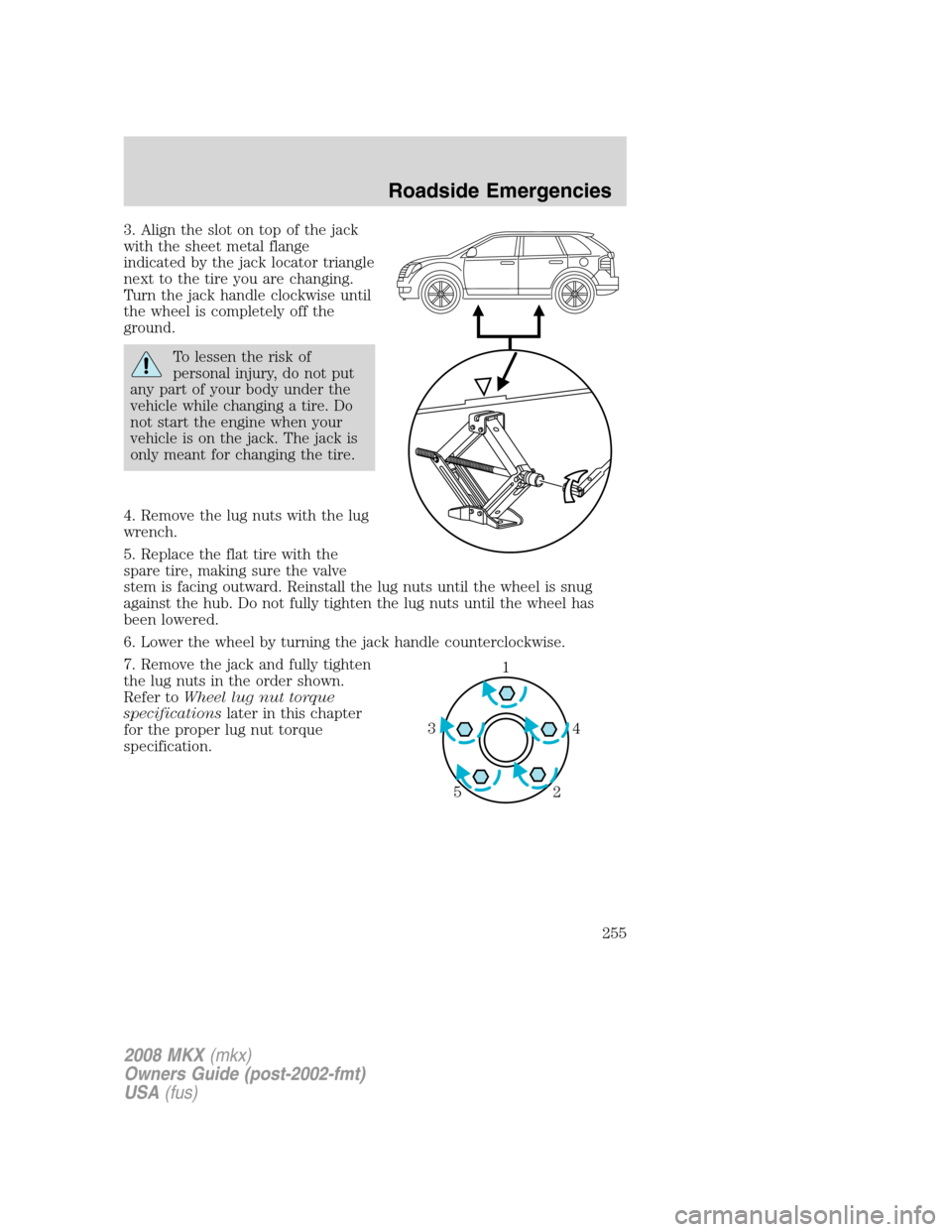
3. Align the slot on top of the jack
with the sheet metal flange
indicated by the jack locator triangle
next to the tire you are changing.
Turn the jack handle clockwise until
the wheel is completely off the
ground.
To lessen the risk of
personal injury, do not put
any part of your body under the
vehicle while changing a tire. Do
not start the engine when your
vehicle is on the jack. The jack is
only meant for changing the tire.
4. Remove the lug nuts with the lug
wrench.
5. Replace the flat tire with the
spare tire, making sure the valve
stem is facing outward. Reinstall the lug nuts until the wheel is snug
against the hub. Do not fully tighten the lug nuts until the wheel has
been lowered.
6. Lower the wheel by turning the jack handle counterclockwise.
7. Remove the jack and fully tighten
the lug nuts in the order shown.
Refer toWheel lug nut torque
specificationslater in this chapter
for the proper lug nut torque
specification.
1
4 3
2 5
2008 MKX(mkx)
Owners Guide (post-2002-fmt)
USA(fus)
Roadside Emergencies
255
Page 256 of 328
Stowing the flat/spare tire and jack
1. Fully collapse the jack, fold the wrench socket into the handle and
place them both into the bag making sure to secure the tabs.
2. Place the jack assembly in the spare tire well aligning it with the two
vertical studs.
3. Place the tire in the spare tire well over the jack assembly.
If you are stowing a flat tire,place the tire in the spare tire well with
the valve stem facing down. Rotate the tire until the jack assembly is
able to protrude through a wheel opening.
If you are stowing the spare tire,place the spare in the spare tire
well in its original position.
4. Secure the wheel by replacing the wing nut and turning clockwise.
WHEEL LUG NUT TORQUE SPECIFICATIONS
Retighten the lug nuts to the specified torque within 100 miles (160 km)
after any wheel disturbance (rotation, flat tire, wheel removal, etc.).
Lug nut socket
size/Bolt sizeWheel lug nut torque*
lb.ft. N•m
Lug nut socket size:
34
inch (19 mm) hex
Bolt size:12x20100 135
* Torque specifications are for nut and bolt threads free of dirt and
rust. Use only Ford recommended replacement fasteners.
When a wheel is installed, always remove any corrosion, dirt or
foreign materials present on the mounting surfaces of the wheel
or the surface of the wheel hub, brake drum or brake disc that
contacts the wheel. Ensure that any fasteners that attach the rotor to
the hub are secured so they do not interfere with the mounting
surfaces of the wheel. Installing wheels without correct metal-to-metal
contact at the wheel mounting surfaces can cause the wheel nuts to
loosen and the wheel to come off while the vehicle is in motion,
resulting in loss of control.
2008 MKX(mkx)
Owners Guide (post-2002-fmt)
USA(fus)
Roadside Emergencies
256