light LINCOLN MKX 2012 Owners Manual
[x] Cancel search | Manufacturer: LINCOLN, Model Year: 2012, Model line: MKX, Model: LINCOLN MKX 2012Pages: 364, PDF Size: 3.64 MB
Page 236 of 364
WARNING:Use caution when using the rear video camera and
the liftgate is ajar. If the liftgate is ajar, the camera will be out of
position and the video image may be incorrect. All guidelines (if
enabled) have been removed when the liftgate is ajar.
If the back end of the vehicle is hit or damaged, then check with your
authorized dealer to have your rear video system checked for proper
coverage and operation.
Night time and dark area use
At night time or in dark areas, the camera system relies on the reverse
lamp lighting to produce an image. Therefore, it is necessary that both
reverse lamps are operating in order to get a clear image in the dark. If
either of the lamps are not operating, stop using the camera system, at
least in the dark, until the lamp(s) are replaced and functioning.
Servicing
•If the image comes on while the vehicle is not in R (Reverse), have
the system inspected by your authorized dealer.
•If the image is not clear, check if anything is covering the lens such as
dirt, mud, ice, snow, etc. If the image is still not clear after cleaning,
have your system inspected by your authorized dealer.
COLLISION WARNING SYSTEM (IF EQUIPPED)
The collision warning with brake support, is designed to alert the driver
of certain collision risks with a red warning light located above the
dashboard and an audible warning chime. The brake support assists the
driver in reducing the collision speed, by pre-charging the brakes.
WARNING:This system is designed to be a supplementary
driving aid. It is not intended to replace the driver’s attention,
and judgment, or the need to apply the brakes. This system does NOT
activate the brakes automatically. Failure to press the brake pedal to
activate the brakes may result in a collision.
WARNING:The collision warning system with brake support
cannot help prevent all collisions. Do not rely on this system to
replace driver judgment and the need to maintain distance and speed.
Note:The collision warning with brake support will not detect, warn, or
respond to potential collisions with vehicles to the rear or sides of the
vehicle.
Driving
236
2012 MKX(mkx)
Owners Guide, 1st Printing
USA(fus)
Page 237 of 364
Operation
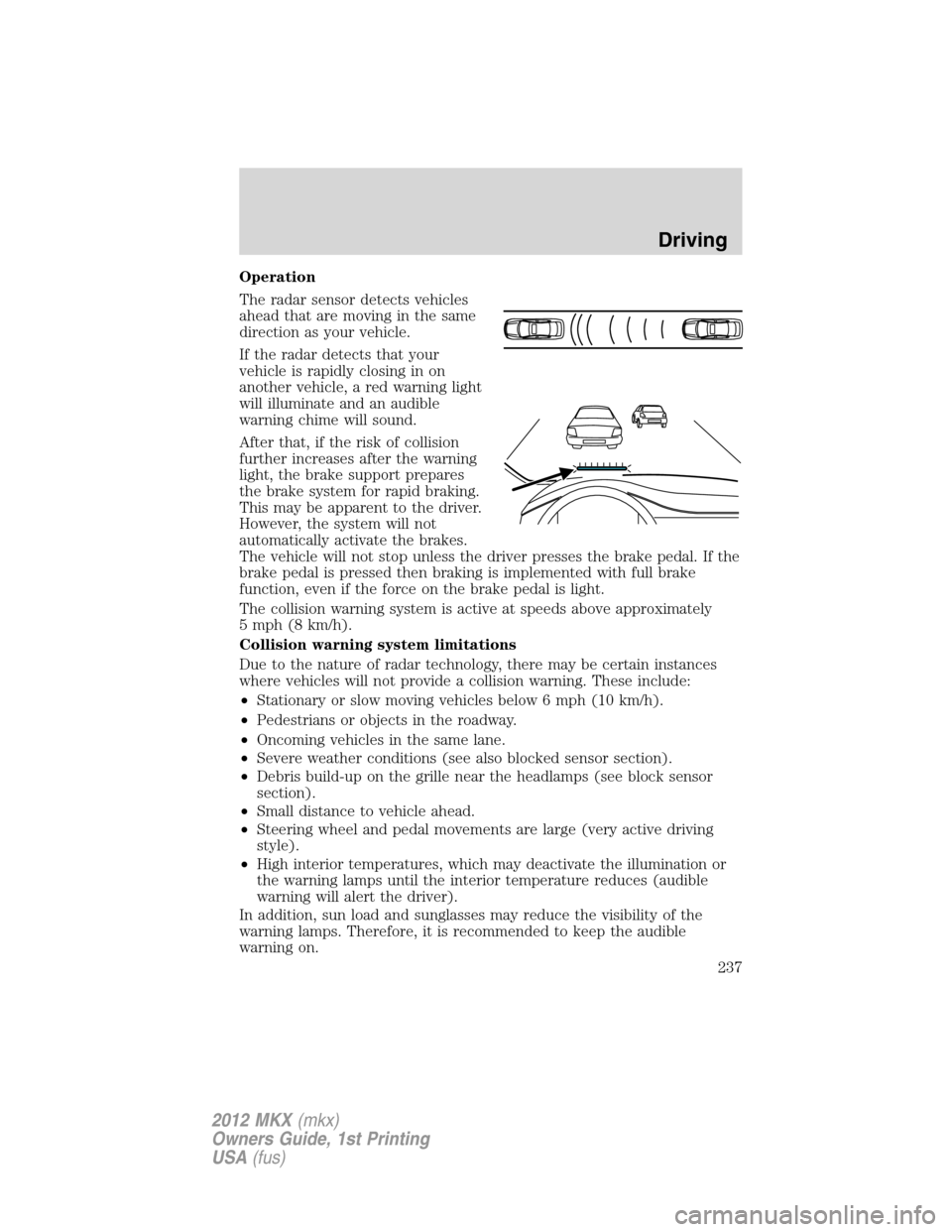
The radar sensor detects vehicles
ahead that are moving in the same
direction as your vehicle.
If the radar detects that your
vehicle is rapidly closing in on
another vehicle, a red warning light
will illuminate and an audible
warning chime will sound.
After that, if the risk of collision
further increases after the warning
light, the brake support prepares
the brake system for rapid braking.
This may be apparent to the driver.
However, the system will not
automatically activate the brakes.
The vehicle will not stop unless the driver presses the brake pedal. If the
brake pedal is pressed then braking is implemented with full brake
function, even if the force on the brake pedal is light.
The collision warning system is active at speeds above approximately
5 mph (8 km/h).
Collision warning system limitations
Due to the nature of radar technology, there may be certain instances
where vehicles will not provide a collision warning. These include:
•Stationary or slow moving vehicles below 6 mph (10 km/h).
•Pedestrians or objects in the roadway.
•Oncoming vehicles in the same lane.
•Severe weather conditions (see also blocked sensor section).
•Debris build-up on the grille near the headlamps (see block sensor
section).
•Small distance to vehicle ahead.
•Steering wheel and pedal movements are large (very active driving
style).
•High interior temperatures, which may deactivate the illumination or
the warning lamps until the interior temperature reduces (audible
warning will alert the driver).
In addition, sun load and sunglasses may reduce the visibility of the
warning lamps. Therefore, it is recommended to keep the audible
warning on.
Driving
237
2012 MKX(mkx)
Owners Guide, 1st Printing
USA(fus)
Page 248 of 364
Note:The AWD feature gives your vehicle some limited off-road
capabilities in which driving surfaces are relatively level, obstruction-free
and otherwise similar to normal on-road driving conditions. Operating
your vehicle under other than those conditions could subject the vehicle
to excessive stress which might result in damage which is not covered
under your warranty.
Driving off-highway with AWD vehicles
AWD vehicles are equipped for driving on sand, snow, mud and rough
roads and have operating characteristics that are somewhat different
from conventional vehicles, both on and off the highway.
When driving at slow speeds off-highway under high outside
temperatures, use L (Low) gear when possible. L (Low) gear operation
will maximize the engine and transmission cooling capability.
Under severe operating conditions, the A/C may cycle on and off to
protect overheating of the engine.
Basic operating principles
•Drive slower in strong crosswinds which can affect the normal steering
characteristics of your vehicle.
•Be extremely careful when driving on pavement made slippery by
loose sand, water, gravel, snow or ice.
If your vehicle goes off the edge of the pavement
•If your vehicle goes off the edge of the pavement, slow down, but
avoid severe brake application, ease the vehicle back onto the
pavement only after reducing your speed. Do not turn the steering
wheel too sharply while returning to the road surface.
•It may be safer to stay on the apron or shoulder of the road and slow
down gradually before returning to the pavement. You may lose
control if you do not slow down or if you turn the steering wheel too
sharply or abruptly.
•It often may be less risky to strike small objects, such as highway
reflectors, with minor damage to your vehicle rather than attempt a
sudden return to the pavement which could cause the vehicle to slide
sideways out of control or rollover. Remember, your safety and the
safety of others should be your primary concern.
If your vehicle gets stuck
If your vehicle gets stuck in mud or snow it may be rocked out by
shifting between forward and reverse gears, stopping between shifts, in a
steady pattern. Press lightly on the accelerator in each gear.
Driving
248
2012 MKX(mkx)
Owners Guide, 1st Printing
USA(fus)
Page 250 of 364
AWD systems (if equipped)
With AWD, the vehicle uses all four wheels to power the vehicle. This
increases traction, enabling you to drive over terrain and road conditions
that a conventional two-wheel drive vehicle cannot.
Sand
When driving over sand, try to keep all four wheels on the most solid
area of the trail. Avoid reducing the tire pressures but shift to a lower
gear and drive steadily through the terrain. Apply the accelerator slowly
and avoid spinning the wheels.
Do not drive your AWD vehicle in deep sand for an extended period of
time. This will cause the AWD system to overheat. If the rear tires stop
spinning while the front tires spin in deep sand, turn off the vehicle and
allow the AWD system to cool down for a minimum of 15 minutes. After
the system has cooled down, normal AWD function will return. When
driving at slow speeds in deep sand under high outside temperatures,
use L (Low) gear when possible. L (Low) gear operation will maximize
the engine and transmission cooling capability.
Under severe operating conditions, the A/C may cycle on and off to
protect overheating of the engine.
Avoid excessive speed because vehicle momentum can work against you
and cause the vehicle to become stuck to the point that assistance may
be required from another vehicle. Remember, you may be able to back
out the way you came if you proceed with caution.
Mud and water
If you must drive through high water, drive slowly. Traction or brake
capability may be limited.
When driving through water, determine the depth; avoid water higher
than the bottom of the wheel rims (for cars) or the bottom of the hubs
(for trucks) (if possible) and proceed slowly. If the ignition system gets
wet, the vehicle may stall.
Once through water, always try the brakes. Wet brakes do not stop the
vehicle as effectively as dry brakes. Drying can be improved by moving
your vehicle slowly while applying light pressure on the brake pedal.
Be cautious of sudden changes in vehicle speed or direction when you
are driving in mud. Even AWD vehicles can lose traction in slick mud. As
when you are driving over sand, apply the accelerator slowly and avoid
spinning your wheels. If the vehicle does slide, steer in the direction of
the slide until you regain control of the vehicle.
Driving
250
2012 MKX(mkx)
Owners Guide, 1st Printing
USA(fus)
Page 251 of 364
After driving through mud, clean off residue stuck to rotating driveshafts
and tires. Excess mud stuck on tires and rotating driveshafts causes an
imbalance that could damage drive components.
Note:Driving through deep water may damage the transmission.
If the front or rear axle is submerged in water, the axle lubricant and
PTU (power transfer unit) lubricant should be checked and changed if
necessary.
“Tread Lightly” is an educational
program designed to increase public
awareness of land-use regulations
and responsibilities in our nations
wilderness areas. Ford Motor
Company joins the U.S. Forest Service and the Bureau of Land
Management in encouraging you to help preserve our national forest and
other public and private lands by “treading lightly.”
Driving on hilly or sloping terrain
Although natural obstacles may make it necessary to travel diagonally up
or down a hill or steep incline, you should always try to drive straight up
or straight down.Note:Avoid driving crosswise or turning on steep
slopes or hills. A danger lies in losing traction, slipping sideways and
possibly rolling over. Whenever driving on a hill, determine beforehand
the route you will use. Do not drive over the crest of a hill without
seeing what conditions are on the other side. Do not drive in reverse
over a hill without the aid of an observer.
When climbing a steep slope or hill, start in a lower gear rather than
downshifting to a lower gear from a higher gear once the ascent has
started. This reduces strain on the engine and the possibility of stalling.
If you do stall out, do not try to turnaround because you might roll over.
It is better to back down to a safe location.
Apply just enough power to the wheels to climb the hill. Too much
power will cause the tires to slip, spin or lose traction, resulting in loss of
vehicle control.
Driving
251
2012 MKX(mkx)
Owners Guide, 1st Printing
USA(fus)
Page 253 of 364
do not “pump” the brakes. Refer to theBrakessection of this chapter
for additional information on the operation of the anti-lock brake system.
Maintenance and modifications
The suspension and steering systems on your vehicle have been designed
and tested to provide predictable performance whether loaded or empty
and durable load carrying capability. For this reason, Ford Motor
Company strongly recommends that you do not make modifications such
as adding or removing parts (such as lift kits or stabilizer bars) or by
using replacement parts not equivalent to the original factory equipment.
Any modifications to a vehicle that raise the center of gravity can make
it more likely the vehicle will rollover as a result of a loss of control.
Ford Motor Company recommends that caution be used with any vehicle
equipped with a high load or device (such as ladder or luggage racks).
Failure to maintain your vehicle properly may void the warranty, increase
your repair cost, reduce vehicle performance and operational capabilities
and adversely affect driver and passenger safety. Frequent inspection of
vehicle chassis components is recommended if the vehicle is subjected to
off-highway usage.
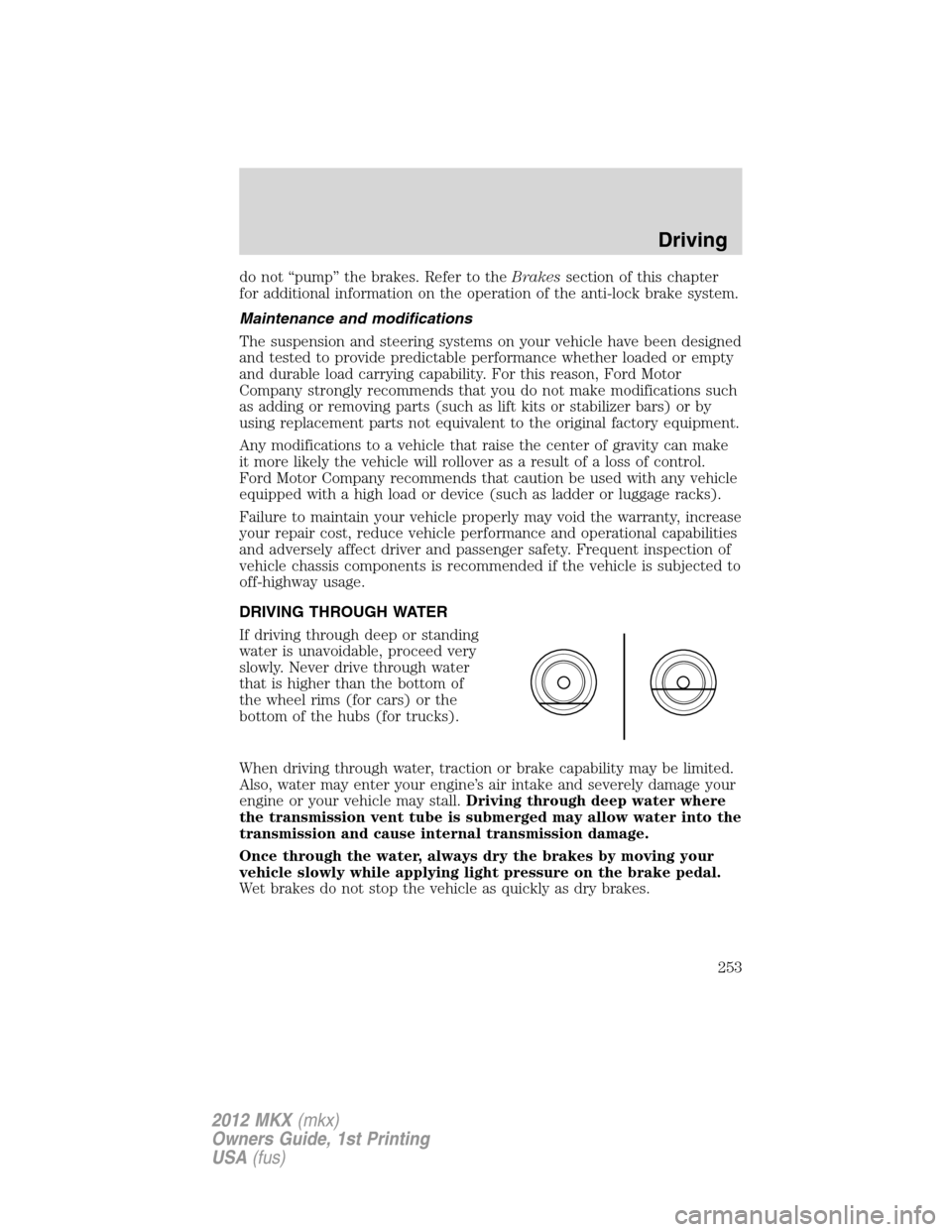
DRIVING THROUGH WATER
If driving through deep or standing
water is unavoidable, proceed very
slowly. Never drive through water
that is higher than the bottom of
the wheel rims (for cars) or the
bottom of the hubs (for trucks).
When driving through water, traction or brake capability may be limited.
Also, water may enter your engine’s air intake and severely damage your
engine or your vehicle may stall.Driving through deep water where
the transmission vent tube is submerged may allow water into the
transmission and cause internal transmission damage.
Once through the water, always dry the brakes by moving your
vehicle slowly while applying light pressure on the brake pedal.
Wet brakes do not stop the vehicle as quickly as dry brakes.
Driving
253
2012 MKX(mkx)
Owners Guide, 1st Printing
USA(fus)
Page 259 of 364
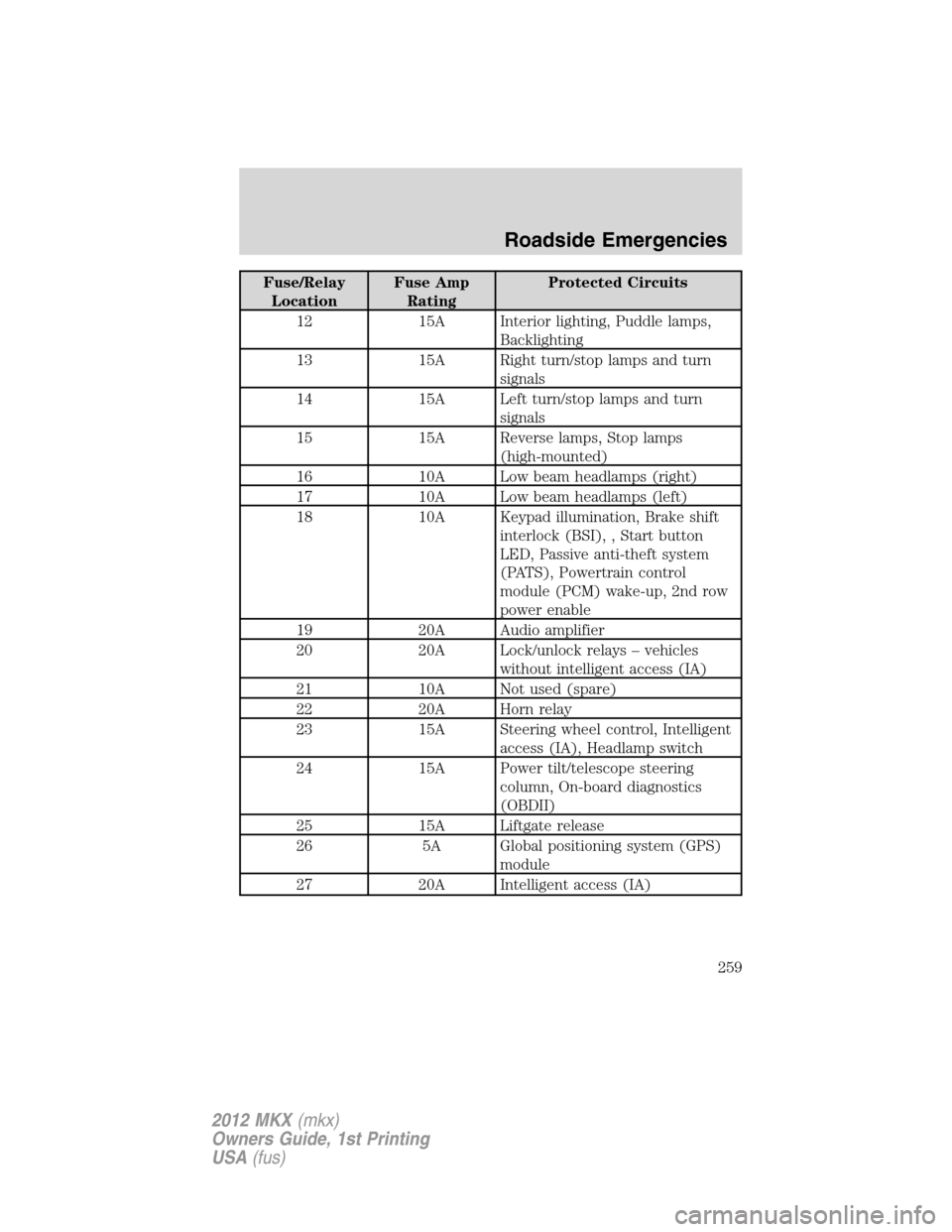
Fuse/Relay
LocationFuse Amp
RatingProtected Circuits
12 15A Interior lighting, Puddle lamps,
Backlighting
13 15A Right turn/stop lamps and turn
signals
14 15A Left turn/stop lamps and turn
signals
15 15A Reverse lamps, Stop lamps
(high-mounted)
16 10A Low beam headlamps (right)
17 10A Low beam headlamps (left)
18 10A Keypad illumination, Brake shift
interlock (BSI), , Start button
LED, Passive anti-theft system
(PATS), Powertrain control
module (PCM) wake-up, 2nd row
power enable
19 20A Audio amplifier
20 20A Lock/unlock relays – vehicles
without intelligent access (IA)
21 10A Not used (spare)
22 20A Horn relay
23 15A Steering wheel control, Intelligent
access (IA), Headlamp switch
24 15A Power tilt/telescope steering
column, On-board diagnostics
(OBDII)
25 15A Liftgate release
26 5A Global positioning system (GPS)
module
27 20A Intelligent access (IA)
Roadside Emergencies
259
2012 MKX(mkx)
Owners Guide, 1st Printing
USA(fus)
Page 262 of 364
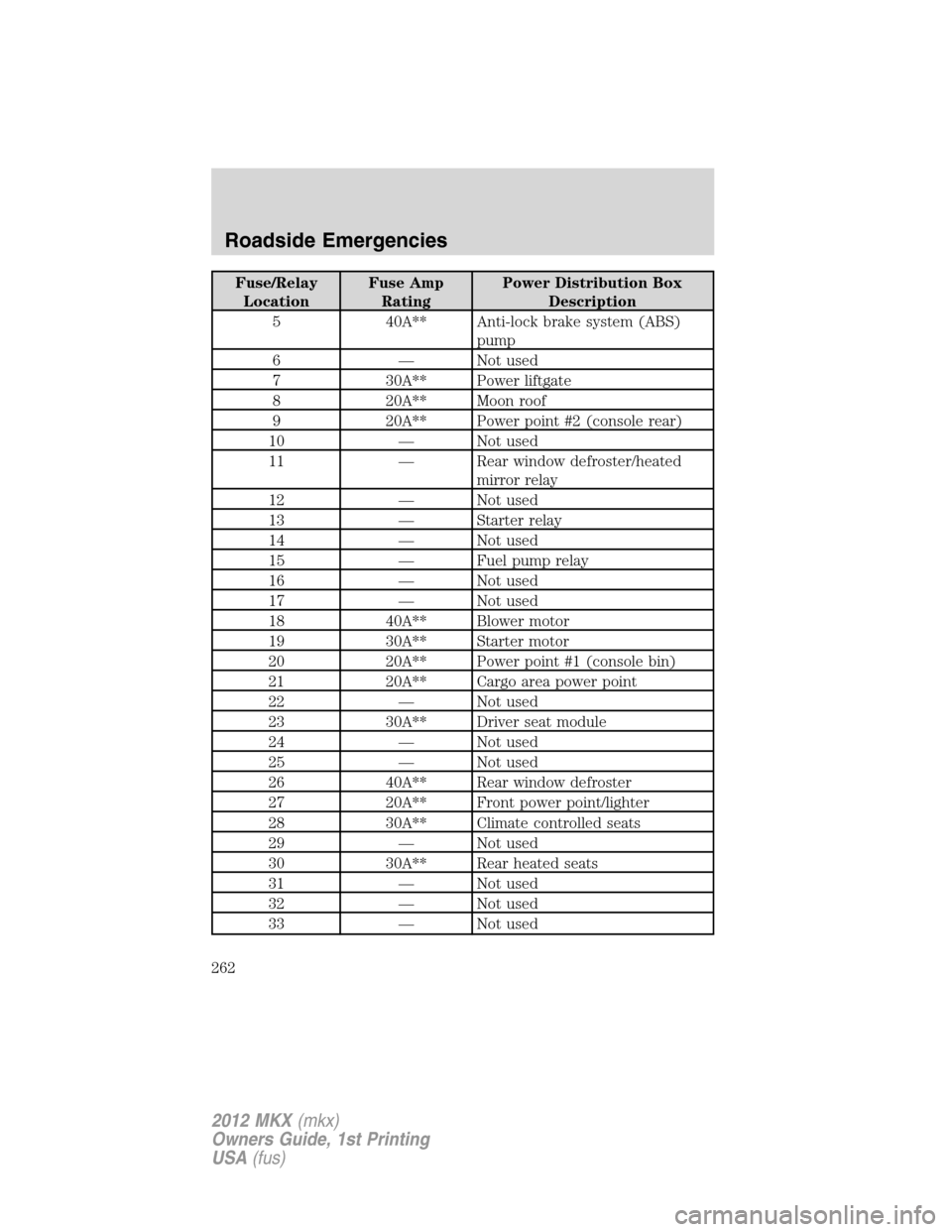
Fuse/Relay
LocationFuse Amp
RatingPower Distribution Box
Description
5 40A** Anti-lock brake system (ABS)
pump
6 — Not used
7 30A** Power liftgate
8 20A** Moon roof
9 20A** Power point #2 (console rear)
10 — Not used
11 — Rear window defroster/heated
mirror relay
12 — Not used
13 — Starter relay
14 — Not used
15 — Fuel pump relay
16 — Not used
17 — Not used
18 40A** Blower motor
19 30A** Starter motor
20 20A** Power point #1 (console bin)
21 20A** Cargo area power point
22 — Not used
23 30A** Driver seat module
24 — Not used
25 — Not used
26 40A** Rear window defroster
27 20A** Front power point/lighter
28 30A** Climate controlled seats
29 — Not used
30 30A** Rear heated seats
31 — Not used
32 — Not used
33 — Not used
Roadside Emergencies
262
2012 MKX(mkx)
Owners Guide, 1st Printing
USA(fus)
Page 264 of 364
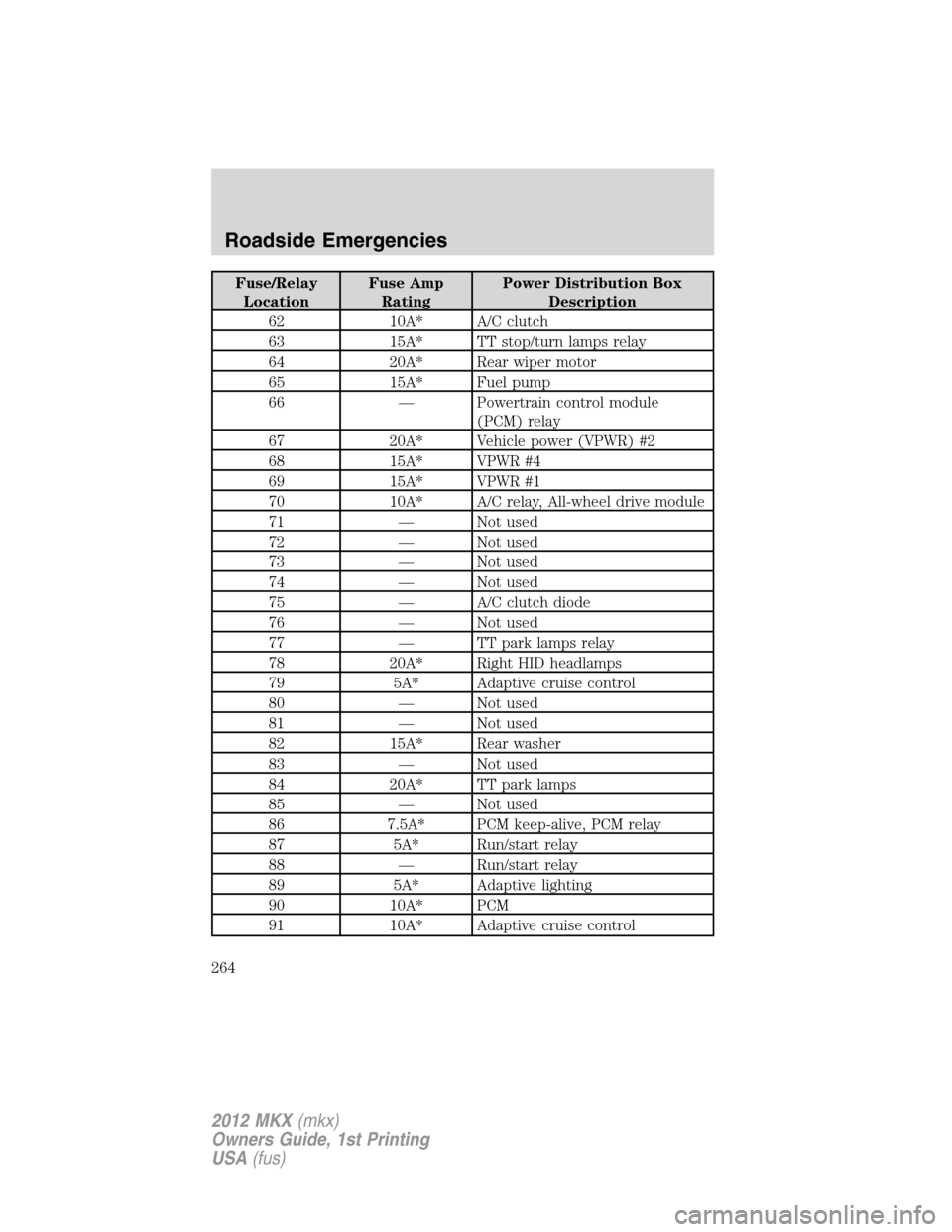
Fuse/Relay
LocationFuse Amp
RatingPower Distribution Box
Description
62 10A* A/C clutch
63 15A* TT stop/turn lamps relay
64 20A* Rear wiper motor
65 15A* Fuel pump
66 — Powertrain control module
(PCM) relay
67 20A* Vehicle power (VPWR) #2
68 15A* VPWR #4
69 15A* VPWR #1
70 10A* A/C relay, All-wheel drive module
71 — Not used
72 — Not used
73 — Not used
74 — Not used
75 — A/C clutch diode
76 — Not used
77 — TT park lamps relay
78 20A* Right HID headlamps
79 5A* Adaptive cruise control
80 — Not used
81 — Not used
82 15A* Rear washer
83 — Not used
84 20A* TT park lamps
85 — Not used
86 7.5A* PCM keep-alive, PCM relay
87 5A* Run/start relay
88 — Run/start relay
89 5A* Adaptive lighting
90 10A* PCM
91 10A* Adaptive cruise control
Roadside Emergencies
264
2012 MKX(mkx)
Owners Guide, 1st Printing
USA(fus)
Page 265 of 364
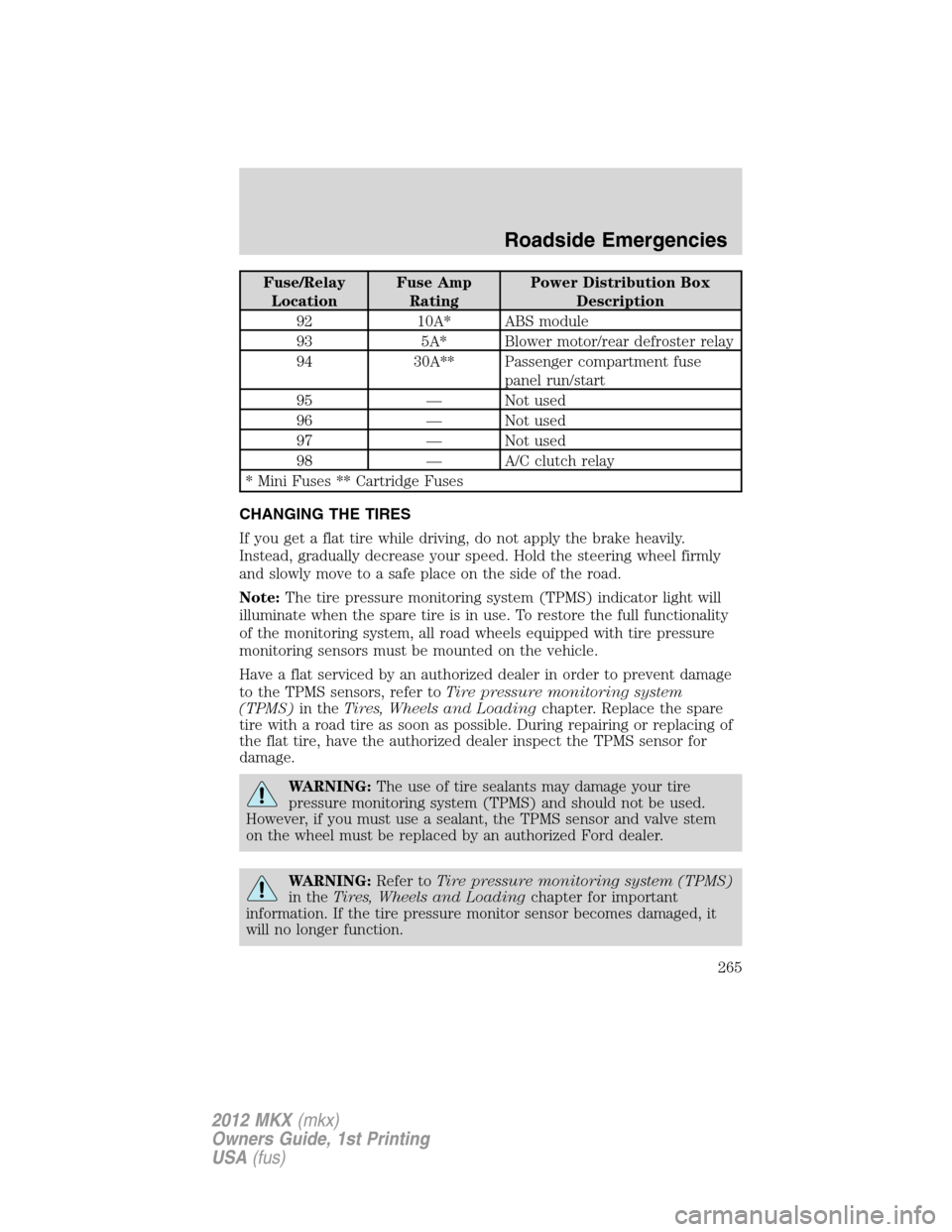
Fuse/Relay
LocationFuse Amp
RatingPower Distribution Box
Description
92 10A* ABS module
93 5A* Blower motor/rear defroster relay
94 30A** Passenger compartment fuse
panel run/start
95 — Not used
96 — Not used
97 — Not used
98 — A/C clutch relay
* Mini Fuses ** Cartridge Fuses
CHANGING THE TIRES
If you get a flat tire while driving, do not apply the brake heavily.
Instead, gradually decrease your speed. Hold the steering wheel firmly
and slowly move to a safe place on the side of the road.
Note:The tire pressure monitoring system (TPMS) indicator light will
illuminate when the spare tire is in use. To restore the full functionality
of the monitoring system, all road wheels equipped with tire pressure
monitoring sensors must be mounted on the vehicle.
Have a flat serviced by an authorized dealer in order to prevent damage
to the TPMS sensors, refer toTire pressure monitoring system
(TPMS)in theTires, Wheels and Loadingchapter. Replace the spare
tire with a road tire as soon as possible. During repairing or replacing of
the flat tire, have the authorized dealer inspect the TPMS sensor for
damage.
WARNING:The use of tire sealants may damage your tire
pressure monitoring system (TPMS) and should not be used.
However, if you must use a sealant, the TPMS sensor and valve stem
on the wheel must be replaced by an authorized Ford dealer.
WARNING:Refer toTire pressure monitoring system (TPMS)
in theTires, Wheels and Loadingchapter for important
information. If the tire pressure monitor sensor becomes damaged, it
will no longer function.
Roadside Emergencies
265
2012 MKX(mkx)
Owners Guide, 1st Printing
USA(fus)