lock LINCOLN MKX 2016 Owners Manual
[x] Cancel search | Manufacturer: LINCOLN, Model Year: 2016, Model line: MKX, Model: LINCOLN MKX 2016Pages: 563, PDF Size: 4.96 MB
Page 298 of 563
Protected components
Fuse amp rating
Fuse or relay number
Wiper motor 2.
25A *
80
110 volt inverter.
40A *
81
Not used.
–
82
TRCM (iShifter).
20A *
83
Starter solenoid.
30A *
84
Vista roof.
30A *
85
Not used.
–
86
Anti-lock brake system pump.
60A **
87
* M-type fuse.
** J-type fuse.
Passenger Compartment Fuse Panel
The fuse panel is located under the
instrument panel to the left of the steering
column. Note:
It may be easier to access the fuse
panel if you remove the finish trim piece.
295
MKX (CD9) Canada/United States of America, enUSA, ASO/OGC Review Fuses
Page 300 of 563
Protected components
Fuse amp rating
Fuse or relay number
Second row easy fold relay coil.
Memory seats.
7.5A 1
2
Lumbar.
Power mirrors.
Driver seat module logic power.
Driver door unlock.
20A 1
3
Not used (spare).
5A 1
4
Subwoofer amplifier.
20A 1
5
USB charger.
10A 2
6
Not used (spare).
10A 2
7
Not used (spare).
10A 2
8
Rear seat entertainment system module.
10A 2
9
360 camera badge.
Keypad.
5A 2
10
Power liftgate module logic power.
Hands free liftgate module.
297
MKX (CD9) Canada/United States of America, enUSA, ASO/OGC Review Fuses
Page 302 of 563
Protected components
Fuse amp rating
Fuse or relay number
Humidity and in-car temperature sensor.
5A 2
21
Occupant classification sensor.
5A 2
22
Delayed accessory (power inverter logic, moonroof logic,
driver window switch power).
10A 1
23
Heads up display.
Gear shift module.
Front camera.
360 camera module.
Central lock unlock.
20A 1
24
Driver door (window, mirror).
30A 1
25
Driver door module.
Driver door lock indicator.
Driver lock switch illumination.
Front passenger door (window, mirror).
30A 1
26
Front passenger door module.
Front passenger lock indicator.
Front passenger switch illumination (window, lock).
Moonroof.
30A 1
27
299
MKX (CD9) Canada/United States of America, enUSA, ASO/OGC Review Fuses
Page 305 of 563
GENERAL INFORMATION
Have your vehicle serviced regularly to help
maintain its roadworthiness and resale value.
There is a large network of authorized
dealers that are there to help you with their
professional servicing expertise. We believe
that their specially trained technicians are
best qualified to service your vehicle properly
and expertly. They are supported by a wide
range of highly specialized tools developed
specifically for servicing your vehicle.
To help you service your vehicle, we provide
scheduled maintenance information which
makes tracking routine service easy. See
Scheduled Maintenance (page 499).
If your vehicle requires professional service,
an authorized dealer can provide the
necessary parts and service. Check your
warranty information to find out which parts
and services are covered.
Use only recommended fuels, lubricants,
fluids and service parts conforming to
specifications. Motorcraft® parts are
designed and built to provide the best
performance in your vehicle. Precautions
•
Do not work on a hot engine.
• Make sure that nothing gets caught in
moving parts.
• Do not work on a vehicle with the engine
running in an enclosed space, unless you
are sure you have enough ventilation.
• Keep all open flames and other burning
material (such as cigarettes) away from
the battery and all fuel related parts.
Working with the Engine Off
1. Set the parking brake and shift to park (P).
2. Switch off the engine.
3. Block the wheels.
Working with the Engine On WARNING
To reduce the risk of vehicle damage
and/or personal burn injuries, do not
start your engine with the air cleaner
removed and do not remove it while the
engine is running. 1. Set the parking brake and shift to park
(P).
2. Block the wheels
OPENING AND CLOSING THE
HOOD
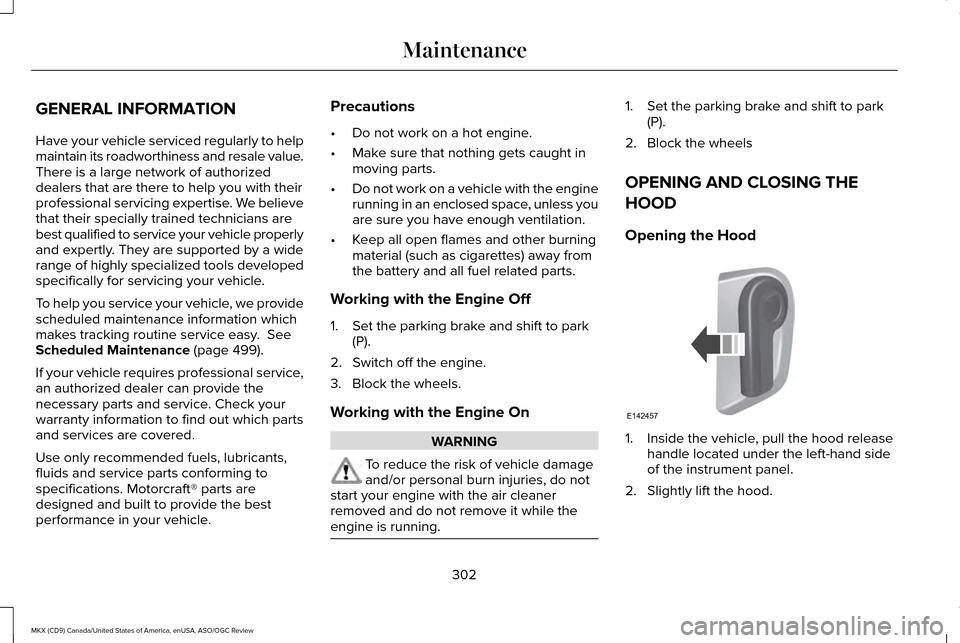
Opening the Hood 1. Inside the vehicle, pull the hood release
handle located under the left-hand side
of the instrument panel.
2. Slightly lift the hood.
302
MKX (CD9) Canada/United States of America, enUSA, ASO/OGC Review MaintenanceE142457
Page 316 of 563
AUTOMATIC TRANSMISSION
FLUID CHECK
WARNING
Do not use supplemental transmission
fluid additives, treatments or cleaning
agents. The use of these materials may affect
transmission operation and result in damage
to internal transmission components. The transmission does not consume fluid.
However, if the transmission slips or shifts
slowly you should check the fluid level. If you
notice a sign of leaking fluid, contact an
authorized dealer.
Checking the Transmission Fluid Level
*
Only check the transmission fluid level when
the engine is at normal operating temprature
179°F (82°C)-199°F (93°C). Normal operating
temprature is reached after driving
approximately
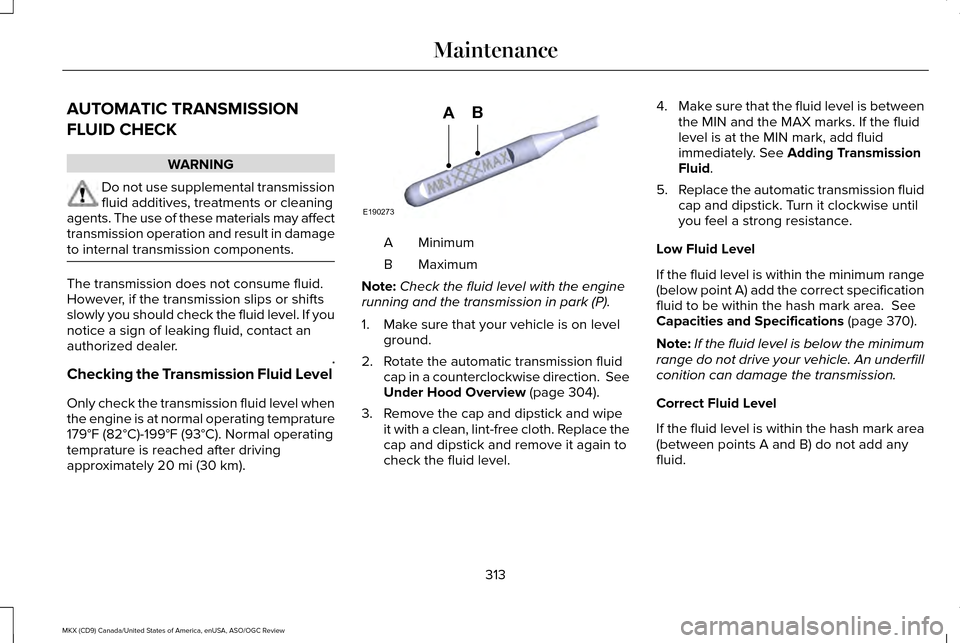
20 mi (30 km). Minimum
A
Maximum
B
Note: Check the fluid level with the engine
running and the transmission in park (P).
1. Make sure that your vehicle is on level ground.
2. Rotate the automatic transmission fluid cap in a counterclockwise direction. See
Under Hood Overview
(page 304).
3. Remove the cap and dipstick and wipe it with a clean, lint-free cloth. Replace the
cap and dipstick and remove it again to
check the fluid level. 4.
Make sure that the fluid level is between
the MIN and the MAX marks. If the fluid
level is at the MIN mark, add fluid
immediately. See
Adding Transmission
Fluid.
5. Replace the automatic transmission fluid
cap and dipstick. Turn it clockwise until
you feel a strong resistance.
Low Fluid Level
If the fluid level is within the minimum range
(below point A) add the correct specification
fluid to be within the hash mark area.
See
Capacities and Specifications (page 370).
Note: If the fluid level is below the minimum
range do not drive your vehicle. An underfill
conition can damage the transmission.
Correct Fluid Level
If the fluid level is within the hash mark area
(between points A and B) do not add any
fluid.
313
MKX (CD9) Canada/United States of America, enUSA, ASO/OGC Review MaintenanceE190273
AB
Page 317 of 563
High Fluid Level
If the fluid level is above the maximum range
(above point A) fluid may need to be
removed. High fluid levels may be caused
by a overheating condition. If you have
operated your vehicle at high speeds, towing
a trailer or in city traffic during hot weather,
allow your vehicle to cool for a minimum of
30 minutes before rechecking the level.
Note:
An overfill conition can damage the
transmission.
Adding Transmission Fluid *
1. Rotate the automatic transmission fluid cap in a counterclockwise direction. *
2. Remove the cap and dipstick and wipe it with a clean, lint-free cloth.
3. Add fluid that meets the Ford specifications. See Capacities and
Specifications (page 376). Pour the fluid
directly into the automatic transmission
fluid cap and dipstick hole.
4. Replace the cap and dipstick and remove
it again to check the fluid level. 5.
Make sure that the fluid level is between
the MIN and the MAX marks.
6. Replace the automatic transmission fluid
cap and dipstick. Turn it clockwise until
you feel a strong resistance.
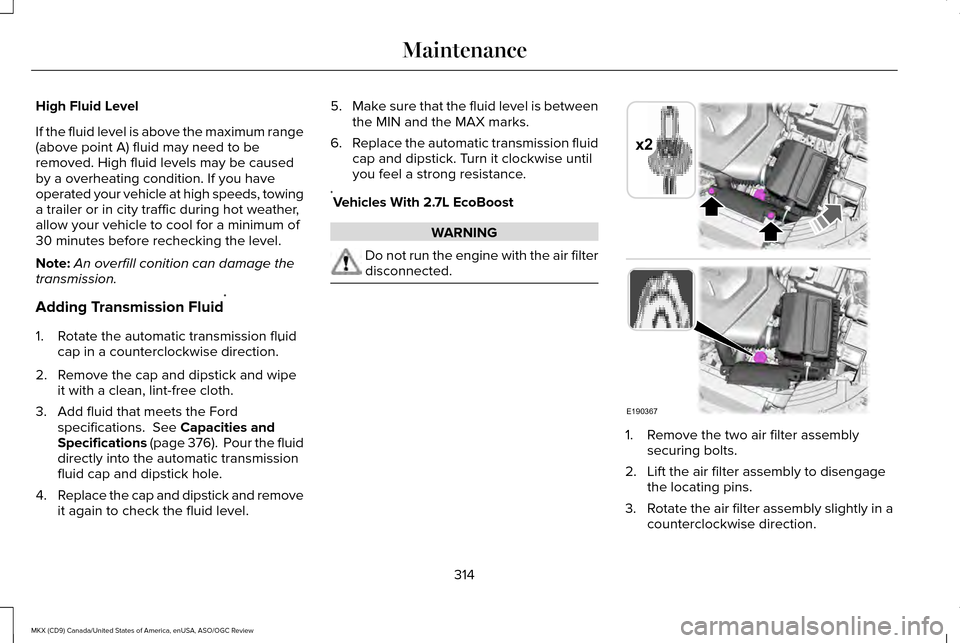
* Vehicles With 2.7L EcoBoost WARNING
Do not run the engine with the air filter
disconnected.
1. Remove the two air filter assembly
securing bolts.
2. Lift the air filter assembly to disengage the locating pins.
3. Rotate the air filter assembly slightly in a
counterclockwise direction.
314
MKX (CD9) Canada/United States of America, enUSA, ASO/OGC Review MaintenanceE190367
x2
Page 320 of 563
For longer, trouble-free operation, keep the
top of the battery clean and dry. Also, make
certain the battery cables are always tightly
fastened to the battery terminals.
If you see any corrosion on the battery or
terminals, remove the cables from the
terminals and clean with a wire brush. You
can neutralize the acid with a solution of
baking soda and water.
When a battery replacement is required, the
battery should only be replaced with a Ford
recommended replacement battery that
matches the electrical requirements of the
vehicle.
Because your vehicle
’s engine is
electronically-controlled by a computer,
some engine control settings are maintained
by power from the low voltage battery. Some
engine computer settings, like the idle trim
and fuel trim strategy, optimize the
driveability and performance of the engine. Some other computer settings, like the clock
and radio station presets, are also maintained
in memory by power from the low voltage
battery. When a technician disconnects and
connects the low voltage battery, these
settings are erased.
Note:
Until you switch the ignition to the on
position, you will receive a message in your
information display stating that your vehicle
is not in park.
Complete the following procedure in order
to restore the settings:
1. With the vehicle at a complete stop, set the parking brake.
2. Shift the transmission into P.
3. Turn off all accessories.
4. Step on the brake pedal and start the vehicle. 5. Run the engine until it reaches normal
operating temperature. While the engine
is warming up, complete the following:
Reset the clock. See Audio System
(page 388). Reset the power windows
bounce-back feature. See Windows and
Mirrors (page 100).
Reset the radio station
presets. See Audio System (page 388).
6. Allow the engine to idle for at least one minute. If the engine turns off, step on
the accelerator to start the engine.
7. While the engine is running, step on the brake pedal and shift the transmission to
N.
8. Allow the engine to run for at least one minute by pressing on the accelerator
pedal.
9. Drive your vehicle at least 10 miles (16 kilometers) to completely relearn the idle
and fuel trim strategy.
Note: Certain features may not operate if
the Battery Monitor System is not reset with
a scan tool following a jump start or battery
replacement. Normal electrical accessory
operation should resume after your vehicle
is left undisturbed for 8 hours.
317
MKX (CD9) Canada/United States of America, enUSA, ASO/OGC Review Maintenance
Page 321 of 563
Note:
If you do not allow the engine to
relearn the idle and fuel trim strategy, the
idle quality of your vehicle may be adversely
affected until the engine computer
eventually relearns the idle trim and fuel trim
strategy.
Note: Always dispose of automotive
batteries in a responsible manner. Follow
your local authorized standards for disposal.
Call your local authorized recycling center
to find out more about recycling automotive
batteries.
Note: It is recommended that the negative
battery cable terminal be disconnected from
the battery if you plan to store your vehicle
for an extended period of time. CHECKING THE WIPER BLADES Run the tip of your fingers over the edge of
the blade to check for roughness.
Clean the wiper blades with washer fluid or
water applied with a soft sponge or cloth.
CHANGING THE WIPER BLADES
Note:
If streaks or smears appear on the
windshield, clean the windshield and the
wiper blades. See Vehicle Care (page 325).
If that does not resolve the issue, install
new wiper blades. See Changing the Wiper
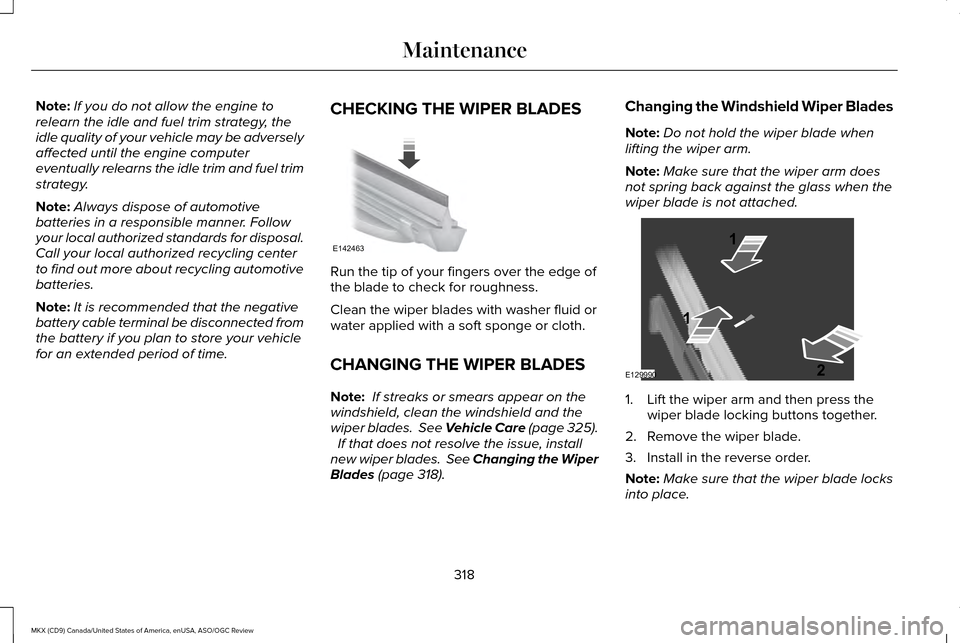
Blades (page 318). Changing the Windshield Wiper Blades
Note:
Do not hold the wiper blade when
lifting the wiper arm.
Note: Make sure that the wiper arm does
not spring back against the glass when the
wiper blade is not attached. 1. Lift the wiper arm and then press the
wiper blade locking buttons together.
2. Remove the wiper blade.
3. Install in the reverse order.
Note: Make sure that the wiper blade locks
into place.
318
MKX (CD9) Canada/United States of America, enUSA, ASO/OGC Review MaintenanceE142463 E129990
1
1 2
Page 322 of 563
Note:
Make sure the windshield is clean
before using new wiper blades. See Vehicle
Care (page 325).
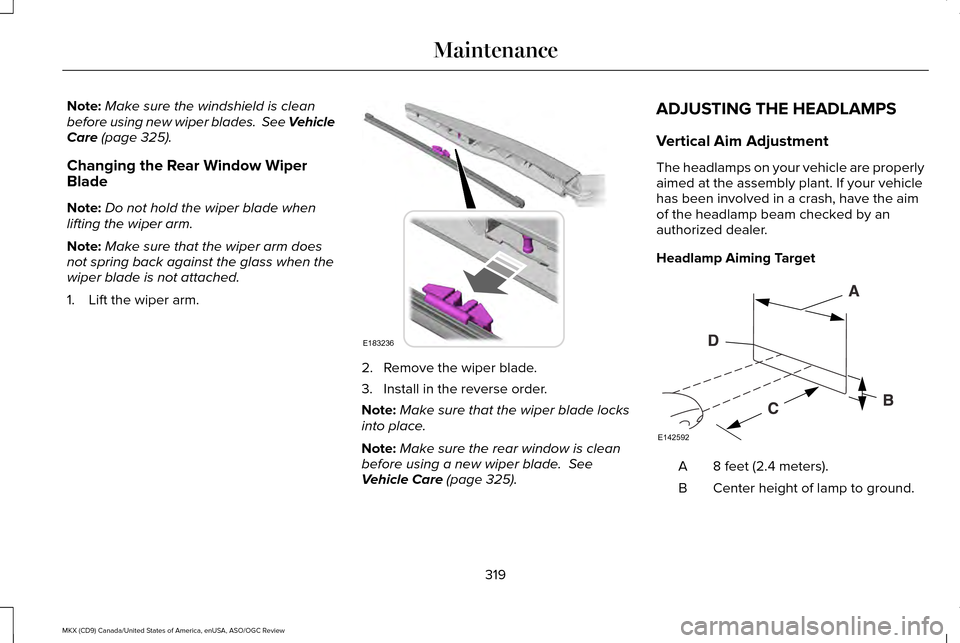
Changing the Rear Window Wiper
Blade
Note: Do not hold the wiper blade when
lifting the wiper arm.
Note: Make sure that the wiper arm does
not spring back against the glass when the
wiper blade is not attached.
1. Lift the wiper arm. 2. Remove the wiper blade.
3. Install in the reverse order.
Note:
Make sure that the wiper blade locks
into place.
Note: Make sure the rear window is clean
before using a new wiper blade.
See
Vehicle Care (page 325). ADJUSTING THE HEADLAMPS
Vertical Aim Adjustment
The headlamps on your vehicle are properly
aimed at the assembly plant. If your vehicle
has been involved in a crash, have the aim
of the headlamp beam checked by an
authorized dealer.
Headlamp Aiming Target
8 feet (2.4 meters).
A
Center height of lamp to ground.
B
319
MKX (CD9) Canada/United States of America, enUSA, ASO/OGC Review MaintenanceE183236 E142592
Page 323 of 563
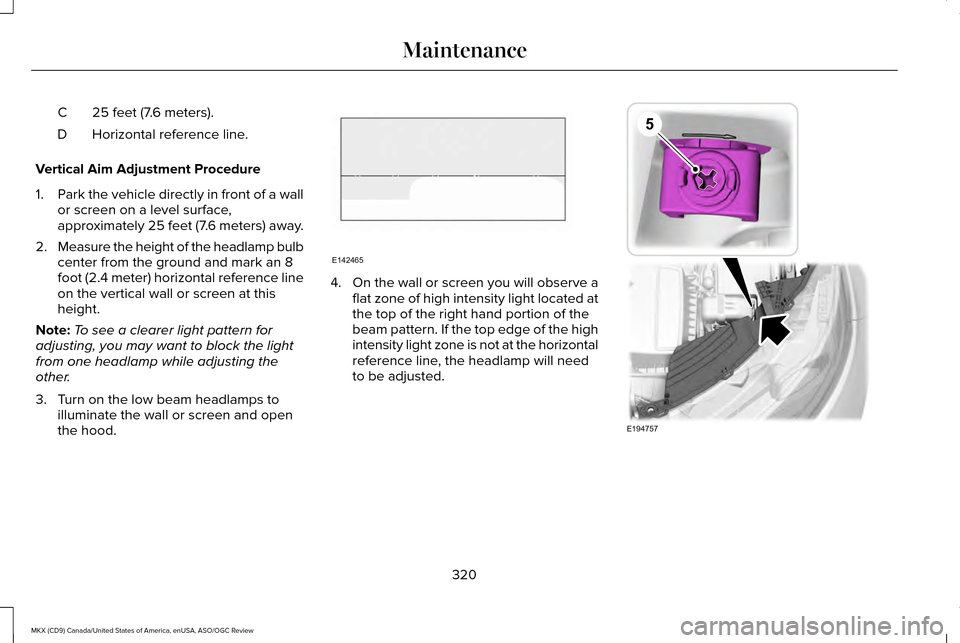
25 feet (7.6 meters).
C
Horizontal reference line.
D
Vertical Aim Adjustment Procedure
1. Park the vehicle directly in front of a wall
or screen on a level surface,
approximately 25 feet (7.6 meters) away.
2. Measure the height of the headlamp bulb
center from the ground and mark an 8
foot (2.4 meter) horizontal reference line
on the vertical wall or screen at this
height.
Note: To see a clearer light pattern for
adjusting, you may want to block the light
from one headlamp while adjusting the
other.
3. Turn on the low beam headlamps to illuminate the wall or screen and open
the hood. 4.
On the wall or screen you will observe a
flat zone of high intensity light located at
the top of the right hand portion of the
beam pattern. If the top edge of the high
intensity light zone is not at the horizontal
reference line, the headlamp will need
to be adjusted. 320
MKX (CD9) Canada/United States of America, enUSA, ASO/OGC Review MaintenanceE142465 E194757
5