tire type LINCOLN MKX 2018 User Guide
[x] Cancel search | Manufacturer: LINCOLN, Model Year: 2018, Model line: MKX, Model: LINCOLN MKX 2018Pages: 603, PDF Size: 4.94 MB
Page 363 of 603
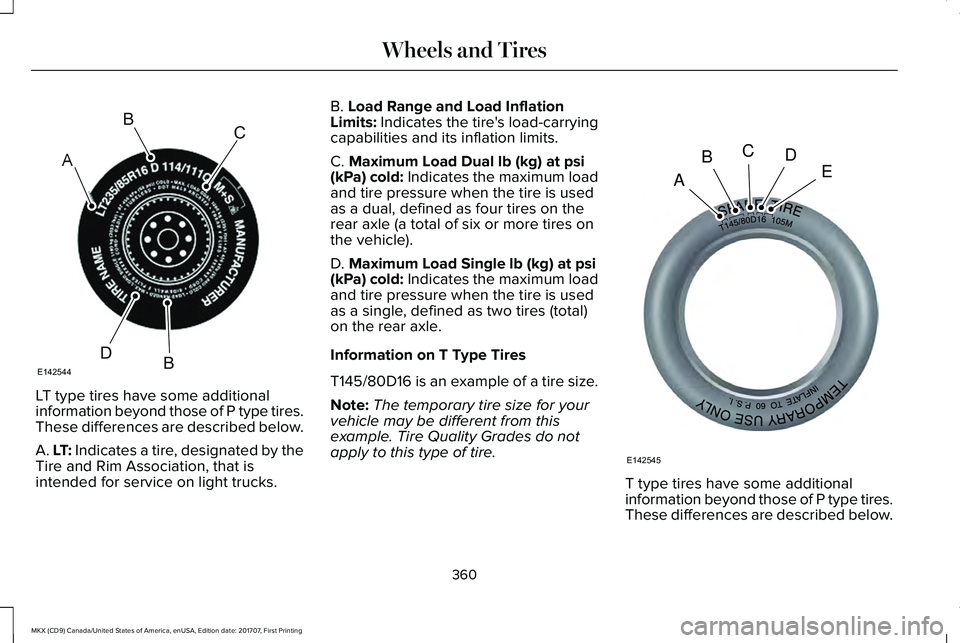
LT type tires have some additional
information beyond those of P type tires.These differences are described below.
A. LT: Indicates a tire, designated by theTire and Rim Association, that isintended for service on light trucks.
B. Load Range and Load InflationLimits: Indicates the tire's load-carryingcapabilities and its inflation limits.
C. Maximum Load Dual lb (kg) at psi(kPa) cold: Indicates the maximum loadand tire pressure when the tire is usedas a dual, defined as four tires on therear axle (a total of six or more tires onthe vehicle).
D. Maximum Load Single lb (kg) at psi(kPa) cold: Indicates the maximum loadand tire pressure when the tire is usedas a single, defined as two tires (total)on the rear axle.
Information on T Type Tires
T145/80D16 is an example of a tire size.
Note:The temporary tire size for yourvehicle may be different from thisexample. Tire Quality Grades do notapply to this type of tire.
T type tires have some additionalinformation beyond those of P type tires.These differences are described below.
360
MKX (CD9) Canada/United States of America, enUSA, Edition date: 201707, First Printing
Wheels and TiresA
BC
BDE142544 A
BCDE
E142545
Page 364 of 603
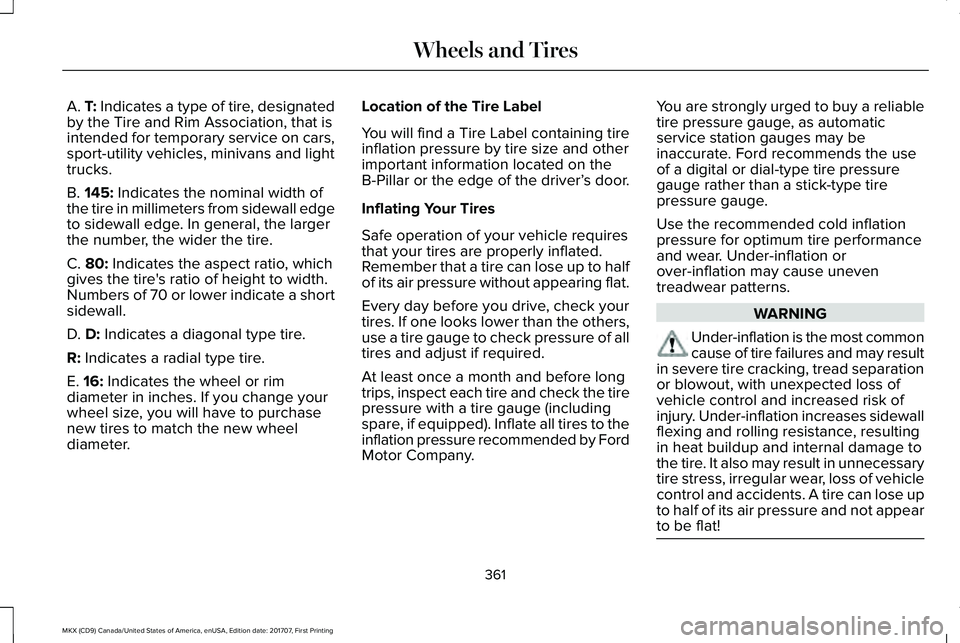
A. T: Indicates a type of tire, designatedby the Tire and Rim Association, that isintended for temporary service on cars,sport-utility vehicles, minivans and lighttrucks.
B. 145: Indicates the nominal width ofthe tire in millimeters from sidewall edgeto sidewall edge. In general, the largerthe number, the wider the tire.
C. 80: Indicates the aspect ratio, whichgives the tire's ratio of height to width.Numbers of 70 or lower indicate a shortsidewall.
D. D: Indicates a diagonal type tire.
R: Indicates a radial type tire.
E. 16: Indicates the wheel or rimdiameter in inches. If you change your
wheel size, you will have to purchasenew tires to match the new wheeldiameter.
Location of the Tire Label
You will find a Tire Label containing tireinflation pressure by tire size and otherimportant information located on theB-Pillar or the edge of the driver’s door.
Inflating Your Tires
Safe operation of your vehicle requiresthat your tires are properly inflated.Remember that a tire can lose up to halfof its air pressure without appearing flat.
Every day before you drive, check yourtires. If one looks lower than the others,use a tire gauge to check pressure of alltires and adjust if required.
At least once a month and before longtrips, inspect each tire and check the tirepressure with a tire gauge (includingspare, if equipped). Inflate all tires to theinflation pressure recommended by FordMotor Company.
You are strongly urged to buy a reliabletire pressure gauge, as automaticservice station gauges may beinaccurate. Ford recommends the useof a digital or dial-type tire pressuregauge rather than a stick-type tirepressure gauge.
Use the recommended cold inflationpressure for optimum tire performanceand wear. Under-inflation orover-inflation may cause uneventreadwear patterns.
WARNING
Under-inflation is the most commoncause of tire failures and may resultin severe tire cracking, tread separationor blowout, with unexpected loss ofvehicle control and increased risk of
injury. Under-inflation increases sidewallflexing and rolling resistance, resultingin heat buildup and internal damage tothe tire. It also may result in unnecessarytire stress, irregular wear, loss of vehiclecontrol and accidents. A tire can lose upto half of its air pressure and not appearto be flat!
361
MKX (CD9) Canada/United States of America, enUSA, Edition date: 201707, First Printing
Wheels and Tires
Page 366 of 603
Note:If you overfill the tire, release airby pressing on the metal stem in thecenter of the valve. Then recheck thepressure with your tire gauge.
4. Replace the valve cap.
5. Repeat this procedure for each tire,including the spare.
Note:Some spare tires operate at ahigher inflation pressure than the othertires. For T type mini-spare tires, see theDissimilar Spare Wheel and TireAssembly section. Store and maintainat 60 psi (4.15 bar). For full-size anddissimilar spare tires, see the DissimilarSpare Wheel and Tire AssemblyInformation section. Store and maintainat the higher of the front and rearinflation pressure as shown on the Tire
Label.
6. Visually inspect the tires to make surethere are no nails or other objectsembedded that could poke a hole in thetire and cause an air leak.
7. Check the sidewalls to make surethere are no gouges, cuts or bulges.
Inspecting Your Tires and Wheel ValveStems
Periodically inspect the tire treads foruneven or excessive wear and removeobjects such as stones, nails or glassthat may be wedged in the treadgrooves. Check the tire and valve stemsfor holes, cracks, or cuts that may permitair leakage and repair or replace the tireand replace the valve stem. Inspect thetire sidewalls for cracking, cuts, bruisesand other signs of damage or excessivewear. If internal damage to the tire issuspected, have the tire demounted andinspected in case it needs to be repairedor replaced. For your safety, tires thatare damaged or show signs of excessivewear should not be used because theyare more likely to blow out or fail.
Improper or inadequate vehiclemaintenance can cause tires to wearabnormally. Inspect all your tires,including the spare, frequently, andreplace them if one or more of thefollowing conditions exist:
Tire Wear
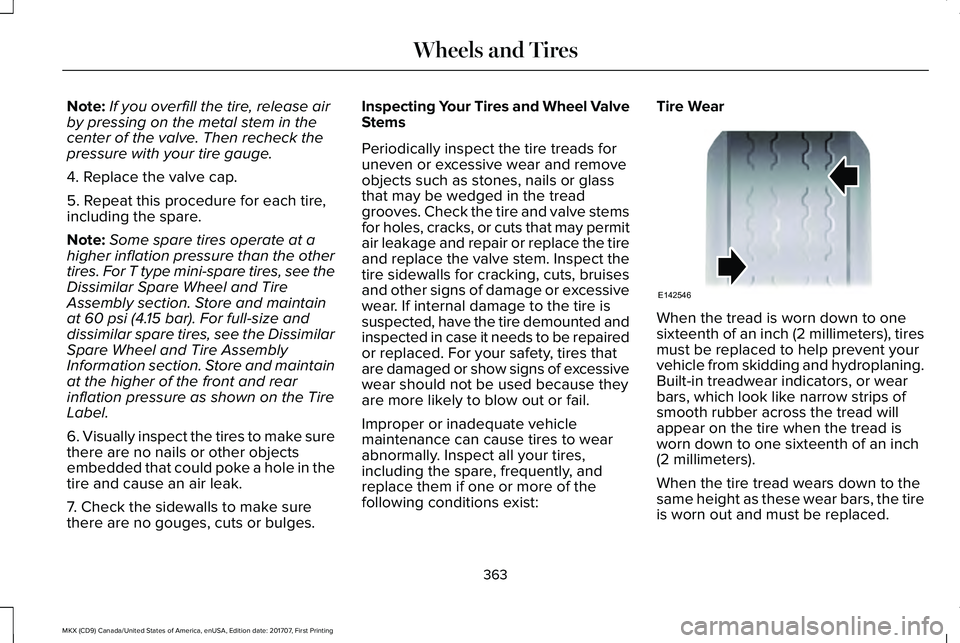
When the tread is worn down to onesixteenth of an inch (2 millimeters), tiresmust be replaced to help prevent yourvehicle from skidding and hydroplaning.Built-in treadwear indicators, or wearbars, which look like narrow strips ofsmooth rubber across the tread willappear on the tire when the tread isworn down to one sixteenth of an inch(2 millimeters).
When the tire tread wears down to thesame height as these wear bars, the tire
is worn out and must be replaced.
363
MKX (CD9) Canada/United States of America, enUSA, Edition date: 201707, First Printing
Wheels and TiresE142546
Page 367 of 603
Damage
Periodically inspect the tire treads andsidewalls for damage (such as bulges inthe tread or sidewalls, cracks in thetread groove and separation in the treador sidewall). If damage is observed orsuspected have the tire inspected by atire professional. Tires can be damagedduring off-road use, so inspection afteroff-road use is also recommended.
Age
WARNING
Tires degrade over time dependingon many factors such as weather,storage conditions, and conditions ofuse (load, speed, inflation pressure) thetires experience throughout their lives.
You should replace your spare tire whenyou replace the road tires or after sixyears due to aging even if it has notbeen used.
U.S. DOT Tire Identification Number
Both United States and Canada Federalregulations require tire manufacturersto place standardized information on thesidewall of all tires. This informationidentifies and describes the fundamentalcharacteristics of the tire and alsoprovides a U.S. DOT Tire IdentificationNumber for safety standard certificationand in case of a recall.
This begins with the letters DOT andindicates that the tire meets all federalstandards. The next two numbers orletters are the plant code designatingwhere it was manufactured, the next twoare the tire size code and the last fournumbers represent the week and yearthe tire was built. For example, the
numbers 317 mean the 31st week of1997. After 2000 the numbers go to fourdigits. For example, 2501 means the25th week of 2001. The numbers inbetween are identification codes usedfor traceability. This information is usedto contact customers if a tire defectrequires a recall.
Tire Replacement Requirements
Your vehicle is equipped with tiresdesigned to provide a safe ride andhandling capability.
WARNINGS
Only use replacement tires andwheels that are the same size, loadindex, speed rating and type (such asP-metric versus LT-metric or all-seasonversus all-terrain) as those originallyprovided by Ford. The recommendedtire and wheel size may be found oneither the Safety ComplianceCertification Label (affixed to either thedoor hinge pillar, door-latch post, or thedoor edge that meets the door-latchpost, next to the driver's seatingposition), or the Tire Label which is
located on the B-Pillar or edge of thedriver's door. If this information is notfound on these labels, then you shouldcontact your authorized dealer as soon
364
MKX (CD9) Canada/United States of America, enUSA, Edition date: 201707, First Printing
Wheels and Tires
Page 377 of 603
Have a flat serviced by an authorized dealerin order to prevent damage to the tirepressure monitoring system sensors. SeeTire Pressure Monitoring System (page 369).Replace the spare tire with a road tire assoon as possible. During repairing orreplacing of the flat tire, have an authorizeddealer inspect the tire pressure monitoringsystem sensor for damage.
Dissimilar Spare Wheel and TireAssembly Information
WARNING
Failure to follow these guidelines couldresult in an increased risk of loss ofvehicle control, injury or death.
If you have a dissimilar spare wheel and tire,then it is intended for temporary use only.This means that if you need to use it, youshould replace it as soon as possible with aroad wheel and tire assembly that is thesame size and type as the road tires andwheels that were originally provided by Ford.If the dissimilar spare tire or wheel isdamaged, it should be replaced rather thanrepaired.
A dissimilar spare wheel and tire assemblyis defined as a spare wheel and tire assemblythat is different in brand, size or appearancefrom the road tires and wheels and can beone of three types:
1. T-type mini-spare: This spare tire beginswith the letter T for tire size and may haveTemporary Use Only molded in the sidewall.
2. Full-size dissimilar spare with label onwheel: This spare tire has a label on thewheel that states: THIS WHEEL AND TIREASSEMBLY FOR TEMPORARY USE ONLY.
When driving with one of the dissimilar sparetires listed above, do not:
•Exceed 50 mph (80 km/h).
•Load the vehicle beyond maximumvehicle load rating listed on the SafetyCompliance Label.
•Tow a trailer.
•Use snow chains on the end of thevehicle with the dissimilar spare tire.
•Use more than one dissimilar spare tireat a time.
•Use commercial car washing equipment.
•Try to repair the dissimilar spare tire.
Use of one of the dissimilar spare tires listedabove at any one wheel location can lead toimpairment of the following:
•Handling, stability and brakingperformance.
•Comfort and noise.
•Ground clearance and parking at curbs.
•Winter weather driving capability.
•Wet weather driving capability.
•All-wheel driving capability (if applicable).
3. Full-size dissimilar spare without labelon wheel
374
MKX (CD9) Canada/United States of America, enUSA, Edition date: 201707, First Printing
Wheels and Tires
Page 588 of 603
TYPE APPROVALS
RF Certification Logos for Tire PressureMonitoring Sensor(s)
Argentina
Brazil
European Union EU
Ghana
Jordan
Malaysia
Mexico
585
MKX (CD9) Canada/United States of America, enUSA, Edition date: 201707, First Printing
AppendicesE207816 E197509 E207818 E253824 E253823 E253822 E253812 E253813
Page 593 of 603
Automatic Transmission..............................188Automatic Transmission AdaptiveLearning............................................................192Brake-Shift Interlock Override..........................191If Your Vehicle Gets Stuck In Mud orSnow..................................................................192Push Button Shift Transmission.......................188SelectShift Automatic™ Transmission.............190
Automatic Transmission Fluid Check - 2.7LEcoBoost™/3.7L............................................321Adding Transmission Fluid ..............................322Checking the Transmission Fluid Level ........321
Autowipers.......................................................94Autowipers Settings.............................................94
Auxiliary Power Points..................................167110 Volt AC Power Point.....................................16712 Volt DC Power Point......................................167Locations................................................................167
AWDSee: All-Wheel Drive...........................................193
B
BatterySee: Changing the 12V Battery.......................324
Blind Spot Information System.................244Switching the System Off and On..................245System Errors......................................................245
Using the Blind Spot InformationSystem..............................................................244
Body Styling Kits...........................................342Bonnet LockSee: Opening and Closing the Hood............308
Booster Seats..................................................30Types of Booster Seats........................................31
Brake Fluid Check........................................323Brakes..............................................................199General Information............................................199
Breaking-In......................................................271Bulb Specification Chart.............................329
C
Cabin Air Filter...............................................148California Proposition 65...............................12Capacities and Specifications - 2.7LEcoBoost™....................................................387Alternative Engine Oil for Extremely ColdClimates...........................................................392Specifications......................................................388
Capacities and Specifications - 3.7L........394Alternative Engine Oil for Extremely ColdClimates...........................................................399Specifications......................................................395
Capacities and Specifications....................381Cargo Nets.....................................................257
Car WashSee: Cleaning the Exterior...............................334
Catalytic Converter.......................................185On-Board Diagnostics (OBD-II)........................186Readiness for Inspection and Maintenance(I/M) Testing.......................................................187
Center Console.............................................169Changing a Bulb...........................................328Headlamp.............................................................329LED Lamps...........................................................329
Changing a Fuse..........................................305Fuses.....................................................................305
Changing a Road Wheel.............................373Dissimilar Spare Wheel and Tire AssemblyInformation.......................................................374Stowing the flat tire ...........................................377Tire Change Procedure....................................375
Changing the 12V Battery..........................324Changing the Engine Air Filter..................332Changing the Wiper Blades......................326Changing the Rear Window WiperBlade.................................................................326Changing the Windshield Wiper Blades......326
Checking MyKey System Status.................69Checking the Wiper Blades.......................326Child Restraint and SeatbeltMaintenance..................................................44Child Restraint Positioning...........................33
590
MKX (CD9) Canada/United States of America, enUSA, Edition date: 201707, First Printing
Index
Page 601 of 603
Stopping the Engine When Your Vehicle isMoving...............................................................174Stopping the Engine When Your Vehicle isStationary..........................................................174
Starting and Stopping the Engine..............171General Information.............................................171
Steering..........................................................250Adaptive Steering...............................................251Electric Power Steering....................................250
Steering Wheel................................................89Storage Compartments...............................169SunroofSee: Moonroof.....................................................109
Sun Visors.......................................................109Illuminated Vanity Mirror...................................109
Supplementary Restraints System..............47Principle of Operation..........................................47
Symbols Glossary..............................................7SYNC™ 3.........................................................406General Information...........................................406
SYNC™ 3 Troubleshooting..........................495
T
Technical SpecificationsSee: Capacities and Specifications................381
The Better Business Bureau (BBB) AutoLine Program (U.S. Only).........................282
Tire Care.........................................................352Glossary of Tire Terminology..........................355Important Information About Low-ProfileTires...................................................................352Important Information About Sport Tires andWheels..............................................................353Information About Uniform Tire QualityGrading.............................................................354Information Contained on the TireSidewall............................................................356Notice to Crossover Vehicle Owners............353Temperature A B C............................................355Tire Rotation........................................................366Traction AA A B C...............................................355Treadwear............................................................354
Tire Inflation When PuncturedSee: Tire Sealant and Inflator Kit....................345
Tire Pressure Monitoring System.............369Changing Tires With a Tire PressureMonitoring System.........................................370Understanding Your Tire Pressure MonitoringSystem .............................................................370
Tire Repair KitSee: Tire Sealant and Inflator Kit....................345
Tire Sealant and Inflator Kit.......................345First Stage: Inflating the Tire with SealingCompound and Air........................................347General Information...........................................346
Second Stage: Checking Tire Pressure.......350Tips for Use of the Kit........................................346What to Do After the Tire has BeenSealed...............................................................350What to do When a Tire Is Punctured...........347
TiresSee: Wheels and Tires......................................343
Towing a Trailer.............................................264Load Placement..................................................264
Towing the Vehicle on Four Wheels.......269Emergency Towing............................................269Recreational Towing..........................................269
Towing.............................................................264Traction Control............................................206Principle of Operation.......................................206
Trailer Sway Control....................................265Transmission Code Designation..............386Transmission...................................................188Transporting the Vehicle............................279Type Approvals.............................................585RF Certification Logos for Tire PressureMonitoring Sensor(s).....................................585
U
Under Hood Overview - 2.7LEcoBoost™.....................................................310Under Hood Overview - 3.7L......................312
598
MKX (CD9) Canada/United States of America, enUSA, Edition date: 201707, First Printing
Index