seats LINCOLN MKZ 2007 Owner's Manual
[x] Cancel search | Manufacturer: LINCOLN, Model Year: 2007, Model line: MKZ, Model: LINCOLN MKZ 2007Pages: 272, PDF Size: 2.24 MB
Page 138 of 272
Types of booster seats
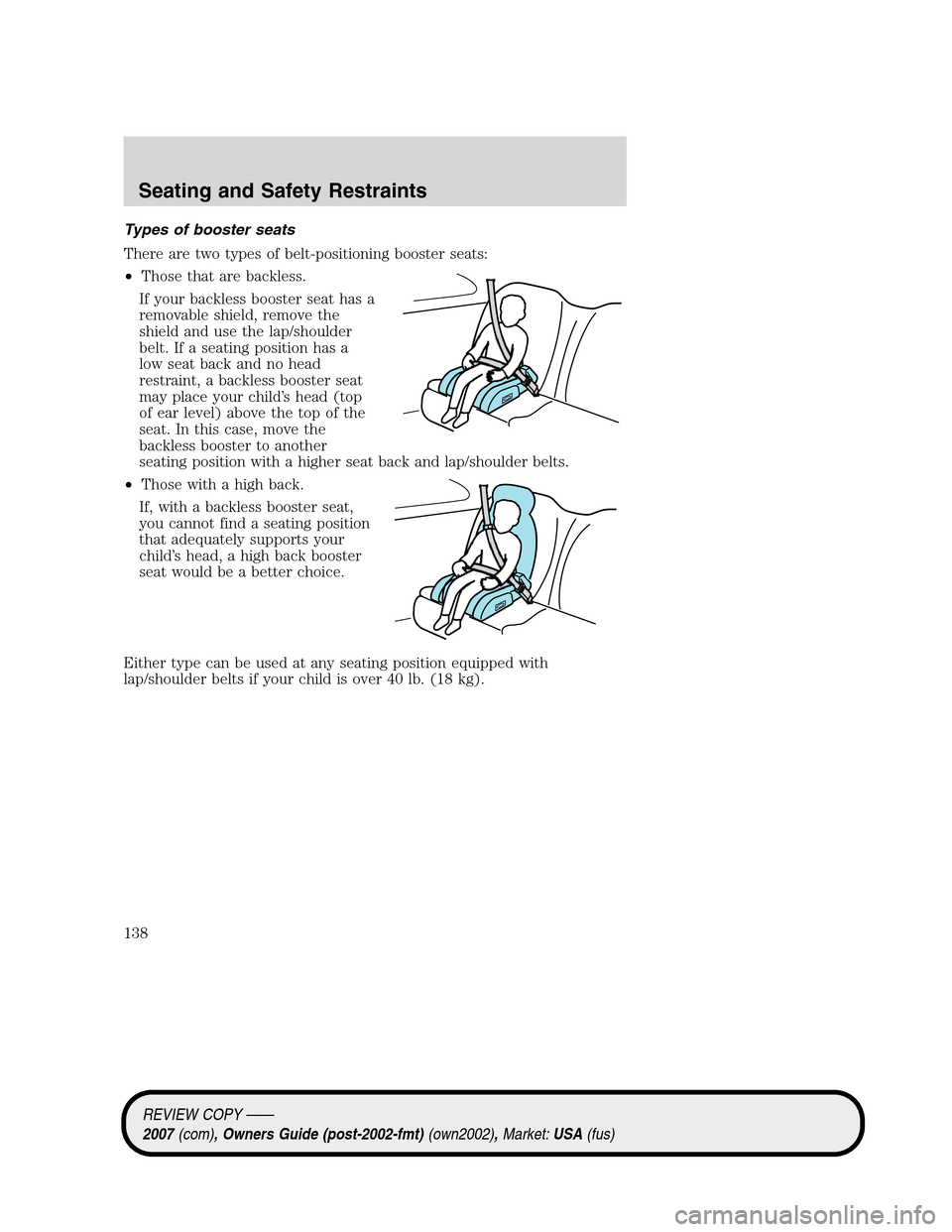
There are two types of belt-positioning booster seats:
•Those that are backless.
If your backless booster seat has a
removable shield, remove the
shield and use the lap/shoulder
belt. If a seating position has a
low seat back and no head
restraint, a backless booster seat
may place your child’s head (top
of ear level) above the top of the
seat. In this case, move the
backless booster to another
seating position with a higher seat back and lap/shoulder belts.
•Those with a high back.
If, with a backless booster seat,
you cannot find a seating position
that adequately supports your
child’s head, a high back booster
seat would be a better choice.
Either type can be used at any seating position equipped with
lap/shoulder belts if your child is over 40 lb. (18 kg).
REVIEW COPY ——
2007(com), Owners Guide (post-2002-fmt)(own2002),Market:USA(fus)
Seating and Safety Restraints
138
Page 139 of 272
Children and booster seats vary widely in size and shape. Choose a
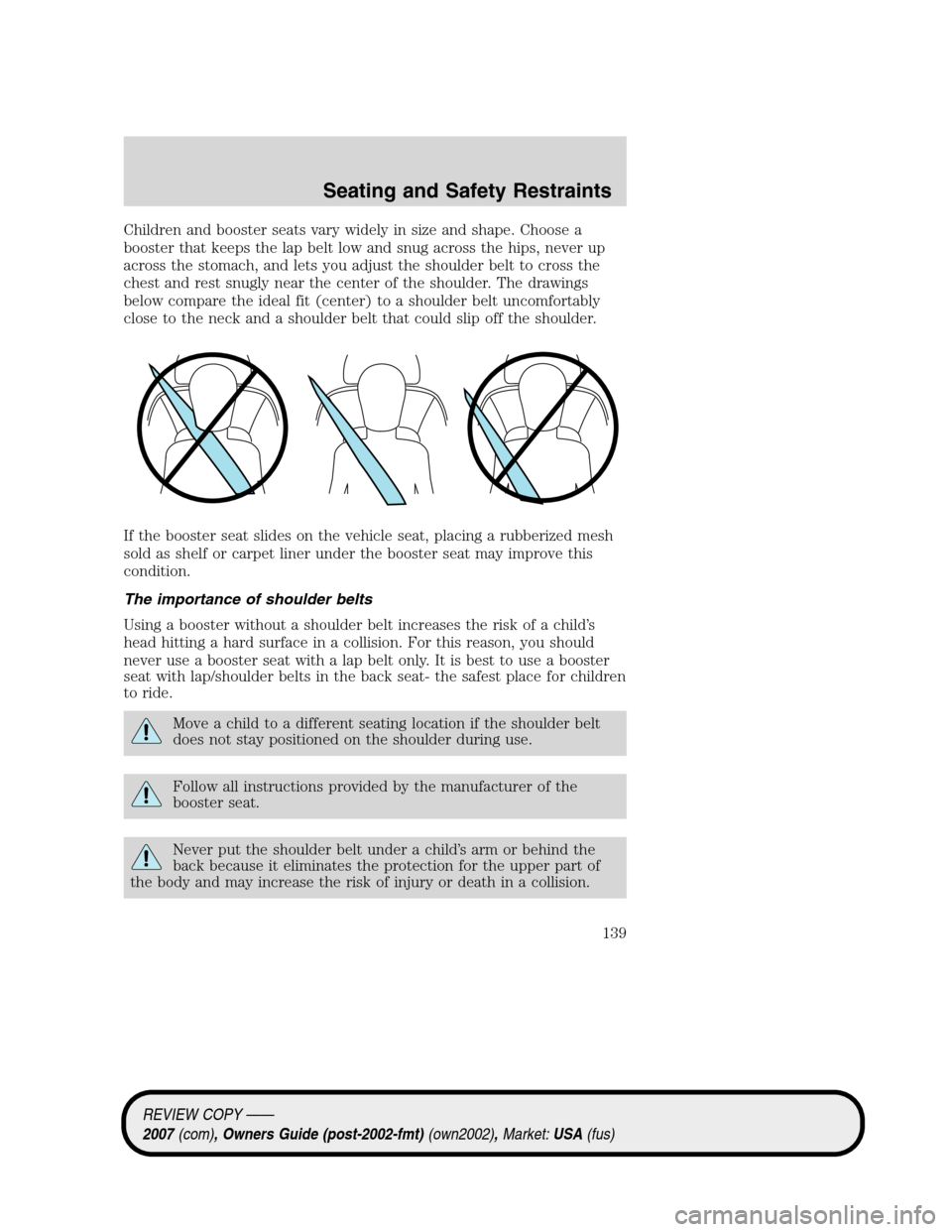
booster that keeps the lap belt low and snug across the hips, never up
across the stomach, and lets you adjust the shoulder belt to cross the
chest and rest snugly near the center of the shoulder. The drawings
below compare the ideal fit (center) to a shoulder belt uncomfortably
close to the neck and a shoulder belt that could slip off the shoulder.
If the booster seat slides on the vehicle seat, placing a rubberized mesh
sold as shelf or carpet liner under the booster seat may improve this
condition.
The importance of shoulder belts
Using a booster without a shoulder belt increases the risk of a child’s
head hitting a hard surface in a collision. For this reason, you should
never use a booster seat with a lap belt only. It is best to use a booster
seat with lap/shoulder belts in the back seat- the safest place for children
to ride.
Move a child to a different seating location if the shoulder belt
does not stay positioned on the shoulder during use.
Follow all instructions provided by the manufacturer of the
booster seat.
Never put the shoulder belt under a child’s arm or behind the
back because it eliminates the protection for the upper part of
the body and may increase the risk of injury or death in a collision.
REVIEW COPY ——
2007(com), Owners Guide (post-2002-fmt)(own2002),Market:USA(fus)
Seating and Safety Restraints
139
Page 140 of 272
Never use pillows, books, or towels to boost a child. They can
slide around and increase the likelihood of injury or death in a
collision.
SAFETY SEATS FOR CHILDREN
Child and infant or child safety seats
Use a safety seat that is recommended for the size and weight of the
child. Carefully follow all of the manufacturer’s instructions with the
safety seat you put in your vehicle. If you do not install and use the
safety seat properly, the child may be injured in a sudden stop or
collision.
When installing a child safety seat:
•Review and follow the information
presented in theAirbag
Supplemental Restraint System
section in this chapter.
•Use the correct safety belt buckle
for that seating position.
•Insert the belt tongue into the
proper buckle until you hear a
snap and feel it latch. Make sure
the tongue is securely fastened in
the buckle.
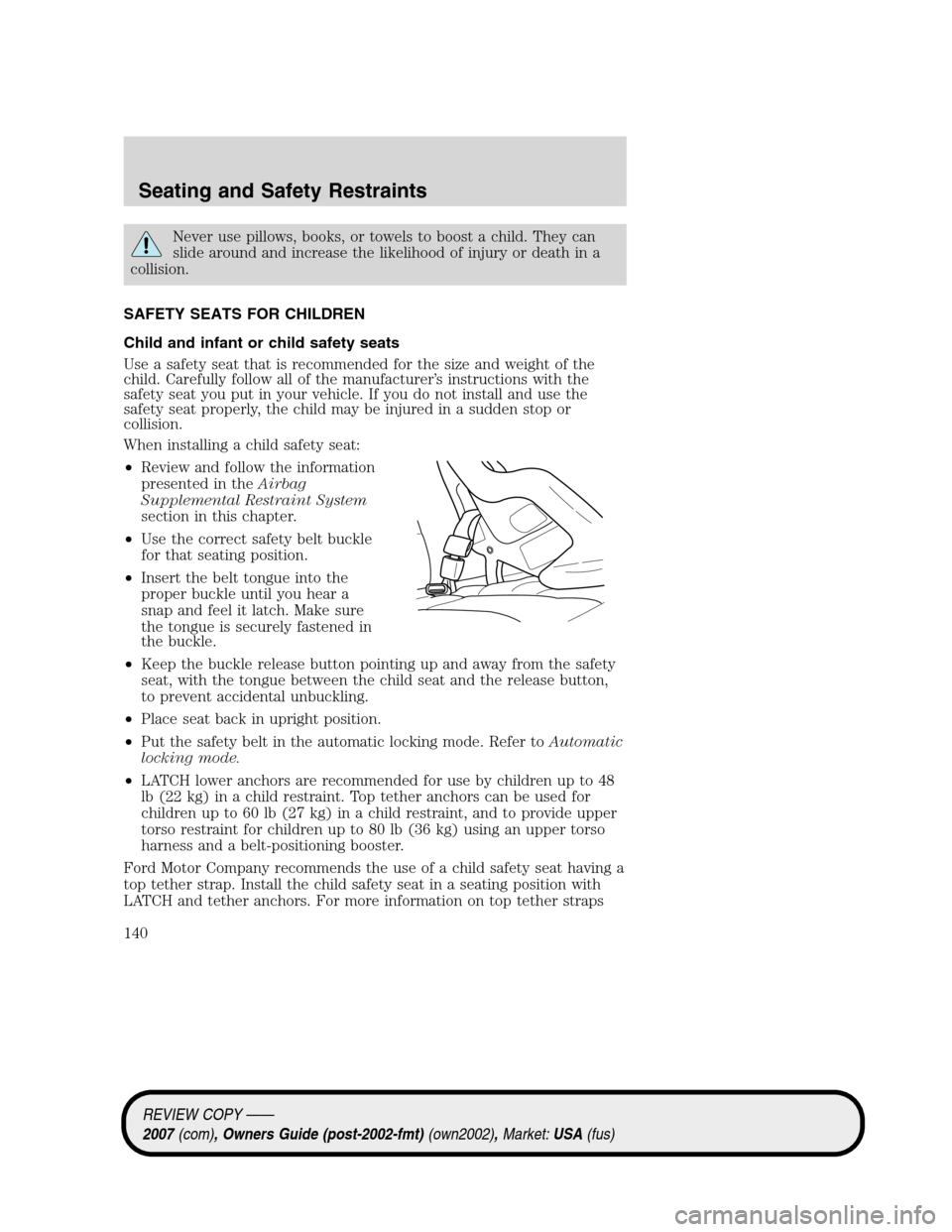
•Keep the buckle release button pointing up and away from the safety
seat, with the tongue between the child seat and the release button,
to prevent accidental unbuckling.
•Place seat back in upright position.
•Put the safety belt in the automatic locking mode. Refer toAutomatic
locking mode.
•LATCH lower anchors are recommended for use by children up to 48
lb (22 kg) in a child restraint. Top tether anchors can be used for
children up to 60 lb (27 kg) in a child restraint, and to provide upper
torso restraint for children up to 80 lb (36 kg) using an upper torso
harness and a belt-positioning booster.
Ford Motor Company recommends the use of a child safety seat having a
top tether strap. Install the child safety seat in a seating position with
LATCH and tether anchors. For more information on top tether straps
REVIEW COPY ——
2007(com), Owners Guide (post-2002-fmt)(own2002),Market:USA(fus)
Seating and Safety Restraints
140
Page 141 of 272
and anchors, refer toAttaching safety seats with tether strapsin this
chapter. For more information of LATCH anchors refer toAttaching
safety seats with LATCH (Lower Anchors and Tethers for Children)
attachmentsin this chapter.
Carefully follow all of the manufacturer’s instructions included
with the safety seat you put in your vehicle. If you do not install
and use the safety seat properly, the child may be injured in a sudden
stop or collision.
Rear-facing child seats or infant carriers should never be placed
in front of an active passenger airbag.
Installing child safety seats with combination lap and shoulder
belts
Airbags can kill or injure a child in a child seat.NEVERplace a
rear-facing child seat in front of an active airbag. If you must use
a forward-facing child seat in the front seat, move the seat all the way
back.
Children 12 and under should be properly restrained in the rear
seat whenever possible.
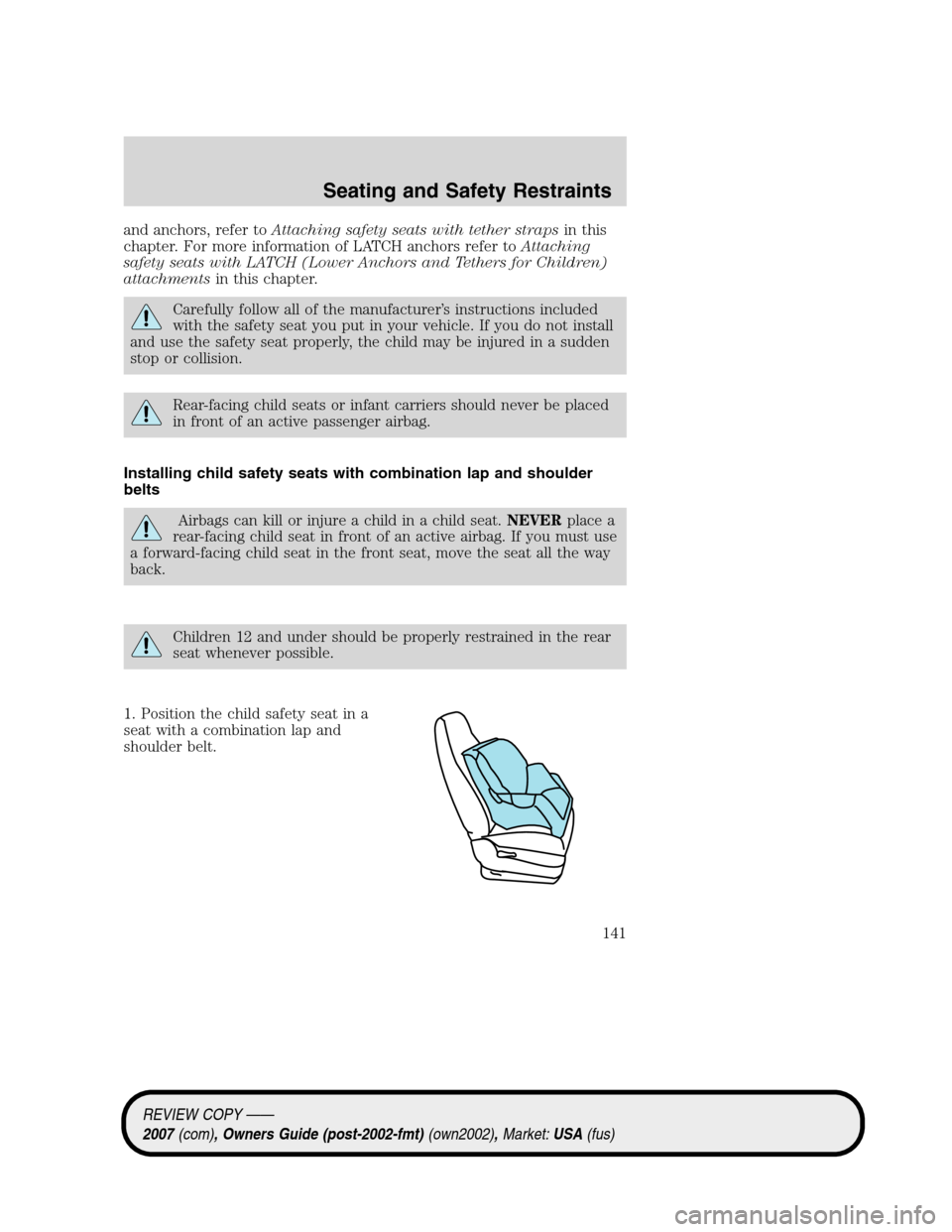
1. Position the child safety seat in a
seat with a combination lap and
shoulder belt.
REVIEW COPY ——
2007(com), Owners Guide (post-2002-fmt)(own2002),Market:USA(fus)
Seating and Safety Restraints
141
Page 144 of 272
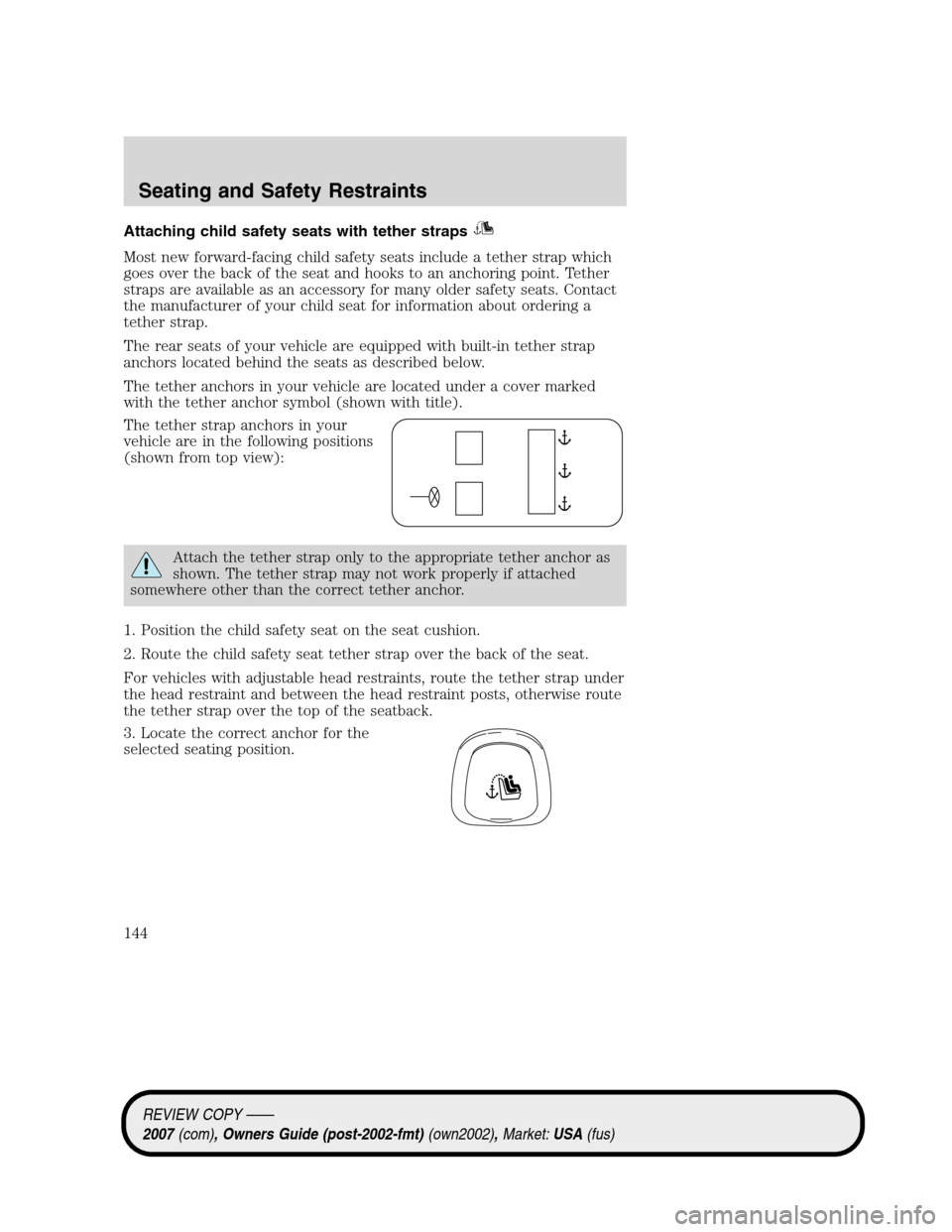
Attaching child safety seats with tether straps
Most new forward-facing child safety seats include a tether strap which
goes over the back of the seat and hooks to an anchoring point. Tether
straps are available as an accessory for many older safety seats. Contact
the manufacturer of your child seat for information about ordering a
tether strap.
The rear seats of your vehicle are equipped with built-in tether strap
anchors located behind the seats as described below.
The tether anchors in your vehicle are located under a cover marked
with the tether anchor symbol (shown with title).
The tether strap anchors in your
vehicle are in the following positions
(shown from top view):
Attach the tether strap only to the appropriate tether anchor as
shown. The tether strap may not work properly if attached
somewhere other than the correct tether anchor.
1. Position the child safety seat on the seat cushion.
2. Route the child safety seat tether strap over the back of the seat.
For vehicles with adjustable head restraints, route the tether strap under
the head restraint and between the head restraint posts, otherwise route
the tether strap over the top of the seatback.
3. Locate the correct anchor for the
selected seating position.
REVIEW COPY ——
2007(com), Owners Guide (post-2002-fmt)(own2002),Market:USA(fus)
Seating and Safety Restraints
144
Page 145 of 272
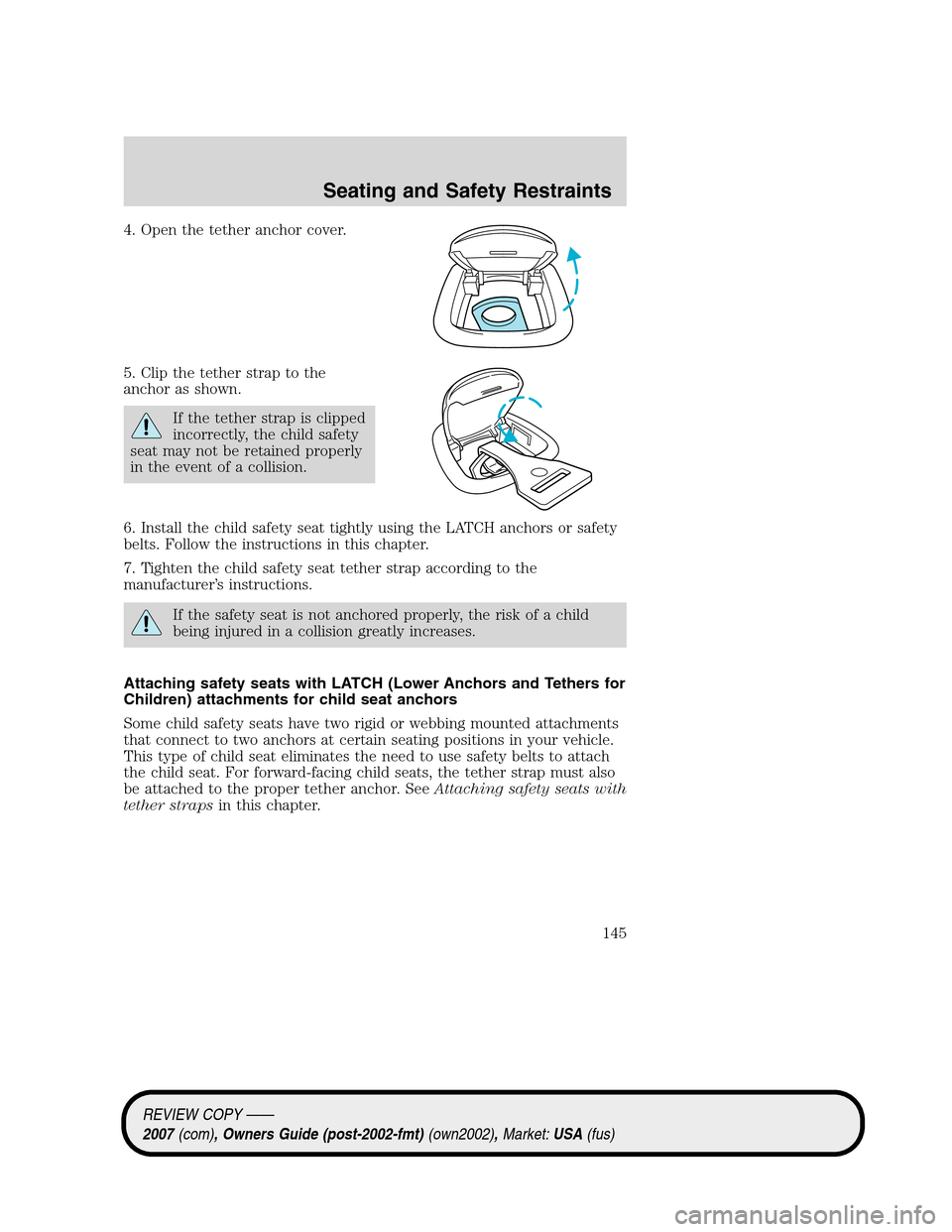
4. Open the tether anchor cover.
5. Clip the tether strap to the
anchor as shown.
If the tether strap is clipped
incorrectly, the child safety
seat may not be retained properly
in the event of a collision.
6. Install the child safety seat tightly using the LATCH anchors or safety
belts. Follow the instructions in this chapter.
7. Tighten the child safety seat tether strap according to the
manufacturer’s instructions.
If the safety seat is not anchored properly, the risk of a child
being injured in a collision greatly increases.
Attaching safety seats with LATCH (Lower Anchors and Tethers for
Children) attachments for child seat anchors
Some child safety seats have two rigid or webbing mounted attachments
that connect to two anchors at certain seating positions in your vehicle.
This type of child seat eliminates the need to use safety belts to attach
the child seat. For forward-facing child seats, the tether strap must also
be attached to the proper tether anchor. SeeAttaching safety seats with
tether strapsin this chapter.
REVIEW COPY ——
2007(com), Owners Guide (post-2002-fmt)(own2002),Market:USA(fus)
Seating and Safety Restraints
145
Page 146 of 272
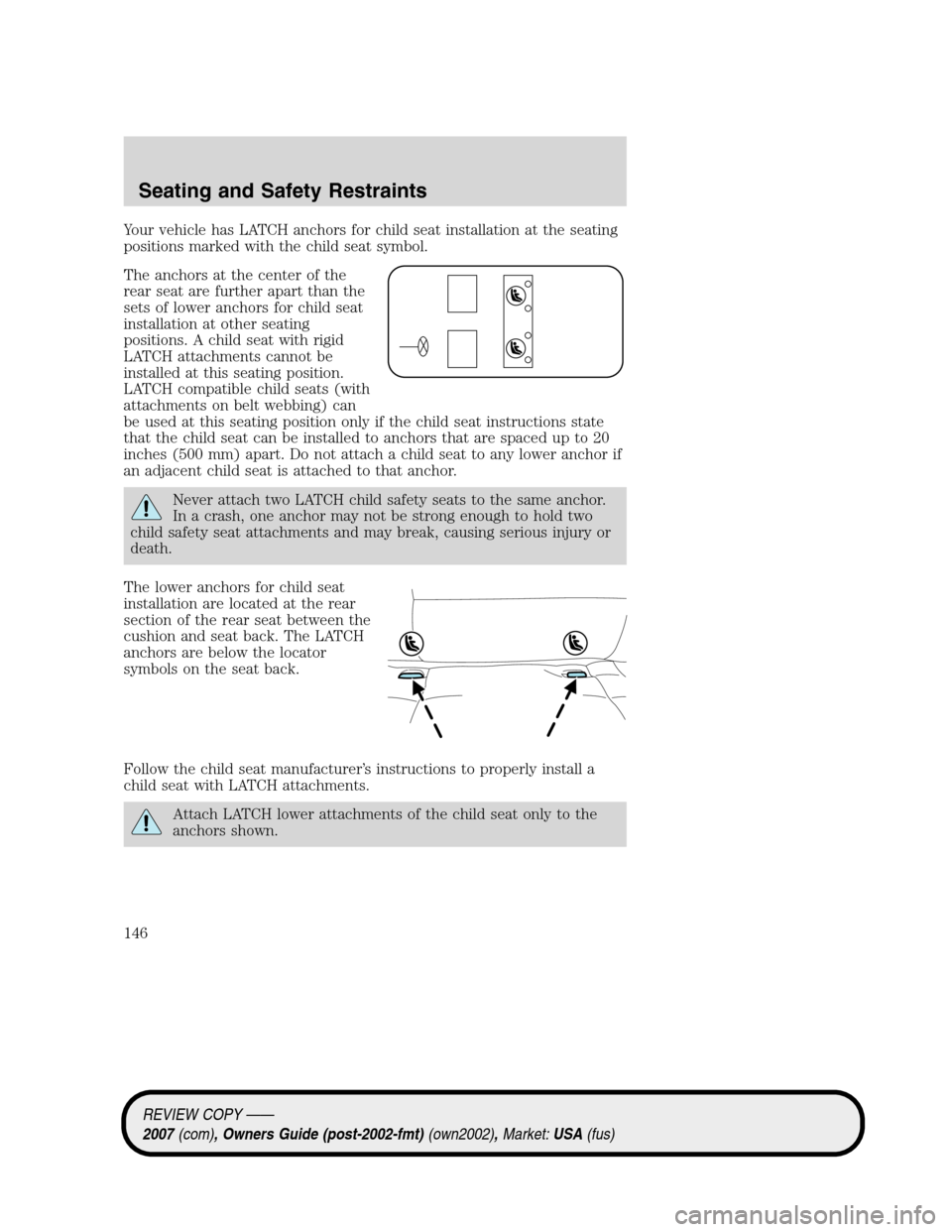
Your vehicle has LATCH anchors for child seat installation at the seating
positions marked with the child seat symbol.
The anchors at the center of the
rear seat are further apart than the
sets of lower anchors for child seat
installation at other seating
positions. A child seat with rigid
LATCH attachments cannot be
installed at this seating position.
LATCH compatible child seats (with
attachments on belt webbing) can
be used at this seating position only if the child seat instructions state
that the child seat can be installed to anchors that are spaced up to 20
inches (500 mm) apart. Do not attach a child seat to any lower anchor if
an adjacent child seat is attached to that anchor.
Never attach two LATCH child safety seats to the same anchor.
In a crash, one anchor may not be strong enough to hold two
child safety seat attachments and may break, causing serious injury or
death.
The lower anchors for child seat
installation are located at the rear
section of the rear seat between the
cushion and seat back. The LATCH
anchors are below the locator
symbols on the seat back.
Follow the child seat manufacturer’s instructions to properly install a
child seat with LATCH attachments.
Attach LATCH lower attachments of the child seat only to the
anchors shown.
REVIEW COPY ——
2007(com), Owners Guide (post-2002-fmt)(own2002),Market:USA(fus)
Seating and Safety Restraints
146
Page 192 of 272
Fuse/Relay
LocationFuse Amp
RatingPassenger Compartment Fuse Panel
Description
12 7.5A Delay accessories: Radio head units,
Moon roof, Front power windows,
Electrochromatic mirrors
13 7.5A Cluster, Analog clock, Climate control
head units
14 15A Washer pump
15 20A Cigar lighter
16 15A Door lock actuator, Decklid lock solenoid
17 20A Not used (Spare)
18 20A Radio head units, OBDII connector
19 7.5A Not used (Spare)
20 7.5A Power mirrors, Satellite radio module, All
wheel drive
21 7.5A Stop lamps, CHMSL
22 7.5A Audio
23 7.5A Wiper relay coil, Cluster logic
24 7.5A OCS (Passenger’s seat), PAD indicator
25 7.5A RCM
26 7.5A PATS Transceiver, Brake shift interlock
solenoid, Brake pedal switch, Automatic
transmission module
27 7.5A Cluster, Climate control head units
28 10A ABS/Traction Control, Heated seats,
Compass
C/B 30A Circuit
BreakerMoon roof, Delayed accessory (SJB fuse
12, rear power windows)
Power distribution box
The power distribution box is located in the engine compartment. The
power distribution box contains high-current fuses that protect your
vehicle’s main electrical systems from overloads.
Always disconnect the battery before servicing high current
fuses.
REVIEW COPY ——
2007(com), Owners Guide (post-2002-fmt)(own2002),Market:USA(fus)
Roadside Emergencies
192
Page 194 of 272
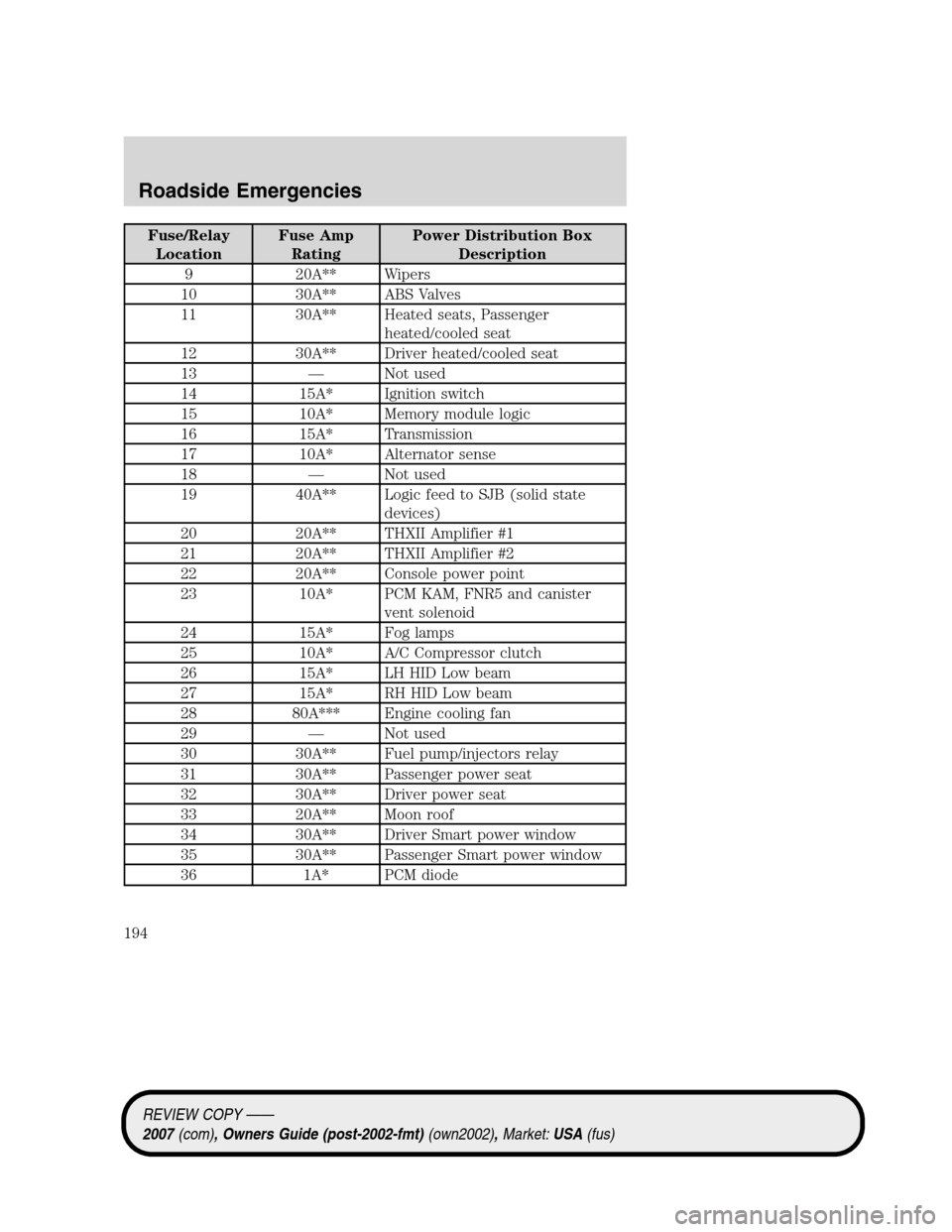
Fuse/Relay
LocationFuse Amp
RatingPower Distribution Box
Description
9 20A** Wipers
10 30A** ABS Valves
11 30A** Heated seats, Passenger
heated/cooled seat
12 30A** Driver heated/cooled seat
13 — Not used
14 15A* Ignition switch
15 10A* Memory module logic
16 15A* Transmission
17 10A* Alternator sense
18 — Not used
19 40A** Logic feed to SJB (solid state
devices)
20 20A** THXII Amplifier #1
21 20A** THXII Amplifier #2
22 20A** Console power point
23 10A* PCM KAM, FNR5 and canister
vent solenoid
24 15A* Fog lamps
25 10A* A/C Compressor clutch
26 15A* LH HID Low beam
27 15A* RH HID Low beam
28 80A*** Engine cooling fan
29 — Not used
30 30A** Fuel pump/injectors relay
31 30A** Passenger power seat
32 30A** Driver power seat
33 20A** Moon roof
34 30A** Driver Smart power window
35 30A** Passenger Smart power window
36 1A* PCM diode
REVIEW COPY ——
2007(com), Owners Guide (post-2002-fmt)(own2002),Market:USA(fus)
Roadside Emergencies
194
Page 219 of 272
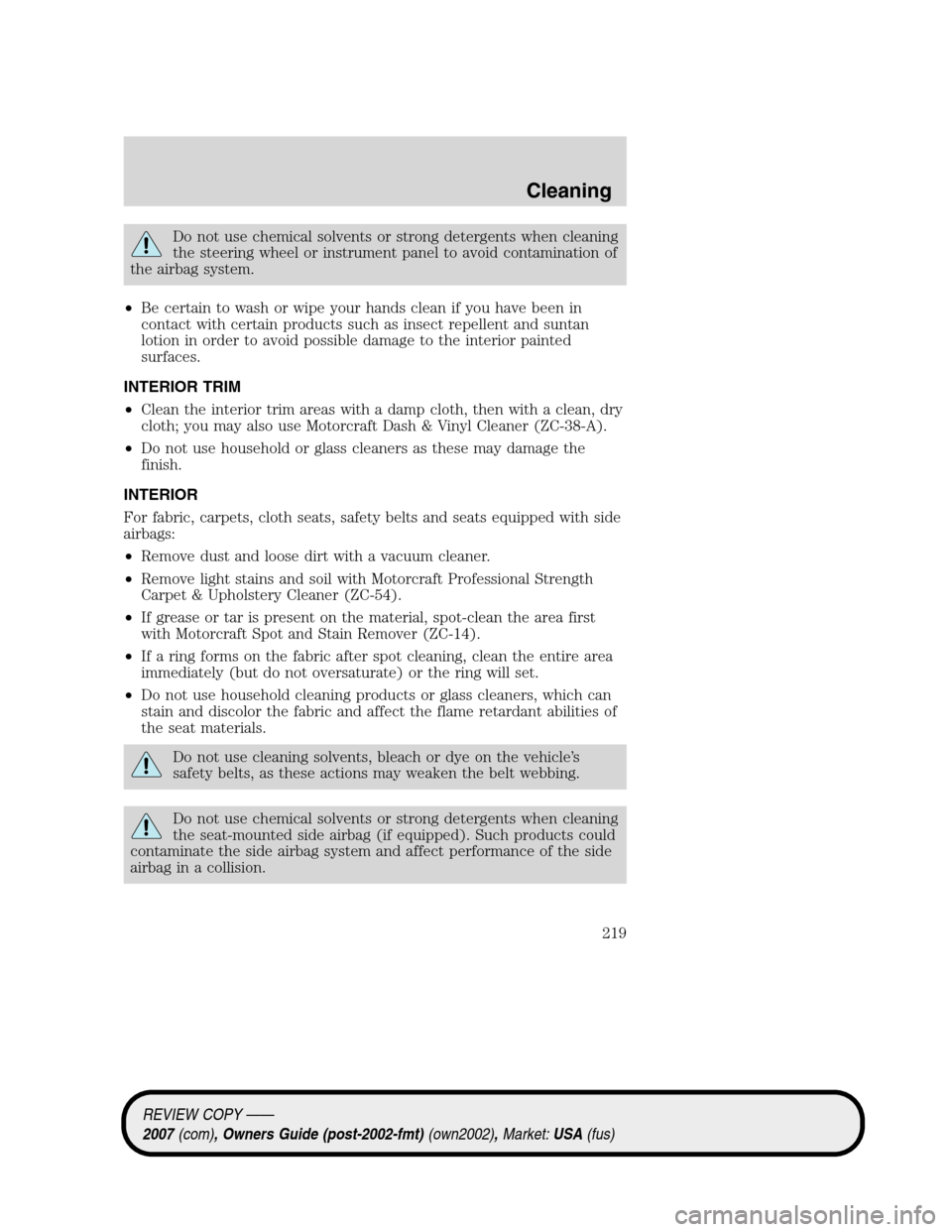
Do not use chemical solvents or strong detergents when cleaning
the steering wheel or instrument panel to avoid contamination of
the airbag system.
•Be certain to wash or wipe your hands clean if you have been in
contact with certain products such as insect repellent and suntan
lotion in order to avoid possible damage to the interior painted
surfaces.
INTERIOR TRIM
•Clean the interior trim areas with a damp cloth, then with a clean, dry
cloth; you may also use Motorcraft Dash & Vinyl Cleaner (ZC-38-A).
•Do not use household or glass cleaners as these may damage the
finish.
INTERIOR
For fabric, carpets, cloth seats, safety belts and seats equipped with side
airbags:
•Remove dust and loose dirt with a vacuum cleaner.
•Remove light stains and soil with Motorcraft Professional Strength
Carpet & Upholstery Cleaner (ZC-54).
•If grease or tar is present on the material, spot-clean the area first
with Motorcraft Spot and Stain Remover (ZC-14).
•If a ring forms on the fabric after spot cleaning, clean the entire area
immediately (but do not oversaturate) or the ring will set.
•Do not use household cleaning products or glass cleaners, which can
stain and discolor the fabric and affect the flame retardant abilities of
the seat materials.
Do not use cleaning solvents, bleach or dye on the vehicle’s
safety belts, as these actions may weaken the belt webbing.
Do not use chemical solvents or strong detergents when cleaning
the seat-mounted side airbag (if equipped). Such products could
contaminate the side airbag system and affect performance of the side
airbag in a collision.
REVIEW COPY ——
2007(com), Owners Guide (post-2002-fmt)(own2002),Market:USA(fus)
Cleaning
219