lights LINCOLN MKZ 2007 Owner's Guide
[x] Cancel search | Manufacturer: LINCOLN, Model Year: 2007, Model line: MKZ, Model: LINCOLN MKZ 2007Pages: 272, PDF Size: 2.24 MB
Page 170 of 272
STARTING
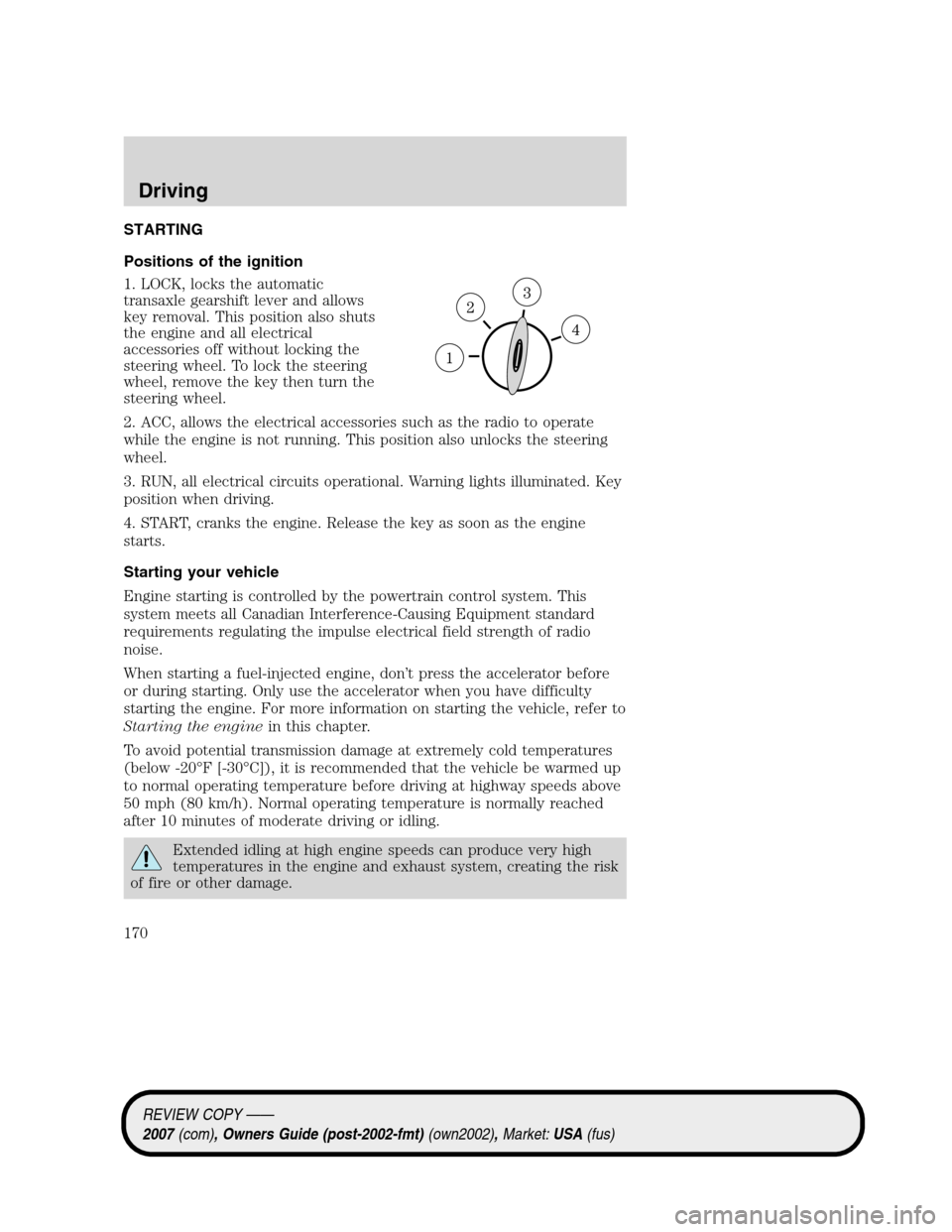
Positions of the ignition
1. LOCK, locks the automatic
transaxle gearshift lever and allows
key removal. This position also shuts
the engine and all electrical
accessories off without locking the
steering wheel. To lock the steering
wheel, remove the key then turn the
steering wheel.
2. ACC, allows the electrical accessories such as the radio to operate
while the engine is not running. This position also unlocks the steering
wheel.
3. RUN, all electrical circuits operational. Warning lights illuminated. Key
position when driving.
4. START, cranks the engine. Release the key as soon as the engine
starts.
Starting your vehicle
Engine starting is controlled by the powertrain control system. This
system meets all Canadian Interference-Causing Equipment standard
requirements regulating the impulse electrical field strength of radio
noise.
When starting a fuel-injected engine, don’t press the accelerator before
or during starting. Only use the accelerator when you have difficulty
starting the engine. For more information on starting the vehicle, refer to
Starting the enginein this chapter.
To avoid potential transmission damage at extremely cold temperatures
(below -20°F [-30°C]), it is recommended that the vehicle be warmed up
to normal operating temperature before driving at highway speeds above
50 mph (80 km/h). Normal operating temperature is normally reached
after 10 minutes of moderate driving or idling.
Extended idling at high engine speeds can produce very high
temperatures in the engine and exhaust system, creating the risk
of fire or other damage.
REVIEW COPY ——
2007(com), Owners Guide (post-2002-fmt)(own2002),Market:USA(fus)
Driving
170
Page 172 of 272
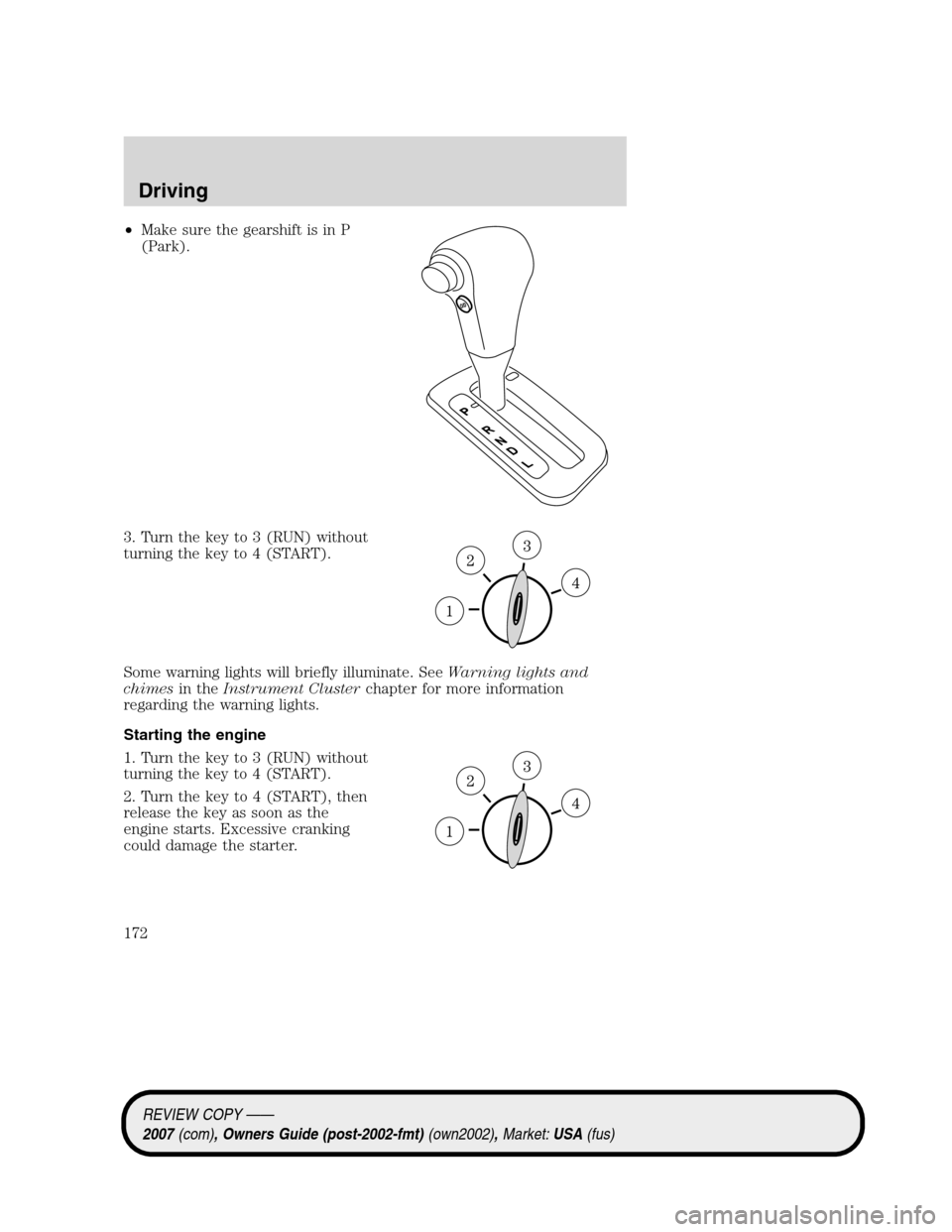
•Make sure the gearshift is in P
(Park).
3. Turn the key to 3 (RUN) without
turning the key to 4 (START).
Some warning lights will briefly illuminate. SeeWarning lights and
chimesin theInstrument Clusterchapter for more information
regarding the warning lights.
Starting the engine
1. Turn the key to 3 (RUN) without
turning the key to 4 (START).
2. Turn the key to 4 (START), then
release the key as soon as the
engine starts. Excessive cranking
could damage the starter.
REVIEW COPY ——
2007(com), Owners Guide (post-2002-fmt)(own2002),Market:USA(fus)
Driving
172
Page 242 of 272
Many of the world’s automakers approved the World-wide Fuel Charter
that recommends gasoline specifications to provide improved
performance and emission control system protection for your vehicle.
Gasolines that meet the World-wide Fuel Charter should be used when
available. Ask your fuel supplier about gasolines that meet the
World-wide Fuel Charter.
Cleaner air
Ford endorses the use of reformulated “cleaner-burning” gasolines to
improve air quality, per the recommendations in theChoosing the Right
Fuelsection.
Running out of fuel
Avoid running out of fuel because this situation may have an adverse
effect on powertrain components.
If you have run out of fuel:
•You may need to cycle the ignition from OFF to ON several times after
refueling to allow the fuel system to pump the fuel from the tank to
the engine. On restarting, cranking time will take a few seconds longer
than normal.
•Normally, adding one gallon of fuel is enough to restart the engine. If
the vehicle is out of fuel and on a steep grade, more than one gallon
may be required.
•The
indicator may come on. For more information on the “check
engine” or the “service engine soon” indicator, refer toWarning lights
and chimesin theInstrument Clusterchapter.
ESSENTIALS OF GOOD FUEL ECONOMY
Measuring techniques
Your best source of information about actual fuel economy is you, the
driver. You must gather information as accurately and consistently as
possible. Fuel expense, frequency of fill-ups or fuel gauge readings are
NOT accurate as a measure of fuel economy. We do not recommend
taking fuel economy measurements during the first 1,000 miles (1,600
km) of driving (engine break-in period). You will get a more accurate
measurement after 2,000 miles-3,000 miles (3,000 km–5,000 km).
Filling the tank
The advertised fuel capacity of the fuel tank on your vehicle is equal to
the rated refill capacity of the fuel tank as listed in theMaintenance
product specifications and capacitiessection of this chapter.
REVIEW COPY ——
2007(com), Owners Guide (post-2002-fmt)(own2002),Market:USA(fus)
Maintenance and Specifications
242
Page 263 of 272
Four-Wheel Drive vehicles
driving off road .......................181
Fuel ............................................238
calculating fuel
economy ............................69, 242
cap ...........................................240
capacity ...................................253
choosing the right fuel ...........241
comparisons with EPA fuel
economy estimates .................245
detergent in fuel .....................242
filling your vehicle
with fuel ..................238, 240, 242
filter, specifications ........237, 252
fuel pump shut-off switch .....189
improving fuel economy ........242
octane rating ...................241, 256
quality ......................................241
running out of fuel .................242
safety information relating
to automotive fuels ................238
Fuel pump shut-off switch .......189
Fuses ..........................................190
G
Gas cap (see Fuel cap) ............240
Gas mileage
(see Fuel economy) .................242
Gauges .........................................14
H
Hazard flashers .........................189
Head restraints .........................100
Headlamps ...................................36
aiming ........................................39
autolamp system .......................36
bulb specifications ....................41
daytime running lights .............37flash to pass ..............................38
high beam .................................38
replacing bulbs .........................42
turning on and off ....................36
Heating
heating and air conditioning
system .................................29, 31
Homelink wireless control
system ..........................................64
Hood ..........................................223
I
Ignition ...............................170, 256
Illuminated visor mirror .............52
Infant seats
(see Safety seats) .....................140
Inspection/maintenance (I/M)
testing ........................................247
Instrument panel
cleaning ...................................218
cluster ........................................10
lighting up panel and
interior .......................................38
J
Jack ............................................195
positioning ...............................195
storage .....................................195
Jump-starting your vehicle ......202
K
Keyless entry system .................92
autolock .....................................80
keypad .......................................92
locking and unlocking doors ....93
programming entry code .........92
Keys .......................................77, 95
positions of the ignition .........170
REVIEW COPY ——
2007(com), Owners Guide (post-2002-fmt)(own2002),Market:USA(fus)
Index
263
Page 264 of 272
L
Lamps
autolamp system .......................36
bulb replacement
specifications chart ..................41
daytime running light ...............37
fog lamps ...................................37
headlamps .................................36
headlamps, flash to pass ..........38
instrument panel, dimming .....38
interior lamps ...........................40
replacing bulbs .........................42
Lane change indicator
(see Turn signal) ........................40
Lights, warning and indicator ....10
anti-lock brakes (ABS) ..........174
Load limits .................................163
Locks
autolock .....................................80
childproof ..................................84
doors ..........................................79
Lubricant specifications ...........253
Lug nuts ....................................201
Lumbar support, seats .............103
M
Message center ...........................68
english/metric button ...............73
system check button ................72
warning messages .....................73
Mirrors .........................................57
automatic dimming
rearview mirror .........................57
heated ........................................58
programmable memory ............88
side view mirrors (power) .......57
Moon roof ..............................62, 87Motorcraft parts ........220, 237, 252
N
Navigation system .......................28
O
Octane rating ............................241
Oil (see Engine oil) ..................226
P
Parking brake ............................175
Parts (see Motorcraft parts) ....252
Passenger Occupant
Classification Sensor .................108
Power distribution box
(see Fuses) ...............................192
Power door locks ........................79
Power mirrors .............................57
Power point .................................54
Power steering ..................176–177
fluid, checking and adding ....248
fluid, refill capacity ................253
fluid, specifications .................253
Power Windows ...........................55
Power windows
opening using remote entry
system .......................................87
R
Radio ............................................16
Relays ........................................190
Remote entry system ...........86–87
illuminated entry ................90–91
locking/unlocking doors ...........87
REVIEW COPY ——
2007(com), Owners Guide (post-2002-fmt)(own2002),Market:USA(fus)
Index
264
Page 266 of 272
wrecker ....................................207
Traction control ........................175
Transmission .............................177
brake-shift interlock (BSI) ....177
fluid, refill capacities ..............253
lubricant specifications ..........253
Trunk ...........................................84
remote release ....................76, 88
Turn signal ..................................40
V
Vehicle Identification Number
(VIN) ..........................................257
Vehicle loading ..........................163
Ventilating your vehicle ...........173W
Warning lights (see Lights)
.......10
Washer fluid
..............................225
Water, Driving through
.............186
Windows
......................................87
opening using remote entry
system
.......................................87
power
.........................................55
Windshield washer fluid and
wipers
..........................................51
checking and adding fluid
.....225
replacing wiper blades
...........225
Wrecker towing
.........................207
REVIEW COPY ——
2007(com), Owners Guide (post-2002-fmt)(own2002),Market:USA(fus)
Index
266