trailer LINCOLN MKZ 2013 Owner's Manual
[x] Cancel search | Manufacturer: LINCOLN, Model Year: 2013, Model line: MKZ, Model: LINCOLN MKZ 2013Pages: 474, PDF Size: 3.79 MB
Page 236 of 474
Vehicles Equipped with a 2.0L
Engine
Front-wheel drive (FWD) vehicles
CANNOT be flat-towed (all wheels
on the ground) as vehicle or
transmission damage may occur. You
must place the front wheels on a
two-wheel tow dolly. If you are using
a tow dolly, follow the instructions
specified by the equipment provider.
All-wheel drive (AWD) vehicles
CANNOT
be flat-towed (all wheels
on the ground), as vehicle or
transmission damage may occur. It is
recommended to tow your vehicle
with all four (4) wheels off the ground
such as when using a car-hauling
trailer. Otherwise, you cannot tow your
vehicle.
Vehicles Equipped with a 3.7L
Engine
You can tow your vehicle with all four
wheels on the ground using the
Neutral Tow feature, or with all four
wheels off the ground using a vehicle
transport trailer. If you are using a
vehicle transport trailer, follow the
instruction specified by the equipment
provider.
If you tow your vehicle with all four
wheels on the ground:
• Tow only in the forward direction.
• Release the parking brake.
Neutral Tow
Enter Neutral Tow mode by doing the
following: 1.
Put the ignition in accessory mode
by pressing the engine START
button without pressing the brake
pedal.
2. Select
Neutral Tow under the
Vehicle Settings menu in the
information display. See General
Information (page 100).
3. Press and hold the OK button to start the neutral tow process.
4. Press the brake pedal and select N
on the push-button
transmission.
5. Turn the ignition off by pressing the
engine START button without
pressing the brake pedal.
If the process is completes
successfully:
• the
N on the push-button
transmission blinks slowly
• Neutral Tow Engaged turn
ignition off for towing
appears
in the information display.
Note: If the parking brake is applied,
Neutral Tow remove park brake for
towing
appears in the information
display.
Note: Do not exceed 65 mph (105
km/h).
Note: Start the engine and allow it to
run for five minutes at the beginning of
each day and every six hours (or fewer).
Shut the engine off and verify that
Neutral tow engaged
appears in the
display before continuing to tow.
233
Towing
Page 241 of 474
ROADSIDE ASSISTANCE
Vehicles Sold In The U.S.:
Getting Roadside Assistance
To fully assist you should you have a
vehicle concern Ford Motor Company
offers a complimentary roadside
assistance program. This program is
separate from the New Vehicle
Limited Warranty. The service is
available:
•
24-hours, seven days a week.
• for the coverage period listed on
the Roadside Assistance Card
included in your Owner's Manual
portfolio.
Roadside assistance will cover:
• a flat tire change with a good spare
(except vehicles that have been
supplied with a tire inflation kit).
• battery jump start.
• lock-out assistance (key
replacement cost is the customer's
responsibility).
• fuel delivery — Independent
Service Contractors, if not
prohibited by state, local or
municipal law shall deliver up to
2.0 gallons (7.5L) of gasoline or
5.0 gallons (18.9L) of diesel fuel
to a disabled vehicle. Fuel delivery
service is limited to two no-charge
occurrences within a 12-month
period. •
winch out — available within 100
feet (30.5 meters) of a paved or
county maintained road, no
recoveries.
• towing — Ford and Lincoln eligible
vehicles towed to an authorized
dealer within 35 miles (56 km) of
the disablement location or to the
nearest authorized dealer. If a
member requests to be towed to
an authorized dealer more than 35
miles (56 km) from the
disablement location, the member
shall be responsible for any
mileage costs in excess of 35 miles
(56 km).
Trailers shall be covered up to $200
if the disabled eligible vehicle requires
service at the nearest authorized
dealer. If the trailer is disabled, but the
towing vehicle is operational, the
trailer does not qualify for any
roadside services.
Vehicles Sold In The U.S. :
Using Roadside Assistance
Complete the roadside assistance
identification card and place it in your
wallet for quick reference. This card
is found in the owner's information
portfolio in the glove compartment.
U.S. Lincoln vehicle customers who
require Roadside Assistance, call
1-800-521-4140.
238
Roadside Emergencies
Page 276 of 474
![LINCOLN MKZ 2013 Owners Manual Note:
Automatic transmission fluid
expands when warmed. To obtain an
accurate fluid check, drive the vehicle
until it is warmed up (approximately
20 miles [30 kilometers]). If your
vehicle has been op](/img/15/6980/w960_6980-275.png "LINCOLN MKZ 2013 Owners Manual Note:
Automatic transmission fluid
expands when warmed. To obtain an
accurate fluid check, drive the vehicle
until it is warmed up (approximately
20 miles [30 kilometers]). If your
vehicle has been op")
Note:
Automatic transmission fluid
expands when warmed. To obtain an
accurate fluid check, drive the vehicle
until it is warmed up (approximately
20 miles [30 kilometers]). If your
vehicle has been operated for an
extended period at high speeds, in city
traffic during hot weather or pulling a
trailer, the vehicle should be turned off
until normal operating temperatures
are reached to allow the fluid to cool
before checking. Depending on vehicle
use, cooling times could take up to 30
minutes or longer.
Refer to your scheduled maintenance
information for scheduled intervals
for fluid checks and changes. Your
transmission does not consume fluid.
However, the fluid level should be
checked if the transmission is not
working properly. For example, if the
transmission slips or shifts slowly or
if you notice some sign of fluid
leakage.
1. Drive the vehicle 20 miles (30 kilometers) or until it reaches
normal operating temperature
2. Park the vehicle on a level surface and engage the parking brake.
3. With the parking brake engaged and your foot on the brake pedal,
start the engine and move the
gearshift lever through all of the
gear ranges. Allow a minimum of
10 seconds for each gear to
engage.
4. Put the gearshift lever in P (Park)
and leave the engine running. Note:
You will need to move the air
filter assembly to access the
transmission dipstick.
5. Remove the dipstick, wiping it clean with a clean, dry lint free rag.
If necessary, refer to Under hood
overview in this chapter for the
location of the dipstick.
6. Install the dipstick making sure it
is fully seated in the filler tube by
turning it to the locked position.
7. Remove the dipstick and inspect the fluid level. The fluid should be
in the designated areas for normal
operating temperature.
Moving the Air Filter Assembly
(Accessing the Dipstick) WARNING
Do not run engine with the air
filter disconnected.
273
Maintenance
Page 278 of 474
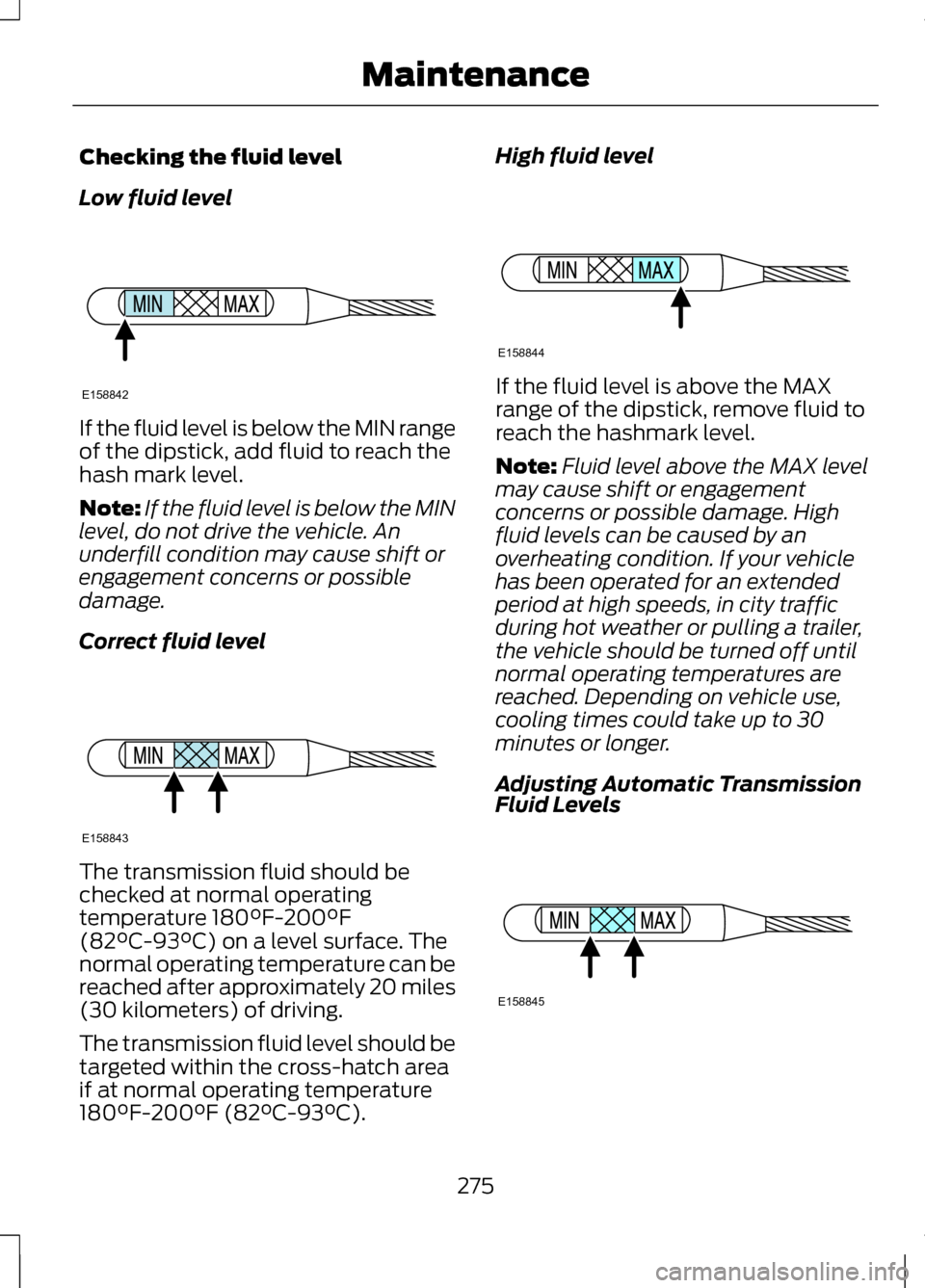
Checking the fluid level
Low fluid level
If the fluid level is below the MIN range
of the dipstick, add fluid to reach the
hash mark level.
Note:
If the fluid level is below the MIN
level, do not drive the vehicle. An
underfill condition may cause shift or
engagement concerns or possible
damage.
Correct fluid level The transmission fluid should be
checked at normal operating
temperature 180°F-200°F
(82°C-93°C) on a level surface. The
normal operating temperature can be
reached after approximately 20 miles
(30 kilometers) of driving.
The transmission fluid level should be
targeted within the cross-hatch area
if at normal operating temperature
180°F-200°F (82°C-93°C). High fluid level
If the fluid level is above the MAX
range of the dipstick, remove fluid to
reach the hashmark level.
Note:
Fluid level above the MAX level
may cause shift or engagement
concerns or possible damage. High
fluid levels can be caused by an
overheating condition. If your vehicle
has been operated for an extended
period at high speeds, in city traffic
during hot weather or pulling a trailer,
the vehicle should be turned off until
normal operating temperatures are
reached. Depending on vehicle use,
cooling times could take up to 30
minutes or longer.
Adjusting Automatic Transmission
Fluid Levels 275
MaintenanceE158842 E158843 E158844 E158845
Page 323 of 474
Have a flat serviced by an authorized
dealer in order to prevent damage to
the tire pressure monitoring system
sensors. See Tire Pressure
Monitoring System (page 298).
Replace the spare tire with a road tire
as soon as possible. During repairing
or replacing of the flat tire, have the
authorized dealer inspect the tire
pressure monitoring system sensor
for damage.
Dissimilar Spare Wheel and
Tire Assembly Information WARNING
Failure to follow these guidelines
could result in an increased risk
of loss of vehicle control, injury or
death. If you have a dissimilar spare wheel
and tire, then it is intended for
temporary use only. This means that
if you need to use it, you should
replace it as soon as possible with a
road wheel and tire assembly that is
the same size and type as the road
tires and wheels that were originally
provided by Ford. If the dissimilar
spare tire or wheel is damaged, it
should be replaced rather than
repaired.
A dissimilar spare wheel and tire
assembly is defined as a spare wheel
and tire assembly that is different in
brand, size or appearance from the
road tires and wheels and can be one
of three types: 1.
T-type mini-spare:
This spare tire
begins with the letter T for tire size
and may have Temporary Use Only
molded in the sidewall.
2. Full-size dissimilar spare with
label on wheel: This spare tire has a
label on the wheel that states: THIS
WHEEL AND TIRE ASSEMBLY FOR
TEMPORARY USE ONLY.
When driving with one of the
dissimilar spare tires listed above, do
not:
• Exceed 50 mph (80 km/h)
• Load the vehicle beyond maximum
vehicle load rating listed on the
Safety Compliance Label.
• Tow a trailer.
• Use snow chains on the end of the
vehicle with the dissimilar spare
tire.
• Use more than one dissimilar spare
tire at a time.
• Use commercial car washing
equipment.
• Try to repair the dissimilar spare
tire.
Use of one of the dissimilar spare tires
listed above at any one wheel location
can lead to impairment of the
following:
• Handling, stability and braking
performance.
• Comfort and noise.
• Ground clearance and parking at
curbs.
• Winter weather driving capability.
320
Wheels and Tires
Page 324 of 474
•
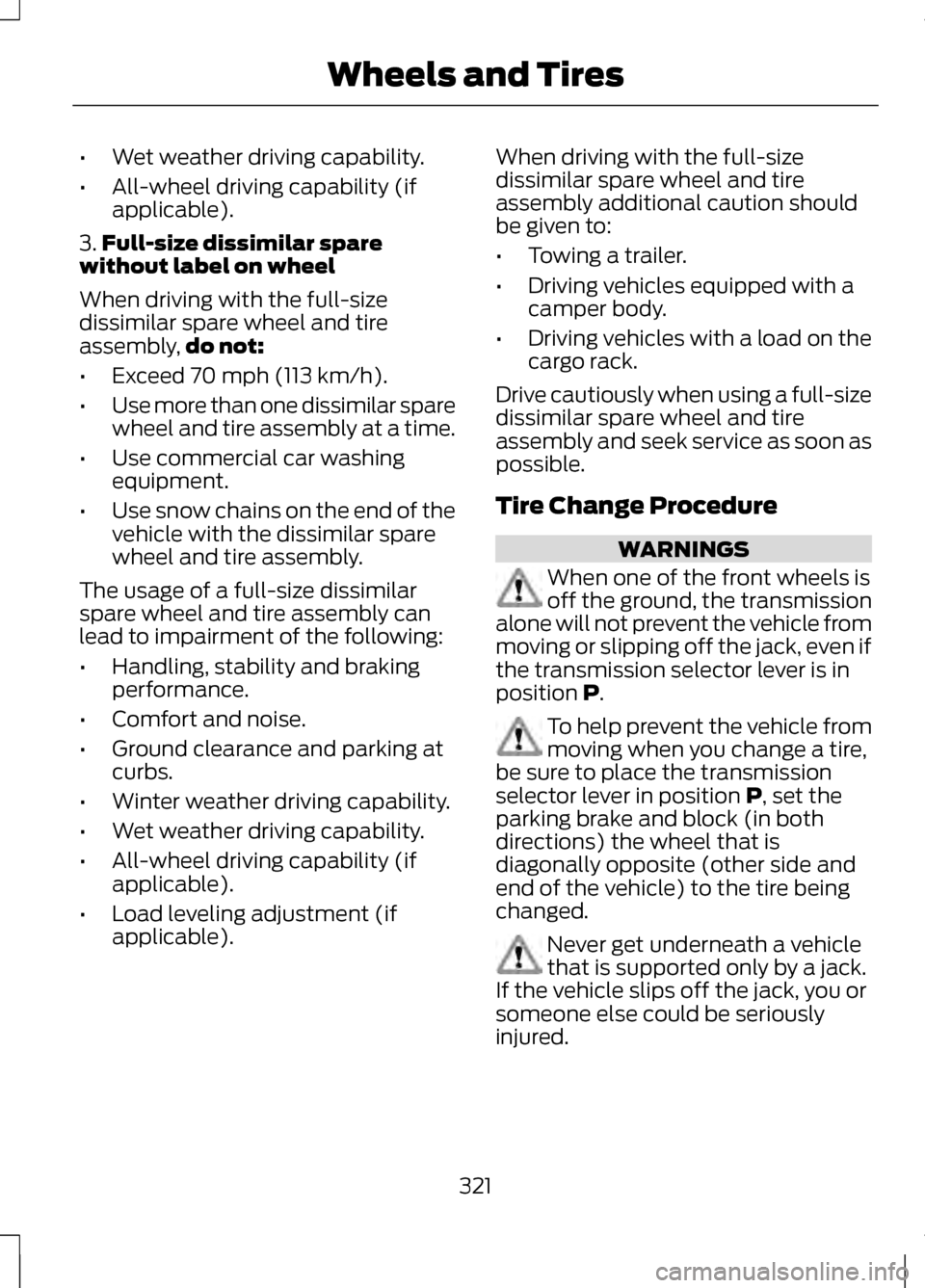
Wet weather driving capability.
• All-wheel driving capability (if
applicable).
3. Full-size dissimilar spare
without label on wheel
When driving with the full-size
dissimilar spare wheel and tire
assembly, do not:
• Exceed 70 mph (113 km/h).
• Use more than one dissimilar spare
wheel and tire assembly at a time.
• Use commercial car washing
equipment.
• Use snow chains on the end of the
vehicle with the dissimilar spare
wheel and tire assembly.
The usage of a full-size dissimilar
spare wheel and tire assembly can
lead to impairment of the following:
• Handling, stability and braking
performance.
• Comfort and noise.
• Ground clearance and parking at
curbs.
• Winter weather driving capability.
• Wet weather driving capability.
• All-wheel driving capability (if
applicable).
• Load leveling adjustment (if
applicable). When driving with the full-size
dissimilar spare wheel and tire
assembly additional caution should
be given to:
•
Towing a trailer.
• Driving vehicles equipped with a
camper body.
• Driving vehicles with a load on the
cargo rack.
Drive cautiously when using a full-size
dissimilar spare wheel and tire
assembly and seek service as soon as
possible.
Tire Change Procedure WARNINGS
When one of the front wheels is
off the ground, the transmission
alone will not prevent the vehicle from
moving or slipping off the jack, even if
the transmission selector lever is in
position P. To help prevent the vehicle from
moving when you change a tire,
be sure to place the transmission
selector lever in position
P, set the
parking brake and block (in both
directions) the wheel that is
diagonally opposite (other side and
end of the vehicle) to the tire being
changed. Never get underneath a vehicle
that is supported only by a jack.
If the vehicle slips off the jack, you or
someone else could be seriously
injured.
321
Wheels and Tires
Page 455 of 474
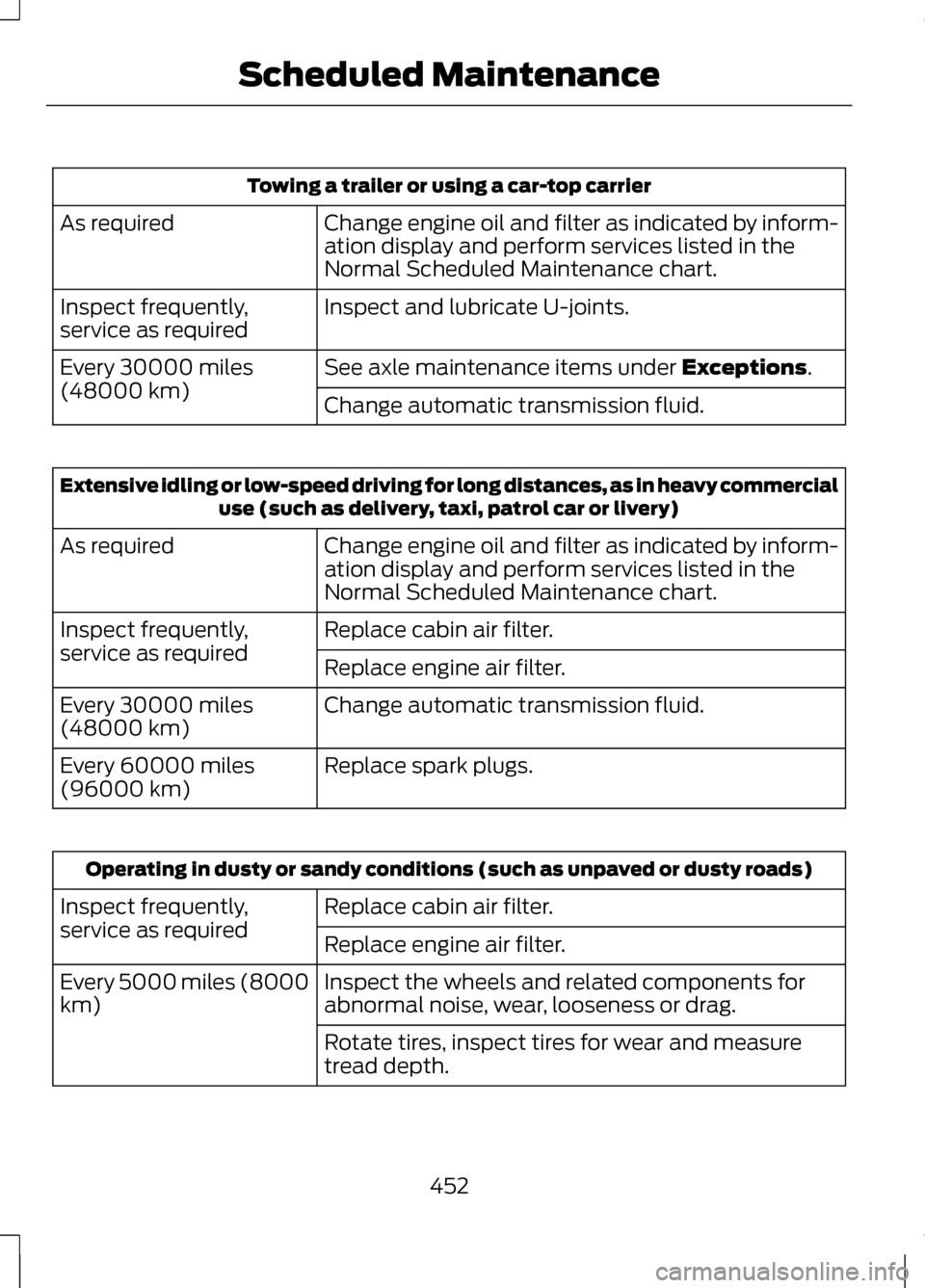
Towing a trailer or using a car-top carrier
Change engine oil and filter as indicated by inform-
ation display and perform services listed in the
Normal Scheduled Maintenance chart.
As required
Inspect and lubricate U-joints.
Inspect frequently,
service as required
See axle maintenance items under Exceptions.
Every 30000 miles
(48000 km)
Change automatic transmission fluid.Extensive idling or low-speed driving for long distances, as in heavy commercial
use (such as delivery, taxi, patrol car or livery)
Change engine oil and filter as indicated by inform-
ation display and perform services listed in the
Normal Scheduled Maintenance chart.
As required
Replace cabin air filter.
Inspect frequently,
service as required
Replace engine air filter.
Change automatic transmission fluid.
Every 30000 miles
(48000 km)
Replace spark plugs.
Every 60000 miles
(96000 km) Operating in dusty or sandy conditions (such as unpaved or dusty roads)
Replace cabin air filter.
Inspect frequently,
service as required
Replace engine air filter.
Inspect the wheels and related components for
abnormal noise, wear, looseness or drag.
Every 5000 miles (8000
km)
Rotate tires, inspect tires for wear and measure
tread depth.
452
Scheduled Maintenance
Page 464 of 474
D
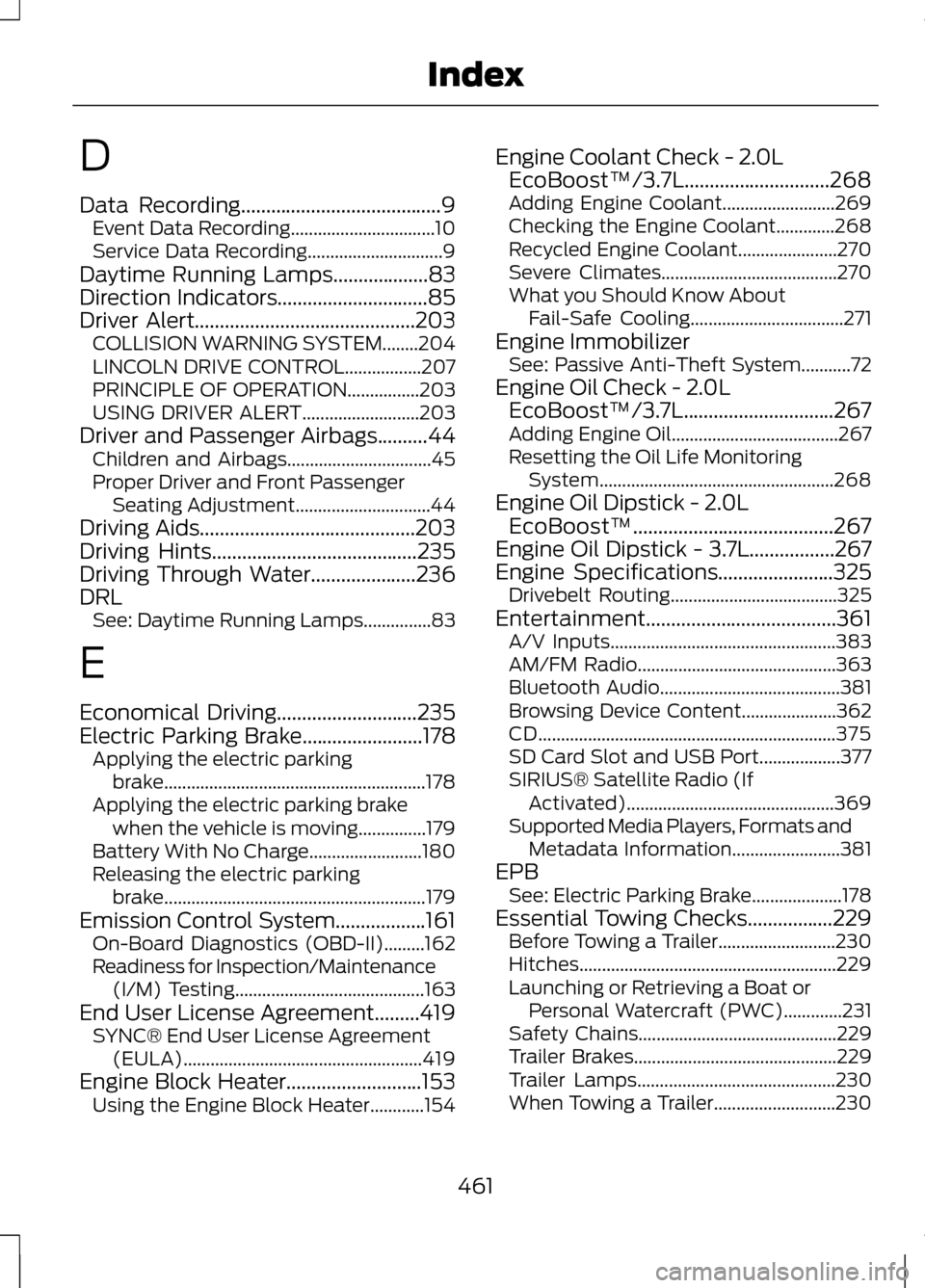
Data Recording........................................9
Event Data Recording................................10
Service Data Recording..............................9
Daytime Running Lamps...................83
Direction Indicators..............................85
Driver Alert............................................203 COLLISION WARNING SYSTEM........204
LINCOLN DRIVE CONTROL.................207
PRINCIPLE OF OPERATION................203
USING DRIVER ALERT..........................203
Driver and Passenger Airbags..........44 Children and Airbags................................45
Proper Driver and Front Passenger
Seating Adjustment..............................44
Driving Aids
...........................................203
Driving Hints.........................................235
Driving Through Water.....................236
DRL See: Daytime Running Lamps...............83
E
Economical Driving
............................235
Electric Parking Brake........................178 Applying the electric parking
brake.......................................................... 178
Applying the electric parking brake when the vehicle is moving...............179
Battery With No Charge.........................180
Releasing the electric parking brake.......................................................... 179
Emission Control System..................161 On-Board Diagnostics (OBD-II).........162
Readiness for Inspection/Maintenance
(I/M) Testing.......................................... 163
End User License Agreement
.........419
SYNC® End User License Agreement
(EULA)..................................................... 419
Engine Block Heater
...........................153
Using the Engine Block Heater............154 Engine Coolant Check - 2.0L
EcoBoost™/3.7L.............................268
Adding Engine Coolant.........................269
Checking the Engine Coolant.............268
Recycled Engine Coolant......................270
Severe Climates.......................................270
What you Should Know About Fail-Safe Cooling..................................271
Engine Immobilizer See: Passive Anti-Theft System...........72
Engine Oil Check - 2.0L EcoBoost™/3.7L..............................267
Adding Engine Oil.....................................267
Resetting the Oil Life Monitoring System.................................................... 268
Engine Oil Dipstick - 2.0L EcoBoost™........................................267
Engine Oil Dipstick - 3.7L
.................267
Engine Specifications.......................325
Drivebelt Routing.....................................325
Entertainment......................................361 A/V Inputs.................................................. 383
AM/FM Radio............................................ 363
Bluetooth Audio........................................381
Browsing Device Content.....................362
CD.................................................................. 375
SD Card Slot and USB Port..................377
SIRIUS® Satellite Radio (If Activated).............................................. 369
Supported Media Players, Formats and Metadata Information........................381
EPB See: Electric Parking Brake....................178
Essential Towing Checks.................229 Before Towing a Trailer..........................230
Hitches......................................................... 229
Launching or Retrieving a Boat or Personal Watercraft (PWC).............231
Safety Chains............................................ 229
Trailer Brakes............................................. 229
Trailer Lamps............................................ 230
When Towing a Trailer...........................230
461
Index
Page 467 of 474
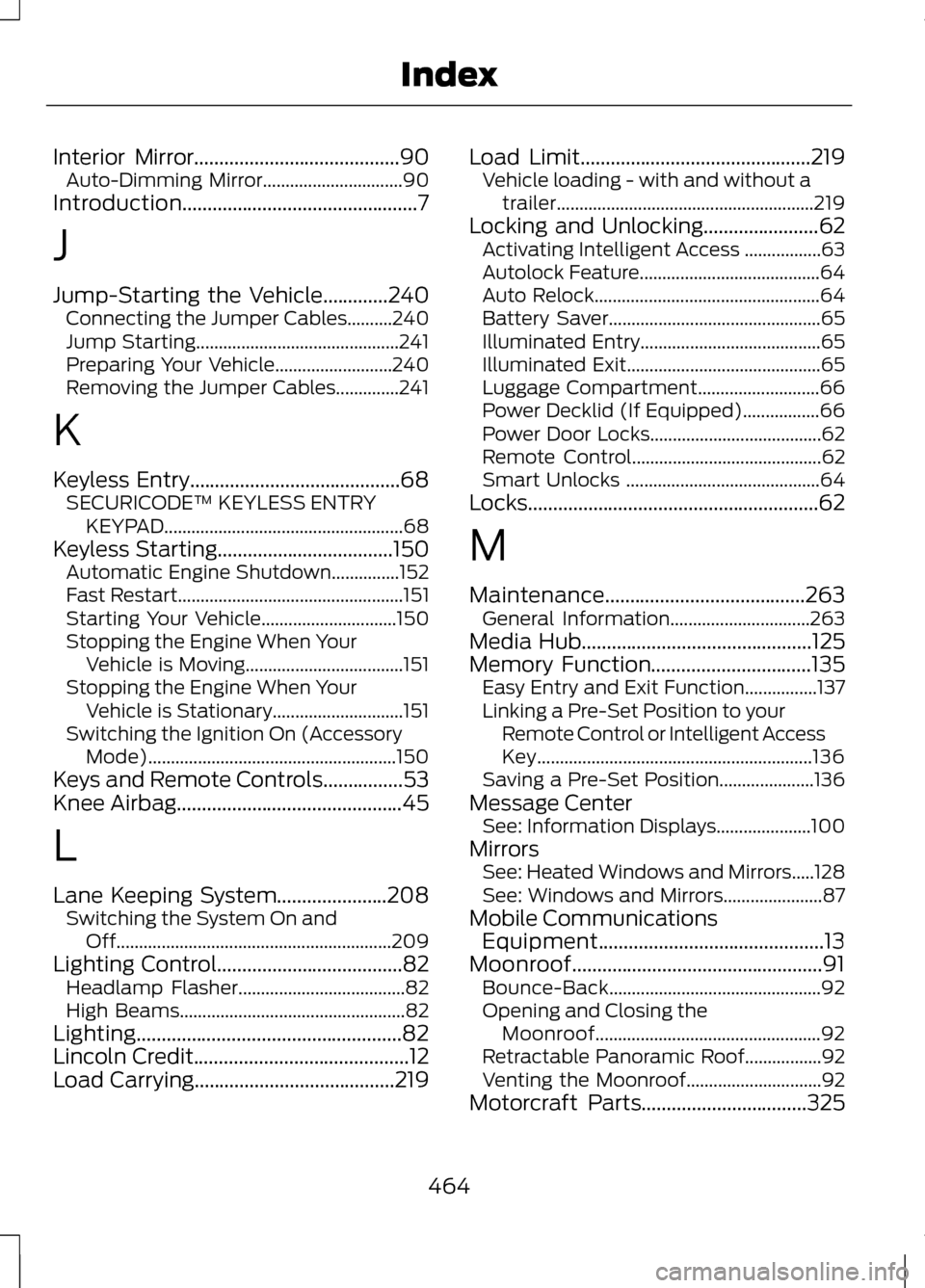
Interior Mirror.........................................90
Auto-Dimming Mirror...............................90
Introduction...............................................7
J
Jump-Starting the Vehicle
.............240
Connecting the Jumper Cables..........240
Jump Starting............................................. 241
Preparing Your Vehicle..........................240
Removing the Jumper Cables..............241
K
Keyless Entry..........................................68 SECURICODE™ KEYLESS ENTRY
KEYPAD..................................................... 68
Keyless Starting...................................150 Automatic Engine Shutdown...............152
Fast Restart.................................................. 151
Starting Your Vehicle..............................150
Stopping the Engine When Your Vehicle is Moving...................................151
Stopping the Engine When Your Vehicle is Stationary.............................151
Switching the Ignition On (Accessory Mode)....................................................... 150
Keys and Remote Controls................53
Knee Airbag
.............................................45
L
Lane Keeping System......................208 Switching the System On and
Off............................................................. 209
Lighting Control
.....................................82
Headlamp Flasher.....................................82
High Beams.................................................. 82
Lighting.....................................................82
Lincoln Credit
...........................................12
Load Carrying........................................219 Load Limit
..............................................219
Vehicle loading - with and without a
trailer......................................................... 219
Locking and Unlocking.......................62 Activating Intelligent Access .................63
Autolock Feature........................................64
Auto Relock.................................................. 64
Battery Saver............................................... 65
Illuminated Entry........................................65
Illuminated Exit........................................... 65
Luggage Compartment...........................66
Power Decklid (If Equipped).................66
Power Door Locks......................................62
Remote Control.......................................... 62
Smart Unlocks ........................................... 64
Locks..........................................................62
M
Maintenance........................................263 General Information...............................263
Media Hub
..............................................125
Memory Function................................135 Easy Entry and Exit Function................137
Linking a Pre-Set Position to your
Remote Control or Intelligent Access
Key............................................................. 136
Saving a Pre-Set Position.....................136
Message Center See: Information Displays.....................100
Mirrors See: Heated Windows and Mirrors.....128
See: Windows and Mirrors......................87
Mobile Communications Equipment.............................................13
Moonroof..................................................91 Bounce-Back............................................... 92
Opening and Closing the Moonroof.................................................. 92
Retractable Panoramic Roof.................92
Venting the Moonroof..............................92
Motorcraft Parts.................................325
464
Index
Page 470 of 474
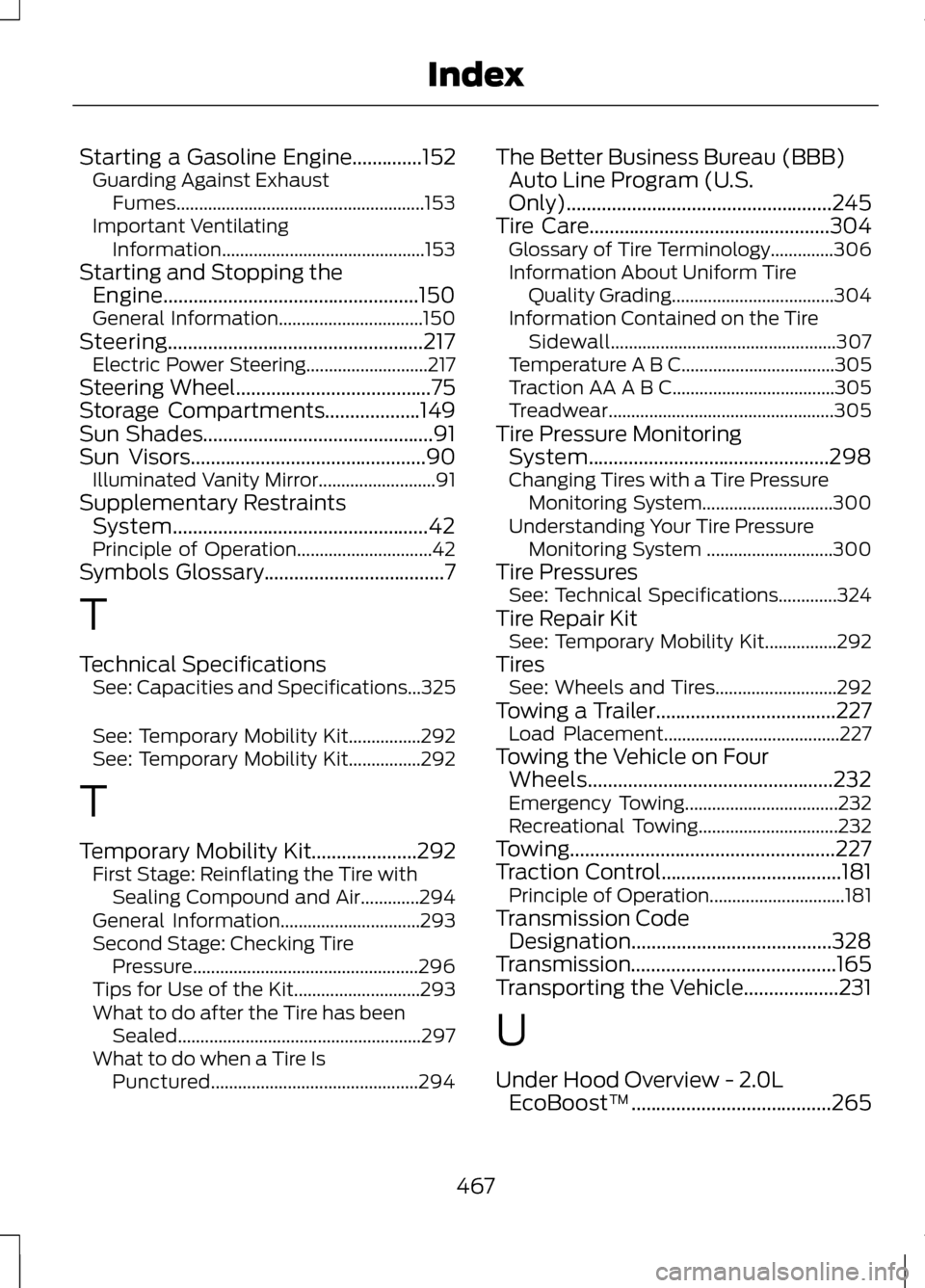
Starting a Gasoline Engine..............152
Guarding Against Exhaust
Fumes....................................................... 153
Important Ventilating Information............................................. 153
Starting and Stopping the Engine...................................................150
General Information................................150
Steering...................................................217 Electric Power Steering...........................217
Steering Wheel.......................................75
Storage Compartments...................149
Sun Shades..............................................91
Sun Visors...............................................90
Illuminated Vanity Mirror..........................91
Supplementary Restraints System...................................................42
Principle of Operation..............................42
Symbols Glossary
....................................7
T
Technical Specifications See: Capacities and Specifications...325
See: Temporary Mobility Kit................292
See: Temporary Mobility Kit................292
T
Temporary Mobility Kit
.....................292
First Stage: Reinflating the Tire with
Sealing Compound and Air.............294
General Information...............................293
Second Stage: Checking Tire Pressure.................................................. 296
Tips for Use of the Kit............................293
What to do after the Tire has been Sealed...................................................... 297
What to do when a Tire Is Punctured.............................................. 294The Better Business Bureau (BBB)
Auto Line Program (U.S.
Only).....................................................245
Tire Care
................................................304
Glossary of Tire Terminology..............306
Information About Uniform Tire
Quality Grading....................................304
Information Contained on the Tire Sidewall.................................................. 307
Temperature A B C..................................305
Traction AA A B C....................................305
Treadwear.................................................. 305
Tire Pressure Monitoring System................................................298
Changing Tires with a Tire Pressure Monitoring System.............................300
Understanding Your Tire Pressure Monitoring System ............................300
Tire Pressures See: Technical Specifications.............324
Tire Repair Kit See: Temporary Mobility Kit................292
Tires See: Wheels and Tires...........................292
Towing a Trailer....................................227 Load Placement.......................................227
Towing the Vehicle on Four Wheels.................................................232
Emergency Towing..................................232
Recreational Towing...............................232
Towing.....................................................227
Traction Control....................................181 Principle of Operation..............................181
Transmission Code Designation........................................328
Transmission.........................................165
Transporting the Vehicle...................231
U
Under Hood Overview - 2.0L EcoBoost™........................................265
467
Index