Spark LINCOLN MKZ 2013 Owners Manual
[x] Cancel search | Manufacturer: LINCOLN, Model Year: 2013, Model line: MKZ, Model: LINCOLN MKZ 2013Pages: 474, PDF Size: 3.79 MB
Page 10 of 474
ABOUT THIS MANUAL
Thank you for choosing Lincoln. We
recommend that you take some time
to get to know your vehicle by reading
this manual. The more that you know
about it, the greater the safety and
pleasure you will get from driving it.
WARNING
Always drive with due care and
attention when using and
operating the controls and features
on your vehicle. Note:
This manual describes product
features and options available
throughout the range, sometimes even
before they are generally available. It
may describe options not fitted to your
vehicle.
Note: Some of the illustrations in this
manual may be used for different
models, so may appear different to
your vehicle. However, the essential
information in the illustrations is
always correct.
Note: Always use and operate your
vehicle in line with all applicable laws
and regulations.
Note: Pass on this manual when
selling your vehicle. It is an integral part
of the vehicle.
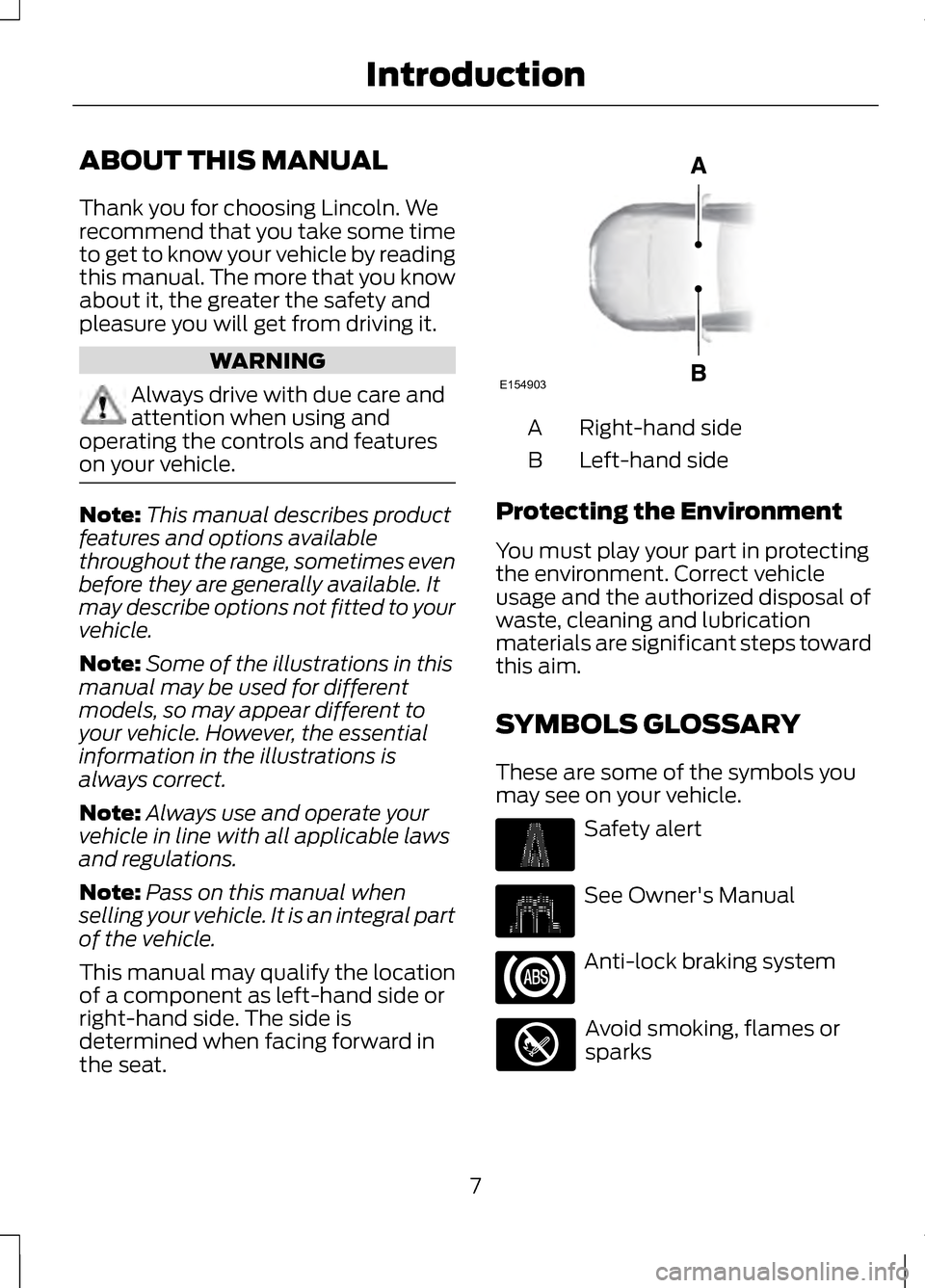
This manual may qualify the location
of a component as left-hand side or
right-hand side. The side is
determined when facing forward in
the seat. Right-hand side
A
Left-hand side
B
Protecting the Environment
You must play your part in protecting
the environment. Correct vehicle
usage and the authorized disposal of
waste, cleaning and lubrication
materials are significant steps toward
this aim.
SYMBOLS GLOSSARY
These are some of the symbols you
may see on your vehicle. Safety alert
See Owner's Manual
Anti-lock braking system
Avoid smoking, flames or
sparks
7
IntroductionE154903
Page 158 of 474
SAFETY PRECAUTIONS
WARNINGS
Do not overfill the fuel tank. The
pressure in an overfilled tank
may cause leakage and lead to fuel
spray and fire. The fuel system may be under
pressure. If you hear a hissing
sound near the fuel filler door (Easy
Fuel capless fuel system), do not
refuel until the sound stops.
Otherwise, fuel may spray out, which
could cause serious personal injury. Automotive fuels can cause
serious injury or death if misused
or mishandled. The flow of fuel through a fuel
pump nozzle can produce static
electricity, which can cause a fire if
fuel is pumped into an ungrounded
fuel container. Fuel ethanol and gasoline may
contain benzene, which is a
cancer-causing agent. When refueling always shut the
engine off and never allow
sparks or open flames near the filler
neck. Never smoke while refueling.
Fuel vapor is extremely hazardous
under certain conditions. Care should
be taken to avoid inhaling excess
fumes. Observe the following guidelines
when handling automotive fuel: •
Extinguish all smoking materials
and any open flames before
refueling your vehicle.
• Always turn off the vehicle before
refueling.
• Automotive fuels can be harmful
or fatal if swallowed. Fuel such as
gasoline is highly toxic and if
swallowed can cause death or
permanent injury. If fuel is
swallowed, call a physician
immediately, even if no symptoms
are immediately apparent. The
toxic effects of fuel may not be
visible for hours.
• Avoid inhaling fuel vapors. Inhaling
too much fuel vapor of any kind
can lead to eye and respiratory
tract irritation. In severe cases,
excessive or prolonged breathing
of fuel vapor can cause serious
illness and permanent injury.
• Avoid getting fuel liquid in your
eyes. If fuel is splashed in the eyes,
remove contact lenses (if worn),
flush with water for 15 minutes and
seek medical attention. Failure to
seek proper medical attention
could lead to permanent injury.
155
Fuel and Refueling
Page 161 of 474
•
In vehicles equipped with a tire
mobility kit the funnel is located in
the rear of the vehicle, inside the
load compartment, underneath
the carpeted floor panel and is
accessible from the trunk.
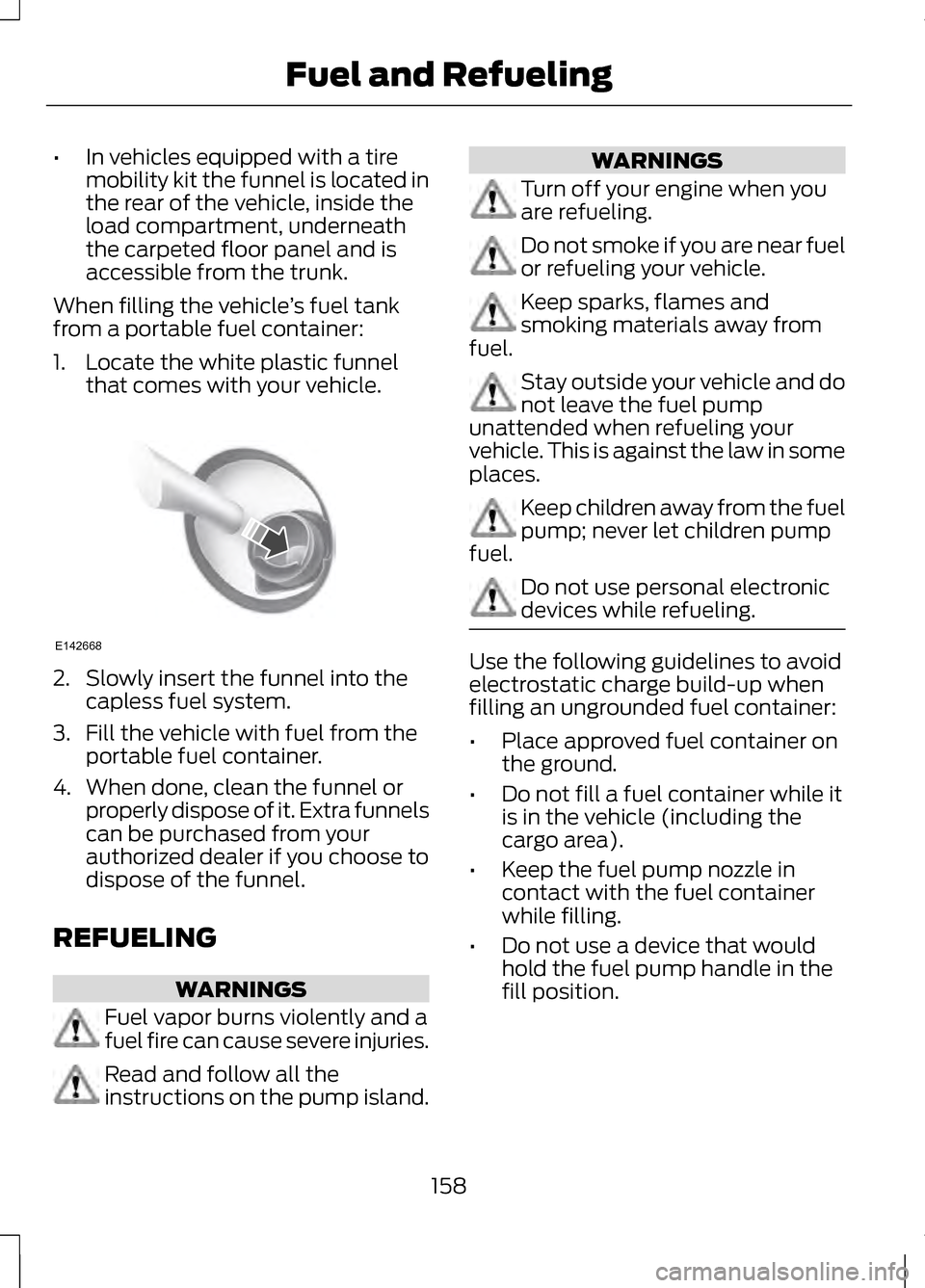
When filling the vehicle ’s fuel tank
from a portable fuel container:
1. Locate the white plastic funnel that comes with your vehicle. 2. Slowly insert the funnel into the
capless fuel system.
3. Fill the vehicle with fuel from the portable fuel container.
4. When done, clean the funnel or properly dispose of it. Extra funnels
can be purchased from your
authorized dealer if you choose to
dispose of the funnel.
REFUELING WARNINGS
Fuel vapor burns violently and a
fuel fire can cause severe injuries.
Read and follow all the
instructions on the pump island. WARNINGS
Turn off your engine when you
are refueling.
Do not smoke if you are near fuel
or refueling your vehicle.
Keep sparks, flames and
smoking materials away from
fuel. Stay outside your vehicle and do
not leave the fuel pump
unattended when refueling your
vehicle. This is against the law in some
places. Keep children away from the fuel
pump; never let children pump
fuel. Do not use personal electronic
devices while refueling.
Use the following guidelines to avoid
electrostatic charge build-up when
filling an ungrounded fuel container:
•
Place approved fuel container on
the ground.
• Do not fill a fuel container while it
is in the vehicle (including the
cargo area).
• Keep the fuel pump nozzle in
contact with the fuel container
while filling.
• Do not use a device that would
hold the fuel pump handle in the
fill position.
158
Fuel and RefuelingE142668
Page 243 of 474
1. Turn the ignition off.
2. Turn the ignition to crank.
3. Turn the ignition off.
4. Turn the ignition on again to
re-enable the fuel pump.
For vehicles equipped with a push
button start system:
1. Press the START/STOP button
to turn the ignition off.
2. Press the brake pedal and press the
START/STOP button (crank
attempt).
3. Remove your foot from the brake pedal and press the
START/STOP
button (ignition
off).
4. Press the
START/STOP button
again to re-enable the fuel system.
JUMP-STARTING THE
VEHICLE WARNINGS
The gases around the battery
can explode if exposed to
flames, sparks, or lit cigarettes. An
explosion could result in injury or
vehicle damage. Batteries contain sulfuric acid
which can burn skin, eyes and
clothing, if contacted. Only use an adequate sized
cable with insulated clamps. Preparing Your Vehicle
Note:
Use only a 12-volt supply to start
your vehicle.
Note: Do not disconnect the battery
of the disabled vehicle as this could
damage the vehicle's electrical system.
Park the booster vehicle close to the
hood of the disabled vehicle, making
sure the two vehicles do not touch.
Turn all accessories off.
Connecting the Jumper Cables WARNING
Do not attach the cables to fuel
lines, engine rocker covers, the
intake manifold or electrical
components as grounding points. Stay
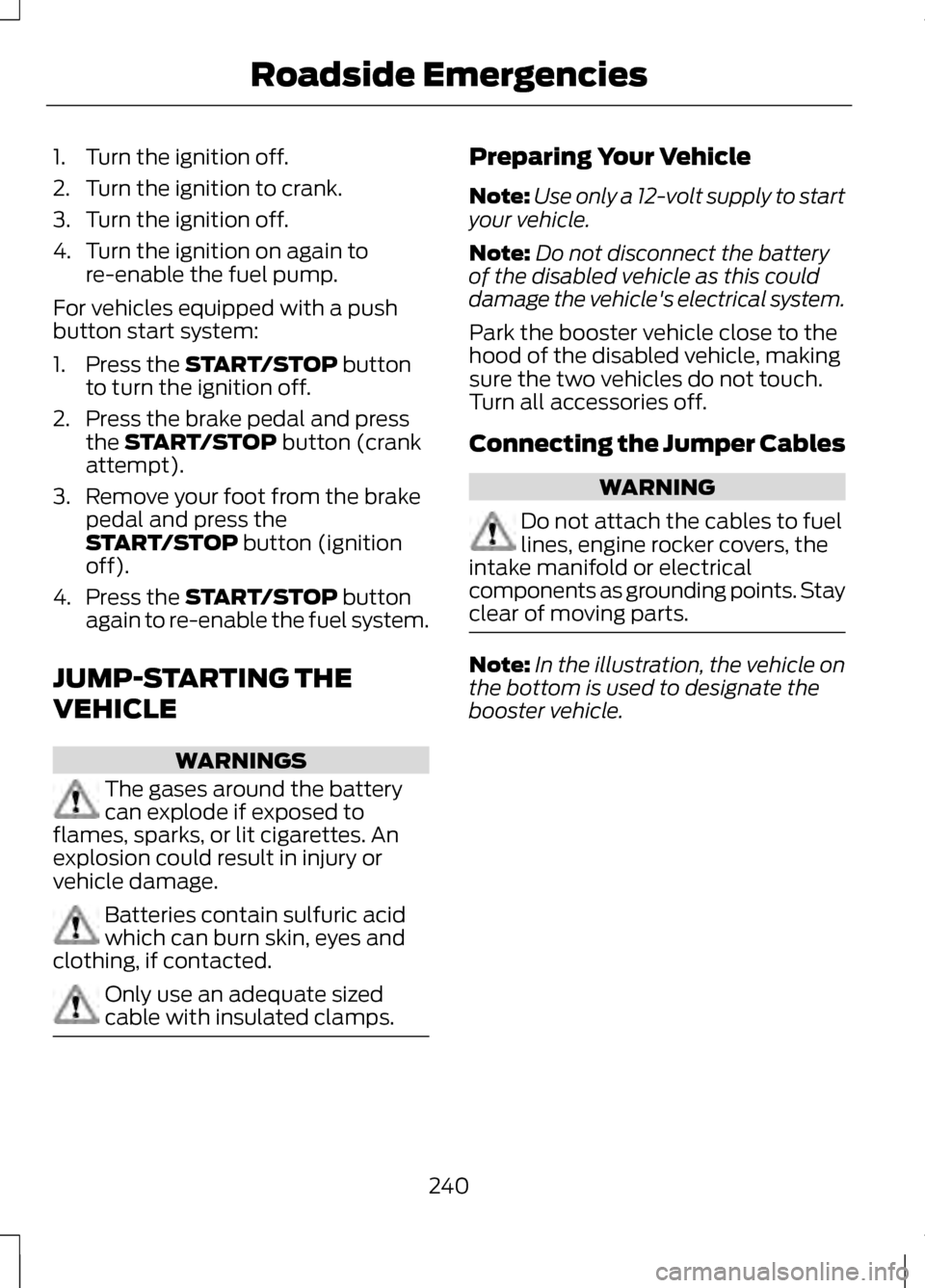
clear of moving parts. Note:
In the illustration, the vehicle on
the bottom is used to designate the
booster vehicle.
240
Roadside Emergencies
Page 244 of 474
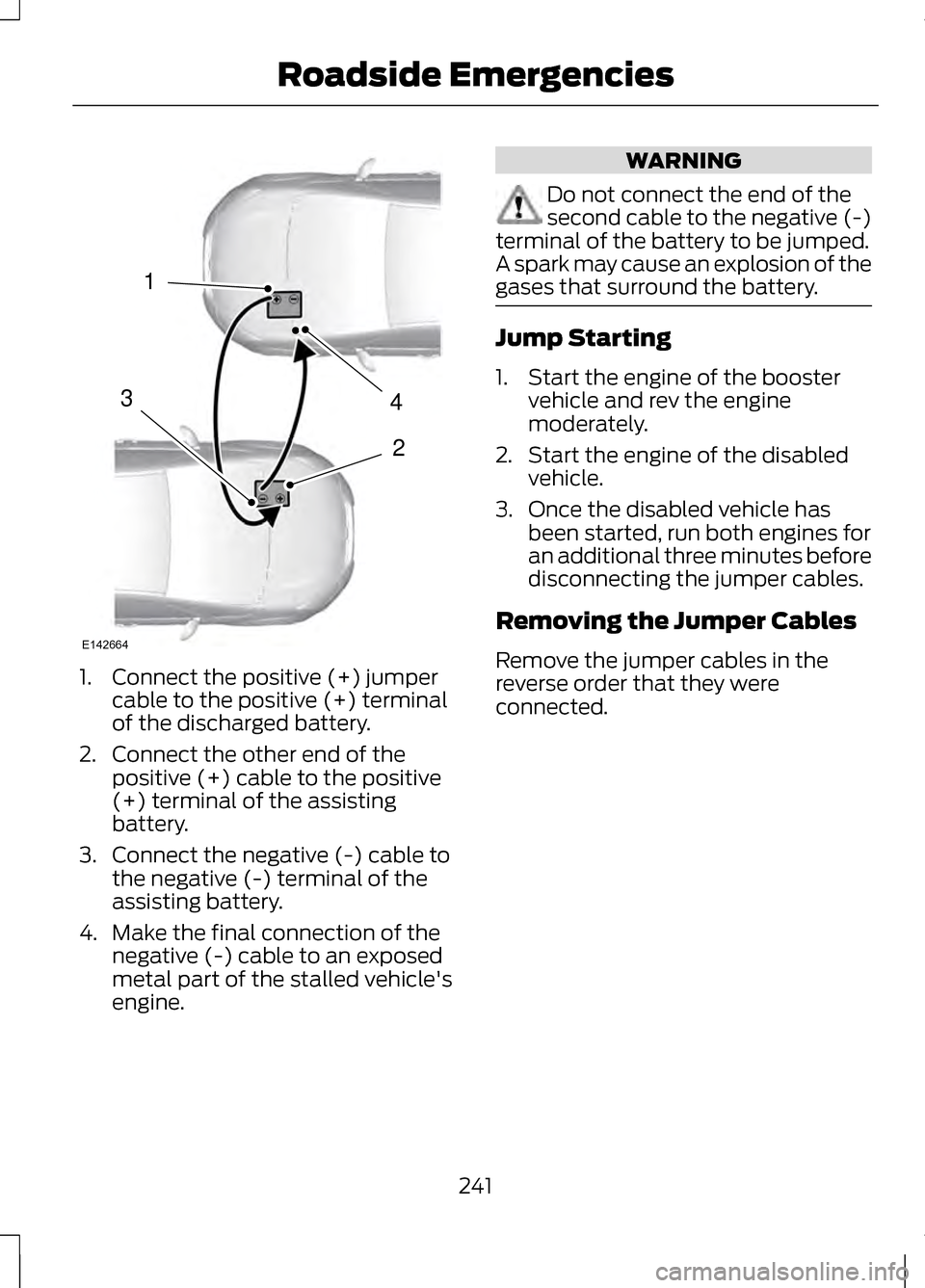
1. Connect the positive (+) jumper
cable to the positive (+) terminal
of the discharged battery.
2. Connect the other end of the positive (+) cable to the positive
(+) terminal of the assisting
battery.
3. Connect the negative (-) cable to the negative (-) terminal of the
assisting battery.
4. Make the final connection of the negative (-) cable to an exposed
metal part of the stalled vehicle's
engine. WARNING
Do not connect the end of the
second cable to the negative (-)
terminal of the battery to be jumped.
A spark may cause an explosion of the
gases that surround the battery. Jump Starting
1. Start the engine of the booster
vehicle and rev the engine
moderately.
2. Start the engine of the disabled vehicle.
3. Once the disabled vehicle has been started, run both engines for
an additional three minutes before
disconnecting the jumper cables.
Removing the Jumper Cables
Remove the jumper cables in the
reverse order that they were
connected.
241
Roadside Emergencies4
2
1
3
E142664
Page 280 of 474
WASHER FLUID CHECK
WARNING
If you operate your vehicle in
temperatures below 40°F (5°C),
use washer fluid with antifreeze
protection. Failure to use washer fluid
with antifreeze protection in cold
weather could result in impaired
windshield vision and increase the risk
of injury or accident. Note:
The front and rear washer
systems are supplied from the same
reservoir.
Add fluid to fill the reservoir if the level
is low. Only use a washer fluid that
meets Ford specifications. See
Capacities and Specifications
(page 325).
State or local regulations on volatile
organic compounds may restrict the
use of methanol, a common
windshield washer antifreeze additive.
Washer fluids containing
non-methanol antifreeze agents
should be used only if they provide
cold weather protection without
damaging the vehicle ’s paint finish,
wiper blades or washer system. CHANGING THE 12V
BATTERY WARNINGS
Batteries normally produce
explosive gases which can cause
personal injury. Therefore, do not
allow flames, sparks or lighted
substances to come near the battery.
When working near the battery,
always shield your face and protect
your eyes. Always provide proper
ventilation. When lifting a plastic-cased
battery, excessive pressure on
the end walls could cause acid to flow
through the vent caps, resulting in
personal injury and/or damage to the
vehicle or battery. Lift the battery with
a battery carrier or with your hands on
opposite corners. Keep batteries out of reach of
children. Batteries contain
sulfuric acid. Avoid contact with skin,
eyes or clothing. Shield your eyes
when working near the battery to
protect against possible splashing of
acid solution. In case of acid contact
with skin or eyes, flush immediately
with water for a minimum of 15
minutes and get prompt medical
attention. If acid is swallowed, call a
physician immediately. Battery posts, terminals and
related accessories contain lead
and lead compounds. Wash hands
after handling. 277
Maintenance
Page 289 of 474
CLEANING THE ENGINE
Engines are more efficient when they
are clean because grease and dirt
buildup keep the engine warmer than
normal.
When washing:
•
Take care when using a power
washer to clean the engine. The
high-pressure fluid could penetrate
the sealed parts and cause
damage.
• Do not spray a hot engine with cold
water to avoid cracking the engine
block or other engine components.
• Spray Motorcraft® Engine
Shampoo and Degreaser on all
parts that require cleaning and
pressure rinse clean. In Canada,
use Motorcraft® Engine Shampoo.
• Never wash or rinse the engine
while it is hot or running; water in
the running engine may cause
internal damage.
• Never wash or rinse any ignition
coil, spark plug wire or spark plug
well, or the area in and around
these locations.
• Cover the battery, power
distribution box, and air filter
assembly to prevent water
damage when cleaning the engine. CLEANING THE WINDOWS
AND WIPER BLADES
The windows and wiper blades should
be cleaned regularly. If the wipers do
not wipe properly, substances on the
vehicle
’s glass or the wiper blades
may cause squeaking or chatter noise
from the blades, and streaking and
smearing of the windshield.
To clean these items, follow these
tips:
• The windows may be cleaned with
a non-abrasive cleaner such as
Motorcraft® Ultra-Clear Spray
Glass Cleaner.
• The wiper blades can be cleaned
with isopropyl (rubbing) alcohol or
Motorcraft® Premium Windshield
Washer Concentrate in the U.S., or
Premium Quality Windshield
Washer Fluid in Canada. Be sure
to replace wiper blades when they
appear worn or do not function
properly.
• Do not use abrasives, as they may
cause scratches
• Do not use fuel, kerosene, or paint
thinner to clean any parts.
286
Vehicle Care
Page 328 of 474
ENGINE SPECIFICATIONS
3.7L V6 Engine
2.0L EcoBoost engine
Engine
227
122
Cubic inches
Minimum 87 octane
Minimum 87 octane
Required fuel
10.5:1
9.3:1
Compression ratio
0.049-0.053 in. (1.25-1.35mm)
0.027-0.031 in. (0.70-0.80
mm)
Spark plug gap
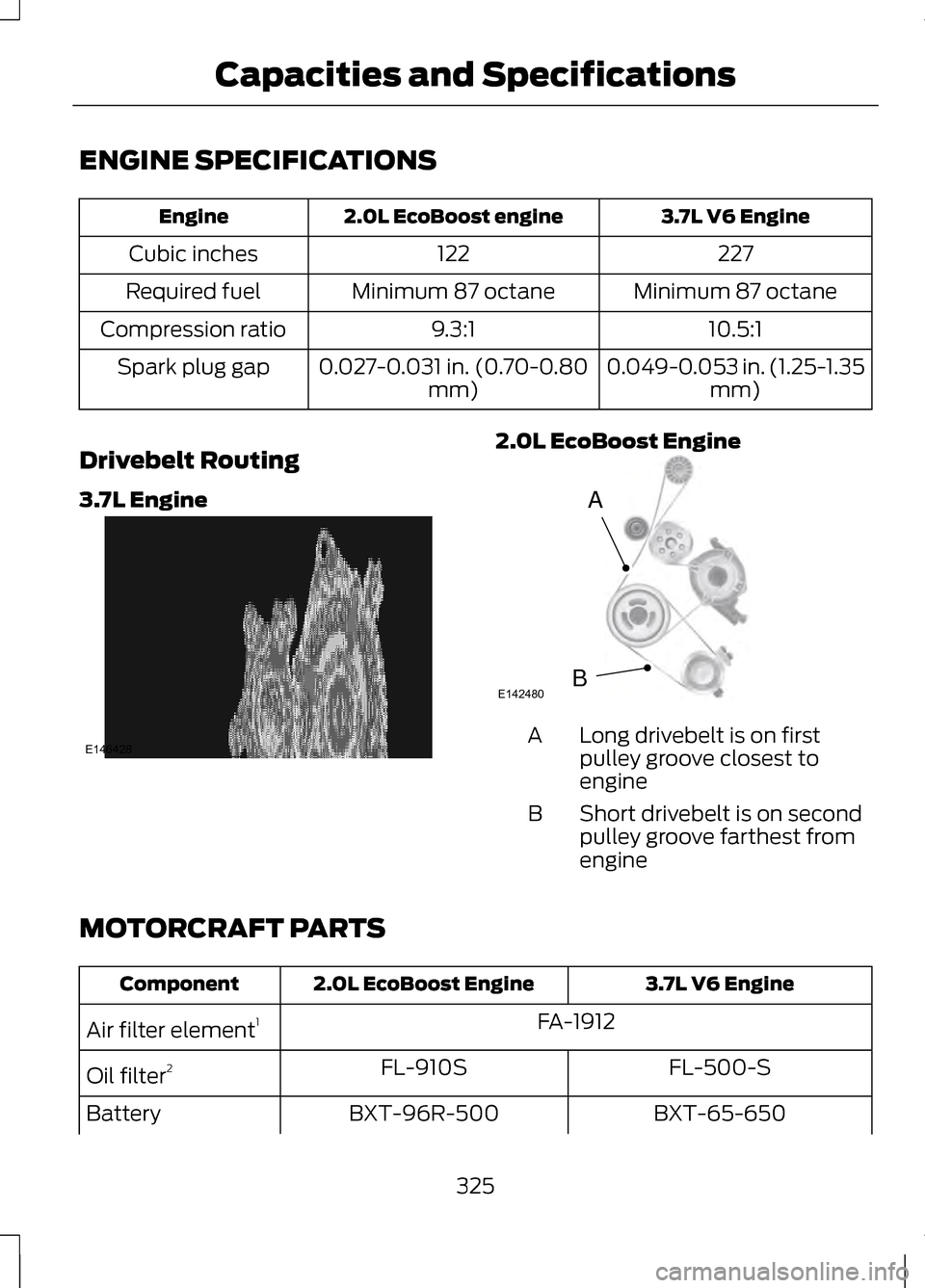
Drivebelt Routing
3.7L Engine 2.0L EcoBoost Engine
Long drivebelt is on first
pulley groove closest to
engine
A
Short drivebelt is on second
pulley groove farthest from
engine
B
MOTORCRAFT PARTS 3.7L V6 Engine
2.0L EcoBoost Engine
Component
FA-1912
Air filter element 1
FL-500-S
FL-910S
Oil filter 2
BXT-65-650
BXT-96R-500
Battery
325
Capacities and SpecificationsE146428 A
BE142480
Page 329 of 474
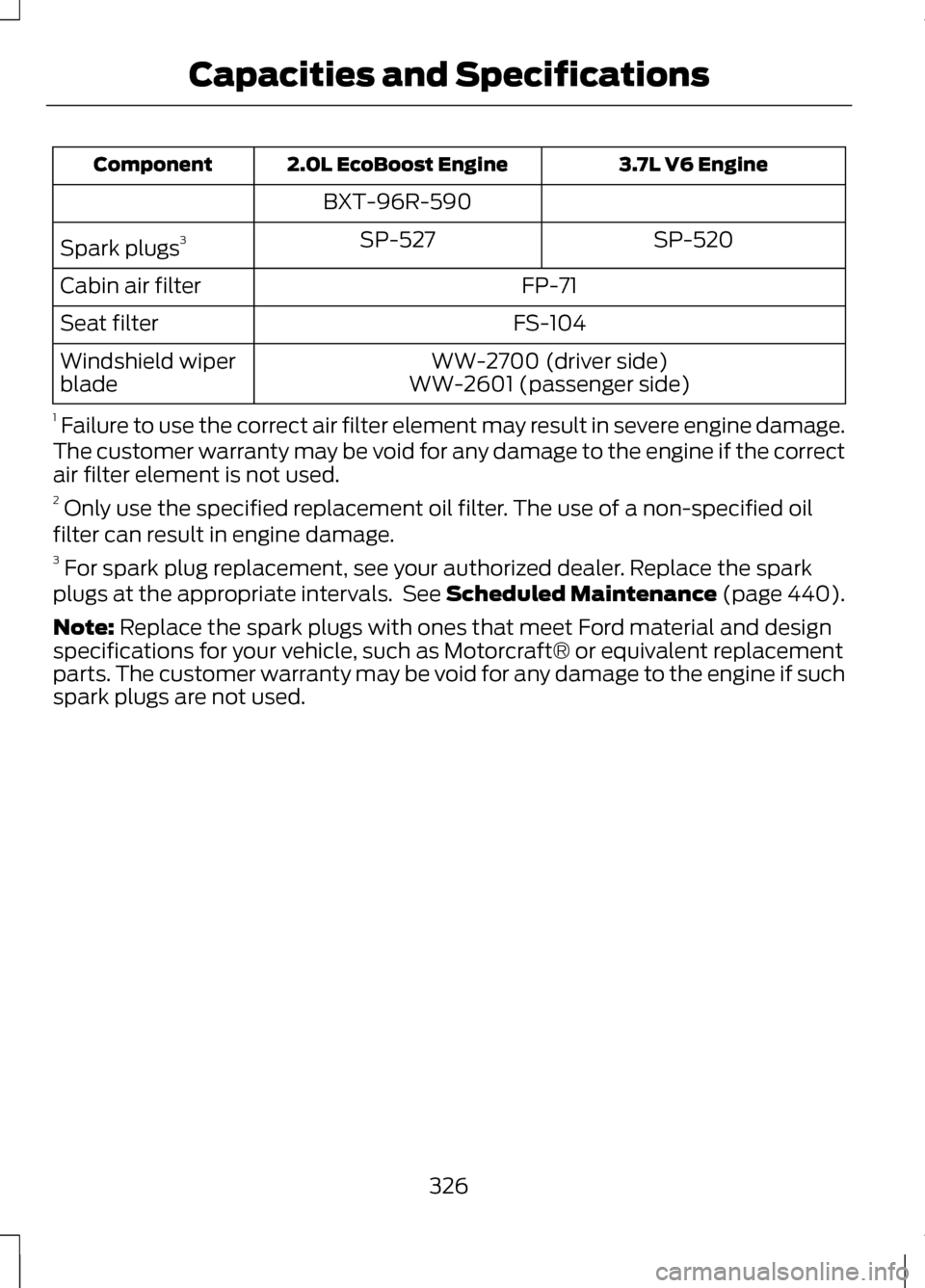
3.7L V6 Engine
2.0L EcoBoost Engine
Component
BXT-96R-590 SP-520
SP-527
Spark plugs 3
FP-71
Cabin air filter
FS-104
Seat filter
WW-2700 (driver side)
Windshield wiper
blade WW-2601 (passenger side)
1 Failure to use the correct air filter element may result in severe engine damage.
The customer warranty may be void for any damage to the engine if the correct
air filter element is not used.
2 Only use the specified replacement oil filter. The use of a non-specified oil
filter can result in engine damage.
3 For spark plug replacement, see your authorized dealer. Replace the spark
plugs at the appropriate intervals. See Scheduled Maintenance (page 440).
Note: Replace the spark plugs with ones that meet Ford material and design
specifications for your vehicle, such as Motorcraft® or equivalent replacement
parts. The customer warranty may be void for any damage to the engine if such
spark plugs are not used.
326
Capacities and Specifications
Page 338 of 474
Ford Extended Service Plan Can
Quickly Pay for Itself
One service bill – the cost of parts and
labor – can easily exceed the price of
your Ford Extended Service Plan
Service Contract. With a Ford Extend
Service Plan, you minimize your risk
for unexpected repair bills and rising
repair costs.
Avoid the Rising Cost of Properly
Maintaining Your Vehicle!
Ford Extended Service Plan also
offers a Premium Maintenance Plan
that covers items that routinely wear
out.
The coverage is prepaid, so you never
have to worry about affording your
vehicle maintenance. It covers regular
checkups, routine inspections,
preventive care and replacement of
items that require periodic attention
for normal wear:
•
Wiper blades
• Spark plugs (except California)
• Clutch disc
• Brake pads and linings
• Shock absorbers
• Belts and hoses Contact your selling Ford or Lincoln
dealership today so they can
customize a Ford Extended Service
Plan that fits your driving lifestyle and
budget.
Interest Free Finance Options
Available
Take advantage of our installment
payment plan, just a 10% down
payment will provide you with an
affordable no interest, no-fee
payment opportunity.
For More Information
PROTECT YOURSELF FROM THE
RISING COST OF VEHICLE REPAIRS
WITH A FORD EXTENDED SERVICE
PLAN.
To learn more, call our Ford ESP
specialists at 800-367-3377, and
don't forget to ask about our interest
free payment program, allowing you
all the security and benefits Ford ESP
has to offer while paying over time.
your pre-approved with no credit
checks, no hassles!
Or, complete the information below
and mail to:
Ford ESP
P.O. Box 8072
Royal Oak, MI 48068-0039
Name (PLEASE PRINT)
APT.#
ADDRESS
335
Ford Extended Service Plan (ESP)