engine oil check LINCOLN MKZ 2013 Owners Manual
[x] Cancel search | Manufacturer: LINCOLN, Model Year: 2013, Model line: MKZ, Model: LINCOLN MKZ 2013Pages: 474, PDF Size: 3.79 MB
Page 7 of 474
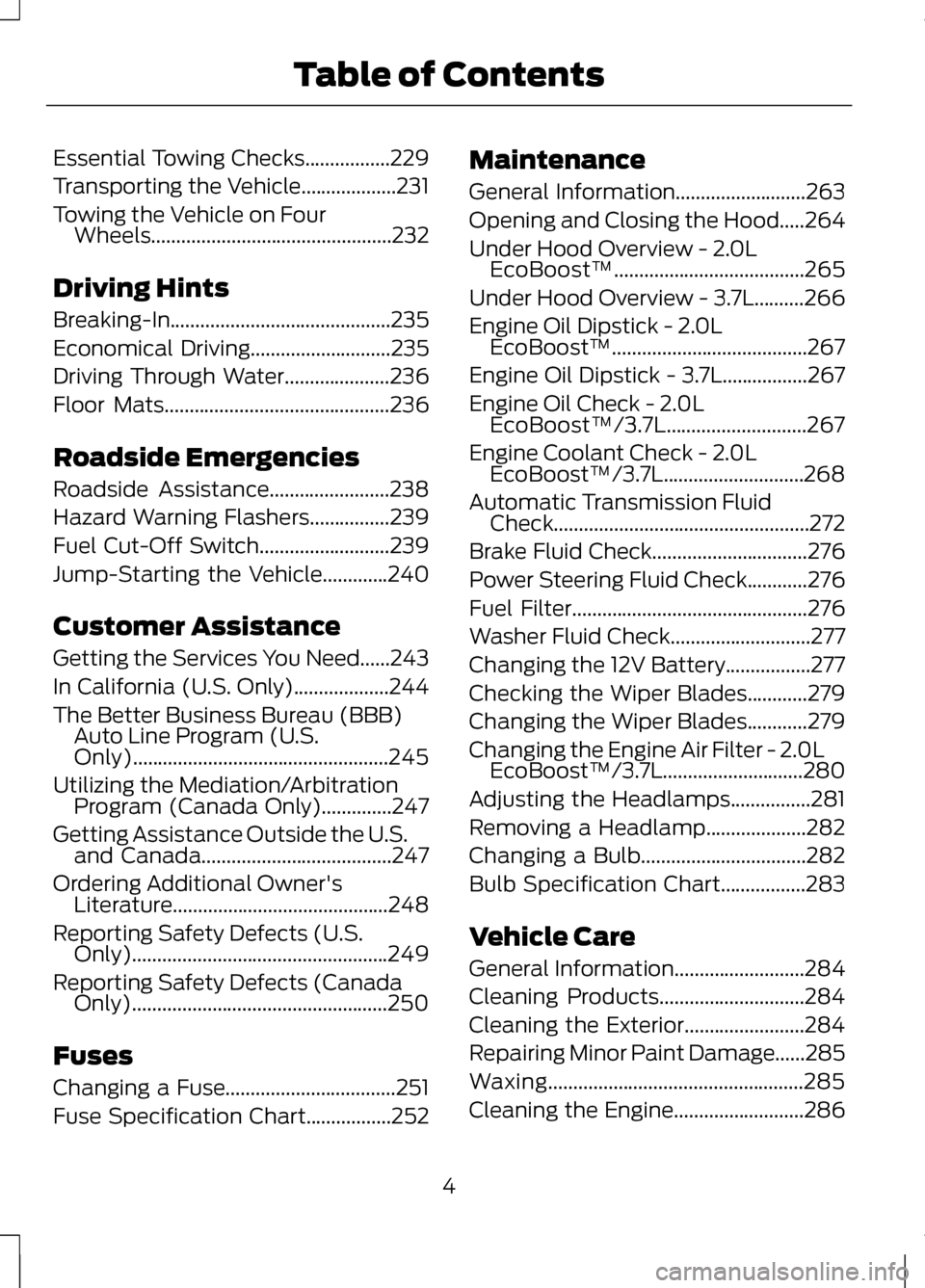
Essential Towing Checks.................229
Transporting the Vehicle...................231
Towing the Vehicle on Four
Wheels................................................232
Driving Hints
Breaking-In............................................235
Economical Driving
............................235
Driving Through Water.....................236
Floor Mats.............................................236
Roadside Emergencies
Roadside Assistance
........................238
Hazard Warning Flashers................239
Fuel Cut-Off Switch..........................239
Jump-Starting the Vehicle.............240
Customer Assistance
Getting the Services You Need......243
In California (U.S. Only)...................244
The Better Business Bureau (BBB) Auto Line Program (U.S.
Only)...................................................245
Utilizing the Mediation/Arbitration Program (Canada Only)..............247
Getting Assistance Outside the U.S. and Canada
......................................247
Ordering Additional Owner's Literature...........................................248
Reporting Safety Defects (U.S. Only)...................................................249
Reporting Safety Defects (Canada Only)...................................................250
Fuses
Changing a Fuse
..................................251
Fuse Specification Chart
.................252 Maintenance
General Information
..........................263
Opening and Closing the Hood.....264
Under Hood Overview - 2.0L EcoBoost™......................................265
Under Hood Overview - 3.7L..........266
Engine Oil Dipstick - 2.0L EcoBoost™.......................................267
Engine Oil Dipstick - 3.7L.................267
Engine Oil Check - 2.0L EcoBoost™/3.7L
............................267
Engine Coolant Check - 2.0L EcoBoost™/3.7L............................268
Automatic Transmission Fluid Check...................................................272
Brake Fluid Check
...............................276
Power Steering Fluid Check............276
Fuel Filter...............................................276
Washer Fluid Check
............................277
Changing the 12V Battery.................277
Checking the Wiper Blades
............279
Changing the Wiper Blades............279
Changing the Engine Air Filter - 2.0L EcoBoost™/3.7L............................280
Adjusting the Headlamps
................281
Removing a Headlamp
....................282
Changing a Bulb
.................................282
Bulb Specification Chart.................283
Vehicle Care
General Information
..........................284
Cleaning Products.............................284
Cleaning the Exterior........................284
Repairing Minor Paint Damage......285
Waxing...................................................285
Cleaning the Engine
..........................286
4
Table of Contents
Page 11 of 474
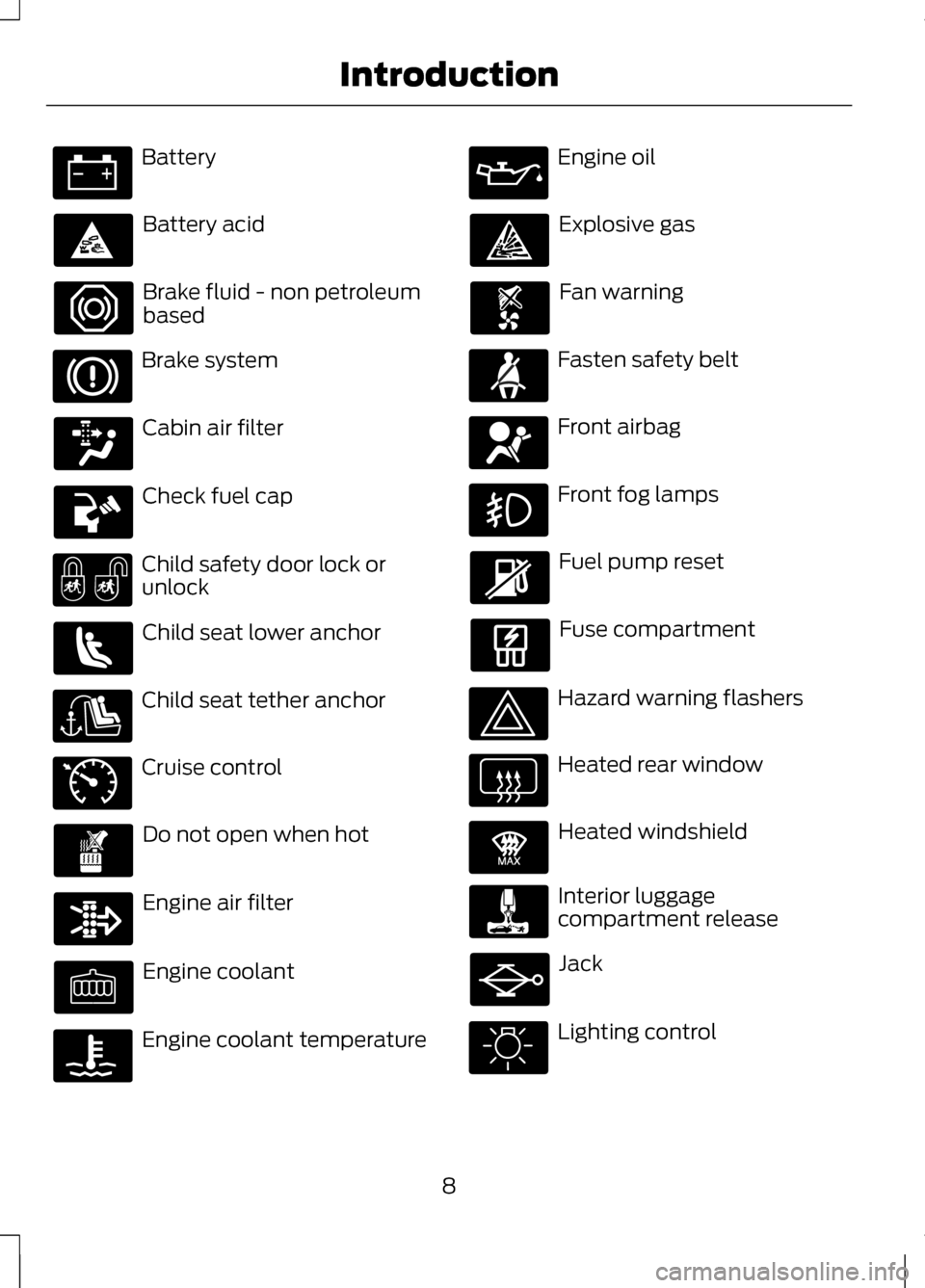
Battery
Battery acid
Brake fluid - non petroleum
based
Brake system
Cabin air filter
Check fuel cap
Child safety door lock or
unlock
Child seat lower anchor
Child seat tether anchor
Cruise control
Do not open when hot
Engine air filter
Engine coolant
Engine coolant temperature Engine oil
Explosive gas
Fan warning
Fasten safety belt
Front airbag
Front fog lamps
Fuel pump reset
Fuse compartment
Hazard warning flashers
Heated rear window
Heated windshield
Interior luggage
compartment release
Jack
Lighting control
8
Introduction E71340 E91392
Page 100 of 474
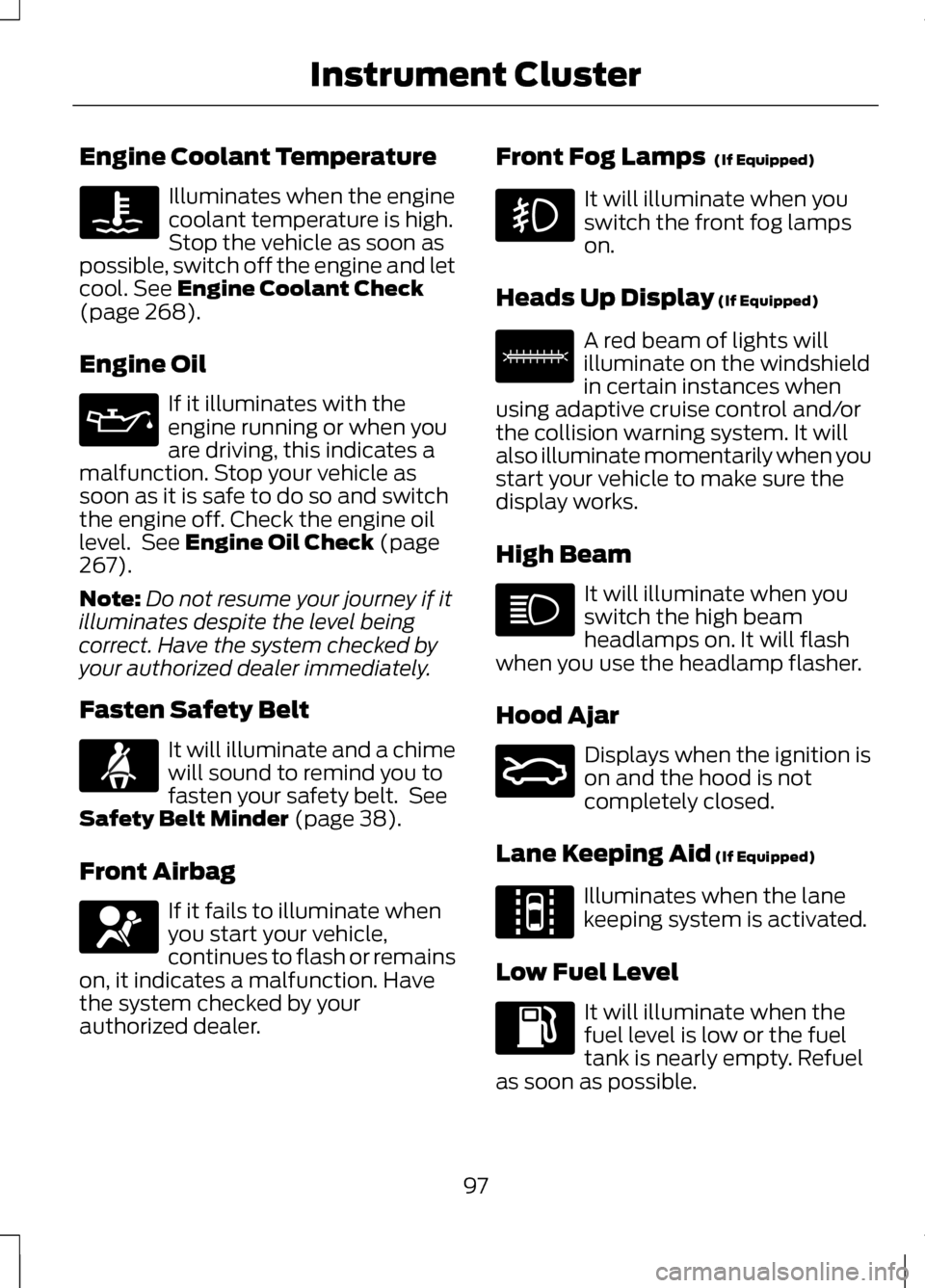
Engine Coolant Temperature
Illuminates when the engine
coolant temperature is high.
Stop the vehicle as soon as
possible, switch off the engine and let
cool. See Engine Coolant Check
(page 268).
Engine Oil If it illuminates with the
engine running or when you
are driving, this indicates a
malfunction. Stop your vehicle as
soon as it is safe to do so and switch
the engine off. Check the engine oil
level. See
Engine Oil Check (page
267).
Note: Do not resume your journey if it
illuminates despite the level being
correct. Have the system checked by
your authorized dealer immediately.
Fasten Safety Belt It will illuminate and a chime
will sound to remind you to
fasten your safety belt. See
Safety Belt Minder
(page 38).
Front Airbag If it fails to illuminate when
you start your vehicle,
continues to flash or remains
on, it indicates a malfunction. Have
the system checked by your
authorized dealer. Front Fog Lamps
(If Equipped) It will illuminate when you
switch the front fog lamps
on.
Heads Up Display
(If Equipped) A red beam of lights will
illuminate on the windshield
in certain instances when
using adaptive cruise control and/or
the collision warning system. It will
also illuminate momentarily when you
start your vehicle to make sure the
display works.
High Beam It will illuminate when you
switch the high beam
headlamps on. It will flash
when you use the headlamp flasher.
Hood Ajar Displays when the ignition is
on and the hood is not
completely closed.
Lane Keeping Aid
(If Equipped) Illuminates when the lane
keeping system is activated.
Low Fuel Level It will illuminate when the
fuel level is low or the fuel
tank is nearly empty. Refuel
as soon as possible.
97
Instrument Cluster E156133 E159324 E144813
Page 117 of 474
Maintenance
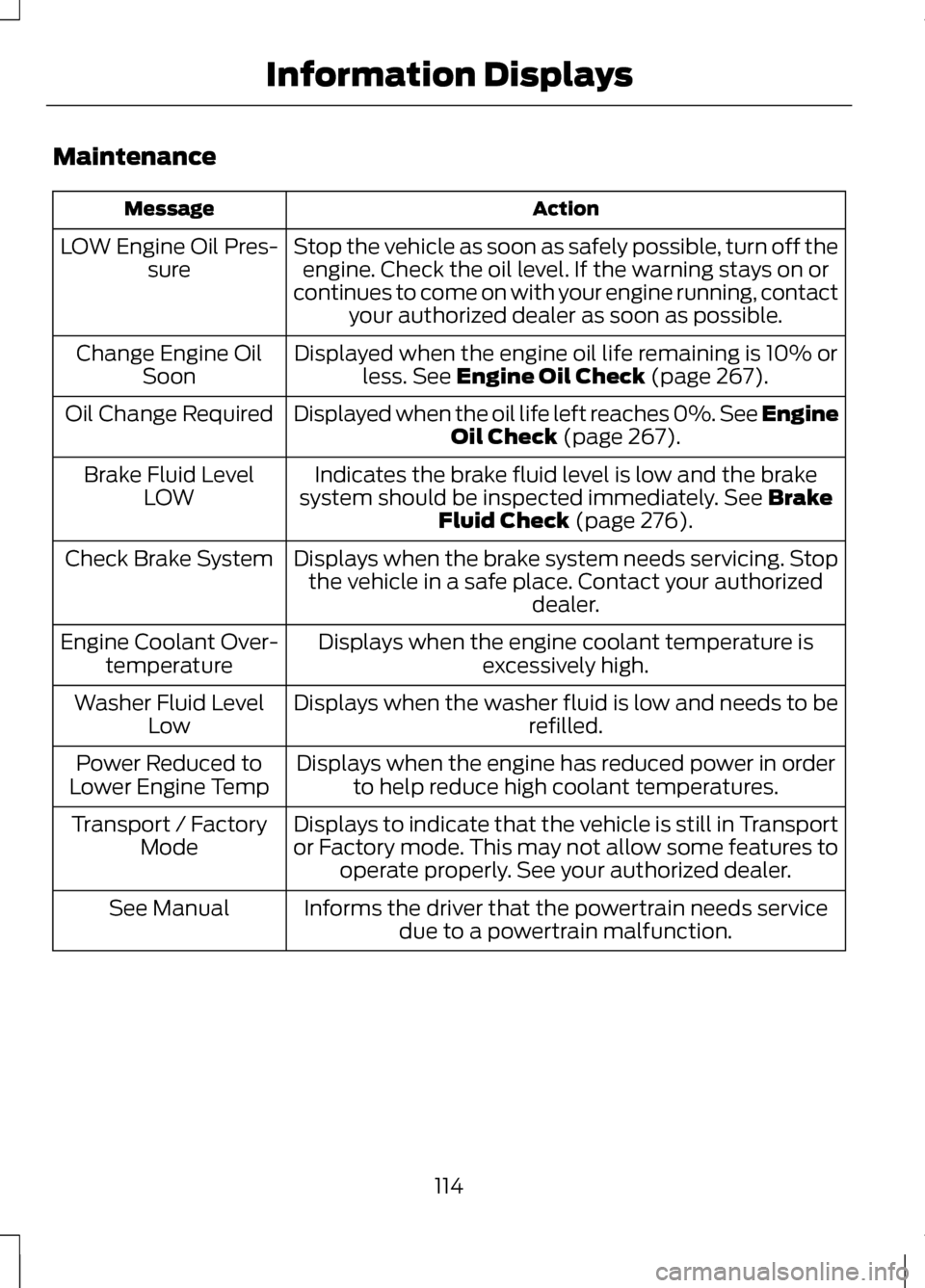
Action
Message
Stop the vehicle as soon as safely possible, turn off theengine. Check the oil level. If the warning stays on or
continues to come on with your engine running, contact your authorized dealer as soon as possible.
LOW Engine Oil Pres-
sure
Displayed when the engine oil life remaining is 10% orless. See Engine Oil Check (page 267).
Change Engine Oil
Soon
Displayed when the oil life left reaches 0%. See Engine Oil Check
(page 267).
Oil Change Required
Indicates the brake fluid level is low and the brake
system should be inspected immediately.
See Brake
Fluid Check (page 276).
Brake Fluid Level
LOW
Displays when the brake system needs servicing. Stopthe vehicle in a safe place. Contact your authorized dealer.
Check Brake System
Displays when the engine coolant temperature isexcessively high.
Engine Coolant Over-
temperature
Displays when the washer fluid is low and needs to be refilled.
Washer Fluid Level
Low
Displays when the engine has reduced power in orderto help reduce high coolant temperatures.
Power Reduced to
Lower Engine Temp
Displays to indicate that the vehicle is still in Transport
or Factory mode. This may not allow some features tooperate properly. See your authorized dealer.
Transport / Factory
Mode
Informs the driver that the powertrain needs servicedue to a powertrain malfunction.
See Manual
114
Information Displays
Page 270 of 474
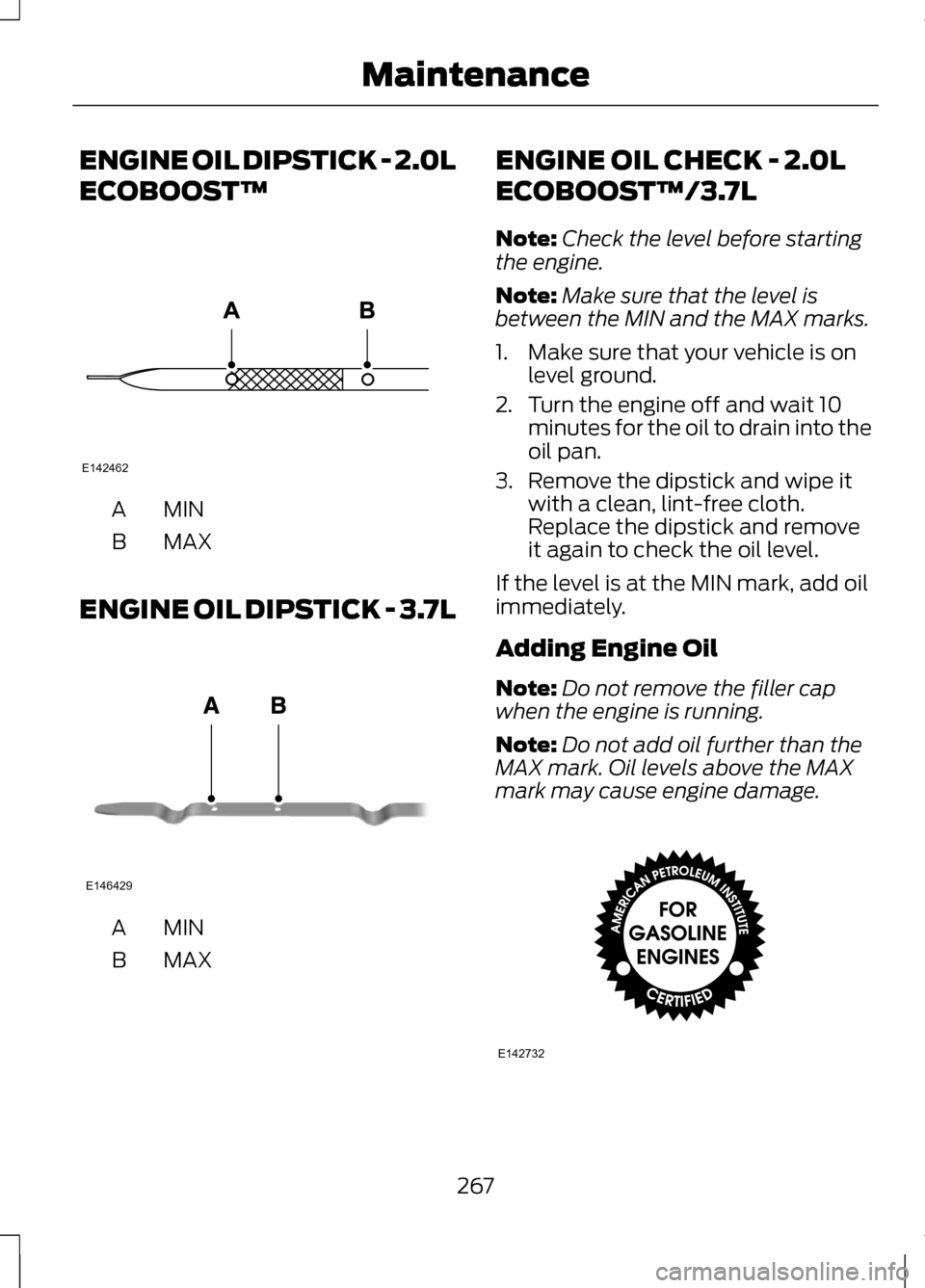
ENGINE OIL DIPSTICK - 2.0L
ECOBOOST™
MINA
MAXB
ENGINE OIL DIPSTICK - 3.7L MINA
MAXB ENGINE OIL CHECK - 2.0L
ECOBOOST™/3.7L
Note:
Check the level before starting
the engine.
Note: Make sure that the level is
between the MIN and the MAX marks.
1. Make sure that your vehicle is on level ground.
2. Turn the engine off and wait 10 minutes for the oil to drain into the
oil pan.
3. Remove the dipstick and wipe it with a clean, lint-free cloth.
Replace the dipstick and remove
it again to check the oil level.
If the level is at the MIN mark, add oil
immediately.
Adding Engine Oil
Note: Do not remove the filler cap
when the engine is running.
Note: Do not add oil further than the
MAX mark. Oil levels above the MAX
mark may cause engine damage. 267
MaintenanceE142462 E146429 E142732
Page 271 of 474
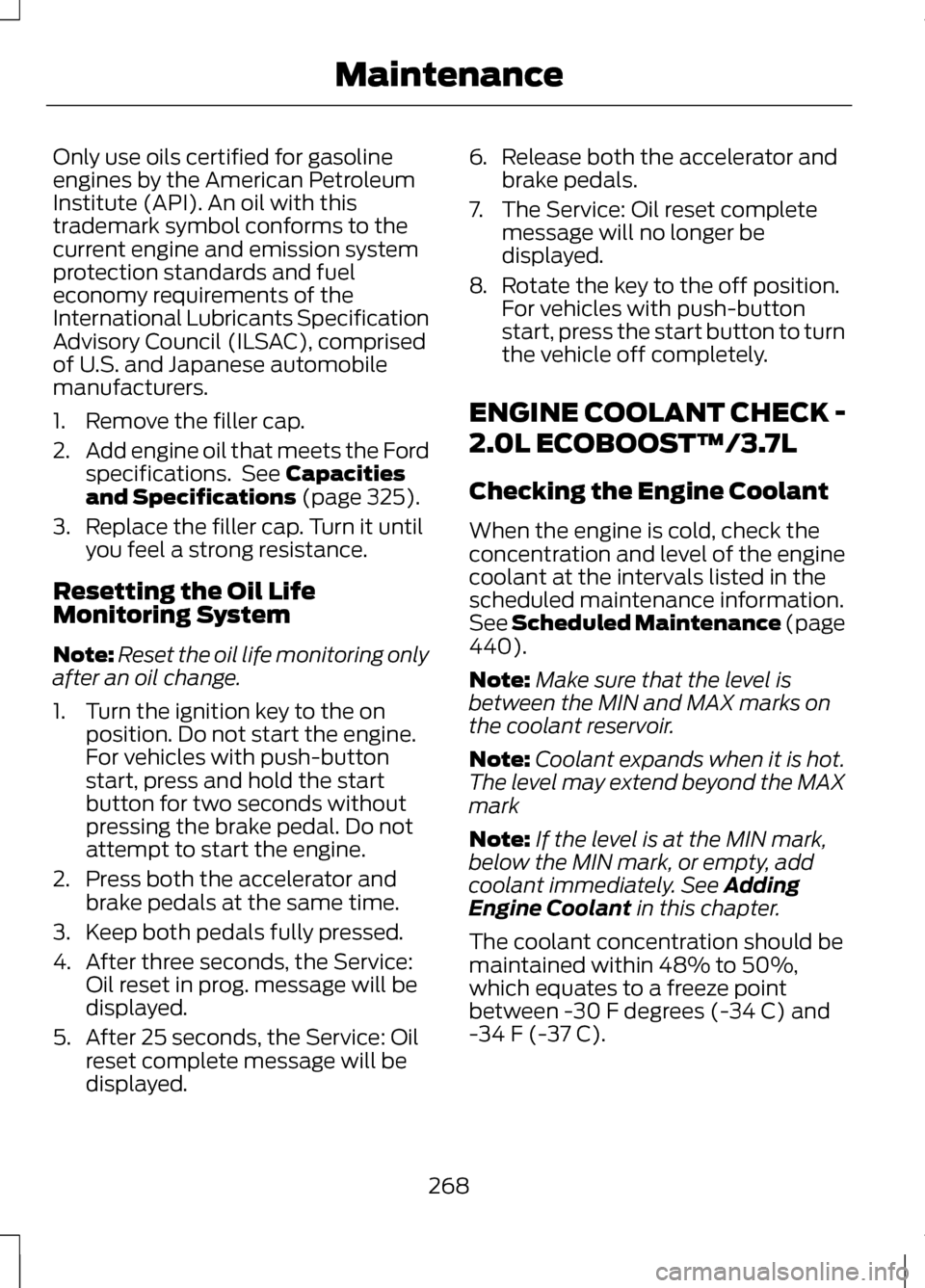
Only use oils certified for gasoline
engines by the American Petroleum
Institute (API). An oil with this
trademark symbol conforms to the
current engine and emission system
protection standards and fuel
economy requirements of the
International Lubricants Specification
Advisory Council (ILSAC), comprised
of U.S. and Japanese automobile
manufacturers.
1. Remove the filler cap.
2.
Add engine oil that meets the Ford
specifications. See Capacities
and Specifications (page 325).
3. Replace the filler cap. Turn it until you feel a strong resistance.
Resetting the Oil Life
Monitoring System
Note: Reset the oil life monitoring only
after an oil change.
1. Turn the ignition key to the on position. Do not start the engine.
For vehicles with push-button
start, press and hold the start
button for two seconds without
pressing the brake pedal. Do not
attempt to start the engine.
2. Press both the accelerator and brake pedals at the same time.
3. Keep both pedals fully pressed.
4. After three seconds, the Service: Oil reset in prog. message will be
displayed.
5. After 25 seconds, the Service: Oil reset complete message will be
displayed. 6.
Release both the accelerator and
brake pedals.
7. The Service: Oil reset complete message will no longer be
displayed.
8. Rotate the key to the off position.
For vehicles with push-button
start, press the start button to turn
the vehicle off completely.
ENGINE COOLANT CHECK -
2.0L ECOBOOST™/3.7L
Checking the Engine Coolant
When the engine is cold, check the
concentration and level of the engine
coolant at the intervals listed in the
scheduled maintenance information.
See Scheduled Maintenance (page
440
).
Note: Make sure that the level is
between the MIN and MAX marks on
the coolant reservoir.
Note: Coolant expands when it is hot.
The level may extend beyond the MAX
mark
Note: If the level is at the MIN mark,
below the MIN mark, or empty, add
coolant immediately. See
Adding
Engine Coolant in this chapter.
The coolant concentration should be
maintained within 48% to 50%,
which equates to a freeze point
between -30 F degrees (-34 C) and
-34 F (-37 C).
268
Maintenance
Page 293 of 474
All motor vehicles and their
components were engineered and
tested for reliable, regular driving.
Long term storage under various
conditions may lead to component
degradation or failure unless specific
precautions are taken to preserve the
components.
General
•
Store all vehicles in a dry,
ventilated place.
• Protect from sunlight, if possible.
• If vehicles are stored outside, they
require regular maintenance to
protect against rust and damage.
Body
• Wash vehicle thoroughly to
remove dirt, grease, oil, tar or mud
from exterior surfaces, rear-wheel
housing and underside of front
fenders.
• Periodically wash vehicles stored
in exposed locations.
• Touch-up raw or primed metal to
prevent rust
• Cover chrome and stainless steel
parts with a thick coat of auto wax
to prevent discoloration. Re-wax
as necessary when the vehicle is
washed.
• Lubricate all hood, door and trunk
lid hinges, and latches with a light
grade oil.
• Cover interior trim to prevent
fading.
• Keep all rubber parts free from oil
and solvents. Engine
•
The engine oil and filter should be
changed prior to storage, as used
engine oil contain contaminates
that may cause engine damage.
• Start the engine every 15 days. Run
at fast idle until it reaches normal
operating temperature
• With your foot on the brake, shift
through all the gears while the
engine is running.
Fuel system
• Fill the fuel tank with high-quality
fuel until the first automatic
shutoff of the fuel pump nozzle.
Note: During extended periods of
vehicle storage (30 days or more), fuel
may deteriorate due to oxidation. Add
a quality gas stabilizer product to the
vehicle fuel system whenever actual or
expected storage periods exceed 30
days. Follow the instructions on the
additive label. The vehicle should then
be operated at idle speed to circulate
the additive throughout the fuel
system.
Cooling system
• Protect against freezing
temperatures.
• When removing vehicle from
storage, check coolant fluid level.
Confirm there are no cooling
system leaks, and fluid is at the
recommended level.
290
Vehicle Care
Page 334 of 474
Ford Part Number
/ Ford Specifica- tion
Ford Part Name or
Equivalent
Capacity
Item
17.5 gal
(66.2 L)
2.0L EcoBoost engine
all-wheel drive fuel tank
17.5 gal
(66.2 L)
3.7L V6 engine front-
wheel drive or all-
wheel drive fuel tank
1 Use only Motorcraft® DOT 4 LV High Performance Brake Fluid or equivalent
meeting WSS-M6C65-A2 and ISO 4925 Class 6. Use of any fluid other than
the recommended fluid may cause brake system damage.
2 Approximate dry fill capacity. Actual amount may vary during fluid changes.
3 Automatic transmissions that require Motorcraft® MERCON® LV transmission
fluid should only use Motorcraft® MERCON® LV transmission fluid.
Use of any fluid other than the recommended fluid may cause transmission
damage.
Change the automatic transmission fluid and filter at the correct service interval.
See Scheduled Maintenance (page 440).
4 See your authorized dealer for fluid level checking or filling.
5 Use of synthetic or synthetic blend motor oil is not mandatory. Engine oil must
meet or exceed the requirements of Ford specification WSS-M2C946-A, SAE
5W-30 (2.0L engine) or WSS-M2C945-A, SAE 5W-20 (3.7L engine) and display
the API Starburst Certification Mark.
6 If the Ford specification is not shown on the oil container, the oil container must
display the API Starburst Certification Mark and the correct viscosity.
7 Add the coolant type originally equipped in your vehicle.
331
Capacities and Specifications
Page 444 of 474
Protecting Your Investment
Maintenance is an investment that
pays dividends in the form of
improved reliability, durability and
resale value. To maintain the proper
performance of your vehicle and its
emission control systems, make sure
you have scheduled maintenance
performed at the designated intervals.
Your vehicle is equipped with the
Intelligent Oil-Life Monitor® system,
which displays a message in the
information display at the proper oil
change interval. This interval may be
up to one year or 10000 miles (16000
kilometers).
When ENGINE OIL CHANGE DUE or
OIL CHANGE REQUIRED appears in
the information display, it is time for
an oil change. Make sure you perform
the oil change within two weeks or
500 miles (800 kilometers) of the
ENGINE OIL CHANGE DUE or OIL
CHANGE REQUIRED message
appearing. Make sure you reset the
Intelligent Oil-Life Monitor® after
each oil change. See Engine Oil
Check (page 267).
If your information display resets
prematurely or becomes inoperative,
you should perform the oil change
interval at six months or 5000 miles
(8000 kilometers) from your last oil
change. Never exceed one year or
10000 miles (16000 kilometers)
between oil change intervals. Your vehicle is very sophisticated and
built with multiple, complex,
performance systems. Every
manufacturer develops these systems
using different specifications and
performance features. That is why it
is important to rely upon your
dealership to properly diagnose and
repair your vehicle.
Ford Motor Company has
recommended maintenance intervals
for various parts and component
systems based upon engineering
testing. Ford Motor Company relies
upon this testing to determine the
most appropriate mileage for
replacement of oils and fluids to
protect your vehicle at the lowest
overall cost to you and recommends
against maintenance schedules that
deviate from the scheduled
maintenance information.
We strongly recommend the use of
only genuine Ford, Motorcraft® or
Ford-authorized re-manufactured
replacement parts engineered for your
vehicle.
Additives and Chemicals
This owner's manual and the Ford
Workshop Manual list the
recommended additives and
chemicals for your vehicle. We do not
recommend using chemicals or
additives not approved by us as part
of your vehicle
’s normal maintenance.
Please consult your warranty
information.
441
Scheduled Maintenance
Page 445 of 474
Oils, Fluids and Flushing
In many cases, fluid discoloration is a
normal operating characteristic and,
by itself, does not necessarily indicate
a concern or that the fluid needs to be
changed. However, a qualified expert,
such as the factory-trained
technicians at your dealership, should
inspect discolored fluids that also
show signs of overheating or foreign
material contamination immediately.
Make sure to change your vehicle
’s
oils and fluids at the specified
intervals or in conjunction with a
repair. Flushing is a viable way to
change fluid for many vehicle
sub-systems during scheduled
maintenance. It is critical that systems
are flushed only with new fluid that is
the same as that required to fill and
operate the system or using a
Ford-approved flushing chemical.
Owner Checks and Services
Make sure you perform the following
basic maintenance checks and
inspections every month or at six
month intervals. Check every month
Engine oil level.
Function of all interior and exterior lights.
Tires (including spare) for wear and proper pressure. Windshield washer fluid level. Check every six months
Battery connections. Clean if necessary.
Body and door drain holes for obstructions. Clean if necessary. Cooling system fluid level and coolant strength.
Door weatherstrips for wear. Lubricate if necessary.
Hinges, latches and outside locks for proper operation. Lubricate if necessary. Parking brake for proper operation.
442
Scheduled Maintenance