engine overheat LINCOLN MKZ 2013 Owners Manual
[x] Cancel search | Manufacturer: LINCOLN, Model Year: 2013, Model line: MKZ, Model: LINCOLN MKZ 2013Pages: 474, PDF Size: 3.79 MB
Page 141 of 474
WARNING
People who are unable to feel
pain to their skin because of
advanced age, chronic illness,
diabetes, spinal cord injury,
medication, alcohol use, exhaustion
or other physical conditions, must
exercise care when using the heated
seat. The heated seat may cause
burns even at low temperatures,
especially if used for long periods of
time. Do not place anything on the
seat that insulates against heat, such
as a blanket or cushion. This may
cause the heated seat to overheat. Do
not puncture the seat with pins,
needles or other pointed objects. This
may damage the heating element
which may cause the heated seat to
overheat. An overheated seat may
cause serious personal injury. Do not do the following:
•
Place heavy objects on the seat.
• Operate the heated seat if water
or any other liquid is spilled on the
seat. Allow the seat to dry
thoroughly.
• Operate the heated seats unless
the engine is running. Doing so can
cause the battery to lose charge. Press the heated seat symbol to cycle
through the various heat settings and
off. Warmer settings are indicated by
more indicator lights.
Rear Heated Seats (If Equipped)
WARNING
Persons who are unable to feel
pain to the skin because of
advanced age, chronic illness,
diabetes, spinal cord injury,
medication, alcohol use, exhaustion,
or other physical conditions, must
exercise care when using the seat
heater. The seat heater may cause
burns even at low temperatures,
especially if used for long periods of
time. Do not place anything on the
seat that insulates against heat, such
as a blanket or cushion, because this
may cause the seat heater to
overheat. Do not puncture the seat
with pins, needles, or other pointed
objects because this may damage the
heating element which may cause the
seat heater to overheat. An
overheated seat may cause serious
personal injury. Note:
Do not do the following:
• Place heavy objects on the seat.
• Operate the seat heater if water or
any other liquid is spilled on the
seat. Allow the seat to dry
thoroughly.
The rear seat heat controls are
located on the rear of the center
console.
138
SeatsE146322
Page 173 of 474
If Your Vehicle Gets Stuck In
Mud or Snow
Note:
Do not rock the vehicle if the
engine is not at normal operating
temperature or damage to the
transmission may occur.
Note: Do not rock the vehicle for more
than a minute or damage to the
transmission and tires may occur, or
the engine may overheat.
If your vehicle gets stuck in mud or
snow, it may be rocked out by shifting
between forward and reverse gears,
stopping between shifts in a steady
pattern. Press lightly on the
accelerator in each gear.
HILL START ASSIST (IF
EQUIPPED) WARNINGS
The system does not replace the
parking brake. When you leave
your vehicle, always apply the parking
brake and put the vehicle in
P (Park). You must remain in your vehicle
once you have activated the
system. During all times, you are
responsible for controlling your
vehicle, supervising the system and
intervening, if required. If the engine is revved
excessively, or if a malfunction
is detected, the system will be
deactivated. The system makes it easier to pull
away when your vehicle is on a slope
without the need to use the parking
brake.
When the system is active, your
vehicle will remain stationary on the
slope for two to three seconds after
you release the brake pedal. This
allows you time to move your foot
from the brake to the accelerator
pedal. The brakes are released
automatically once the engine has
developed sufficient drive to prevent
your vehicle from rolling down the
slope. This is an advantage when
pulling away on a slope, (for example
from a car park ramp, traffic lights or
when reversing uphill into a parking
space).
The system will activate
automatically on any slope which can
result in significant vehicle rollback.
Using Hill Start Assist
1.
Press the brake pedal to bring your
vehicle to a complete standstill.
Keep the brake pedal pressed.
2. If the sensors detect that your vehicle is on a slope, the system
will be activated automatically.
3. When you remove your foot from the brake pedal, your vehicle will
remain on the slope without rolling
away for approximately two or
three seconds. This hold time will
automatically be extended if you
are in the process of driving off.
4. Drive off in the normal manner. The brakes will be released
automatically.
170
Transmission
Page 174 of 474
USING ALL-WHEEL DRIVE
All-wheel drive uses all four wheels
to power the vehicle. This increases
traction, enabling you to drive over
terrain and road conditions that a
conventional two-wheel drive vehicle
cannot. The AWD system is active all
the time and requires no input from
the operator.
Note:
Your AWD vehicle is not
intended for off-road use. The AWD
feature gives your vehicle some limited
off-road capabilities in which driving
surfaces are relatively level,
obstruction-free and otherwise similar
to normal on-road driving conditions.
Operating your vehicle under other than
those conditions could subject the
vehicle to excessive stress which might
result in damage which is not covered
under your warranty.
Note: A warning message will be
displayed in the information display
when an AWD system fault is present
See Information Messages (page 105).
An AWD system fault will cause the
AWD system to default to front-wheel
drive only mode. When this warning
message is displayed, have your vehicle
serviced at an authorized dealer Note:
A warning message will be
displayed in the information display if
the AWD system has overheated See
Information Messages (page 105).
This condition may occur if the vehicle
was operated in extreme conditions
with excessive wheel slip, such as deep
sand. To resume normal AWD function
as soon as possible, stop the vehicle in
a safe location and stop the engine for
at least 10 minutes. After the engine
has been restarted and the AWD
system has adequately cooled, the
warning message will turn off and
normal AWD function will return.
Do not use a spare tire of a different
size other than the tire provided. If the
mini-spare tire is installed, the AWD
system may disable automatically
and enter front-wheel drive only mode
to protect driveline components. This
condition will be indicated by a
warning in the information display
See
Information Messages (page
105). If there is a warning message in
the information display from using the
spare tire, this indicator should turn
off after reinstalling the repaired or
replaced normal road tire and cycling
the ignition off and on. It is
recommended to reinstall the repaired
or replaced road tire as soon as
possible. Major dissimilar tire sizes
between the front and rear axles
could cause the AWD system to stop
functioning and default to front-wheel
drive or damage the AWD system.
171
All-Wheel Drive
(If Equipped)
Page 175 of 474
Driving In Special Conditions
With All-Wheel Drive (AWD)
AWD vehicles are equipped for driving
on sand, snow, mud and rough roads
and have operating characteristics
that are somewhat different from
conventional vehicles, both on and off
the highway.
Under severe operating conditions,
the A/C may cycle on and off to
protect overheating of the engine.
Basic operating principles in
special conditions
•
Drive slower in strong crosswinds
which can affect the normal
steering characteristics of your
vehicle.
• Be extremely careful when driving
on pavement made slippery by
loose sand, water, gravel, snow or
ice. If Your Vehicle Goes Off the Edge of
the Pavement
•
If your vehicle goes off the edge of
the pavement, slow down, but
avoid severe brake application,
ease the vehicle back onto the
pavement only after reducing your
speed. Do not turn the steering
wheel too sharply while returning
to the road surface.
• It may be safer to stay on the
apron or shoulder of the road and
slow down gradually before
returning to the pavement. You
may lose control if you do not slow
down or if you turn the steering
wheel too sharply or abruptly.
• It often may be less risky to strike
small objects, such as highway
reflectors, with minor damage to
your vehicle rather than attempt a
sudden return to the pavement
which could cause the vehicle to
slide sideways out of control or
rollover. Remember, your safety
and the safety of others should be
your primary concern.
If Your Vehicle Gets Stuck WARNINGS
Always set the parking brake
fully and make sure the gearshift
is latched in P (Park). Turn the ignition
to the lock position and remove the
key whenever you leave your vehicle. If the parking brake is fully
released, but the brake warning
lamp remains illuminated, the brakes
may not be working properly. See your
authorized dealer.
172
All-Wheel Drive (If Equipped)
Page 176 of 474
WARNINGS
Do not spin the wheels at over
35 mph (56 km/h). The tires may
fail and injure a passenger or
bystander. Note:
Do not rock the vehicle if the
engine is not at normal operating
temperature or damage to the
transmission may occur.
Note: Do not rock the vehicle for more
than a few minutes or damage to the
transmission and tires may occur or the
engine may overheat.
If your vehicle gets stuck in mud or
snow it may be rocked out by shifting
between forward and reverse gears,
stopping between shifts, in a steady
pattern. Press lightly on the
accelerator in each gear.
If your vehicle is equipped with
AdvanceTrac® with Roll Stability
Control ™, it may be beneficial to
disengage the AdvanceTrac® with
Roll Stability Control ™ system while
attempting to rock the vehicle.
Emergency Maneuvers
• In an unavoidable emergency
situation where a sudden sharp
turn must be made, remember to
avoid "over-driving" your vehicle
(i.e., turn the steering wheel only
as rapidly and as far as required to
avoid the emergency). Excessive
steering will result in less vehicle
control, not more. Additionally,
smooth variations of the
accelerator and/or brake pedal
pressure should be utilized if changes in vehicle speed are called
for. Avoid abrupt steering,
acceleration or braking which
could result in an increased risk of
loss of vehicle control, vehicle
rollover and/or personal injury. Use
all available road surface to return
the vehicle to a safe direction of
travel.
• In the event of an emergency stop,
avoid skidding the tires and do not
attempt any sharp steering wheel
movements.
• If the vehicle goes from one type
of surface to another (i.e., from
concrete to gravel) there will be a
change in the way the vehicle
responds to a maneuver (steering,
acceleration or braking). Again,
avoid these abrupt inputs.
Sand
When driving over sand, try to keep all
four wheels on the most solid area of
the trail. Avoid reducing the tire
pressures but shift to a lower gear and
drive steadily through the terrain.
Apply the accelerator slowly and
avoid spinning the wheels.
Do not drive your AWD vehicle in deep
sand. This will cause the AWD system
to overheat. After the system has
cooled down, normal AWD function
will return.
Under severe operating conditions,
the A/C may cycle on and off to
protect overheating of the engine.
173
All-Wheel Drive (If Equipped)
Page 178 of 474
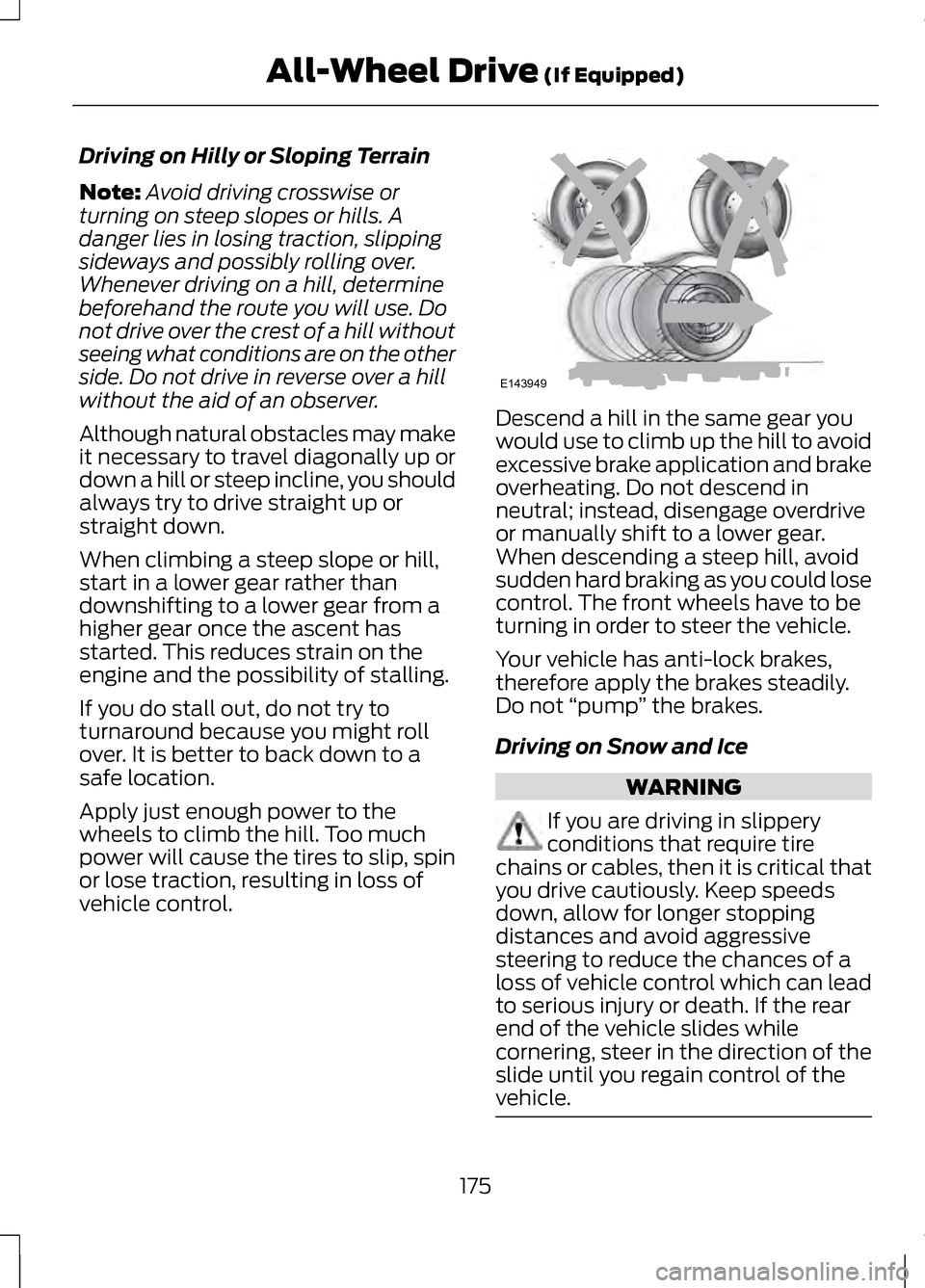
Driving on Hilly or Sloping Terrain
Note:
Avoid driving crosswise or
turning on steep slopes or hills. A
danger lies in losing traction, slipping
sideways and possibly rolling over.
Whenever driving on a hill, determine
beforehand the route you will use. Do
not drive over the crest of a hill without
seeing what conditions are on the other
side. Do not drive in reverse over a hill
without the aid of an observer.
Although natural obstacles may make
it necessary to travel diagonally up or
down a hill or steep incline, you should
always try to drive straight up or
straight down.
When climbing a steep slope or hill,
start in a lower gear rather than
downshifting to a lower gear from a
higher gear once the ascent has
started. This reduces strain on the
engine and the possibility of stalling.
If you do stall out, do not try to
turnaround because you might roll
over. It is better to back down to a
safe location.
Apply just enough power to the
wheels to climb the hill. Too much
power will cause the tires to slip, spin
or lose traction, resulting in loss of
vehicle control. Descend a hill in the same gear you
would use to climb up the hill to avoid
excessive brake application and brake
overheating. Do not descend in
neutral; instead, disengage overdrive
or manually shift to a lower gear.
When descending a steep hill, avoid
sudden hard braking as you could lose
control. The front wheels have to be
turning in order to steer the vehicle.
Your vehicle has anti-lock brakes,
therefore apply the brakes steadily.
Do not
“pump” the brakes.
Driving on Snow and Ice WARNING
If you are driving in slippery
conditions that require tire
chains or cables, then it is critical that
you drive cautiously. Keep speeds
down, allow for longer stopping
distances and avoid aggressive
steering to reduce the chances of a
loss of vehicle control which can lead
to serious injury or death. If the rear
end of the vehicle slides while
cornering, steer in the direction of the
slide until you regain control of the
vehicle. 175
All-Wheel Drive (If Equipped)E143949
Page 203 of 474
Resuming the Set Speed
Note:
Resume should only be used if
you are aware of the set speed and
intend to return to it.
Press and release RES. The vehicle
will return to the previously set speed.
The set speed will display
continuously in the information
display while the system is active.
Low Speed Automatic
Cancellation
The system is not functional at vehicle
speeds below 12 mph (20 km/h). An
audible alarm will sound and the
automatic braking will be released if
the vehicle drops below this speed.
Hilly Condition Usage
Note: An audible alarm will sound and
the system will shut down if it is
applying brakes for an extended period
of time. This allows the brakes to cool
down. The system will function
normally again when the brakes have
cooled down.
You should select a lower gear
position when the system is active in
situations such as prolonged downhill
driving on steep grades (i.e., driving in
mountainous areas). Additional
engine braking is needed in these
situations to reduce the load on the
vehicle ’s regular brake system to
prevent them from overheating.
Switching the System Off
Note: The set speed memory is erased
when you switch off the system. Press and release
OFF or turn off the
ignition.
Detection Issues
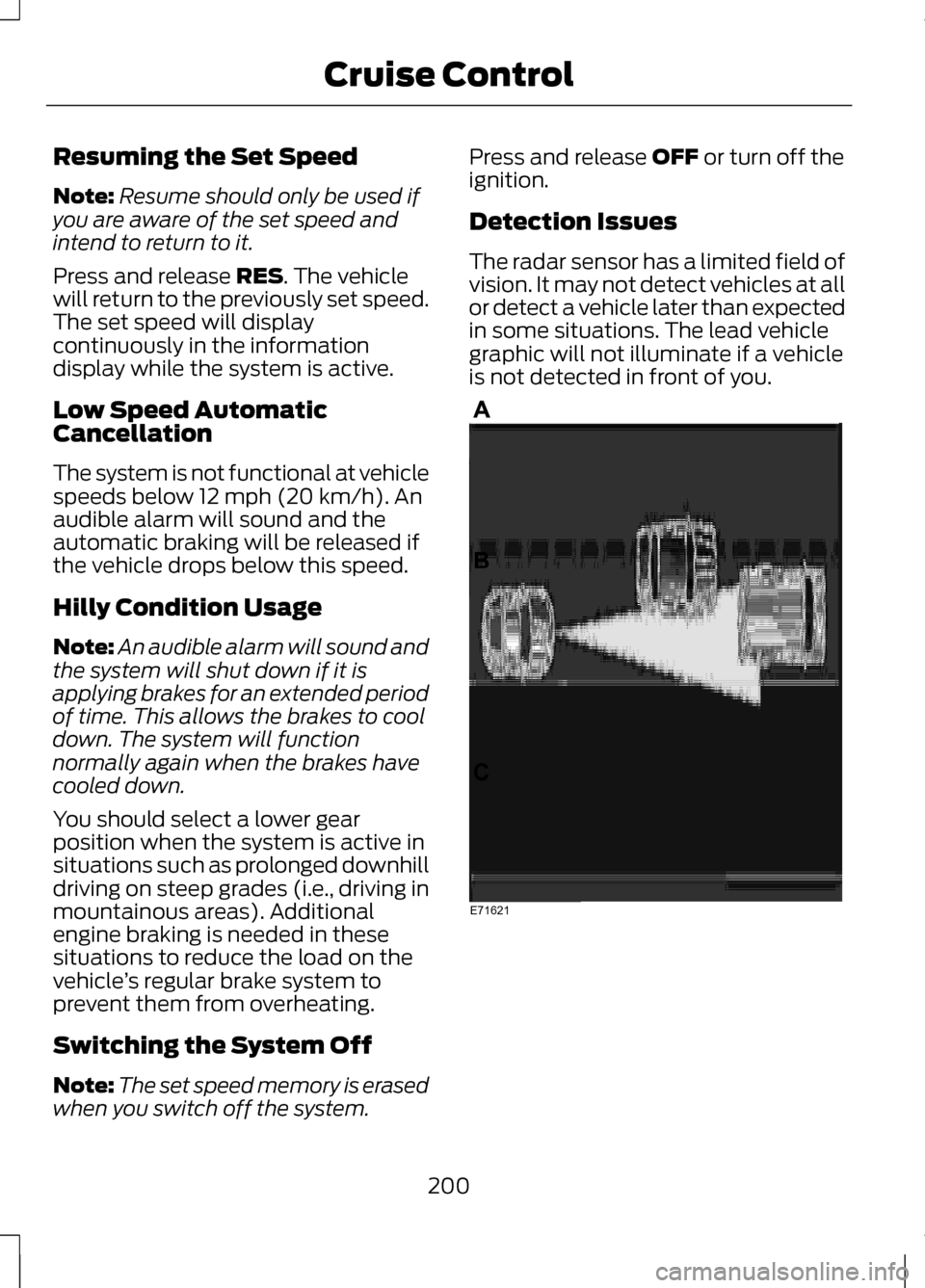
The radar sensor has a limited field of
vision. It may not detect vehicles at all
or detect a vehicle later than expected
in some situations. The lead vehicle
graphic will not illuminate if a vehicle
is not detected in front of you. 200
Cruise ControlE71621
Page 220 of 474
STEERING
Electric Power Steering
WARNING
Obtain immediate service if a
system error is detected. You
may not notice any difference in the
feel of your steering, but a serious
condition may exist. Failure to do so
may result in loss of steering control. Note:
Your vehicle is equipped with an
electric power-assisted steering
system. There is no fluid reservoir to
check or fill.
The electric power steering system
has diagnostic checks that
continuously monitor the system to
ensure proper operation of the
electronic system. When an electronic
error is detected, a message will be
displayed in the information display.
If this happens, stop the vehicle in a
safe place, and turn off the engine.
After at least 10 seconds, reset the
system by restarting the engine, and
watch the information display for a
steering message. If a steering
message returns, or returns while
driving, take the vehicle to your dealer
to have it checked. If your vehicle loses electrical power
while you are driving (or if the ignition
is turned off), you can steer the
vehicle manually, but it takes more
effort. Extreme continuous steering
may increase the effort it takes for you
to steer. This occurs to prevent
internal overheating and permanent
damage to your steering system. If this
should occur, you will neither lose the
ability to steer the vehicle manually
nor will it cause permanent damage.
Typical steering and driving
maneuvers will allow the system to
cool and steering assist will return to
normal.
Steering Tips
If the steering wanders or pulls, check
for:
•
an improperly inflated tire
• uneven tire wear
• loose or worn suspension
components
• loose or worn steering
components
• improper vehicle alignment
A high crown in the road or high
crosswinds may also make the
steering seem to wander or pull.
217
Driving Aids
Page 233 of 474
The braking system of the tow
vehicle is rated for operation at the
GVWR not GCWR.
Separate functioning brake
systems are required for safe
control of towed vehicles and
trailers weighing more than 1500
pounds (680 kilograms) when
loaded.
Trailer Lamps
Trailer lamps are required on most
towed vehicles. Make sure all running
lights, brake lights, turn signals and
hazard lights are working. Contact
your authorized dealer or trailer rental
agency for proper instructions and
equipment for hooking up the lamps.
Before Towing a Trailer
Practice turning, stopping and
backing-up to get the feel of the
vehicle-trailer combination before
starting on a trip. When turning, make
wider turns so the trailer wheels clear
curbs and other obstacles.
When Towing a Trailer
•
Do not drive faster than 70 mph
(113 km/h) during the first 500
miles (800 kilometers).
• Do not make full-throttle starts.
• Check your hitch, electrical
connections and trailer wheel lug
nuts thoroughly after you have
traveled 50 miles (80 kilometers). •
When stopped in congested or
heavy traffic during hot weather,
place the gearshift in position P to
aid engine and transmission
cooling and to help A/C
performance.
• Turn off the speed control with
heavy loads or in hilly terrain. The
speed control may turn off
automatically when you are towing
on long, steep grades.
• Shift to a lower gear when driving
down a long or steep hill. Do not
apply the brakes continuously, as
they may overheat and become
less effective.
• If your transmission is equipped
with a grade assist or Tow/Haul
feature, use this feature when
towing. This provides engine
braking and helps eliminate
excessive transmission shifting for
optimum fuel economy and
transmission cooling.
• Allow more distance for stopping
with a trailer attached. Anticipate
stops and brake gradually.
230
Towing
Page 272 of 474
Note:
For best results, coolant
concentration should be tested with a
refractometer such as Rotunda tool
300-ROB75240 available from your
authorized dealer. Ford does not
recommend the use of hydrometers or
coolant test strips for measuring
coolant concentrations.
Note: Automotive fluids are not
interchangeable. Do not use engine
coolant or antifreeze or windshield
washer fluid outside of its specified
function and vehicle location.
Adding Engine Coolant WARNINGS
Do not add engine coolant when
the engine is hot. Steam and
scalding liquids released from a hot
cooling system can burn you badly.
Also, you can be burned if you spill
coolant on hot engine parts. Do not put engine coolant in the
windshield washer fluid
container. If sprayed on the
windshield, engine coolant could
make it difficult to see through the
windshield. To reduce the risk of personal
injury, make sure the engine is
cool before unscrewing the coolant
pressure relief cap. The cooling
system is under pressure; steam and
hot liquid can come out forcefully
when the cap is loosened slightly. Do not add coolant further than
the MAX mark. Note:
Do not use stop leak pellets,
cooling system sealants, or additives
as they can cause damage to the
engine cooling or heating systems. This
damage would not be covered under
your vehicle ’s warranty.
Note: During normal vehicle operation,
the engine coolant may change color
from orange to pink or light red. As long
as the engine coolant is clear and
uncontaminated, this color change
does not indicate the engine coolant
has degraded nor does it require the
engine coolant to be drained, the
system to be flushed, or the engine
coolant to be replaced.
• Do not mix different colors or types
of coolant in your vehicle. Make
sure the correct coolant is used.
Mixing of engine coolants may
harm your engine ’s cooling system.
The use of an improper coolant
may harm engine and cooling
system components and may void
the warranty. Use prediluted
engine coolant meeting the Ford
specification. See Capacities and
Specifications (page 325).
• In case of emergency, a large
amount of water without engine
coolant may be added in order to
reach a vehicle service location. In
this instance, the cooling system
must be drained, chemically
cleaned with Motorcraft®
Premium Cooling System Flush,
and refilled with prediluted engine
coolant as soon as possible. Water
alone (without engine coolant)
can cause engine damage from
corrosion, overheating or freezing.
269
Maintenance