washer fluid LINCOLN MKZ 2013 Owners Manual
[x] Cancel search | Manufacturer: LINCOLN, Model Year: 2013, Model line: MKZ, Model: LINCOLN MKZ 2013Pages: 474, PDF Size: 3.79 MB
Page 7 of 474
Essential Towing Checks.................229
Transporting the Vehicle...................231
Towing the Vehicle on Four
Wheels................................................232
Driving Hints
Breaking-In............................................235
Economical Driving
............................235
Driving Through Water.....................236
Floor Mats.............................................236
Roadside Emergencies
Roadside Assistance
........................238
Hazard Warning Flashers................239
Fuel Cut-Off Switch..........................239
Jump-Starting the Vehicle.............240
Customer Assistance
Getting the Services You Need......243
In California (U.S. Only)...................244
The Better Business Bureau (BBB) Auto Line Program (U.S.
Only)...................................................245
Utilizing the Mediation/Arbitration Program (Canada Only)..............247
Getting Assistance Outside the U.S. and Canada
......................................247
Ordering Additional Owner's Literature...........................................248
Reporting Safety Defects (U.S. Only)...................................................249
Reporting Safety Defects (Canada Only)...................................................250
Fuses
Changing a Fuse
..................................251
Fuse Specification Chart
.................252 Maintenance
General Information
..........................263
Opening and Closing the Hood.....264
Under Hood Overview - 2.0L EcoBoost™......................................265
Under Hood Overview - 3.7L..........266
Engine Oil Dipstick - 2.0L EcoBoost™.......................................267
Engine Oil Dipstick - 3.7L.................267
Engine Oil Check - 2.0L EcoBoost™/3.7L
............................267
Engine Coolant Check - 2.0L EcoBoost™/3.7L............................268
Automatic Transmission Fluid Check...................................................272
Brake Fluid Check
...............................276
Power Steering Fluid Check............276
Fuel Filter...............................................276
Washer Fluid Check
............................277
Changing the 12V Battery.................277
Checking the Wiper Blades
............279
Changing the Wiper Blades............279
Changing the Engine Air Filter - 2.0L EcoBoost™/3.7L............................280
Adjusting the Headlamps
................281
Removing a Headlamp
....................282
Changing a Bulb
.................................282
Bulb Specification Chart.................283
Vehicle Care
General Information
..........................284
Cleaning Products.............................284
Cleaning the Exterior........................284
Repairing Minor Paint Damage......285
Waxing...................................................285
Cleaning the Engine
..........................286
4
Table of Contents
Page 84 of 474
A wipe will occur a few seconds after
washing to clear any remaining
washer fluid. This feature can be
switched on or off in the information
display. See General Information
(page 100).
81
Wipers and Washers
Page 101 of 474
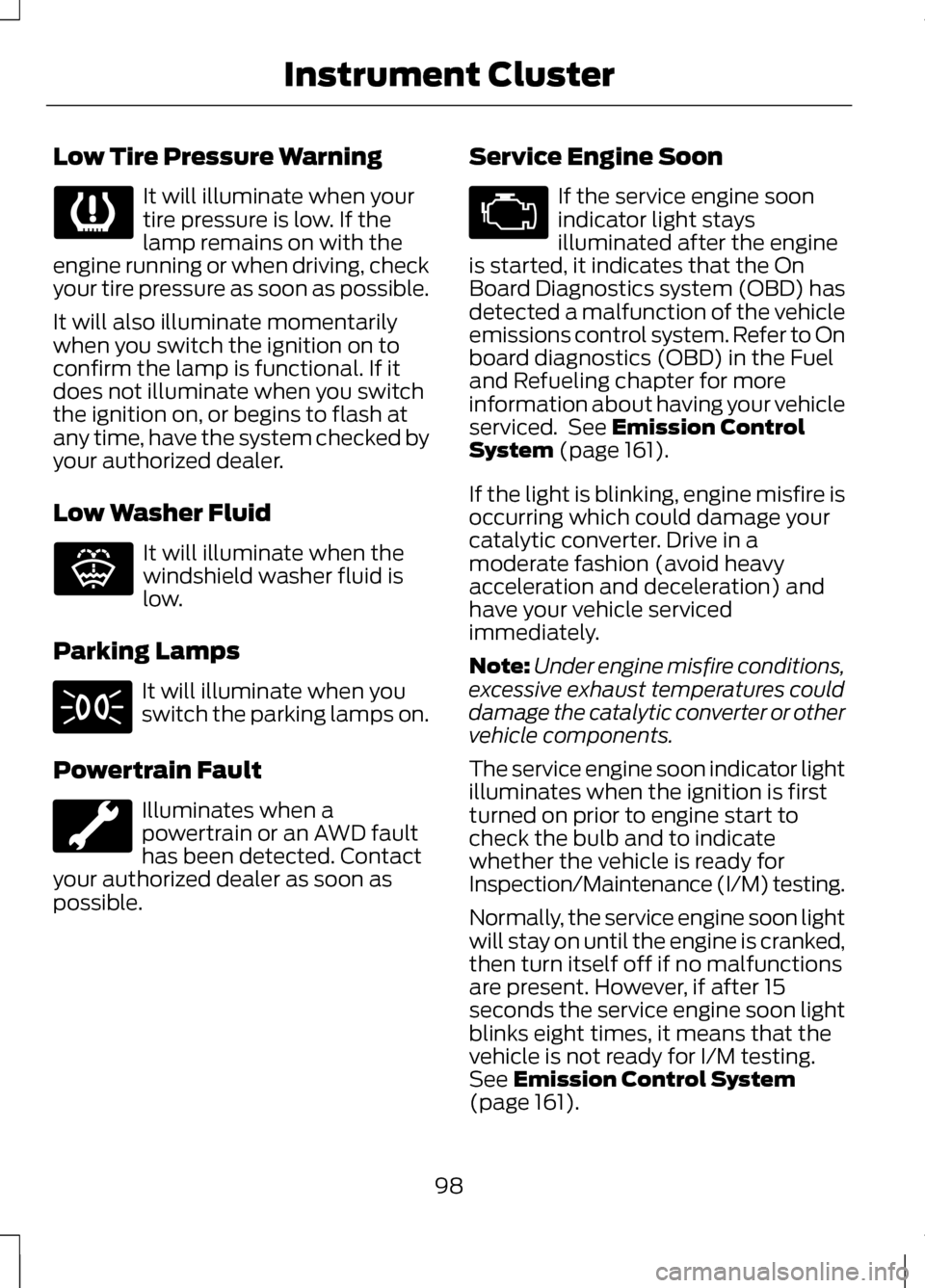
Low Tire Pressure Warning
It will illuminate when your
tire pressure is low. If the
lamp remains on with the
engine running or when driving, check
your tire pressure as soon as possible.
It will also illuminate momentarily
when you switch the ignition on to
confirm the lamp is functional. If it
does not illuminate when you switch
the ignition on, or begins to flash at
any time, have the system checked by
your authorized dealer.
Low Washer Fluid It will illuminate when the
windshield washer fluid is
low.
Parking Lamps It will illuminate when you
switch the parking lamps on.
Powertrain Fault Illuminates when a
powertrain or an AWD fault
has been detected. Contact
your authorized dealer as soon as
possible. Service Engine Soon If the service engine soon
indicator light stays
illuminated after the engine
is started, it indicates that the On
Board Diagnostics system (OBD) has
detected a malfunction of the vehicle
emissions control system. Refer to On
board diagnostics (OBD) in the Fuel
and Refueling chapter for more
information about having your vehicle
serviced. See Emission Control
System (page 161).
If the light is blinking, engine misfire is
occurring which could damage your
catalytic converter. Drive in a
moderate fashion (avoid heavy
acceleration and deceleration) and
have your vehicle serviced
immediately.
Note: Under engine misfire conditions,
excessive exhaust temperatures could
damage the catalytic converter or other
vehicle components.
The service engine soon indicator light
illuminates when the ignition is first
turned on prior to engine start to
check the bulb and to indicate
whether the vehicle is ready for
Inspection/Maintenance (I/M) testing.
Normally, the service engine soon light
will stay on until the engine is cranked,
then turn itself off if no malfunctions
are present. However, if after 15
seconds the service engine soon light
blinks eight times, it means that the
vehicle is not ready for I/M testing.
See
Emission Control System
(page 161).
98
Instrument Cluster E132353
Page 117 of 474
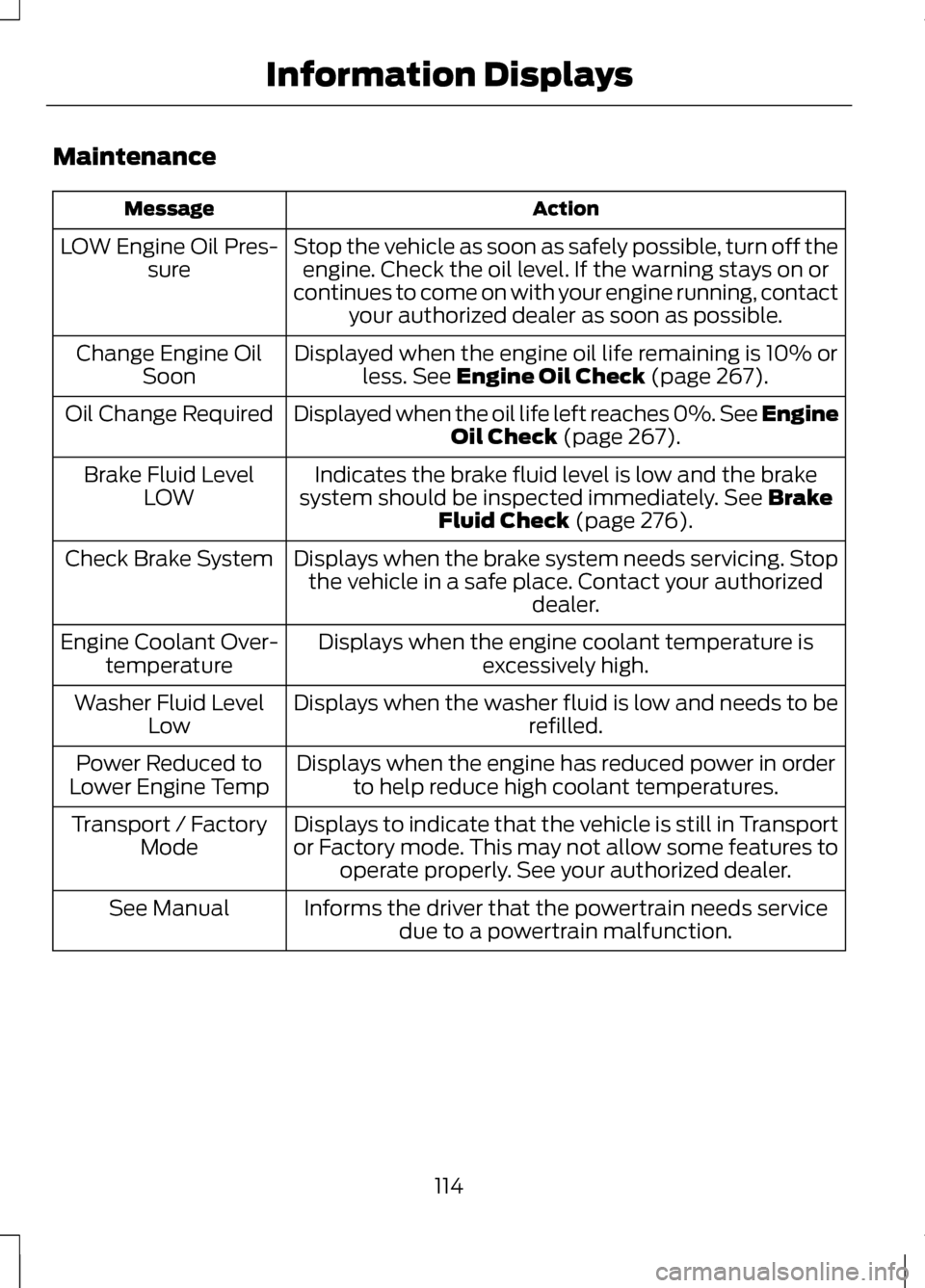
Maintenance
Action
Message
Stop the vehicle as soon as safely possible, turn off theengine. Check the oil level. If the warning stays on or
continues to come on with your engine running, contact your authorized dealer as soon as possible.
LOW Engine Oil Pres-
sure
Displayed when the engine oil life remaining is 10% orless. See Engine Oil Check (page 267).
Change Engine Oil
Soon
Displayed when the oil life left reaches 0%. See Engine Oil Check
(page 267).
Oil Change Required
Indicates the brake fluid level is low and the brake
system should be inspected immediately.
See Brake
Fluid Check (page 276).
Brake Fluid Level
LOW
Displays when the brake system needs servicing. Stopthe vehicle in a safe place. Contact your authorized dealer.
Check Brake System
Displays when the engine coolant temperature isexcessively high.
Engine Coolant Over-
temperature
Displays when the washer fluid is low and needs to be refilled.
Washer Fluid Level
Low
Displays when the engine has reduced power in orderto help reduce high coolant temperatures.
Power Reduced to
Lower Engine Temp
Displays to indicate that the vehicle is still in Transport
or Factory mode. This may not allow some features tooperate properly. See your authorized dealer.
Transport / Factory
Mode
Informs the driver that the powertrain needs servicedue to a powertrain malfunction.
See Manual
114
Information Displays
Page 268 of 474
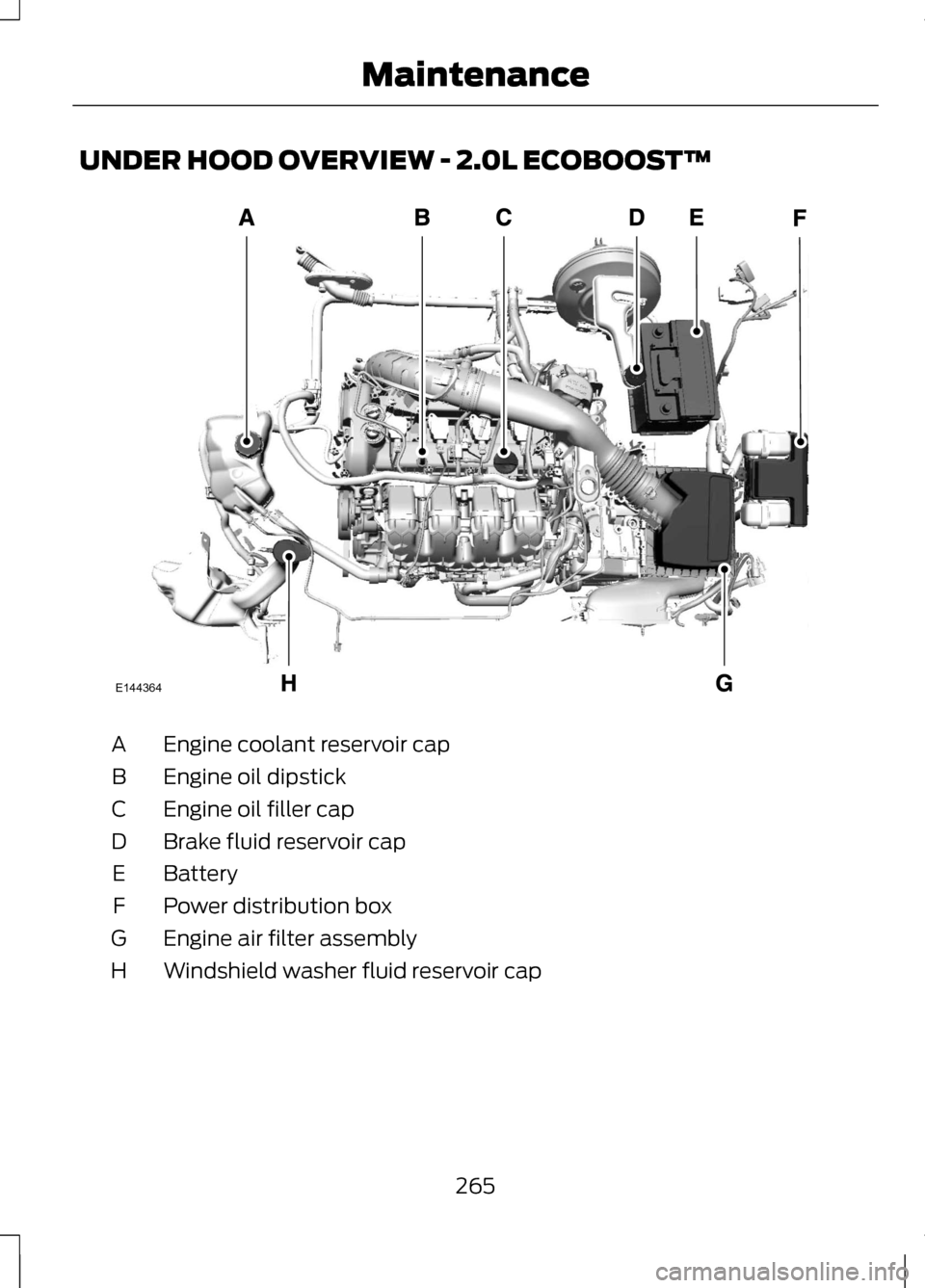
UNDER HOOD OVERVIEW - 2.0L ECOBOOST™
Engine coolant reservoir cap
A
Engine oil dipstick
B
Engine oil filler cap
C
Brake fluid reservoir cap
D
Battery
E
Power distribution box
F
Engine air filter assembly
G
Windshield washer fluid reservoir cap
H
265
MaintenanceE144364
Page 269 of 474
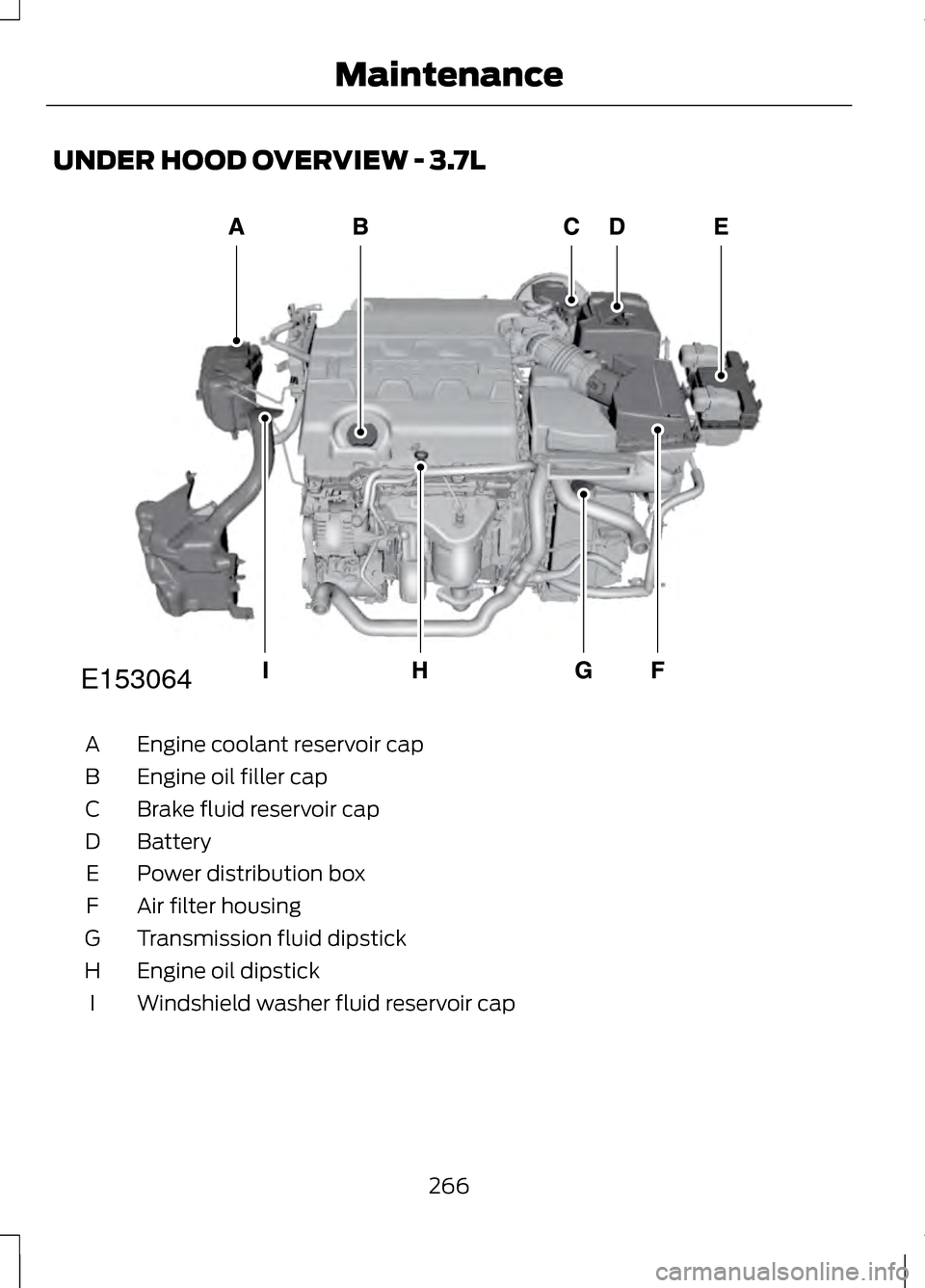
UNDER HOOD OVERVIEW - 3.7L
Engine coolant reservoir cap
A
Engine oil filler cap
B
Brake fluid reservoir cap
C
Battery
D
Power distribution box
E
Air filter housing
F
Transmission fluid dipstick
G
Engine oil dipstick
H
Windshield washer fluid reservoir cap
I
266
MaintenanceE153064
Page 272 of 474
Note:
For best results, coolant
concentration should be tested with a
refractometer such as Rotunda tool
300-ROB75240 available from your
authorized dealer. Ford does not
recommend the use of hydrometers or
coolant test strips for measuring
coolant concentrations.
Note: Automotive fluids are not
interchangeable. Do not use engine
coolant or antifreeze or windshield
washer fluid outside of its specified
function and vehicle location.
Adding Engine Coolant WARNINGS
Do not add engine coolant when
the engine is hot. Steam and
scalding liquids released from a hot
cooling system can burn you badly.
Also, you can be burned if you spill
coolant on hot engine parts. Do not put engine coolant in the
windshield washer fluid
container. If sprayed on the
windshield, engine coolant could
make it difficult to see through the
windshield. To reduce the risk of personal
injury, make sure the engine is
cool before unscrewing the coolant
pressure relief cap. The cooling
system is under pressure; steam and
hot liquid can come out forcefully
when the cap is loosened slightly. Do not add coolant further than
the MAX mark. Note:
Do not use stop leak pellets,
cooling system sealants, or additives
as they can cause damage to the
engine cooling or heating systems. This
damage would not be covered under
your vehicle ’s warranty.
Note: During normal vehicle operation,
the engine coolant may change color
from orange to pink or light red. As long
as the engine coolant is clear and
uncontaminated, this color change
does not indicate the engine coolant
has degraded nor does it require the
engine coolant to be drained, the
system to be flushed, or the engine
coolant to be replaced.
• Do not mix different colors or types
of coolant in your vehicle. Make
sure the correct coolant is used.
Mixing of engine coolants may
harm your engine ’s cooling system.
The use of an improper coolant
may harm engine and cooling
system components and may void
the warranty. Use prediluted
engine coolant meeting the Ford
specification. See Capacities and
Specifications (page 325).
• In case of emergency, a large
amount of water without engine
coolant may be added in order to
reach a vehicle service location. In
this instance, the cooling system
must be drained, chemically
cleaned with Motorcraft®
Premium Cooling System Flush,
and refilled with prediluted engine
coolant as soon as possible. Water
alone (without engine coolant)
can cause engine damage from
corrosion, overheating or freezing.
269
Maintenance
Page 280 of 474
WASHER FLUID CHECK
WARNING
If you operate your vehicle in
temperatures below 40°F (5°C),
use washer fluid with antifreeze
protection. Failure to use washer fluid
with antifreeze protection in cold
weather could result in impaired
windshield vision and increase the risk
of injury or accident. Note:
The front and rear washer
systems are supplied from the same
reservoir.
Add fluid to fill the reservoir if the level
is low. Only use a washer fluid that
meets Ford specifications. See
Capacities and Specifications
(page 325).
State or local regulations on volatile
organic compounds may restrict the
use of methanol, a common
windshield washer antifreeze additive.
Washer fluids containing
non-methanol antifreeze agents
should be used only if they provide
cold weather protection without
damaging the vehicle ’s paint finish,
wiper blades or washer system. CHANGING THE 12V
BATTERY WARNINGS
Batteries normally produce
explosive gases which can cause
personal injury. Therefore, do not
allow flames, sparks or lighted
substances to come near the battery.
When working near the battery,
always shield your face and protect
your eyes. Always provide proper
ventilation. When lifting a plastic-cased
battery, excessive pressure on
the end walls could cause acid to flow
through the vent caps, resulting in
personal injury and/or damage to the
vehicle or battery. Lift the battery with
a battery carrier or with your hands on
opposite corners. Keep batteries out of reach of
children. Batteries contain
sulfuric acid. Avoid contact with skin,
eyes or clothing. Shield your eyes
when working near the battery to
protect against possible splashing of
acid solution. In case of acid contact
with skin or eyes, flush immediately
with water for a minimum of 15
minutes and get prompt medical
attention. If acid is swallowed, call a
physician immediately. Battery posts, terminals and
related accessories contain lead
and lead compounds. Wash hands
after handling. 277
Maintenance
Page 282 of 474
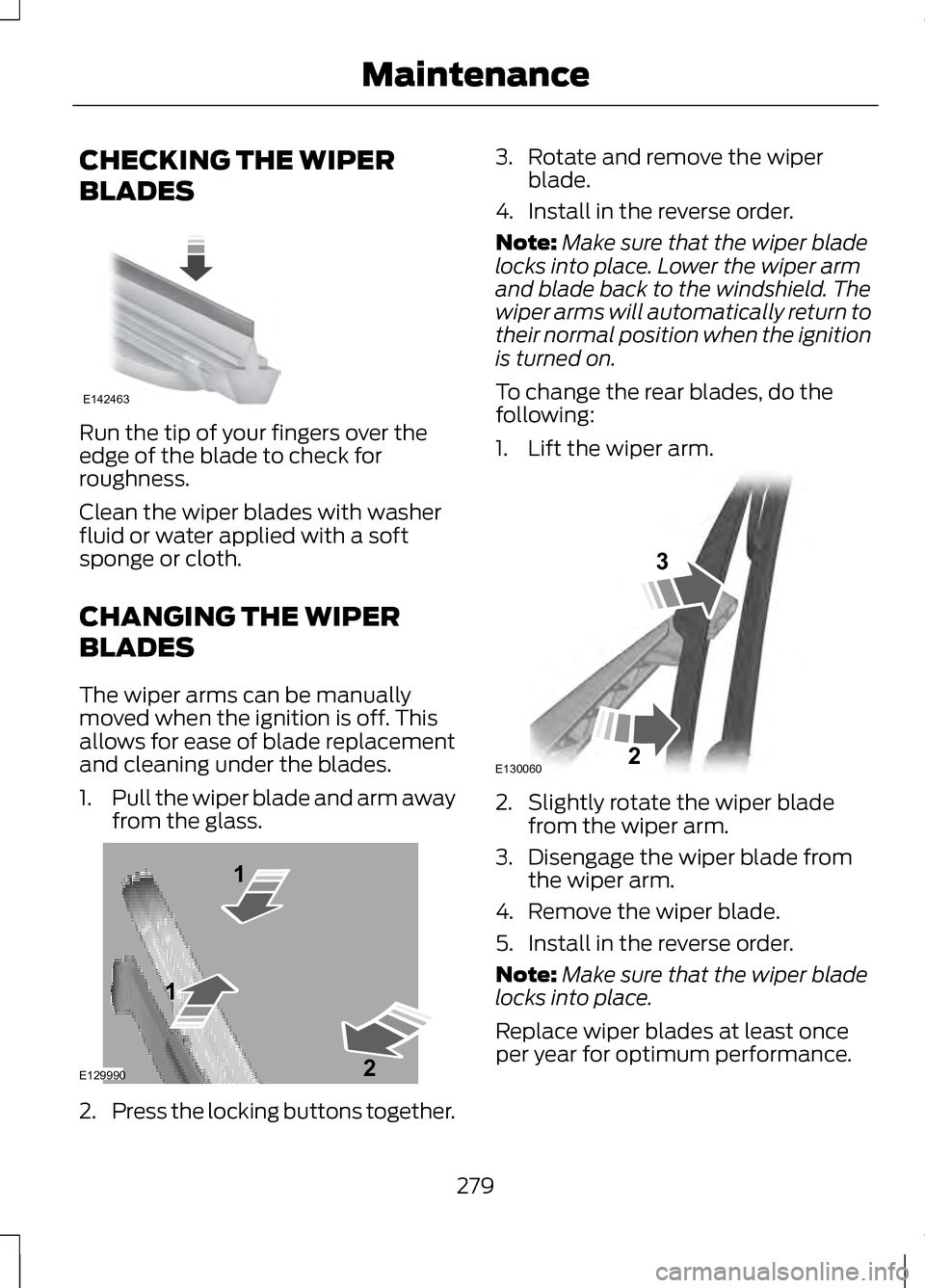
CHECKING THE WIPER
BLADES
Run the tip of your fingers over the
edge of the blade to check for
roughness.
Clean the wiper blades with washer
fluid or water applied with a soft
sponge or cloth.
CHANGING THE WIPER
BLADES
The wiper arms can be manually
moved when the ignition is off. This
allows for ease of blade replacement
and cleaning under the blades.
1.
Pull the wiper blade and arm away
from the glass. 2.
Press the locking buttons together. 3. Rotate and remove the wiper
blade.
4. Install in the reverse order.
Note: Make sure that the wiper blade
locks into place. Lower the wiper arm
and blade back to the windshield. The
wiper arms will automatically return to
their normal position when the ignition
is turned on.
To change the rear blades, do the
following:
1. Lift the wiper arm. 2. Slightly rotate the wiper blade
from the wiper arm.
3. Disengage the wiper blade from the wiper arm.
4. Remove the wiper blade.
5. Install in the reverse order.
Note: Make sure that the wiper blade
locks into place.
Replace wiper blades at least once
per year for optimum performance.
279
MaintenanceE142463 E129990
1
1 2 E130060
3
2
Page 287 of 474
GENERAL INFORMATION
Your Ford or Lincoln authorized dealer
has many quality products available
to clean your vehicle and protect its
finishes.
CLEANING PRODUCTS
For best results, use the following
products or products of equivalent
quality:
Motorcraft® Bug and Tar Remover
(ZC-42)
Motorcraft® Custom Bright Metal
Cleaner (ZC-15)
Motorcraft® Detail Wash (ZC-3-A)
Motorcraft® Dusting Cloth (ZC-24)
Motorcraft® Engine Shampoo and
Degreaser (U.S. only) (ZC-20)
Motorcraft® Engine Shampoo
(Canada only) (CXC-66-A)
Motorcraft® Multi-Purpose Cleaner
(Canada only) (CXC-101)
Motorcraft® Premium Glass Cleaner
(Canada only) (CXC-100)
Motorcraft® Premium Quality
Windshield Washer Fluid (Canada
only) [CXC-37-(A, B, D or F)]
Motorcraft® Premium Windshield
Washer Concentrate (U.S. only)
(ZC-32-A)
Motorcraft® Professional Strength
Carpet & Upholstery Cleaner (ZC-54)
Motorcraft® Spot and Stain Remover
(U.S. only) (ZC-14)
Motorcraft® Ultra-Clear Spray Glass
Cleaner (ZC-23)
Motorcraft® Vinyl Cleaner (Canada
only) (CXC-93)
Motorcraft® Wheel and Tire Cleaner
(ZC-37-A)
CLEANING THE EXTERIOR
Wash your vehicle regularly with cool
or lukewarm water and a neutral pH
shampoo, such as Motorcraft® Detail
Wash.
•
Never use strong household
detergents or soap, such as dish
washing or laundry liquid. These
products can discolor and spot
painted surfaces.
• Never wash a vehicle that is “hot
to the touch ” or during exposure
to strong, direct sunlight.
• Dry the vehicle with a chamois or
soft terry cloth towel in order to
eliminate water spotting.
• Immediately remove items such
as gasoline, diesel fuel, bird
droppings and insect deposits
because they can cause damage
to the vehicle ’s paintwork and trim
over time. Use Motorcraft® Bug
and Tar Remover.
• Remove any exterior accessories,
such as antennas, before entering
a car wash.
Note: Suntan lotions and insect
repellents can damage any painted
surface; if these substances come in
contact with your vehicle, wash off as
soon as possible.
284
Vehicle Care