oil LINCOLN MKZ 2014 User Guide
[x] Cancel search | Manufacturer: LINCOLN, Model Year: 2014, Model line: MKZ, Model: LINCOLN MKZ 2014Pages: 468, PDF Size: 4.49 MB
Page 274 of 468
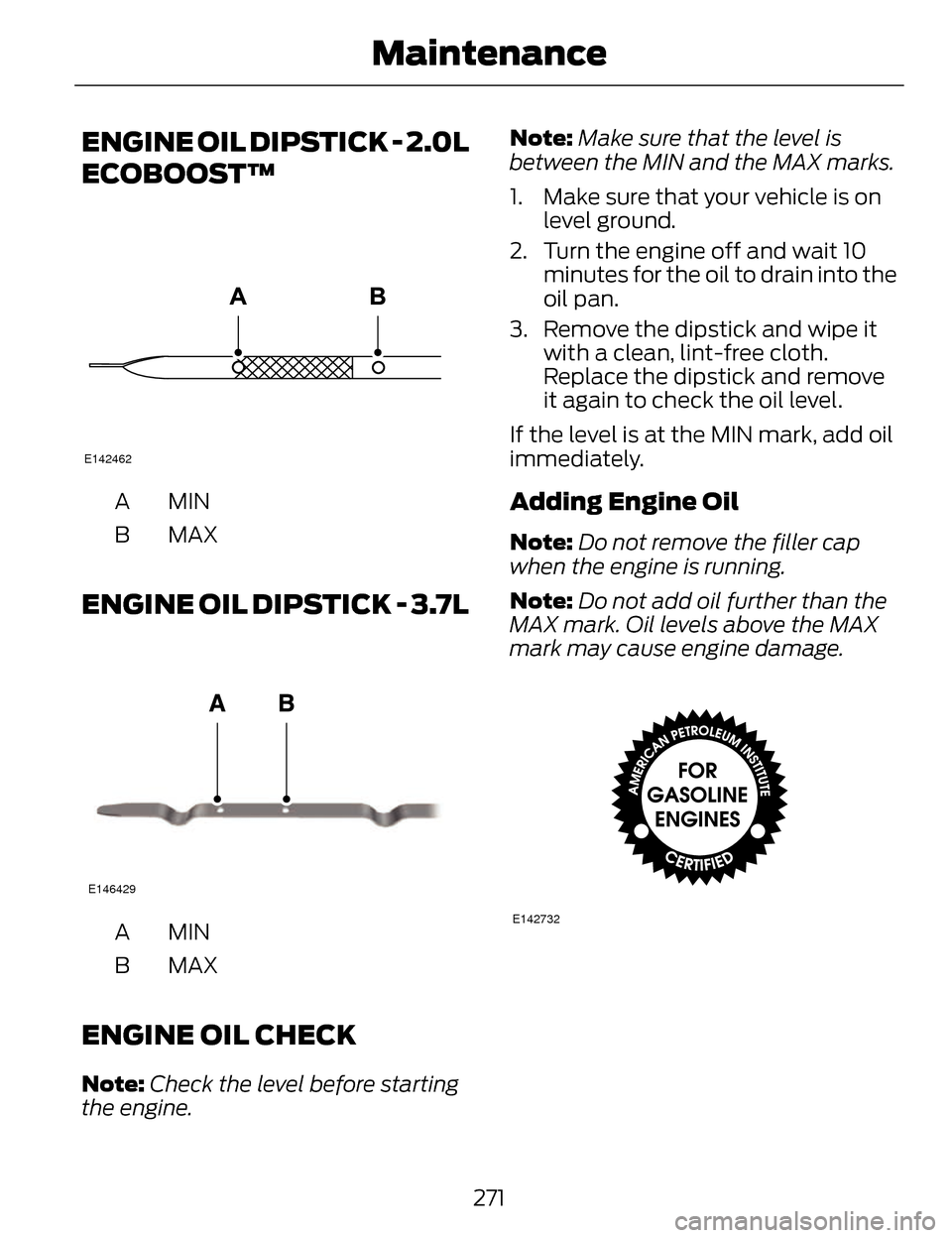
ENGINE OIL DIPSTICK - 2.0L
ECOBOOST™
E142462
MINA
MAXB
ENGINE OIL DIPSTICK - 3.7L
E146429
MINA
MAXB
ENGINE OIL CHECK
Note:Check the level before starting
the engine. Note:
Make sure that the level is
between the MIN and the MAX marks.
1. Make sure that your vehicle is on level ground.
2. Turn the engine off and wait 10 minutes for the oil to drain into the
oil pan.
3. Remove the dipstick and wipe it with a clean, lint-free cloth.
Replace the dipstick and remove
it again to check the oil level.
If the level is at the MIN mark, add oil
immediately.
Adding Engine Oil
Note: Do not remove the filler cap
when the engine is running.
Note: Do not add oil further than the
MAX mark. Oil levels above the MAX
mark may cause engine damage.
E142732
271
Maintenance
Page 275 of 468
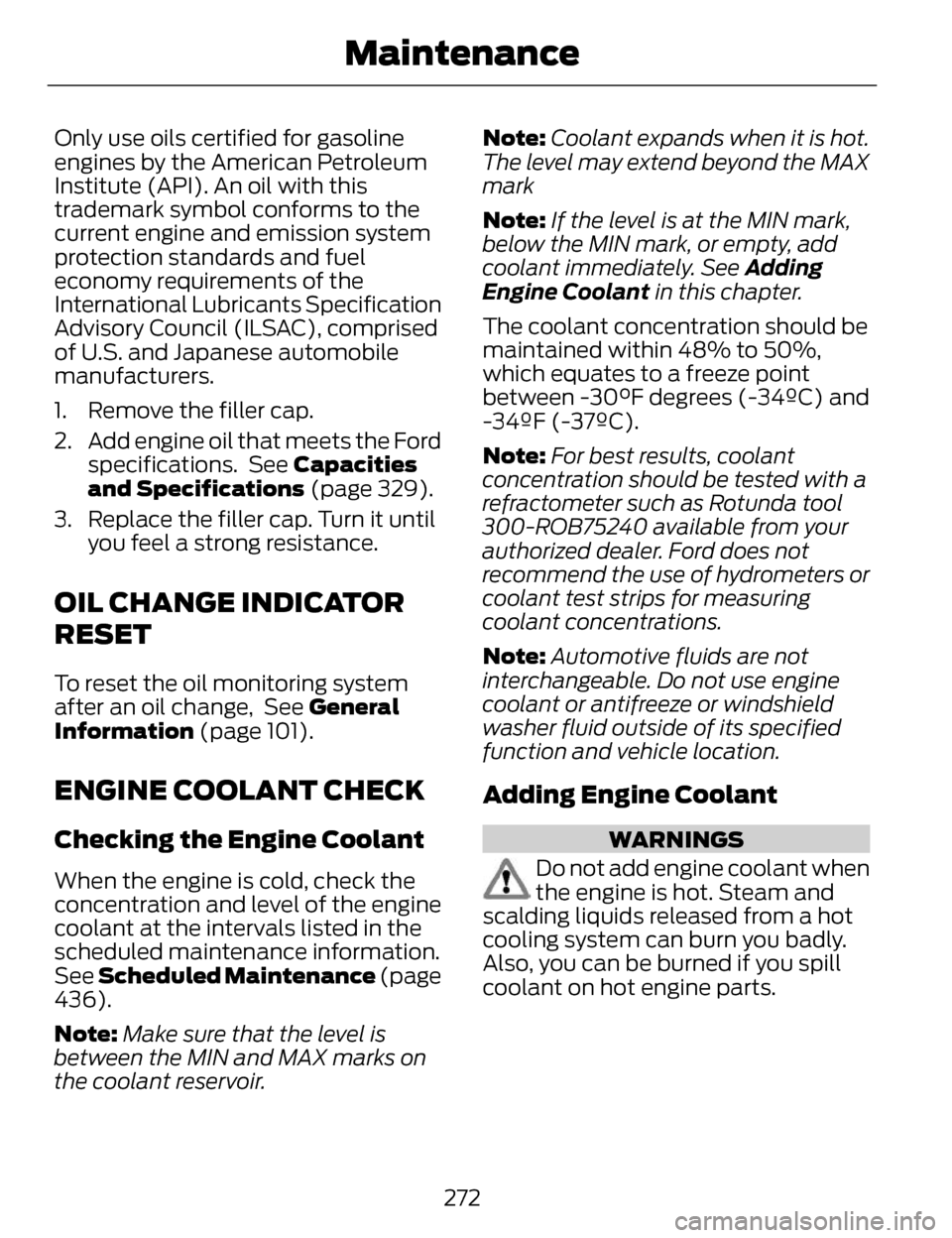
Only use oils certified for gasoline
engines by the American Petroleum
Institute (API). An oil with this
trademark symbol conforms to the
current engine and emission system
protection standards and fuel
economy requirements of the
International Lubricants Specification
Advisory Council (ILSAC), comprised
of U.S. and Japanese automobile
manufacturers.
1. Remove the filler cap.
2. Add engine oil that meets the Fordspecifications. See Capacities
and Specifications (page 329).
3. Replace the filler cap. Turn it until you feel a strong resistance.
OIL CHANGE INDICATOR
RESET
To reset the oil monitoring system
after an oil change, See General
Information (page 101).
ENGINE COOLANT CHECK
Checking the Engine Coolant
When the engine is cold, check the
concentration and level of the engine
coolant at the intervals listed in the
scheduled maintenance information.
See Scheduled Maintenance (page
436).
Note: Make sure that the level is
between the MIN and MAX marks on
the coolant reservoir. Note:
Coolant expands when it is hot.
The level may extend beyond the MAX
mark
Note: If the level is at the MIN mark,
below the MIN mark, or empty, add
coolant immediately. See Adding
Engine Coolant in this chapter.
The coolant concentration should be
maintained within 48% to 50%,
which equates to a freeze point
between -30°F degrees (-34ºC) and
-34ºF (-37ºC).
Note: For best results, coolant
concentration should be tested with a
refractometer such as Rotunda tool
300-ROB75240 available from your
authorized dealer. Ford does not
recommend the use of hydrometers or
coolant test strips for measuring
coolant concentrations.
Note: Automotive fluids are not
interchangeable. Do not use engine
coolant or antifreeze or windshield
washer fluid outside of its specified
function and vehicle location.
Adding Engine Coolant
WARNINGS
Do not add engine coolant when
the engine is hot. Steam and
scalding liquids released from a hot
cooling system can burn you badly.
Also, you can be burned if you spill
coolant on hot engine parts.
272
Maintenance
Page 293 of 468
When washing and waxing, park your
vehicle in a shaded area out of direct
sunlight. Always wash your vehicle
before applying wax.
• Use a quality wax that does notcontain abrasives.
• Follow the manufacturer’s instructions to apply and remove
the wax.
• Apply a small amount of wax in a back-and-forth motion, not in
circles.
• Do not allow wax to come in contact with any non-body
(low-gloss black) colored trim.
The wax will discolor or stain the
parts over time.
• Roof racks.
• Bumpers.
• Grained door handles.
• Side mouldings.
• Mirror housings.
• Windshield cowl area.
• Do not apply wax to glass areas.
• After waxing, your car's paint should feel smooth, and be free of
streaks and smudges.
CLEANING THE ENGINE
Engines are more efficient when they
are clean because grease and dirt
buildup keep the engine warmer than
normal. When washing:
• Take care when using a power
washer to clean the engine. The
high-pressure fluid could penetrate
the sealed parts and cause
damage.
• Do not spray a hot engine with cold water to avoid cracking the engine
block or other engine components.
• Spray Motorcraft® Engine Shampoo and Degreaser on all
parts that require cleaning and
pressure rinse clean. In Canada,
use Motorcraft® Engine Shampoo.
• Never wash or rinse the engine while it is hot or running; water in
the running engine may cause
internal damage.
• Never wash or rinse any ignition coil, spark plug wire or spark plug
well, or the area in and around
these locations.
• Cover the battery, power distribution box, and air filter
assembly to prevent water
damage when cleaning the engine.
CLEANING THE WINDOWS
AND WIPER BLADES
Clean your windows and wiper blades
regularly. If the wipers do not wipe
properly, substances on the vehicle’s
glass or the wiper blades may cause
squeaking or chatter noise from the
blades, and streaking and smearing
of the windshield.
290
Vehicle Care
Page 294 of 468
To clean these items, follow these
tips:
• You can clean the windows with anon-abrasive cleaner such as
Motorcraft Ultra-Clear Spray Glass
Cleaner.
• You can clean the wiper blades with isopropyl rubbing-alcohol or
Motorcraft Premium Windshield
Wash Concentrates in the U.S., or
Premium Quality Windshield
Washer Fluid in Canada. Be sure
to replace wiper blades when they
appear worn or do not function
properly.
• Do not use abrasives, as they may cause scratches.
• Do not use fuel, kerosene, or paint thinner to clean any parts.
If you cannot remove those streaks
after cleaning with the glass cleaner
or if the wipers chatter and move in a
jerky motion, clean the outer surface
of the windshield and the wiper
blades using a sponge or soft cloth
with a neutral detergent or
mild-abrasive cleaning solution. After
cleaning, rinse the windshield and
wiper blades with clean water. The
windshield is clean if beads do not
form when you rinse the windshield
with water.
Note: Do not use sharp objects, such
as a razorblade, to clean the inside of
the rear window or to remove decals,
as this may cause damage to the rear
window defroster’s heated grid lines.CLEANING THE INTERIOR
WARNINGS
Do not use cleaning solvents,
bleach or dye on the vehicle’s
safety belts, as these actions may
weaken the belt webbing.
On vehicles equipped with
seat-mounted airbags, do not
use chemical solvents or strong
detergents. Such products could
contaminate the side airbag system
and affect performance of the side
airbag in a collision.
For fabric, carpets, cloth seats, safety
belts and seats equipped with side
airbags:
• Remove dust and loose dirt with a vacuum cleaner.
• Remove light stains and soil with Motorcraft Professional Strength
Carpet & Upholstery Cleaner.
• If grease or tar is present on the material, spot-clean the area first
with Motorcraft Spot and Stain
Remover. In Canada, use
Motorcraft Multi-Purpose Cleaner.
• If a ring forms on the fabric after spot cleaning, clean the entire area
immediately (but do not
oversaturate) or the ring will set.
• Do not use household cleaning products or glass cleaners, which
can stain and discolor the fabric
and affect the flame retardant
abilities of the seat materials.
291
Vehicle Care
Page 295 of 468
CLEANING THE
INSTRUMENT PANEL AND
INSTRUMENT CLUSTER
LENS
WARNING
Do not use chemical solvents or
strong detergents when cleaning
the steering wheel or instrument panel
to avoid contamination of the airbag
system.
Clean the instrument panel and
cluster lens with a clean, damp, white
cotton cloth, then use a clean and dry
white cotton cloth to dry these areas.
• Avoid cleaners or polishes that increase the gloss of the upper
portion of the instrument panel.
The dull finish in this area helps
protect you from undesirable
windshield reflection.
• Be certain to wash or wipe your hands clean if you have been in
contact with certain products such
as insect repellent and suntan
lotion in order to avoid possible
damage to the interior painted
surfaces.
• Do not use household or glass cleaners as these may damage the
finish of the instrument panel,
interior trim and cluster lens.
• Do not allow air fresheners and hand sanitizers to spill onto interior
surfaces. If a spill occurs, wipe off
immediately. Damage may not be
covered by y our warranty. If a staining liquid like coffee or juice
has been spilled on the instrument
panel or on interior trim surfaces,
clean as follows:
1. Wipe up spilled liquid using a
clean, white, cotton cloth.
2. Wipe the surface with a damp, clean, white cotton cloth. For more
thorough cleaning, use a mild soap
and water solution. If the spot
cannot be completely cleaned by
this method, the area may be
cleaned using a commercially
available cleaning product
designed for automotive interiors.
3. If necessary, apply more soap and water solution or cleaning product
to a clean, white, cotton cloth and
press the cloth onto the soiled
area. Allow this to set at room
temperature for 30 minutes.
4. Remove the soaked cloth and if it is not soiled badly, use this cloth
to clean the area by using a
rubbing motion for 60 seconds.
5. Following this, wipe area dry with a clean, white, cotton cloth.
CLEANING LEATHER SEATS
(IF EQUIPPED)
For routine cleaning, wipe the surface
with a soft, damp cloth. For more
thorough cleaning, wipe the surface
with a mild soap and water solution.
Dry the area with a soft cloth. In
Canada, use Motorcraft® Vinyl
Cleaner.
292
Vehicle Care
Page 296 of 468
If the leather cannot be completely
cleaned using a mild soap and water
solution, the leather may be cleaned
using a commercially available leather
cleaning product designed for
automotive interiors.
Note:To check for compatibility, first
test any cleaner or stain remover on an
inconspicuous part of the leather.
You should:
• remove dust and loose dirt with a vacuum cleaner.
• clean spills and stains as quickly as possible.
• check for compatibility by first testing any cleaner or stain
remover on an inconspicuous part
of the leather.
Do not use the following products as
these may damage the leather:
• oil/petroleum-based leather conditioners.
• household cleaners.
• alcohol solutions.
• solvents or cleaners intended specifically for rubber, vinyl and
plastics.
CLEANING THE ALLOY
WHEELS
Note: Do not apply a cleaning
chemical to warm or hot wheel rims
and covers.
Note: Some automatic car washes
may cause damage to the finish on
your wheel rims and covers. Note:
Industrial-strength or
heavy-duty cleaners in combination
with brush agitation to remove brake
dust and dirt, could wear away the
clear coat finish over a period time.
Note: Do not use hydrofluoric
acid-based or high caustic-based
wheel cleaners, steel wool, fuels or
strong household detergents.
Note: If you intend parking your vehicle
for an extended period after cleaning
the wheels with a wheel cleaner, drive
your vehicle for a few minutes before
doing so. This will reduce the risk of
increased corrosion of the brake discs.
Alloy wheels and wheel covers are
coated with a clear coat paint finish.
To maintain their condition we
recommend that you:
• Clean the wheels weekly using Motorcraft Wheel and Tire Cleaner.
Apply using manufacturer's
instructions.
• Use a sponge to remove heavy deposits of dirt and brake dust
accumulation.
• Rinse thoroughly with a strong stream of water when you have
completed the cleaning process.
• To remove tar and grease, use Motorcraft Bug and Tar Remover.
293
Vehicle Care
Page 297 of 468
VEHICLE STORAGE
If you plan on storing your vehicle for
an extended period of time (30 days
or more), read the following
maintenance recommendations to
make sure your vehicle stays in good
operating condition.
All motor vehicles and their
components were engineered and
tested for reliable, regular driving.
Long term storage under various
conditions may lead to component
degradation or failure unless specific
precautions are taken to preserve the
components.
General
• Store all vehicles in a dry,ventilated place.
• Protect from sunlight, if possible.
• If vehicles are stored outside, they require regular maintenance to
protect against rust and damage.
Body
• Wash your vehicle thoroughly toremove dirt, grease, oil, tar or mud
from exterior surfaces, rear-wheel
housing and underside of front
fenders.
• Periodically wash your vehicle stored in exposed locations.
• Touch-up exposed or primed metal to prevent rust. • Cover chrome and stainless steel
parts with a thick coat of auto wax
to prevent discoloration. Re-wax
as necessary when your vehicle is
washed.
• Lubricate all hood, door and trunk lid hinges, and latches with a light
grade oil.
• Cover interior trim to prevent fading.
• Keep all rubber parts free from oil and solvents.
Engine
• The engine oil and filter should bechanged prior to storage, as used
engine oil contain contaminates
that may cause engine damage.
• Start the engine every 15 days. Run at fast idle until it reaches normal
operating temperature
• With your foot on the brake, shift through all the gears while the
engine is running.
Fuel system
• Fill the fuel tank with high-qualityfuel until the first automatic
shutoff of the fuel pump nozzle.
294
Vehicle Care
Page 299 of 468
• Check fluid levels (includingcoolant, oil and gas) to make sure
there are no leaks, and fluids are
at recommended levels.
• If the battery was removed, clean the battery cable ends and inspect.
Contact your authorized dealer if you
have any concerns or issues.
296
Vehicle Care
Page 332 of 468
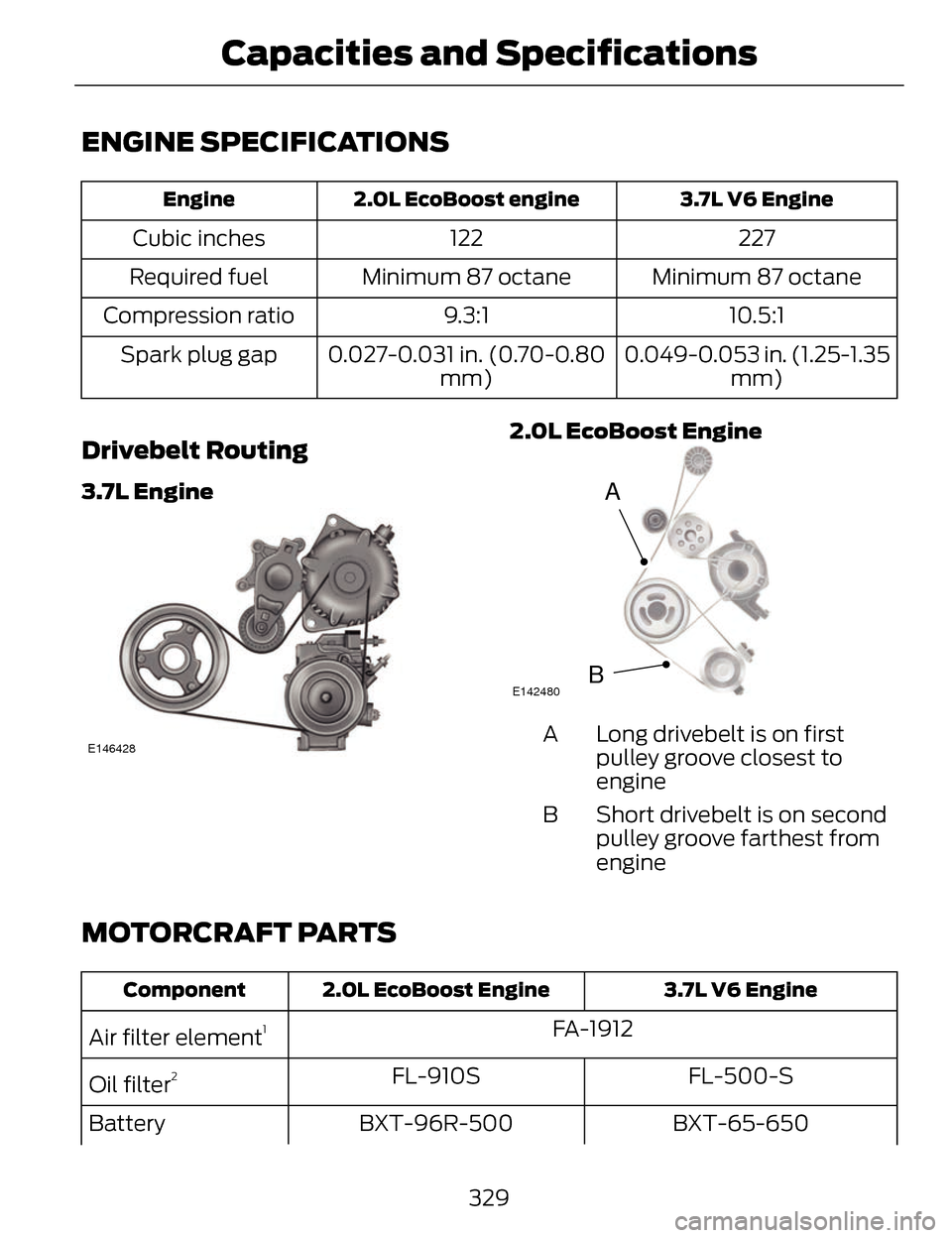
ENGINE SPECIFICATIONS
3.7L V6 Engine
2.0L EcoBoost engine
Engine
227
122
Cubic inches
Minimum 87 octane
Minimum 87 octane
Required fuel
10.5:1
9.3:1
Compression ratio
0.049-0.053 in. (1.25-1.35mm)
0.027-0.031 in. (0.70-0.80
mm)
Spark plug gap
Drivebelt Routing
3.7L Engine
E146428
2.0L EcoBoost Engine
A
BE142480
Long drivebelt is on first
pulley groove closest to
engine
A
Short drivebelt is on second
pulley groove farthest from
engine
B
MOTORCRAFT PARTS
3.7L V6 Engine
2.0L EcoBoost Engine
Component
FA-1912
Air filter element1
FL-500-S
FL-910S
Oil filter2
BXT-65-650
BXT-96R-500
Battery
329
Capacities and Specifications
Page 333 of 468
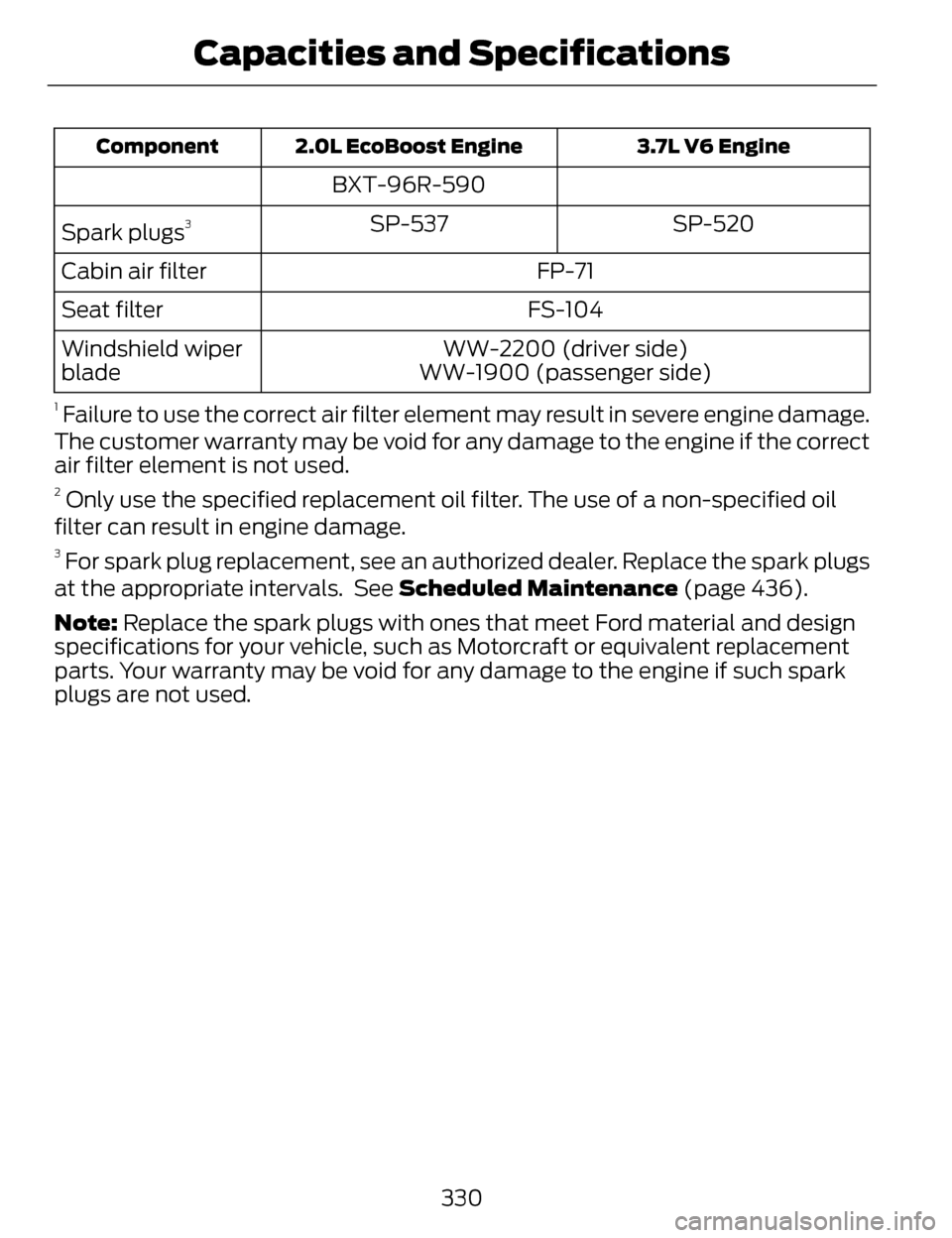
3.7L V6 Engine
2.0L EcoBoost Engine
Component
BXT-96R-590
SP-520
SP-537
Spark plugs
3
FP-71
Cabin air filter
FS-104
Seat filter
WW-2200 (driver side)
Windshield wiper
blade WW-1900 (passenger side)
1 Failure to use the correct air filter element may result in severe engine damage.
The customer warranty may be void for any damage to the engine if the correct
air filter element is not used.
2 Only use the specified replacement oil filter. The use of a non-specified oil
filter can result in engine damage.
3 For spark plug replacement, see an authorized dealer. Replace the spark plugs
at the appropriate intervals. See Scheduled Maintenance (page 436).
Note: Replace the spark plugs with ones that meet Ford material and design
specifications for your vehicle, such as Motorcraft or equivalent replacement
parts. Your warranty may be void for any damage to the engine if such spark
plugs are not used.
330
Capacities and Specifications