automatic transmission LINCOLN MKZ 2014 Owner's Manual
[x] Cancel search | Manufacturer: LINCOLN, Model Year: 2014, Model line: MKZ, Model: LINCOLN MKZ 2014Pages: 468, PDF Size: 4.49 MB
Page 195 of 468
When automatic steering is finished,
the touch screen displays a message
and a chime sounds, indicating that
the active park assist process is done.
The driver is responsible for checking
the parking job and making any
necessary corrections before putting
the transmission in P (Park).
Deactivating the Park Assist
Feature
The system can be deactivated
manually by:
• pressing the active park assistbutton
• grabbing the steering wheel
• driving above approximately 50 mph (80 km/h) for 30 seconds
during an active park search • driving above 6 mph (10 km/h)
during automatic steering
• turning off the traction control system.
Certain vehicle conditions can also
deactivate the system, such as:
• Traction control has activated on a slippery or loose surface.
• There is an anti-lock brake system activation or failure.
• Something touches the steering wheel.
If a problem occurs with the system,
a warning message is displayed,
followed by a chime. Occasional
system messages may occur in
normal operation. For recurring or
frequent system faults, contact an
authorized dealer to have your vehicle
serviced.
Troubleshooting the System
The system does not look for a space
The traction control system may be off
The transmission is in R (Reverse); the vehicle must be moving forward to
detect a parking space
The system does not offer a particular space
Something may be contacting the front bumper or side sensors
There is not enough room on both sides of the vehicle in order to park
There is not enough space for the parking maneuver on the opposite side of
the parking space
192
Parking Aids
Page 199 of 468
Active guidelines are only shown with
fixed guidelines. To use active
guidelines, turn the steering wheel to
point the guidelines toward an
intended path. If the steering wheel
position is changed while reversing,
the vehicle might deviate from the
original intended path.
The fixed and active guidelines fade
in and out depending on the steering
wheel position. The active guidelines
are not shown when the steering
wheel position is straight.
Always use caution while reversing.
Objects in the red zone are closest to
your vehicle and objects in the green
zone are farther away. Objects are
getting closer to your vehicle as they
move from the green zone to the
yellow or red zones. Use the side view
mirrors and rear view mirror to get
better coverage on both sides and rear
of the vehicle.
Selectable settings for this feature are
ACTIVE + FIXED, FIXED and OFF.
Visual Park Aid Alert
Note: Visual park alert is only available
when the transmission is in R
(Reverse).
Note: The reverse sensing system is
not effective at speeds above 3 mph
(5 km/h) and may not detect certain
angular or moving objects. The system uses red, yellow and green
highlights which appear on top of the
video image when an object is
detected by the reverse sensing
system. The alert highlights the
closest object detected. The reverse
sensing alert can be disabled and if
visual park aid alert is enabled,
highlighted areas are still displayed.
Selectable settings for this feature are
ON and OFF.
Manual Zoom
WARNING
When manual zoom is on, the
full area behind the vehicle is not
shown. Be aware of your surroundings
when using the manual zoom feature.
Note: Manual zoom is only available
when the transmission is in R
(Reverse).
Note: When manual zoom is enabled,
only the centerline is shown.
This allows you to get a closer view of
an object behind the vehicle. The
zoomed image keeps the bumper in
the image to provide a reference. The
zoom is only active while the
transmission is in R (Reverse). When
the transmission is shifted out of R
(Reverse), the feature automatically
turns off and must be reset when it is
used again.
Selectable settings for this feature are
ON and OFF.
196
Parking Aids
Page 238 of 468
Trailer Lamps
WARNING
Never connect any trailer lamp
wiring to the vehicle's tail lamp
wiring; this may damage the electrical
system resulting in fire. Contact your
authorized dealer as soon as possible
for assistance in proper trailer tow
wiring installation. Additional
electrical equipment may be required.
Trailer lamps are required on most
towed vehicles. Make sure all running
lights, brake lights, turn signals and
hazard lights are working.
Before Towing a Trailer
Practice turning, stopping and backing
up to get the feel of your
vehicle-trailer combination before
starting on a trip. When turning, make
wider turns so the trailer wheels clear
curbs and other obstacles.
When Towing a Trailer
• Do not drive faster than 70 mph (113 km/h) during the first 500
miles (800 kilometers).
• Do not make full-throttle starts.
• Check your hitch, electrical connections and trailer wheel lug
nuts thoroughly after you have
traveled 50 miles (80 kilometers).
• When stopped in congested or heavy traffic during hot weather,
place the gearshift in position P to
aid engine and transmission
cooling and to help A/C
performance. • Turn off the speed control with
heavy loads or in hilly terrain. The
speed control may turn off
automatically when you are towing
on long, steep grades.
• Shift to a lower gear when driving down a long or steep hill. Do not
apply the brakes continuously, as
they may overheat and become
less effective.
• If your transmission is equipped with a Grade Assist or Tow/Haul
feature, use this feature when
towing. This provides engine
braking and helps eliminate
excessive transmission shifting for
optimum fuel economy and
transmission cooling.
• Allow more distance for stopping with a trailer attached. Anticipate
stops and brake gradually.
• Avoid parking on a grade. However, if you must park on a grade:
• Turn the steering wheel to pointyour vehicle tires away from
traffic flow.
• Set your vehicle parking brake.
• Place the automatic transmission in position P.
• Place wheel chocks in front and back of the trailer wheels.
(Chocks not included with
vehicle.)
Launching or Retrieving a Boat
or Personal Watercraft (PWC)
Note: Disconnect the wiring to the
trailer before backing the trailer into
the water.
235
Towing
Page 248 of 468
1. Turn the ignition off.
2. Turn the ignition to crank.
3. Turn the ignition off.
4. Turn the ignition on again tore-enable the fuel pump.
For vehicles equipped with a push
button start system:
1. Press the START/STOP button to turn the ignition off.
2. Press the brake pedal and press the START/STOP button (crank
attempt).
3. Remove your foot from the brake pedal and press the
START/STOP button (ignition
off).
4. Press the START/STOP button again to re-enable the fuel system.
JUMP-STARTING THE
VEHICLE
WARNINGS
The gases around the battery
can explode if exposed to
flames, sparks, or lit cigarettes. An
explosion could result in injury or
vehicle damage.
Batteries contain sulfuric acid
which can burn skin, eyes and
clothing, if contacted.
Use only an adequate-sized
cable with insulated clamps.
Preparing Your Vehicle
Note: Do not attempt to push-start
your automatic transmission vehicle.
Automatic transmissions do not have
push-start capability. Attempting to
push-start a vehicle with an automatic
transmission may cause transmission
damage.
Note: Use only a 12-volt supply to start
your vehicle.
Note: Do not disconnect the battery
of the disabled vehicle as this could
damage the vehicle's electrical system.
Park the booster vehicle close to the
hood of the disabled vehicle, making
sure the two vehicles do not touch.
Turn all accessories off.
Connecting the Jumper Cables
WARNING
Do not attach the cables to fuel
lines, engine rocker covers, the
intake manifold or electrical
components as grounding points. Stay
clear of moving parts. To avoid reverse
polarity connections, make sure that
you correctly identify the positive (+)
and negative (-) terminals on both the
disabled and booster vehicles before
connecting the cables.
Note: In the illustration, the bottom
vehicle represents the booster vehicle.
245
Roadside Emergencies
Page 279 of 468
AUTOMATIC
TRANSMISSION FLUID
CHECK
6F35/HF35 transmission (If
Equipped)
Note: Transmission fluid should be
checked by an authorized dealer. If
required, fluid should be added by an
authorized dealer.
The automatic transmission does not
have a transmission fluid dipstick.
Refer to your scheduled maintenance
information for scheduled intervals
for fluid checks and changes. Your
transmission does not consume fluid.
However, the fluid level should be
checked if the transmission is not
working properly, (For example: if the
transmission slips or shifts slowly) or
if you notice some sign of fluid
leakage. See Scheduled
Maintenance (page 436).
Do not use supplemental transmission
fluid additives, treatments or cleaning
agents. The use of these materials
may affect transmission operation
and result in damage to internal
transmission components.
6F50/6F55 Transmission (If
Equipped)
WARNINGS
The dipstick cap and surrounding
components may be hot; gloves
are recommended.
WARNINGS
Use gloves when moving the air
filter assembly. Components will
be hot.
Note: Automatic transmission fluid
expands when warmed. To obtain an
accurate fluid check, drive the vehicle
until it is warmed up (approximately
20 miles [30 kilometers]). If your
vehicle has been operated for an
extended period at high speeds, in city
traffic during hot weather or pulling a
trailer, the vehicle should be turned off
until normal operating temperatures
are reached to allow the fluid to cool
before checking. Depending on vehicle
use, cooling times could take up to 30
minutes or longer.
Refer to your scheduled maintenance
information for scheduled intervals
for fluid checks and changes. Your
transmission does not consume fluid.
However, the fluid level should be
checked if the transmission is not
working properly. For example, if the
transmission slips or shifts slowly or
if you notice some sign of fluid
leakage.
1. Drive the vehicle 20 miles (30 kilometers) or until it reaches
normal operating temperature
2. Park the vehicle on a level surface and engage the parking brake.
276
Maintenance
Page 282 of 468
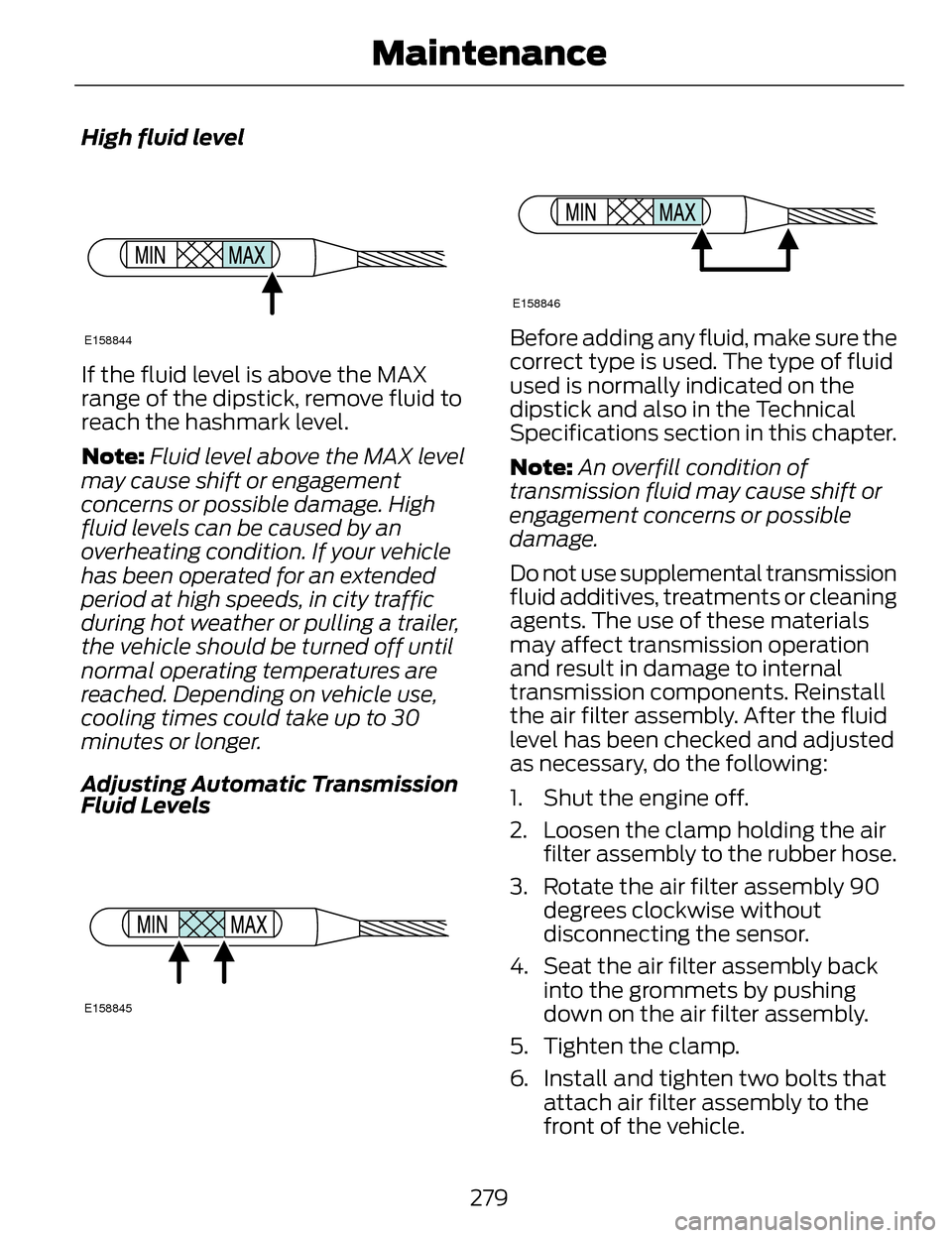
High fluid level
E158844
If the fluid level is above the MAX
range of the dipstick, remove fluid to
reach the hashmark level.
Note:Fluid level above the MAX level
may cause shift or engagement
concerns or possible damage. High
fluid levels can be caused by an
overheating condition. If your vehicle
has been operated for an extended
period at high speeds, in city traffic
during hot weather or pulling a trailer,
the vehicle should be turned off until
normal operating temperatures are
reached. Depending on vehicle use,
cooling times could take up to 30
minutes or longer.
Adjusting Automatic Transmission
Fluid Levels
E158845
E158846
Before adding any fluid, make sure the
correct type is used. The type of fluid
used is normally indicated on the
dipstick and also in the Technical
Specifications section in this chapter.
Note: An overfill condition of
transmission fluid may cause shift or
engagement concerns or possible
damage.
Do not use supplemental transmission
fluid additives, treatments or cleaning
agents. The use of these materials
may affect transmission operation
and result in damage to internal
transmission components. Reinstall
the air filter assembly. After the fluid
level has been checked and adjusted
as necessary, do the following:
1. Shut the engine off.
2. Loosen the clamp holding the air filter assembly to the rubber hose.
3. Rotate the air filter assembly 90 degrees clockwise without
disconnecting the sensor.
4. Seat the air filter assembly back into the grommets by pushing
down on the air filter assembly.
5. Tighten the clamp.
6. Install and tighten two bolts that attach air filter assembly to the
front of the vehicle.
279
Maintenance
Page 336 of 468
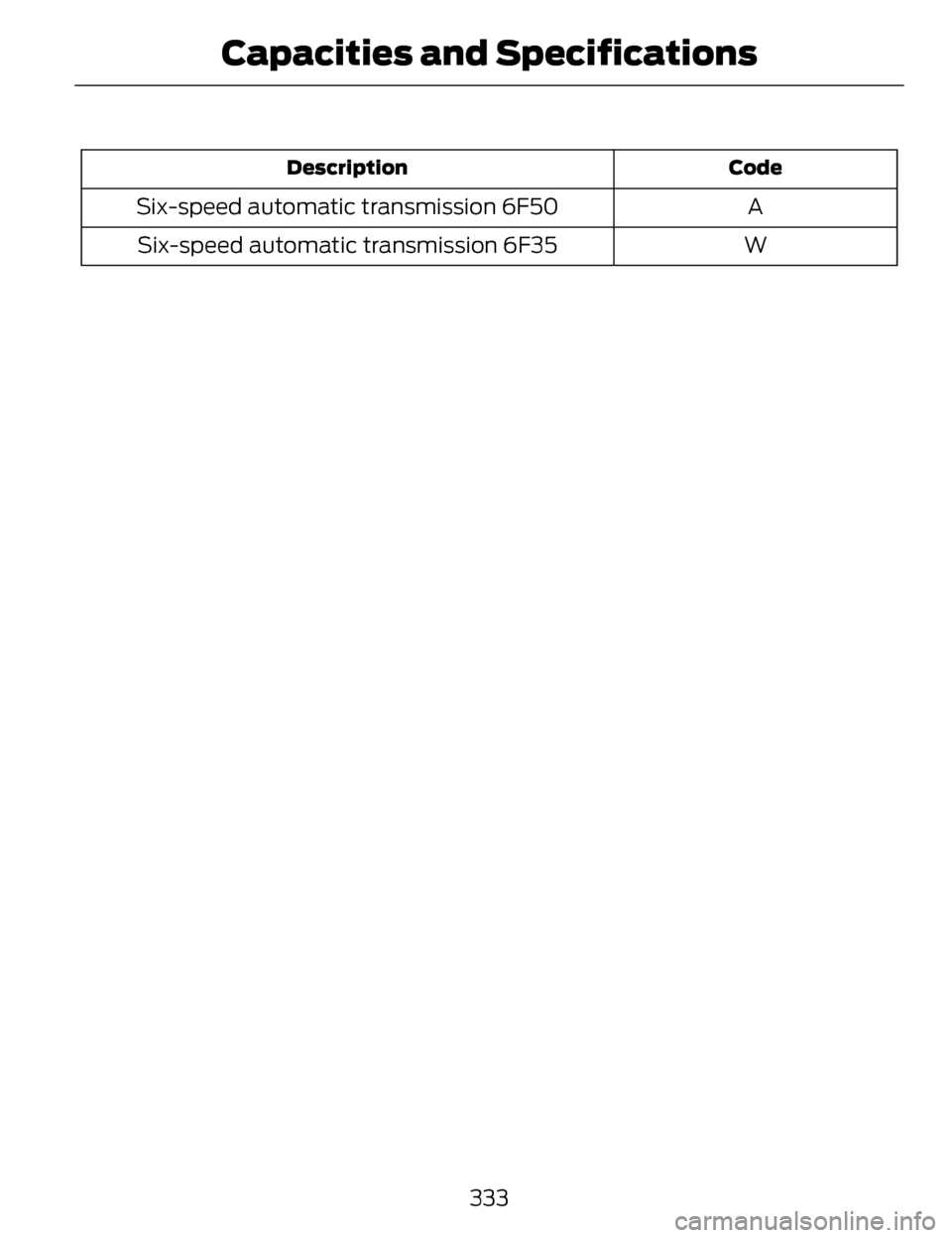
Code
Description
A
Six-speed automatic transmission 6F50
W
Six-speed automatic transmission 6F35
333
Capacities and Specifications
Page 337 of 468
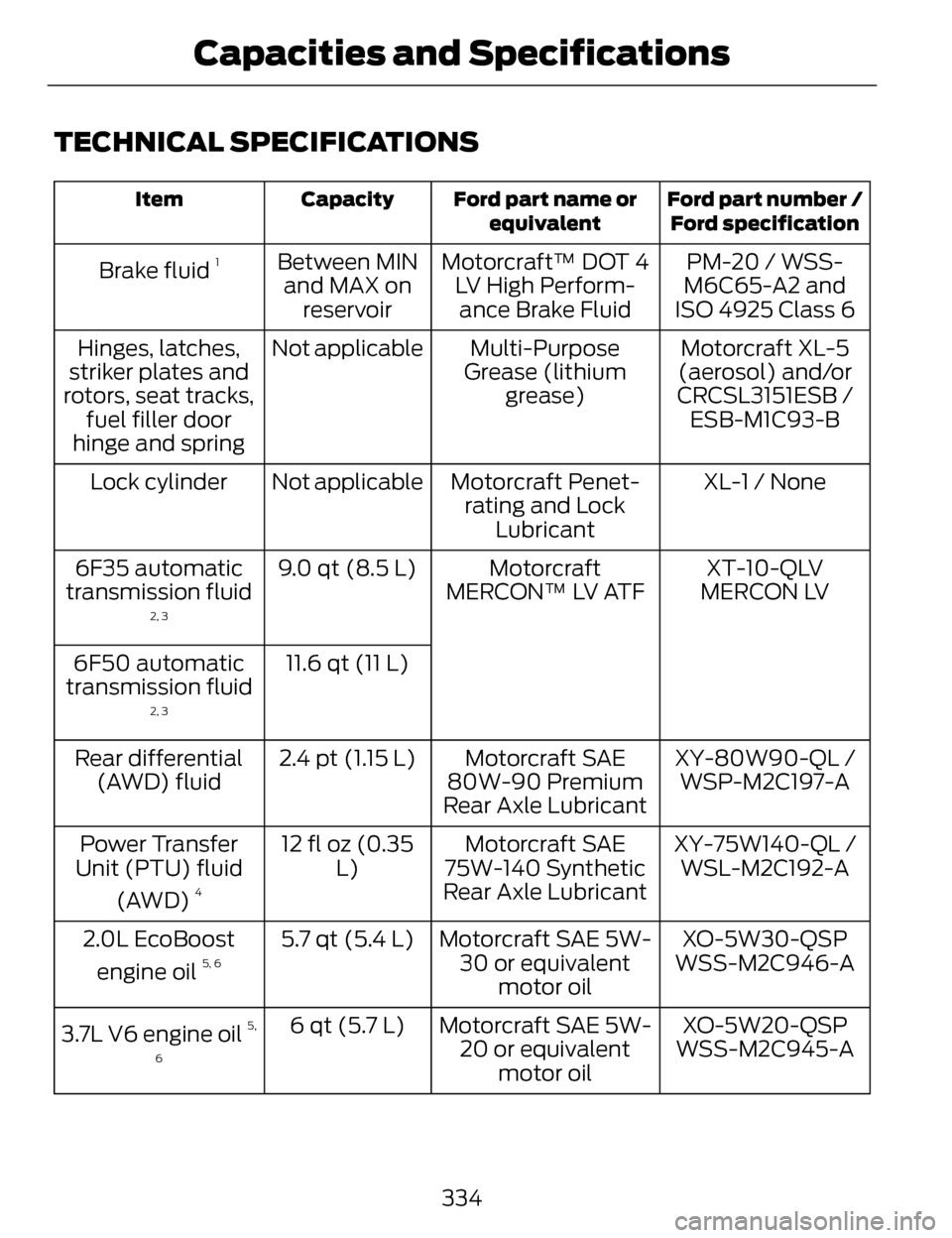
TECHNICAL SPECIFICATIONS
Ford part number /Ford specification
Ford part name or
equivalent
Capacity
Item
PM-20 / WSS-
M6C65-A2 and
ISO 4925 Class 6
Motorcraft™ DOT 4
LV High Perform-ance Brake Fluid
Between MIN
and MAX on reservoir
Brake fluid 1
Motorcraft XL-5
(aerosol) and/or
CRCSL3151ESB / ESB-M1C93-B
Multi-Purpose
Grease (lithium grease)
Not applicable
Hinges, latches,
striker plates and
rotors, seat tracks, fuel filler door
hinge and spring
XL-1 / None
Motorcraft Penet-
rating and Lock Lubricant
Not applicable
Lock cylinder
XT-10-QLV
MERCON LV
Motorcraft
MERCON™ LV ATF
9.0 qt (8.5 L)
6F35 automatic
transmission fluid
2, 3
11.6 qt (11 L)
6F50 automatic
transmission fluid
2, 3
XY-80W90-QL / WSP-M2C197-A
Motorcraft SAE
80W-90 Premium
Rear Axle Lubricant
2.4 pt (1.15 L)
Rear differential
(AWD) fluid
XY-75W140-QL /WSL-M2C192-A
Motorcraft SAE
75W-140 Synthetic
Rear Axle Lubricant
12 fl oz (0.35
L)
Power Transfer
Unit (PTU) fluid
(AWD)
4
XO-5W30-QSP
Motorcraft SAE 5W-
30 or equivalent motor oil
5.7 qt (5.4 L)
2.0L EcoBoost
engine oil 5, 6WSS-M2C946-A
XO-5W20-QSP
Motorcraft SAE 5W-
20 or equivalent motor oil
6 qt (5.7 L)
3.7L V6 engine oil
5,
6
WSS-M2C945-A
334
Capacities and Specifications
Page 339 of 468
Ford part number /Ford specification
Ford part name or
equivalent
Capacity
Item
/ WSH-M1C231-A
1Use only Motorcraft DOT 4 LV High Performance Brake Fluid or equivalent
meeting WSS-M6C65-A2 and ISO 4925 Class 6. Use of any fluid other than
the recommended fluid may cause brake system damage.
2Approximate dry fill capacity. Actual amount may vary during fluid changes.
3Automatic transmissions that require Motorcraft MERCON LV transmission
fluid should only use Motorcraft MERCON LV transmission fluid.
Use of any fluid other than the recommended fluid may cause transmission
damage.
Change the automatic transmission fluid and filter at the correct service interval.
See Scheduled Maintenance (page 436).
4See your authorized dealer for fluid level checking or filling.
5Your engine has been designed to use Motorcraft engine oils or equivalent oils
that meet Ford specifications. It is also acceptable to use an engine oil of
recommended viscosity grade that meets API SN requirements and displays
the API Certification Mark for gasoline engines
6Do not use supplemental engine oil additives in your engine. They are
unnecessary and could lead to engine damage that is not covered by your Ford
warranty.
7Add the coolant type originally equipped in your vehicle.
8
WARNING
The A/C refrigerant system contains refrigerant R-134a under high pressure.
Opening the A/C refrigerant system can cause personal injury. A/C
refrigerant system is to be serviced only by qualified personnel.
336
Capacities and Specifications
Page 389 of 468
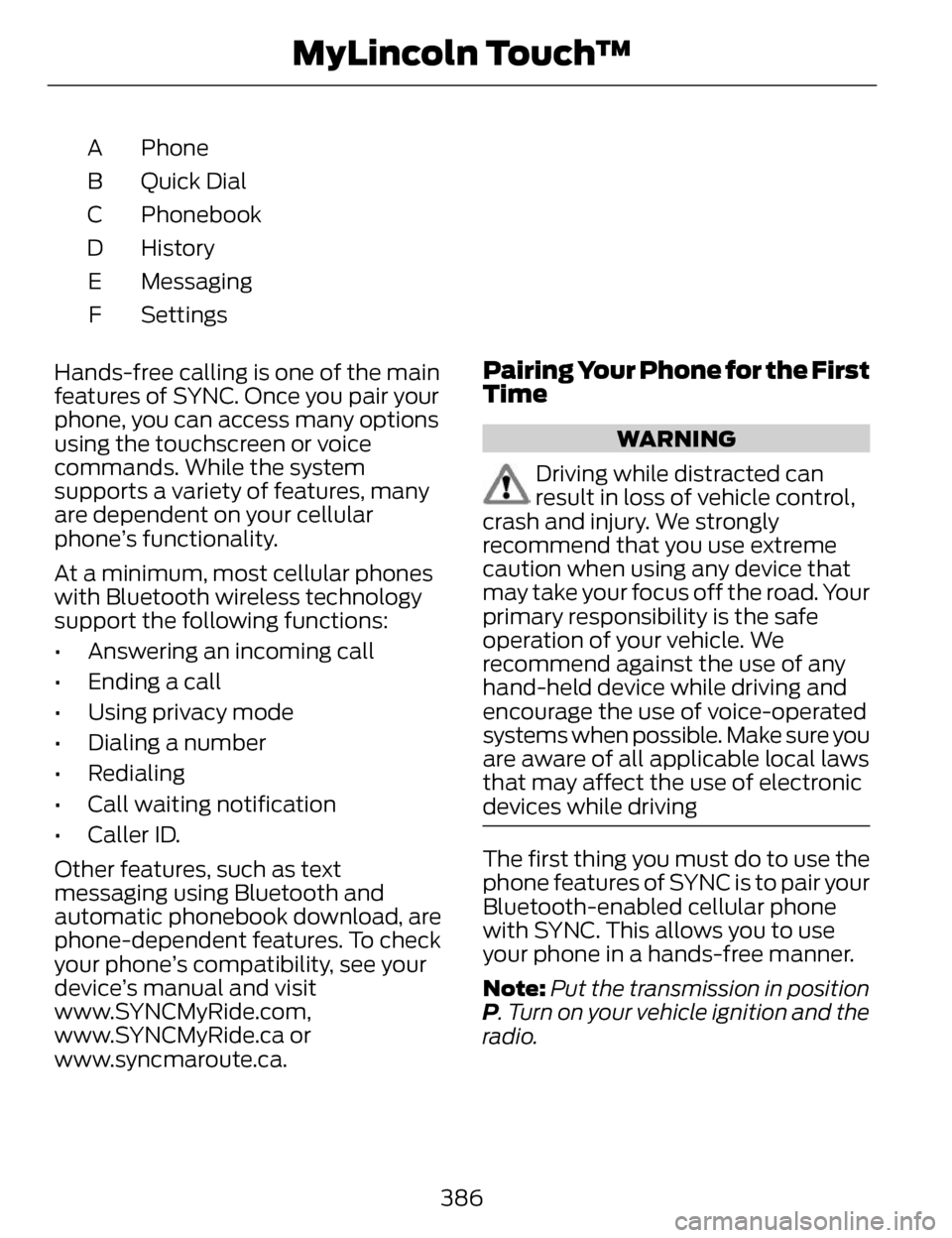
Phone
A
Quick Dial
B
Phonebook
C
History
D
Messaging
E
Settings
F
Hands-free calling is one of the main
features of SYNC. Once you pair your
phone, you can access many options
using the touchscreen or voice
commands. While the system
supports a variety of features, many
are dependent on your cellular
phone’s functionality.
At a minimum, most cellular phones
with Bluetooth wireless technology
support the following functions:
• Answering an incoming call
• Ending a call
• Using privacy mode
• Dialing a number
• Redialing
• Call waiting notification
• Caller ID.
Other features, such as text
messaging using Bluetooth and
automatic phonebook download, are
phone-dependent features. To check
your phone’s compatibility, see your
device’s manual and visit
www.SYNCMyRide.com,
www.SYNCMyRide.ca or
www.syncmaroute.ca.
Pairing Your Phone for the First
Time
WARNING
Driving while distracted can
result in loss of vehicle control,
crash and injury. We strongly
recommend that you use extreme
caution when using any device that
may take your focus off the road. Your
primary responsibility is the safe
operation of your vehicle. We
recommend against the use of any
hand-held device while driving and
encourage the use of voice-operated
systems when possible. Make sure you
are aware of all applicable local laws
that may affect the use of electronic
devices while driving
The first thing you must do to use the
phone features of SYNC is to pair your
Bluetooth-enabled cellular phone
with SYNC. This allows you to use
your phone in a hands-free manner.
Note: Put the transmission in position
P. Turn on your vehicle ignition and the
radio.
386
MyLincoln Touch™