light LINCOLN MKZ 2014 Owner's Manual
[x] Cancel search | Manufacturer: LINCOLN, Model Year: 2014, Model line: MKZ, Model: LINCOLN MKZ 2014Pages: 468, PDF Size: 4.49 MB
Page 86 of 468
The headlamps will remain on for a
period of time after you switch the
ignition off. You can adjust the time
delay using the information display
controls. See Information Displays
(page 101).
Note:If you switch autolamps on in
conjunction with autowipers, low beam
headlamps will illuminate
automatically when the rain sensor
activates the windshield wipers
continuously.
INSTRUMENT LIGHTING
DIMMER
Note: If you disconnect and connect
the battery, or fully discharge and
charge the battery, the illuminated
components will switch to the
maximum setting.
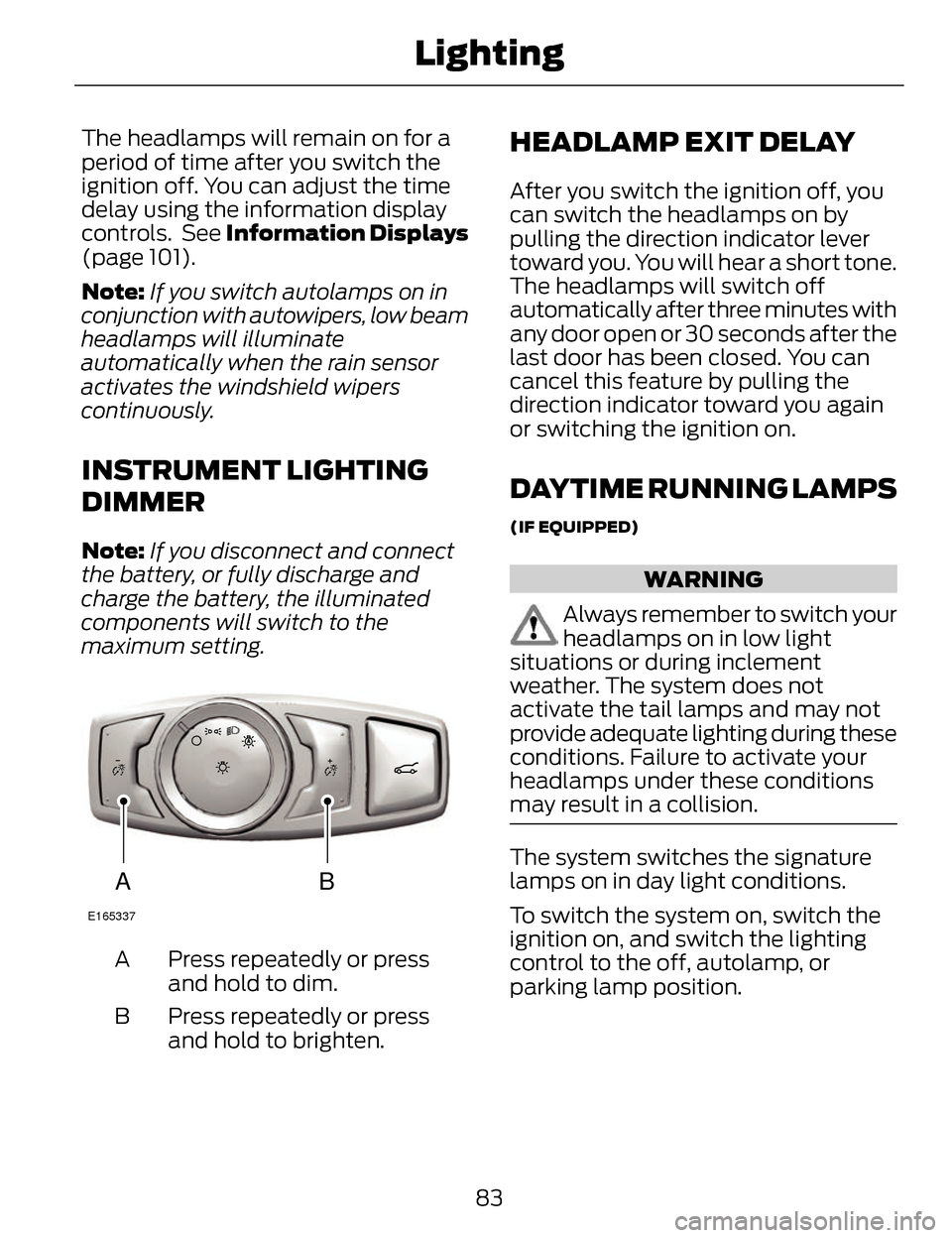
AB
E165337
Press repeatedly or press
and hold to dim.
A
Press repeatedly or press
and hold to brighten.
B
HEADLAMP EXIT DELAY
After you switch the ignition off, you
can switch the headlamps on by
pulling the direction indicator lever
toward you. You will hear a short tone.
The headlamps will switch off
automatically after three minutes with
any door open or 30 seconds after the
last door has been closed. You can
cancel this feature by pulling the
direction indicator toward you again
or switching the ignition on.
DAYTIME RUNNING LAMPS
(IF EQUIPPED)
WARNING
Always remember to switch your
headlamps on in low light
situations or during inclement
weather. The system does not
activate the tail lamps and may not
provide adequate lighting during these
conditions. Failure to activate your
headlamps under these conditions
may result in a collision.
The system switches the signature
lamps on in day light conditions.
To switch the system on, switch the
ignition on, and switch the lighting
control to the off, autolamp, or
parking lamp position.
83
Lighting
Page 87 of 468
AUTOMATIC HIGH BEAM
CONTROL
(IF EQUIPPED)
The system will automatically turn on
your high beams if it is dark enough
and no other traffic is present. When
it detects the headlights of an
approaching vehicle, the tail lamps of
the preceding vehicle or street lighting,
the system will turn off the high
beams before they distract other
drivers. The low beams remain on.
Note:If it appears that automatic
control of the high beams is not
functioning properly, check the
windshield in front of the camera for a
blockage. A clear view of the road is
required for proper system operation.
Have any windshield damage in the
area of the camera’s field-of-view
repaired.
Note: If the system detects a blockage
such as bird droppings, bug splatter,
snow or ice, and you do not observe
changes, the system will go into low
beam mode until you clear the
blockage. A message may also appear
in the instrument cluster display noting
the front camera is blocked. Note:
Typical road dust, dirt and water
spots will not affect the performance
of the automatic high beam system .
However, in cold or inclement weather
conditions, you will notice a decrease
in the availability of the high beam
system, especially at start up. If you
want to change the beam state
independently of the system, you may
switch the high beams on or off using
the multifunction switch. Automatic
control will resume when conditions
are correct.
Note: Modification of the vehicle ride
height such as using much larger tires,
may degrade feature performance.
A camera sensor, centrally mounted
behind the windshield of your vehicle,
continuously monitors conditions to
decide when to switch the high beams
off and on.
Once the system is active, the high
beams will switch on if:
• the ambient light level is low enough
• there is no traffic in front of the vehicle
• the vehicle speed is greater than 25 mph (40 km/h)
The high beams will switch off if:
• the system detects the headlamps of an approaching vehicle or the
tail lamps of a preceding vehicle.
• vehicle speed falls below 16 mph (25 km/h)
• the ambient light level is high enough that high beams are not
required
84
Lighting
Page 88 of 468
• the system detects severe rain,snow or fog
• the camera is blocked
Activating the System
Switch on the system using the
information display and autolamps.
See Information Displays (page 101).
See Autolamps (page 82).
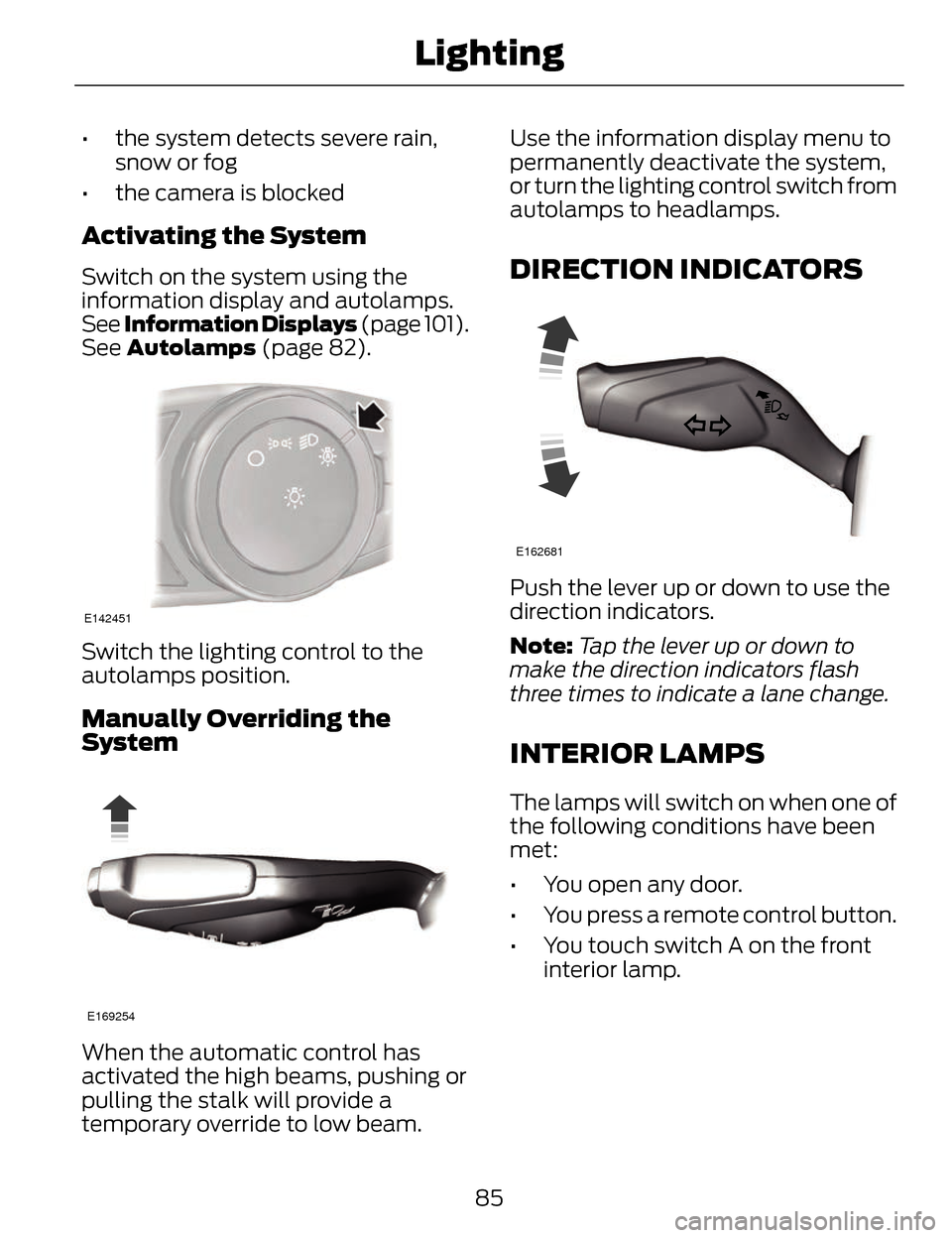
E142451
Switch the lighting control to the
autolamps position.
Manually Overriding the
System
E169254
When the automatic control has
activated the high beams, pushing or
pulling the stalk will provide a
temporary override to low beam. Use the information display menu to
permanently deactivate the system,
or turn the lighting control switch from
autolamps to headlamps.
DIRECTION INDICATORS
E162681
Push the lever up or down to use the
direction indicators.
Note:
Tap the lever up or down to
make the direction indicators flash
three times to indicate a lane change.
INTERIOR LAMPS
The lamps will switch on when one of
the following conditions have been
met:
• You open any door.
• You press a remote control button.
• You touch switch A on the front interior lamp.
85
Lighting
Page 89 of 468
Front Interior Lamp
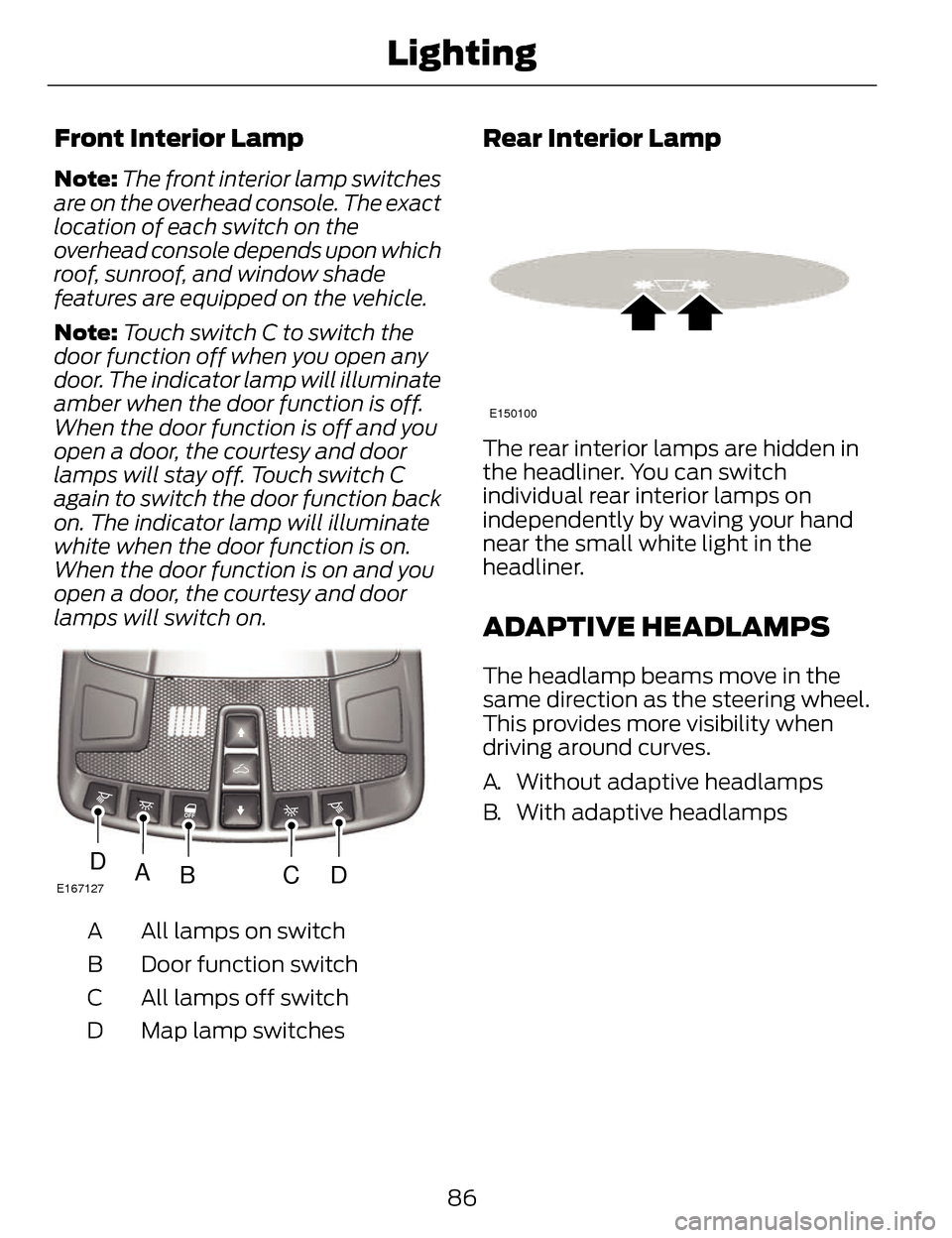
Note:The front interior lamp switches
are on the overhead console. The exact
location of each switch on the
overhead console depends upon which
roof, sunroof, and window shade
features are equipped on the vehicle.
Note: Touch switch C to switch the
door function off when you open any
door. The indicator lamp will illuminate
amber when the door function is off.
When the door function is off and you
open a door, the courtesy and door
lamps will stay off. Touch switch C
again to switch the door function back
on. The indicator lamp will illuminate
white when the door function is on.
When the door function is on and you
open a door, the courtesy and door
lamps will switch on.
E167127ABCDD
All lamps on switch
A
Door function switch
B
All lamps off switch
C
Map lamp switches
D
Rear Interior Lamp
E150100
The rear interior lamps are hidden in
the headliner. You can switch
individual rear interior lamps on
independently by waving your hand
near the small white light in the
headliner.
ADAPTIVE HEADLAMPS
The headlamp beams move in the
same direction as the steering wheel.
This provides more visibility when
driving around curves.
A. Without adaptive headlamps
B. With adaptive headlamps
86
Lighting
Page 90 of 468
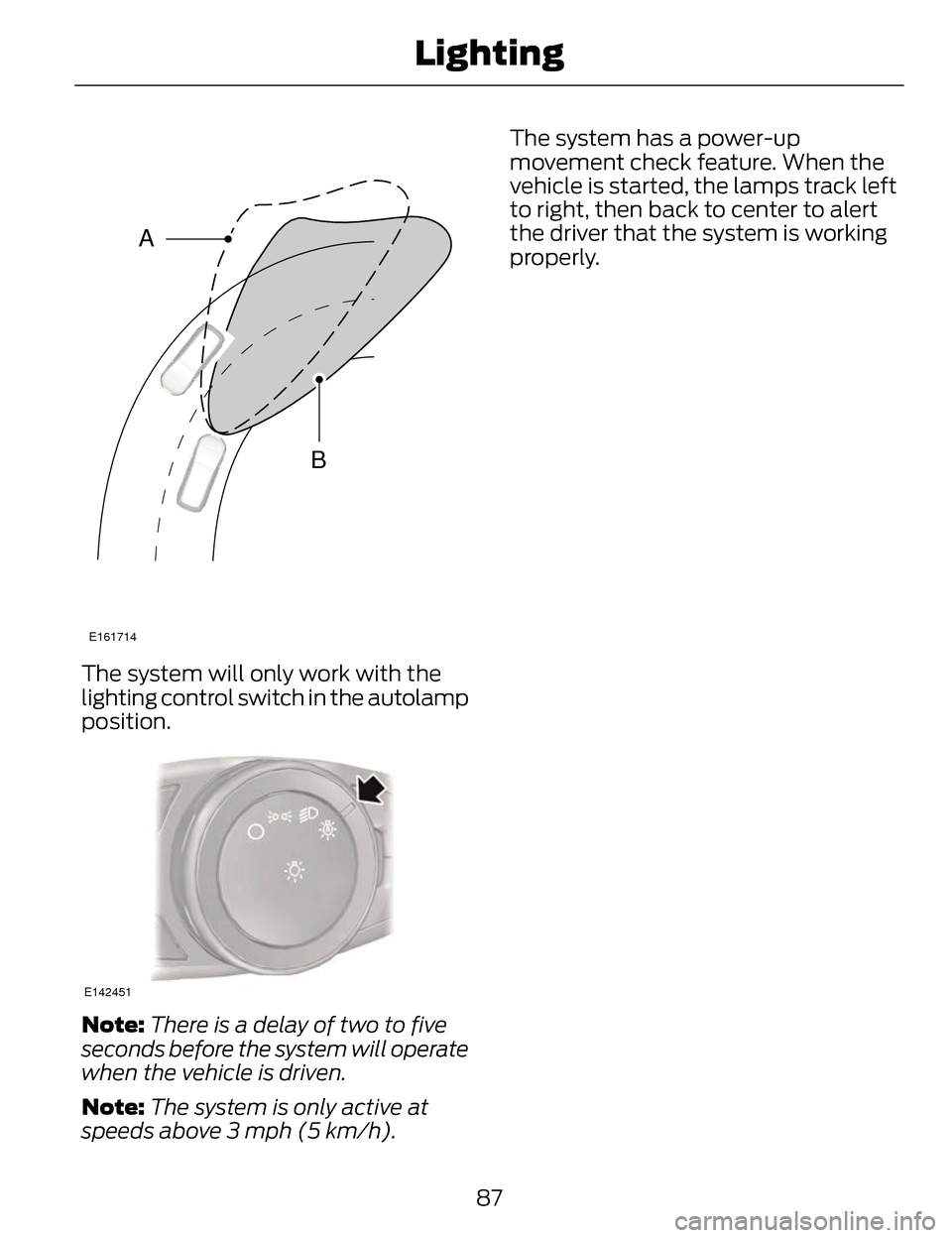
E161714
B
A
The system will only work with the
lighting control switch in the autolamp
position.
E142451
Note:There is a delay of two to five
seconds before the system will operate
when the vehicle is driven.
Note: The system is only active at
speeds above 3 mph (5 km/h). The system has a power-up
movement check feature. When the
vehicle is started, the lamps track left
to right, then back to center to alert
the driver that the system is working
properly.
87
Lighting
Page 91 of 468
POWER WINDOWS
WARNINGS
Do not leave children
unattended in your vehicle and
do not let them play with the power
windows. They may seriously injure
themselves.
When closing the power
windows, you should verify they
are free of obstructions and make sure
that children and pets are not in the
proximity of the window openings.
E146043
Note: You may hear a pulsing noise
when just one of the windows is open.
Lower the opposite window slightly to
reduce this noise.
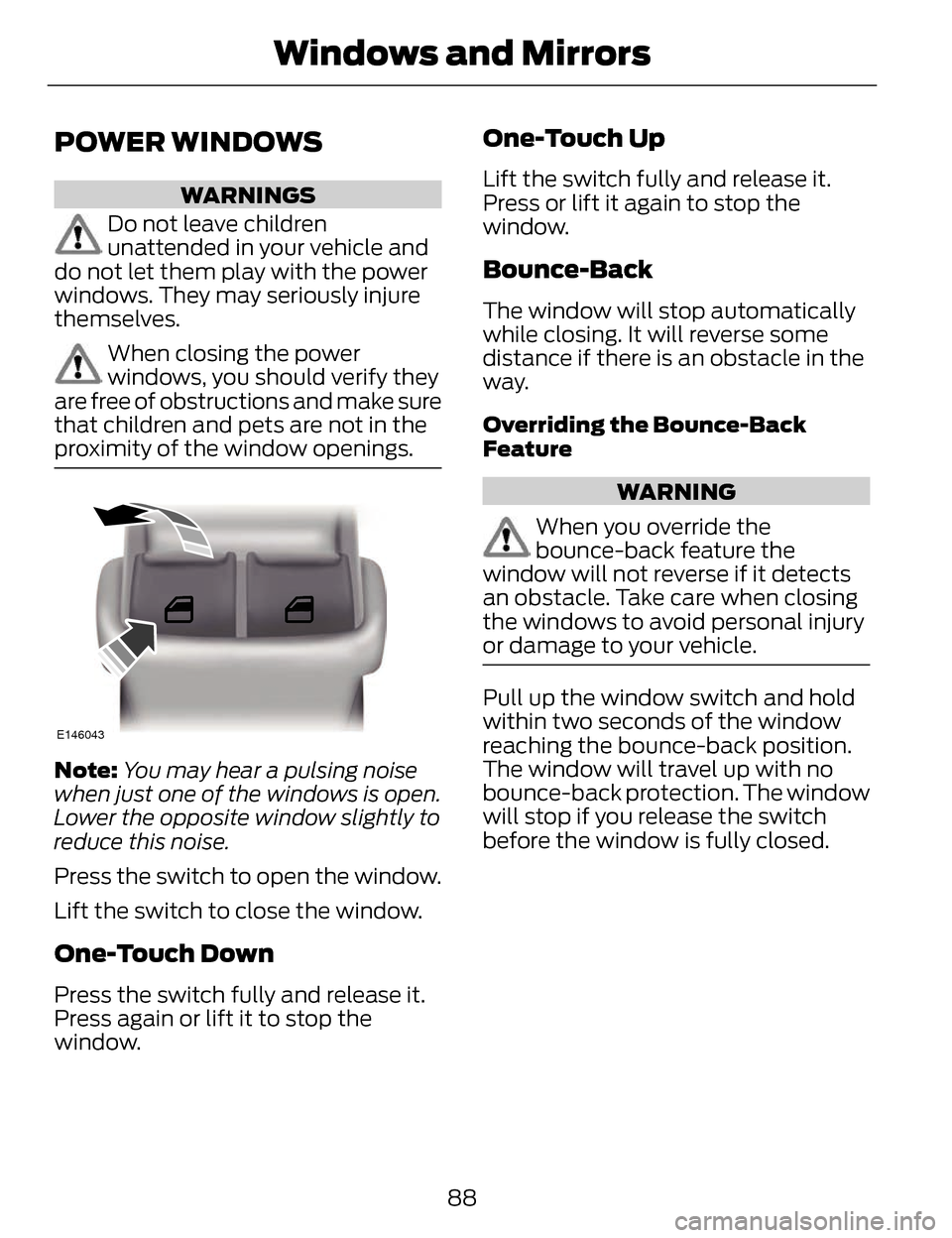
Press the switch to open the window.
Lift the switch to close the window.
One-Touch Down
Press the switch fully and release it.
Press again or lift it to stop the
window.
One-Touch Up
Lift the switch fully and release it.
Press or lift it again to stop the
window.
Bounce-Back
The window will stop automatically
while closing. It will reverse some
distance if there is an obstacle in the
way.
Overriding the Bounce-Back
Feature
WARNING
When you override the
bounce-back feature the
window will not reverse if it detects
an obstacle. Take care when closing
the windows to avoid personal injury
or damage to your vehicle.
Pull up the window switch and hold
within two seconds of the window
reaching the bounce-back position.
The window will travel up with no
bounce-back protection. The window
will stop if you release the switch
before the window is fully closed.
88
Windows and Mirrors
Page 94 of 468
A
B
C
E138665
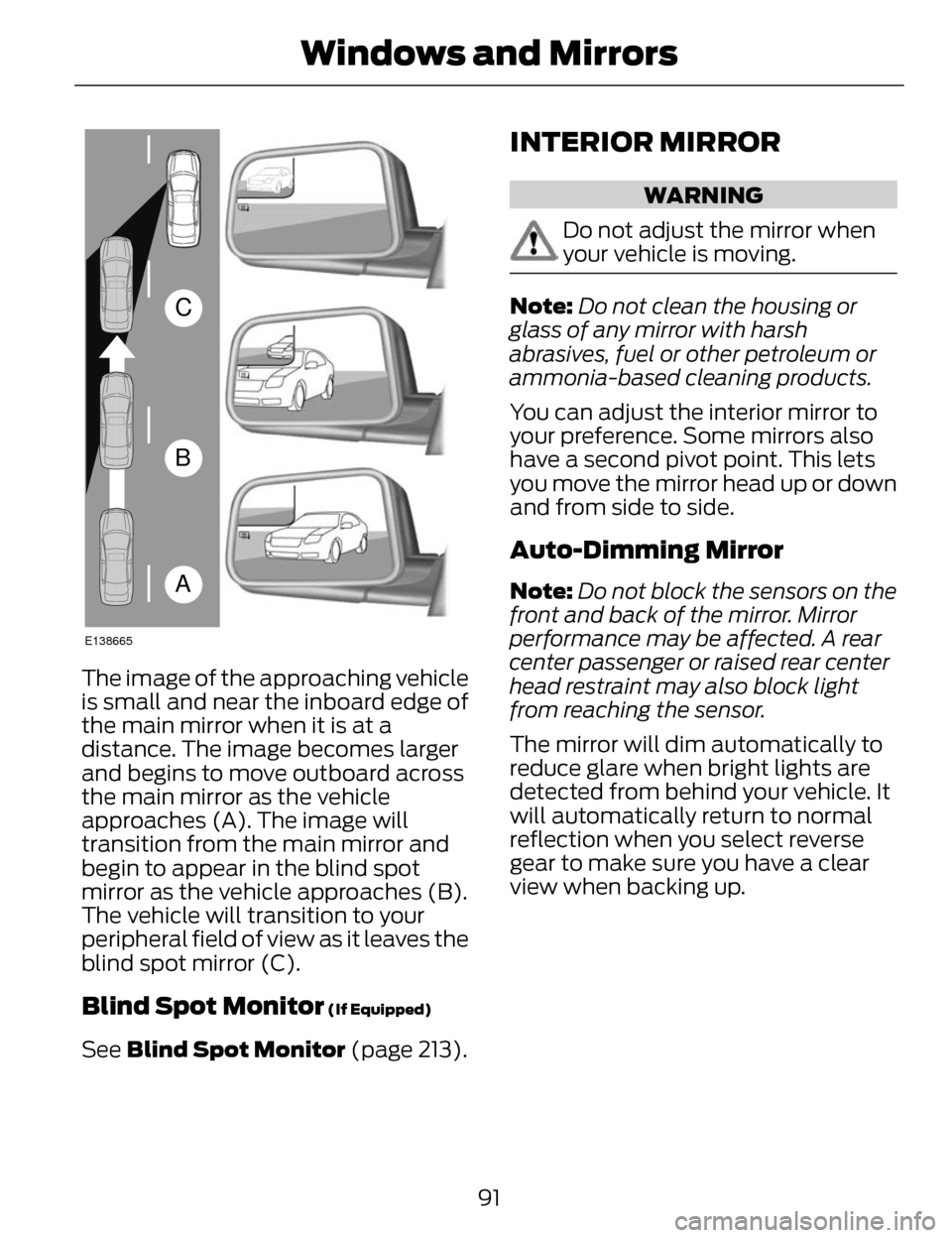
The image of the approaching vehicle
is small and near the inboard edge of
the main mirror when it is at a
distance. The image becomes larger
and begins to move outboard across
the main mirror as the vehicle
approaches (A). The image will
transition from the main mirror and
begin to appear in the blind spot
mirror as the vehicle approaches (B).
The vehicle will transition to your
peripheral field of view as it leaves the
blind spot mirror (C).
Blind Spot Monitor (If Equipped)
See Blind Spot Monitor (page 213).
INTERIOR MIRROR
WARNING
Do not adjust the mirror when
your vehicle is moving.
Note:Do not clean the housing or
glass of any mirror with harsh
abrasives, fuel or other petroleum or
ammonia-based cleaning products.
You can adjust the interior mirror to
your preference. Some mirrors also
have a second pivot point. This lets
you move the mirror head up or down
and from side to side.
Auto-Dimming Mirror
Note: Do not block the sensors on the
front and back of the mirror. Mirror
performance may be affected. A rear
center passenger or raised rear center
head restraint may also block light
from reaching the sensor.
The mirror will dim automatically to
reduce glare when bright lights are
detected from behind your vehicle. It
will automatically return to normal
reflection when you select reverse
gear to make sure you have a clear
view when backing up.
91
Windows and Mirrors
Page 99 of 468
Vehicle Settings and
Personalization
See General Information (page 101).
Fuel Gauge
Indicates approximately how much
fuel is left in the fuel tank (when the
ignition is on). The fuel gauge may
vary slightly when the vehicle is in
motion or on a grade. The fuel icon
and arrow indicates which side of the
vehicle the fuel filler door is located.
Engine Coolant Temperature
Gauge
Indicates engine coolant temperature.
At normal operating temperature, the
level indicator will be in the normal
range. If the engine coolant
temperature exceeds the normal
range, stop the vehicle as soon as
safely possible, switch off the engine
and let the engine cool.
WARNING
Never remove the coolant
reservoir cap while the engine is
running or hot.
WARNING LAMPS AND
INDICATORS
The following warning lamps and
indicators will alert you to a vehicle
condition that may become serious.
Some lamps will illuminate when you
start your vehicle to make sure they
work. If any lamps remain on after
starting your vehicle, refer to the
respective system warning lamp for
further information.
Note: Some warning indicators appear
in the information display and function
the same as a warning lamp, but do
not display when you start your vehicle.
Adaptive Cruise Control (If
Equipped)
E144524
The speed control system
indicator light changes color
to indicate what mode the
system is in: See Using Adaptive
Cruise Control (page 199).
On (white light): Illuminates when the
adaptive cruise control system is
turned on. Turns off when the speed
control system is turned off.
Engaged (green light): Illuminates
when the adaptive cruise control
system is engaged. Turns off when
the speed control system is
disengaged.
96
Instrument Cluster
Page 101 of 468
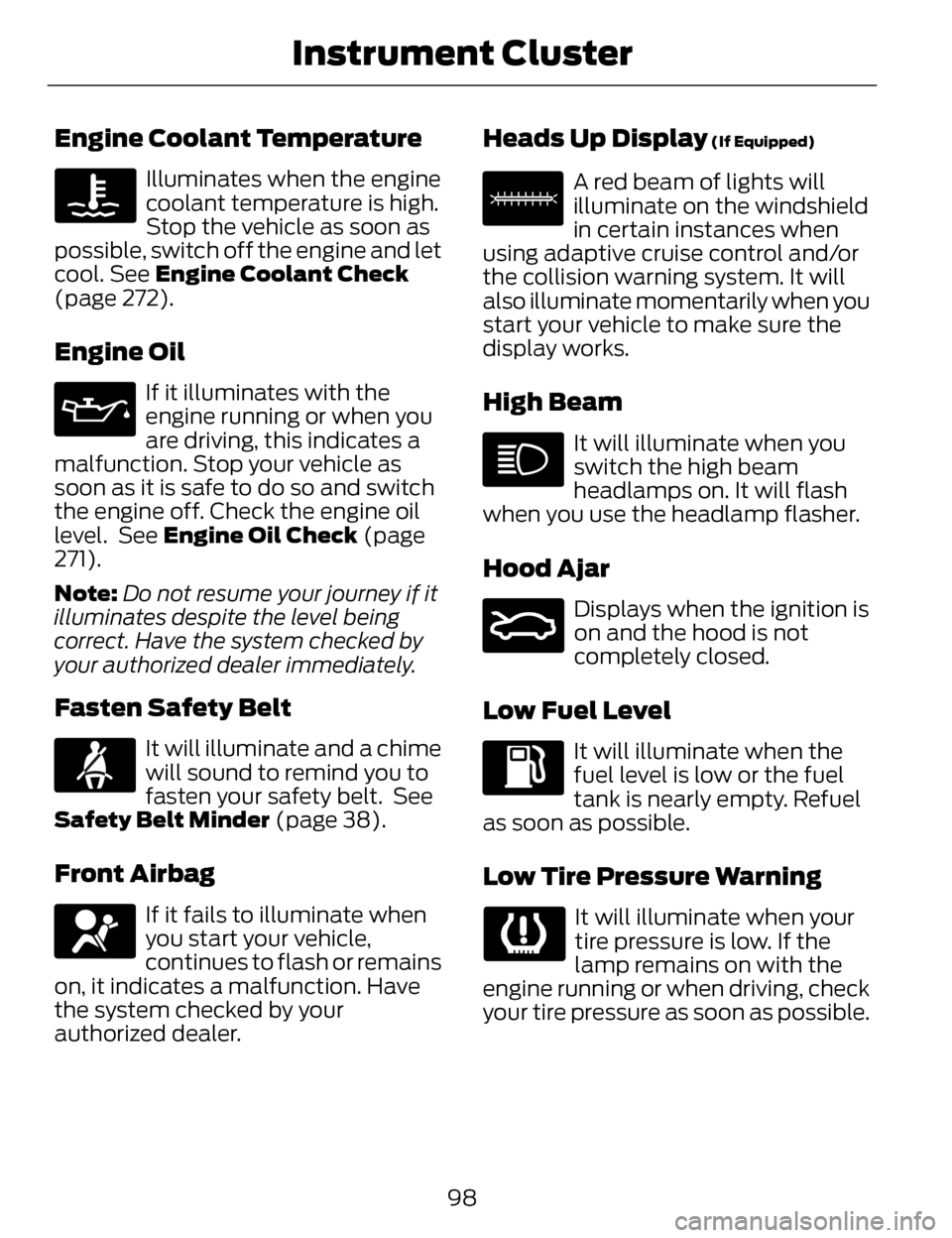
Engine Coolant Temperature
Illuminates when the engine
coolant temperature is high.
Stop the vehicle as soon as
possible, switch off the engine and let
cool. See Engine Coolant Check
(page 272).
Engine Oil
If it illuminates with the
engine running or when you
are driving, this indicates a
malfunction. Stop your vehicle as
soon as it is safe to do so and switch
the engine off. Check the engine oil
level. See Engine Oil Check (page
271).
Note: Do not resume your journey if it
illuminates despite the level being
correct. Have the system checked by
your authorized dealer immediately.
Fasten Safety Belt
It will illuminate and a chime
will sound to remind you to
fasten your safety belt. See
Safety Belt Minder (page 38).
Front Airbag
If it fails to illuminate when
you start your vehicle,
continues to flash or remains
on, it indicates a malfunction. Have
the system checked by your
authorized dealer.
Heads Up Display (If Equipped)
E156133
A red beam of lights will
illuminate on the windshield
in certain instances when
using adaptive cruise control and/or
the collision warning system. It will
also illuminate momentarily when you
start your vehicle to make sure the
display works.
High Beam
It will illuminate when you
switch the high beam
headlamps on. It will flash
when you use the headlamp flasher.
Hood Ajar
E159324
Displays when the ignition is
on and the hood is not
completely closed.
Low Fuel Level
It will illuminate when the
fuel level is low or the fuel
tank is nearly empty. Refuel
as soon as possible.
Low Tire Pressure Warning
It will illuminate when your
tire pressure is low. If the
lamp remains on with the
engine running or when driving, check
your tire pressure as soon as possible.
98
Instrument Cluster
Page 102 of 468
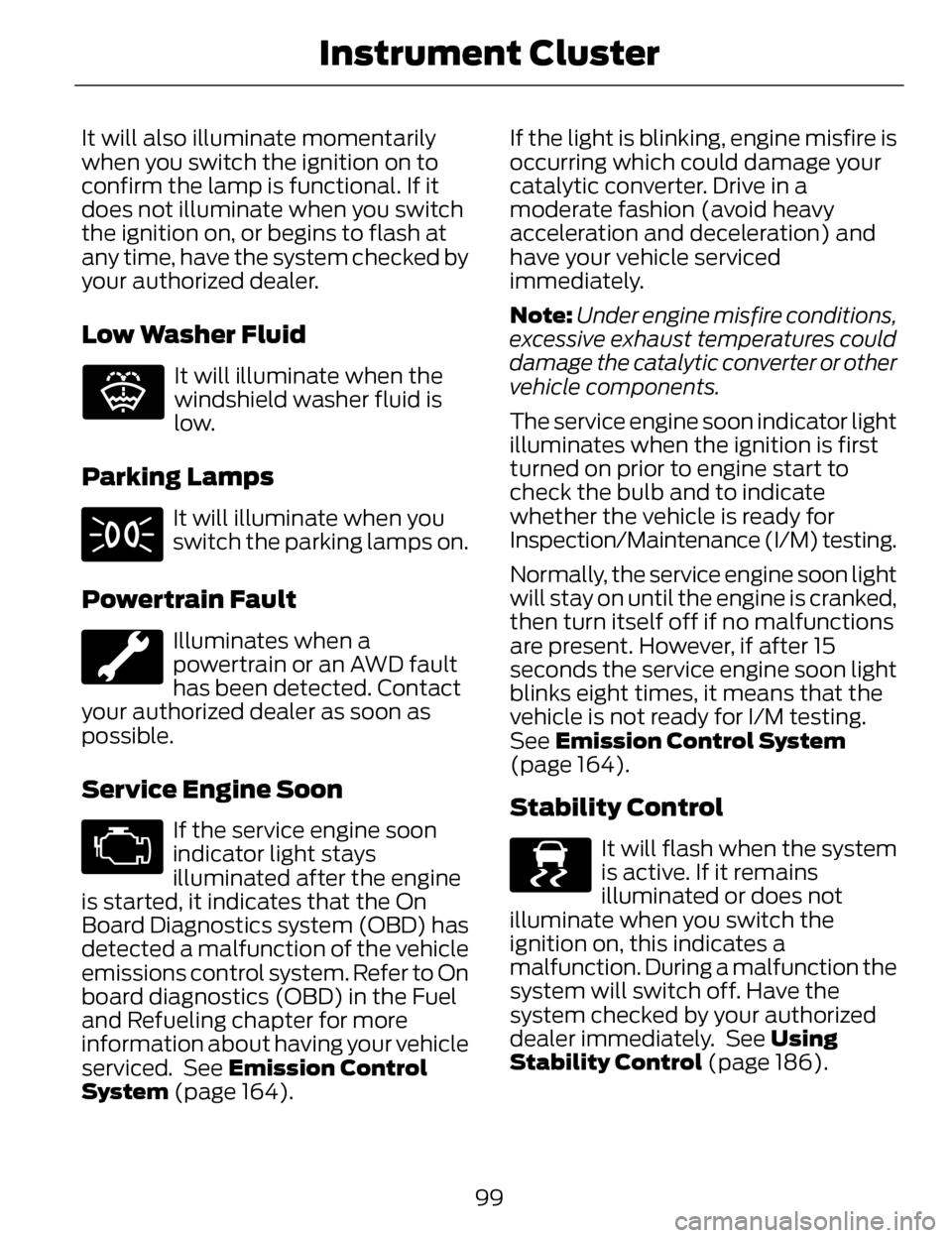
It will also illuminate momentarily
when you switch the ignition on to
confirm the lamp is functional. If it
does not illuminate when you switch
the ignition on, or begins to flash at
any time, have the system checked by
your authorized dealer.
Low Washer Fluid
E132353
It will illuminate when the
windshield washer fluid is
low.
Parking Lamps
It will illuminate when you
switch the parking lamps on.
Powertrain Fault
Illuminates when a
powertrain or an AWD fault
has been detected. Contact
your authorized dealer as soon as
possible.
Service Engine Soon
If the service engine soon
indicator light stays
illuminated after the engine
is started, it indicates that the On
Board Diagnostics system (OBD) has
detected a malfunction of the vehicle
emissions control system. Refer to On
board diagnostics (OBD) in the Fuel
and Refueling chapter for more
information about having your vehicle
serviced. See Emission Control
System (page 164). If the light is blinking, engine misfire is
occurring which could damage your
catalytic converter. Drive in a
moderate fashion (avoid heavy
acceleration and deceleration) and
have your vehicle serviced
immediately.
Note:
Under engine misfire conditions,
excessive exhaust temperatures could
damage the catalytic converter or other
vehicle components.
The service engine soon indicator light
illuminates when the ignition is first
turned on prior to engine start to
check the bulb and to indicate
whether the vehicle is ready for
Inspection/Maintenance (I/M) testing.
Normally, the service engine soon light
will stay on until the engine is cranked,
then turn itself off if no malfunctions
are present. However, if after 15
seconds the service engine soon light
blinks eight times, it means that the
vehicle is not ready for I/M testing.
See Emission Control System
(page 164).Stability Control
E138639
It will flash when the system
is active. If it remains
illuminated or does not
illuminate when you switch the
ignition on, this indicates a
malfunction. During a malfunction the
system will switch off. Have the
system checked by your authorized
dealer immediately. See Using
Stability Control (page 186).
99
Instrument Cluster