belt LINCOLN MKZ 2014 Service Manual
[x] Cancel search | Manufacturer: LINCOLN, Model Year: 2014, Model line: MKZ, Model: LINCOLN MKZ 2014Pages: 468, PDF Size: 4.49 MB
Page 155 of 468
The keyless starting system has three
modes:
•Off: Turns the ignition off.
• Without applying the brake
pedal, press and release the
button once when the ignition
is in the on mode, or when the
engine is running but the
vehicle is not moving.
• On: All electrical circuits are
operational and the warning lamps
and indicators illuminate.
• Without applying the brake
pedal, press and release the
button once.
• Start: Starts the engine.
• Press the brake pedal, and then
press the button for any length
of time. An indicator light on the
button illuminates when then
ignition is on and when the
engine starts.
STARTING A GASOLINE
ENGINE
When you start the engine, the idle
speed increases, this helps to warm
up the engine. If the engine idle speed
does not slow down automatically,
have your vehicle checked by an
authorized dealer.
Before starting the engine, check the
following:
• Make sure all occupants havefastened their safety belts.
• Make sure the headlamps and electrical accessories are off. • Make sure the parking brake is on.
• Put the transmission in P.
Note:
Do not touch the accelerator
pedal.
1. Fully press the brake pedal.
2. Press the button.
The system does not function if:
• The key frequencies are jammed.
• The key battery has no charge.
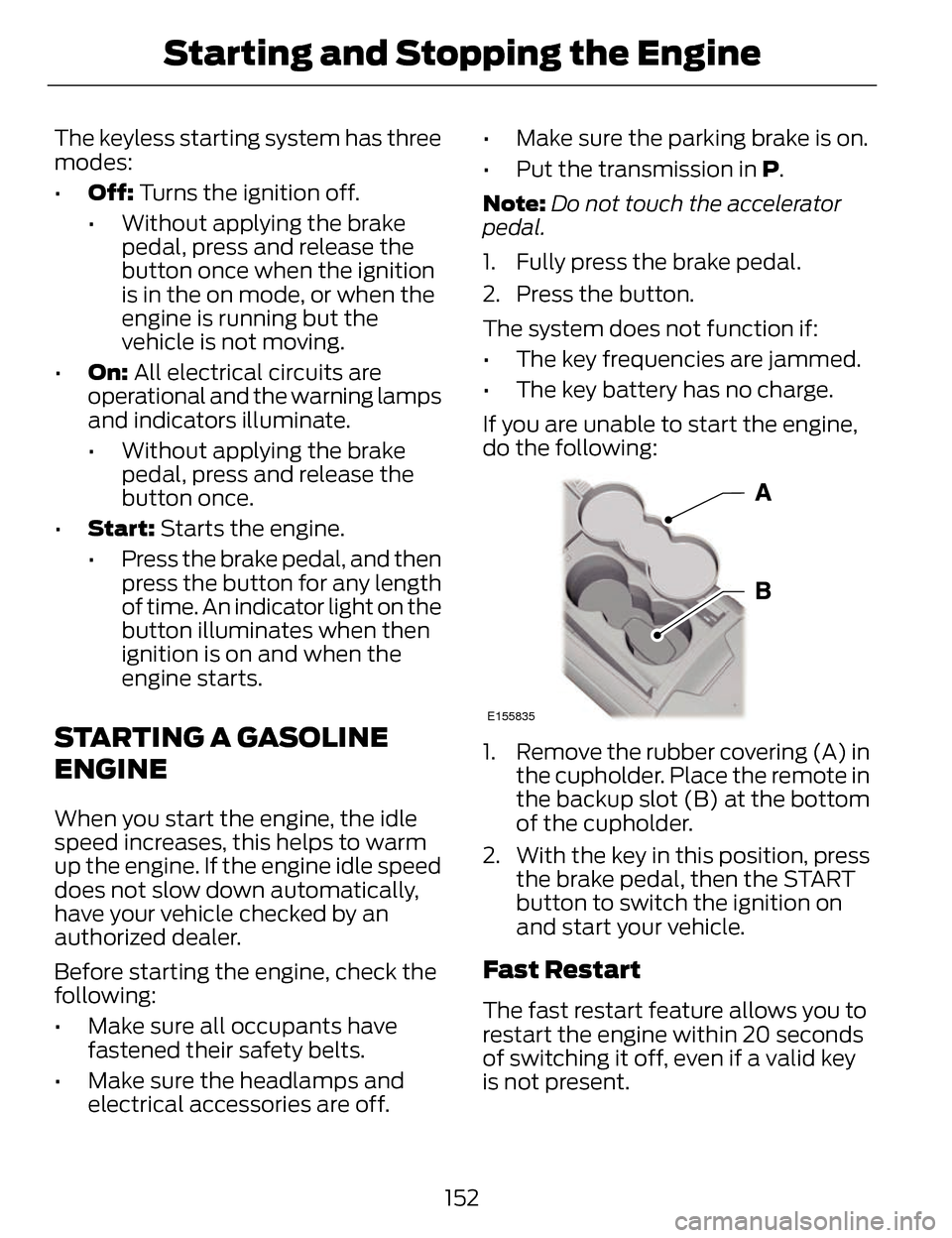
If you are unable to start the engine,
do the following:
E155835
1. Remove the rubber covering (A) in the cupholder. Place the remote in
the backup slot (B) at the bottom
of the cupholder.
2. With the key in this position, press the brake pedal, then the START
button to switch the ignition on
and start your vehicle.
Fast Restart
The fast restart feature allows you to
restart the engine within 20 seconds
of switching it off, even if a valid key
is not present.
152
Starting and Stopping the Engine
Page 171 of 468
Note:If you attempt to leave your
vehicle while it is in gear, the vehicle
will automatically shift into P (Park).
Safety belt and door monitors
determine your intent and make the
shift for you. During this time, a
Transmission not in Park message
will appear in the information display
screen prompting you to make the shift.
Note: To put your vehicle in gear with
the door open, perform steps 1-4. See
the Automatic Return to Park section
in this chapter for more information on
this feature.
P (Park)
With the transmission in P (Park),
your vehicle locks the transmission
and prevents the front wheels from
turning. Always come to a complete
stop before putting your vehicle into
and out of P (Park). An audible chime
sounds once you select P (Park).
When the ignition is turned off, the
vehicle will automatically shift into P
(Park). If the ignition is turned off
while the vehicle is moving, it will first
shift into N (Neutral) until a slow
enough speed is reached. The vehicle
will then shift into P (Park)
automatically.
Automatic Return to Park
Note: This feature will not operate
when your vehicle is in Stay in Neutral
mode or neutral tow.
Your vehicle has a safety feature that
will automatically shift your vehicle
into P (Park) when any of the
following conditions occur: • You turn the ignition off
• You open the driver's door with
your safety belt unlatched
• Your safety belt is unlatched while the driver's door is open
If you turn the ignition off while your
vehicle is moving, your vehicle will first
shift into N (Neutral) until it slows
down enough to shift into P (Park)
automatically.
Note: If you have waited an extended
period of time, (2-15 minutes) before
starting your vehicle, unlatching your
safety belt will cause this feature to
activate, even with the driver's door
closed.
Note: This feature may not work
properly if the door ajar switch is
malfunctioning. If your door ajar
indicator does not illuminate when you
open the driver’s door or the indicator
illuminates with the driver’s door
closed. See your authorized dealer.
R (Reverse)
With the transmission in R (Reverse),
your vehicle will move backward.
Always come to a complete stop
before shifting into and out of R
(Reverse).
N (Neutral)
With the transmission in N (Neutral),
you can start your vehicle and it is free
to roll. Hold the brake pedal down
while in this position.
168
Transmission
Page 185 of 468
Driving with a Trailer
Depending on the grade and the
weight of the trailer, your vehicle and
trailer may roll backwards slightly
when you start on a slope. To prevent
this from happening, do the following:
1. Pull the switch and hold it in thisposition.
2. Drive your vehicle, then release the switch when you notice that the
engine has developed sufficient
driving force.
Automatic release - drive away
release
Note: The driver's door must be closed
and the driver's safety belt must be
fastened before this feature will
operate.
Note: If the electric parking brake
warning lamp stays illuminated, the
electric parking brake will not
automatically release. You must
release the electric parking brake using
the electric parking brake switch.
Note: The engine must be running and
the accelerator pedal must be pressed
before the drive away release feature
will operate.
The brake system warning lamp will
go off to confirm that the electric
parking brake has been released. Note:
The electric parking brake drive
away release makes starting on a hill
easier. This feature will release the
parking brake automatically when the
vehicle has sufficient drive force to
move up the hill. To assure drive away
release when starting uphill, press the
accelerator pedal quickly.
Battery With No Charge
WARNING
You will not be able to apply or
release the electric parking brake
if the battery is low or has no charge.
If the battery is low or has no charge,
use jumper cables and a booster
battery.
HILL START ASSIST
WARNINGS
The system does not replace the
parking brake. When you leave
your vehicle, always apply the parking
brake and put the vehicle in position
P.
You must remain in your vehicle
once you have activated the
system.
During all times, you are
responsible for controlling your
vehicle, supervising the system and
intervening, if required.
If the engine is revved
excessively, or if a malfunction
is detected, the system will be
deactivated.
182
Brakes
Page 239 of 468
Note:Reconnect the wiring to the
trailer after removing the trailer from
the water.
When backing down a ramp during
boat launching or retrieval:
• Do not allow the static water level to rise above the bottom edge of
the rear bumper.
• Do not allow waves to break higher than 6 inches (15 centimeters)
above the bottom edge of the rear
bumper.
Exceeding these limits may allow
water to enter vehicle components:
• Causing internal damage to the components.
• Affecting driveability, emissions, and reliability.
Any time the rear axle submerges in
water, replace the rear axle lubricant.
Water may contaminate the rear axle
lubricant, which is not a normal
maintenance inspection item unless
there is a possibility of a leak or other
axle repair is required.TRANSPORTING THE
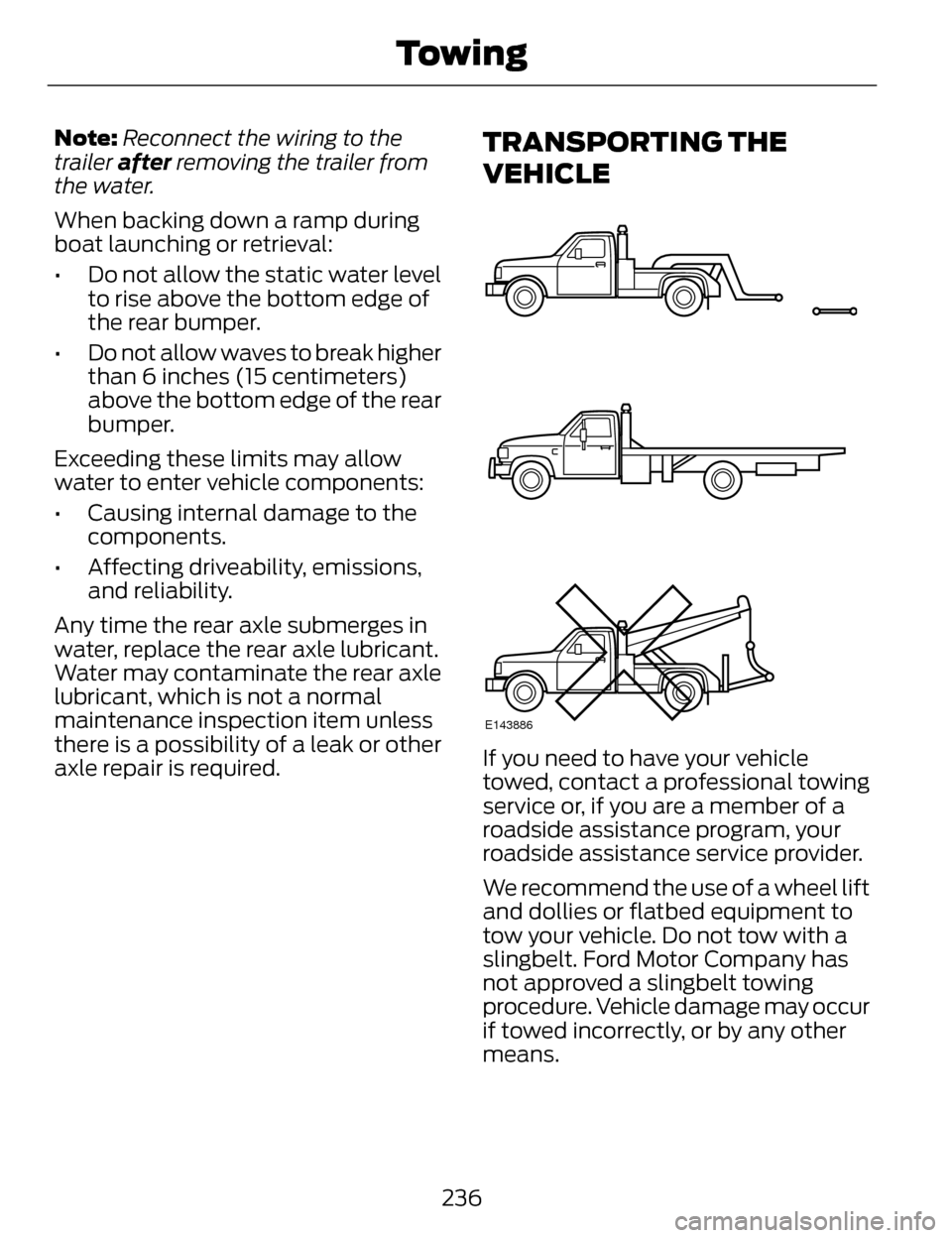
VEHICLE
E143886
If you need to have your vehicle
towed, contact a professional towing
service or, if you are a member of a
roadside assistance program, your
roadside assistance service provider.
We recommend the use of a wheel lift
and dollies or flatbed equipment to
tow your vehicle. Do not tow with a
slingbelt. Ford Motor Company has
not approved a slingbelt towing
procedure. Vehicle damage may occur
if towed incorrectly, or by any other
means.
236
Towing
Page 250 of 468
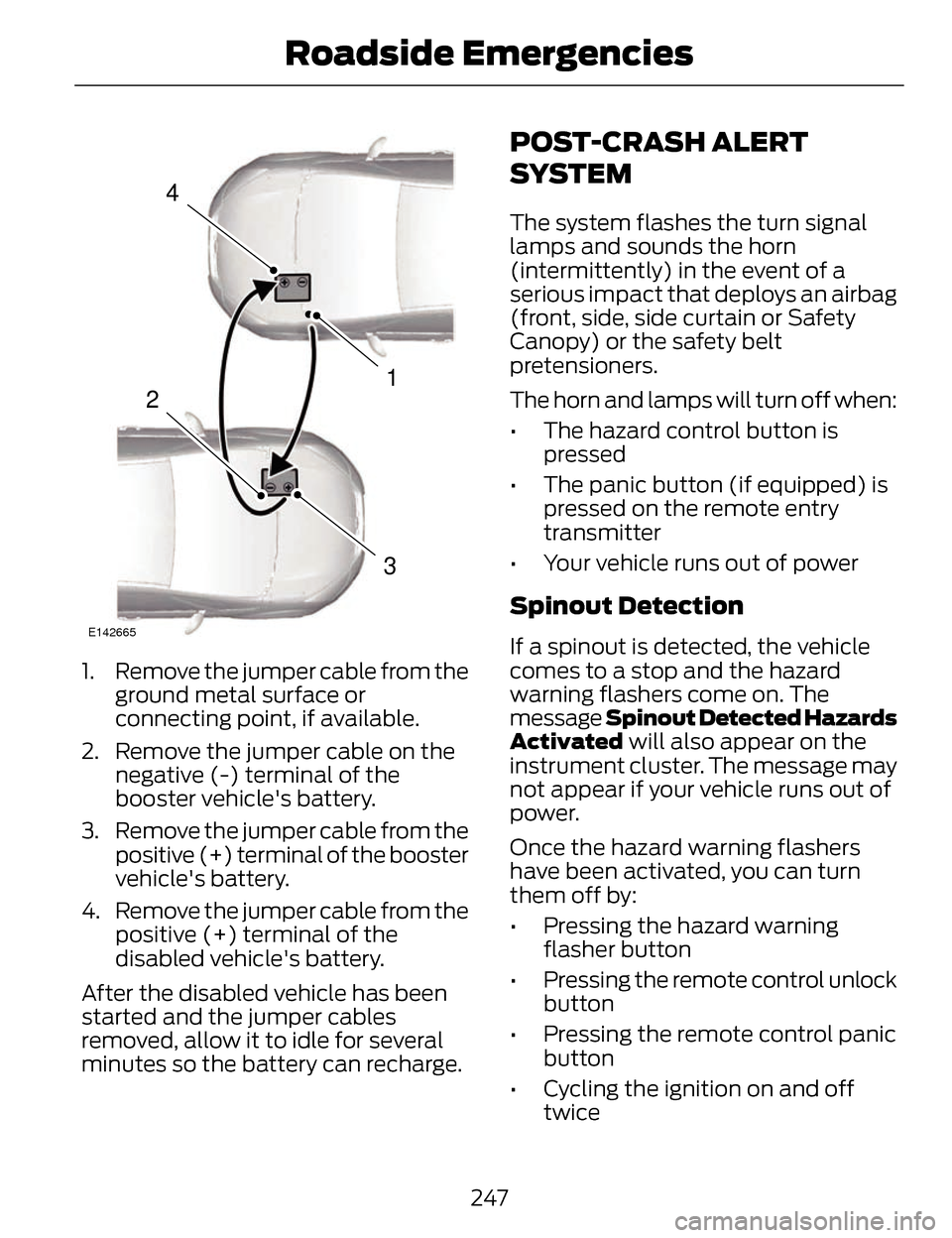
4
1
3
2
E142665
1. Remove the jumper cable from theground metal surface or
connecting point, if available.
2. Remove the jumper cable on the negative (-) terminal of the
booster vehicle's battery.
3. Remove the jumper cable from the positive (+) terminal of the booster
vehicle's battery.
4. Remove the jumper cable from the positive (+) terminal of the
disabled vehicle's battery.
After the disabled vehicle has been
started and the jumper cables
removed, allow it to idle for several
minutes so the battery can recharge.
POST-CRASH ALERT
SYSTEM
The system flashes the turn signal
lamps and sounds the horn
(intermittently) in the event of a
serious impact that deploys an airbag
(front, side, side curtain or Safety
Canopy) or the safety belt
pretensioners.
The horn and lamps will turn off when:
• The hazard control button is pressed
• The panic button (if equipped) is pressed on the remote entry
transmitter
• Your vehicle runs out of power
Spinout Detection
If a spinout is detected, the vehicle
comes to a stop and the hazard
warning flashers come on. The
message Spinout Detected Hazards
Activated will also appear on the
instrument cluster. The message may
not appear if your vehicle runs out of
power.
Once the hazard warning flashers
have been activated, you can turn
them off by:
• Pressing the hazard warning flasher button
• Pressing the remote control unlock button
• Pressing the remote control panic button
• Cycling the ignition on and off twice
247
Roadside Emergencies
Page 294 of 468
To clean these items, follow these
tips:
• You can clean the windows with anon-abrasive cleaner such as
Motorcraft Ultra-Clear Spray Glass
Cleaner.
• You can clean the wiper blades with isopropyl rubbing-alcohol or
Motorcraft Premium Windshield
Wash Concentrates in the U.S., or
Premium Quality Windshield
Washer Fluid in Canada. Be sure
to replace wiper blades when they
appear worn or do not function
properly.
• Do not use abrasives, as they may cause scratches.
• Do not use fuel, kerosene, or paint thinner to clean any parts.
If you cannot remove those streaks
after cleaning with the glass cleaner
or if the wipers chatter and move in a
jerky motion, clean the outer surface
of the windshield and the wiper
blades using a sponge or soft cloth
with a neutral detergent or
mild-abrasive cleaning solution. After
cleaning, rinse the windshield and
wiper blades with clean water. The
windshield is clean if beads do not
form when you rinse the windshield
with water.
Note: Do not use sharp objects, such
as a razorblade, to clean the inside of
the rear window or to remove decals,
as this may cause damage to the rear
window defroster’s heated grid lines.CLEANING THE INTERIOR
WARNINGS
Do not use cleaning solvents,
bleach or dye on the vehicle’s
safety belts, as these actions may
weaken the belt webbing.
On vehicles equipped with
seat-mounted airbags, do not
use chemical solvents or strong
detergents. Such products could
contaminate the side airbag system
and affect performance of the side
airbag in a collision.
For fabric, carpets, cloth seats, safety
belts and seats equipped with side
airbags:
• Remove dust and loose dirt with a vacuum cleaner.
• Remove light stains and soil with Motorcraft Professional Strength
Carpet & Upholstery Cleaner.
• If grease or tar is present on the material, spot-clean the area first
with Motorcraft Spot and Stain
Remover. In Canada, use
Motorcraft Multi-Purpose Cleaner.
• If a ring forms on the fabric after spot cleaning, clean the entire area
immediately (but do not
oversaturate) or the ring will set.
• Do not use household cleaning products or glass cleaners, which
can stain and discolor the fabric
and affect the flame retardant
abilities of the seat materials.
291
Vehicle Care
Page 332 of 468
ENGINE SPECIFICATIONS
3.7L V6 Engine
2.0L EcoBoost engine
Engine
227
122
Cubic inches
Minimum 87 octane
Minimum 87 octane
Required fuel
10.5:1
9.3:1
Compression ratio
0.049-0.053 in. (1.25-1.35mm)
0.027-0.031 in. (0.70-0.80
mm)
Spark plug gap
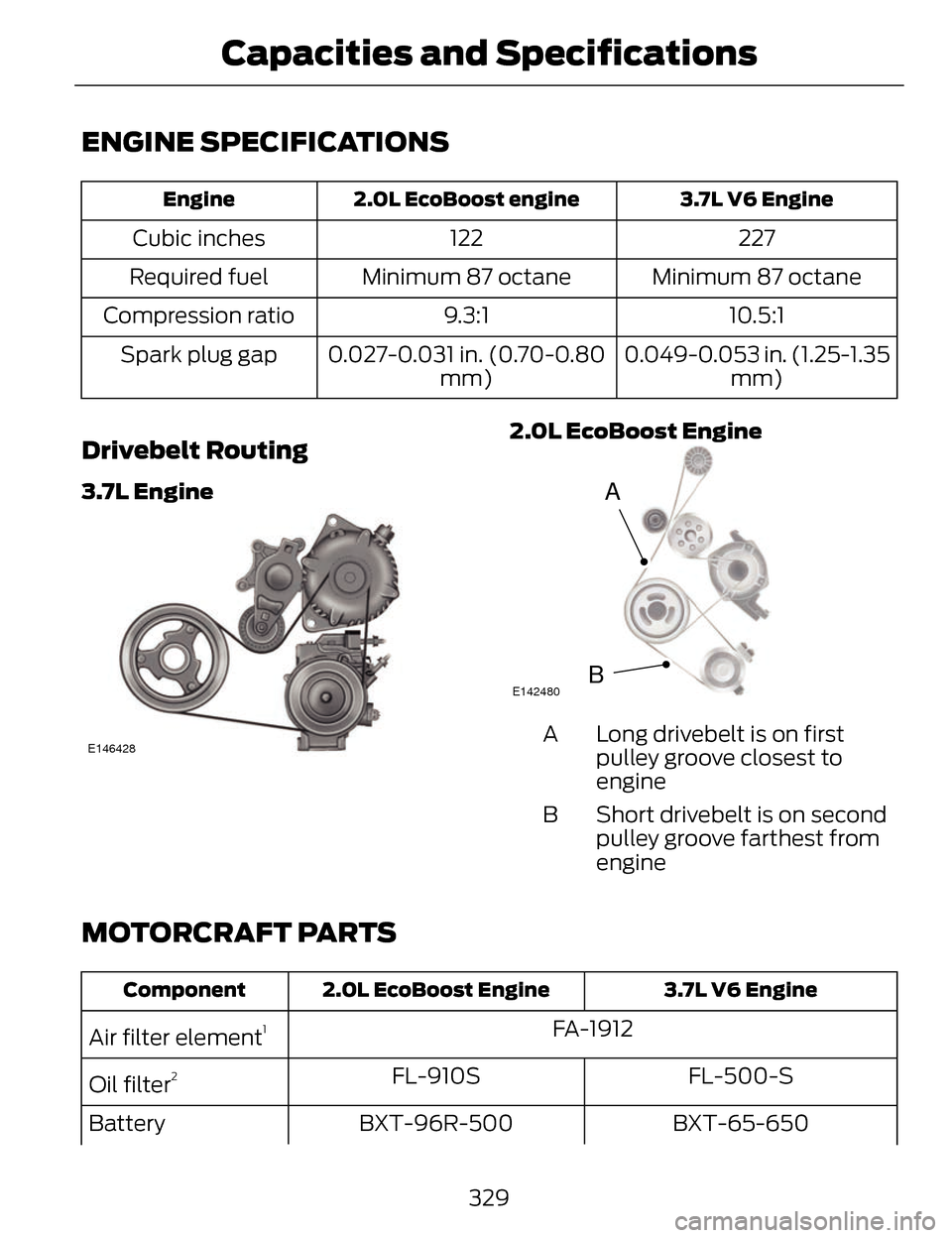
Drivebelt Routing
3.7L Engine
E146428
2.0L EcoBoost Engine
A
BE142480
Long drivebelt is on first
pulley groove closest to
engine
A
Short drivebelt is on second
pulley groove farthest from
engine
B
MOTORCRAFT PARTS
3.7L V6 Engine
2.0L EcoBoost Engine
Component
FA-1912
Air filter element1
FL-500-S
FL-910S
Oil filter2
BXT-65-650
BXT-96R-500
Battery
329
Capacities and Specifications
Page 343 of 468
• Travel expense reimbursement forlodging, meals and rental car
• Destination assistance for taxi, shuttle, rental car coverage and
emergency transportation
Transferable Coverage
If you sell your vehicle before your
Ford Extended Service Plan coverage
expires, you can transfer any
remaining coverage to the new owner.
Whenever you sell your vehicle,
prospective buyers may have a higher
degree of confidence that vehicle was
properly maintained with Ford ESP,
thereby improving resale value.
Avoid the Rising Cost of Properly
Maintaining Your Vehicle!
Ford Extended Service Plan also
offers a Premium Maintenance Plan
that covers all scheduled
maintenance, and select items that
routinely wear out.
The coverage is prepaid, so you never
have to worry about affording your
vehicle maintenance. It covers regular
checkups, routine inspections,
preventive care and replacement of
select items that require periodic
attention for normal wear:
• Windshield Wiper Blades
• Spark Plugs (except in California) • The Clutch Disc
• Brake Pads and Linings
• Shock Absorbers
• Belts and Hoses
• Diesel Exhaust Fluid
Replenishment
Contact your selling authorized Ford
or Lincoln dealership today so they
can customize a Ford Extended
Service Plan that fits your driving
lifestyle and budget.
Interest Free Finance Options
Available
Take advantage of our interest free
installment payment plan. Just a 10%
down payment will provide you with
an affordable, no interest, no fee
payment program.
To learn more, call our Ford ESP
specialists at 800-367-3377. Don’t
forget to ask about our interest free
payment program, allowing you all
the security and benefits Ford ESP has
to offer while paying over time. You
are pre-approved with no credit
checks, no hassles!
Complete the information below and
mail to:
Ford ESP
P.O. Box 8072
Royal Oak, MI 48068-0039
340
Ford Extended Service Plan (ESP)
Page 404 of 468
Note:If any user turns 911 Assist on or
off, that setting applies for all paired
phones. If 911 Assist is turned off, either
a voice message plays or a display
message (or icon) comes on (or both)
when your vehicle is started after a
previously paired phone connects.
Note: Every phone operates differently.
While SYNC 911 Assist works with most
cellular phones, some may have
trouble using this feature.
If a crash deploys an airbag (excludes
knee airbags and rear inflatable safety
belts [if equipped]) or activates the
fuel pump shut-off, your
SYNC-equipped vehicle may be able
to contact emergency services by
dialing 911 through a paired and
connected Bluetooth-enabled phone.
You can learn more about the 911
Assist feature, visit
www.SYNCMyRide.com,
www.SYNCMyRide.ca or
www.syncmaroute.ca.
See Supplementary Restraints
System (page 42). Important
information regarding airbag
deployment is in this chapter.
See Roadside Emergencies (page
243). Important information regarding
the fuel pump shut-off is in this
chapter. Setting 911 Assist On
E142608
If your vehicle is equipped
with Navigation, touch the i
(Information) button to
access these features. If your vehicle
is not equipped with Navigation, touch
the corner of the touchscreen with the
green tab.
Touch Apps > 911 Assist, then select
On.
E142607
You can also access 911
Assist by:
• Pressing the Settings icon > Settings > Phone > 911 Assist,
or
• Pressing the Settings icon > Help > 911 Assist.
To make sure that 911 Assist works
properly:
• SYNC must be powered and working properly at the time of the
incident and throughout feature
activation and use.
• The 911 Assist feature must be set on prior to the incident.
• You must pair and connect a Bluetooth-enabled and
compatible phone to SYNC.
• A connected Bluetooth-enabled phone must have the ability to
make and maintain an outgoing
call at the time of the incident.
401
MyLincoln Touch™
Page 442 of 468
Check every six months
Safety belts and seat latches for wear and function.
Safety warning lamps (brake, ABS, airbag and safety belt) for operation.
Washer spray and wiper operation. Clean or replace blades as necessary.
Multi-Point Inspection
In order to keep your vehicle running
right, it is important to have the
systems on your vehicle checked
regularly. This can help identify
potential issues and prevent major
problems. We recommend having the
following multi-point inspection
performed at every scheduled
maintenance interval to help make
sure your vehicle keeps running great.
Multi-Point inspection
Hazard warning system operation
Accessory drive belt(s)
Horn operation
Battery performance
Radiator, cooler, heater and air condi-tioning hoses
Engine air filter
Suspension components for leaks ordamage
Exhaust system
Steering and linkage
Exterior lamps operation
Tires (including spare) for wear andproper pressure
**Fluid levels*; fill if necessary
439
Scheduled Maintenance