warning light LINCOLN MKZ 2014 Workshop Manual
[x] Cancel search | Manufacturer: LINCOLN, Model Year: 2014, Model line: MKZ, Model: LINCOLN MKZ 2014Pages: 468, PDF Size: 4.49 MB
Page 306 of 468

Installation of the sealant canister
to the kit
E144626
1. Align the sealant canister with thekit housing.
E161567
2. Once aligned, seat the sealantcanister by lightly pushing down
until you hear an audible click.
E144628
3. Wrap the clear tube around thecompressor housing.
Note: If you experience any difficulties
with the removal or installation of the
sealant canister, consult your Ford
Motor Company authorized dealer for
assistance.
E144629
Be sure to check the sealant
compound's use by date regularly.
The use by date is on the lower right
hand corner of the label located on
the sealant canister (bottle). The
sealant canister should be replaced
after four years.
TIRE PRESSURE
MONITORING SYSTEM
WARNING
The tire pressure monitoring
system is not a substitute for
manually checking tire pressure. The
tire pressure should be checked
periodically (at least monthly) using
a tire gauge, see Inflating your tires in
this chapter. Failure to properly
maintain your tire pressure could
increase the risk of tire failure, loss of
control, vehicle rollover and personal
injury.
303
Wheels and Tires
Page 308 of 468
Changing Tires With a Tire
Pressure Monitoring System
E142549
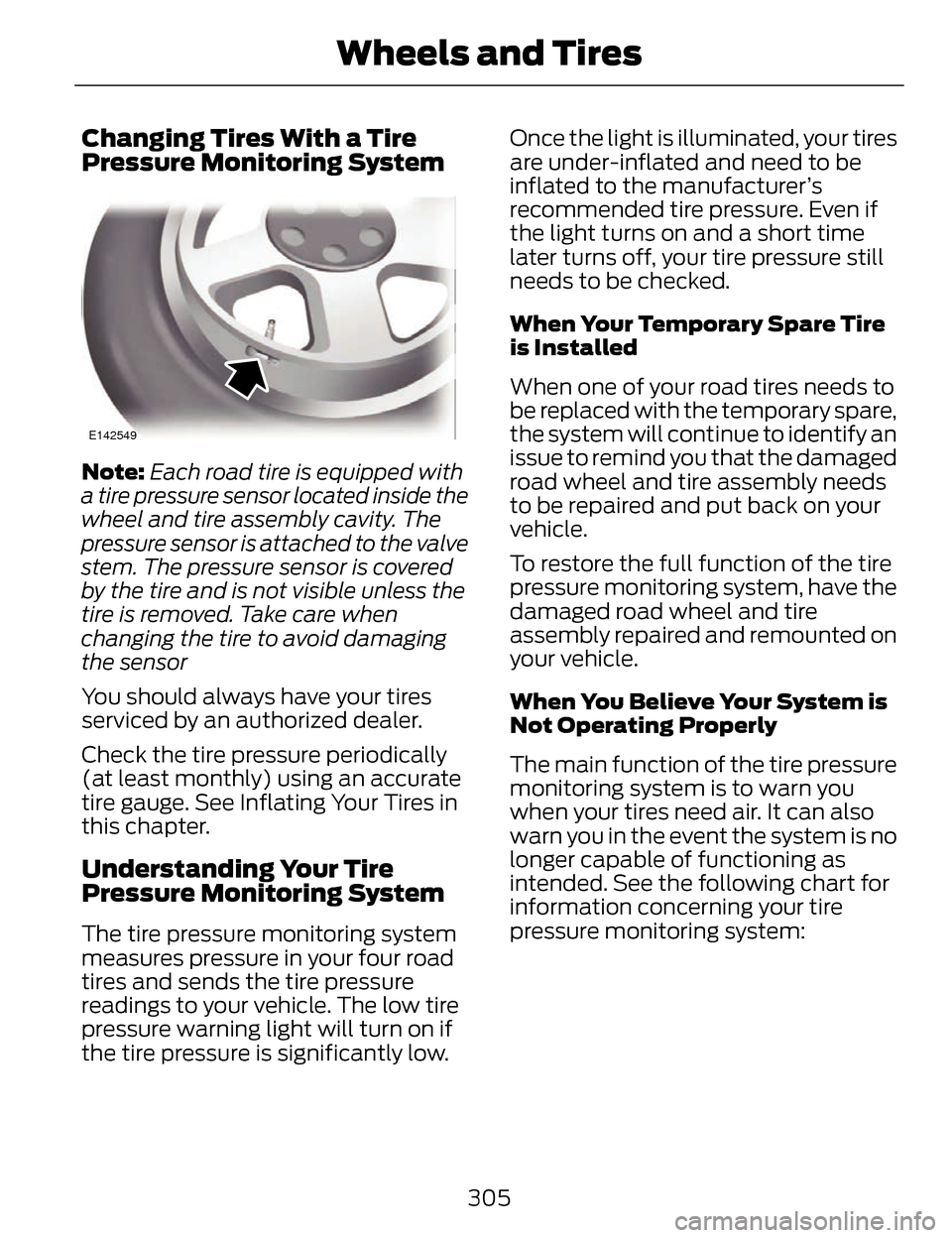
Note:Each road tire is equipped with
a tire pressure sensor located inside the
wheel and tire assembly cavity. The
pressure sensor is attached to the valve
stem. The pressure sensor is covered
by the tire and is not visible unless the
tire is removed. Take care when
changing the tire to avoid damaging
the sensor
You should always have your tires
serviced by an authorized dealer.
Check the tire pressure periodically
(at least monthly) using an accurate
tire gauge. See Inflating Your Tires in
this chapter.
Understanding Your Tire
Pressure Monitoring System
The tire pressure monitoring system
measures pressure in your four road
tires and sends the tire pressure
readings to your vehicle. The low tire
pressure warning light will turn on if
the tire pressure is significantly low. Once the light is illuminated, your tires
are under-inflated and need to be
inflated to the manufacturer’s
recommended tire pressure. Even if
the light turns on and a short time
later turns off, your tire pressure still
needs to be checked.
When Your Temporary Spare Tire
is Installed
When one of your road tires needs to
be replaced with the temporary spare,
the system will continue to identify an
issue to remind you that the damaged
road wheel and tire assembly needs
to be repaired and put back on your
vehicle.
To restore the full function of the tire
pressure monitoring system, have the
damaged road wheel and tire
assembly repaired and remounted on
your vehicle.
When You Believe Your System is
Not Operating Properly
The main function of the tire pressure
monitoring system is to warn you
when your tires need air. It can also
warn you in the event the system is no
longer capable of functioning as
intended. See the following chart for
information concerning your tire
pressure monitoring system:
305
Wheels and Tires
Page 309 of 468
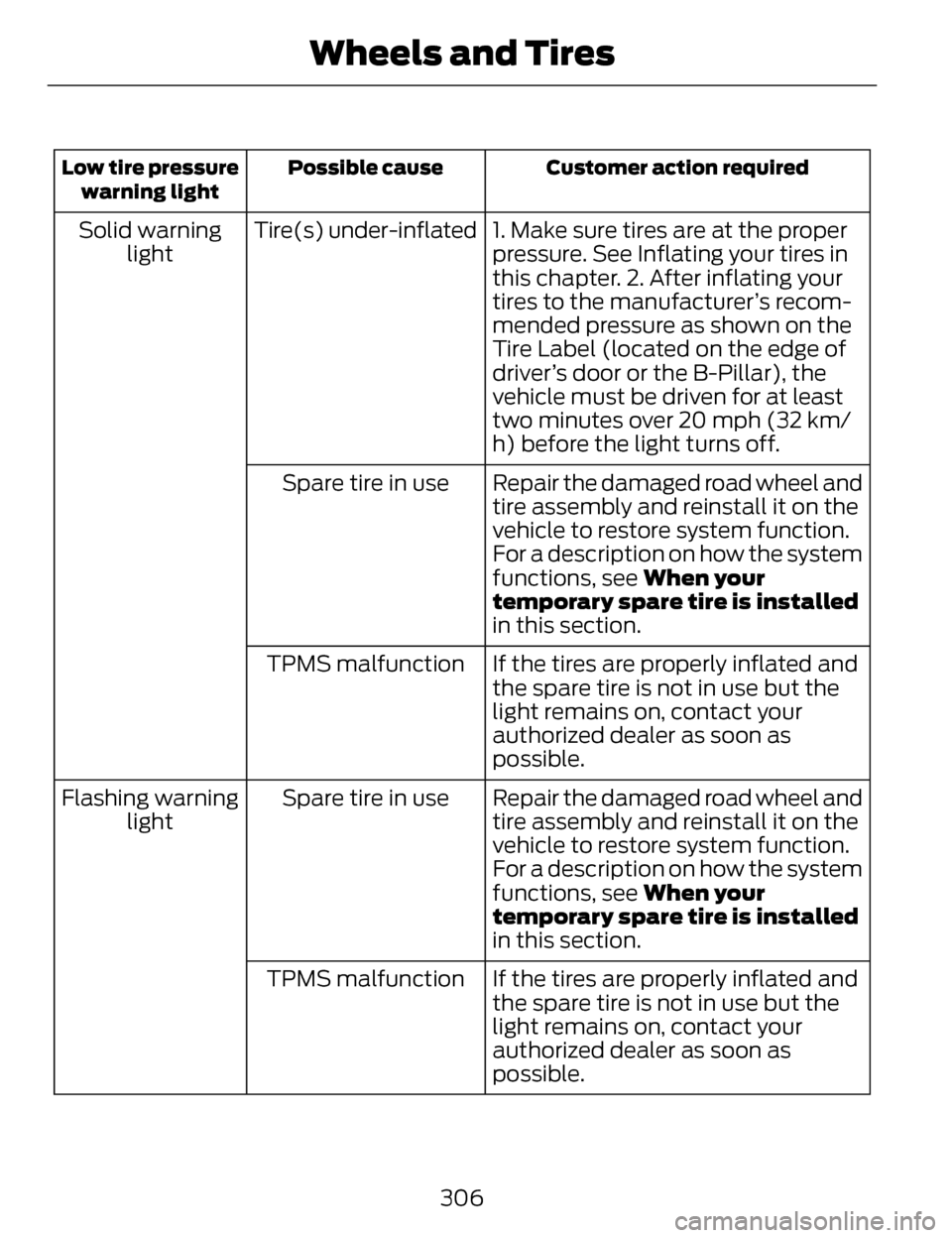
Customer action required
Possible cause
Low tire pressure
warning light
1. Make sure tires are at the proper
pressure. See Inflating your tires in
this chapter. 2. After inflating your
tires to the manufacturer’s recom-
mended pressure as shown on the
Tire Label (located on the edge of
driver’s door or the B-Pillar), the
vehicle must be driven for at least
two minutes over 20 mph (32 km/
h) before the light turns off.
Tire(s) under-inflated
Solid warning
light
Repair the damaged road wheel and
tire assembly and reinstall it on the
vehicle to restore system function.
For a description on how the system
functions, see When your
temporary spare tire is installed
in this section.
Spare tire in use
If the tires are properly inflated and
the spare tire is not in use but the
light remains on, contact your
authorized dealer as soon as
possible.
TPMS malfunction
Repair the damaged road wheel and
tire assembly and reinstall it on the
vehicle to restore system function.
For a description on how the system
functions, see When your
temporary spare tire is installed
in this section.
Spare tire in use
Flashing warning
light
If the tires are properly inflated and
the spare tire is not in use but the
light remains on, contact your
authorized dealer as soon as
possible.
TPMS malfunction
306
Wheels and Tires
Page 310 of 468

When Inflating Your Tires
When putting air into your tires (such
as at a gas station or in your garage),
the tire pressure monitoring system
may not respond immediately to the
air added to your tires.
It may take up to two minutes of
driving over 20 mph (32 km/h) for the
light to turn off after you have filled
your tires to the recommended
inflation pressure
How Temperature Affects Your
Tire Pressure
The tire pressure monitoring system
monitors tire pressure in each
pneumatic tire. While driving in a
normal manner, a typical passenger
tire inflation pressure may increase
about 2 to 4 psi (14 to 28 kPa) from a
cold start situation. If the vehicle is
stationary overnight with the outside
temperature significantly lower than
the daytime temperature, the tire
pressure may decrease about 3 psi (21
kPa) for a drop of 30°F (17°C) in
ambient temperature. This lower
pressure value may be detected by
the tire pressure monitoring system
as being significantly lower than the
recommended inflation pressure and
activate the system warning light for
low tire pressure. If the low tire
pressure warning light is on, visually
check each tire to verify that no tire is
flat. If one or more tires are flat, repair
as necessary. Check the air pressurein the road tires. If any tire is
under-inflated, carefully drive the
vehicle to the nearest location where
air can be added to the tires. Inflate
all the tires to the recommended
inflation pressure.
TIRE CARE
Important information for
245/40R19 low-profile tires
and wheels If your vehicle is
equipped with 245/40R19 tires,
they are low-profile tires. These
tires and wheels are designed to
give your vehicle a sport
appearance. With low-profile tires,
you may notice an increase in road
noise and faster tire wear,
depending on road conditions and
driving styles. Due to their design,
low-profile tires and wheels are
more prone to road damage from
potholes, rough or unpaved roads,
car wash rails and curb contact
than standard tires and wheels.
Note:
Your vehicle’s warranty does
not cover these types of damage.
Tires should always be kept at the
correct inflation pressures and
extra caution should be taken when
operating on rough roads to avoid
impacts that could cause wheel
and tire damage.
307
Wheels and Tires
Page 311 of 468
Information About Uniform
Tire Quality Grading
E142542
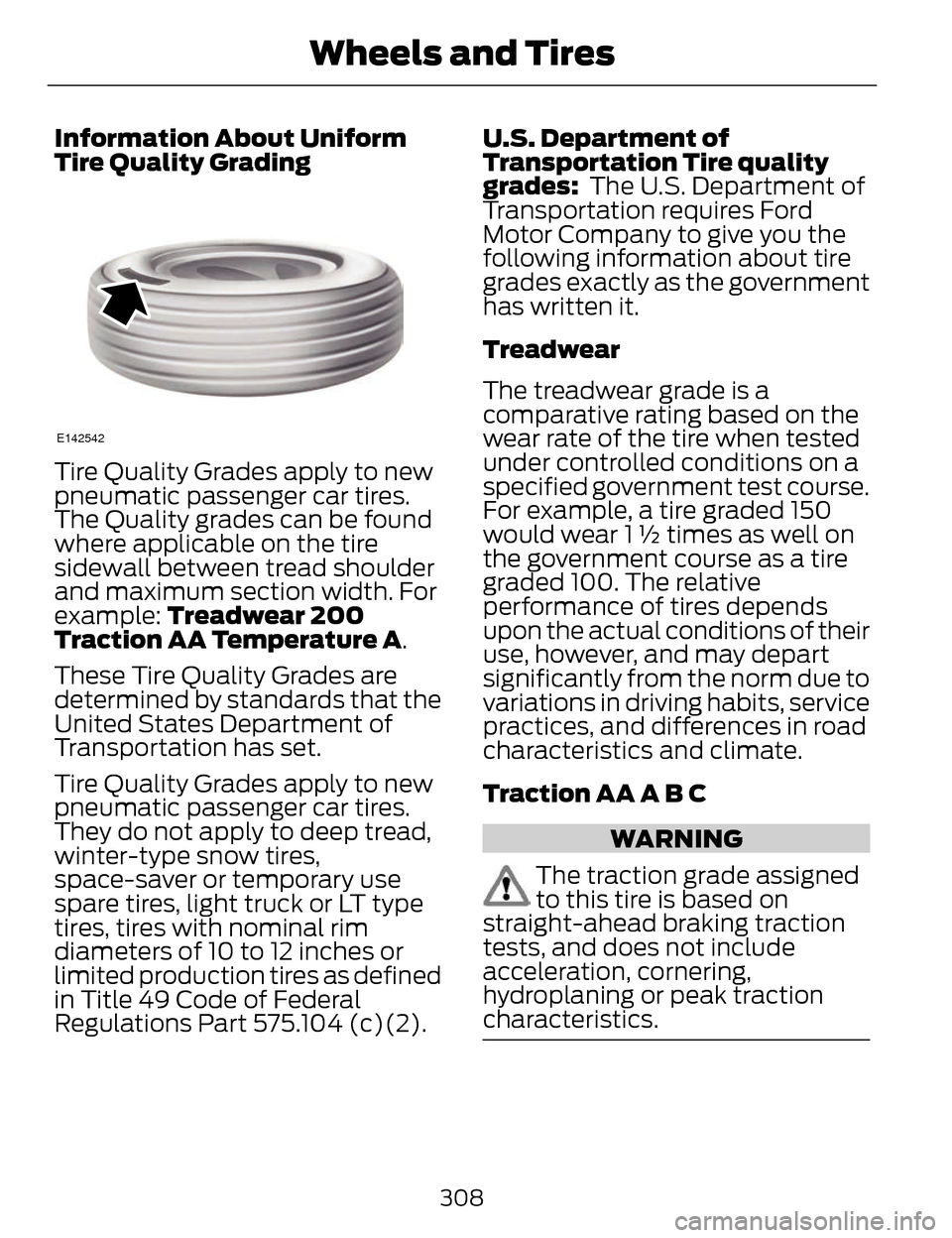
Tire Quality Grades apply to new
pneumatic passenger car tires.
The Quality grades can be found
where applicable on the tire
sidewall between tread shoulder
and maximum section width. For
example: Treadwear 200
Traction AA Temperature A.
These Tire Quality Grades are
determined by standards that the
United States Department of
Transportation has set.
Tire Quality Grades apply to new
pneumatic passenger car tires.
They do not apply to deep tread,
winter-type snow tires,
space-saver or temporary use
spare tires, light truck or LT type
tires, tires with nominal rim
diameters of 10 to 12 inches or
limited production tires as defined
in Title 49 Code of Federal
Regulations Part 575.104 (c)(2). U.S. Department of
Transportation Tire quality
grades:
The U.S. Department of
Transportation requires Ford
Motor Company to give you the
following information about tire
grades exactly as the government
has written it.
Treadwear
The treadwear grade is a
comparative rating based on the
wear rate of the tire when tested
under controlled conditions on a
specified government test course.
For example, a tire graded 150
would wear 1 ½ times as well on
the government course as a tire
graded 100. The relative
performance of tires depends
upon the actual conditions of their
use, however, and may depart
significantly from the norm due to
variations in driving habits, service
practices, and differences in road
characteristics and climate.
Traction AA A B C
WARNING
The traction grade assigned
to this tire is based on
straight-ahead braking traction
tests, and does not include
acceleration, cornering,
hydroplaning or peak traction
characteristics.
308
Wheels and Tires
Page 326 of 468
USING SNOW CHAINS
WARNINGS
If you choose to install snow tires
on your vehicle, they must be the
same size, construction, and load
range as the original tires listed on the
tire placard, and they must be
installed on all four wheels. Mixing
tires of different size or construction
on your vehicle can adversely affect
your vehicle's handling and braking,
and may lead to loss of vehicle
control.
Do not use snow chains or cables
on this vehicle as they may cause
damage to your vehicle which may
lead to loss of vehicle control.
Snow chains have not been approved
for use on your vehicle.
The original equipment tires on your
vehicle may have an all-weather tread
design to provide traction, handling,
and braking performance in
year-round driving. You may install
snow tires for improved traction when
driving in areas with sustained periods
of snow or icy driving conditions.
CHANGING A ROAD WHEEL
WARNINGS
The use of tire sealants may
damage your tire pressure
monitoring system and should not be
used. However, if you must use a
sealant, the tire pressure monitoring
system sensor and valve stem on the
wheel must be replaced by an
authorized dealer.
If the tire pressure monitor
sensor becomes damaged, it will
no longer function. See Tire Pressure
Monitoring System (page 303).
Note: The tire pressure monitoring
system indicator light will illuminate
when the spare tire is in use. To restore
the full function of the monitoring
system, all road wheels equipped with
tire pressure monitoring sensors must
be mounted on the vehicle.
If you get a flat tire while driving, do
not apply the brake heavily. Instead,
gradually decrease your speed. Hold
the steering wheel firmly and slowly
move to a safe place on the side of
the road.
Have a flat serviced by an authorized
dealer in order to prevent damage to
the tire pressure monitoring system
sensors. See Tire Pressure
Monitoring System (page 303).
Replace the spare tire with a road tire
as soon as possible. During repairing
or replacing of the flat tire, have the
authorized dealer inspect the tire
pressure monitoring system sensor
for damage.
323
Wheels and Tires
Page 461 of 468
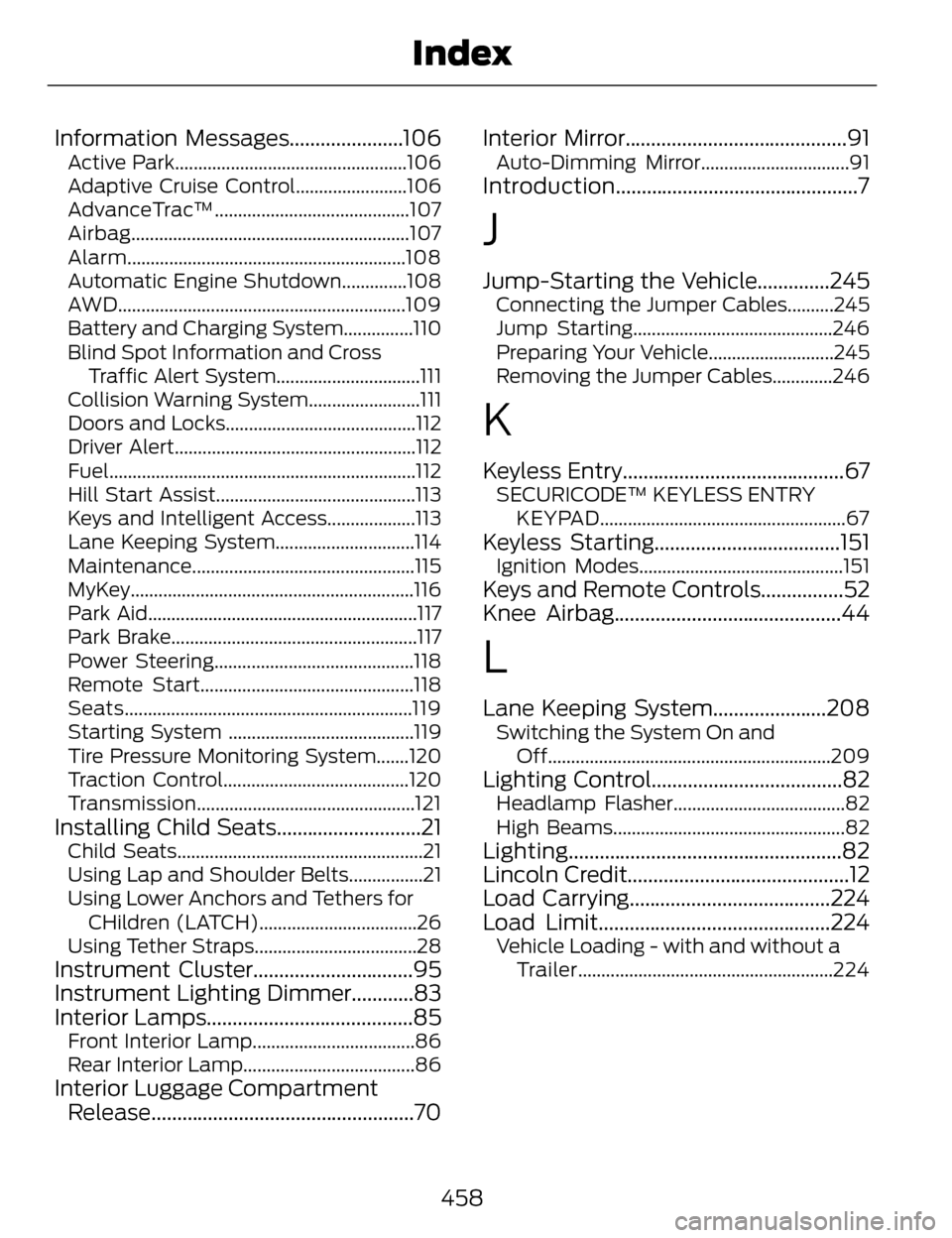
Information Messages......................106Active Park..................................................106
Adaptive Cruise Control........................106
AdvanceTrac™..........................................107
Airbag............................................................107
Alarm............................................................108
Automatic Engine Shutdown..............108
AWD..............................................................109
Battery and Charging System...............110
Blind Spot Information and CrossTraffic Alert System...............................111
Collision Warning System........................111
Doors and Locks.........................................112
Driver Alert....................................................112
Fuel..................................................................112
Hill Start Assist...........................................113
Keys and Intelligent Access...................113
Lane Keeping System..............................114
Maintenance................................................115
MyKey.............................................................116
Park Aid..........................................................117
Park Brake.....................................................117
Power Steering...........................................118
Remote Start..............................................118
Seats..............................................................119
Starting System ........................................119
Tire Pressure Monitoring System.......120
Traction Control........................................120
Transmission...............................................121
Installing Child Seats............................21Child Seats.....................................................21
Using Lap and Shoulder Belts................21
Using Lower Anchors and Tethers for CHildren (LATCH)..................................26
Using Tether Straps...................................28
Instrument Cluster...............................95
Instrument Lighting Dimmer............83
Interior Lamps........................................85
Front Interior Lamp...................................86
Rear Interior Lamp.....................................86
Interior Luggage Compartment Release...................................................70 Interior Mirror...........................................91
Auto-Dimming Mirror................................91
Introduction...............................................7
J
Jump-Starting the Vehicle..............245Connecting the Jumper Cables..........245
Jump Starting...........................................246
Preparing Your Vehicle...........................245
Removing the Jumper Cables.............246
K
Keyless Entry...........................................67SECURICODE™ KEYLESS ENTRY
KEYPAD.....................................................67
Keyless Starting....................................151Ignition Modes............................................151
Keys and Remote Controls................52
Knee Airbag............................................44
L
Lane Keeping System......................208Switching the System On andOff.............................................................209
Lighting Control.....................................82Headlamp Flasher.....................................82
High Beams..................................................82
Lighting.....................................................82
Lincoln Credit...........................................12
Load Carrying.......................................224
Load Limit.............................................224
Vehicle Loading - with and without aTrailer.......................................................224
458
Index
Page 466 of 468
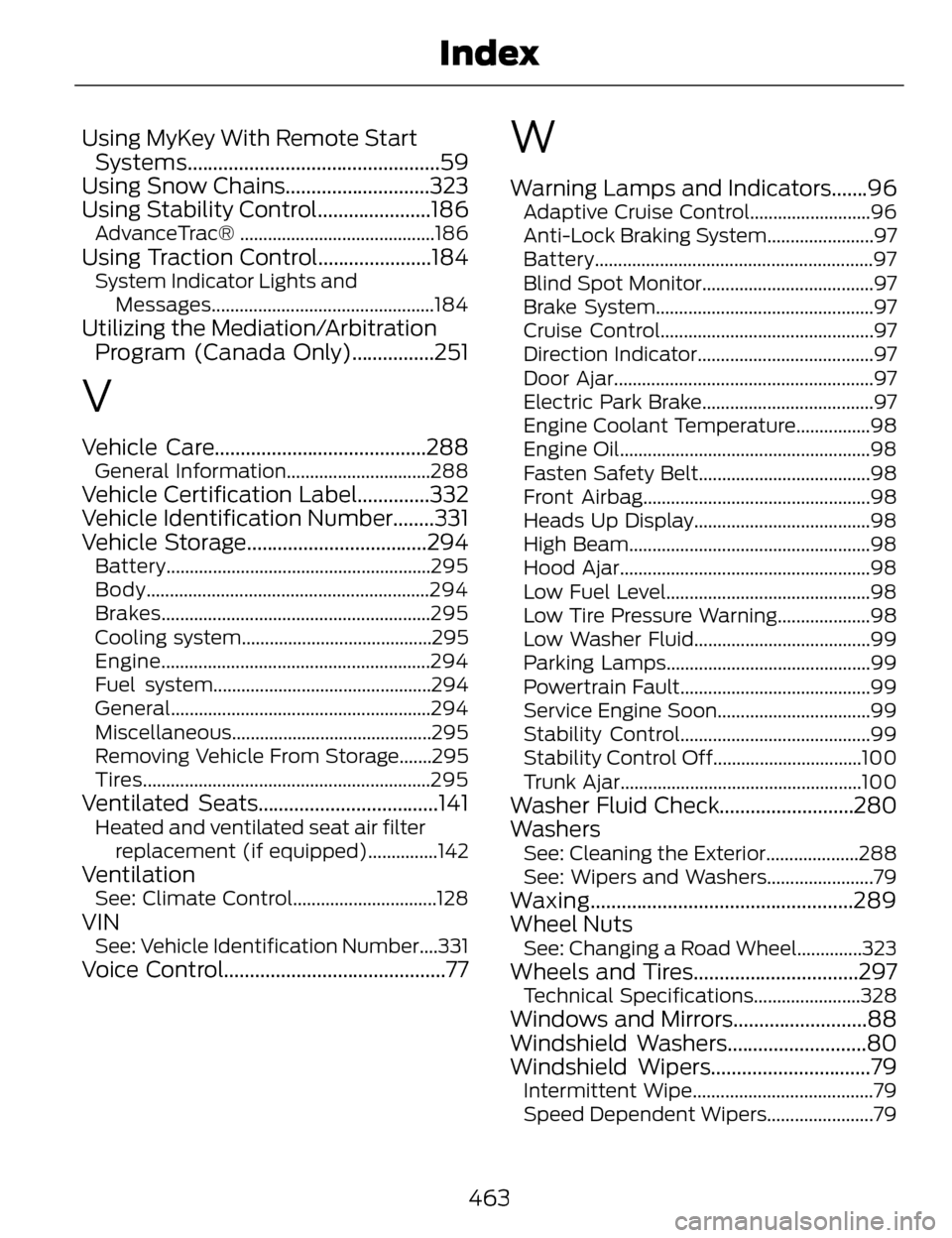
Using MyKey With Remote StartSystems.................................................59
Using Snow Chains............................323
Using Stability Control......................186
AdvanceTrac® ..........................................186
Using Traction Control......................184System Indicator Lights and
Messages................................................184
Utilizing the Mediation/ArbitrationProgram (Canada Only)................251
V
Vehicle Care.........................................288General Information...............................288
Vehicle Certification Label..............332
Vehicle Identification Number........331
Vehicle Storage...................................294
Battery.........................................................295
Body.............................................................294
Brakes..........................................................295
Cooling system.........................................295
Engine..........................................................294
Fuel system...............................................294
General........................................................294
Miscellaneous...........................................295
Removing Vehicle From Storage.......295
Tires..............................................................295
Ventilated Seats...................................141Heated and ventilated seat air filter
replacement (if equipped)...............142
VentilationSee: Climate Control...............................128
VINSee: Vehicle Identification Number....331
Voice Control...........................................77
W
Warning Lamps and Indicators.......96Adaptive Cruise Control..........................96
Anti-Lock Braking System.......................97
Battery............................................................97
Blind Spot Monitor.....................................97
Brake System...............................................97
Cruise Control..............................................97
Direction Indicator......................................97
Door Ajar........................................................97
Electric Park Brake.....................................97
Engine Coolant Temperature................98
Engine Oil......................................................98
Fasten Safety Belt.....................................98
Front Airbag.................................................98
Heads Up Display......................................98
High Beam....................................................98
Hood Ajar......................................................98
Low Fuel Level............................................98
Low Tire Pressure Warning....................98
Low Washer Fluid......................................99
Parking Lamps............................................99
Powertrain Fault.........................................99
Service Engine Soon.................................99
Stability Control.........................................99
Stability Control Off................................100
Trunk Ajar....................................................100
Washer Fluid Check..........................280
Washers
See: Cleaning the Exterior....................288
See: Wipers and Washers.......................79
Waxing...................................................289
Wheel Nuts
See: Changing a Road Wheel..............323
Wheels and Tires................................297Technical Specifications.......................328
Windows and Mirrors..........................88
Windshield Washers...........................80
Windshield Wipers...............................79
Intermittent Wipe.......................................79
Speed Dependent Wipers.......................79
463
Index