airbag off LINCOLN MKZ 2014 Owners Manual
[x] Cancel search | Manufacturer: LINCOLN, Model Year: 2014, Model line: MKZ, Model: LINCOLN MKZ 2014Pages: 468, PDF Size: 4.49 MB
Page 14 of 468
authorities or other third parties
acting with lawful authority. Other
parties may seek to access the
information independently of Ford
Motor Company and Ford of
Canada.
Note:Including to the extent that
any law pertaining to Event Data
Recorders applies to SYNC or its
features, please note the following:
Once 911 Assist (if equipped) is
enabled (set ON), 911 Assist may,
through any paired and connected
cell phone, disclose to emergency
services that the vehicle has been in
a crash involving the deployment of
an airbag or, in certain vehicles, the
activation of the fuel pump shut-off.
Certain versions or updates to 911
Assist may also be capable of being
used to electronically or verbally
provide to 911 operators the vehicle
location (such as latitude and
longitude), and/or other details
about the vehicle or crash or
personal information about the
occupants to assist 911 operators to
provide the most appropriate
emergency services. If you do not
want to disclose this information, do
not activate the 911 Assist feature.
See MyLincoln Touch™ (page 342).
Additionally, when you connect to
Traffic, Directions and Information
(if equipped, U.S. only), the service
uses GPS technology and
advanced vehicle sensors to
collect the vehicle’s current
location, t ravel direction, and
speed (“vehicle travel
information”), only to help provide you with the directions, traffic
reports, or business searches that
you request. If you do not want
Ford or its vendors to receive this
information, do not activate the
service. Ford Motor Company and
the vendors it uses to provide you
with this information do not store
your vehicle travel information.
For more information, see Traffic,
Directions and Information, Terms
and Conditions.
See MyLincoln
Touch™ (page 342).
CALIFORNIA PROPOSITION
65
WARNING
Some constituents of engine
exhaust, certain vehicle
components, certain fluids contained
in vehicles and certain products of
component wear contain or emit
chemicals known to the State of
California to cause cancer and birth
defects or other reproductive harm.
PERCHLORATE
Certain components in your vehicle
such as airbag modules, safety belt
pretensioners and remote control
batteries may contain perchlorate
material. Special handling may apply
for service or vehicle end of life
disposal. For more information visit:
11
Introduction
Page 16 of 468
SPECIAL NOTICES
New Vehicle Limited Warranty
For a detailed description of what is
covered and what is not covered by
your vehicle’s New Vehicle Limited
Warranty, refer to the Warranty
Manual that is provided to you along
with your Owner’s Manual.
Special Instructions
For your added safety, your vehicle is
fitted with sophisticated electronic
controls.
WARNINGS
Failure to follow the specific
warnings and instructions could
result in personal injury. See
Supplementary Restraints System
(page 42).
Front seat mounted rear-facing
child or infant seats should
NEVER be placed in front of an active
passenger airbag.
MOBILE
COMMUNICATIONS
EQUIPMENT
Using mobile communications
equipment is becoming increasingly
important in the conduct of business
and personal affairs. However, you
must not compromise your own or
others’ safety when using such
equipment. Mobile communications
can enhance personal safety and
security when appropriately used, particularly in emergency situations.
Safety must be paramount when
using mobile communications
equipment to avoid negating these
benefits. Mobile communication
equipment includes, but is not limited
to, cellular phones, pagers, portable
email devices, text messaging devices
and portable two-way radios.
WARNING
Driving while distracted can
result in loss of vehicle control,
crash and injury. We strongly
recommend that you use extreme
caution when using any device that
may take your focus off the road. Your
primary responsibility is the safe
operation of your vehicle. We
recommend against the use of any
hand-held device while driving and
encourage the use of voice-operated
systems when possible. Make sure you
are aware of all applicable local laws
that may affect the use of electronic
devices while driving.
EXPORT UNIQUE OPTIONS
For your particular global region, your
vehicle may be equipped with
features and options that are different
from the features and options that are
described in this Owner’s Manual. A
market unique supplement may be
supplied that complements this book.
By referring to the market unique
supplement, if provided, you can
properly identify those features,
recommendations and specifications
that are unique to your vehicle. This
Owner’s Manual is written primarily
13
Introduction
Page 44 of 468
The Personal Safety System provides
an improved overall level of frontal
crash protection to front seat
occupants and is designed to help
further reduce the risk of
airbag-related injuries. The system is
able to analyze different occupant
conditions and crash severity before
activating the appropriate safety
devices to help better protect a range
of occupants in a variety of frontal
crash situations.
Your vehicle's Personal Safety System
consists of:
• Driver and passenger dual-stageairbag supplemental restraints.
• Front outboard safety belts with pretensioners, energy
management retractors (first row
only), and safety belt usage
sensors.
• Driver’s seat position sensor.
• Front passenger sensing system.
• Passenger airbag off and on indicator lamp.
• Front crash severity sensors.
• Restraints control module with impact and safing sensors.
• Restraint system warning light and backup tone.
• The electrical wiring for the airbags, crash sensor(s), safety
belt pretensioners, front safety belt
usage sensors, driver seat position
sensor, front passenger sensing
system, and indicator lights.How Does the Personal Safety
System Work?
The Personal Safety System can
adapt the deployment strategy of
your vehicle’s safety devices
according to crash severity and
occupant conditions. A collection of
crash and occupant sensors provides
information to the restraints control
module. During a crash, the restraints
control module may activate the
safety belt pretensioners and may
activate either one or both stages of
the dual-stage airbag supplemental
restraints based on crash severity and
occupant conditions.
41
Personal Safety System™
Page 48 of 468
certain crash and occupant
conditions, the driver’s and
passenger’s knee airbag may deploy
(individually or both) but the
corresponding front airbag may not
activate. As with front and side
airbags, it is important to be properly
seated and restrained to reduce the
risk of death or serious injury.
Make sure the knee airbags
are operating properly. See
Crash Sensors and Airbag
Indicator (page 50).
FRONT PASSENGER
SENSING SYSTEM
WARNINGS
Even with Advanced Restraints
Systems, children 12 and under
should be properly restrained in a rear
seating position. Failure to follow this
could seriously increase the risk of
injury or death.
Sitting improperly out of position
or with the seat back reclined too
far can take off weight from the seat
cushion and affect the decision of the
front passenger sensing system,
resulting in serious injury or death in a
crash. Always sit upright against your
seat back, with your feet on the floor.
Any alteration or modification to
the front passenger seat may
affect the performance of the front
passenger sensing system which
could seriously increase the risk of
injury or death.
This system works with sensors that
are part of the front passenger’s seat
and safety belt to detect the presence
of a properly-seated occupant and
determine if the front passenger’s
frontal airbag should be enabled (may
inflate) or not.
E151849
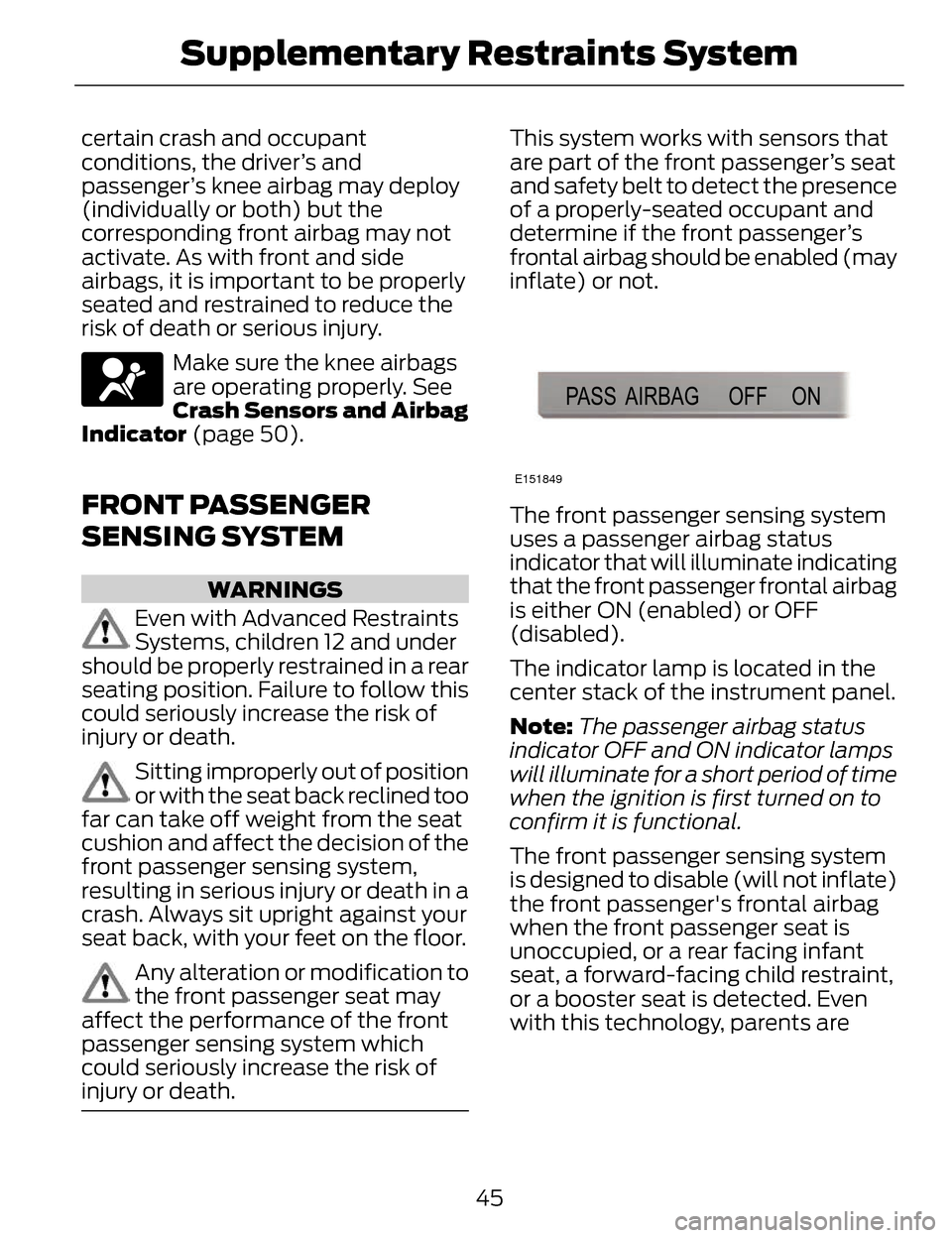
The front passenger sensing system
uses a passenger airbag status
indicator that will illuminate indicating
that the front passenger frontal airbag
is either ON (enabled) or OFF
(disabled).
The indicator lamp is located in the
center stack of the instrument panel.
Note: The passenger airbag status
indicator OFF and ON indicator lamps
will illuminate for a short period of time
when the ignition is first turned on to
confirm it is functional.
The front passenger sensing system
is designed to disable (will not inflate)
the front passenger's frontal airbag
when the front passenger seat is
unoccupied, or a rear facing infant
seat, a forward-facing child restraint,
or a booster seat is detected. Even
with this technology, parents are
45
Supplementary Restraints System
Page 49 of 468
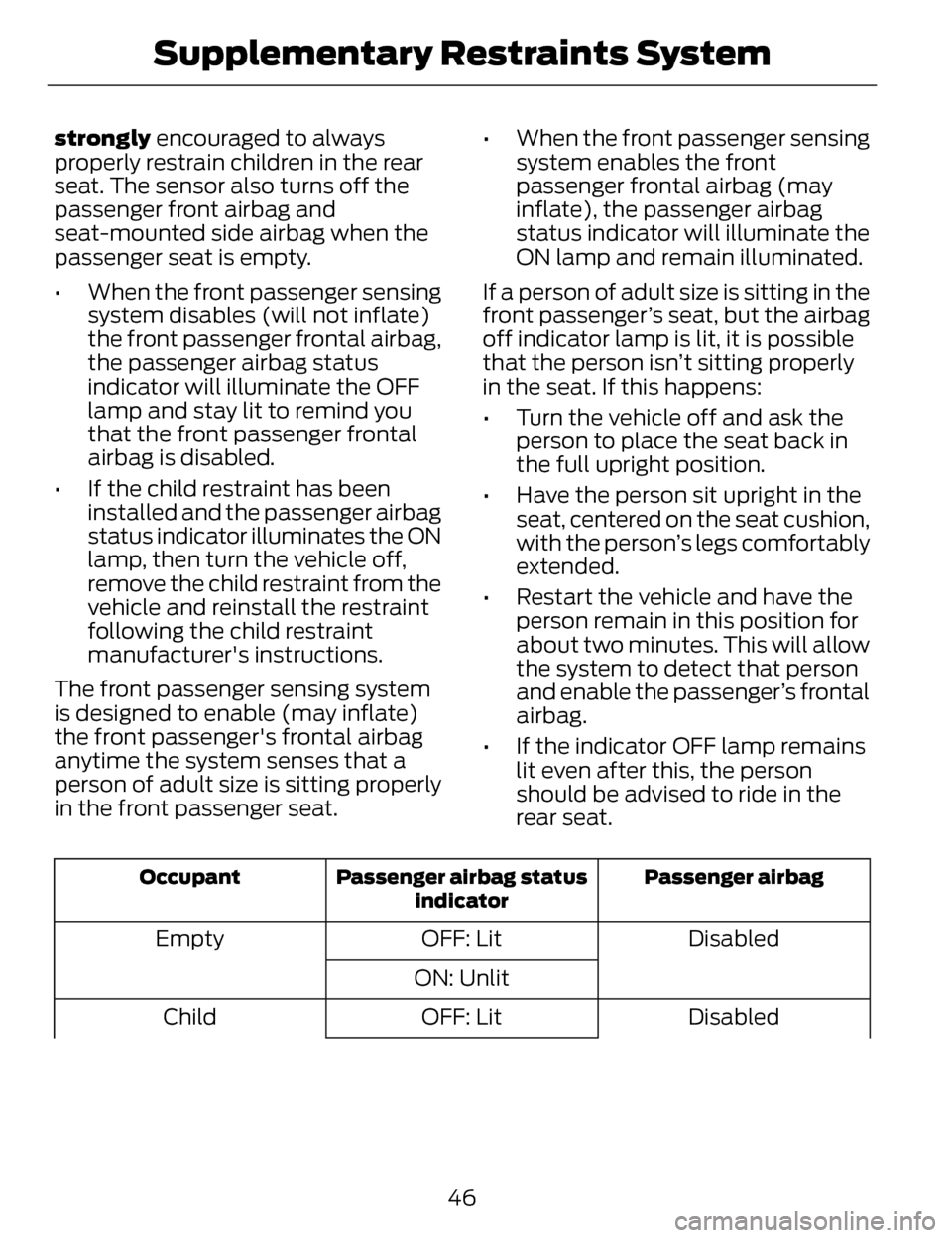
strongly encouraged to always
properly restrain children in the rear
seat. The sensor also turns off the
passenger front airbag and
seat-mounted side airbag when the
passenger seat is empty.
• When the front passenger sensingsystem disables (will not inflate)
the front passenger frontal airbag,
the passenger airbag status
indicator will illuminate the OFF
lamp and stay lit to remind you
that the front passenger frontal
airbag is disabled.
• If the child restraint has been installed and the passenger airbag
status indicator illuminates the ON
lamp, then turn the vehicle off,
remove the child restraint from the
vehicle and reinstall the restraint
following the child restraint
manufacturer's instructions.
The front passenger sensing system
is designed to enable (may inflate)
the front passenger's frontal airbag
anytime the system senses that a
person of adult size is sitting properly
in the front passenger seat. • When the front passenger sensing
system enables the front
passenger frontal airbag (may
inflate), the passenger airbag
status indicator will illuminate the
ON lamp and remain illuminated.
If a person of adult size is sitting in the
front passenger’s seat, but the airbag
off indicator lamp is lit, it is possible
that the person isn’t sitting properly
in the seat. If this happens:
• Turn the vehicle off and ask the person to place the seat back in
the full upright position.
• Have the person sit upright in the seat, centered on the seat cushion,
with the person’s legs comfortably
extended.
• Restart the vehicle and have the person remain in this position for
about two minutes. This will allow
the system to detect that person
and enable the passenger’s frontal
airbag.
• If the indicator OFF lamp remains lit even after this, the person
should be advised to ride in the
rear seat.
Passenger airbag
Passenger airbag status
indicator
Occupant
Disabled
OFF: Lit
Empty
ON: Unlit Disabled
OFF: Lit
Child
46
Supplementary Restraints System
Page 50 of 468
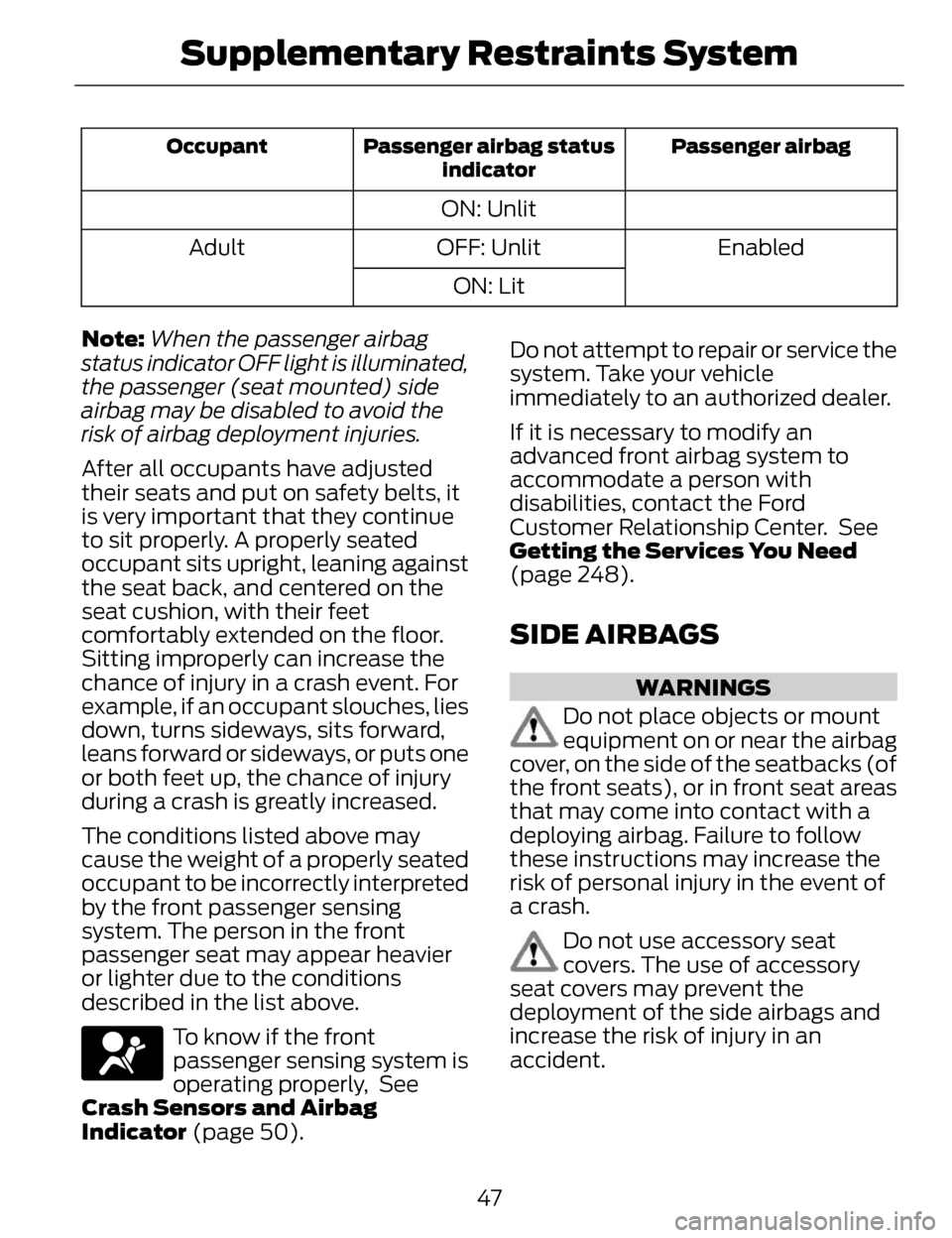
Passenger airbag
Passenger airbag status
indicator
Occupant
ON: Unlit
Enabled
OFF: Unlit
Adult
ON: Lit
Note: When the passenger airbag
status indicator OFF light is illuminated,
the passenger (seat mounted) side
airbag may be disabled to avoid the
risk of airbag deployment injuries.
After all occupants have adjusted
their seats and put on safety belts, it
is very important that they continue
to sit properly. A properly seated
occupant sits upright, leaning against
the seat back, and centered on the
seat cushion, with their feet
comfortably extended on the floor.
Sitting improperly can increase the
chance of injury in a crash event. For
example, if an occupant slouches, lies
down, turns sideways, sits forward,
leans forward or sideways, or puts one
or both feet up, the chance of injury
during a crash is greatly increased.
The conditions listed above may
cause the weight of a properly seated
occupant to be incorrectly interpreted
by the front passenger sensing
system. The person in the front
passenger seat may appear heavier
or lighter due to the conditions
described in the list above.
To know if the front
passenger sensing system is
operating properly, See
Crash Sensors and Airbag
Indicator (page 50). Do not attempt to repair or service the
system. Take your vehicle
immediately to an authorized dealer.
If it is necessary to modify an
advanced front airbag system to
accommodate a person with
disabilities, contact the Ford
Customer Relationship Center. See
Getting the Services You Need
(page 248).
SIDE AIRBAGS
WARNINGS
Do not place objects or mount
equipment on or near the airbag
cover, on the side of the seatbacks (of
the front seats), or in front seat areas
that may come into contact with a
deploying airbag. Failure to follow
these instructions may increase the
risk of personal injury in the event of
a crash.
Do not use accessory seat
covers. The use of accessory
seat covers may prev ent the
deployment of the side airbags and
increase the risk of injury in an
accident.
47
Supplementary Restraints System
Page 101 of 468
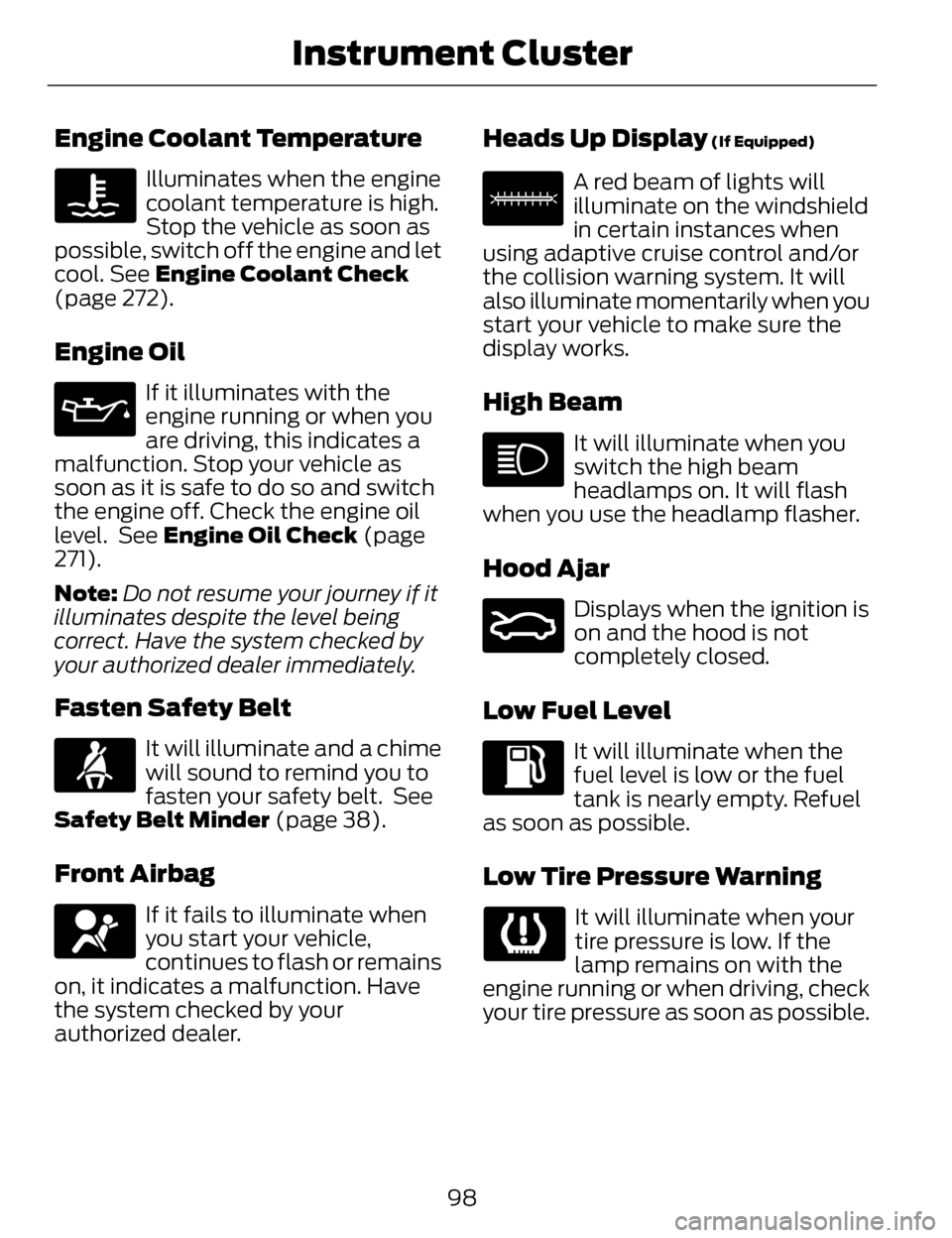
Engine Coolant Temperature
Illuminates when the engine
coolant temperature is high.
Stop the vehicle as soon as
possible, switch off the engine and let
cool. See Engine Coolant Check
(page 272).
Engine Oil
If it illuminates with the
engine running or when you
are driving, this indicates a
malfunction. Stop your vehicle as
soon as it is safe to do so and switch
the engine off. Check the engine oil
level. See Engine Oil Check (page
271).
Note: Do not resume your journey if it
illuminates despite the level being
correct. Have the system checked by
your authorized dealer immediately.
Fasten Safety Belt
It will illuminate and a chime
will sound to remind you to
fasten your safety belt. See
Safety Belt Minder (page 38).
Front Airbag
If it fails to illuminate when
you start your vehicle,
continues to flash or remains
on, it indicates a malfunction. Have
the system checked by your
authorized dealer.
Heads Up Display (If Equipped)
E156133
A red beam of lights will
illuminate on the windshield
in certain instances when
using adaptive cruise control and/or
the collision warning system. It will
also illuminate momentarily when you
start your vehicle to make sure the
display works.
High Beam
It will illuminate when you
switch the high beam
headlamps on. It will flash
when you use the headlamp flasher.
Hood Ajar
E159324
Displays when the ignition is
on and the hood is not
completely closed.
Low Fuel Level
It will illuminate when the
fuel level is low or the fuel
tank is nearly empty. Refuel
as soon as possible.
Low Tire Pressure Warning
It will illuminate when your
tire pressure is low. If the
lamp remains on with the
engine running or when driving, check
your tire pressure as soon as possible.
98
Instrument Cluster
Page 110 of 468
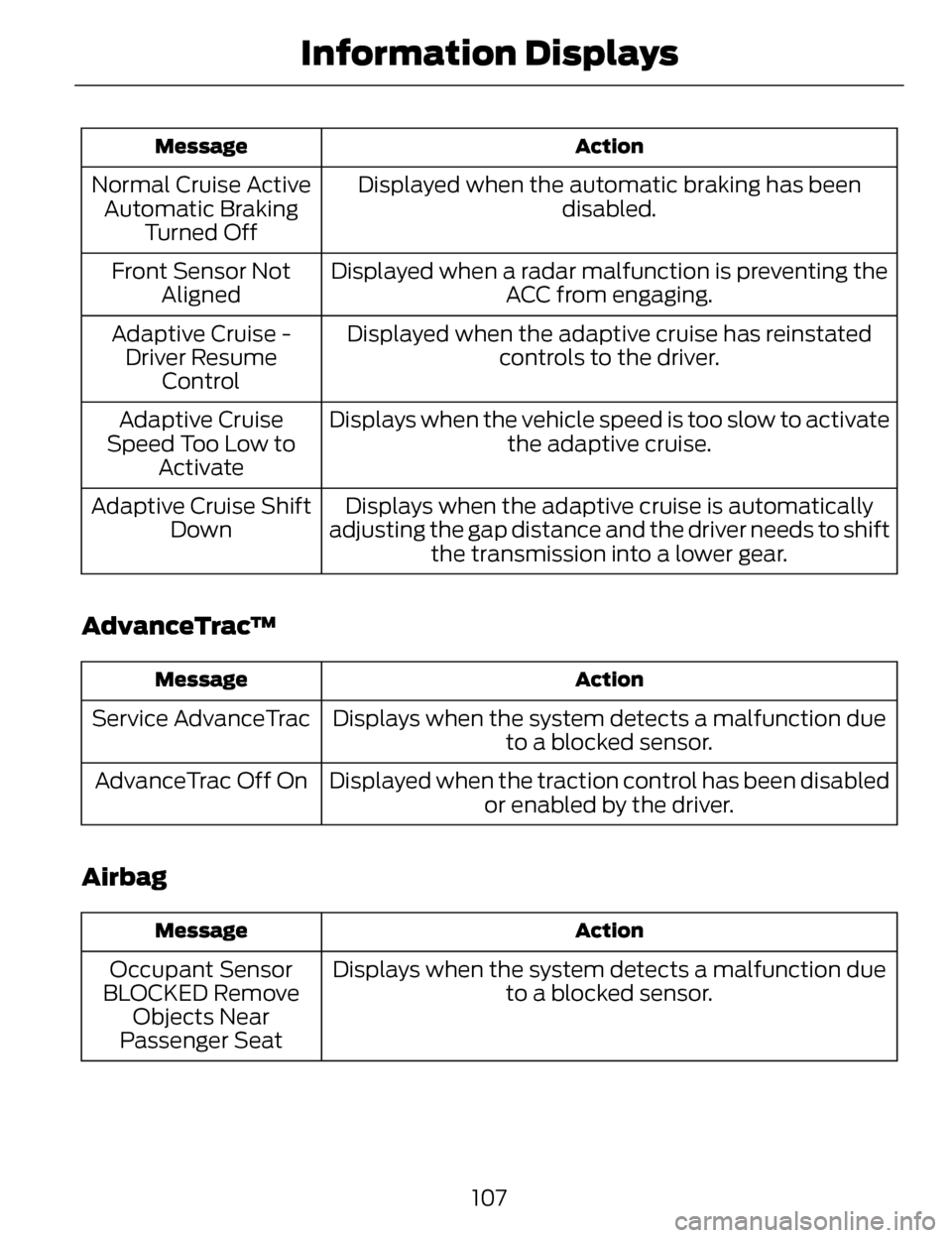
Action
Message
Displayed when the automatic braking has been
disabled.
Normal Cruise Active
Automatic Braking Turned Off
Displayed when a radar malfunction is preventing theACC from engaging.
Front Sensor Not
Aligned
Displayed when the adaptive cruise has reinstatedcontrols to the driver.
Adaptive Cruise -
Driver Resume Control
Displays when the vehicle speed is too slow to activate the adaptive cruise.
Adaptive Cruise
Speed Too Low to Activate
Displays when the adaptive cruise is automatically
adjusting the gap distance and the driver needs to shift the transmission into a lower gear.
Adaptive Cruise Shift
Down
AdvanceTrac™
Action
Message
Displays when the system detects a malfunction due
to a blocked sensor.
Service AdvanceTrac
Displayed when the traction control has been disabledor enabled by the driver.
AdvanceTrac Off On
Airbag
Action
Message
Displays when the system detects a malfunction due
to a blocked sensor.
Occupant Sensor
BLOCKED Remove Objects Near
Passenger Seat
107
Information Displays
Page 250 of 468
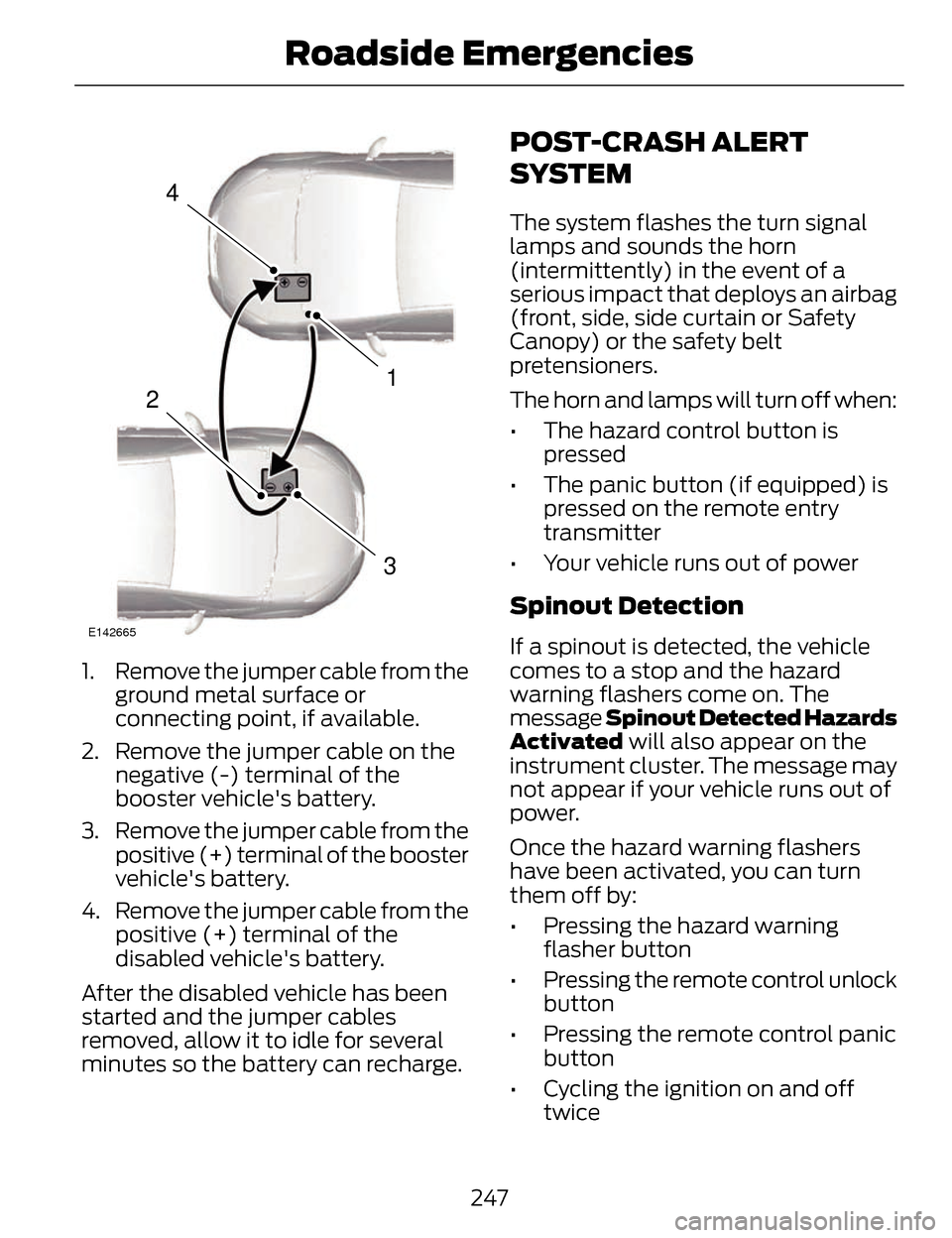
4
1
3
2
E142665
1. Remove the jumper cable from theground metal surface or
connecting point, if available.
2. Remove the jumper cable on the negative (-) terminal of the
booster vehicle's battery.
3. Remove the jumper cable from the positive (+) terminal of the booster
vehicle's battery.
4. Remove the jumper cable from the positive (+) terminal of the
disabled vehicle's battery.
After the disabled vehicle has been
started and the jumper cables
removed, allow it to idle for several
minutes so the battery can recharge.
POST-CRASH ALERT
SYSTEM
The system flashes the turn signal
lamps and sounds the horn
(intermittently) in the event of a
serious impact that deploys an airbag
(front, side, side curtain or Safety
Canopy) or the safety belt
pretensioners.
The horn and lamps will turn off when:
• The hazard control button is pressed
• The panic button (if equipped) is pressed on the remote entry
transmitter
• Your vehicle runs out of power
Spinout Detection
If a spinout is detected, the vehicle
comes to a stop and the hazard
warning flashers come on. The
message Spinout Detected Hazards
Activated will also appear on the
instrument cluster. The message may
not appear if your vehicle runs out of
power.
Once the hazard warning flashers
have been activated, you can turn
them off by:
• Pressing the hazard warning flasher button
• Pressing the remote control unlock button
• Pressing the remote control panic button
• Cycling the ignition on and off twice
247
Roadside Emergencies
Page 295 of 468
CLEANING THE
INSTRUMENT PANEL AND
INSTRUMENT CLUSTER
LENS
WARNING
Do not use chemical solvents or
strong detergents when cleaning
the steering wheel or instrument panel
to avoid contamination of the airbag
system.
Clean the instrument panel and
cluster lens with a clean, damp, white
cotton cloth, then use a clean and dry
white cotton cloth to dry these areas.
• Avoid cleaners or polishes that increase the gloss of the upper
portion of the instrument panel.
The dull finish in this area helps
protect you from undesirable
windshield reflection.
• Be certain to wash or wipe your hands clean if you have been in
contact with certain products such
as insect repellent and suntan
lotion in order to avoid possible
damage to the interior painted
surfaces.
• Do not use household or glass cleaners as these may damage the
finish of the instrument panel,
interior trim and cluster lens.
• Do not allow air fresheners and hand sanitizers to spill onto interior
surfaces. If a spill occurs, wipe off
immediately. Damage may not be
covered by y our warranty. If a staining liquid like coffee or juice
has been spilled on the instrument
panel or on interior trim surfaces,
clean as follows:
1. Wipe up spilled liquid using a
clean, white, cotton cloth.
2. Wipe the surface with a damp, clean, white cotton cloth. For more
thorough cleaning, use a mild soap
and water solution. If the spot
cannot be completely cleaned by
this method, the area may be
cleaned using a commercially
available cleaning product
designed for automotive interiors.
3. If necessary, apply more soap and water solution or cleaning product
to a clean, white, cotton cloth and
press the cloth onto the soiled
area. Allow this to set at room
temperature for 30 minutes.
4. Remove the soaked cloth and if it is not soiled badly, use this cloth
to clean the area by using a
rubbing motion for 60 seconds.
5. Following this, wipe area dry with a clean, white, cotton cloth.
CLEANING LEATHER SEATS
(IF EQUIPPED)
For routine cleaning, wipe the surface
with a soft, damp cloth. For more
thorough cleaning, wipe the surface
with a mild soap and water solution.
Dry the area with a soft cloth. In
Canada, use Motorcraft® Vinyl
Cleaner.
292
Vehicle Care