Tension LINCOLN MKZ 2017 Owners Manual
[x] Cancel search | Manufacturer: LINCOLN, Model Year: 2017, Model line: MKZ, Model: LINCOLN MKZ 2017Pages: 564, PDF Size: 5.54 MB
Page 4 of 564
Introduction
About This Manual............................................7
Symbols Glossary
..............................................7
Data Recording
..................................................9
California Proposition 65
...............................12
Perchlorate........................................................12
Lincoln Automotive Financial Services
.........................................................12
Replacement Parts Recommendation........13
Special Notices
.................................................13
Mobile Communications Equipment
...........14
Export Unique Options...................................14
Environment
Protecting the Environment..........................16
Child Safety
General Information
........................................17
Installing Child Restraints
..............................19
Booster Seats
..................................................28
Child Restraint Positioning
............................31
Child Safety Locks..........................................32 Seatbelts
Principle of Operation....................................34
Fastening the Seatbelts................................35
Seatbelt Height Adjustment.........................38
Seatbelt Warning Lamp and Indicator
Chime
............................................................39
Seatbelt Reminder..........................................40
Child Restraint and Seatbelt Maintenance.................................................41
Seatbelt Extension
.........................................42
Personal Safety System ™
Personal Safety System ™
..............................43
Supplementary Restraints System
Principle of Operation
....................................44
Driver and Passenger Airbags....................45
Front Passenger Sensing System...............47
Side Airbags
.....................................................49
Driver and Passenger Knee Airbags.........50
Safety Canopy™................................................51
Crash Sensors and Airbag Indicator
..........52 Airbag Disposal
...............................................53
Keys and Remote Controls
General Information on Radio Frequencies.................................................54
Remote Control...............................................55
Replacing a Lost Key or Remote Control..........................................................59
MyKey™
Principle of Operation...................................60
Creating a MyKey............................................61
Clearing All MyKeys
.......................................62
Checking MyKey System Status.................62
Using MyKey With Remote Start Systems.........................................................63
MyKey Troubleshooting
................................63
Locks
Locking and Unlocking
.................................65
Keyless Entry.....................................................71
Interior Luggage Compartment Release..........................................................73
1
MKZ (CC9) Canada/United States of America, enUSA, First Printing Table of Contents
Page 15 of 564
Additionally, when you connect to Traffic,
Directions and Information (if equipped,
U.S. only), the service uses GPS technology
and advanced vehicle sensors to collect
the vehicle
’s current location, travel
direction, and speed (“vehicle travel
information ”), only to help provide you with
the directions, traffic reports, or business
searches that you request. If you do not
want Ford or its vendors to receive this
information, do not activate the service. For
more information, see Traffic, Directions
and Information, Terms and Conditions.
See SYNC™ 3 (page 390).
CALIFORNIA PROPOSITION 65 WARNINGS
Some constituents of engine exhaust,
certain vehicle components, certain
fluids contained in vehicles and certain
products of component wear contain or emit
chemicals known to the State of California
to cause cancer and birth defects or other
reproductive harm. WARNINGS
Battery posts, terminals and related
accessories contain lead and lead
compounds, chemicals known to the State
of California to cause cancer and
reproductive harm. Batteries also contain
other chemicals known to the State of
California to cause cancer. Wash your hands
after handling. PERCHLORATE
Certain components in your vehicle such as
airbag modules, seatbelt pretensioners and
remote control batteries may contain
perchlorate material. Special handling may
apply for service or vehicle end of life
disposal.
For more information visit: Web Address
www.dtsc.ca.gov/hazard- ouswaste/perchlorate
LINCOLN AUTOMOTIVE
FINANCIAL SERVICES
Lincoln Automotive Financial Services offers
a full range of financing and lease plans to
help you acquire your vehicle. We are
dedicated to providing answers, information
and a truly extraordinary experience.
Use the options below to contact us with
questions about your account or financing
and we will respond promptly: Web Address
www.LincolnAFS.com
Phone: 1-888-498-8801
Mail: Lincoln Automotive Financial Services
12
MKZ (CC9) Canada/United States of America, enUSA, First Printing Introduction
Page 37 of 564
PRINCIPLE OF OPERATION
WARNINGS
Always drive and ride with your
seatback upright and the lap belt snug
and low across the hips. To reduce the risk of injury, make sure
children sit where they can be properly
restrained. Never let a passenger hold a child on
his or her lap while the vehicle is
moving. The passenger cannot protect the
child from injury in a crash. All occupants of your vehicle, including
the driver, should always properly wear
their seatbelts, even when an airbag
supplemental restraint system is provided.
Failure to properly wear your seatbelt could
seriously increase the risk of injury or death. WARNINGS
It is extremely dangerous to ride in a
cargo area, inside or outside of a
vehicle. In a crash, people riding in these
areas are more likely to be seriously injured
or killed. Do not allow people to ride in any
area of your vehicle that is not equipped with
seats and seatbelts. Be sure everyone in
your vehicle is in a seat and using a seatbelt
properly. In a rollover crash, an unbelted person
is significantly more likely to die than
a person wearing a seatbelt. Each seating position in your vehicle
has a specific seatbelt assembly which
is made up of one buckle and one tongue
that are designed to be used as a pair. 1) Use
the shoulder belt on the outside shoulder
only. Never wear the shoulder belt under the
arm. 2) Never swing the seatbelt around your
neck over the inside shoulder. 3) Never use
a single belt for more than one person. Airbags can kill or injure a child in a
child restraint. Properly restrain
children 12 and under in the rear seat
whenever possible. WARNINGS
Seatbelts and seats can become hot
in a vehicle that has been closed up in
sunny weather. They could burn a small child.
Check seat covers and buckles before you
place a child anywhere near them. Front and rear seat occupants,
including pregnant women, should
wear seatbelts for optimum protection in an
accident. All seating positions in your vehicle have lap
and shoulder seatbelts. All occupants of the
vehicle should always properly wear their
seatbelts, even when an airbag supplemental
restraint system is provided.
The seatbelt system consists of:
•
Lap and shoulder seatbelts.
• Shoulder seatbelt with automatic locking
mode, (except driver seatbelt).
• Height adjuster at the front outboard
seating positions.
• Seatbelt pretensioner at the front
outboard seating positions.
34
MKZ (CC9) Canada/United States of America, enUSA, First Printing Seatbelts
Page 38 of 564
•
Seatbelt warning light and chime. •
Crash sensors and monitoring system
with readiness indicator.
The seatbelt pretensioners at the front
seating positions are designed to tighten the
seatbelts when activated. In frontal and
near-frontal crashes, the seatbelt
pretensioners may be activated alone or, if
the crash is of sufficient severity, together
with the front airbags. The pretensioners may
also activate when the Safety Canopy is
deployed.
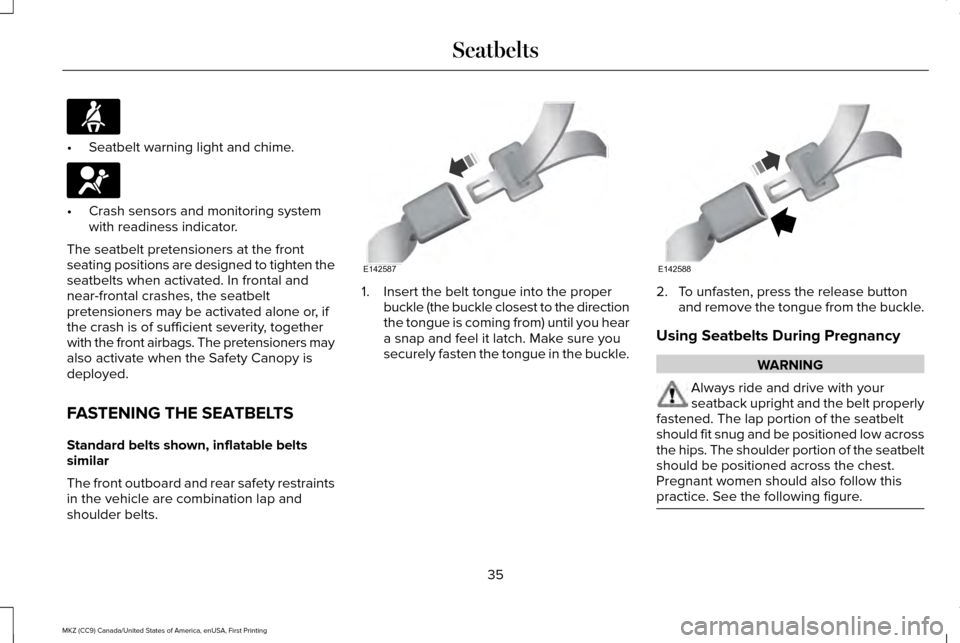
FASTENING THE SEATBELTS
Standard belts shown, inflatable belts
similar
The front outboard and rear safety restraints
in the vehicle are combination lap and
shoulder belts. 1. Insert the belt tongue into the proper
buckle (the buckle closest to the direction
the tongue is coming from) until you hear
a snap and feel it latch. Make sure you
securely fasten the tongue in the buckle. 2. To unfasten, press the release button
and remove the tongue from the buckle.
Using Seatbelts During Pregnancy WARNING
Always ride and drive with your
seatback upright and the belt properly
fastened. The lap portion of the seatbelt
should fit snug and be positioned low across
the hips. The shoulder portion of the seatbelt
should be positioned across the chest.
Pregnant women should also follow this
practice. See the following figure. 35
MKZ (CC9) Canada/United States of America, enUSA, First Printing Seatbelts E142587 E142588
Page 45 of 564
We recommend that all safety belt
assemblies in use in vehicles involved in a
crash be replaced. However, if the crash was
minor and an authorized dealer finds that the
belts do not show damage and continue to
operate properly, they do not need to be
replaced. Safety belt assemblies not in use
during a crash should also be inspected and
replaced if either damage or improper
operation is noted.
Properly care for safety belts. See Cleaning
the Interior (page 323).
SEATBELT EXTENSION WARNINGS
Persons who fit into the vehicle's
seatbelt should not use an extension.
Unnecessary use could result in serious
personal injury in the event of a crash. WARNINGS
Only use extensions provided free of
charge by Lincoln Motor Company
dealers. The dealer will provide an extension
designed specifically for this vehicle, model
year and seating position. The use of an
extension intended for another vehicle,
model year or seating position may not offer
you the full protection of your vehicle ’s
seatbelt restraint system. Never use seatbelt extensions to install
child restraints.
Do not use a seatbelt extension with
an inflatable seatbelt.
Do not use extensions to change the
fit of the belt across the torso, over the
lap or to make the seatbelt buckle easier to
reach. If, because of body size or driving position,
it is not possible to properly fasten the
seatbelt over your lap and shoulder, an
extension that is compatible with the
seatbelts is available free of charge from
Lincoln Motor Company dealers. Only Lincolnseatbelt extensions made by the same
company which made the original equipment
seatbelts, should be used with Lincoln
seatbelts. Ask your authorized dealer if your
extension is compatible with your Lincoln
vehicle restraint system.
42
MKZ (CC9) Canada/United States of America, enUSA, First Printing Seatbelts
Page 46 of 564
The Personal Safety System provides an
improved overall level of frontal crash
protection to front seat occupants and is
designed to help further reduce the risk of
airbag-related injuries. The system is able to
analyze different occupant conditions and
crash severity before activating the
appropriate safety devices to help better
protect a range of occupants in a variety of
frontal crash situations.
The Vehicle Personal Safety System consists
of:
•
Driver and passenger dual-stage airbag
supplemental restraints.
• Front seat outboard safety belts with
pretensioners, energy management
retractors and safety belt usage sensors.
• Driver seat position sensor.
• Front passenger sensing system.
• Passenger airbag off and on indicator
lamp.
• Front crash severity sensors.
• Restraints control module with impact
and safing sensors. •
Restraint system warning light and
backup tone.
• The electrical wiring for the airbags, crash
sensors, safety belt pretensioners, front
safety belt usage sensors, driver seat
position sensor, front passenger sensing
system and indicator lights.
How Does the Personal Safety System
Work?
The Personal Safety System can adapt the
deployment strategy of the safety devices
according to crash severity and occupant
conditions. A collection of crash and
occupant sensors provides information to
the restraints control module. During a crash,
the restraints control module may deploy the
safety belt pretensioners, one or both stages
of the dual-stage airbags based on crash
severity and occupant conditions.
43
MKZ (CC9) Canada/United States of America, enUSA, First Printing Personal Safety System
™
Page 56 of 564
The seatbelt pretensioners and the front
airbag supplemental restraint system are
designed to activate when the vehicle
sustains frontal deceleration sufficient to
cause the restraints control module to deploy
a safety device.
The fact that the seatbelt pretensioners or
front airbags did not activate for both front
seat occupants in a crash does not mean
that something is wrong with the system.
Rather, it means the restraints control module
determined the accident conditions (crash
severity, belt usage) were not appropriate to
activate these safety devices.
•
The design of the front airbags is to
activate only in frontal and near-frontal
crashes (not rollovers, side impacts or
rear impacts) unless the crash causes
sufficient frontal deceleration.
• The seatbelt pretensioners and rear
inflatable seatbelts are designed to
activate in frontal, near-frontal and side
crashes and rollovers.
• The knee airbag(s) may deploy based on
crash severity and occupant conditions. •
The design of the side airbags is to inflate
in certain side impact crashes. Side
airbags may activate in other types of
crashes if the vehicle experiences
sufficient sideways motion or
deformation.
• The design of the Safety Canopy is to
inflate in certain side impact crashes or
rollover events. The Safety Canopy may
activate in other types of crashes if the
vehicle experiences sufficient sideways
motion or deformation, or a certain
likelihood of rollover.
AIRBAG DISPOSAL
Contact your authorized dealer as soon as
possible. Airbags must be disposed of by
qualified personnel.
53
MKZ (CC9) Canada/United States of America, enUSA, First Printing Supplementary Restraints System
Page 61 of 564
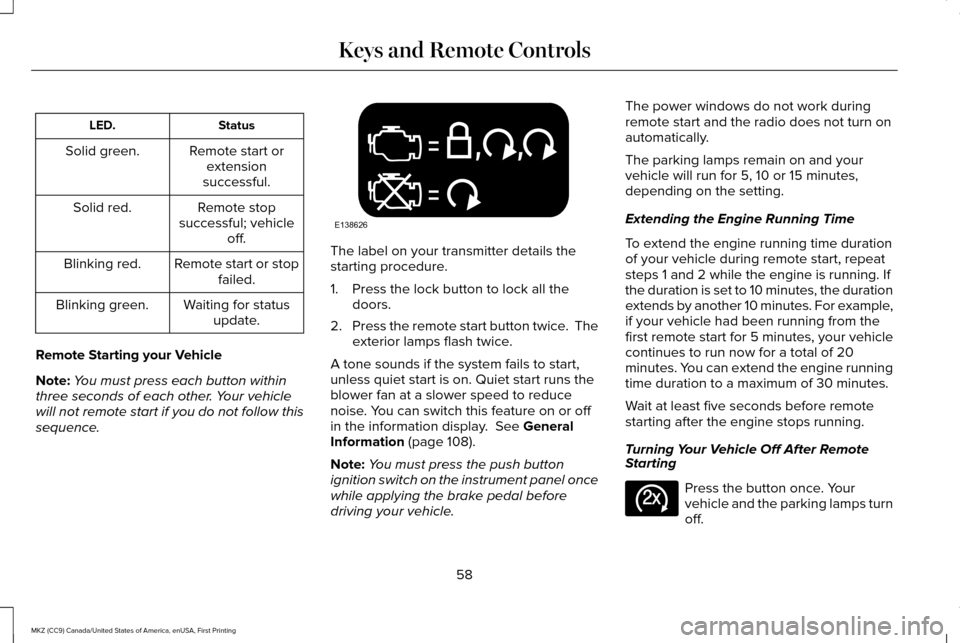
Status
LED.
Remote start orextension
successful.
Solid green.
Remote stop
successful; vehicle off.
Solid red.
Remote start or stopfailed.
Blinking red.
Waiting for statusupdate.
Blinking green.
Remote Starting your Vehicle
Note: You must press each button within
three seconds of each other. Your vehicle
will not remote start if you do not follow this
sequence. The label on your transmitter details the
starting procedure.
1. Press the lock button to lock all the
doors.
2. Press the remote start button twice. The
exterior lamps flash twice.
A tone sounds if the system fails to start,
unless quiet start is on. Quiet start runs the
blower fan at a slower speed to reduce
noise. You can switch this feature on or off
in the information display. See General
Information (page 108).
Note: You must press the push button
ignition switch on the instrument panel once
while applying the brake pedal before
driving your vehicle. The power windows do not work during
remote start and the radio does not turn on
automatically.
The parking lamps remain on and your
vehicle will run for 5, 10 or 15 minutes,
depending on the setting.
Extending the Engine Running Time
To extend the engine running time duration
of your vehicle during remote start, repeat
steps 1 and 2 while the engine is running. If
the duration is set to 10 minutes, the duration
extends by another 10 minutes. For example,
if your vehicle had been running from the
first remote start for 5 minutes, your vehicle
continues to run now for a total of 20
minutes. You can extend the engine running
time duration to a maximum of 30 minutes.
Wait at least five seconds before remote
starting after the engine stops running.
Turning Your Vehicle Off After Remote
Starting
Press the button once. Your
vehicle and the parking lamps turn
off.
58
MKZ (CC9) Canada/United States of America, enUSA, First Printing Keys and Remote ControlsE138626 E138625
Page 159 of 564
12 Volt DC Power Point
WARNINGS
Do not plug optional electrical
accessories into the cigar lighter
socket. Incorrect use of the cigar lighter can
cause damage not covered by the vehicle
warranty, and can result in fire or serious
injury. Do not use a power point for operating
a cigar lighter. Incorrect use of the
power points can cause damage not covered
by the vehicle warranty, and can result in fire
or serious injury. Note:
When you switch the ignition on, you
can use the socket to power 12 volt
appliances with a maximum current rating
of 15 amps.
If the power supply does not work after you
switch the ignition off, switch the ignition on.
Note: Do not hang any accessory from the
accessory plug.
Note: Do not use the power point over the
vehicle capacity of 12 volt DC 180 watts or
a fuse may blow. Note:
Always keep the power point caps
closed when not in use.
Do not insert objects other than an accessory
plug into the power point. This will damage
the power point and blow the fuse.
Run the vehicle for full capacity use of the
power point.
To prevent the battery from running out of
charge:
• Do not use the power point longer than
necessary when the vehicle is not
running.
• Do not leave devices plugged in
overnight or when you park your vehicle
for extended periods.
Locations
Power points may be in the following
locations:
• On the front of the center console.
• Inside the center console.
• On the rear of the center console. 110 Volt AC Power Point (If Equipped) WARNING
Do not keep electrical devices plugged
in the power point whenever the
device is not in use. Do not use any
extension cord with the 110 volt AC power
point, since it will defeat the safety protection
design. Doing so may cause the power point
to overload due to powering multiple devices
that can reach beyond the 150 watt load limit
and could result in fire or serious injury. Note:
The power point will turn off when the
ignition is switched off or the battery voltage
drops below 11 volts.
156
MKZ (CC9) Canada/United States of America, enUSA, First Printing Auxiliary Power Points
Page 166 of 564
ENGINE BLOCK HEATER (If Equipped)
WARNINGS
Failure to follow engine block heater
instructions could result in property
damage or serious personal injury. Do not use your heater with
ungrounded electrical systems or
two-pronged adapters. There is a risk of
electrical shock. Do not fully close the hood, or allow it
to drop under its own weight when
using the engine block heater. This could
damage the power cable and may cause an
electrical short resulting in fire, injury and
property damage. Note:
The heater is most effective when
outdoor temperatures are below 0°F (-18°C).
The heater acts as a starting aid by warming
the engine coolant. This allows the climate
control system to respond quickly. The
equipment includes a heater element
(installed in the engine block) and a wire
harness. You can connect the system to a
grounded 120-volt AC electrical source. We recommend that you do the following for
a safe and correct operation:
•
Use a 16-gauge outdoor extension cord
that is product certified by Underwriter’ s
Laboratory (UL) or Canadian Standards
Association (CSA). This extension cord
must be suitable for use outdoors, in cold
temperatures, and be clearly marked
Suitable for Use with Outdoor
Appliances. Do not use an indoor
extension cord outdoors. This could
result in an electric shock or become a
fire hazard.
• Use as short an extension cord as
possible.
• Do not use multiple extension cords.
• Make sure that when in operation, the
extension cord plug and heater cord plug
connections are free and clear of water.
This could cause an electric shock or fire.
• Make sure your vehicle is parked in a
clean area, clear of combustibles.
• Make sure the heater, heater cord and
extension cord are firmly connected. •
Check for heat anywhere in the electrical
hookup once the system has been
operating for approximately 30 minutes.
• Make sure the system is unplugged and
properly stowed before starting and
driving your vehicle. Make sure the
protective cover seals the prongs of the
block heater cord plug when not in use.
• Make sure the heater system is checked
for proper operation before winter.
Using the Engine Block Heater
Make sure the receptacle terminals are clean
and dry prior to use. Clean them with a dry
cloth if necessary.
The heater uses 0.4 to 1.0 kilowatt-hours of
energy per hour of use. The system does not
have a thermostat. It achieves maximum
temperature after approximately three hours
of operation. Using the heater longer than
three hours does not improve system
performance and unnecessarily uses
electricity.
163
MKZ (CC9) Canada/United States of America, enUSA, First Printing Starting and Stopping the Engine