height LINCOLN MKZ 2018 Owners Manual
[x] Cancel search | Manufacturer: LINCOLN, Model Year: 2018, Model line: MKZ, Model: LINCOLN MKZ 2018Pages: 595, PDF Size: 5.06 MB
Page 4 of 595
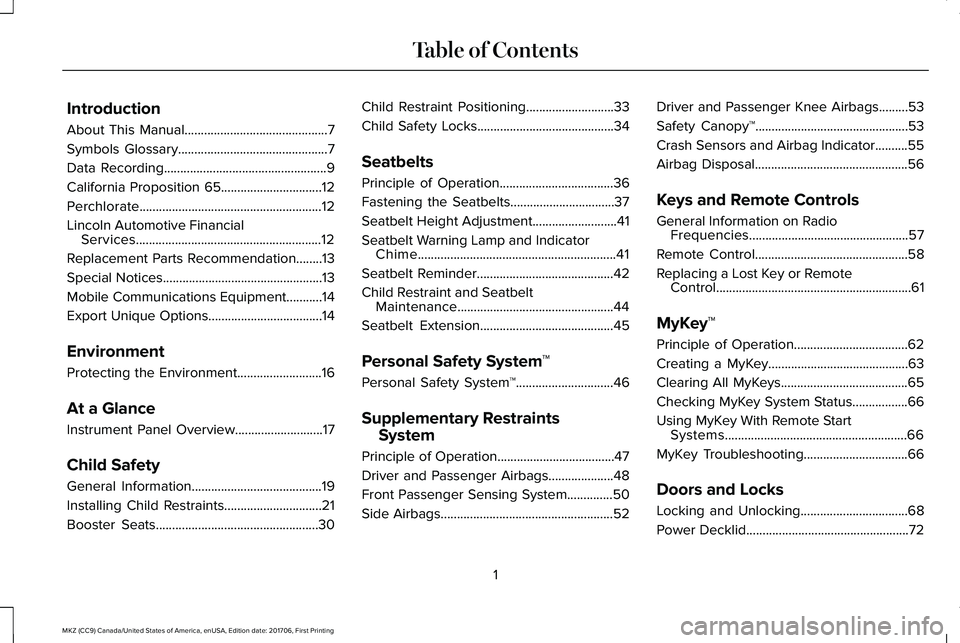
Introduction
About This Manual............................................7
Symbols Glossary..............................................7
Data Recording..................................................9
California Proposition 65...............................12
Perchlorate........................................................12
Lincoln Automotive FinancialServices.........................................................12
Replacement Parts Recommendation........13
Special Notices.................................................13
Mobile Communications Equipment...........14
Export Unique Options...................................14
Environment
Protecting the Environment..........................16
At a Glance
Instrument Panel Overview...........................17
Child Safety
General Information........................................19
Installing Child Restraints..............................21
Booster Seats..................................................30
Child Restraint Positioning...........................33
Child Safety Locks..........................................34
Seatbelts
Principle of Operation...................................36
Fastening the Seatbelts................................37
Seatbelt Height Adjustment..........................41
Seatbelt Warning Lamp and IndicatorChime.............................................................41
Seatbelt Reminder..........................................42
Child Restraint and SeatbeltMaintenance................................................44
Seatbelt Extension.........................................45
Personal Safety System™
Personal Safety System™..............................46
Supplementary Restraints
System
Principle of Operation....................................47
Driver and Passenger Airbags....................48
Front Passenger Sensing System..............50
Side Airbags.....................................................52
Driver and Passenger Knee Airbags.........53
Safety Canopy™...............................................53
Crash Sensors and Airbag Indicator..........55
Airbag Disposal...............................................56
Keys and Remote Controls
General Information on RadioFrequencies.................................................57
Remote Control...............................................58
Replacing a Lost Key or RemoteControl............................................................61
MyKey™
Principle of Operation...................................62
Creating a MyKey...........................................63
Clearing All MyKeys.......................................65
Checking MyKey System Status.................66
Using MyKey With Remote StartSystems........................................................66
MyKey Troubleshooting................................66
Doors and Locks
Locking and Unlocking.................................68
Power Decklid..................................................72
1
MKZ (CC9) Canada/United States of America, enUSA, Edition date: 201706, First Printing
Table of Contents
Page 22 of 595
GENERAL INFORMATION
See the following sections for directions onhow to properly use safety restraints forchildren.
WARNINGS
Always make sure your child is securedproperly in a device that is appropriatefor their height, age and weight. Child safetyrestraints must be bought separately fromyour vehicle. Failure to follow theseinstructions and guidelines may result in anincreased risk of serious injury or death toyour child.
WARNINGS
All children are shaped differently. TheNational Highway Traffic SafetyAdministration and other safetyorganizations, base their recommendationsfor child restraints on probable child height,age and weight thresholds, or on theminimum requirements of the law. Werecommend that you check with a NHTSACertified Child Passenger Safety Technician(CPST) to make sure that you properly installthe child restraint in your vehicle and thatyou consult your pediatrician to make sureyou have a child restraint appropriate foryour child. To locate a child restraint fittingstation and CPST, contact NHTSA toll freeat 1-888-327-4236 or go to
WARNINGS
www.nhtsa.dot.gov. In Canada, contactTransport Canada toll free at 1-800-333-0371or go to www.tc.gc.ca to find a Child Car SeatClinic in your area. Failure to properly restrainchildren in child restraints made especiallyfor their height, age and weight, may resultin an increased risk of serious injury or deathto your child.
On hot days, the temperature insidethe vehicle can rise very quickly.Exposure of people or animals to these hightemperatures for even a short time can causedeath or serious heat related injuries,including brain damage. Small children areparticularly at risk.
19
MKZ (CC9) Canada/United States of America, enUSA, Edition date: 201706, First Printing
Child Safety
Page 23 of 595
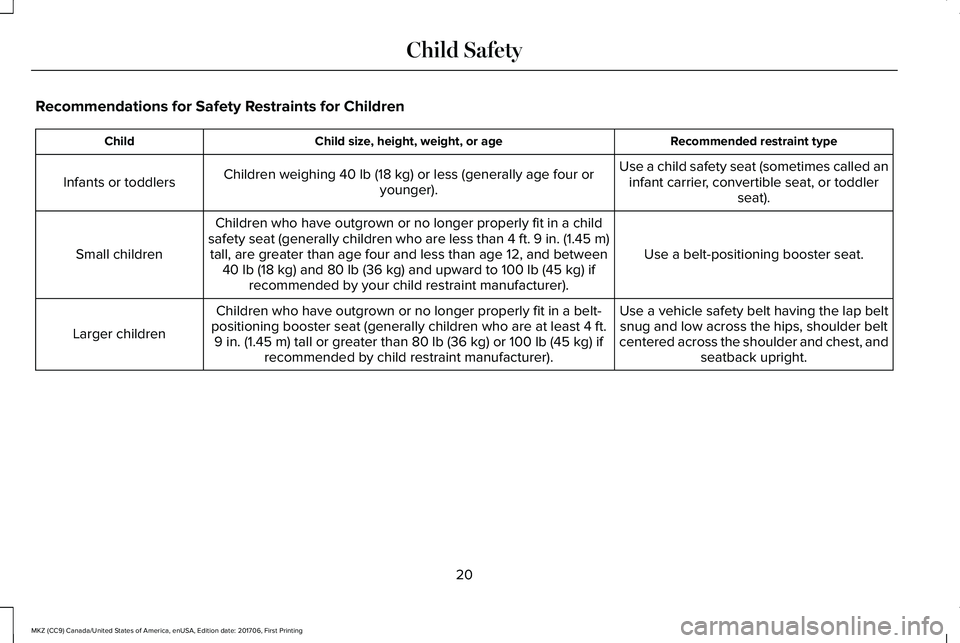
Recommendations for Safety Restraints for Children
Recommended restraint typeChild size, height, weight, or ageChild
Use a child safety seat (sometimes called aninfant carrier, convertible seat, or toddlerseat).
Children weighing 40 lb (18 kg) or less (generally age four oryounger).Infants or toddlers
Use a belt-positioning booster seat.
Children who have outgrown or no longer properly fit in a childsafety seat (generally children who are less than 4 ft. 9 in. (1.45 m)tall, are greater than age four and less than age 12, and between40 lb (18 kg) and 80 lb (36 kg) and upward to 100 lb (45 kg) ifrecommended by your child restraint manufacturer).
Small children
Use a vehicle safety belt having the lap beltsnug and low across the hips, shoulder beltcentered across the shoulder and chest, andseatback upright.
Children who have outgrown or no longer properly fit in a belt-positioning booster seat (generally children who are at least 4 ft.9 in. (1.45 m) tall or greater than 80 lb (36 kg) or 100 lb (45 kg) ifrecommended by child restraint manufacturer).
Larger children
20
MKZ (CC9) Canada/United States of America, enUSA, Edition date: 201706, First Printing
Child Safety
Page 24 of 595
•You are required by law to properly usesafety seats for infants and toddlers inthe United States and Canada.
•Many states and provinces require thatsmall children use approved boosterseats until they reach age eight, a heightof 4 feet 9 inches (1.45 meters) tall, or80 lb (36 kg). Check your local and stateor provincial laws for specificrequirements about the safety of childrenin your vehicle.
•When possible, always properly restrainchildren 12 years of age and under in arear seating position of your vehicle.Accident statistics suggest that childrenare safer when properly restrained in therear seating positions than in a frontseating position. See Front PassengerSensing System (page 50).
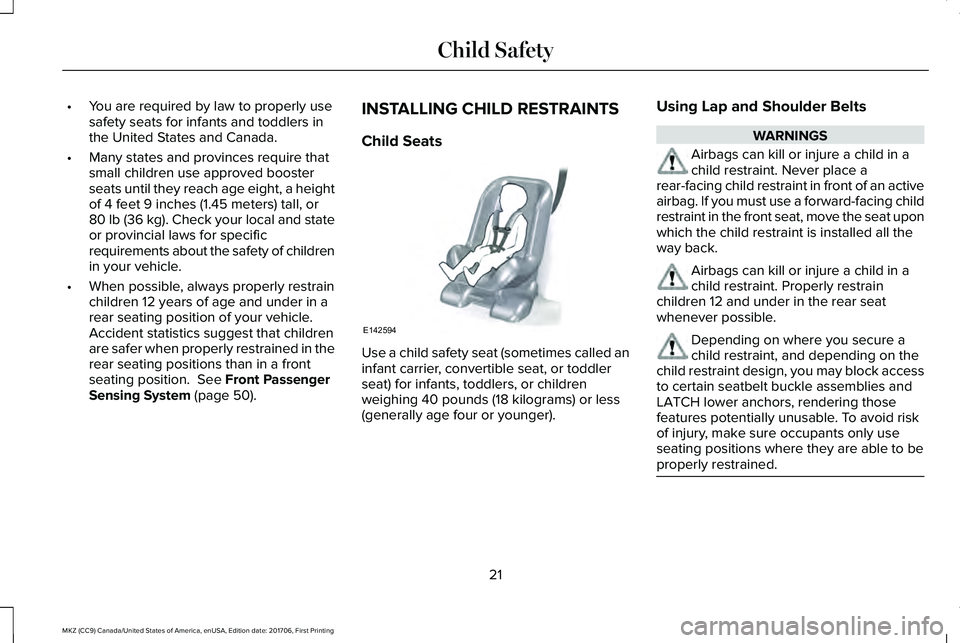
INSTALLING CHILD RESTRAINTS
Child Seats
Use a child safety seat (sometimes called aninfant carrier, convertible seat, or toddlerseat) for infants, toddlers, or childrenweighing 40 pounds (18 kilograms) or less(generally age four or younger).
Using Lap and Shoulder Belts
WARNINGS
Airbags can kill or injure a child in achild restraint. Never place arear-facing child restraint in front of an activeairbag. If you must use a forward-facing childrestraint in the front seat, move the seat uponwhich the child restraint is installed all theway back.
Airbags can kill or injure a child in achild restraint. Properly restrainchildren 12 and under in the rear seatwhenever possible.
Depending on where you secure achild restraint, and depending on thechild restraint design, you may block accessto certain seatbelt buckle assemblies andLATCH lower anchors, rendering thosefeatures potentially unusable. To avoid riskof injury, make sure occupants only useseating positions where they are able to beproperly restrained.
21
MKZ (CC9) Canada/United States of America, enUSA, Edition date: 201706, First Printing
Child SafetyE142594
Page 33 of 595
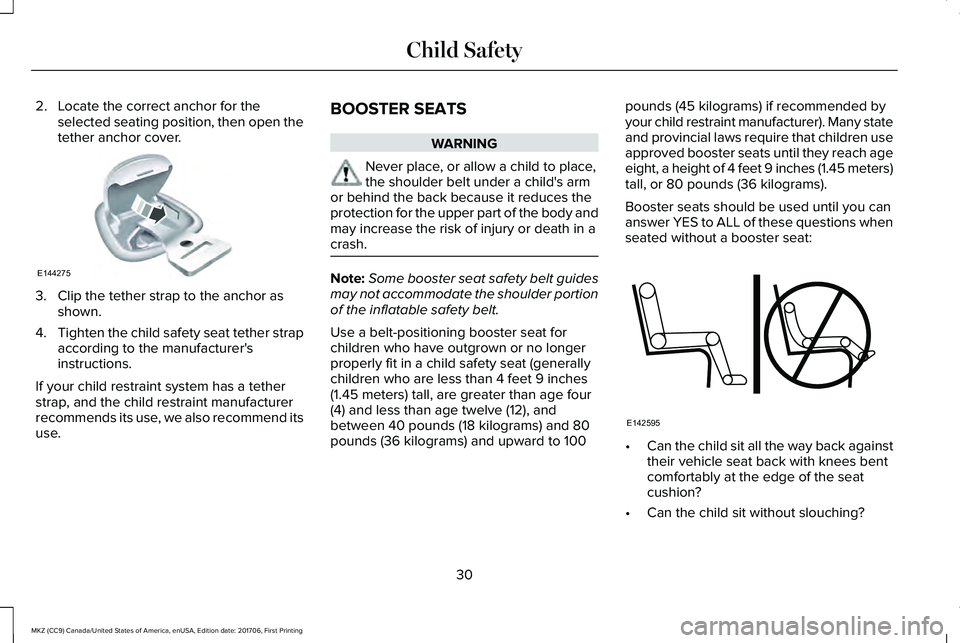
2. Locate the correct anchor for theselected seating position, then open thetether anchor cover.
3. Clip the tether strap to the anchor asshown.
4.Tighten the child safety seat tether strapaccording to the manufacturer'sinstructions.
If your child restraint system has a tetherstrap, and the child restraint manufacturerrecommends its use, we also recommend itsuse.
BOOSTER SEATS
WARNING
Never place, or allow a child to place,the shoulder belt under a child's armor behind the back because it reduces theprotection for the upper part of the body andmay increase the risk of injury or death in acrash.
Note:Some booster seat safety belt guidesmay not accommodate the shoulder portionof the inflatable safety belt.
Use a belt-positioning booster seat forchildren who have outgrown or no longerproperly fit in a child safety seat (generallychildren who are less than 4 feet 9 inches(1.45 meters) tall, are greater than age four(4) and less than age twelve (12), andbetween 40 pounds (18 kilograms) and 80pounds (36 kilograms) and upward to 100
pounds (45 kilograms) if recommended byyour child restraint manufacturer). Many stateand provincial laws require that children useapproved booster seats until they reach ageeight, a height of 4 feet 9 inches (1.45 meters)tall, or 80 pounds (36 kilograms).
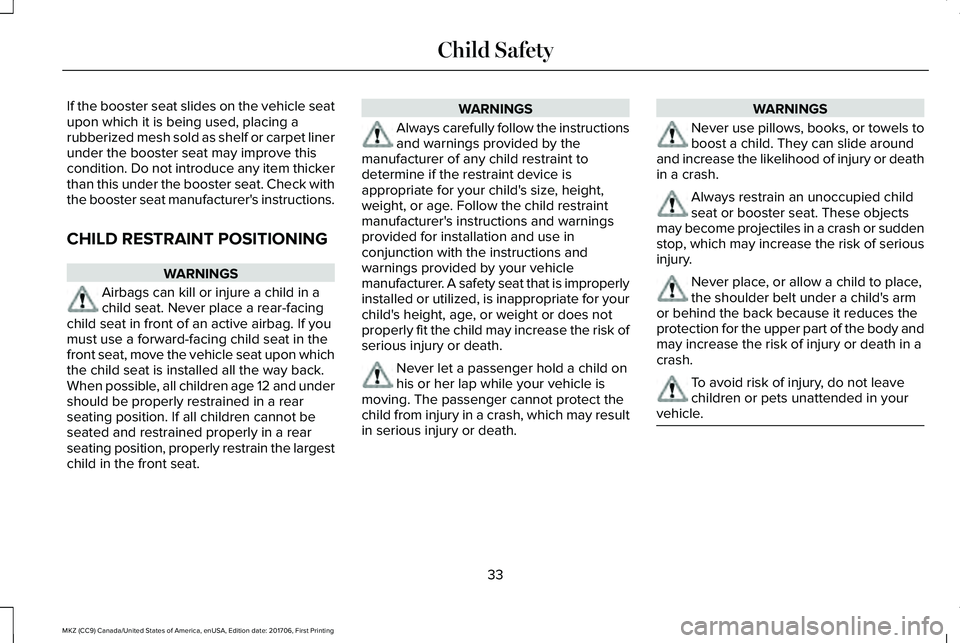
Booster seats should be used until you cananswer YES to ALL of these questions whenseated without a booster seat:
•Can the child sit all the way back againsttheir vehicle seat back with knees bentcomfortably at the edge of the seatcushion?
•Can the child sit without slouching?
30
MKZ (CC9) Canada/United States of America, enUSA, Edition date: 201706, First Printing
Child SafetyE144275 E142595
Page 36 of 595
If the booster seat slides on the vehicle seatupon which it is being used, placing arubberized mesh sold as shelf or carpet linerunder the booster seat may improve thiscondition. Do not introduce any item thickerthan this under the booster seat. Check withthe booster seat manufacturer's instructions.
CHILD RESTRAINT POSITIONING
WARNINGS
Airbags can kill or injure a child in achild seat. Never place a rear-facingchild seat in front of an active airbag. If youmust use a forward-facing child seat in thefront seat, move the vehicle seat upon whichthe child seat is installed all the way back.When possible, all children age 12 and undershould be properly restrained in a rearseating position. If all children cannot beseated and restrained properly in a rearseating position, properly restrain the largestchild in the front seat.
WARNINGS
Always carefully follow the instructionsand warnings provided by themanufacturer of any child restraint todetermine if the restraint device isappropriate for your child's size, height,weight, or age. Follow the child restraintmanufacturer's instructions and warningsprovided for installation and use inconjunction with the instructions andwarnings provided by your vehiclemanufacturer. A safety seat that is improperlyinstalled or utilized, is inappropriate for yourchild's height, age, or weight or does notproperly fit the child may increase the risk ofserious injury or death.
Never let a passenger hold a child onhis or her lap while your vehicle ismoving. The passenger cannot protect thechild from injury in a crash, which may resultin serious injury or death.
WARNINGS
Never use pillows, books, or towels toboost a child. They can slide aroundand increase the likelihood of injury or deathin a crash.
Always restrain an unoccupied childseat or booster seat. These objectsmay become projectiles in a crash or suddenstop, which may increase the risk of seriousinjury.
Never place, or allow a child to place,the shoulder belt under a child's armor behind the back because it reduces theprotection for the upper part of the body andmay increase the risk of injury or death in acrash.
To avoid risk of injury, do not leavechildren or pets unattended in yourvehicle.
33
MKZ (CC9) Canada/United States of America, enUSA, Edition date: 201706, First Printing
Child Safety
Page 39 of 595

PRINCIPLE OF OPERATION
WARNINGS
Always drive and ride with yourseatback upright and the lap belt snugand low across the hips.
Children must always be properlyrestrained.
Never let a passenger hold a child onhis or her lap while the vehicle ismoving. The passenger cannot protect thechild from injury in a crash.
All occupants of your vehicle, includingthe driver, should always properly weartheir seatbelts, even when an airbagsupplemental restraint system is provided.Failure to properly wear your seatbelt couldseriously increase the risk of injury or death.
WARNINGS
It is extremely dangerous to ride in acargo area, inside or outside of avehicle. In a crash, people riding in theseareas are more likely to be seriously injuredor killed. Do not allow people to ride in anyarea of your vehicle that is not equipped withseats and seatbelts. Make sure everyone inyour vehicle is in a seat and properly usinga seatbelt. Failure to follow this warningcould result in serious personal injury ordeath.
In a rollover crash, an unbelted personis significantly more likely to die thana person wearing a seatbelt.
Each seating position in your vehiclehas a specific seatbelt assembly madeup of one buckle and one tongue designedto be used as a pair. Use the shoulder belton the outside shoulder only. Never wearthe shoulder belt under the arm. Never usea single seatbelt for more than one person.
Airbags can kill or injure a child in achild restraint. Properly restrainchildren 12 and under in the rear seatwhenever possible.
WARNINGS
Seatbelts and seats may be hot in avehicle that is in the sunshine. The hotseatbelts or seats may burn a small child.Check seat covers and buckles before youplace a child anywhere near them.
All seating positions in your vehicle have lapand shoulder seatbelts. All occupants of thevehicle should always properly wear theirseatbelts, even when an airbag supplementalrestraint system is provided.
The seatbelt system consists of:
•Lap and shoulder seatbelts.
•Shoulder seatbelt with automatic lockingmode, (except driver seatbelt).
•Height adjuster at the front outboardseating positions.
•Seatbelt pretensioner at the frontoutboard seating positions.
•Belt tension sensor at the outboardpassenger seating position.
36
MKZ (CC9) Canada/United States of America, enUSA, Edition date: 201706, First Printing
Seatbelts
Page 41 of 595
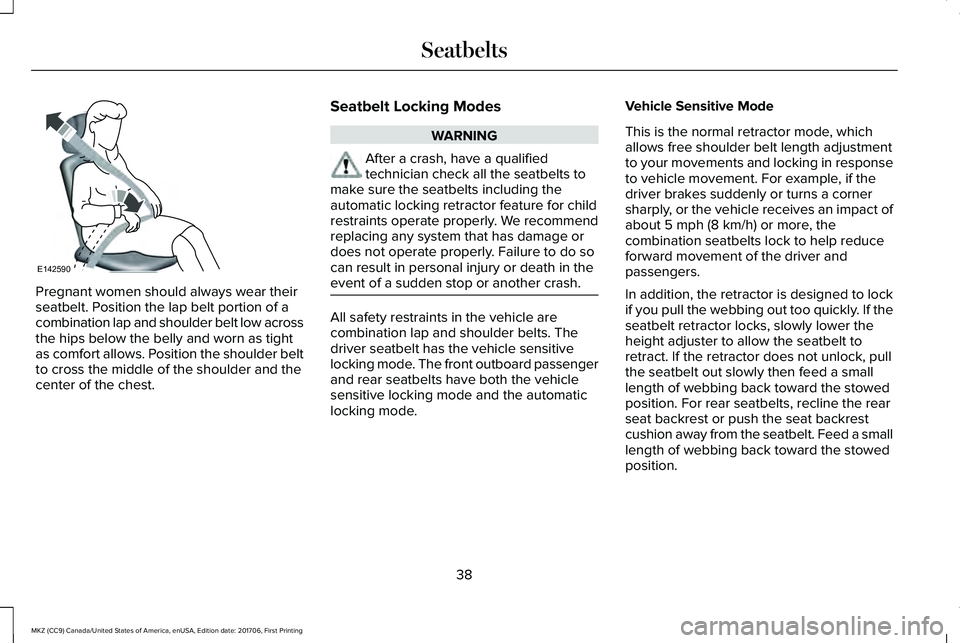
Pregnant women should always wear theirseatbelt. Position the lap belt portion of acombination lap and shoulder belt low acrossthe hips below the belly and worn as tightas comfort allows. Position the shoulder beltto cross the middle of the shoulder and thecenter of the chest.
Seatbelt Locking Modes
WARNING
After a crash, have a qualifiedtechnician check all the seatbelts tomake sure the seatbelts including theautomatic locking retractor feature for childrestraints operate properly. We recommendreplacing any system that has damage ordoes not operate properly. Failure to do socan result in personal injury or death in theevent of a sudden stop or another crash.
All safety restraints in the vehicle arecombination lap and shoulder belts. Thedriver seatbelt has the vehicle sensitivelocking mode. The front outboard passengerand rear seatbelts have both the vehiclesensitive locking mode and the automaticlocking mode.
Vehicle Sensitive Mode
This is the normal retractor mode, whichallows free shoulder belt length adjustmentto your movements and locking in responseto vehicle movement. For example, if thedriver brakes suddenly or turns a cornersharply, or the vehicle receives an impact ofabout 5 mph (8 km/h) or more, thecombination seatbelts lock to help reduceforward movement of the driver andpassengers.
In addition, the retractor is designed to lockif you pull the webbing out too quickly. If theseatbelt retractor locks, slowly lower theheight adjuster to allow the seatbelt toretract. If the retractor does not unlock, pullthe seatbelt out slowly then feed a smalllength of webbing back toward the stowedposition. For rear seatbelts, recline the rearseat backrest or push the seat backrestcushion away from the seatbelt. Feed a smalllength of webbing back toward the stowedposition.
38
MKZ (CC9) Canada/United States of America, enUSA, Edition date: 201706, First Printing
SeatbeltsE142590
Page 44 of 595

The fully inflated belt's increased diametermore effectively holds the occupant in theappropriate seating position, and spreadscrash forces over more area of the body thanregular seatbelts. This helps reduce pressureon the chest and helps control head andneck motion for passengers.
The rear inflatable seatbelts are designed toinflate in frontal or near-frontal crashes andin some side impact crashes and rollovercrashes. The fact that the rear inflatableseatbelt did not inflate in a crash does notmean that something is wrong with thesystem. Rather, it means the forces were notof the type sufficient to cause activation.
SEATBELT HEIGHT ADJUSTMENT
WARNING
Position the safety belt height adjustersso that the belt rests across the middleof your shoulder. Failure to adjust the safetybelt properly could reduce the effectivenessof the safety belt and increase the risk ofinjury in a crash.
Adjust the height of the shoulder belt so thebelt rests across the middle of your shoulder.
To adjust the shoulder belt height:
1. Press the button and slide the heightadjuster up or down.
2.Release the button and pull down on theheight adjuster to make sure it is lockedin place.
SEATBELT WARNING LAMP AND
INDICATOR CHIME
This lamp illuminates and anaudible warning will sound if thedriver seatbelt has not beenfastened when the vehicle's ignition is turnedon.
41
MKZ (CC9) Canada/United States of America, enUSA, Edition date: 201706, First Printing
SeatbeltsE146191 E71880
Page 47 of 595

Deactivating and Activating the Belt-MinderFeature
WARNING
While the system allows you todeactivate it, this system is designedto improve your chances of being safelybelted and surviving an accident. Werecommend you leave the system activatedfor yourself and others who may use thevehicle.
Note:The driver and front passengerwarnings switch on and off independently.When you perform this procedure for oneseating position, do not buckle the otherposition as this will terminate the process.
Read Steps 1 - 4 thoroughly beforeproceeding with the programmingprocedure.
Before following the procedure, make surethat:
•The parking brake is set.
•The transmission is in park (P) or neutral(N).
•The ignition is off.
•The driver and front passenger safetybelts are unbuckled.
1. Switch the ignition on. Do not start thevehicle.
2. Wait until the safety belt warning lightturns off (about one minute). After Step2, wait an additional 5 seconds beforeproceeding with Step 3. Once you startStep 3, you must complete the procedurewithin 30 seconds.
3.For the seating position you are switchingoff, buckle then unbuckle the safety beltthree times at a moderate speed, endingin the unbuckled state. After Step 3, thesafety belt warning light turns on.
4. While the safety belt warning light is on,buckle and then unbuckle the safety belt.After Step 4, the safety belt warning lightflashes for confirmation.
•This will switch the feature off for thatseating position if it is currently on.
•This will switch the feature on for thatseating position if it is currently off.
CHILD RESTRAINT AND SEATBELT
MAINTENANCE
Inspect the vehicle seatbelts and childrestraint systems periodically to make surethey work properly and are not damaged.Inspect the vehicle seatbelts to make surethere are no nicks, tears or cuts. Replace ifnecessary. All vehicle seatbelt assemblies,including retractors, buckles, front seatbeltbuckle assemblies, buckle supportassemblies (slide bar-if equipped), shoulderbelt height adjusters (if equipped), shoulderbelt guide on seatback (if equipped), rearinflatable seatbelts (if equipped), childrestraint LATCH and tether anchors, andattaching hardware, should be inspectedafter a crash. Read the child restraintmanufacturer's instructions for additionalinspection and maintenance informationspecific to the child restraint.
44
MKZ (CC9) Canada/United States of America, enUSA, Edition date: 201706, First Printing
Seatbelts