warning LINCOLN MKZ 2019 User Guide
[x] Cancel search | Manufacturer: LINCOLN, Model Year: 2019, Model line: MKZ, Model: LINCOLN MKZ 2019Pages: 595, PDF Size: 4.95 MB
Page 22 of 595
GENERAL INFORMATION
See the following sections for directions onhow to properly use safety restraints forchildren.
WARNING: Always make sure yourchild is secured properly in a device that isappropriate for their height, age and weight.Child safety restraints must be boughtseparately from your vehicle. Failure to followthese instructions and guidelines may resultin an increased risk of serious injury or deathto your child.
WARNING: All children are shapeddifferently. The National Highway TrafficSafety Administration and other safetyorganizations, base their recommendationsfor child restraints on probable child height,age and weight thresholds, or on theminimum requirements of the law. Werecommend that you check with a NHTSACertified Child Passenger Safety Technician(CPST) to make sure that you properly installthe child restraint in your vehicle and thatyou consult your pediatrician to make sureyou have a child restraint appropriate foryour child. To locate a child restraint fittingstation and CPST, contact NHTSA toll freeat 1-888-327-4236 or go to
www.nhtsa.dot.gov. In Canada, contactTransport Canada toll free at 1-800-333-0371or go to www.tc.gc.ca to find a Child Car SeatClinic in your area. Failure to properly restrainchildren in child restraints made especiallyfor their height, age and weight, may resultin an increased risk of serious injury or deathto your child.
WARNING: On hot days, thetemperature inside the vehicle can rise veryquickly. Exposure of people or animals tothese high temperatures for even a shorttime can cause death or serious heat relatedinjuries, including brain damage. Smallchildren are particularly at risk.
19
MKZ (CC9) Canada/United States of America, enUSA, Edition date: 201805, First-Printing
Child Safety
Page 24 of 595
•You are required by law to properly usesafety seats for infants and toddlers inthe United States and Canada.
•Many states and provinces require thatsmall children use approved boosterseats until they reach age eight, a heightof 4 feet 9 inches (1.45 meters) tall, or80 lb (36 kg). Check your local and stateor provincial laws for specificrequirements about the safety of childrenin your vehicle.
•When possible, always properly restrainchildren 12 years of age and under in arear seating position of your vehicle.Accident statistics suggest that childrenare safer when properly restrained in therear seating positions than in a frontseating position. See Front PassengerSensing System (page 50).
INSTALLING CHILD RESTRAINTS
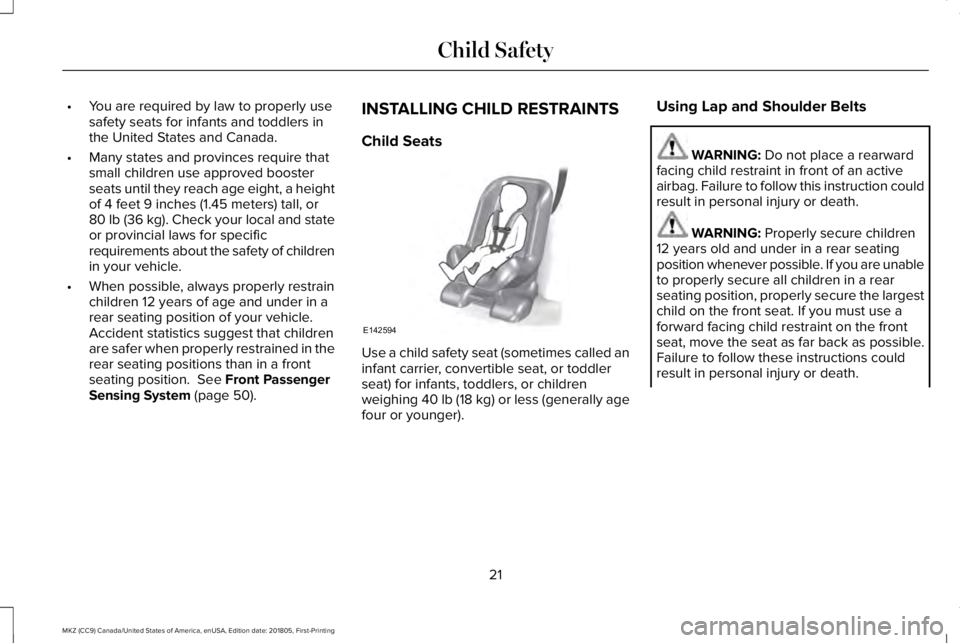
Child Seats
Use a child safety seat (sometimes called aninfant carrier, convertible seat, or toddlerseat) for infants, toddlers, or childrenweighing 40 lb (18 kg) or less (generally agefour or younger).
Using Lap and Shoulder Belts
WARNING: Do not place a rearwardfacing child restraint in front of an activeairbag. Failure to follow this instruction couldresult in personal injury or death.
WARNING: Properly secure children12 years old and under in a rear seatingposition whenever possible. If you are unableto properly secure all children in a rearseating position, properly secure the largestchild on the front seat. If you must use aforward facing child restraint on the frontseat, move the seat as far back as possible.Failure to follow these instructions couldresult in personal injury or death.
21
MKZ (CC9) Canada/United States of America, enUSA, Edition date: 201805, First-Printing
Child SafetyE142594
Page 25 of 595

WARNING: Depending on where yousecure a child restraint, and depending onthe child restraint design, you may blockaccess to certain seatbelt buckle assembliesand LATCH lower anchors, rendering thosefeatures potentially unusable. To avoid riskof injury, make sure occupants only useseating positions where they are able to beproperly restrained.
When installing a child safety seat withcombination lap and shoulder belts:
•Use the correct seatbelt buckle for thatseating position.
•Insert the belt tongue into the properbuckle until you hear a snap and feel itlatch. Make sure the tongue is securelyfastened in the buckle.
•Keep the buckle release button pointingup and away from the safety seat, withthe tongue between the child restraintand the release button, to preventaccidental unbuckling.
•Place the vehicle seat upon which thechild restraint will be installed in theupright position.
•Put the seatbelt in the automatic lockingmode. See Step 5. This vehicle does notrequire the use of a locking clip.
Perform the following steps when installingthe child restraint with combination lap andshoulder belts:
Note:Although the child restraint illustratedis a forward facing child restraint, the stepsare the same for installing a rear facing childrestraint.
Standard Seatbelts
1. Position the child safety seat in a seatwith a combination lap and shoulder belt.
2. After positioning the child safety seat inthe proper seating position, pull down onthe shoulder belt and then grasp theshoulder belt and lap belt togetherbehind the belt tongue.
22
MKZ (CC9) Canada/United States of America, enUSA, Edition date: 201805, First-Printing
Child SafetyE142528 E142529
Page 30 of 595
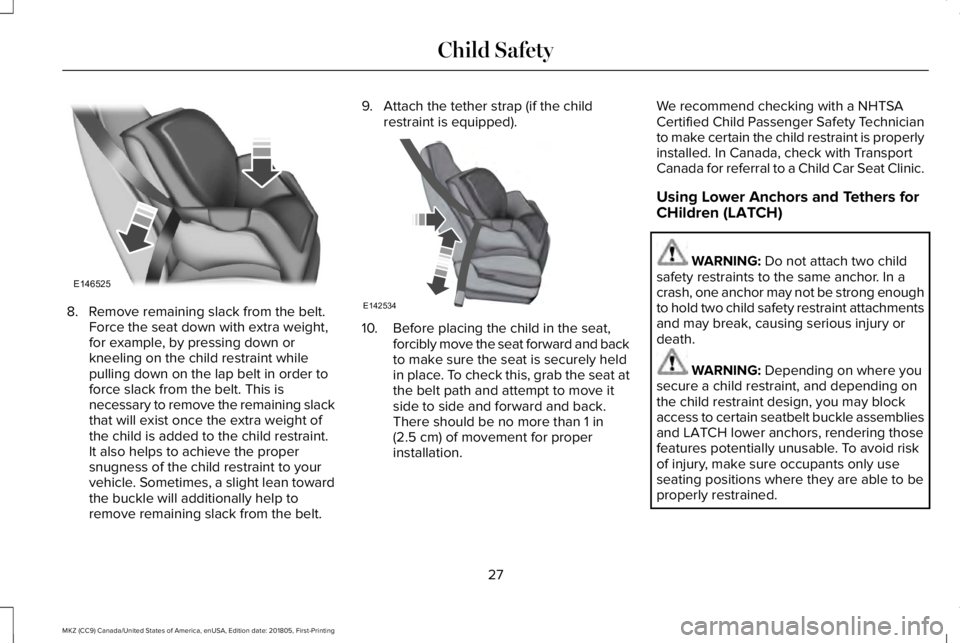
8. Remove remaining slack from the belt.Force the seat down with extra weight,for example, by pressing down orkneeling on the child restraint whilepulling down on the lap belt in order toforce slack from the belt. This isnecessary to remove the remaining slackthat will exist once the extra weight ofthe child is added to the child restraint.It also helps to achieve the propersnugness of the child restraint to yourvehicle. Sometimes, a slight lean towardthe buckle will additionally help toremove remaining slack from the belt.
9. Attach the tether strap (if the childrestraint is equipped).
10. Before placing the child in the seat,forcibly move the seat forward and backto make sure the seat is securely heldin place. To check this, grab the seat atthe belt path and attempt to move itside to side and forward and back.There should be no more than 1 in(2.5 cm) of movement for properinstallation.
We recommend checking with a NHTSACertified Child Passenger Safety Technicianto make certain the child restraint is properlyinstalled. In Canada, check with TransportCanada for referral to a Child Car Seat Clinic.
Using Lower Anchors and Tethers for
CHildren (LATCH)
WARNING: Do not attach two childsafety restraints to the same anchor. In acrash, one anchor may not be strong enoughto hold two child safety restraint attachmentsand may break, causing serious injury ordeath.
WARNING: Depending on where yousecure a child restraint, and depending onthe child restraint design, you may blockaccess to certain seatbelt buckle assembliesand LATCH lower anchors, rendering thosefeatures potentially unusable. To avoid riskof injury, make sure occupants only useseating positions where they are able to beproperly restrained.
27
MKZ (CC9) Canada/United States of America, enUSA, Edition date: 201805, First-Printing
Child SafetyE146525 E142534
Page 31 of 595

The LATCH system is composed of threevehicle anchor points: two lower anchorswhere the seat backrest and seat cushionmeet (called the seat bight) and one toptether anchor behind that seating position.
LATCH compatible child safety seats havetwo rigid or webbing mounted attachmentsthat connect to the two lower anchors at theLATCH equipped seating positions in yourvehicle. This type of attachment methodeliminates the need to use seatbelts to attachthe child restraint. However, you can still usethe seatbelt to attach the child restraint. Forforward-facing child restraints, the top tetherstrap must also be attached to the propertop tether anchor if a top tether strap hasbeen provided with your child restraint.
Your vehicle has LATCH lower anchors forchild restraint installation at the seatingpositions marked with the child restraintsymbol.
The LATCH anchors are at the rear sectionof the rear seat between the cushion andseat backrest below the symbols as shown.Follow the child restraint manufacturer'sinstructions to properly install a child restraintwith LATCH attachments. Follow theinstructions on attaching child safety seatswith tether straps.
Attach LATCH lower attachments of the childrestraint only to the anchors shown.
Use of Inboard Lower Anchors from theOutboard Seating Positions (Center SeatingUse)
WARNING: The standardized spacingfor LATCH lower anchors is 11 in (280 mm)center to center. Do not use LATCH loweranchors for the center seating positionunless the child restraint manufacturer'sinstructions permit and specify using anchorsspaced at least as far apart as those in thisvehicle.
28
MKZ (CC9) Canada/United States of America, enUSA, Edition date: 201805, First-Printing
Child SafetyE142535 E144054
Page 33 of 595

Note:If you install a child restraint with rigidLATCH attachments, do not tighten thetether strap enough to lift the child restraintoff your vehicle seat cushion when the childis seated in it. Keep the tether strap just snugwithout lifting the front of the child restraint.Keeping the child restraint just touching yourvehicle seat gives the best protection in asevere crash.
1. Route the child safety seat tether strapover the back of the seat. For theoutermost seating positions, route thetether strap under the head restraint andbetween the head restraint posts. For thecenter seating positions, route the tetherstrap over the top of the head restraint.If needed, you can also remove the headrestraints.
2. Locate the correct anchor for theselected seating position, then open thetether anchor cover.
3. Clip the tether strap to the anchor asshown.
4.Tighten the child safety seat tether strapaccording to the manufacturer'sinstructions.
If your child restraint system has a tetherstrap, and the child restraint manufacturerrecommends its use, we also recommend itsuse.
BOOSTER SEATS
WARNING: Do not put the shouldersection of the seatbelt or allow the child toput the shoulder section of the seatbeltunder their arm or behind their back. Failureto follow this instruction could reduce theeffectiveness of the seatbelt and increasethe risk of injury or death in a crash.
Note:Some booster seat seatbelt guidesmay not accommodate the shoulder portionof the inflatable seatbelt.
Use a belt-positioning booster seat forchildren who have outgrown or no longerproperly fit in a child safety seat (generallychildren who are less than 57 in (1.45 m) tall,are greater than age four (4) and less thanage twelve (12), and between 40 lb (18 kg)and 80 lb (36 kg) and upward to 100 lb(45 kg) if recommended by your childrestraint manufacturer). Many state andprovincial laws require that children useapproved booster seats until they reach ageeight, a height of 57 in (1.45 m) tall, or 80 lb(36 kg).
30
MKZ (CC9) Canada/United States of America, enUSA, Edition date: 201805, First-Printing
Child SafetyE144274 E144275
Page 36 of 595
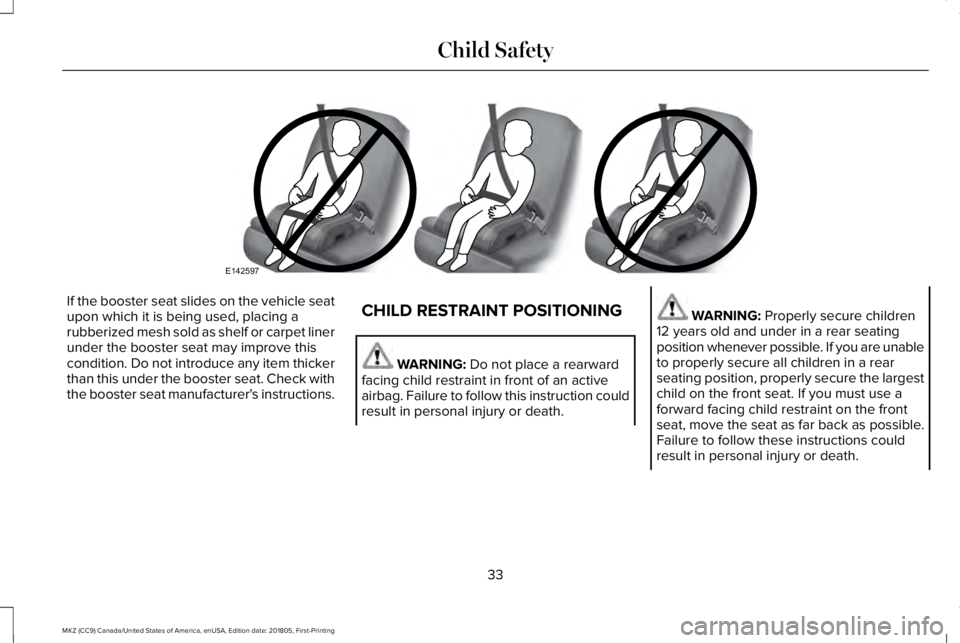
If the booster seat slides on the vehicle seatupon which it is being used, placing arubberized mesh sold as shelf or carpet linerunder the booster seat may improve thiscondition. Do not introduce any item thickerthan this under the booster seat. Check withthe booster seat manufacturer's instructions.
CHILD RESTRAINT POSITIONING
WARNING: Do not place a rearwardfacing child restraint in front of an activeairbag. Failure to follow this instruction couldresult in personal injury or death.
WARNING: Properly secure children12 years old and under in a rear seatingposition whenever possible. If you are unableto properly secure all children in a rearseating position, properly secure the largestchild on the front seat. If you must use aforward facing child restraint on the frontseat, move the seat as far back as possible.Failure to follow these instructions couldresult in personal injury or death.
33
MKZ (CC9) Canada/United States of America, enUSA, Edition date: 201805, First-Printing
Child SafetyE142597
Page 37 of 595
WARNING: Always carefully follow theinstructions and warnings provided by themanufacturer of any child restraint todetermine if the restraint device isappropriate for your child's size, height,weight, or age. Follow the child restraintmanufacturer's instructions and warningsprovided for installation and use inconjunction with the instructions andwarnings provided by your vehiclemanufacturer. A safety seat that is improperlyinstalled or utilized, is inappropriate for yourchild's height, age, or weight or does notproperly fit the child may increase the risk ofserious injury or death.
WARNING: Do not allow a passengerto hold a child on their lap when your vehicleis moving. Failure to follow this instructioncould result in personal injury or death in theevent of a sudden stop or crash.
WARNING: Do not use pillows, booksor towels to boost your child's height. Failureto follow this instruction could result inpersonal injury or death.
WARNING: Properly secure childrestraints or booster seats when they are notin use. They could become projectiles in asudden stop or crash. Failure to follow thisinstruction could result in personal injury ordeath.
WARNING: Do not put the shouldersection of the seatbelt or allow the child toput the shoulder section of the seatbeltunder their arm or behind their back. Failureto follow this instruction could reduce theeffectiveness of the seatbelt and increasethe risk of injury or death in a crash.
WARNING: Do not leave children orpets unattended in your vehicle. Failure tofollow this instruction could result in personalinjury or death.
34
MKZ (CC9) Canada/United States of America, enUSA, Edition date: 201805, First-Printing
Child Safety
Page 40 of 595

PRINCIPLE OF OPERATION
WARNING: Always drive and ride withyour seatback upright and the lap belt snugand low across the hips.
WARNING: Children must always beproperly restrained.
WARNING: Never let a passenger holda child on his or her lap while the vehicle ismoving. The passenger cannot protect thechild from injury in a crash.
WARNING: All occupants of yourvehicle, including the driver, should alwaysproperly wear their seatbelts, even when anairbag supplemental restraint system isprovided. Failure to properly wear yourseatbelt could seriously increase the risk ofinjury or death.
WARNING: It is extremely dangerousto ride in a cargo area, inside or outside ofa vehicle. In a crash, people riding in theseareas are more likely to be seriously injuredor killed. Do not allow people to ride in anyarea of your vehicle that is not equipped withseats and seatbelts. Make sure everyone inyour vehicle is in a seat and properly usinga seatbelt. Failure to follow this warningcould result in serious personal injury ordeath.
WARNING: In a rollover crash, anunbelted person is significantly more likelyto die than a person wearing a seatbelt.
WARNING: Each seating position inyour vehicle has a specific seatbelt assemblymade up of one buckle and one tonguedesigned to be used as a pair. Use theshoulder belt on the outside shoulder only.Never wear the shoulder belt under the arm.Never use a single seatbelt for more thanone person.
WARNING: Airbags can kill or injure achild in a child restraint. Properly restrainchildren 12 and under in the rear seatwhenever possible.
WARNING: Seatbelts and seats maybe hot in a vehicle that is in the sunshine.The hot seatbelts or seats may burn a smallchild. Check seat covers and buckles beforeyou place a child anywhere near them.
All seating positions in your vehicle have lapand shoulder seatbelts. All occupants of thevehicle should always properly wear theirseatbelts, even when an airbag supplementalrestraint system is provided.
The seatbelt system consists of:
•Lap and shoulder seatbelts.
•Shoulder seatbelt with automatic lockingmode, (except driver seatbelt).
•Height adjuster at the front outboardseating positions.
37
MKZ (CC9) Canada/United States of America, enUSA, Edition date: 201805, First-Printing
Seatbelts
Page 41 of 595
•Seatbelt pretensioner at the frontoutboard seating positions.
•Belt tension sensor at the outboardpassenger seating position.
•Seatbelt warning light and chime.
•Crash sensors and monitoring systemwith readiness indicator.
The seatbelt pretensioners at the frontseating positions are designed to tighten theseatbelts when activated. In frontal andnear-frontal crashes, the seatbeltpretensioners may be activated alone or, ifthe crash is of sufficient severity, togetherwith the front airbags. The pretensioners mayalso activate when the Safety Canopydeploys.
FASTENING THE SEATBELTS
Standard belts shown, inflatable belts similar
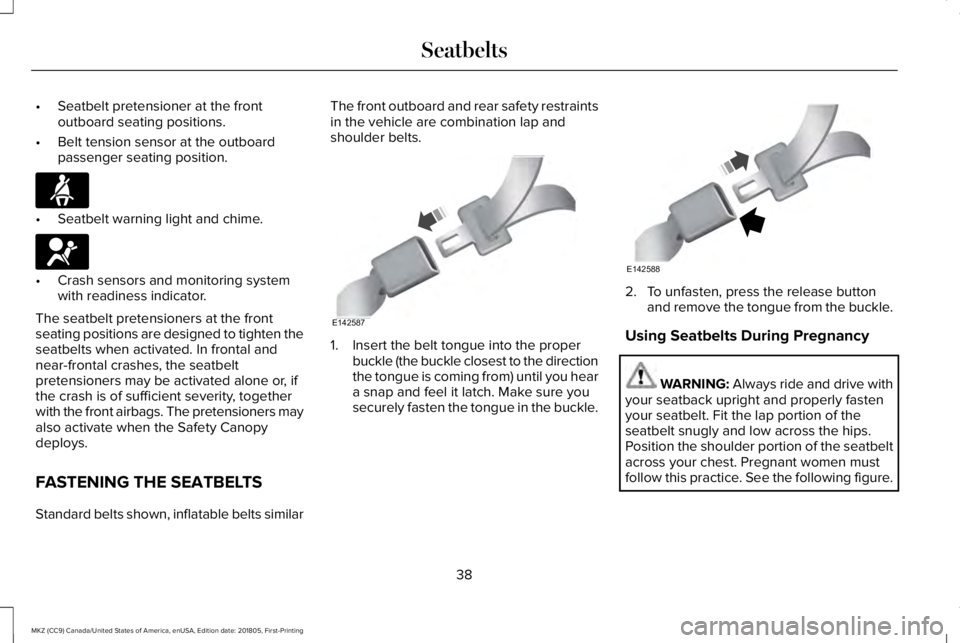
The front outboard and rear safety restraintsin the vehicle are combination lap andshoulder belts.
1. Insert the belt tongue into the properbuckle (the buckle closest to the directionthe tongue is coming from) until you heara snap and feel it latch. Make sure yousecurely fasten the tongue in the buckle.
2. To unfasten, press the release buttonand remove the tongue from the buckle.
Using Seatbelts During Pregnancy
WARNING: Always ride and drive withyour seatback upright and properly fastenyour seatbelt. Fit the lap portion of theseatbelt snugly and low across the hips.Position the shoulder portion of the seatbeltacross your chest. Pregnant women mustfollow this practice. See the following figure.
38
MKZ (CC9) Canada/United States of America, enUSA, Edition date: 201805, First-Printing
SeatbeltsE71880 E67017 E142587 E142588