wheel LINCOLN MKZ 2019 Manual PDF
[x] Cancel search | Manufacturer: LINCOLN, Model Year: 2019, Model line: MKZ, Model: LINCOLN MKZ 2019Pages: 595, PDF Size: 4.95 MB
Page 334 of 595
What to do when a Tire Is Punctured
A tire puncture within the tire's tread areacan be repaired in two stages with the kit:
•In the first stage, the tire is reinflated witha sealing compound and air. After the tirehas been inflated, you need to drive thevehicle about 3.7 mi (6 km) to distributethe sealant in the tire.
•In the second stage, you need to checkthe tire pressure and adjust, if necessary,to the vehicle's specified tire inflationpressure.
First Stage: Reinflating the Tire withSealing Compound and Air
WARNING: Do not stand directlybeside the tire while the compressor isoperating. This could cause personal injuryif the tire bursts.
Note:If the tire does not inflate to therecommended tire pressure within 15minutes, stop and call roadside assistance.
WARNING: Watch the sidewall of thetire when inflating. If any cracks, bumps orsimilar damage appears, switch thecompressor off and let the air out by meansof the pressure relief valve. Do not continuedriving with this tire. This could cause lossof vehicle control.
WARNING: Do not run the enginewhen operating the air compressor unlessthe vehicle is outdoors or in a well-ventilatedarea.
Preparation: Park the vehicle in a safe, leveland secure area, away from moving traffic.
Turn the hazard lights on. Apply the parkingbrake and turn the engine off. Inspect theflat tire for visible damage.
Sealant compound contains latex. Useappropriate precautions to avoid any allergicreactions.
Do not remove any foreign object that haspierced the tire. If a puncture is located inthe tire sidewall, stop and call roadsideassistance.
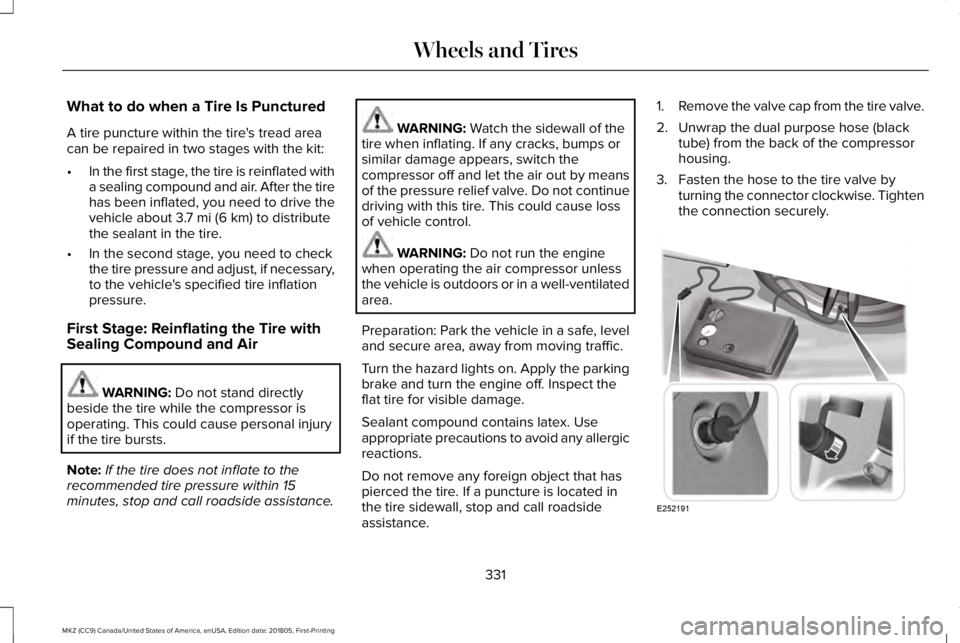
1.Remove the valve cap from the tire valve.
2. Unwrap the dual purpose hose (blacktube) from the back of the compressorhousing.
3. Fasten the hose to the tire valve byturning the connector clockwise. Tightenthe connection securely.
331
MKZ (CC9) Canada/United States of America, enUSA, Edition date: 201805, First-Printing
Wheels and TiresE252191
Page 335 of 595
4. Plug the power cable into the 12-voltpower point in the vehicle.
5.Remove the warning sticker found on thecasing/housing and place it on the centerof the steering wheel.
6. Start the vehicle and leave the enginerunning so the compressor does notdrain the vehicle’s battery.
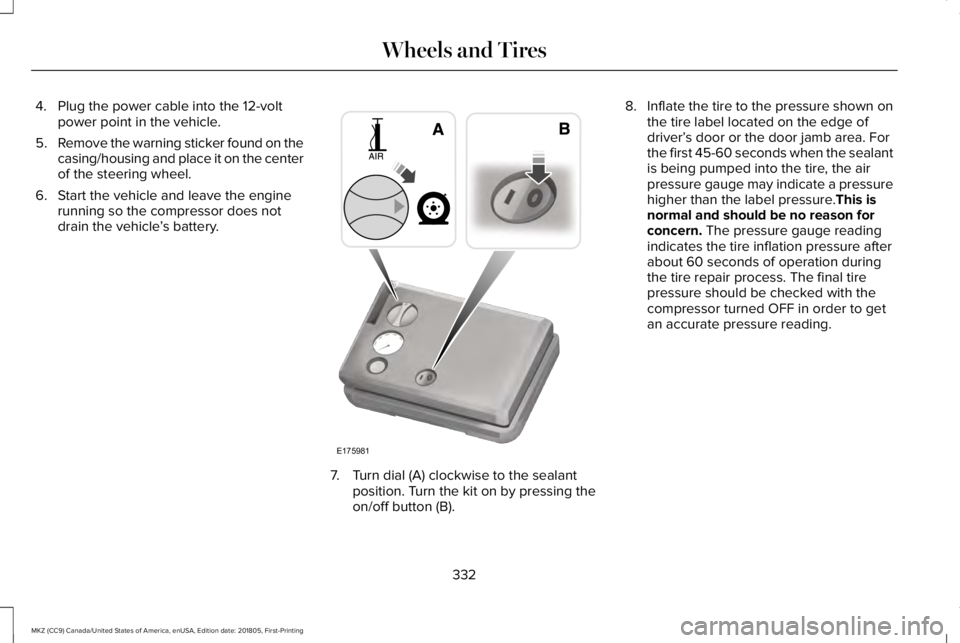
7. Turn dial (A) clockwise to the sealantposition. Turn the kit on by pressing theon/off button (B).
8.Inflate the tire to the pressure shown onthe tire label located on the edge ofdriver’s door or the door jamb area. Forthe first 45-60 seconds when the sealantis being pumped into the tire, the airpressure gauge may indicate a pressurehigher than the label pressure.This isnormal and should be no reason forconcern. The pressure gauge readingindicates the tire inflation pressure afterabout 60 seconds of operation duringthe tire repair process. The final tirepressure should be checked with thecompressor turned OFF in order to getan accurate pressure reading.
332
MKZ (CC9) Canada/United States of America, enUSA, Edition date: 201805, First-Printing
Wheels and TiresE175981
Page 336 of 595
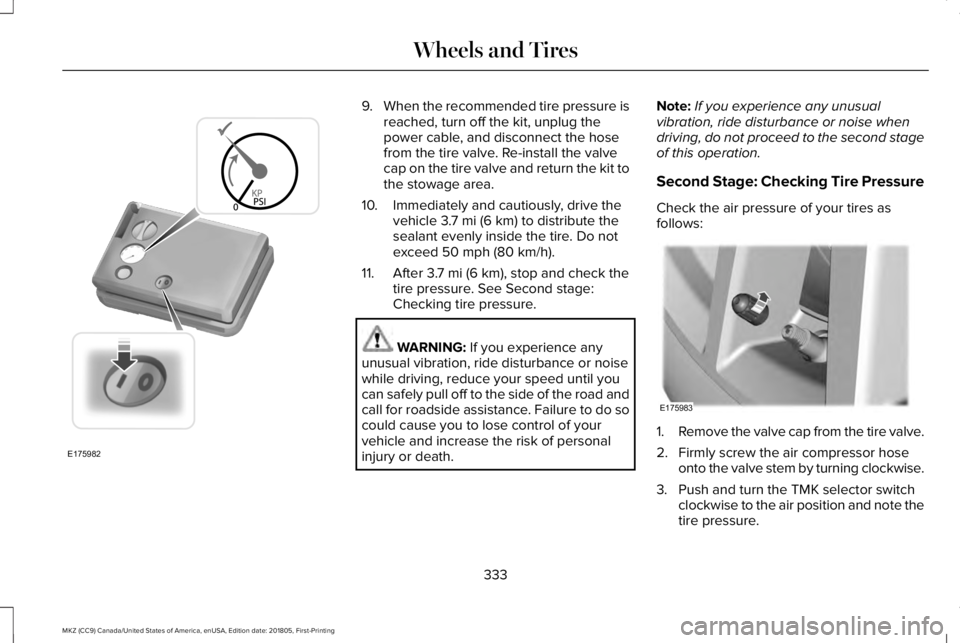
9.When the recommended tire pressure isreached, turn off the kit, unplug thepower cable, and disconnect the hosefrom the tire valve. Re-install the valvecap on the tire valve and return the kit tothe stowage area.
10. Immediately and cautiously, drive thevehicle 3.7 mi (6 km) to distribute thesealant evenly inside the tire. Do notexceed 50 mph (80 km/h).
11. After 3.7 mi (6 km), stop and check thetire pressure. See Second stage:Checking tire pressure.
WARNING: If you experience anyunusual vibration, ride disturbance or noisewhile driving, reduce your speed until youcan safely pull off to the side of the road andcall for roadside assistance. Failure to do socould cause you to lose control of yourvehicle and increase the risk of personalinjury or death.
Note:If you experience any unusualvibration, ride disturbance or noise whendriving, do not proceed to the second stageof this operation.
Second Stage: Checking Tire Pressure
Check the air pressure of your tires asfollows:
1.Remove the valve cap from the tire valve.
2. Firmly screw the air compressor hoseonto the valve stem by turning clockwise.
3. Push and turn the TMK selector switchclockwise to the air position and note thetire pressure.
333
MKZ (CC9) Canada/United States of America, enUSA, Edition date: 201805, First-Printing
Wheels and TiresE175982 E175983
Page 337 of 595
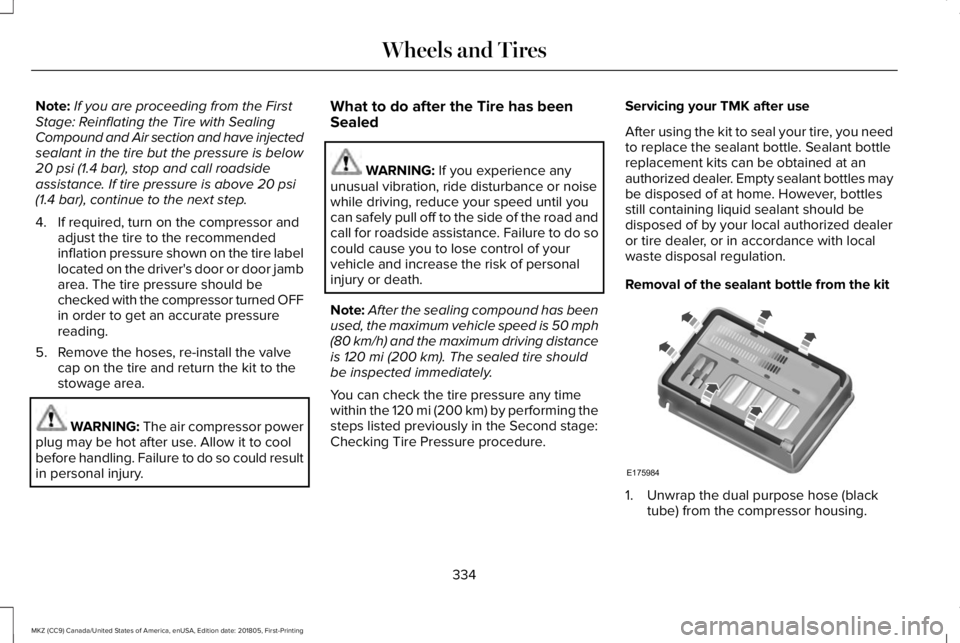
Note:If you are proceeding from the FirstStage: Reinflating the Tire with SealingCompound and Air section and have injectedsealant in the tire but the pressure is below20 psi (1.4 bar), stop and call roadsideassistance. If tire pressure is above 20 psi(1.4 bar), continue to the next step.
4. If required, turn on the compressor andadjust the tire to the recommendedinflation pressure shown on the tire labellocated on the driver's door or door jambarea. The tire pressure should bechecked with the compressor turned OFFin order to get an accurate pressurereading.
5. Remove the hoses, re-install the valvecap on the tire and return the kit to thestowage area.
WARNING: The air compressor powerplug may be hot after use. Allow it to coolbefore handling. Failure to do so could resultin personal injury.
What to do after the Tire has beenSealed
WARNING: If you experience anyunusual vibration, ride disturbance or noisewhile driving, reduce your speed until youcan safely pull off to the side of the road andcall for roadside assistance. Failure to do socould cause you to lose control of yourvehicle and increase the risk of personalinjury or death.
Note:After the sealing compound has beenused, the maximum vehicle speed is 50 mph(80 km/h) and the maximum driving distanceis 120 mi (200 km). The sealed tire shouldbe inspected immediately.
You can check the tire pressure any timewithin the 120 mi (200 km) by performing thesteps listed previously in the Second stage:Checking Tire Pressure procedure.
Servicing your TMK after use
After using the kit to seal your tire, you needto replace the sealant bottle. Sealant bottlereplacement kits can be obtained at anauthorized dealer. Empty sealant bottles maybe disposed of at home. However, bottlesstill containing liquid sealant should bedisposed of by your local authorized dealeror tire dealer, or in accordance with localwaste disposal regulation.
Removal of the sealant bottle from the kit
1. Unwrap the dual purpose hose (blacktube) from the compressor housing.
334
MKZ (CC9) Canada/United States of America, enUSA, Edition date: 201805, First-Printing
Wheels and TiresE175984
Page 338 of 595
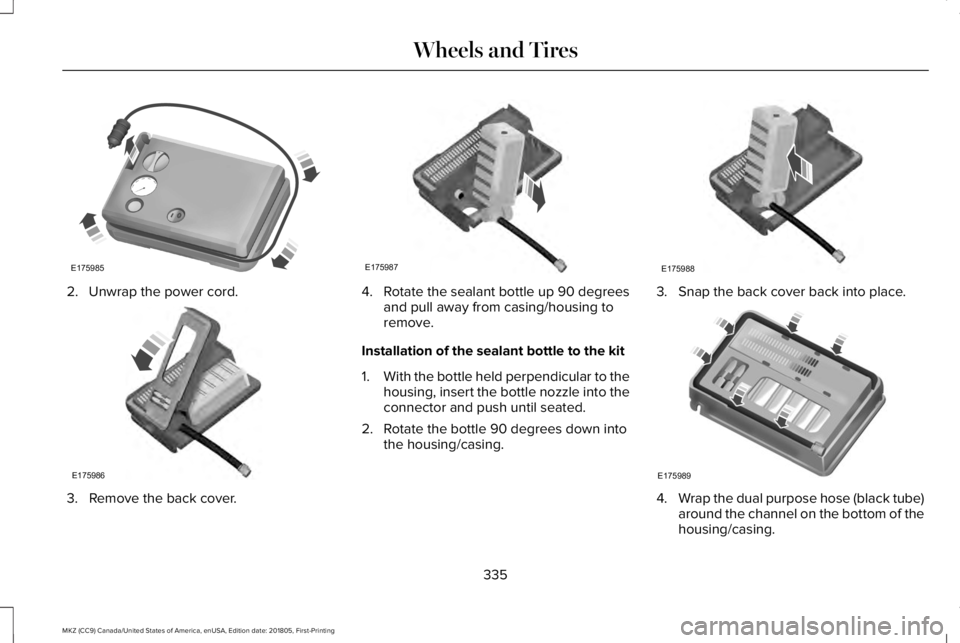
2. Unwrap the power cord.
3. Remove the back cover.
4.Rotate the sealant bottle up 90 degreesand pull away from casing/housing toremove.
Installation of the sealant bottle to the kit
1.With the bottle held perpendicular to thehousing, insert the bottle nozzle into theconnector and push until seated.
2. Rotate the bottle 90 degrees down intothe housing/casing.
3. Snap the back cover back into place.
4.Wrap the dual purpose hose (black tube)around the channel on the bottom of thehousing/casing.
335
MKZ (CC9) Canada/United States of America, enUSA, Edition date: 201805, First-Printing
Wheels and TiresE175985 E175986 E175987 E175988 E175989
Page 339 of 595
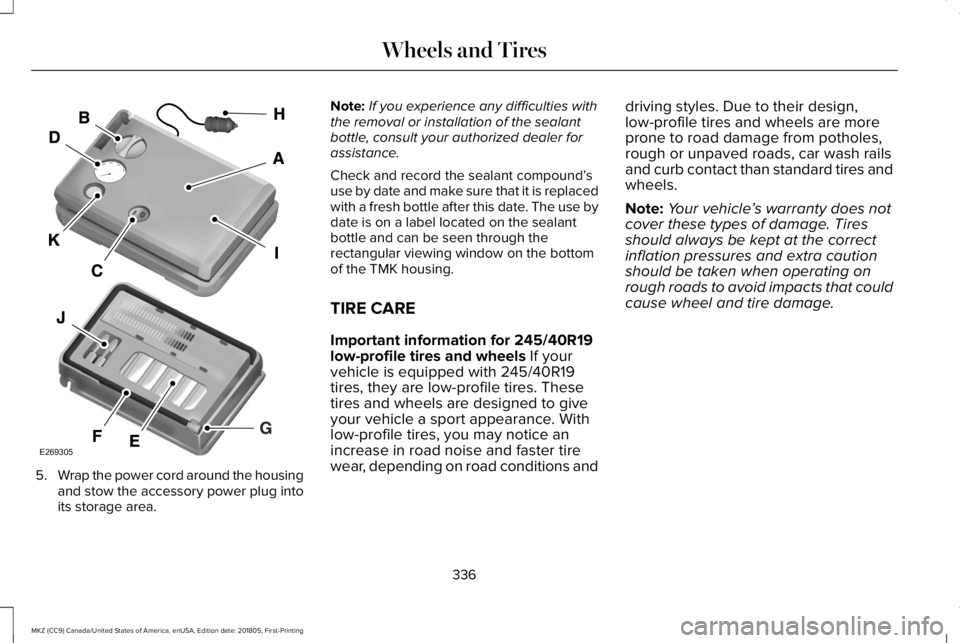
5.Wrap the power cord around the housingand stow the accessory power plug intoits storage area.
Note:If you experience any difficulties withthe removal or installation of the sealantbottle, consult your authorized dealer forassistance.
Check and record the sealant compound’suse by date and make sure that it is replacedwith a fresh bottle after this date. The use bydate is on a label located on the sealantbottle and can be seen through therectangular viewing window on the bottomof the TMK housing.
TIRE CARE
Important information for 245/40R19low-profile tires and wheels If yourvehicle is equipped with 245/40R19tires, they are low-profile tires. Thesetires and wheels are designed to giveyour vehicle a sport appearance. Withlow-profile tires, you may notice anincrease in road noise and faster tirewear, depending on road conditions and
driving styles. Due to their design,low-profile tires and wheels are moreprone to road damage from potholes,rough or unpaved roads, car wash railsand curb contact than standard tires andwheels.
Note:Your vehicle’s warranty does notcover these types of damage. Tiresshould always be kept at the correctinflation pressures and extra cautionshould be taken when operating onrough roads to avoid impacts that couldcause wheel and tire damage.
336
MKZ (CC9) Canada/United States of America, enUSA, Edition date: 201805, First-Printing
Wheels and TiresE269305
Page 340 of 595
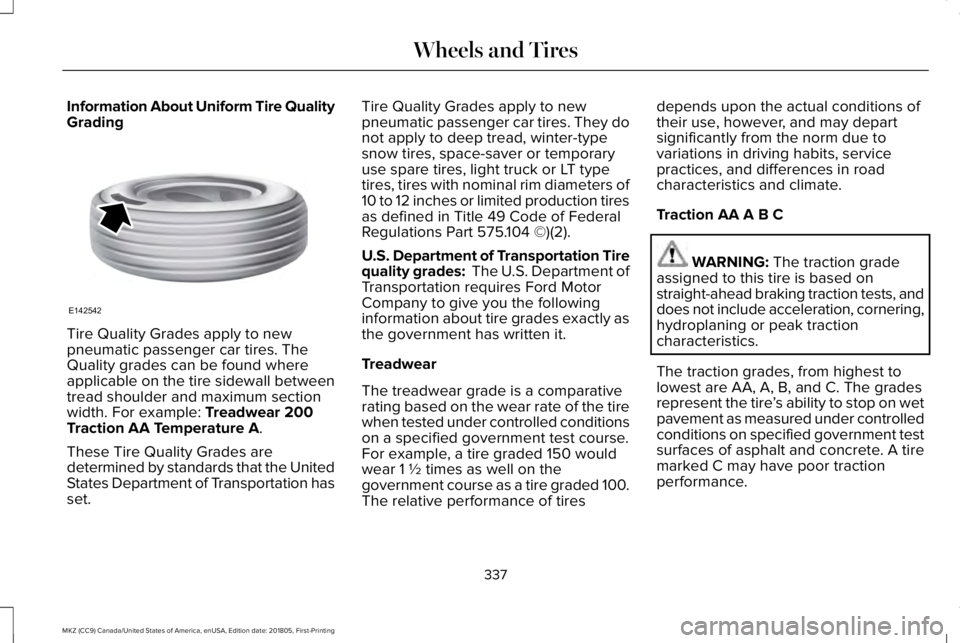
Information About Uniform Tire QualityGrading
Tire Quality Grades apply to newpneumatic passenger car tires. TheQuality grades can be found whereapplicable on the tire sidewall betweentread shoulder and maximum sectionwidth. For example: Treadwear 200Traction AA Temperature A.
These Tire Quality Grades aredetermined by standards that the UnitedStates Department of Transportation hasset.
Tire Quality Grades apply to newpneumatic passenger car tires. They donot apply to deep tread, winter-typesnow tires, space-saver or temporaryuse spare tires, light truck or LT typetires, tires with nominal rim diameters of10 to 12 inches or limited production tiresas defined in Title 49 Code of FederalRegulations Part 575.104 ©)(2).
U.S. Department of Transportation Tirequality grades: The U.S. Department ofTransportation requires Ford MotorCompany to give you the followinginformation about tire grades exactly asthe government has written it.
Treadwear
The treadwear grade is a comparative
rating based on the wear rate of the tirewhen tested under controlled conditionson a specified government test course.For example, a tire graded 150 wouldwear 1 ½ times as well on thegovernment course as a tire graded 100.The relative performance of tires
depends upon the actual conditions oftheir use, however, and may departsignificantly from the norm due tovariations in driving habits, servicepractices, and differences in roadcharacteristics and climate.
Traction AA A B C
WARNING: The traction gradeassigned to this tire is based onstraight-ahead braking traction tests, anddoes not include acceleration, cornering,hydroplaning or peak tractioncharacteristics.
The traction grades, from highest tolowest are AA, A, B, and C. The gradesrepresent the tire’s ability to stop on wetpavement as measured under controlledconditions on specified government testsurfaces of asphalt and concrete. A tiremarked C may have poor tractionperformance.
337
MKZ (CC9) Canada/United States of America, enUSA, Edition date: 201805, First-Printing
Wheels and TiresE142542
Page 341 of 595
Temperature A B C
WARNING: The temperature gradefor this tire is established for a tire thatis properly inflated and not overloaded.Excessive speed, underinflation, orexcessive loading, either separately orin combination, can cause heat buildupand possible tire failure.
The temperature grades are A (thehighest), B and C, representing the tire’sresistance to the generation of heat andits ability to dissipate heat when testedunder controlled conditions on aspecified indoor laboratory test wheel.Sustained high temperature can causethe material of the tire to degenerateand reduce tire life, and excessivetemperature can lead to sudden tirefailure. The grade C corresponds to alevel of performance which all
passenger car tires must meet under theFederal Motor Vehicle Safety StandardNo. 139. Grades B and A representhigher levels of performance on thelaboratory test wheel than the minimumrequired by law.
Glossary of Tire Terminology
•Tire label: A label showing theoriginal equipment tire sizes,recommended inflation pressure andthe maximum weight the vehicle cancarry.
•Tire Identification Number: Anumber on the sidewall of each tireproviding information about the tirebrand and manufacturing plant, tiresize and date of manufacture. Alsoreferred to as DOT code.
•Inflation pressure: A measure of theamount of air in a tire.
•Standard load: A class of P-metric orMetric tires designed to carry amaximum load at set pressure. Forexample: For P-metric tires 35 psi(2.4 bar) and for Metric tires 36 psi(2.5 bar). Increasing the inflationpressure beyond this pressure willnot increase the tire’s load carryingcapability.
•Extra load: A class of P-metric orMetric tires designed to carry aheavier maximum load at 42 psi(2.9 bar). Increasing the inflationpressure beyond this pressure willnot increase the tire’s load carryingcapability.
•kPa: Kilopascal, a metric unit of airpressure.
•PSI: Pounds per square inch, astandard unit of air pressure.
•Cold tire pressure: The tire pressurewhen the vehicle has been stationaryand out of direct sunlight for an houror more and prior to the vehiclebeing driven for 1.0 mi (1.6 km).
338
MKZ (CC9) Canada/United States of America, enUSA, Edition date: 201805, First-Printing
Wheels and Tires
Page 342 of 595
•Recommended inflation pressure:The cold inflation pressure found onthe Safety Compliance CertificationLabel (affixed to either the doorhinge pillar, door-latch post, or thedoor edge that meets the door-latchpost, next to the driver's seatingposition), or Tire Label located on theB-Pillar or the edge of the driver’sdoor.
•B-pillar: The structural member atthe side of the vehicle behind thefront door
•Bead area of the tire: Area of the tirenext to the rim.
•Sidewall of the tire: Area betweenthe bead area and the tread.
•Tread area of the tire: Area of theperimeter of the tire that contacts theroad when mounted on the vehicle.
•Rim: The metal support (wheel) for atire or a tire and tube assembly uponwhich the tire beads are seated.
Information Contained on the TireSidewall
Both United States and Canada Federalregulations require tire manufacturersto place standardized information on thesidewall of all tires. This informationidentifies and describes the fundamentalcharacteristics of the tire and alsoprovides a U.S. DOT Tire IdentificationNumber for safety standard certificationand in case of a recall.
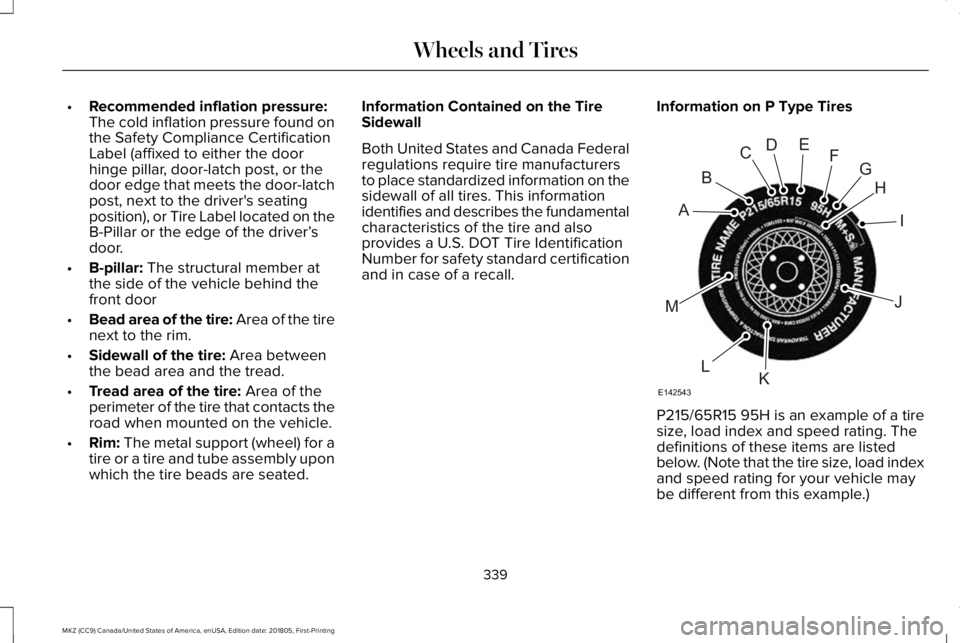
Information on P Type Tires
P215/65R15 95H is an example of a tiresize, load index and speed rating. Thedefinitions of these items are listedbelow. (Note that the tire size, load indexand speed rating for your vehicle maybe different from this example.)
339
MKZ (CC9) Canada/United States of America, enUSA, Edition date: 201805, First-Printing
Wheels and TiresH
I
J
KL
M
A
B
CDEFG
E142543
Page 343 of 595
A. P: Indicates a tire, designated by theTire and Rim Association, that may beused for service on cars, sport utilityvehicles, minivans and light trucks. Note:If your tire size does not begin with aletter this may mean it is designated byeither the European Tire and RimTechnical Organization or the Japan TireManufacturing Association.
B. 215: Indicates the nominal width ofthe tire in millimeters from sidewall edgeto sidewall edge. In general, the largerthe number, the wider the tire.
C. 65: Indicates the aspect ratio whichgives the tire's ratio of height to width.
D. R: Indicates a radial type tire.
E. 15: Indicates the wheel or rim
diameter in inches. If you change yourwheel size, you will have to purchasenew tires to match the new wheeldiameter.
F. 95: Indicates the tire's load index. Itis an index that relates to how muchweight a tire can carry. You may find thisinformation in your owner’s manual. Ifnot, contact a local tire dealer.
Note:You may not find this informationon all tires because it is not required byfederal law.
G. H: Indicates the tire's speed rating.The speed rating denotes the speed atwhich a tire is designed to be driven forextended periods of time under astandard condition of load and inflationpressure. The tires on your vehicle mayoperate at different conditions for loadand inflation pressure. These speedratings may need to be adjusted for thedifference in conditions. The ratings
range from 81–186 mph (130–299 km/h).These ratings are listed in the followingchart.
Note:You may not find this informationon all tires because it is not required byfederal law.
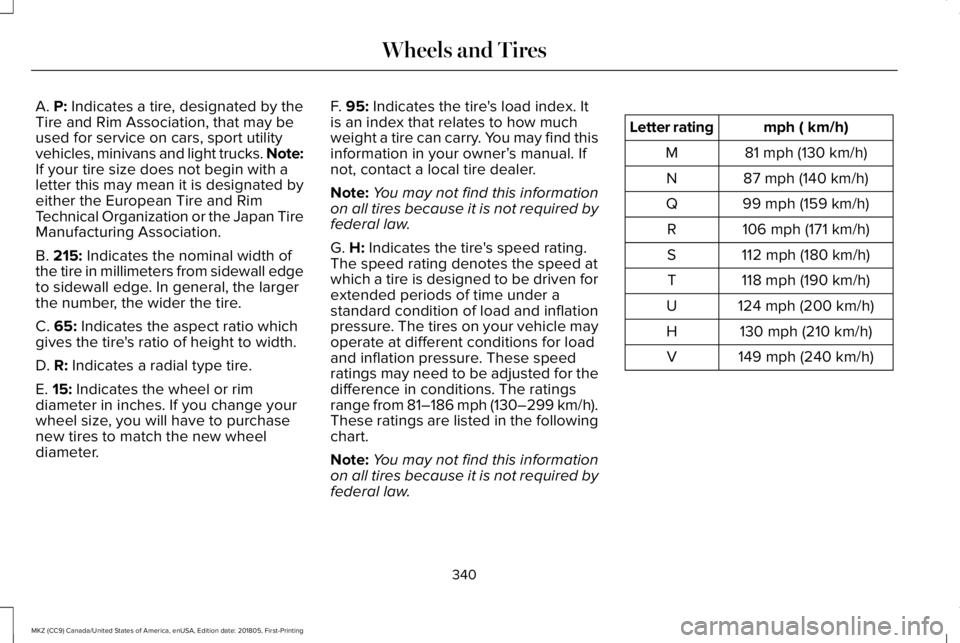
mph ( km/h)Letter rating
81 mph (130 km/h)M
87 mph (140 km/h)N
99 mph (159 km/h)Q
106 mph (171 km/h)R
112 mph (180 km/h)S
118 mph (190 km/h)T
124 mph (200 km/h)U
130 mph (210 km/h)H
149 mph (240 km/h)V
340
MKZ (CC9) Canada/United States of America, enUSA, Edition date: 201805, First-Printing
Wheels and Tires