Transmission LINCOLN MKZ HYBRID 2013 Owner's Manual
[x] Cancel search | Manufacturer: LINCOLN, Model Year: 2013, Model line: MKZ HYBRID, Model: LINCOLN MKZ HYBRID 2013Pages: 475, PDF Size: 3.89 MB
Page 183 of 475
Your vehicle may not pass the I/M test
if the service engine soon indicator is
on or not working properly (bulb is
burned out), or if the OBD-II system
has determined that some of the
emission control systems have not
been properly checked. In this case,
your vehicle is not ready for I/M
testing.
If the vehicle
’s engine or transmission
has just been serviced, or the battery
has recently run down or been
replaced, the OBD-II system may
indicate that the vehicle is not ready
for I/M testing. To determine if the
vehicle is ready for I/M testing, turn
the ignition key to the on position for
15 seconds without cranking the
engine. If the service engine soon
indicator blinks eight times, it means
that the vehicle is not ready for I/M
testing; if the service engine soon
indicator stays on solid, it means that
the vehicle is ready for I/M testing.
The OBD-II system monitors the
emission control system during
normal driving. A complete check may
take several days. If the vehicle is not
ready for I/M testing, you may need
to perform the following driving cycle
consisting of mixed city and highway
driving:
Drive on an expressway or highway
for a steady 15 minutes, followed by
20 minutes of stop-and-go driving
with at least four 30-second idle
periods. Allow the vehicle to sit for at least
eight hours without starting the
engine. Then, start the engine and
complete the above driving cycle. The
engine must warm up to its normal
operating temperature. Once started,
do not turn off the engine until the
above driving cycle is complete. If the
vehicle is still not ready for I/M testing,
you will have to repeat the above
driving cycle.
181
MKZ (CC9) Fuel and Refueling
Page 187 of 475
AUTOMATIC
TRANSMISSION
WARNINGS
Always set the parking brake
fully and make sure the vehicle
is in P (Park). Turn the ignition off
whenever you leave your vehicle. Do not apply the brake pedal and
accelerator pedal
simultaneously. Applying both pedals
simultaneously for more than three
seconds will limit engine rpm, which
may result in difficulty maintaining
speed in traffic and could lead to
serious injury. Push Button Shift
Transmission
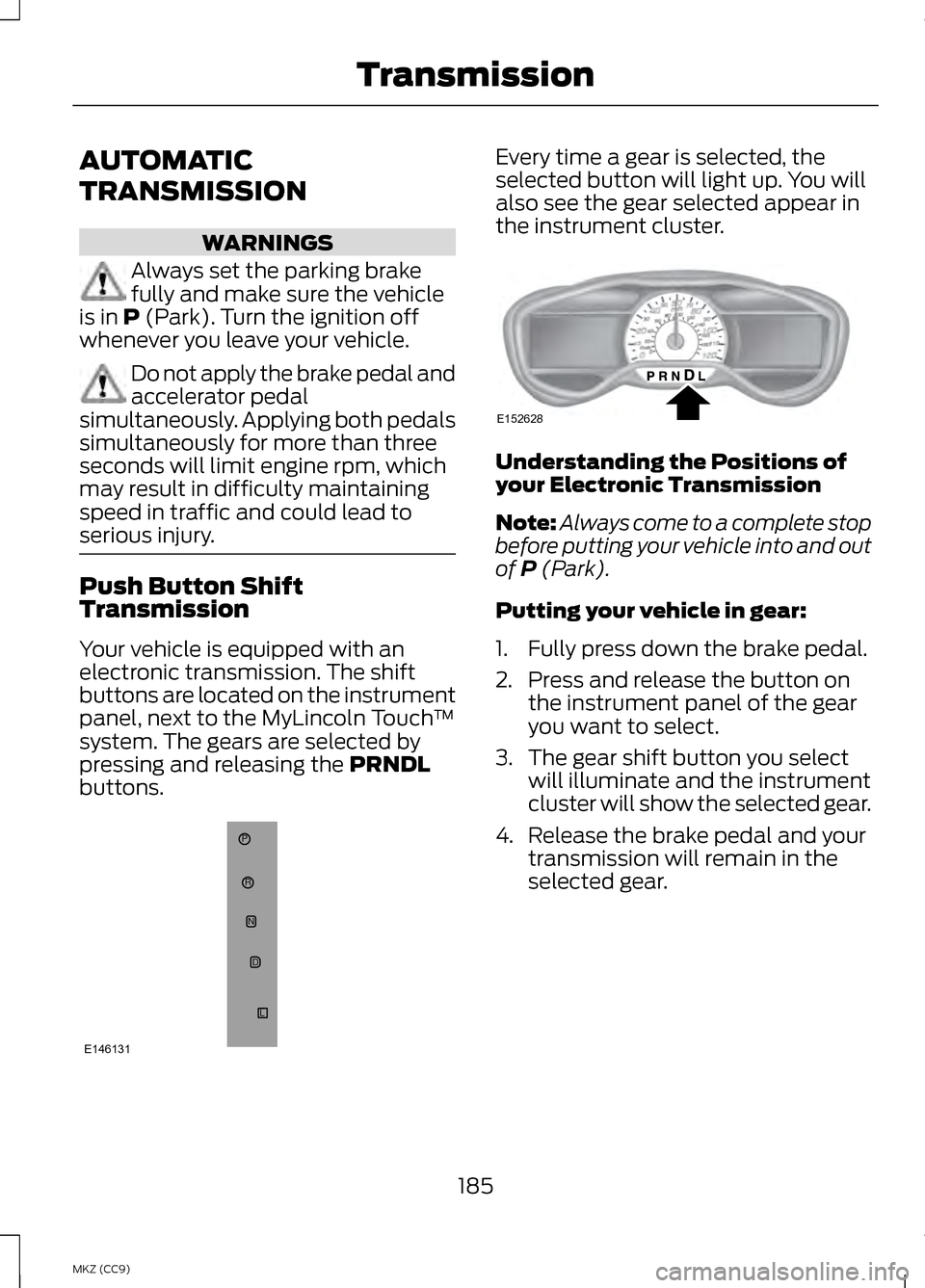
Your vehicle is equipped with an
electronic transmission. The shift
buttons are located on the instrument
panel, next to the MyLincoln Touch
™
system. The gears are selected by
pressing and releasing the
PRNDL
buttons. Every time a gear is selected, the
selected button will light up. You will
also see the gear selected appear in
the instrument cluster.
Understanding the Positions of
your Electronic Transmission
Note:
Always come to a complete stop
before putting your vehicle into and out
of
P (Park).
Putting your vehicle in gear:
1. Fully press down the brake pedal.
2. Press and release the button on the instrument panel of the gear
you want to select.
3. The gear shift button you select will illuminate and the instrument
cluster will show the selected gear.
4. Release the brake pedal and your transmission will remain in the
selected gear.
185
MKZ (CC9) TransmissionP
RN
D
L
E146131 E152628
Page 188 of 475
Note:
If the driver attempts to leave
the vehicle while it is in gear, the vehicle
will automatically shift into P (Park).
Seatbelt and door monitors determine
the driver's intent and makes the shift
for you. During this time a
Transmission not in Park
message
will appear in the display screen,
prompting the driver to make the shift.
To put the vehicle in gear with the door
open perform steps 1-4. See the
Automatic Return to Park
section in
this chapter for more information on
this feature.
Note: To put your vehicle in gear with
the door open, perform steps 1-4. See
the
Automatic Return to Park section
in this chapter for more information on
this feature.
P (Park)
This position locks the transmission
and prevents the front wheels from
turning. Always come to a complete
stop before putting your vehicle into
and out of P (Park). An audible chime
will sound when P (Park) is manually
selected.
When the ignition is turned off, the
vehicle will automatically shift into
P
(Park). If the ignition is turned off
while the vehicle is moving, it will first
shift into
N (Neutral) until a slow
enough speed is reached. The vehicle
will then shift into
P (Park)
automatically.
Automatic Return to Park
Note: This feature will not operate
when the vehicle is in Stay in Neutral
mode or neutral tow. Your vehicle has a safety feature that
will automatically shift your vehicle
into
P (Park) when any of the
following circumstances are met:
• Turn the ignition off
• Open the driver's door with your
seat belt unlatched
• Unlatching your seatbelt while the
driver's door is open
If you turn the ignition off while your
vehicle is moving, your vehicle will first
shift into N (Neutral) until it slows
down enough to shift into P (Park)
automatically.
Note: If you have waited an extended
period of time, (2-15 minutes) before
starting your vehicle, unlatching your
safety belt will cause this feature to
activate, even with the driver's door
closed.
Note: This feature may not work
properly if the door ajar switch is
malfunctioning. If your door ajar
indicator does not illuminate when you
open the driver ’s door or the indicator
illuminates with the driver ’s door
closed. See your authorized dealer.
R (Reverse)
With the transmission in
R (Reverse),
the vehicle will move backward.
Always come to a complete stop
before shifting into and out of
R
(Reverse).
186
MKZ (CC9) Transmission
Page 189 of 475
N (Neutral)
Press the N button to put the vehicle
in N (Neutral). In neutral, the vehicle
can be started and is free to roll. Hold
the brake pedal down while in this
position.
Stay in Neutral mode
Stay in Neutral mode allows the
vehicle to stay in
N (Neutral) when
you exit the vehicle. The vehicle must
be stationary to enter this mode.
To enter Stay in Neutral mode:
1. Press the
N (Neutral) button on
the shifter assembly.
2. The message
Select N Again to
Enter Stay in Neutral mode will
appear in the information display
screen.
3. Press the N (Neutral) button again
to enter Stay in Neutral mode.
The message
Stay in Neutral mode
engaged will appear in the
instrument cluster when the vehicle
has entered Stay in Neutral mode.
Note: During this mode the
N button
will flash continuously and the
instrument cluster will display N as the
selected gear.
Exiting Stay in Neutral mode
To disable Stay in Neutral mode put
the vehicle in another gear. See the
Putting the Vehicle in Gear section
for instructions on how to do this. Entering a Carwash
Note:
Always put the vehicle in Stay
in Neutral mode when entering an
automatic car wash. Failure to do this
could result in vehicle damage that
may not be covered by warranty.
D (Drive)
The normal driving position for the
best fuel economy.
D (Drive) with Grade Assist The grade assist button is
located on the instrument
panel next the MyLincoln
Touch ™ system. Press the grade
assist button to activate and
deactivate grade assist.
Grade assist:
• Provides additional grade braking
with a combination of engine
motoring and high-voltage battery
charging to help maintain vehicle
speed when descending a grade.
• As the vehicle determines the
amount of engine motoring and
high-voltage battery charging, you
may notice the engine speed
increasing and decreasing to help
maintain your vehicle speed when
descending a grade. The grade assist lamp will
appear in the instrument
cluster when grade assist is
turned on.
187
MKZ (CC9) TransmissionE144523 E144523
Page 190 of 475
L (Low)
•
Provides maximum engine braking.
• The transmission may be put into
L (Low) at any vehicle speed.
Brake-Shift Interlock Override WARNINGS
Do not drive your vehicle until
you verify that the brake lamps
are working. When doing this procedure, you
will be taking the vehicle out of
park which means the vehicle can roll
freely. To avoid unwanted vehicle
movement, always fully set the
parking brake prior to doing this
procedure. Use wheel chocks if
appropriate. If the parking brake is fully
released, but the brake warning
lamp remains illuminated, the brakes
may not be working properly. See your
authorized dealer. Note:
See your authorized dealer as
soon as possible if this procedure is
used.
Note: For some markets this feature
will be disabled.
Note: This feature will only function if
your 12-volt battery has power. Use the brake-shift interlock override
procedure to put the vehicle in gear in
the event of an electrical malfunction
or if your vehicle has a dead battery.
The brake shift interlock override
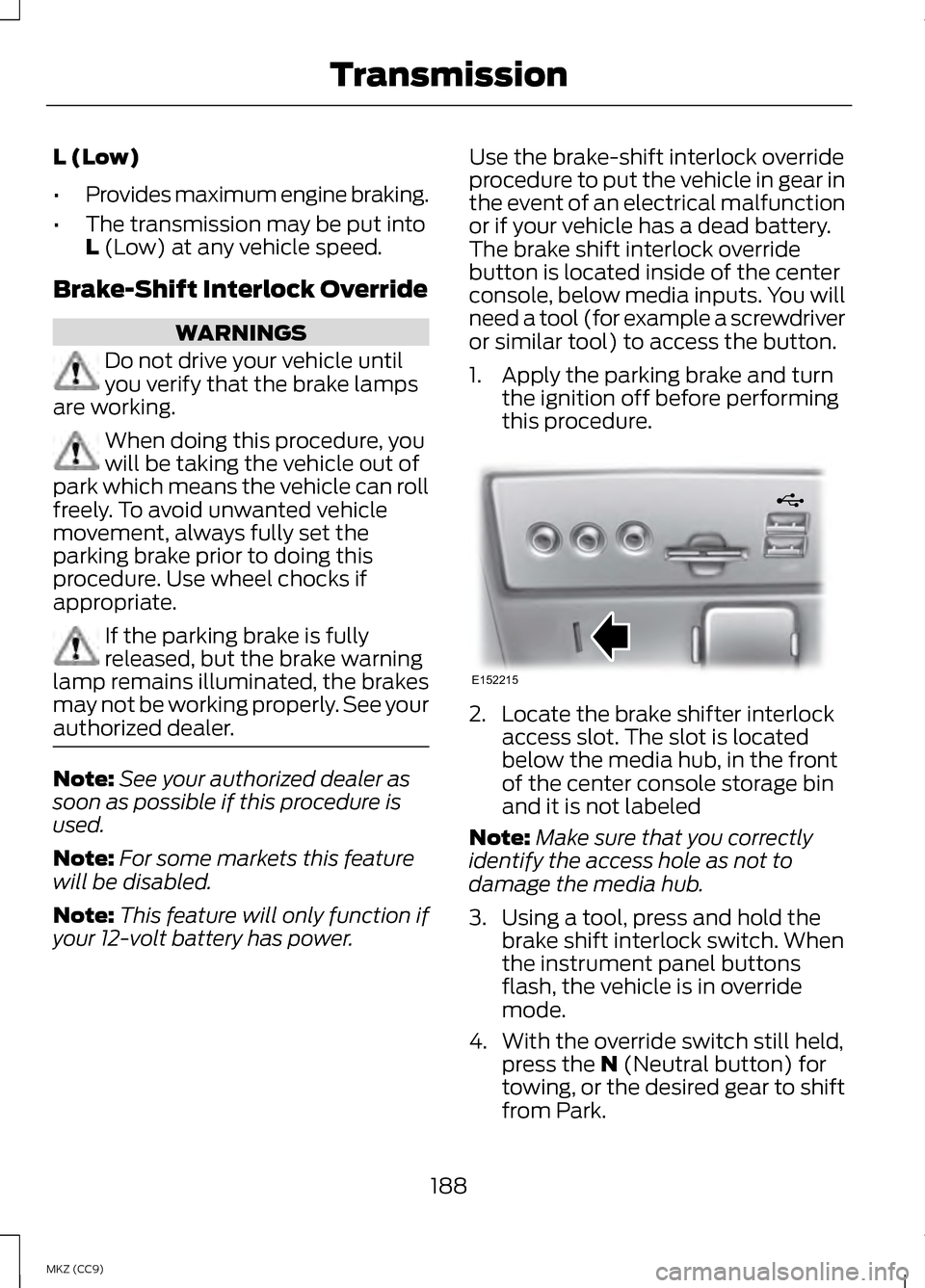
button is located inside of the center
console, below media inputs. You will
need a tool (for example a screwdriver
or similar tool) to access the button.
1. Apply the parking brake and turn
the ignition off before performing
this procedure. 2. Locate the brake shifter interlock
access slot. The slot is located
below the media hub, in the front
of the center console storage bin
and it is not labeled
Note: Make sure that you correctly
identify the access hole as not to
damage the media hub.
3. Using a tool, press and hold the brake shift interlock switch. When
the instrument panel buttons
flash, the vehicle is in override
mode.
4. With the override switch still held, press the
N (Neutral button) for
towing, or the desired gear to shift
from Park.
188
MKZ (CC9) TransmissionE152215
Page 191 of 475
5. Release the override button.
6.
The vehicle will remain in Stay in
Neutral mode for wrecker towing
purposes or can be shifted to the
desired gear and driven (if the
vehicle can be driven).
7. Release the parking brake.
If Your Vehicle Gets Stuck In
Mud or Snow
Note: Do not rock the vehicle if the
engine is not at normal operating
temperature or damage to the
transmission may occur.
Note: Do not rock the vehicle for more
than a minute or damage to the
transmission and tires may occur, or
the engine may overheat.
If your vehicle gets stuck in mud or
snow, it may be rocked out by shifting
between forward and reverse gears,
stopping between shifts in a steady
pattern. Press lightly on the
accelerator in each gear.
HILL START ASSIST WARNINGS
The system does not replace the
parking brake. When you leave
your vehicle, always apply the parking
brake and put the vehicle in P (Park). You must remain in your vehicle
once you have activated the
system. WARNINGS
During all times, you are
responsible for controlling your
vehicle, supervising the system and
intervening, if required. If the engine is revved
excessively, or if a malfunction
is detected, the system will be
deactivated. The system makes it easier to pull
away when your vehicle is on a slope
without the need to use the parking
brake.
When the system is active, your
vehicle will remain stationary on the
slope for two to three seconds after
you release the brake pedal. This
allows you time to move your foot
from the brake to the accelerator
pedal. The brakes are released
automatically once the engine has
developed sufficient drive to prevent
your vehicle from rolling down the
slope. This is an advantage when
pulling away on a slope, (for example
from a car park ramp, traffic lights or
when reversing uphill into a parking
space).
The system will activate
automatically on any slope that will
cause significant vehicle rollback.
Using Hill Start Assist
1.
Press the brake pedal to bring your
vehicle to a complete standstill.
Keep the brake pedal pressed.
189
MKZ (CC9) Transmission
Page 192 of 475
2. If the sensors detect that your
vehicle is on a slope, the system
will activate automatically.
3. When you remove your foot from the brake pedal, your vehicle will
remain on the slope without rolling
away for approximately two or
three seconds. This hold time will
automatically be extended if you
are in the process of driving off.
4. Drive off in the normal manner. The brakes will release
automatically.
190
MKZ (CC9) Transmission
Page 193 of 475
GENERAL INFORMATION
Note:
Occasional brake noise is
normal. If a metal-to-metal,
continuous grinding or continuous
squeal sound is present, the brake
linings may be worn-out. Have the
system checked by an authorized
dealer. If the vehicle has continuous
vibration or shudder in the steering
wheel while braking, have it checked
by an authorized dealer.
Note: Brake dust may accumulate on
the wheels, even under normal driving
conditions. Some dust is inevitable as
the brakes wear and does not
contribute to brake noise. See
Cleaning the Alloy Wheels (page 299). See Warning Lamps and
Indicators (page 98).
Wet brakes result in reduced braking
efficiency. Gently press the brake
pedal a few times when driving from
a car wash or standing water to dry
the brakes.
Brake Over Accelerator
In the event the accelerator pedal
becomes stuck or entrapped, apply
steady and firm pressure to the brake
pedal to slow the vehicle and reduce
engine power. If you experience this
condition, apply the brakes and bring
your vehicle to a safe stop. Move the
transmission selector lever to position P,
switch the engine off and apply the
parking brake. Inspect the accelerator
pedal for any interference. If none are
found and the condition persists, have
your vehicle towed to the nearest
authorized dealer.
Brake Assist
Brake assist detects when you brake
heavily by measuring the rate at which
you press the brake pedal. It provides
maximum braking efficiency as long
as you press the pedal. Brake assist
can reduce stopping distances in
critical situations.
Anti-lock Brake System
This system helps you maintain
steering control during emergency
stops by keeping the brakes from
locking. This lamp momentarily
illuminates when you turn
the ignition on. If the light
does not illuminate during start up,
remains on or flashes, the anti-lock
braking system may be disabled. Have
the system checked by an authorized
dealer. If the system is disabled,
normal braking is still
effective. If the brake
warning lamp illuminates when you
release the parking brake, have your
system checked by an authorized
dealer.
191
MKZ (CC9) BrakesE144522 E144522
Page 194 of 475
Regenerative Braking System
This feature is used to simulate the
engine braking of an internal
combustion engine and assist the
standard brake system while
recovering some of the energy of
motion and storing it in the battery to
improve fuel economy. The standard
brake system is designed to fully stop
the car if regenerative braking is not
available. During regenerative braking,
the motor is spun as a generator to
create electrical current. This
recharges the battery and slows the
vehicle. In effect, once the accelerator
pedal is released, the motor changes
from an energy user to an energy
producer.
When you release the accelerator
pedal or press the brake pedal, the
brake controller automatically detects
the amount of deceleration requested
and optimizes how much of the
deceleration will be produced by
regenerative braking. The remaining
portion is generated by standard
friction braking. When the battery is
almost fully charged, the amount of
regenerative braking is limited to avoid
overcharging, and the requested
deceleration is produced by standard
friction braking alone.
Regenerative braking does not take
the place of the standard friction
brakes; it only assists them.
Regenerative braking has also been
designed to interact with the anti-lock
brake system. Regenerative braking
is disabled when the anti-lock brake
system is activated or the battery is
fully charged.
HINTS ON DRIVING WITH
ANTI-LOCK BRAKES
Note:
When the system is operating,
the brake pedal will pulse and may
travel further. Maintain pressure on the
brake pedal. You may also hear a noise
from the system. This is normal.
The anti-lock braking system will not
eliminate the risks when:
• you drive too closely to the vehicle
in front of you
• your vehicle is hydroplaning
• you take corners too fast
• the road surface is poor.
ELECTRIC PARKING BRAKE
The electric parking brake replaces
the conventional handbrake. The
operating switch is located on the
instrument panel to the left of the
steering wheel. WARNING
Always set the parking brake and
leave your vehicle with the
transmission selector in position P. Note:
When you apply the electric
parking brake in certain conditions, for
example on a steep hill, the electric
parking brake may reapply the brakes
within three to ten minutes.
Note: You may notice various noises
when you apply and release the electric
parking brake. This is normal and no
cause for concern.
192
MKZ (CC9) Brakes
Page 200 of 475
USING STABILITY
CONTROL
AdvanceTrac®
The system automatically activates
when you start your vehicle. The
AdvanceTrac system cannot be
completely turned off, but the
electronic stability control system is
disabled when the transmission
selector lever is in position R. You can
turn off the traction control portion of
the system independently. See Using
Traction Control (page 196).
198
MKZ (CC9) Stability Control