reset LINCOLN MKZ HYBRID 2013 Owner's Manual
[x] Cancel search | Manufacturer: LINCOLN, Model Year: 2013, Model line: MKZ HYBRID, Model: LINCOLN MKZ HYBRID 2013Pages: 475, PDF Size: 3.89 MB
Page 235 of 475
If the front end of the vehicle is hit or
damaged, the radar sensing zone may
be altered causing missed or false
collision warnings. See your
authorized dealer to have your
collision warning radar checked for
proper coverage and operation.
STEERING
Electric Power Steering
WARNINGS
The electric power steering
system has diagnostic checks
that continuously monitor the system
to ensure proper operation. When a
system error is detected a steering
message will appear in the
information display. The electric power steering
system has diagnostic checks
that continuously monitor the system
to ensure proper operation of the
electronic system. When an electronic
error is detected, a message will be
displayed in the information display.
If this happens, stop the vehicle in a
safe place, and turn off the engine.
After at least 10 seconds, reset the
system by restarting the engine, and
watch the information display for a
steering message. If a steering
message returns, or returns while
driving, take the vehicle to your dealer
to have it checked. WARNINGS
Obtain immediate service if a
system error is detected. You
may not notice any difference in the
feel of your steering, but a serious
condition may exist. Failure to do so
may result in loss of steering control. Your vehicle is equipped with an
electric power-assisted steering
system. There is no fluid reservoir to
check or fill.
If your vehicle loses electrical power
while you are driving (or if the ignition
is turned off), you can steer the
vehicle manually, but it takes more
effort. Extreme continuous steering
may increase the effort it takes for you
to steer. This occurs to prevent
internal overheating and permanent
damage to your steering system. If this
should occur, you will neither lose the
ability to steer the vehicle manually
nor will it cause permanent damage.
Typical steering and driving
maneuvers will allow the system to
cool and steering assist will return to
normal.
Steering Tips
If the steering wanders or pulls, check
for:
•
an improperly inflated tire
• uneven tire wear
• loose or worn suspension
components
• loose or worn steering
components
• improper vehicle alignment
233
MKZ (CC9) Driving Aids
Page 236 of 475
A high crown in the road or high
crosswinds may also make the
steering seem to wander or pull.
Adaptive Learning
The EPS system adaptive learning
helps correct for road irregularities
and improves overall handling and
steering feel. It communicates with
the vehicle's brake system to help
operate advanced stability control
and accident avoidance systems.
Additionally, whenever the battery is
disconnected or a new battery
installed, the vehicle must be driven
a short distance before the strategy
is relearned and all systems are
reactivated.
DRIVE CONTROL
LINCOLN DRIVE CONTROL
Lincoln Drive Control delivers the
Lincoln driving experience through a
suite of sophisticated electronic
vehicle systems. These systems
continuously monitor both your driving
inputs and the road conditions to
optimize ride comfort, steering,
handling, powertrain response and
sound. You can preset your
preferences for these systems within
the information display. Lincoln Drive
Control will respond to your
preferences based on what gear
position you select. This provides a
single location to control multiple
systems performance settings.
Lincoln Drive Control consists of the
following systems:
•
Continuously Controlled Damping
dynamically adjusts the shock
absorbers stiffness in real time to
match the road surface and driver
inputs. Vehicle motion (roll, pitch,
bounce), suspension position,
vehicle loading, vehicle speed, road
conditions, and steering are
continuously monitored to adjust
the suspension damping for
optimal vehicle control.
• Electronically Power-Assisted
Steering adjusts steering effort and
feel based on vehicle speed and
your inputs
• Active Noise Control utilizes
vehicle electronics to enhance the
acoustic experience
• Electronic Stability Control and
Traction Control maintain vehicle
control in adverse conditions or
high performance driving
• Electronic Throttle Control which
enhances the powertrain response
to your inputs
These systems have a range of modes
which you can choose from in order
to customize your ideal driving
experience:
234
MKZ (CC9) Driving Aids
Page 268 of 475
FUSE SPECIFICATION
CHART
Power Distribution Box
WARNINGS
Always disconnect the battery
before servicing high-current
fuses. To reduce risk of electrical shock,
always replace the cover to the
power distribution box before
reconnecting the battery or refilling
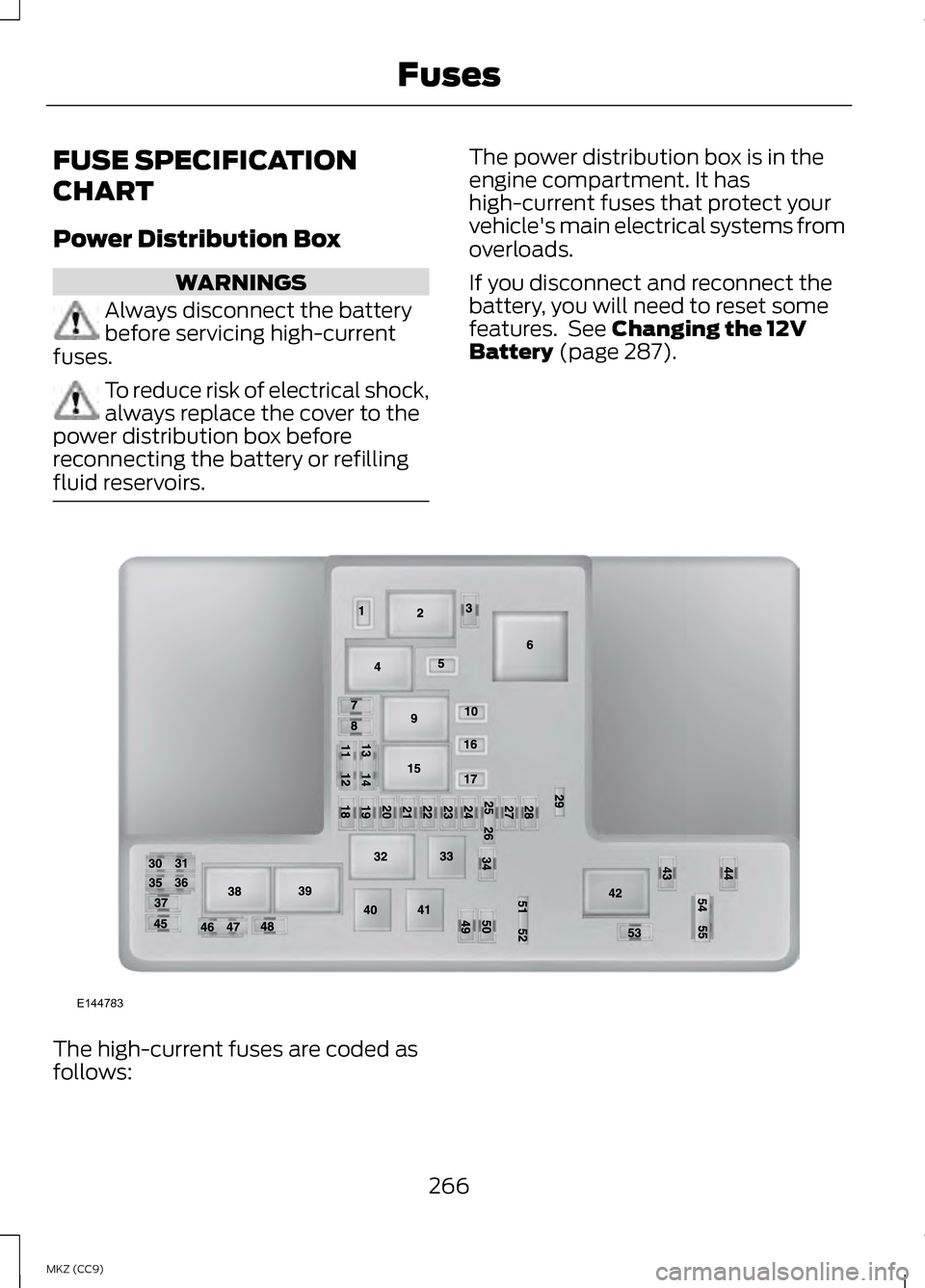
fluid reservoirs. The power distribution box is in the
engine compartment. It has
high-current fuses that protect your
vehicle's main electrical systems from
overloads.
If you disconnect and reconnect the
battery, you will need to reset some
features. See Changing the 12V
Battery (page 287). The high-current fuses are coded as
follows:
266
MKZ (CC9) FusesE144783
Page 282 of 475
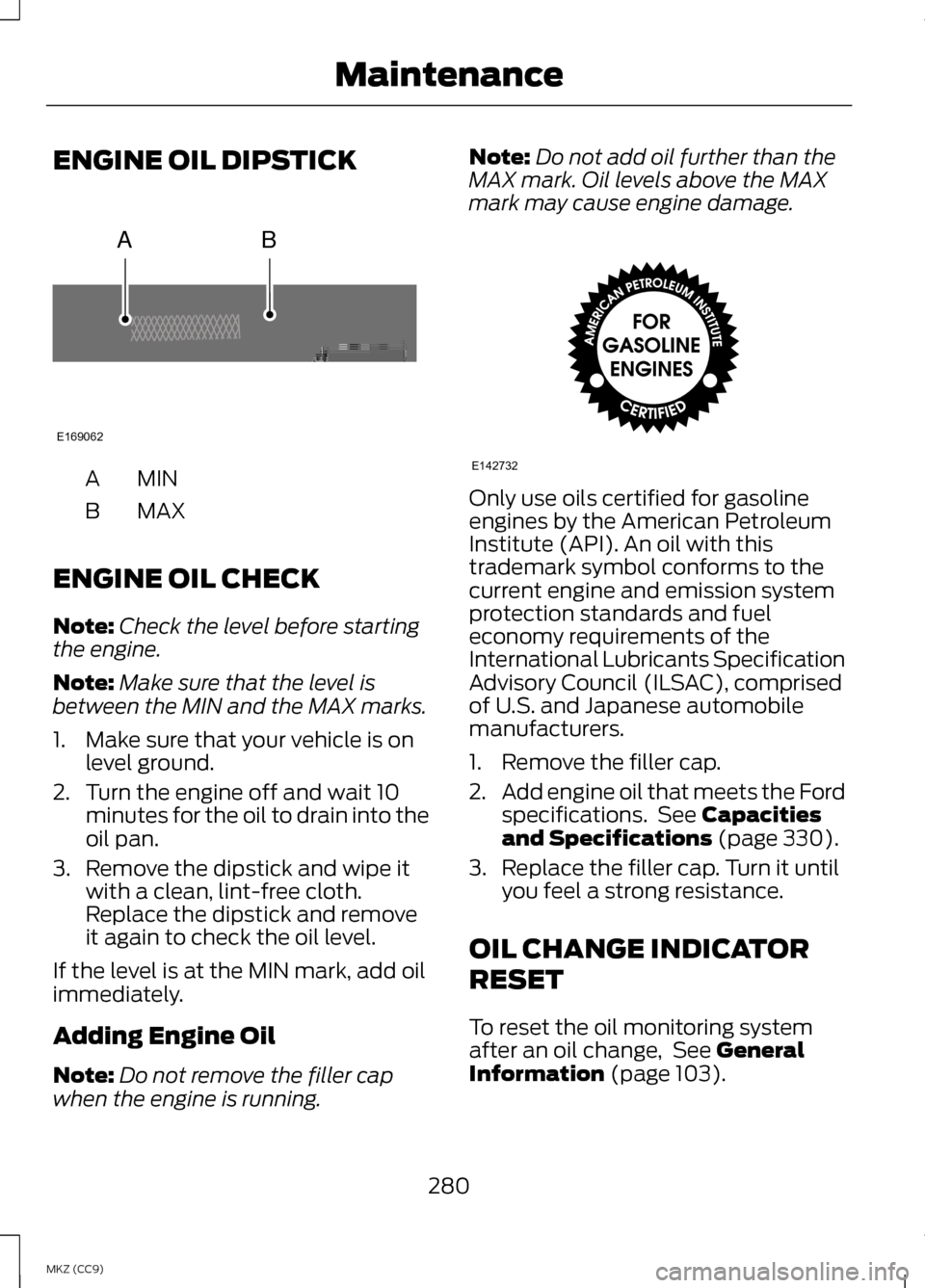
ENGINE OIL DIPSTICK
MINA
MAXB
ENGINE OIL CHECK
Note: Check the level before starting
the engine.
Note: Make sure that the level is
between the MIN and the MAX marks.
1. Make sure that your vehicle is on level ground.
2. Turn the engine off and wait 10 minutes for the oil to drain into the
oil pan.
3. Remove the dipstick and wipe it with a clean, lint-free cloth.
Replace the dipstick and remove
it again to check the oil level.
If the level is at the MIN mark, add oil
immediately.
Adding Engine Oil
Note: Do not remove the filler cap
when the engine is running. Note:
Do not add oil further than the
MAX mark. Oil levels above the MAX
mark may cause engine damage. Only use oils certified for gasoline
engines by the American Petroleum
Institute (API). An oil with this
trademark symbol conforms to the
current engine and emission system
protection standards and fuel
economy requirements of the
International Lubricants Specification
Advisory Council (ILSAC), comprised
of U.S. and Japanese automobile
manufacturers.
1. Remove the filler cap.
2.
Add engine oil that meets the Ford
specifications. See Capacities
and Specifications (page 330).
3. Replace the filler cap. Turn it until you feel a strong resistance.
OIL CHANGE INDICATOR
RESET
To reset the oil monitoring system
after an oil change, See
General
Information (page 103).
280
MKZ (CC9) MaintenanceAB
E169062 E142732
Page 287 of 475
What You Should Know About
Fail-Safe Cooling
If the engine coolant supply is
depleted, this feature allows the
vehicle to be driven temporarily before
incremental component damage is
incurred. The
“fail-safe” distance
depends on ambient temperatures,
vehicle load and terrain.
How Fail-Safe Cooling Works
If the engine begins to overheat, the
engine coolant temperature gauge
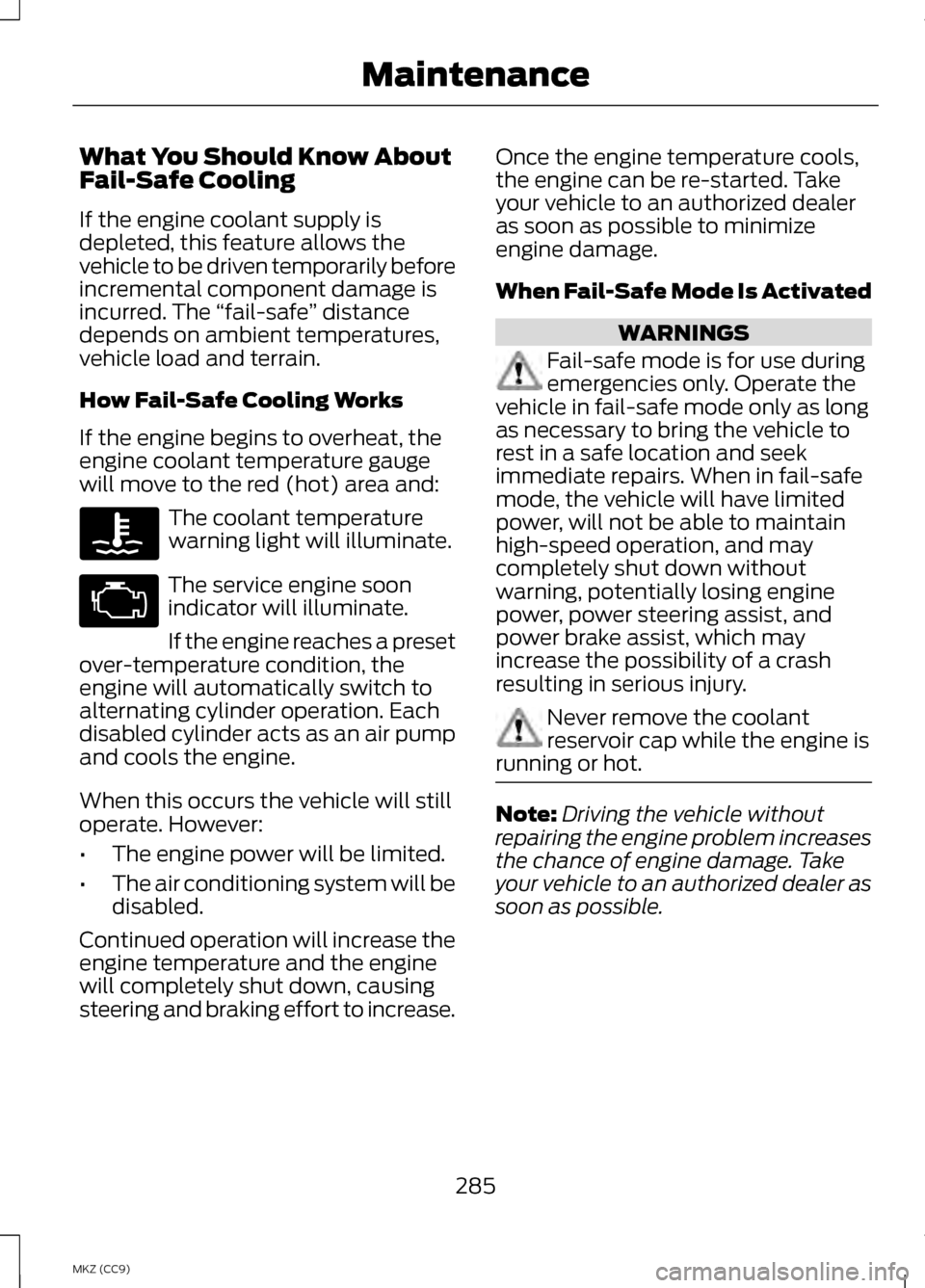
will move to the red (hot) area and: The coolant temperature
warning light will illuminate.
The service engine soon
indicator will illuminate.
If the engine reaches a preset
over-temperature condition, the
engine will automatically switch to
alternating cylinder operation. Each
disabled cylinder acts as an air pump
and cools the engine.
When this occurs the vehicle will still
operate. However:
• The engine power will be limited.
• The air conditioning system will be
disabled.
Continued operation will increase the
engine temperature and the engine
will completely shut down, causing
steering and braking effort to increase. Once the engine temperature cools,
the engine can be re-started. Take
your vehicle to an authorized dealer
as soon as possible to minimize
engine damage.
When Fail-Safe Mode Is Activated WARNINGS
Fail-safe mode is for use during
emergencies only. Operate the
vehicle in fail-safe mode only as long
as necessary to bring the vehicle to
rest in a safe location and seek
immediate repairs. When in fail-safe
mode, the vehicle will have limited
power, will not be able to maintain
high-speed operation, and may
completely shut down without
warning, potentially losing engine
power, power steering assist, and
power brake assist, which may
increase the possibility of a crash
resulting in serious injury. Never remove the coolant
reservoir cap while the engine is
running or hot. Note:
Driving the vehicle without
repairing the engine problem increases
the chance of engine damage. Take
your vehicle to an authorized dealer as
soon as possible.
285
MKZ (CC9) Maintenance
Page 290 of 475
Note:
If your battery has a
cover/shield, make sure it is reinstalled
after the battery has been cleaned or
replaced.
Note: See an authorized dealer for low
voltage battery access, testing, or
replacement.
When a low voltage battery
replacement is necessary, see an
authorized dealer to replace the low
voltage battery with a Ford
recommended replacement low
voltage battery that matches the
electrical requirements of the vehicle
To ensure proper operation of the
battery management system (BMS),
do not allow a technician to connect
any electrical device ground
connection directly to the low voltage
battery negative post. A connection
at the low voltage battery negative
post can cause inaccurate
measurements of the battery
condition and potential incorrect
system operation.
Note: If a person adds electrical or
electronic accessories or components
to the vehicle, the accessories or
components may adversely affect the
low voltage battery performance and
durability and may also affect the
performance of other electrical
systems in the vehicle.
For longer, trouble-free operation,
keep the top of the battery clean and
dry. Also, make certain the battery
cables are always tightly fastened to
the battery terminals. If you see any corrosion on the battery
or terminals, remove the cables from
the terminals and clean with a wire
brush. You can neutralize the acid with
a solution of baking soda and water.
When a battery replacement is
required, the battery should only be
replaced with a Ford recommended
replacement battery that matches
the electrical requirements of the
vehicle.
Because your vehicle
’s engine is
electronically-controlled by a
computer, some engine control
settings are maintained by power
from the low voltage battery. Some
engine computer settings, like the idle
trim and fuel trim strategy, optimize
the driveability and performance of
the engine. Some other computer
settings, like the clock and radio
station presets, are also maintained
in memory by power from the low
voltage battery. When a technician
disconnects and connects the low
voltage battery, these settings are
erased. Complete the following
procedure in order to restore the
settings:
1. With the vehicle at a complete stop, set the parking brake.
2. Shift the transmission into P.
3. Turn off all accessories.
4. Step on the brake pedal and start the vehicle.
288
MKZ (CC9) Maintenance
Page 291 of 475
5. Run the engine until it reaches
normal operating temperature.
While the engine is warming up,
complete the following: Reset the
clock. See Audio System (page
134). Reset the power windows
bounce-back feature. See
Windows and Mirrors (page 88).
Reset the radio station presets.
See
Audio System (page 134).
6. Allow the engine to idle for at least
one minute. If the engine turns off,
step on the accelerator to start the
engine.
7. While the engine is running, step on the brake pedal and shift the
transmission to N.
8. Allow the engine to run for at least
one minute by pressing on the
accelerator pedal.
9. Drive the vehicle at least 10 miles (16 kilometers) to completely
relearn the idle and fuel trim
strategy.
Note: If you do not allow the engine to
relearn the idle and fuel trim strategy,
the idle quality of your vehicle may be
adversely affected until the engine
computer eventually relearns the idle
trim and fuel trim strategy.
Note: Always dispose of automotive
batteries in a responsible manner.
Follow your local authorized standards
for disposal. Call your local authorized
recycling center to find out more about
recycling automotive batteries. Note:
It is recommended that the
negative battery cable terminal be
disconnected from the battery if you
plan to store your vehicle for an
extended period of time.
CHECKING THE WIPER
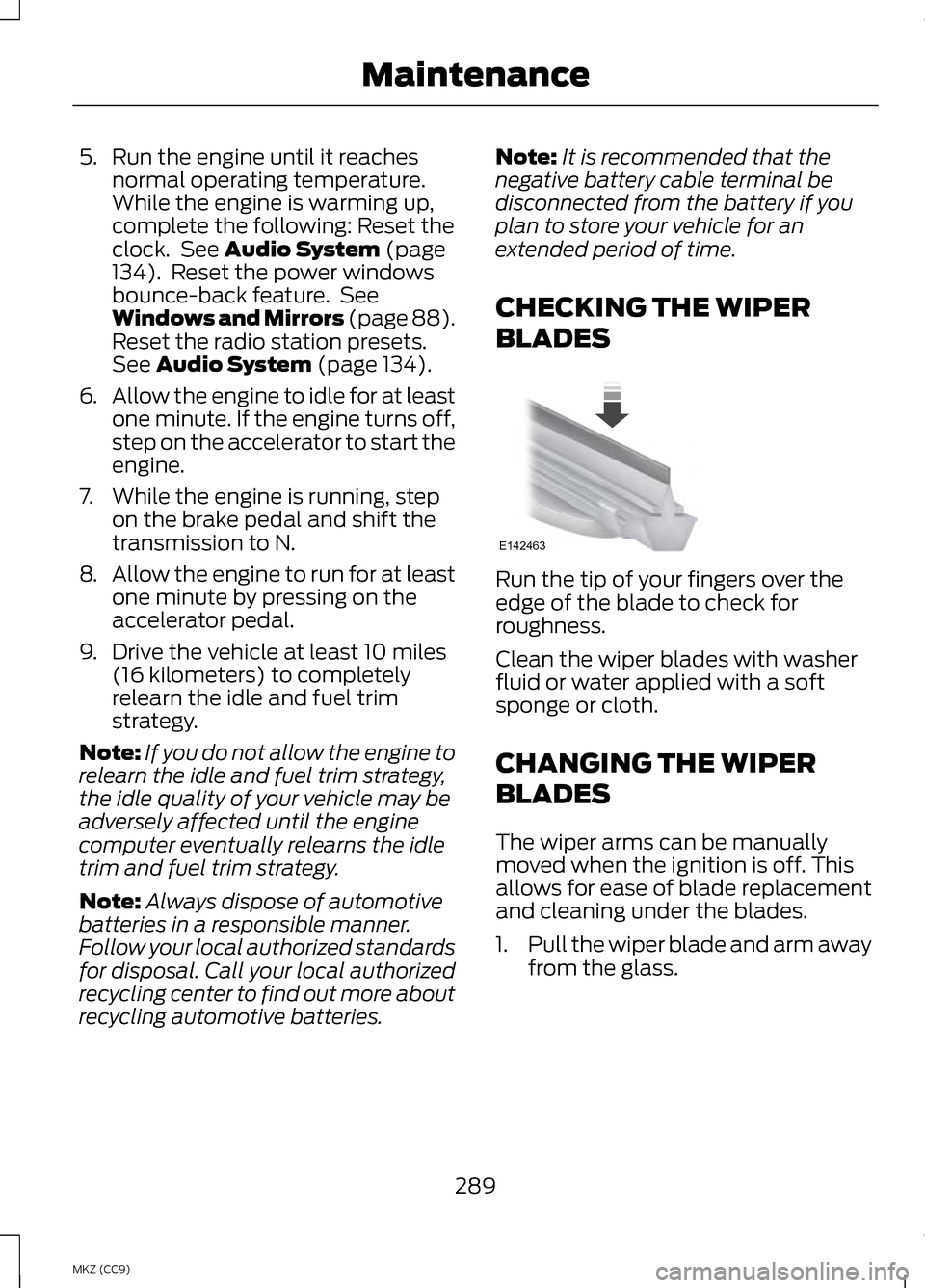
BLADES Run the tip of your fingers over the
edge of the blade to check for
roughness.
Clean the wiper blades with washer
fluid or water applied with a soft
sponge or cloth.
CHANGING THE WIPER
BLADES
The wiper arms can be manually
moved when the ignition is off. This
allows for ease of blade replacement
and cleaning under the blades.
1.
Pull the wiper blade and arm away
from the glass.
289
MKZ (CC9) MaintenanceE142463
Page 303 of 475
Note:
During extended periods of
vehicle storage (30 days or more), fuel
may deteriorate due to oxidation. Add
a quality gas stabilizer product to your
vehicle's fuel system whenever actual
or expected storage periods exceed 30
days. Follow the instructions on the
additive label. your vehicle should then
be operated at idle speed to circulate
the additive throughout the fuel
system.
Cooling system
• Protect against freezing
temperatures.
• When removing your vehicle from
storage, check coolant fluid level.
Confirm there are no cooling
system leaks, and fluid is at the
recommended level.
Battery
• Check and recharge as necessary.
Keep connections clean.
• If storing your vehicle for more
than 30 days without recharging
the battery, it may be advisable to
disconnect the battery cables to
ensure battery charge is
maintained for quick starting.
Note: If battery cables are
disconnected, it will be necessary to
reset memory features.
Brakes
• Make sure brakes and parking
brake are fully released. Tires
•
Maintain recommended air
pressure.
Miscellaneous
• Make sure all linkages, cables,
levers and pins under your vehicle
are covered with grease to prevent
rust.
• Move vehicles at least 25 feet (8
meters) every 15 days to lubricate
working parts and prevent
corrosion.
Removing Vehicle From
Storage
When your vehicle is ready to come
out of storage, do the following:
• Wash your vehicle to remove any
dirt or grease film build-up on
window surfaces.
• Check windshield wipers for any
deterioration.
• Check under the hood for any
foreign material that may have
collected during storage
(mice/squirrel nests).
• Check the exhaust for any foreign
material that may have collected
during storage.
• Check tire pressures and set tire
inflation per the Tire Label.
• Check brake pedal operation. Drive
your vehicle 15 feet (4.5 meters)
back and forth to remove rust
build-up.
301
MKZ (CC9) Vehicle Care
Page 350 of 475
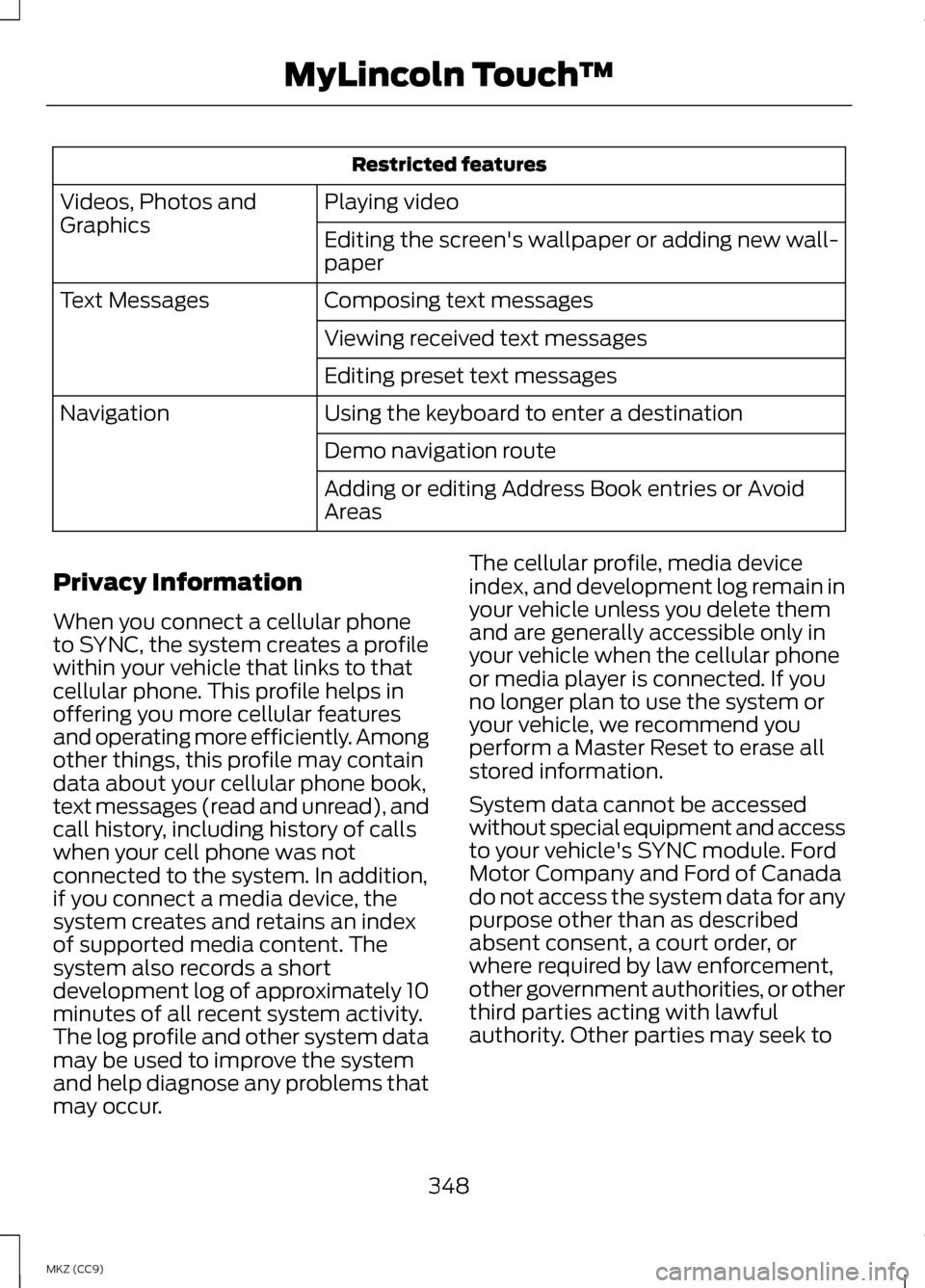
Restricted features
Playing video
Videos, Photos and
Graphics
Editing the screen's wallpaper or adding new wall-
paper
Composing text messages
Text Messages
Viewing received text messages
Editing preset text messages
Using the keyboard to enter a destination
Navigation
Demo navigation route
Adding or editing Address Book entries or Avoid
Areas
Privacy Information
When you connect a cellular phone
to SYNC, the system creates a profile
within your vehicle that links to that
cellular phone. This profile helps in
offering you more cellular features
and operating more efficiently. Among
other things, this profile may contain
data about your cellular phone book,
text messages (read and unread), and
call history, including history of calls
when your cell phone was not
connected to the system. In addition,
if you connect a media device, the
system creates and retains an index
of supported media content. The
system also records a short
development log of approximately 10
minutes of all recent system activity.
The log profile and other system data
may be used to improve the system
and help diagnose any problems that
may occur. The cellular profile, media device
index, and development log remain in
your vehicle unless you delete them
and are generally accessible only in
your vehicle when the cellular phone
or media player is connected. If you
no longer plan to use the system or
your vehicle, we recommend you
perform a Master Reset to erase all
stored information.
System data cannot be accessed
without special equipment and access
to your vehicle's SYNC module. Ford
Motor Company and Ford of Canada
do not access the system data for any
purpose other than as described
absent consent, a court order, or
where required by law enforcement,
other government authorities, or other
third parties acting with lawful
authority. Other parties may seek to
348
MKZ (CC9) MyLincoln Touch
™
Page 351 of 475
access the information independently
of Ford Motor Company and Ford of
Canada. For further privacy
information, see the sections on 911
Assist, Vehicle Health Report, and
Traffic, Directions and Information.
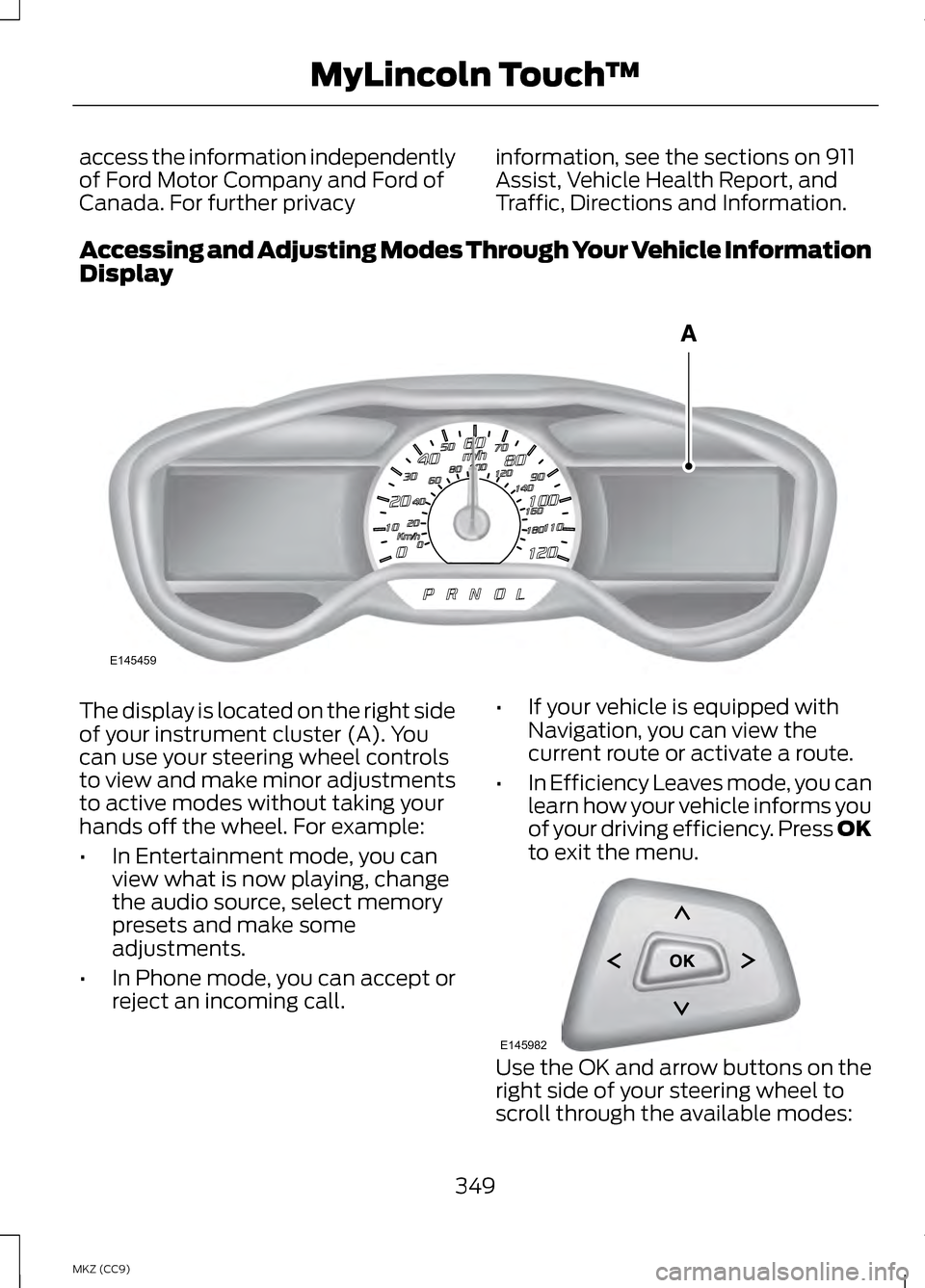
Accessing and Adjusting Modes Through Your Vehicle Information
Display The display is located on the right side
of your instrument cluster (A). You
can use your steering wheel controls
to view and make minor adjustments
to active modes without taking your
hands off the wheel. For example:
•
In Entertainment mode, you can
view what is now playing, change
the audio source, select memory
presets and make some
adjustments.
• In Phone mode, you can accept or
reject an incoming call. •
If your vehicle is equipped with
Navigation, you can view the
current route or activate a route.
• In Efficiency Leaves mode, you can
learn how your vehicle informs you
of your driving efficiency. Press OK
to exit the menu. Use the OK and arrow buttons on the
right side of your steering wheel to
scroll through the available modes:
349
MKZ (CC9) MyLincoln Touch
™E145459 E145982