lock LINCOLN MKZ HYBRID 2013 Workshop Manual
[x] Cancel search | Manufacturer: LINCOLN, Model Year: 2013, Model line: MKZ HYBRID, Model: LINCOLN MKZ HYBRID 2013Pages: 475, PDF Size: 3.89 MB
Page 169 of 475
Note:
Since engine speed is controlled
by the transmission, it may seem
elevated at times. This is normal hybrid
operation and helps deliver fuel
efficiency and performance.
Neutral: It is not recommended to
idle the vehicle in position N for an
extended period of time because this
will discharge your high voltage
battery and decrease fuel economy.
The engine will not start, and cannot
provide power to the hybrid system in
position
N.
Low Gear:
Low gear (position L) is
designed to mimic the enhanced
engine braking available in non-hybrid
vehicles. Low gear will produce high
engine speeds to provide necessary
engine braking. This is normal and will
not damage your vehicle. In low gear,
the gas engine will remain on more
often than in position
D.
Unique Hybrid Operating
Characteristics
Your vehicle behaves differently
compared to a non-hybrid. Here is a
description of the major differences:
Battery: Your Hybrid is equipped with
a high voltage battery. A cool battery
ensures battery life and provides the
best possible performance. Your
hybrid high voltage battery may
periodically re-condition itself to
ensure maximum efficiency. You may
notice slight changes in driveability
during this process, but it is an
important part of your hybrid's high
voltage battery optimization features. Cabin air cools the high voltage
battery by pulling air through vents in
the rear package tray. Avoid placing
objects on the package tray which
could block air flow through the vents.
If you leave your vehicle inoperative
for over 31 days, it may be necessary
to jumpstart the vehicle. See
Roadside Emergencies
(page 250).
Engine:
The engine speed in your
hybrid is not directly tied to your
vehicle speed. Your vehicle's engine
and transmission are designed to
deliver the power you need at the
most efficient engine speed. During
heavy accelerations, your hybrid may
reach high engine speeds (up to 6000
RPM).
In prolonged mountainous driving, you
may see the engine tachometer
changing without your input. This is
intentional and maintains the battery
charge level. You may also notice
during extended downhill driving that
your engine continues to run instead
of shutting off.
During this engine braking, the engine
stays on, but it is not using any fuel.
You may also hear a slight whine or
whistle when operating your vehicle.
This is the normal operation of the
electric generator in the hybrid
system.
167
MKZ (CC9) Unique Driving Characteristics
Page 184 of 475
GENERAL INFORMATION
WARNING
This battery pack shall only be
serviced by an authorized electric
vehicle technician. Improper handling
can result in personal injury or death. Note:
The high-voltage battery does
not require regular service
maintenance.
Your vehicle consists of various
high-voltage components and wiring.
All of the high-voltage power flows
through specific wiring assemblies
which are labeled as such or are
covered with a solid orange convolute,
or orange striped tape, or both. Do not
come in contact with these
components.
The high-voltage battery system is a
high-voltage, lithium-ion battery
system. The pack is located in the rear
cargo area. The high-voltage battery
system uses an air cooled system to
regulate the high-voltage battery
temperature and help maximize
high-voltage battery life. Note:
The high-voltage battery is
equipped with air vents in the package
tray that help to regulate its
temperature. It is important to keep
these openings free of obstructions. Do
not block the flow of cabin air to this
area.
HIGH-VOLTAGE SERVICE
DISCONNECT
The high-voltage service disconnect
shuts off power from the high-voltage
battery.
Note: There is a disconnect circuit in
your vehicle. Disconnecting the circuit
will automatically disable the
high-voltage battery.
To disable the battery and stop all
high-voltage electric activity in the
vehicle you can access high-voltage
disconnect circuit. To do this, you
must unplug the circuit from the
circuit port connected to the battery.
The high-voltage service disconnect
is located behind the rear fold down
seats. Disabling the High-Voltage Battery
1. Fold down the rear seats.
182
MKZ (CC9) High Voltage BatteryE159505 E159506
Page 188 of 475
Note:
If the driver attempts to leave
the vehicle while it is in gear, the vehicle
will automatically shift into P (Park).
Seatbelt and door monitors determine
the driver's intent and makes the shift
for you. During this time a
Transmission not in Park
message
will appear in the display screen,
prompting the driver to make the shift.
To put the vehicle in gear with the door
open perform steps 1-4. See the
Automatic Return to Park
section in
this chapter for more information on
this feature.
Note: To put your vehicle in gear with
the door open, perform steps 1-4. See
the
Automatic Return to Park section
in this chapter for more information on
this feature.
P (Park)
This position locks the transmission
and prevents the front wheels from
turning. Always come to a complete
stop before putting your vehicle into
and out of P (Park). An audible chime
will sound when P (Park) is manually
selected.
When the ignition is turned off, the
vehicle will automatically shift into
P
(Park). If the ignition is turned off
while the vehicle is moving, it will first
shift into
N (Neutral) until a slow
enough speed is reached. The vehicle
will then shift into
P (Park)
automatically.
Automatic Return to Park
Note: This feature will not operate
when the vehicle is in Stay in Neutral
mode or neutral tow. Your vehicle has a safety feature that
will automatically shift your vehicle
into
P (Park) when any of the
following circumstances are met:
• Turn the ignition off
• Open the driver's door with your
seat belt unlatched
• Unlatching your seatbelt while the
driver's door is open
If you turn the ignition off while your
vehicle is moving, your vehicle will first
shift into N (Neutral) until it slows
down enough to shift into P (Park)
automatically.
Note: If you have waited an extended
period of time, (2-15 minutes) before
starting your vehicle, unlatching your
safety belt will cause this feature to
activate, even with the driver's door
closed.
Note: This feature may not work
properly if the door ajar switch is
malfunctioning. If your door ajar
indicator does not illuminate when you
open the driver ’s door or the indicator
illuminates with the driver ’s door
closed. See your authorized dealer.
R (Reverse)
With the transmission in
R (Reverse),
the vehicle will move backward.
Always come to a complete stop
before shifting into and out of
R
(Reverse).
186
MKZ (CC9) Transmission
Page 190 of 475
L (Low)
•
Provides maximum engine braking.
• The transmission may be put into
L (Low) at any vehicle speed.
Brake-Shift Interlock Override WARNINGS
Do not drive your vehicle until
you verify that the brake lamps
are working. When doing this procedure, you
will be taking the vehicle out of
park which means the vehicle can roll
freely. To avoid unwanted vehicle
movement, always fully set the
parking brake prior to doing this
procedure. Use wheel chocks if
appropriate. If the parking brake is fully
released, but the brake warning
lamp remains illuminated, the brakes
may not be working properly. See your
authorized dealer. Note:
See your authorized dealer as
soon as possible if this procedure is
used.
Note: For some markets this feature
will be disabled.
Note: This feature will only function if
your 12-volt battery has power. Use the brake-shift interlock override
procedure to put the vehicle in gear in
the event of an electrical malfunction
or if your vehicle has a dead battery.
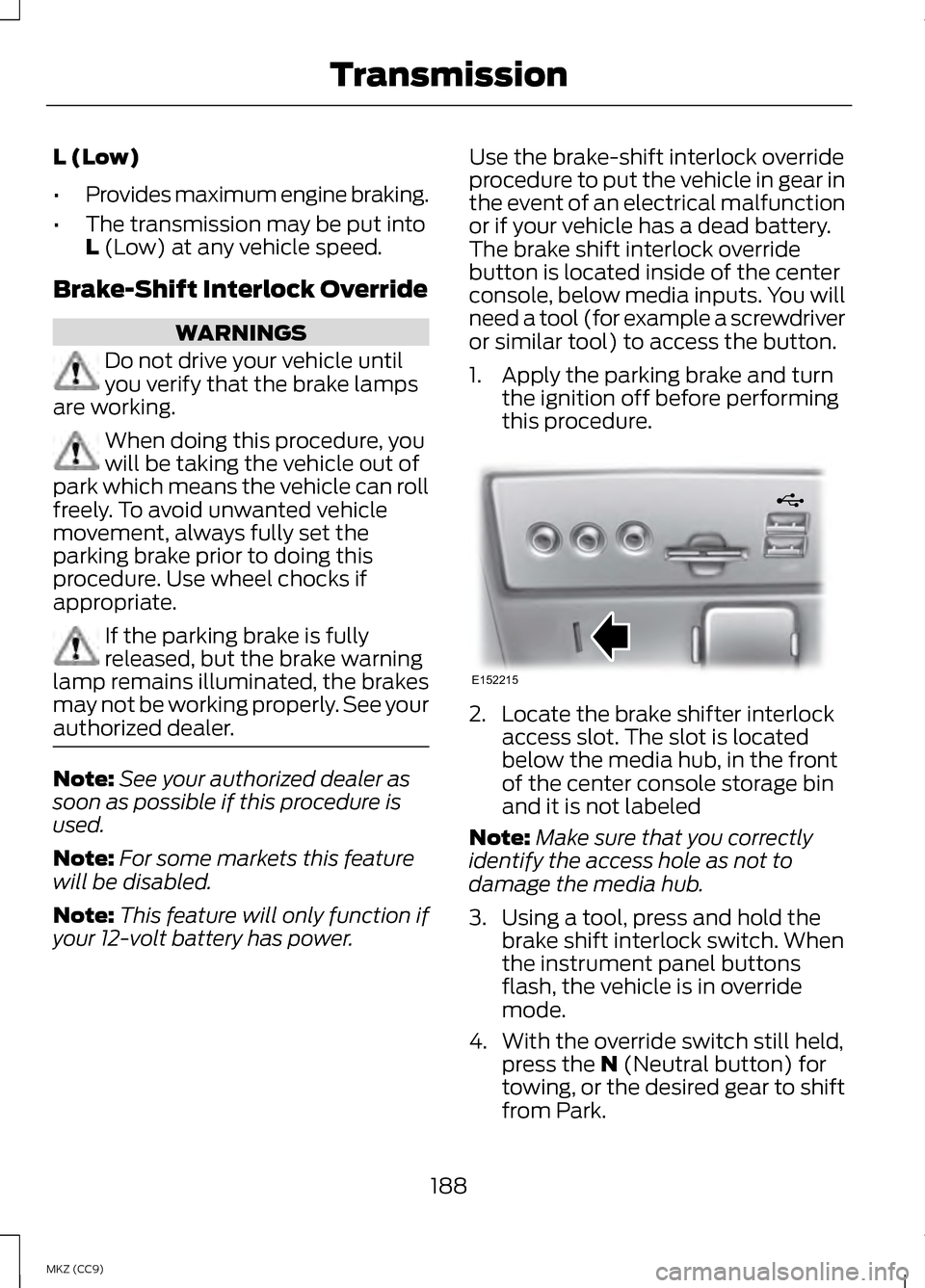
The brake shift interlock override
button is located inside of the center
console, below media inputs. You will
need a tool (for example a screwdriver
or similar tool) to access the button.
1. Apply the parking brake and turn
the ignition off before performing
this procedure. 2. Locate the brake shifter interlock
access slot. The slot is located
below the media hub, in the front
of the center console storage bin
and it is not labeled
Note: Make sure that you correctly
identify the access hole as not to
damage the media hub.
3. Using a tool, press and hold the brake shift interlock switch. When
the instrument panel buttons
flash, the vehicle is in override
mode.
4. With the override switch still held, press the
N (Neutral button) for
towing, or the desired gear to shift
from Park.
188
MKZ (CC9) TransmissionE152215
Page 193 of 475
GENERAL INFORMATION
Note:
Occasional brake noise is
normal. If a metal-to-metal,
continuous grinding or continuous
squeal sound is present, the brake
linings may be worn-out. Have the
system checked by an authorized
dealer. If the vehicle has continuous
vibration or shudder in the steering
wheel while braking, have it checked
by an authorized dealer.
Note: Brake dust may accumulate on
the wheels, even under normal driving
conditions. Some dust is inevitable as
the brakes wear and does not
contribute to brake noise. See
Cleaning the Alloy Wheels (page 299). See Warning Lamps and
Indicators (page 98).
Wet brakes result in reduced braking
efficiency. Gently press the brake
pedal a few times when driving from
a car wash or standing water to dry
the brakes.
Brake Over Accelerator
In the event the accelerator pedal
becomes stuck or entrapped, apply
steady and firm pressure to the brake
pedal to slow the vehicle and reduce
engine power. If you experience this
condition, apply the brakes and bring
your vehicle to a safe stop. Move the
transmission selector lever to position P,
switch the engine off and apply the
parking brake. Inspect the accelerator
pedal for any interference. If none are
found and the condition persists, have
your vehicle towed to the nearest
authorized dealer.
Brake Assist
Brake assist detects when you brake
heavily by measuring the rate at which
you press the brake pedal. It provides
maximum braking efficiency as long
as you press the pedal. Brake assist
can reduce stopping distances in
critical situations.
Anti-lock Brake System
This system helps you maintain
steering control during emergency
stops by keeping the brakes from
locking. This lamp momentarily
illuminates when you turn
the ignition on. If the light
does not illuminate during start up,
remains on or flashes, the anti-lock
braking system may be disabled. Have
the system checked by an authorized
dealer. If the system is disabled,
normal braking is still
effective. If the brake
warning lamp illuminates when you
release the parking brake, have your
system checked by an authorized
dealer.
191
MKZ (CC9) BrakesE144522 E144522
Page 194 of 475
Regenerative Braking System
This feature is used to simulate the
engine braking of an internal
combustion engine and assist the
standard brake system while
recovering some of the energy of
motion and storing it in the battery to
improve fuel economy. The standard
brake system is designed to fully stop
the car if regenerative braking is not
available. During regenerative braking,
the motor is spun as a generator to
create electrical current. This
recharges the battery and slows the
vehicle. In effect, once the accelerator
pedal is released, the motor changes
from an energy user to an energy
producer.
When you release the accelerator
pedal or press the brake pedal, the
brake controller automatically detects
the amount of deceleration requested
and optimizes how much of the
deceleration will be produced by
regenerative braking. The remaining
portion is generated by standard
friction braking. When the battery is
almost fully charged, the amount of
regenerative braking is limited to avoid
overcharging, and the requested
deceleration is produced by standard
friction braking alone.
Regenerative braking does not take
the place of the standard friction
brakes; it only assists them.
Regenerative braking has also been
designed to interact with the anti-lock
brake system. Regenerative braking
is disabled when the anti-lock brake
system is activated or the battery is
fully charged.
HINTS ON DRIVING WITH
ANTI-LOCK BRAKES
Note:
When the system is operating,
the brake pedal will pulse and may
travel further. Maintain pressure on the
brake pedal. You may also hear a noise
from the system. This is normal.
The anti-lock braking system will not
eliminate the risks when:
• you drive too closely to the vehicle
in front of you
• your vehicle is hydroplaning
• you take corners too fast
• the road surface is poor.
ELECTRIC PARKING BRAKE
The electric parking brake replaces
the conventional handbrake. The
operating switch is located on the
instrument panel to the left of the
steering wheel. WARNING
Always set the parking brake and
leave your vehicle with the
transmission selector in position P. Note:
When you apply the electric
parking brake in certain conditions, for
example on a steep hill, the electric
parking brake may reapply the brakes
within three to ten minutes.
Note: You may notice various noises
when you apply and release the electric
parking brake. This is normal and no
cause for concern.
192
MKZ (CC9) Brakes
Page 195 of 475
Applying the electric parking
brake
WARNING
If the brake system warning lamp
does not illuminate or flashes,
there could be a problem with your
electric parking brake. Have the
system checked by an authorized
dealer as soon as possible. Note:
The brake system warning lamp
will illuminate for ten seconds, if the
ignition is turned off after the electric
parking brake has been applied, or the
electric parking brake has been applied
after the ignition has been turned off.
Note: The electric parking brake will
not automatically apply. You must
apply the electric parking brake using
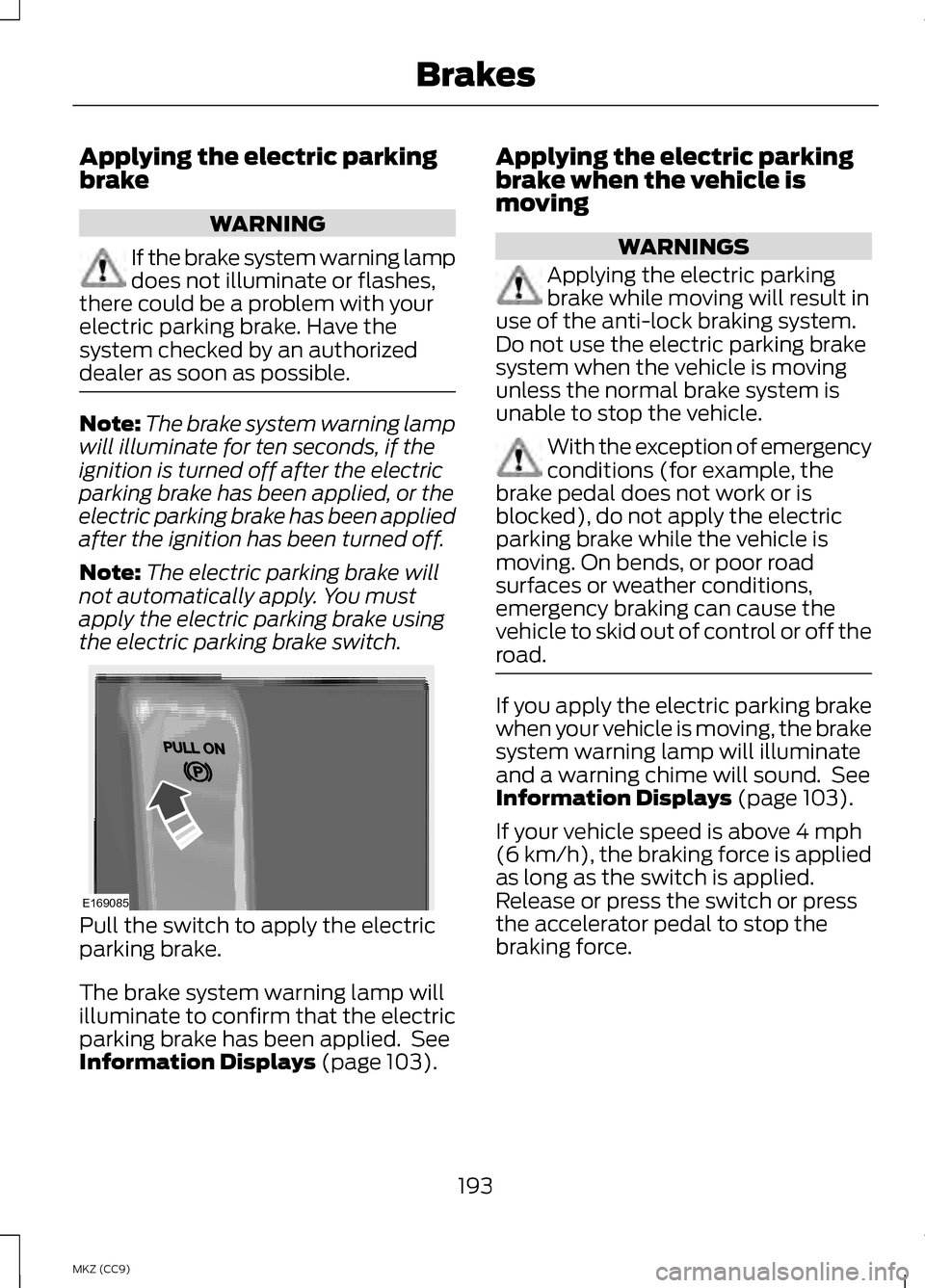
the electric parking brake switch. Pull the switch to apply the electric
parking brake.
The brake system warning lamp will
illuminate to confirm that the electric
parking brake has been applied. See
Information Displays (page 103). Applying the electric parking
brake when the vehicle is
moving WARNINGS
Applying the electric parking
brake while moving will result in
use of the anti-lock braking system.
Do not use the electric parking brake
system when the vehicle is moving
unless the normal brake system is
unable to stop the vehicle. With the exception of emergency
conditions (for example, the
brake pedal does not work or is
blocked), do not apply the electric
parking brake while the vehicle is
moving. On bends, or poor road
surfaces or weather conditions,
emergency braking can cause the
vehicle to skid out of control or off the
road. If you apply the electric parking brake
when your vehicle is moving, the brake
system warning lamp will illuminate
and a warning chime will sound. See
Information Displays
(page 103).
If your vehicle speed is above 4 mph
(6 km/h), the braking force is applied
as long as the switch is applied.
Release or press the switch or press
the accelerator pedal to stop the
braking force.
193
MKZ (CC9) BrakesE169085
Page 201 of 475
PARKING AID (IF EQUIPPED)
WARNINGS
To help avoid personal injury,
please read and understand the
limitations of the system as contained
in this section. Sensing is only an aid
for some (generally large and fixed)
objects when moving in reverse on a
flat surface at parking speeds. Traffic
control systems, inclement weather,
air brakes, and external motors and
fans may also affect the function of
the sensing system; this may include
reduced performance or a false
activation. To help avoid personal injury,
always use caution when in R
(Reverse) and when using the sensing
system. This system is not designed to
prevent contact with small or
moving objects. The system is
designed to provide a warning to
assist the driver in detecting large
stationary objects to avoid damaging
the vehicle. The system may not
detect smaller objects, particularly
those close to the ground. Certain add-on devices such as
large trailer hitches, bike or
surfboard racks and any device that
may block the normal detection zone
of the system, may create false beeps. Note:
Keep the sensors, located on the
bumper or fascia, free from snow, ice
and large accumulations of dirt. If the
sensors are covered, the system ’s
accuracy can be affected. Do not clean
the sensors with sharp objects.
Note: If your vehicle sustains damage
to the bumper or fascia, leaving it
misaligned or bent, the sensing zone
may be altered causing inaccurate
measurement of obstacles or false
alarms.
Note: If your vehicle is equipped with
MyKey®, it is possible to prevent
turning the sensing system off. See
MyKey ™
(page 57).
The sensing system warns the driver
of obstacles within a certain range of
the bumper area. The system turns on
automatically whenever the ignition
is switched on.
When receiving a detection warning,
the radio volume is reduced to a
predetermined level. After the warning
goes away, the radio volume returns
to the previous level.
The system can be switched off
through the information display menu
or from the pop-up message that
appears once the transmission is
shifted into
R. See General
Information (page 103).
If a fault is present in the system, a
warning message appears in the
information display and does not
allow the driver to switch the faulted
system on. See
(page 103).
199
MKZ (CC9) Parking Aids
Page 206 of 475
When automatic steering is finished,
the touch screen displays a message
and a chime sounds, indicating that
the active park assist process is done.
The driver is responsible for checking
the parking job and making any
necessary corrections before putting
the transmission in P (Park).
Deactivating the Park Assist
Feature
The system can be deactivated
manually by:
• pressing the active park assist
button
• grabbing the steering wheel
• driving above approximately 50
mph (80 km/h) for 30 seconds
during an active park search •
driving above 6 mph (10 km/h)
during automatic steering
• turning off the traction control
system.
Certain vehicle conditions can also
deactivate the system, such as:
• Traction control has activated on
a slippery or loose surface.
• There is an anti-lock brake system
activation or failure.
• Something touches the steering
wheel.
If a problem occurs with the system,
a warning message is displayed,
followed by a chime. Occasional
system messages may occur in
normal operation. For recurring or
frequent system faults, contact an
authorized dealer to have your vehicle
serviced.
Troubleshooting the System The system does not look for a space
The traction control system may be off
The transmission is in R (Reverse); the vehicle must be moving forward to
detect a parking space The system does not offer a particular space
Something may be contacting the front bumper or side sensors
There is not enough room on both sides of the vehicle in order to park
There is not enough space for the parking maneuver on the opposite side of
the parking space
204
MKZ (CC9) Parking Aids
Page 218 of 475
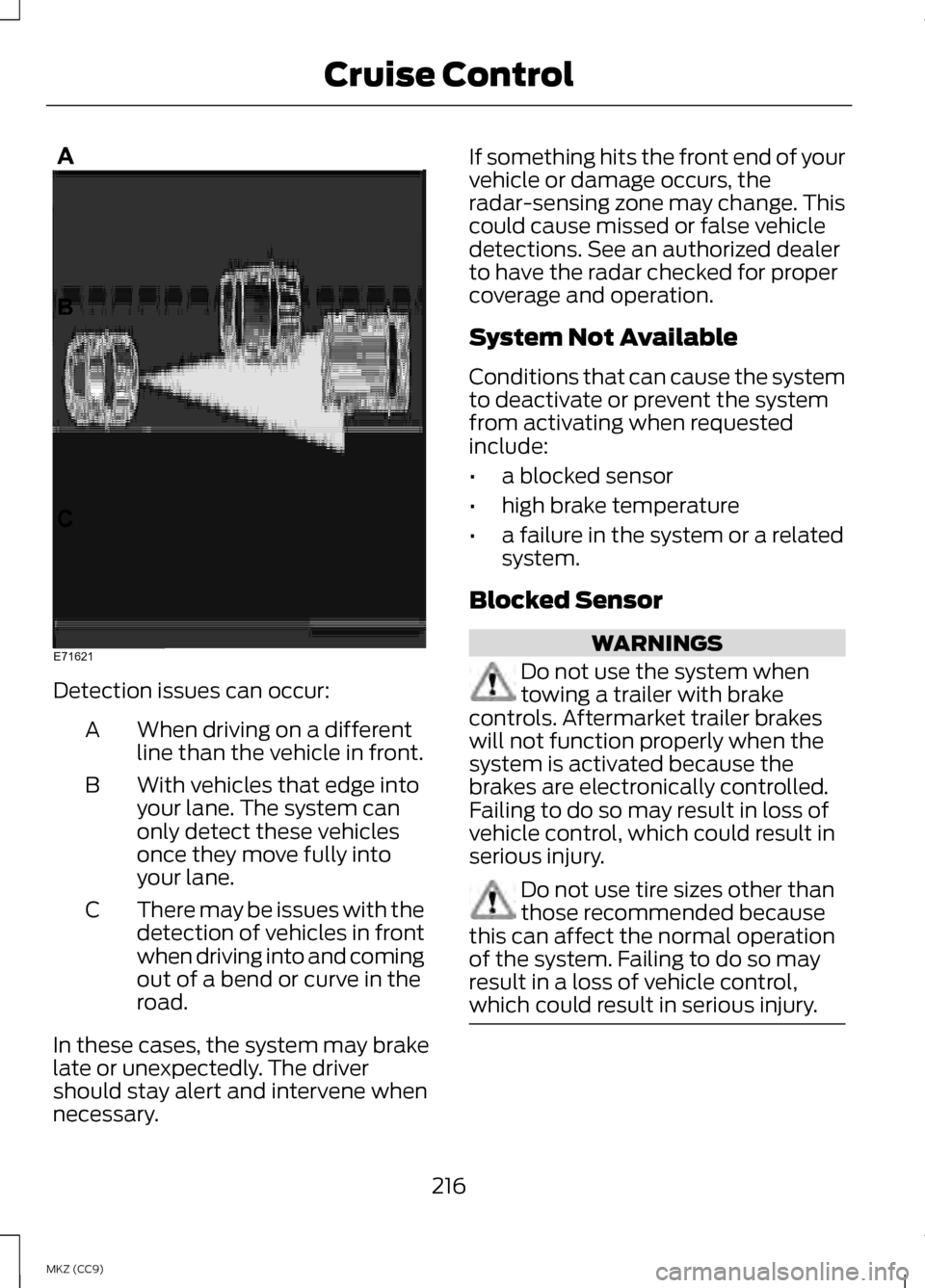
Detection issues can occur:
When driving on a different
line than the vehicle in front.
A
With vehicles that edge into
your lane. The system can
only detect these vehicles
once they move fully into
your lane.
B
There may be issues with the
detection of vehicles in front
when driving into and coming
out of a bend or curve in the
road.
C
In these cases, the system may brake
late or unexpectedly. The driver
should stay alert and intervene when
necessary. If something hits the front end of your
vehicle or damage occurs, the
radar-sensing zone may change. This
could cause missed or false vehicle
detections. See an authorized dealer
to have the radar checked for proper
coverage and operation.
System Not Available
Conditions that can cause the system
to deactivate or prevent the system
from activating when requested
include:
•
a blocked sensor
• high brake temperature
• a failure in the system or a related
system.
Blocked Sensor WARNINGS
Do not use the system when
towing a trailer with brake
controls. Aftermarket trailer brakes
will not function properly when the
system is activated because the
brakes are electronically controlled.
Failing to do so may result in loss of
vehicle control, which could result in
serious injury. Do not use tire sizes other than
those recommended because
this can affect the normal operation
of the system. Failing to do so may
result in a loss of vehicle control,
which could result in serious injury. 216
MKZ (CC9) Cruise ControlE71621