lock LINCOLN MKZ HYBRID 2013 Manual Online
[x] Cancel search | Manufacturer: LINCOLN, Model Year: 2013, Model line: MKZ HYBRID, Model: LINCOLN MKZ HYBRID 2013Pages: 475, PDF Size: 3.89 MB
Page 292 of 475
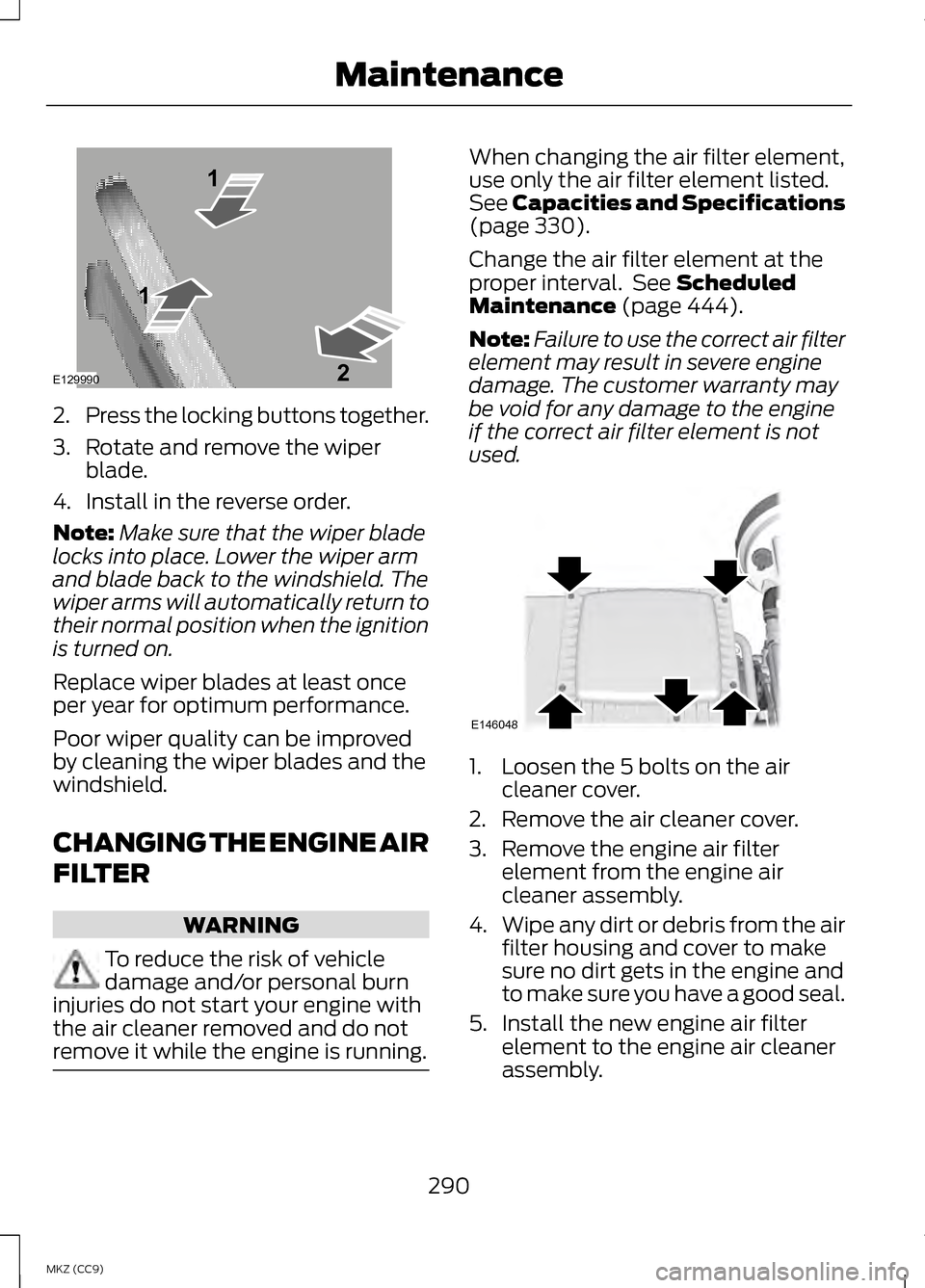
2.
Press the locking buttons together.
3. Rotate and remove the wiper blade.
4. Install in the reverse order.
Note: Make sure that the wiper blade
locks into place. Lower the wiper arm
and blade back to the windshield. The
wiper arms will automatically return to
their normal position when the ignition
is turned on.
Replace wiper blades at least once
per year for optimum performance.
Poor wiper quality can be improved
by cleaning the wiper blades and the
windshield.
CHANGING THE ENGINE AIR
FILTER WARNING
To reduce the risk of vehicle
damage and/or personal burn
injuries do not start your engine with
the air cleaner removed and do not
remove it while the engine is running. When changing the air filter element,
use only the air filter element listed.
See Capacities and Specifications
(page 330).
Change the air filter element at the
proper interval. See
Scheduled
Maintenance (page 444).
Note: Failure to use the correct air filter
element may result in severe engine
damage. The customer warranty may
be void for any damage to the engine
if the correct air filter element is not
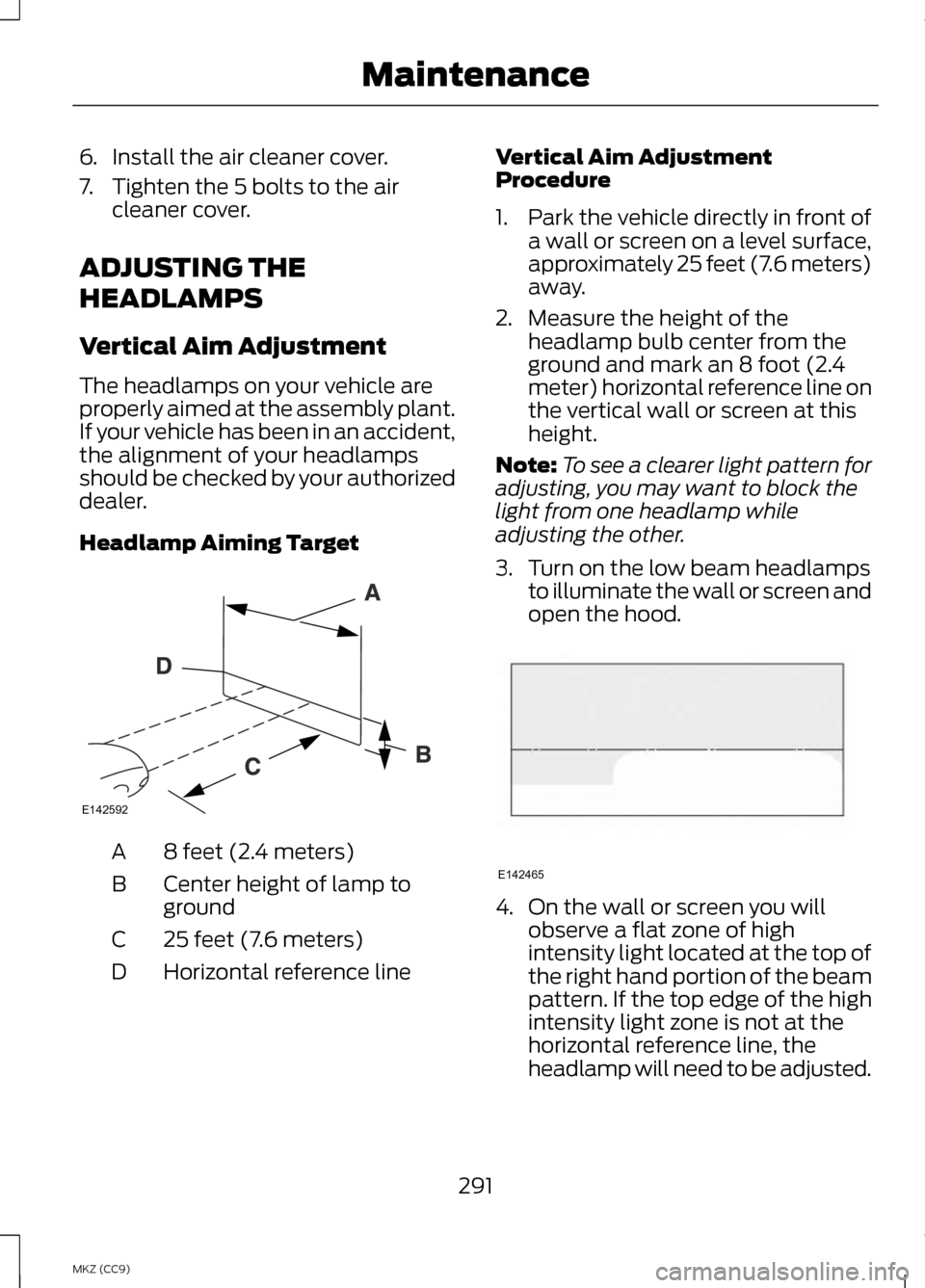
used. 1. Loosen the 5 bolts on the air
cleaner cover.
2. Remove the air cleaner cover.
3. Remove the engine air filter element from the engine air
cleaner assembly.
4. Wipe any dirt or debris from the air
filter housing and cover to make
sure no dirt gets in the engine and
to make sure you have a good seal.
5. Install the new engine air filter element to the engine air cleaner
assembly.
290
MKZ (CC9) MaintenanceE129990
1
1 2 E146048
Page 293 of 475
6.
Install the air cleaner cover.
7. Tighten the 5 bolts to the air cleaner cover.
ADJUSTING THE
HEADLAMPS
Vertical Aim Adjustment
The headlamps on your vehicle are
properly aimed at the assembly plant.
If your vehicle has been in an accident,
the alignment of your headlamps
should be checked by your authorized
dealer.
Headlamp Aiming Target 8 feet (2.4 meters)
A
Center height of lamp to
ground
B
25 feet (7.6 meters)
C
Horizontal reference line
D Vertical Aim Adjustment
Procedure
1.
Park the vehicle directly in front of
a wall or screen on a level surface,
approximately 25 feet (7.6 meters)
away.
2. Measure the height of the headlamp bulb center from the
ground and mark an 8 foot (2.4
meter) horizontal reference line on
the vertical wall or screen at this
height.
Note: To see a clearer light pattern for
adjusting, you may want to block the
light from one headlamp while
adjusting the other.
3. Turn on the low beam headlamps to illuminate the wall or screen and
open the hood. 4. On the wall or screen you will
observe a flat zone of high
intensity light located at the top of
the right hand portion of the beam
pattern. If the top edge of the high
intensity light zone is not at the
horizontal reference line, the
headlamp will need to be adjusted.
291
MKZ (CC9) MaintenanceE142592 E142465
Page 294 of 475
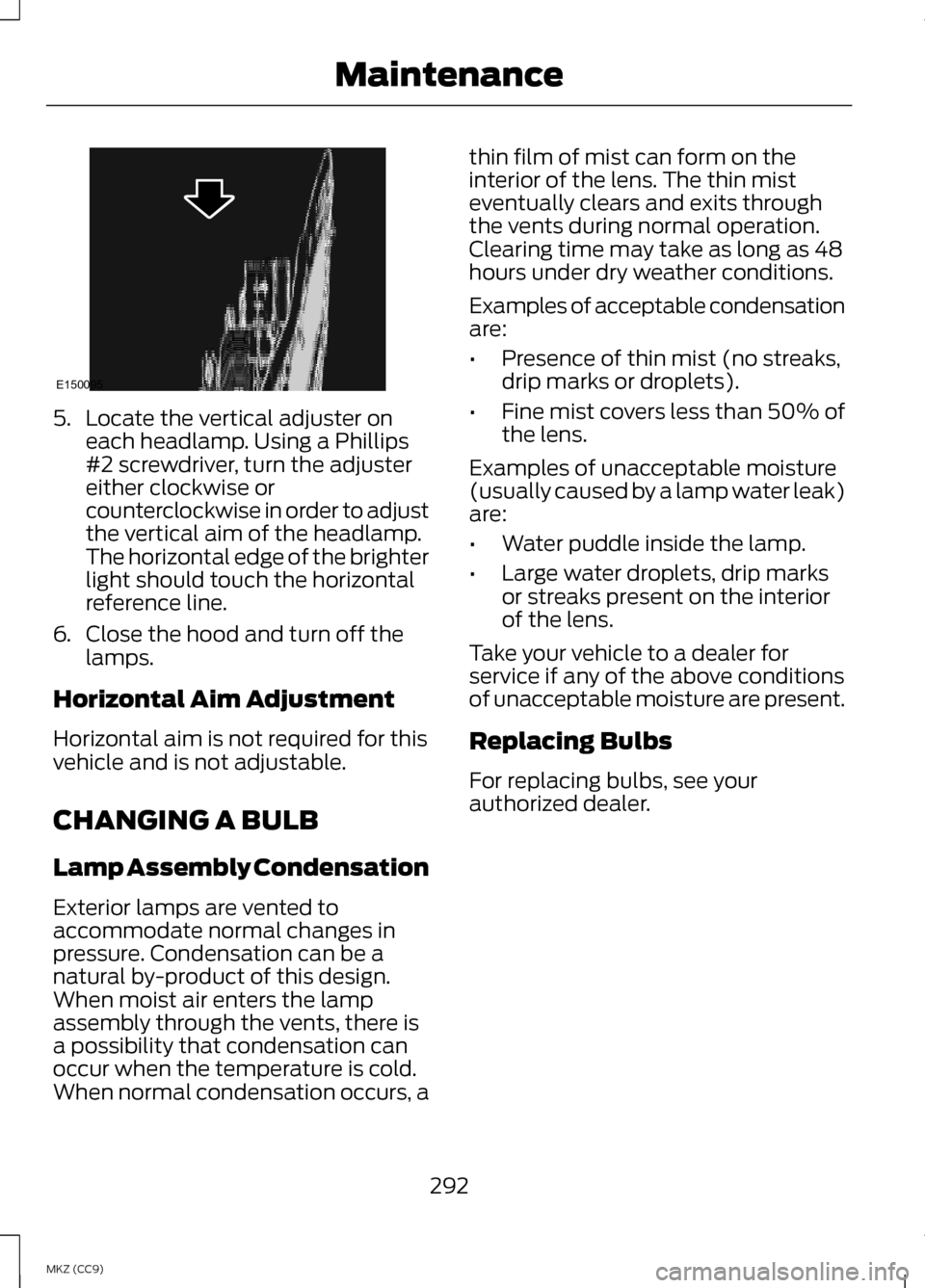
5. Locate the vertical adjuster on
each headlamp. Using a Phillips
#2 screwdriver, turn the adjuster
either clockwise or
counterclockwise in order to adjust
the vertical aim of the headlamp.
The horizontal edge of the brighter
light should touch the horizontal
reference line.
6. Close the hood and turn off the
lamps.
Horizontal Aim Adjustment
Horizontal aim is not required for this
vehicle and is not adjustable.
CHANGING A BULB
Lamp Assembly Condensation
Exterior lamps are vented to
accommodate normal changes in
pressure. Condensation can be a
natural by-product of this design.
When moist air enters the lamp
assembly through the vents, there is
a possibility that condensation can
occur when the temperature is cold.
When normal condensation occurs, a thin film of mist can form on the
interior of the lens. The thin mist
eventually clears and exits through
the vents during normal operation.
Clearing time may take as long as 48
hours under dry weather conditions.
Examples of acceptable condensation
are:
•
Presence of thin mist (no streaks,
drip marks or droplets).
• Fine mist covers less than 50% of
the lens.
Examples of unacceptable moisture
(usually caused by a lamp water leak)
are:
• Water puddle inside the lamp.
• Large water droplets, drip marks
or streaks present on the interior
of the lens.
Take your vehicle to a dealer for
service if any of the above conditions
of unacceptable moisture are present.
Replacing Bulbs
For replacing bulbs, see your
authorized dealer.
292
MKZ (CC9) MaintenanceE150095
Page 298 of 475
When washing and waxing, park your
vehicle in a shaded area out of direct
sunlight. Always wash your vehicle
before applying wax.
•
Use a quality wax that does not
contain abrasives.
• Follow the manufacturer ’s
instructions to apply and remove
the wax.
• Apply a small amount of wax in a
back-and-forth motion, not in
circles.
• Do not allow wax to come in
contact with any non-body
(low-gloss black) colored trim.
The wax will discolor or stain the
parts over time.
•Roof racks.
• Bumpers.
• Grained door handles.
• Side mouldings.
• Mirror housings.
• Windshield cowl area.
• Do not apply wax to glass areas.
• After waxing, your car's paint
should feel smooth, and be free of
streaks and smudges.
CLEANING THE ENGINE
Engines are more efficient when they
are clean because grease and dirt
buildup keep the engine warmer than
normal. When washing:
•
Take care when using a power
washer to clean the engine. The
high-pressure fluid could penetrate
the sealed parts and cause
damage.
• Do not spray a hot engine with cold
water to avoid cracking the engine
block or other engine components.
• Spray Motorcraft® Engine
Shampoo and Degreaser on all
parts that require cleaning and
pressure rinse clean. In Canada,
use Motorcraft® Engine Shampoo.
• Never wash or rinse the engine
while it is hot or running; water in
the running engine may cause
internal damage.
• Never wash or rinse any ignition
coil, spark plug wire or spark plug
well, or the area in and around
these locations.
• Cover the battery, power
distribution box, and air filter
assembly to prevent water
damage when cleaning the engine.
CLEANING THE WINDOWS
AND WIPER BLADES
Clean your windows and wiper blades
regularly. If the wipers do not wipe
properly, substances on the vehicle ’s
glass or the wiper blades may cause
squeaking or chatter noise from the
blades, and streaking and smearing
of the windshield.
296
MKZ (CC9) Vehicle Care
Page 308 of 475
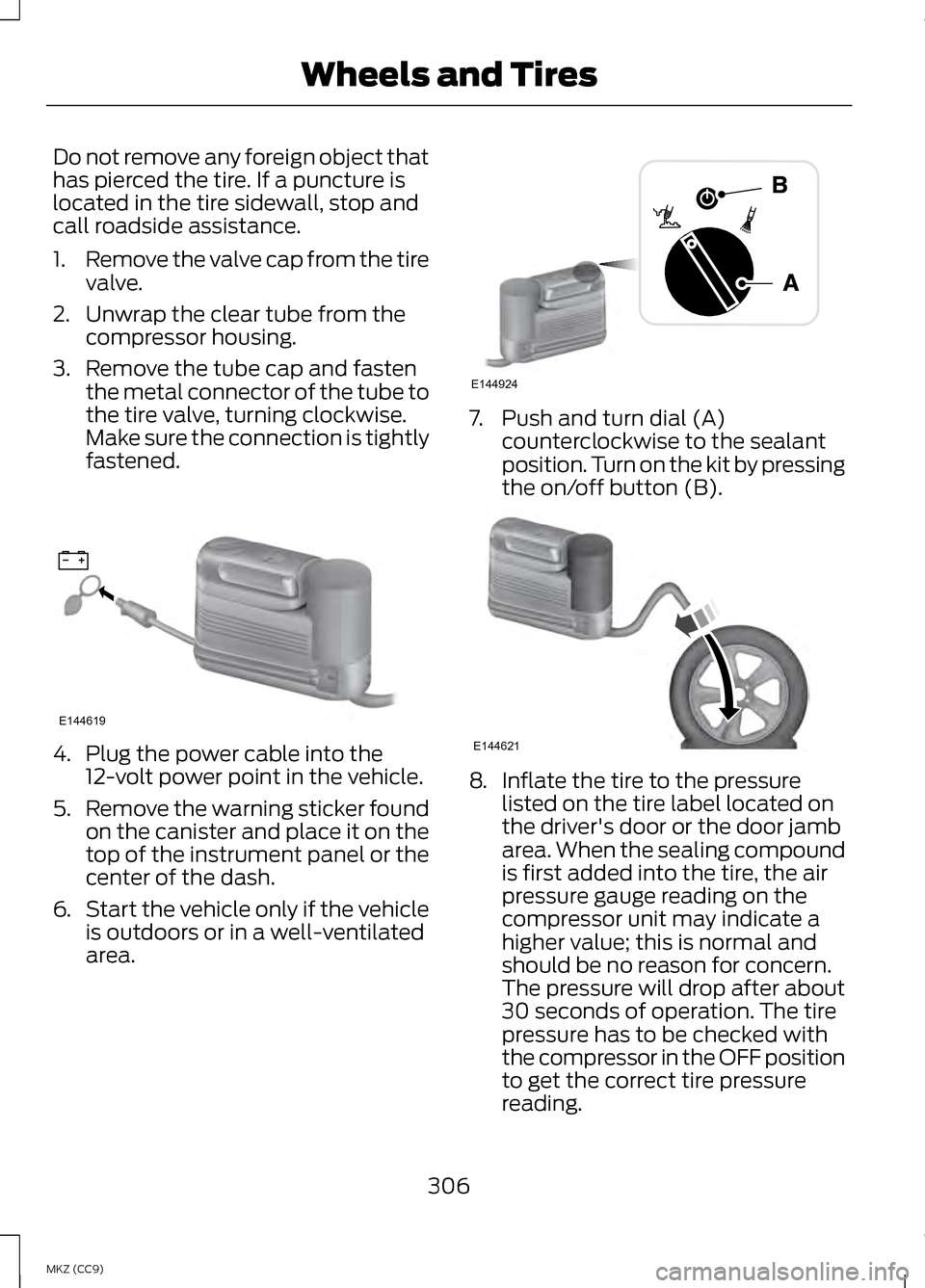
Do not remove any foreign object that
has pierced the tire. If a puncture is
located in the tire sidewall, stop and
call roadside assistance.
1.
Remove the valve cap from the tire
valve.
2. Unwrap the clear tube from the compressor housing.
3. Remove the tube cap and fasten the metal connector of the tube to
the tire valve, turning clockwise.
Make sure the connection is tightly
fastened. 4. Plug the power cable into the
12-volt power point in the vehicle.
5. Remove the warning sticker found
on the canister and place it on the
top of the instrument panel or the
center of the dash.
6. Start the vehicle only if the vehicle
is outdoors or in a well-ventilated
area. 7. Push and turn dial (A)
counterclockwise to the sealant
position. Turn on the kit by pressing
the on/off button (B). 8.
Inflate the tire to the pressure
listed on the tire label located on
the driver's door or the door jamb
area. When the sealing compound
is first added into the tire, the air
pressure gauge reading on the
compressor unit may indicate a
higher value; this is normal and
should be no reason for concern.
The pressure will drop after about
30 seconds of operation. The tire
pressure has to be checked with
the compressor in the OFF position
to get the correct tire pressure
reading.
306
MKZ (CC9) Wheels and TiresE144619 E144924 E144621
Page 309 of 475
9. When the recommended tire
pressure is reached, turn off the kit
by pressing the on button;
disconnect the kit from the tire
valve and the power point.
Re-install the valve cap on the tire
valve, place the tube cap on the
metal connector, and return the kit
to the stowage area
10. Immediately and cautiously, drive
the vehicle 4 miles (6 kilometers)
to distribute the sealant evenly
inside the tire. Do not exceed 50
mph (80 km/h).
11. After 4 miles (6 kilometers), stop
and check the tire pressure. See
Second stage: Checking tire
pressure.
Note: If you experience any unusual
vibration, ride disturbance or noise
while driving, reduce your speed until
you can safely pull off to the side of the
road to call for roadside assistance.
Note: Do not proceed to the second
stage of this operation.
Second Stage: Checking Tire
Pressure WARNINGS
If you are proceeding from the
First stage: Re–inflating the tire
with sealing compound and air section
and have injected sealant in the tire
and the pressure is below 20 psi (1.4
bar), stop and call roadside
assistance. If tire pressure is above 20
psi (1.4 bar), continue to the next step. The power plug may get hot
after use and should be handled
carefully while unplugging. Check the air pressure of your tires as
follows:
1.
Remove the valve cap from the tire
valve.
2. Unhook the black hose from the side of the compressor and fasten
firmly on the valve stem by turning
clockwise.
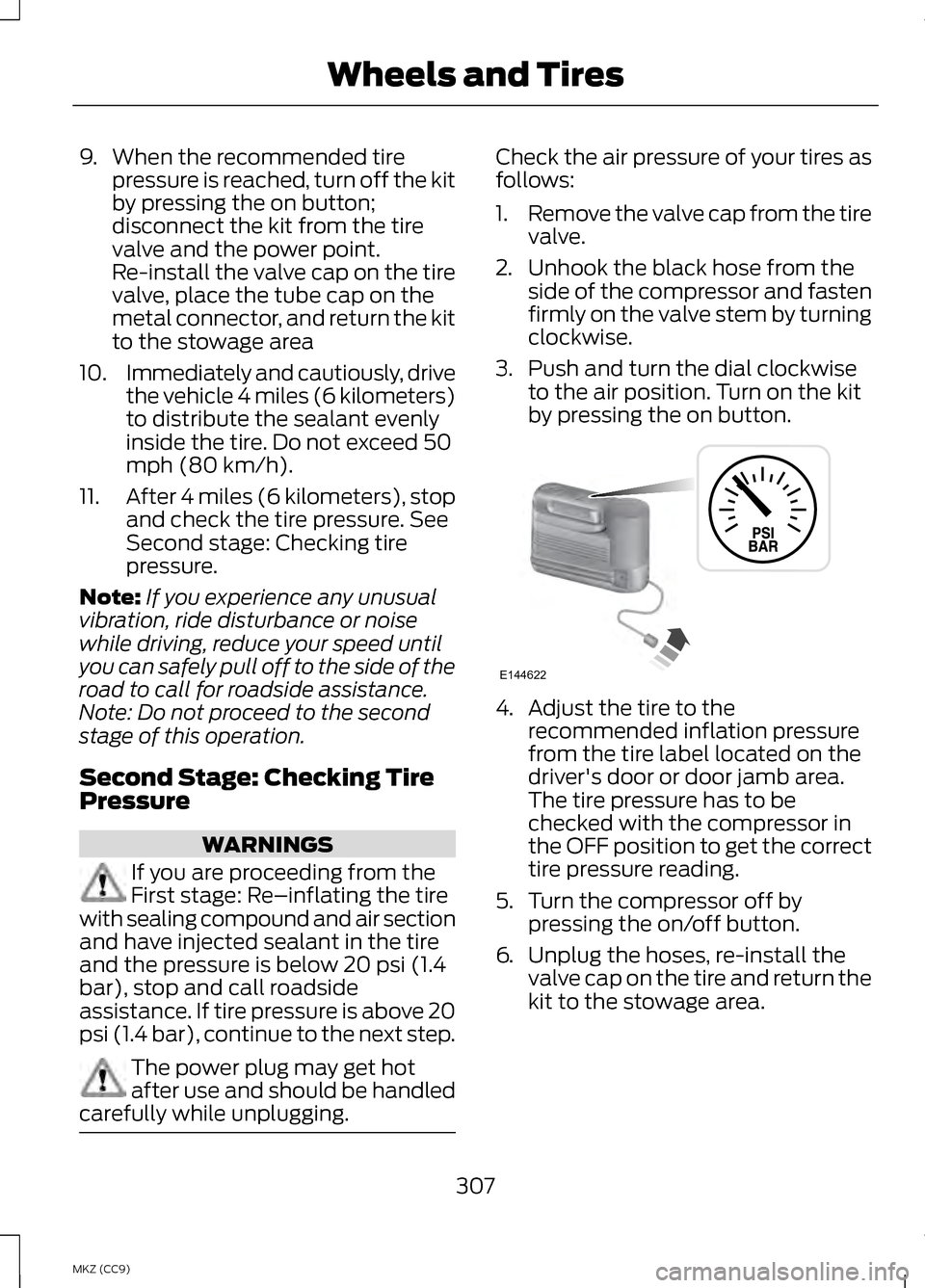
3. Push and turn the dial clockwise to the air position. Turn on the kit
by pressing the on button. 4. Adjust the tire to the
recommended inflation pressure
from the tire label located on the
driver's door or door jamb area.
The tire pressure has to be
checked with the compressor in
the OFF position to get the correct
tire pressure reading.
5. Turn the compressor off by pressing the on/off button.
6. Unplug the hoses, re-install the
valve cap on the tire and return the
kit to the stowage area.
307
MKZ (CC9) Wheels and TiresE144622
Page 337 of 475
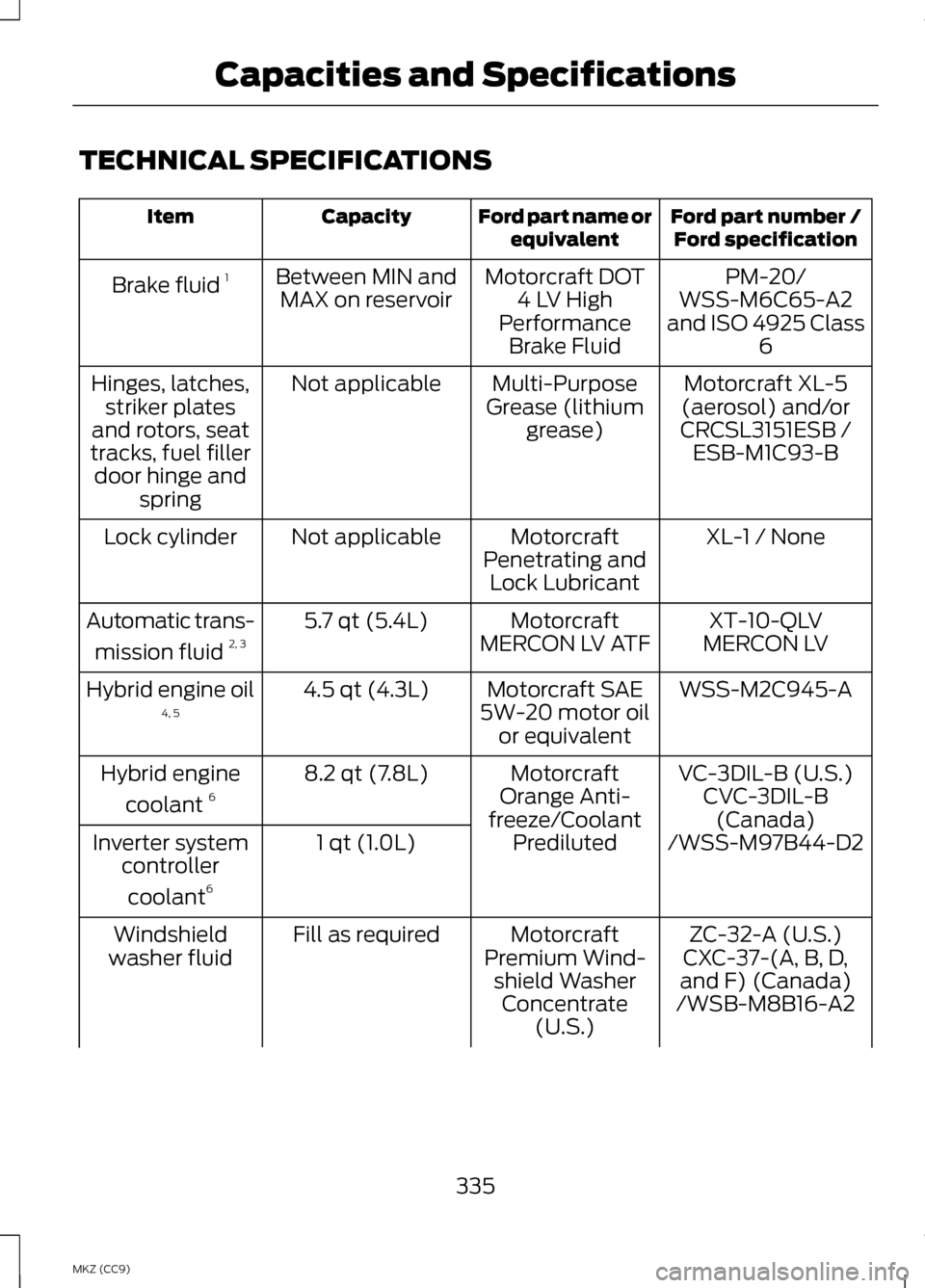
TECHNICAL SPECIFICATIONS
Ford part number /
Ford specification
Ford part name or
equivalent
Capacity
Item
PM-20/
Motorcraft DOT
4 LV High
Performance Brake Fluid
Between MIN and
MAX on reservoir
Brake fluid
1
WSS-M6C65-A2
and ISO 4925 Class 6
Motorcraft XL-5
(aerosol) and/or
CRCSL3151ESB /
Multi-Purpose
Grease (lithium grease)
Not applicable
Hinges, latches,
striker plates
and rotors, seat
tracks, fuel filler door hinge and spring ESB-M1C93-B
XL-1 / None
Motorcraft
Penetrating and Lock Lubricant
Not applicable
Lock cylinder
XT-10-QLV
MERCON LV
Motorcraft
MERCON LV ATF
5.7 qt (5.4L)
Automatic trans-
mission fluid 2, 3
WSS-M2C945-A
Motorcraft SAE
5W-20 motor oil or equivalent
4.5 qt (4.3L)
Hybrid engine oil
4, 5
VC-3DIL-B (U.S.)
Motorcraft
Orange Anti-
freeze/Coolant Prediluted
8.2 qt (7.8L)
Hybrid engine
coolant 6
CVC-3DIL-B
(Canada)
/WSS-M97B44-D2
1 qt (1.0L)
Inverter system
controller
coolant 6
ZC-32-A (U.S.)
Motorcraft
Premium Wind- shield WasherConcentrate (U.S.)
Fill as required
Windshield
washer fluid CXC-37-(A, B, D,
and F) (Canada)
/WSB-M8B16-A2
335
MKZ (CC9) Capacities and Specifications
Page 340 of 475
For a complete listing of the
accessories that are available for your
vehicle, please contact an authorized
dealer or visit our online store at
Accessories.Lincoln.com (United
States only).
Lincoln Custom Accessories are
available for your vehicle through an
authorized Lincoln dealer. Lincoln
Motor Company will repair or replace
any properly authorized
dealer-installed Lincoln Custom
Accessories found to be defective in
factory-supplied materials or
workmanship during the warranty
period, as well as any component
damaged by the defective
accessories.
Lincoln Motor Company will warrant
your vehicle through the warranty that
provides the greatest benefit:
• 12 months or 12000 miles (20000
kilometers) (whichever occurs
first).
• The remainder of your new vehicle
limited warranty.
Contact an authorized dealer for
details and a copy of the warranty.
Exterior style
• Hood deflectors
• Side-window deflectors
• Wheels
• Bumper protectors Interior style
•
All-weather floor mats
• Rear seat entertainment*
• Premium carpeted floor mats
Lifestyle
• Ash cup (smoker's packages)
• Cargo area protector
• Cargo net
• Cargo organizer
• Roof racks and carriers*
Peace of mind
• Car cover*
• Wheel locks
• Bumper mounted parking sensor*
• Locking fuel plug for capless fuel
system
*The accessory manufacturer designs,
develops and therefore warrants
Lincoln Licensed Accessories, and
does not design or test these
accessories to Lincoln Motor
Company engineering requirements.
Contact an authorized Lincoln dealer
for the manufacturer's limited
warranty details and request a copy
of the Lincoln Licensed Accessories
product limited warranty from the
accessory manufacturer.
338
MKZ (CC9) Accessories
Page 341 of 475
For maximum vehicle performance,
keep the following information in mind
when adding accessories or
equipment to your vehicle:
•
When adding accessories,
equipment, passengers and
luggage to your vehicle, do not
exceed the total weight capacity
of the vehicle or of the front or rear
axle (GVWR or GAWR as indicated
on the Safety Compliance
Certification label). Consult an
authorized dealer for specific
weight information.
• The Federal Communications
Commission (FCC) and Canadian
Radio Telecommunications
Commission (CRTC) regulate the
use of mobile communications
systems that are equipped with
radio transmitters, for example,
two-way radios, telephones and
theft alarms. Any such equipment
installed in your vehicle should
comply with the Federal
Communications Commission
(FCC) and Canadian Radio
Telecommunications Commission
(CRTC) regulations and should be
installed only by an authorized
dealer.
• Mobile communications systems
may harm the operation of your
vehicle, particularly if their
manufacturer did not design them
specifically for automotive use. •
To avoid interference with other
vehicle functions, for example
anti-lock brake systems, do not
locate amateur radio antennas in
the area of the driver side hood.
• If you or an authorized Lincoln
dealer add any non-Lincoln
custom electrical or electronic
accessories or components to your
vehicle, you may adversely affect
battery performance and
durability. In addition, you may also
adversely affect the performance
of other electrical systems in the
vehicle.
339
MKZ (CC9) Accessories
Page 342 of 475
PROTECT YOURSELF FROM THE
RISING COST OF VEHICLE REPAIRS
WITH A FORD EXTENDED SERVICE
PLAN.
SERVICE PLANS (U.S. Only)
More than 32 million Ford and Lincoln
owners have discovered the powerful
protection of Ford Extended Service
Plan. It is the only extended service
plan backed by Ford Motor Company,
and provides peace of mind
protection beyond the New Vehicle
Limited Warranty coverage.
Ford ESP Can Quickly Pay for Itself
One service bill – the cost of parts and
labor – can easily exceed the price of
your Ford Extended Service Plan. With
Ford ESP, you minimize your risk for
unexpected repair bills and rising
repair costs.
Up to 500+ Covered Vehicle
Components
There are four Extended Service Plans
with different levels of coverage. Ask
your authorized dealer for details.
1. PremiumCARE - Our most
comprehensive coverage. With
over 500 covered components,
this plan is so complete that we
generally only discuss what’ s not
covered.
2. ExtraCARE - Covers 113 components, and includes many
high-tech items.
3. BaseCARE - Covers 84 components. 4. PowertrainCARE - Covers 29
critical components.
Ford Extended Service Plan is honored
by all authorized Ford and Lincoln
dealers in the U.S. and Canada. It is
the only extended service plan
authorized and backed by Ford Motor
Company.
That means you get:
• Reliable, quality service anywhere
you go
• Repairs performed by factory
trained technicians, using Genuine
Ford and Lincoln parts
Rental Car Reimbursement
1st day Rental Benefit
You take advantage of replacement
transportation if your vehicle is at your
authorized dealer for same day
covered repairs.
Extended Rental Benefits
If your vehicle is kept overnight for
covered repairs, you are eligible for
rental car coverage, including Bumper
to Bumper warranty repairs, or Field
Service Actions.
Roadside Assistance
Exclusive 24/7 roadside assistance,
including:
• Towing, flat-tire change and
battery jump starts
• Out of fuel and lock-out assistance
340
MKZ (CC9) Ford Extended Service Plan (ESP)