climate control LINCOLN MKZ HYBRID 2015 User Guide
[x] Cancel search | Manufacturer: LINCOLN, Model Year: 2015, Model line: MKZ HYBRID, Model: LINCOLN MKZ HYBRID 2015Pages: 504, PDF Size: 4.45 MB
Page 156 of 504
CLIMATE CONTROLLED SEATS (If
Equipped)
Heated Seats WARNING
People who are unable to feel pain to
their skin because of advanced age,
chronic illness, diabetes, spinal cord injury,
medication, alcohol use, exhaustion or other
physical conditions, must exercise care when
using the heated seat. The heated seat may
cause burns even at low temperatures,
especially if used for long periods of time.
Do not place anything on the seat that
insulates against heat, such as a blanket or
cushion. This may cause the heated seat to
overheat. Do not puncture the seat with pins,
needles or other pointed objects. This may
damage the heating element which may
cause the heated seat to overheat. An
overheated seat may cause serious personal
injury. Do not do the following:
•
Place heavy objects on the seat.
• Operate the heated seat if water or any
other liquid is spilled on the seat. Allow
the seat to dry thoroughly.
• Operate the heated seats unless the
engine is running. Doing so can cause
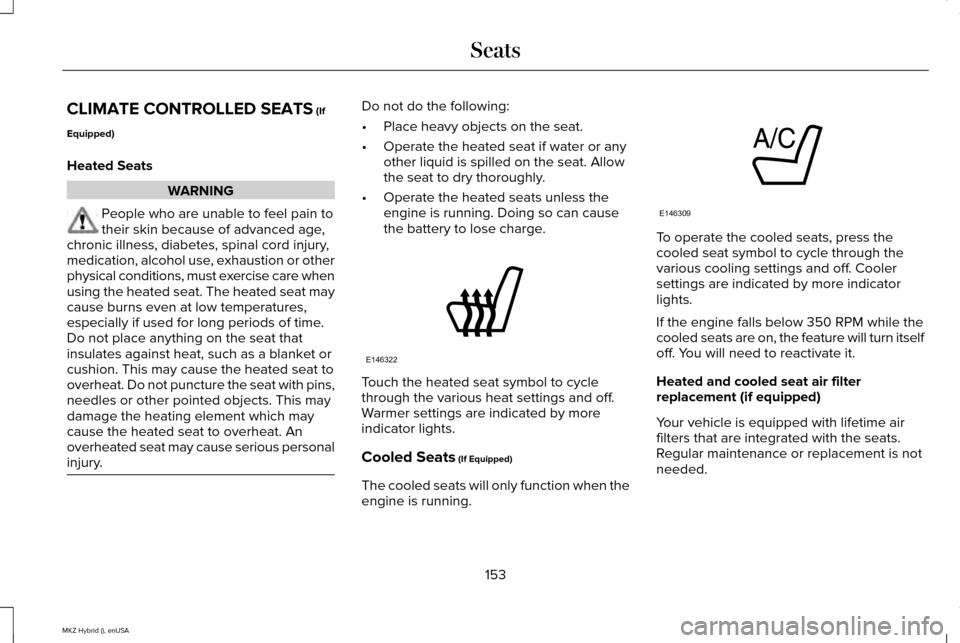
the battery to lose charge. Touch the heated seat symbol to cycle
through the various heat settings and off.
Warmer settings are indicated by more
indicator lights.
Cooled Seats
(If Equipped)
The cooled seats will only function when the
engine is running. To operate the cooled seats, press the
cooled seat symbol to cycle through the
various cooling settings and off. Cooler
settings are indicated by more indicator
lights.
If the engine falls below 350 RPM while the
cooled seats are on, the feature will turn itself
off. You will need to reactivate it.
Heated and cooled seat air filter
replacement (if equipped)
Your vehicle is equipped with lifetime air
filters that are integrated with the seats.
Regular maintenance or replacement is not
needed.
153
MKZ Hybrid (), enUSA SeatsE146322 E146309
Page 169 of 504
Switching Off the Vehicle When It Is
Stationary
1. Put the transmission in position P.
2. Press the button once.
3. Apply the parking brake.
Note: This switches off the ignition, all
electrical circuits, warning lamps and
indicators.
Note: If the engine is idling for 30 minutes,
the ignition and engine automatically shut
down.
Switching Off the Vehicle When It Is
Moving WARNING
Switching off the engine when the
vehicle is still moving will result in a
loss of brake and steering assistance. The
steering will not lock, but higher effort will
be required. When the ignition is switched
off, some electrical circuits, warning lamps
and indicators may also be off. 1. Put the transmission in position
N and
use the brakes to bring your vehicle to a
safe stop.
2. When your vehicle has stopped, put the transmission in position
P.
3. Press and hold the button for one second, or press it three times within two
seconds.
4. Apply the parking brake.
Guarding Against Exhaust Fumes WARNING
If you smell exhaust fumes inside your
vehicle, have your vehicle checked by
your authorized dealer immediately. Do not
drive your vehicle if you smell exhaust fumes.
Carbon monoxide is present in exhaust
fumes. Take precautions to avoid its
dangerous effects. Important Ventilating Information
If you stop your vehicle and the leave the
engine idling for long periods of time, we
recommend that you do one of the following:•
Open the windows at least 1 inch (2.5
centimeters)
• Set your climate control to outside air.
ENGINE BLOCK HEATER (If Equipped) WARNINGS
Failure to follow engine block heater
instructions could result in property
damage or serious personal injury. Do not use your heater with
ungrounded electrical systems or
two-pronged adapters. There is a risk of
electrical shock. Note:
The heater is most effective when
outdoor temperatures are below 0°F (-18°C).
The heater acts as a starting aid by warming
the engine coolant. This allows the climate
control system to respond quickly. The
equipment includes a heater element
(installed in the engine block) and a wire
harness. You can connect the system to a
grounded 120-volt AC electrical source.
166
MKZ Hybrid (), enUSA Starting and Stopping the Engine
Page 171 of 504
HYBRID ELECTRIC VEHICLE
This hybrid vehicle combines electric and
gasoline propulsion to provide performance
and efficiency. It requires no special fuels
and you never have to plug it in.
Note:
You may notice higher engine speeds
upon start-up. This temporary condition is
normal and necessary to heat up the cabin
and minimize emissions. Starting: Switch the ignition on
while your transmission is in park
(P). The green ready indicator light
will appear in the instrument cluster, letting
you know that the vehicle is ready for driving.
The engine may not start because this
vehicle is equipped with silent key start. This
fuel saving feature allows your vehicle to be
ready to drive without requiring the gas
engine to be running. This indicator will
remain on while the vehicle is on, whether the engine is running or not to indicate the
vehicle is capable of movement (using its
electric motor, engine, or both). Typically, the
engine will not start unless the vehicle is
cold, you make a climate control change, or
you press the accelerator.
Driving:
The gas engine automatically starts
and stops to provide power when needed
and to save fuel when not needed. While
coasting at low speeds, coming to a stop, or
standing, the gas engine normally shuts
down and the vehicle operates in
electric-only mode. Conditions that may
cause the engine to start up or remain
running include:
• Considerable vehicle acceleration.
• Vehicle speed above 85 mph (137 km/h)
However, the maximum speed for
electric–only operation may be lower
while driving in hot temperatures or on
hilly terrain.
• Ascending a hill.
• Charge level of high voltage battery is
low. •
Very high or low outside temperature (to
provide system cooling or heating).
• Engine not warm enough to provide
passenger requested cabin temperature.
Stopping:
The gas engine may shut off to
conserve fuel as you come to a stop.
Restarting the vehicle is not required. Simply
step on the accelerator when you are ready
to drive.
Transmission Operation:
Due to the
technologically advanced,
electronically-controlled continuously
variable transaxle, you will not feel shift
changes like those of a non-hybrid vehicle.
Note: Since engine speed is controlled by
the transmission, it may seem elevated at
times. This is normal hybrid operation and
helps deliver fuel efficiency and
performance.
Neutral:
It is not recommended to idle the
vehicle in neutral (N) for an extended period
of time because this will discharge your high
voltage battery and decrease fuel economy.
The engine will not start, and cannot provide
power to the hybrid system in neutral (N).
168
MKZ Hybrid (), enUSA Unique Driving CharacteristicsE144692
Page 174 of 504
Frequently asked questions
Answer
Question
The high voltage battery is electrically isolated from the rest of the
vehicle when the key is off. When you turn the key to on, high voltage
contactors inside the battery are closed to make the electricity avail-
able to the motor/generator and enable the vehicle to drive. The clicks
are the sound of these contactors as they close and open during start up and shut down.
What are the series of clicks from the cargo area when I first turn the
key in the ignition?
The vehicle's computer will determine if an engine start is requiredat key-on. Silent key start will start the engine if it is necessary for
cabin heating, windshield defrost, or if the outside temperature is low.
Why does the engine sometimes start at key-on?
There are several reasons the engine stays on for an extended amountof time when you first start it. One common reason is to ensure that the emissions components are warm enough to minimize tailpipe
emissions. As the climate gets cooler, this engine-on time is extended.
Why does it take a long time before the engine shuts down?
The engine is required to turn on above this speed to protect thetransmission hardware.
Why does my engine never shut down above 85 mph (137 km/h)?
In order to ensure that the climate control system can begin heatingthe cabin or defrosting the windshield as soon as a driver requests it, the engine coolant temperature has to be kept sufficiently hot.
Keeping the engine on is required to maintain the correct minimum temperature.
Why does my engine stay on when it is extremely cold outside?
171
MKZ Hybrid (), enUSA Unique Driving Characteristics
Page 251 of 504
TOWING THE VEHICLE ON FOUR
WHEELS
Emergency Towing
In the event your vehicle becomes disabled
(without access to wheel dollies, car-hauling
trailer, or flatbed transport vehicle), it can be
flat-towed (all wheels on the ground,
regardless of the powertrain/transmission
configuration) under the following conditions:
•
The vehicle is facing forward so that it is
towed in a forward direction.
• The transmission gear shift lever is
placed in position N. If the transmission
gear shift lever cannot be moved to
position N, it may need to be overridden.
See Automatic Transmission (page
187).
• Maximum speed is 35 mph (56 km/h).
• Maximum distance is 50 miles (80
kilometers). Recreational Towing
Note:
Put your climate control system in
recirculated air mode to prevent exhaust
fumes from entering the vehicle.
See
Climate Control (page 139).
Follow these guidelines if you have a need
for recreational (RV) towing. An example of
recreational towing would be towing your
vehicle behind a motorhome. These
guidelines are designed to ensure that your
transmission is not damaged.
Your vehicle can be towed with all four
wheels on the ground using the Neutral Tow
feature, or with all four wheels off the ground
using a vehicle transport trailer. If you are
using a vehicle transport trailer, follow the
instruction specified by the equipment
provider.
Neutral Tow
If you tow your vehicle with all four wheels
on the ground:
• Tow only in the forward direction.
• Release the parking brake. •
Place the vehicle in Neutral Tow mode
by doing the following:
•Put the ignition in accessory mode
(ignition on, engine off ). See Keyless
Starting (page 163).
• Select Neutral Tow in the information
display.
• When prompted by the information
display, press the brake pedal and
select Neutral on the transmission.
Make sure the parking brake is off. If
done successfully,
Neutral Tow
Engaged appears in the display.
• Shut the ignition off.
See Keyless
Starting (page 163). If the process is
completed successfully, the N on the
transmission slowly blinks and
"Neutral tow engaged" appears in the
information display.
• Do not exceed 70 mph (113 km/h).
• Start the engine and allow it to run for
one minute at the beginning of each day.
With the engine running and your foot
on the brake, shift into position
D and
then into position R before shifting back
into position
N.
248
MKZ Hybrid (), enUSA Towing
Page 280 of 504
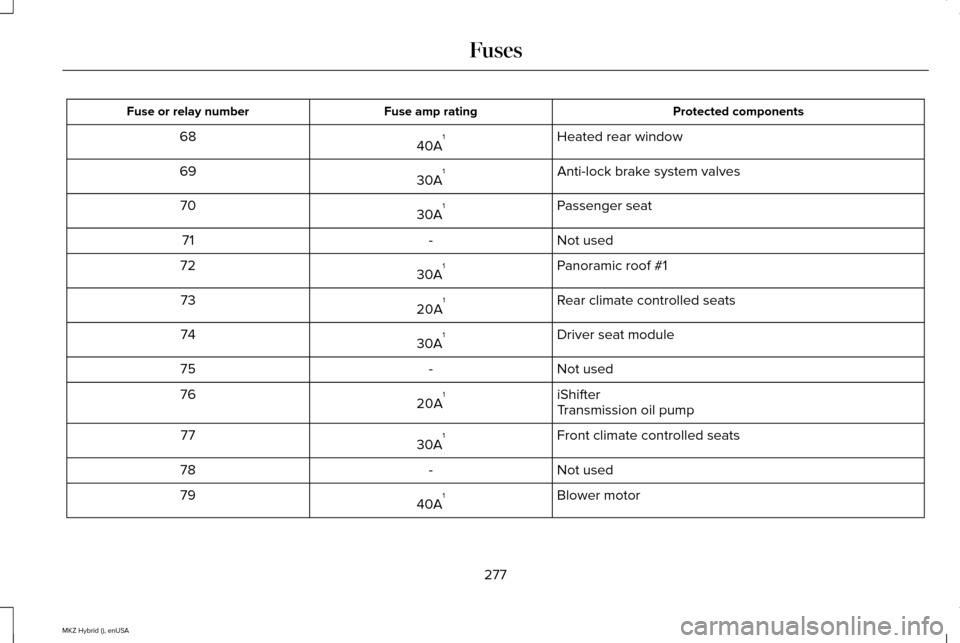
Protected components
Fuse amp rating
Fuse or relay number
Heated rear window
40A 1
68
Anti-lock brake system valves
30A 1
69
Passenger seat
30A 1
70
Not used
-
71
Panoramic roof #1
30A 1
72
Rear climate controlled seats
20A 1
73
Driver seat module
30A 1
74
Not used
-
75
iShifter
20A 1
76
Transmission oil pump
Front climate controlled seats
30A 1
77
Not used
-
78
Blower motor
40A 1
79
277
MKZ Hybrid (), enUSA Fuses
Page 284 of 504
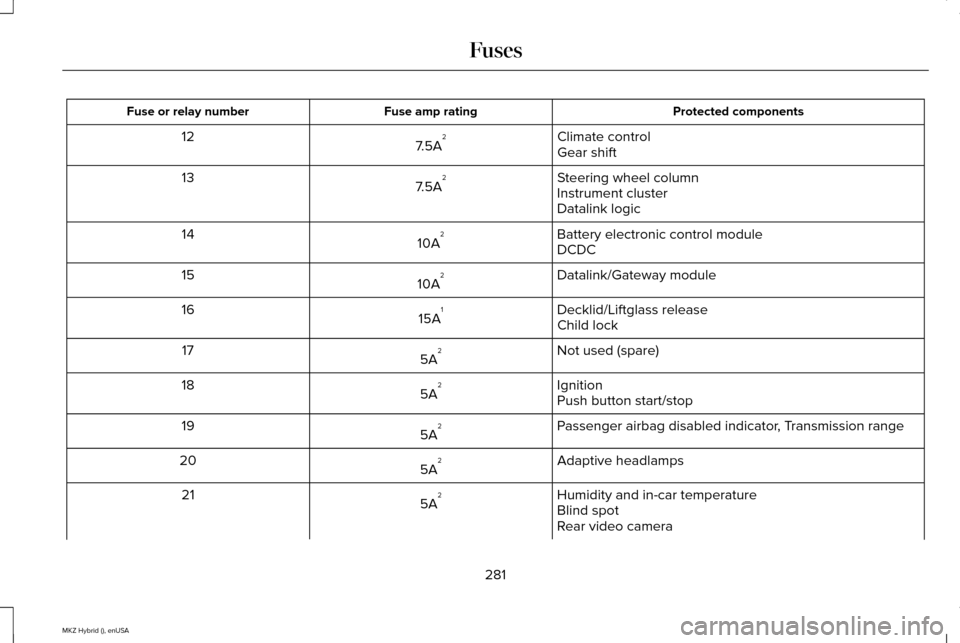
Protected components
Fuse amp rating
Fuse or relay number
Climate control
7.5A 2
12
Gear shift
Steering wheel column
7.5A 2
13
Instrument cluster
Datalink logic
Battery electronic control module
10A 2
14
DCDC
Datalink/Gateway module
10A 2
15
Decklid/Liftglass release
15A 1
16
Child lock
Not used (spare)
5A 2
17
Ignition
5A 2
18
Push button start/stop
Passenger airbag disabled indicator, Transmission range
5A 2
19
Adaptive headlamps
5A 2
20
Humidity and in-car temperature
5A 2
21
Blind spot
Rear video camera
281
MKZ Hybrid (), enUSA Fuses
Page 295 of 504
Whenever you add coolant, check the
coolant level in the engine coolant reservoir
the next few times you drive the vehicle. If
necessary, add enough prediluted engine
coolant to bring the engine coolant level to
the proper level.
Adding Inverter System Controller
Coolant
1. Open the inverter system controller
coolant reservoir cap.
2. Use a funnel to add prediluted coolant to the inverter system controller coolant
reservoir. Make sure that the level is
between the MIN and MAX marks on the
inverter system controller coolant
reservoir. Use prediluted coolant meeting
the Ford specification. See Capacities
and Specifications (page 346).
3. Close the inverter system controller coolant reservoir cap. Whenever you add coolant, check the
coolant level in the inverter system controller
coolant reservoir the next few times you
drive the vehicle. If necessary, add enough
prediluted coolant to bring the inverter
system controller coolant level to the proper
level.
Recycled Engine Coolant
Ford Motor Company does not recommend
the use of recycled engine coolant since a
Ford-approved recycling process is not yet
available.
Used engine coolant should be disposed of
in an appropriate manner. Follow your
community’
s regulations and standards for
recycling and disposing of automotive fluids. Severe Climates
If you drive in extremely cold climates:
•
It may be necessary to have an
authorized Ford dealer increase the
coolant concentration above 50%.
• A coolant concentration of 60% will
provide improved freeze point protection.
Engine coolant concentrations above
60% will decrease the overheat
protection characteristics of the engine
coolant and may cause engine damage.
If you drive in extremely hot climates:
• It may be necessary to have an
authorized Ford dealer decrease the
coolant concentration to 40%.
• A coolant concentration of 40% will
provide improved overheat protection.
Engine coolant concentrations below
40% will decrease the corrosion/freeze
protection characteristics of the engine
coolant and may cause engine damage.
Vehicles driven year-round in non-extreme
climates should use prediluted coolant
meeting the Ford specification for optimum
cooling system and engine protection.
292
MKZ Hybrid (), enUSA Maintenance
Page 312 of 504
General
•
Store all vehicles in a dry, ventilated
place.
• Protect from sunlight, if possible.
• If vehicles are stored outside, they
require regular maintenance to protect
against rust and damage.
Body
• Wash your vehicle thoroughly to remove
dirt, grease, oil, tar or mud from exterior
surfaces, rear-wheel housing and the
underside of front fenders.
• Periodically wash your vehicle if it is
stored in exposed locations.
• Touch-up exposed or primed metal to
prevent rust.
• Cover chrome and stainless steel parts
with a thick coat of auto wax to prevent
discoloration. Re-wax as necessary when
you wash your vehicle.
• Lubricate all hood, door and trunk lid
hinges, and latches with a light grade oil. •
Cover interior trim to prevent fading.
• Keep all rubber parts free from oil and
solvents.
Engine
• The engine oil and filter should be
changed prior to storage because used
engine oil contains contaminates that
may cause engine damage.
• Start the engine every 15 days for a
minimum of 15 minutes. Run at fast idle
with the climate controls set to defrost
until the engine reaches normal
operating temperature.
• With your foot on the brake, shift through
all the gears while the engine is running.
• We recommend that you change the
engine oil before you use your vehicle
again.
Fuel system
• Fill the fuel tank with high-quality fuel
until the first automatic shutoff of the fuel
pump nozzle. Cooling system
•
Protect against freezing temperatures.
• When removing your vehicle from
storage, check coolant fluid level.
Confirm that there are no cooling system
leaks and that fluid is at the
recommended level.
Battery
• Check and recharge as necessary. Keep
connections clean.
• If storing your vehicle for more than 30
days without recharging the battery, we
recommend that you disconnect the
battery cables to maintain battery charge
for quick starting.
Note: It is necessary to reset memory
features if battery cables are disconnected.
Brakes
• Make sure the brakes and parking brake
release fully.
Tires
• Maintain recommended air pressure.
309
MKZ Hybrid (), enUSA Vehicle Care
Page 328 of 504
Tire Quality Grades apply to new
pneumatic passenger car tires. They do
not apply to deep tread, winter-type
snow tires, space-saver or temporary
use spare tires, light truck or LT type
tires, tires with nominal rim diameters of
10 to 12 inches or limited production tires
as defined in Title 49 Code of Federal
Regulations Part 575.104 (c)(2).
U.S. Department of Transportation Tire
quality grades: The U.S. Department of
Transportation requires Ford Motor
Company to give you the following
information about tire grades exactly as
the government has written it.
Treadwear
The treadwear grade is a comparative
rating based on the wear rate of the tire
when tested under controlled conditions
on a specified government test course.
For example, a tire graded 150 would
wear one and one-half (1 ½) times as well
on the government course as a tire
graded 100. The relative performance
of tires depends upon the actual
conditions of their use, however, and
may depart significantly from the norm
due to variations in driving habits,
service practices, and differences in
road characteristics and climate.
Traction AA A B C
WARNING
The traction grade assigned to this
tire is based on straight-ahead
braking traction tests, and does not
include acceleration, cornering,
hydroplaning or peak traction
characteristics. The traction grades, from highest to
lowest are AA, A, B, and C. The grades
represent the tire
’s ability to stop on wet
pavement as measured under controlled
conditions on specified government test
surfaces of asphalt and concrete. A tire
marked C may have poor traction
performance. Temperature A B C WARNING
The temperature grade for this tire
is established for a tire that is
properly inflated and not overloaded.
Excessive speed, underinflation, or
excessive loading, either separately or
in combination, can cause heat buildup
and possible tire failure. The temperature grades are A (the
highest), B and C, representing the tire
’s
resistance to the generation of heat and
its ability to dissipate heat when tested
under controlled conditions on a
specified indoor laboratory test wheel.
Sustained high temperature can cause
the material of the tire to degenerate
and reduce tire life, and excessive
temperature can lead to sudden tire
failure. The grade C corresponds to a
level of performance which all
325
MKZ Hybrid (), enUSA Wheels and Tires