lock LINCOLN MKZ HYBRID 2015 Workshop Manual
[x] Cancel search | Manufacturer: LINCOLN, Model Year: 2015, Model line: MKZ HYBRID, Model: LINCOLN MKZ HYBRID 2015Pages: 504, PDF Size: 4.45 MB
Page 169 of 504
Switching Off the Vehicle When It Is
Stationary
1. Put the transmission in position P.
2. Press the button once.
3. Apply the parking brake.
Note: This switches off the ignition, all
electrical circuits, warning lamps and
indicators.
Note: If the engine is idling for 30 minutes,
the ignition and engine automatically shut
down.
Switching Off the Vehicle When It Is
Moving WARNING
Switching off the engine when the
vehicle is still moving will result in a
loss of brake and steering assistance. The
steering will not lock, but higher effort will
be required. When the ignition is switched
off, some electrical circuits, warning lamps
and indicators may also be off. 1. Put the transmission in position
N and
use the brakes to bring your vehicle to a
safe stop.
2. When your vehicle has stopped, put the transmission in position
P.
3. Press and hold the button for one second, or press it three times within two
seconds.
4. Apply the parking brake.
Guarding Against Exhaust Fumes WARNING
If you smell exhaust fumes inside your
vehicle, have your vehicle checked by
your authorized dealer immediately. Do not
drive your vehicle if you smell exhaust fumes.
Carbon monoxide is present in exhaust
fumes. Take precautions to avoid its
dangerous effects. Important Ventilating Information
If you stop your vehicle and the leave the
engine idling for long periods of time, we
recommend that you do one of the following:•
Open the windows at least 1 inch (2.5
centimeters)
• Set your climate control to outside air.
ENGINE BLOCK HEATER (If Equipped) WARNINGS
Failure to follow engine block heater
instructions could result in property
damage or serious personal injury. Do not use your heater with
ungrounded electrical systems or
two-pronged adapters. There is a risk of
electrical shock. Note:
The heater is most effective when
outdoor temperatures are below 0°F (-18°C).
The heater acts as a starting aid by warming
the engine coolant. This allows the climate
control system to respond quickly. The
equipment includes a heater element
(installed in the engine block) and a wire
harness. You can connect the system to a
grounded 120-volt AC electrical source.
166
MKZ Hybrid (), enUSA Starting and Stopping the Engine
Page 170 of 504
We recommend that you do the following for
a safe and correct operation:
•
Use a 16-gauge outdoor extension cord
that is product certified by Underwriter’ s
Laboratory (UL) or Canadian Standards
Association (CSA). This extension cord
must be suitable for use outdoors, in cold
temperatures, and be clearly marked
Suitable for Use with Outdoor
Appliances. Do not use an indoor
extension cord outdoors. This could
result in an electric shock or become a
fire hazard.
• Use as short an extension cord as
possible.
• Do not use multiple extension cords.
• Make sure that when in operation, the
extension cord plug and heater cord plug
connections are free and clear of water.
This could cause an electric shock or fire.
• Make sure your vehicle is parked in a
clean area, clear of combustibles.
• Make sure the heater, heater cord and
extension cord are firmly connected. •
Check for heat anywhere in the electrical
hookup once the system has been
operating for approximately 30 minutes.
• Make sure the system is unplugged and
properly stowed before driving your
vehicle. Make sure the protective cover
seals the prongs of the block heater cord
plug when not in use.
• Make sure the heater system is checked
for proper operation before winter.
Using the Engine Block Heater
Make sure the receptacle terminals are clean
and dry prior to use. Clean them with a dry
cloth if necessary.
The heater uses 0.4 to 1.0 kilowatt-hours of
energy per hour of use. The system does not
have a thermostat. It achieves maximum
temperature after approximately three hours
of operation. Using the heater longer than
three hours does not improve system
performance and unnecessarily uses
electricity.
167
MKZ Hybrid (), enUSA Starting and Stopping the Engine
Page 172 of 504
Low Gear: Low gear (L) is designed to mimic
the enhanced engine braking available in
non-hybrid vehicles. Low gear will produce
high engine speeds to provide necessary
engine braking. This is normal and will not
damage your vehicle. In low gear, the gas
engine will remain on more often than in
drive (D).
Unique Hybrid Operating Characteristics
Your vehicle behaves differently compared
to a non-hybrid. Here is a description of the
major differences:
Battery:
Your Hybrid is equipped with a high
voltage battery. A cool battery ensures
battery life and provides the best possible
performance. Your hybrid high voltage
battery may periodically re-condition itself to
ensure maximum efficiency. You may notice
slight changes in driveability during this
process, but it is an important part of your
hybrid's high voltage battery optimization
features. Cabin air cools the high voltage battery by
pulling air through vents in the rear package
tray. Avoid placing objects on the package
tray which could block air flow through the
vents.
If you leave your vehicle inoperative for over
31 days, it may be necessary to jumpstart the
vehicle.
See Roadside Emergencies (page
252).
Engine:
The engine speed in your hybrid is
not directly tied to your vehicle speed. Your
vehicle's engine and transmission are
designed to deliver the power you need at
the most efficient engine speed. During
heavy accelerations, your hybrid may reach
high engine speeds (up to 6000 RPM).
In prolonged mountainous driving, you may
see the engine tachometer changing without
your input. This is intentional and maintains
the battery charge level. You may also notice
during extended downhill driving that your
engine continues to run instead of shutting
off. During this engine braking, the engine stays
on, but it is not using any fuel. You may also
hear a slight whine or whistle when operating
your vehicle. This is the normal operation of
the electric generator in the hybrid system.
During certain events (such as vehicle
servicing) your low voltage 12-volt battery
may become disconnected or disabled. Once
the battery is reconnected and after driving
the vehicle, the engine may continue to
operate for three to five seconds after the
key is turned to off. This is a normal
condition.
Braking:
Your hybrid is equipped with
standard hydraulic braking and regenerative
braking. Regenerative braking is performed
by your transmission and it captures brake
energy and stores it in your high voltage
battery.
Driving to optimize fuel economy
Note: Having your engine running is not
always an indication of inefficiency. In some
cases, it is actually more efficient than
driving in electric mode.
169
MKZ Hybrid (), enUSA Unique Driving Characteristics
Page 175 of 504
Answer
Question
Your vehicle's engine and transmission are designed to deliver thepower you need at the most efficient engine speed. This may be
higher than expected during heavy accelerations, and may fluctuate
during steady state driving. These are characteristics of the Atkinson engine cycle and the transmission technology that help maximize your hybrid's fuel economy.
Why does my engine rev up so high sometimes when I accelerate?
The fan noise comes from a fan located outside the high voltage
battery. This fan turns on when the battery requires cooling air. The
fan speed, and associated noise level, will change according to the
amount of cooling required to maintain good performance. Maintaining
the battery temperature at optimal conditions also prolongs the useful life of the battery and helps to achieve better fuel economy. Do not
place objects on the package tray which could block air flow through the hybrid vehicle battery cooling vents.
What is the fan noise I hear from the rear of my hybrid?
Running out of gas is not recommended. However, you may be ableto go about one mile, driving at 30 mph (48 km/h), if the battery has a normal state of charge.
How far can I go in Electric Drive if I run out of gas?
Change the engine oil every 10000 miles (16000 km) under normaloperating conditions. See Scheduled Maintenance (page 468).
What is the engine oil change service interval?
Your hybrid vehicle can use E15 (15% ethanol, 85% gasoline) fuel, butyou may notice slightly reduced fuel economy because ethanol
contains less energy per gallon than gasoline. Your hybrid vehicle is not designed to use E85 (85% ethanol).
Can I put E15 or E85 in my vehicle, and how will it affect my fuel
economy?
172
MKZ Hybrid (), enUSA Unique Driving Characteristics
Page 187 of 504
GENERAL INFORMATION
WARNING
This battery pack should only be
serviced by an authorized electric
vehicle technician. Improper handling can
result in personal injury or death. Note:
The high voltage battery does not
require regular service maintenance.
Your vehicle consists of various high voltage
components and wiring. All of the high
voltage power flows through specific wiring
assemblies which are labeled as such or that
are covered with a solid orange convolute,
orange striped tape or both. Do not come in
contact with these components.
The high voltage battery system is a high
voltage, lithium-ion battery system. The pack
is located in the rear cargo area. The high
voltage battery system uses an air-cooled
system to regulate the high voltage battery
temperature and help maximize high voltage
battery life. Note:
The high voltage battery is equipped
with air vents in the package tray that help
to regulate its temperature. It is important to
keep these openings free of obstructions.
Do not block the flow of cabin air to this
area.
HIGH VOLTAGE SERVICE
DISCONNECT
The high voltage service disconnect turns
off power from the high voltage battery.
There is a disconnect circuit in your vehicle.
Disconnecting the circuit will automatically
disable the high voltage battery. To disable the battery and stop all high
voltage electric activity in the vehicle, you
can access the high voltage disconnect
circuit. To do this, you must unplug the circuit
from the circuit port connected to the battery.
The service disconnect is equipped with an
outer lever. This is to aid in properly seating
the service disconnect lever. Remove this to
disconnect the high voltage service
disconnect.
The high voltage service disconnect is
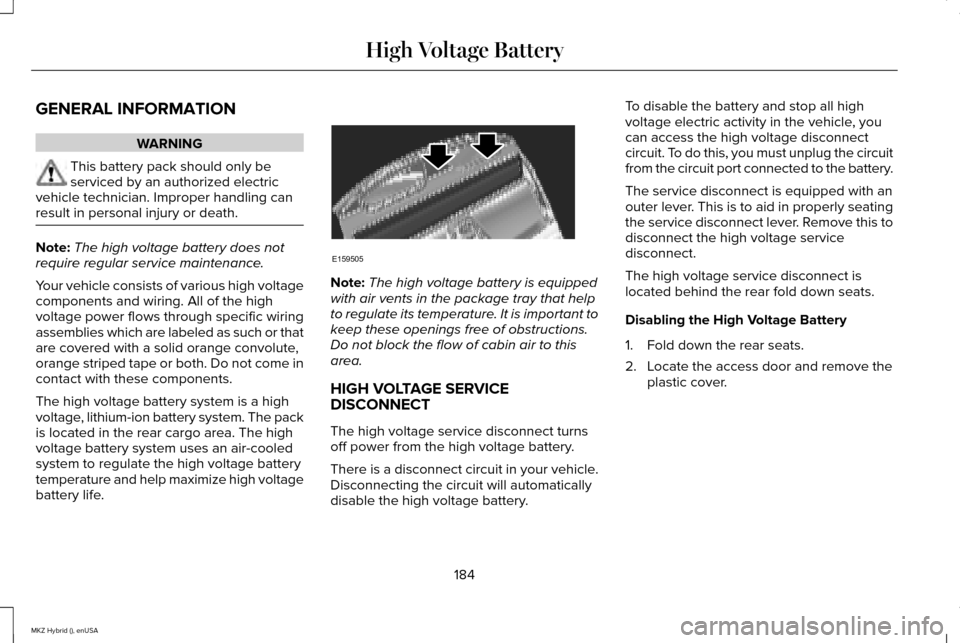
located behind the rear fold down seats.
Disabling the High Voltage Battery
1. Fold down the rear seats.
2. Locate the access door and remove the
plastic cover.
184
MKZ Hybrid (), enUSA High Voltage BatteryE159505
Page 191 of 504
Note:
If the driver attempts to leave the
vehicle while it is in gear, the vehicle will
automatically shift into park (P). Seatbelt and
door monitors determine the driver's intent
and makes the shift for you. During this time
a Transmission not in Park message will
appear in the display screen, prompting the
driver to make the shift. To put the vehicle
in gear with the door open perform steps 1-4.
See the
Automatic Return to Park section
in this chapter for more information on this
feature.
Note: To put your vehicle in gear with the
door open, perform steps 1-4. See the
Automatic Return to Park
section in this
chapter for more information on this feature.
Park (P)
This position locks the transmission and
prevents the front wheels from turning.
Always come to a complete stop before
putting your vehicle into and out of park (P).
An audible chime will sound when park (P)
is manually selected. When you turn the ignition off, your vehicle
will automatically shift into park (P). If you turn
the ignition off while your vehicle is moving,
it will first shift into neutral (N) until a slow
enough speed is reached. Your vehicle will
then shift into park (P) automatically.
Automatic Return to Park
Note:
This feature will not operate when your
vehicle is in Stay in Neutral mode or neutral
tow.
Your vehicle has a safety feature that will
automatically shift your vehicle into park (P)
when any of the following circumstances are
met:
• Turn the ignition off.
• Open the driver's door with your seat belt
unlatched.
• Unlatching your seatbelt while the
driver's door is open.
If you turn the ignition off while your vehicle
is moving, your vehicle will first shift into
neutral (N) until it slows down enough to shift
into park (P) automatically. Note:
If you have waited an extended period
of time, (2-15 minutes) before starting your
vehicle, unlatching your safety belt will cause
this feature to activate, even with the driver's
door closed.
Note: This feature may not work properly if
the door ajar switch is malfunctioning. If your
door ajar indicator does not illuminate when
you open the driver’ s door or the indicator
illuminates with the driver’ s door closed. See
your authorized dealer.
Reverse (R)
With the transmission in reverse (R), your
vehicle will move backward. Always come
to a complete stop before shifting into and
out of reverse (R).
Neutral (N)
Press the neutral (N) button to put your
vehicle in neutral. In neutral, your vehicle can
start and is free to roll. Hold the brake pedal
down while in this position.
188
MKZ Hybrid (), enUSA Transmission
Page 193 of 504
Brake-Shift Interlock Override
WARNINGS
Do not drive your vehicle until you
verify that the brake lamps are working.
When doing this procedure, you will
be taking your vehicle out of park
which means your vehicle can roll freely. To
avoid unwanted vehicle movement, always
fully set the parking brake prior to doing this
procedure. Use wheel chocks if appropriate. If you fully release the parking brake,
but the brake warning lamp remains
illuminated, the brakes may not be working
properly. See your authorized dealer. Note:
See your authorized dealer as soon
as possible if this procedure is used.
Note: For some markets this feature will be
disabled.
Note: This feature will only function if your
12-volt battery has power. Use the brake-shift interlock override
procedure to put your vehicle in gear in the
event of an electrical malfunction or if your
vehicle has a dead battery. The brake shift
interlock override button is located inside of
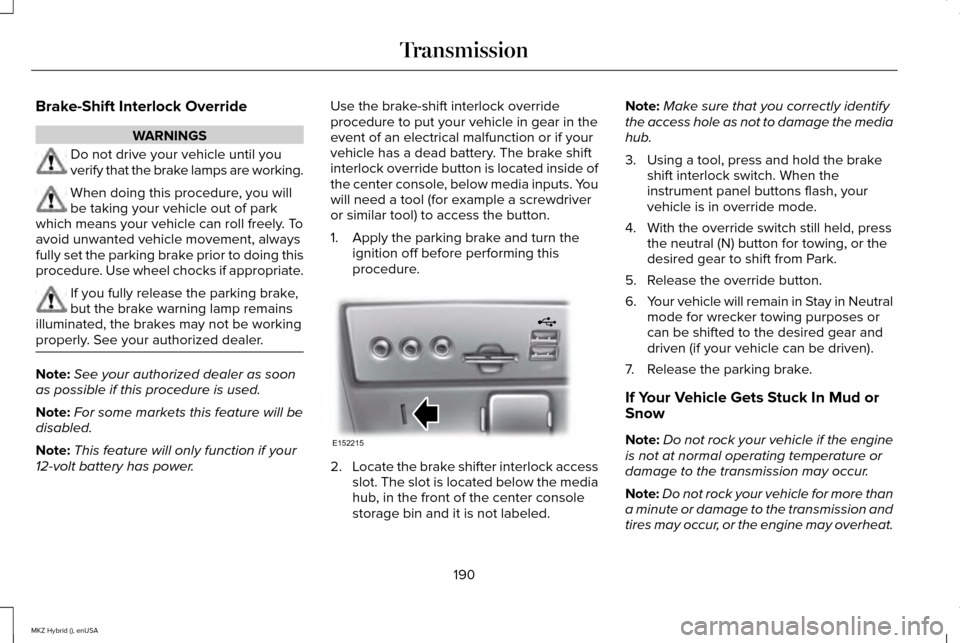
the center console, below media inputs. You
will need a tool (for example a screwdriver
or similar tool) to access the button.
1. Apply the parking brake and turn the
ignition off before performing this
procedure. 2.
Locate the brake shifter interlock access
slot. The slot is located below the media
hub, in the front of the center console
storage bin and it is not labeled. Note:
Make sure that you correctly identify
the access hole as not to damage the media
hub.
3. Using a tool, press and hold the brake shift interlock switch. When the
instrument panel buttons flash, your
vehicle is in override mode.
4. With the override switch still held, press the neutral (N) button for towing, or the
desired gear to shift from Park.
5. Release the override button.
6. Your vehicle will remain in Stay in Neutral
mode for wrecker towing purposes or
can be shifted to the desired gear and
driven (if your vehicle can be driven).
7. Release the parking brake.
If Your Vehicle Gets Stuck In Mud or
Snow
Note: Do not rock your vehicle if the engine
is not at normal operating temperature or
damage to the transmission may occur.
Note: Do not rock your vehicle for more than
a minute or damage to the transmission and
tires may occur, or the engine may overheat.
190
MKZ Hybrid (), enUSA TransmissionE152215
Page 195 of 504
GENERAL INFORMATION
Note:
Occasional brake noise is normal. If a
metal-to-metal, continuous grinding or
continuous squeal sound is present, the
brake linings may be worn-out. Have the
system checked by an authorized dealer. If
the vehicle has continuous vibration or
shudder in the steering wheel while braking,
have it checked by an authorized dealer.
Note: Brake dust may accumulate on the
wheels, even under normal driving
conditions. Some dust is inevitable as the
brakes wear and does not contribute to
brake noise. See Cleaning the Alloy Wheels
(page 308). See
Warning Lamps and
Indicators (page 103).
Wet brakes result in reduced braking
efficiency. Gently press the brake pedal a
few times when driving from a car wash or
standing water to dry the brakes. Brake Over Accelerator
In the event the accelerator pedal becomes
stuck or entrapped, apply steady and firm
pressure to the brake pedal to slow the
vehicle and reduce engine power. If you
experience this condition, apply the brakes
and bring your vehicle to a safe stop. Move
the transmission selector lever to position P,
switch the engine off and apply the parking
brake. Inspect the accelerator pedal for any
interference. If none are found and the
condition persists, have your vehicle towed
to the nearest authorized dealer.
Brake Assist
Brake assist detects when you brake heavily
by measuring the rate at which you press the
brake pedal. It provides maximum braking
efficiency as long as you press the pedal.
Brake assist can reduce stopping distances
in critical situations.
Anti-lock Brake System
This system helps you maintain steering
control during emergency stops by keeping
the brakes from locking. This lamp momentarily illuminates
when you turn the ignition on. If
the light does not illuminate during
start up, remains on or flashes, the anti-lock
braking system may be disabled. Have the
system checked by an authorized dealer. If the system is disabled, normal
braking is still effective. If the brake
warning lamp illuminates when you
release the parking brake, have your system
checked by an authorized dealer.
Regenerative Braking System
This feature is used to simulate the engine
braking of an internal combustion engine
and assist the standard brake system while
recovering some of the energy of motion and
storing it in the battery to improve fuel
economy. The standard brake system is
designed to fully stop the car if regenerative
braking is not available. During regenerative
192
MKZ Hybrid (), enUSA BrakesE144522 E144522
Page 196 of 504
braking, the motor is spun as a generator to
create electrical current. This recharges the
battery and slows the vehicle. In effect, once
the accelerator pedal is released, the motor
changes from an energy user to an energy
producer.
When you release the accelerator pedal or
press the brake pedal, the brake controller
automatically detects the amount of
deceleration requested and optimizes how
much of the deceleration will be produced
by regenerative braking. The remaining
portion is generated by standard friction
braking. When the battery is almost fully
charged, the amount of regenerative braking
is limited to avoid overcharging, and the
requested deceleration is produced by
standard friction braking alone.
Regenerative braking does not take the
place of the standard friction brakes; it only
assists them. Regenerative braking has also
been designed to interact with the anti-lock
brake system. Regenerative braking is
disabled when the anti-lock brake system is
activated or the battery is fully charged.
HINTS ON DRIVING WITH ANTI-
LOCK BRAKES
Note:
When the system is operating, the
brake pedal will pulse and may travel further.
Maintain pressure on the brake pedal. You
may also hear a noise from the system. This
is normal.
The anti-lock braking system will not
eliminate the risks when:
• You drive too closely to the vehicle in
front of you.
• Your vehicle is hydroplaning.
• You take corners too fast.
• The road surface is poor.
ELECTRIC PARKING BRAKE
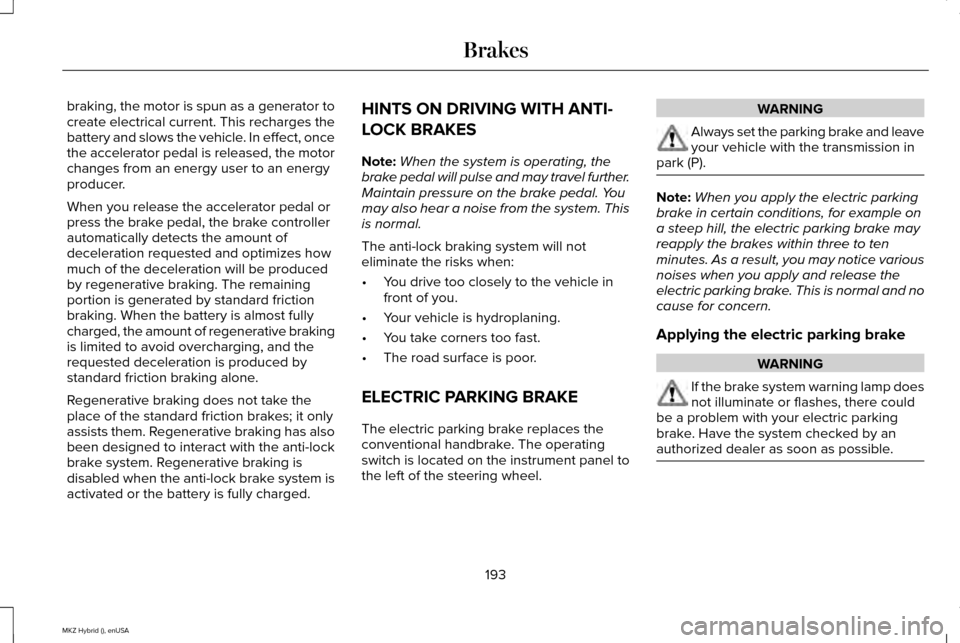
The electric parking brake replaces the
conventional handbrake. The operating
switch is located on the instrument panel to
the left of the steering wheel. WARNING
Always set the parking brake and leave
your vehicle with the transmission in
park (P). Note:
When you apply the electric parking
brake in certain conditions, for example on
a steep hill, the electric parking brake may
reapply the brakes within three to ten
minutes. As a result, you may notice various
noises when you apply and release the
electric parking brake. This is normal and no
cause for concern.
Applying the electric parking brake WARNING
If the brake system warning lamp does
not illuminate or flashes, there could
be a problem with your electric parking
brake. Have the system checked by an
authorized dealer as soon as possible. 193
MKZ Hybrid (), enUSA Brakes
Page 197 of 504
Note:
The brake system warning lamp will
illuminate for ten seconds if the ignition is
turned off after the electric parking brake
has been applied, or the electric parking
brake has been applied after the ignition
has been turned off.
Note: The electric parking brake will not
automatically apply. You must apply the
electric parking brake using the electric
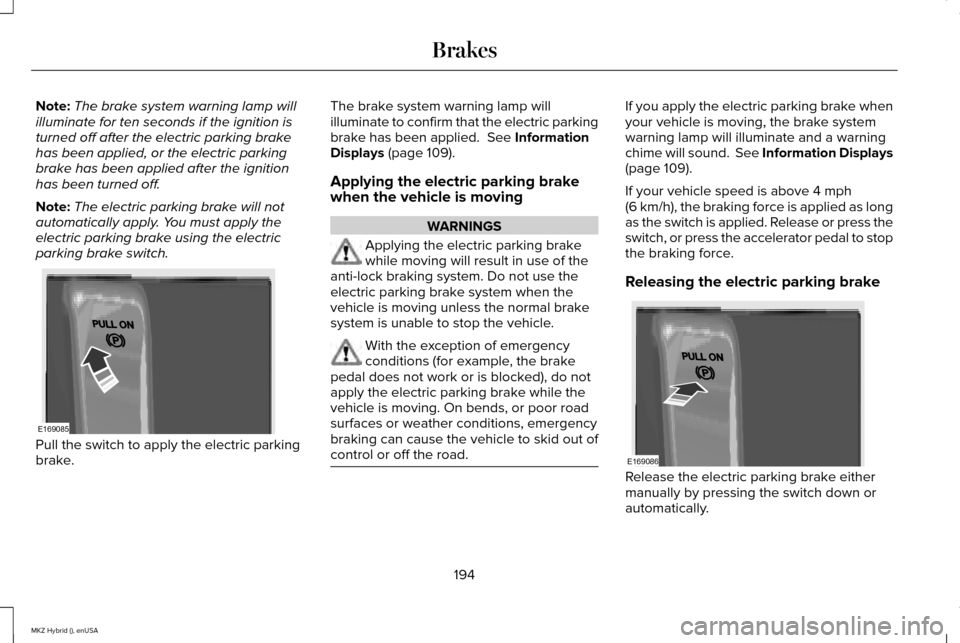
parking brake switch. Pull the switch to apply the electric parking
brake. The brake system warning lamp will
illuminate to confirm that the electric parking
brake has been applied. See Information
Displays (page 109).
Applying the electric parking brake
when the vehicle is moving WARNINGS
Applying the electric parking brake
while moving will result in use of the
anti-lock braking system. Do not use the
electric parking brake system when the
vehicle is moving unless the normal brake
system is unable to stop the vehicle. With the exception of emergency
conditions (for example, the brake
pedal does not work or is blocked), do not
apply the electric parking brake while the
vehicle is moving. On bends, or poor road
surfaces or weather conditions, emergency
braking can cause the vehicle to skid out of
control or off the road. If you apply the electric parking brake when
your vehicle is moving, the brake system
warning lamp will illuminate and a warning
chime will sound. See Information Displays
(page 109).
If your vehicle speed is above
4 mph
(6 km/h), the braking force is applied as long
as the switch is applied. Release or press the
switch, or press the accelerator pedal to stop
the braking force.
Releasing the electric parking brake Release the electric parking brake either
manually by pressing the switch down or
automatically.
194
MKZ Hybrid (), enUSA BrakesE169085 E169086