light LINCOLN MKZ HYBRID 2019 Workshop Manual
[x] Cancel search | Manufacturer: LINCOLN, Model Year: 2019, Model line: MKZ HYBRID, Model: LINCOLN MKZ HYBRID 2019Pages: 575, PDF Size: 4.77 MB
Page 174 of 575
HYBRID VEHICLE OPERATION
This hybrid vehicle combines electric andgasoline propulsion to provide breakthroughperformance and improved efficiency.
Familiarizing yourself with these uniquecharacteristics will provide an optimal drivingexperience from your new vehicle.
Note:You may notice higher engine speedsupon start-up. This temporary condition isnormal and necessary to heat up the cabinand minimize emissions.
Starting:
When you start your vehicle, agreen ready indicator light willappear in the lower right portionof the instrument cluster and a ready to drivemessage will appear in the middle of the leftcluster screen, letting you know that yourvehicle is ready for driving.
The engine may not start because thisvehicle is equipped with silent key start. Thisfuel saving feature allows your vehicle to beready–to–drive without requiring the gasengine to be running. This indicator willremain on while your vehicle is on, whetherthe engine is running or not to indicate yourvehicle is capable of movement (using itselectric motor, engine, or both). Typically, theengine will not start unless the vehicle iscold, a climate control change is requested,or the accelerator is pressed.
Driving:
The gas engine automatically starts andstops to provide power when needed andto save fuel when not needed. Whilecoasting at low speeds, coming to a stop, orstanding, the gas engine normally shutsdown and your vehicle operates inelectric-only mode.
Conditions that may cause the engine to startup or remain running include:
•Considerable vehicle acceleration.
•Vehicle speed above 85 mph (137 km/h).However, the maximum speed forelectric-only operation may be lowerwhile driving in hot temperatures or onhilly terrain.
•Ascending a hill.
•Charge level of high voltage battery islow.
•Very high or low outside temperature (toprovide system cooling or heating).
•Engine not warm enough to providepassenger requested cabin temperature.
Stopping:
The gas engine may shut off to conserve fuelas you come to a stop. Restarting yourvehicle is not required. Simply step on theaccelerator when you are ready to drive.
171
MKZ Hybrid (CC9) Hybrid Electric Vehicle (HEV), Canada/United States of America, enUSA, Edition date: 201805, First-Printing
Unique Driving CharacteristicsE144692
Page 175 of 575
Transmission Operation:
Due to the technologically advanced,electronically-controlled continuouslyvariable transaxle, you will not feel shiftchanges like those of a non-hybrid vehicle.
Note:Since engine speed is controlled bythe transmission, it may seem elevated attimes. This is normal hybrid operation andhelps deliver fuel efficiency andperformance.
Neutral:
We recommend that you do not idle thevehicle in neutral (N) for an extended periodof time because this will discharge your highvoltage battery, shut off your air conditioningand heating, and decrease fuel economy.The engine will not start or stop, and cannotprovide power to the hybrid system in neutral(N).
Low:
Low (L) is designed to mimic the enhancedengine braking available in non-hybridvehicles. Low gear will produce high enginespeeds to provide necessary engine braking.This is normal and will not damage yourvehicle. In low gear, the gas engine willremain on more often than in drive (D).
Reverse:
In reverse (R), vehicle speed is limited to22 mph (35 km/h).
Battery:
Your hybrid is equipped with a high voltagebattery. A cool battery maintains battery lifeand provides the best possible performance.The high voltage battery is cooled by cabinair drawn from vent holes in the trim panelsbehind the rear seats. Avoid placing objectsat the vent holes that block airflow to thehigh voltage battery.
Engine:
The engine speed in your hybrid is notdirectly tied to your vehicle speed. Yourvehicle's engine and transmission aredesigned to deliver the power you need atthe most efficient engine speed. Duringheavy accelerations, your hybrid may reachhigh engine speeds (up to 6000 RPM).
In prolonged mountainous driving, you maysee the engine speed changing without yourinput. This is intentional and maintains thebattery charge level. You may also noticeduring extended downhill driving that yourengine continues to run instead of shuttingoff.
During this engine braking, the engine stayson, but it is not using any fuel. You may alsohear a slight whine or whistle when operatingyour vehicle. This is the normal operation ofthe electric generator in the hybrid system.
172
MKZ Hybrid (CC9) Hybrid Electric Vehicle (HEV), Canada/United States of America, enUSA, Edition date: 201805, First-Printing
Unique Driving Characteristics
Page 178 of 575
AnswerQuestion
In order to make sure that the climate control system can begin heatingthe cabin or defrosting the windshield as soon as a driver requestsit, the engine coolant temperature has to be kept sufficiently hot.Keeping the engine on is required to maintain the correct coolanttemperature.
Why does my engine stay on when it is extremely cold outside?
Your vehicle's engine and transmission are designed to deliver thepower you need at the most efficient engine speed. This may behigher than expected during heavy accelerations, and may fluctuatewhen driving at a steady speed. These are characteristics of theAtkinson engine cycle and the transmission technology that helpmaximize your hybrid's fuel economy.
Why does my engine rev up so high sometimes when I accelerate?
The fan noise comes from a fan located next to the high voltagebattery pack. This fan turns on when the battery requires cooling air.The fan speed, and associated noise level, will change according tothe amount of cooling required to maintain good performance. Main-taining the battery temperature at optimal conditions also prolongsthe useful life of the battery and helps to achieve better fuel economy.
What is the fan noise I hear from the rear of my hybrid?
Change the engine oil every 10,000 mi (16,000 km) or once per yearunder normal operating conditions.What is the engine oil change service interval?
Your hybrid vehicle can use E15 (15% ethanol, 85% gasoline) fuel, butyou may notice slightly reduced fuel economy because ethanolcontains less energy per gallon than gasoline. Your hybrid vehicle isnot designed to use E85 (85% ethanol).
Can I put E15 or E85 in my vehicle, and how will it affect my fueleconomy?
175
MKZ Hybrid (CC9) Hybrid Electric Vehicle (HEV), Canada/United States of America, enUSA, Edition date: 201805, First-Printing
Unique Driving Characteristics
Page 181 of 575
Your vehicle is designed to operate onregular unleaded gasoline with a minimumpump (R+M)/2 octane rating of 87.
Some fuel stations, particularly those in highaltitude areas, offer fuels posted as regularunleaded gasoline with an octane ratingbelow 87. The use of these fuels could resultin engine damage that will not be coveredby the vehicle warranty.
For best overall vehicle and engineperformance, premium fuel with an octanerating of 91 or higher is recommended. Theperformance gained by using premium fuelis most noticeable in hot weather.
Do not be concerned if the enginesometimes knocks lightly. However, if theengine knocks heavily while using fuel withthe recommended octane rating, contact anauthorized dealer to prevent any enginedamage.
We recommend Top Tier detergentgasolines, where available to help minimizeengine deposits and maintain optimal vehicleand engine performance. For additionalinformation, refer to www.toptiergas.com.
Note:Use of any fuel for which the vehiclewas not designed can impair the emissioncontrol system, cause loss of vehicleperformance, and cause damage to theengine which may not be covered by thevehicle Warranty.
Do not use:
•Diesel fuel.
•Fuels containing kerosene or paraffin.
•Fuel containing more than 15% ethanolor E85 fuel.
•Fuels containing methanol.
•Fuels containing metallic-based additives,including manganese-based compounds.
•Fuels containing the octane boosteradditive, methylcyclopentadienylmanganese tricarbonyl (MMT).
•Leaded fuel, using leaded fuel isprohibited by law.
The use of fuels with metallic compoundssuch as methylcyclopentadienyl manganesetricarbonyl (commonly known as MMT), whichis a manganese-based fuel additive, willimpair engine performance and affect theemission control system.
Fuel Freshness Mode (If Equipped)
This helps keep the fuel system functionaland the fuel fresh.
If you mainly use your vehicle in electricpower mode without refueling, the gasolinein the fuel tank may become stale due toaging. Stale gasoline can damage theengine and fuel system.
Your vehicle automatically switches to fuelfreshness mode if you do not refuel yourvehicle with fresh fuel within an 18-monthperiod. Fuel freshness mode protects yourvehicle from potential engine and fuel systemdamage caused by using stale fuel.
Note:If you do not add new fuel during an18-month period, fuel freshness mode willuse fuel until approximately 1.2 gal (4.5 L) offuel remains in the fuel tank.
178
MKZ Hybrid (CC9) Hybrid Electric Vehicle (HEV), Canada/United States of America, enUSA, Edition date: 201805, First-Printing
Fuel and Refueling
Page 185 of 575
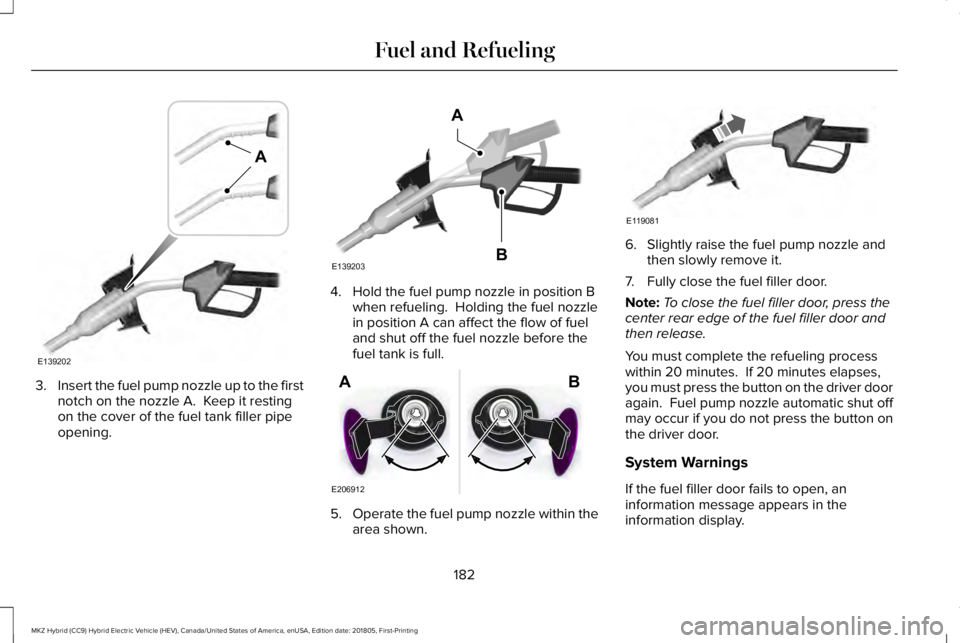
3.Insert the fuel pump nozzle up to the firstnotch on the nozzle A. Keep it restingon the cover of the fuel tank filler pipeopening.
4. Hold the fuel pump nozzle in position Bwhen refueling. Holding the fuel nozzlein position A can affect the flow of fueland shut off the fuel nozzle before thefuel tank is full.
5.Operate the fuel pump nozzle within thearea shown.
6. Slightly raise the fuel pump nozzle andthen slowly remove it.
7. Fully close the fuel filler door.
Note:To close the fuel filler door, press thecenter rear edge of the fuel filler door andthen release.
You must complete the refueling processwithin 20 minutes. If 20 minutes elapses,you must press the button on the driver dooragain. Fuel pump nozzle automatic shut offmay occur if you do not press the button onthe driver door.
System Warnings
If the fuel filler door fails to open, aninformation message appears in theinformation display.
182
MKZ Hybrid (CC9) Hybrid Electric Vehicle (HEV), Canada/United States of America, enUSA, Edition date: 201805, First-Printing
Fuel and RefuelingE139202
A E139203
A
B E206912
AB E119081
Page 187 of 575
Impacting Fuel Economy
•Incorrect tire inflation pressures.
•Fully loading your vehicle.
•Carrying unnecessary weight.
•Adding certain accessories to yourvehicle such as bug deflectors, rollbarsor light bars, running boards and skiracks.
•Using fuel blended with alcohol. SeeFuel Quality (page 177).
•Fuel economy may decrease with lowertemperatures.
•Fuel economy may decrease whendriving short distances.
•You may get better fuel economy whendriving on flat terrain than when drivingon hilly terrain.
184
MKZ Hybrid (CC9) Hybrid Electric Vehicle (HEV), Canada/United States of America, enUSA, Edition date: 201805, First-Printing
Fuel and Refueling
Page 188 of 575
EMISSION LAW
WARNING: Do not remove or alter theoriginal equipment floor covering orinsulation between it and the metal floor ofthe vehicle. The floor covering and insulationprotect occupants of the vehicle from theengine and exhaust system heat and noise.On vehicles with no original equipment floorcovering insulation, do not carry passengersin a manner that permits prolonged skincontact with the metal floor. Failure to followthese instructions may result in fire orpersonal injury.
U.S. federal laws and certain state lawsprohibit removing or rendering inoperativeemission control system components. Similarfederal or provincial laws may apply inCanada. We do not approve of any vehiclemodification without first determiningapplicable laws.
Tampering with emissions controlsystems including related sensorsor the Diesel Exhaust Fluid systemcan result in reduced engine power and theillumination of the service engine soon light.
Tampering With a Noise ControlSystem
Federal laws prohibit the following acts:
•Removal or rendering inoperative by anyperson other than for purposes ofmaintenance.
•Repair or replacement of any device orelement of the design incorporated intoa new vehicle for the purpose of noisecontrol prior to its sale or delivery to theultimate purchaser or while it is in use.
•The use of the vehicle after any personremoves or renders inoperative anydevice or element of the design.
The U.S. Environmental Protection Agencymay presume to constitute tampering asfollows:
•Removal of hood blanket, fender apronabsorbers, fender apron barriers,underbody noise shields or acousticallyabsorptive material.
•Tampering or rendering inoperative theengine speed governor, to allow enginespeed to exceed manufacturerspecifications.
If the engine does not start, runs rough,experiences a decrease in engineperformance, experiences excess fuelconsumption or produces excessive exhaustsmoke, check for the following:
•A plugged or disconnected air inletsystem hose.
•A plugged engine air filter element.
•Water in the fuel filter and waterseparator.
•A clogged fuel filter.
•Contaminated fuel.
•Air in the fuel system, due to looseconnections.
185
MKZ Hybrid (CC9) Hybrid Electric Vehicle (HEV), Canada/United States of America, enUSA, Edition date: 201805, First-Printing
Engine Emission Control
Page 190 of 575
The scheduled maintenance items listed inscheduled maintenance information areessential to the life and performance of yourvehicle and to its emissions system.
If you use anything other than Lincoln,Motorcraft or Lincoln-authorized parts formaintenance replacements or for service ofcomponents affecting emission control, suchnon-Lincoln parts should be equivalent togenuine Lincoln Motor Company parts inperformance and durability.
Illumination of the service engine soonindicator, charging system warning light orthe temperature warning light, fluid leaks,strange odors, smoke or loss of enginepower could indicate that the emissioncontrol system is not working properly.
An improperly operating or damaged exhaustsystem may allow exhaust to enter thevehicle. Have a damaged or improperlyoperating exhaust system inspected andrepaired immediately.
Do not make any unauthorized changes toyour vehicle or engine. By law, vehicleowners and anyone who manufactures,repairs, services, sells, leases, tradesvehicles, or supervises a fleet of vehicles arenot permitted to intentionally remove anemission control device or prevent it fromworking. Information about your vehicle’semission system is on the Vehicle EmissionControl Information Decal located on or nearthe engine. This decal also lists enginedisplacement.
Please consult your warranty information forcomplete details.
On-Board Diagnostics (OBD-II)
Your vehicle has a computer known as theon-board diagnostics system (OBD-II) thatmonitors the engine’s emission controlsystem. The system protects the environmentby making sure that your vehicle continuesto meet government emission standards. TheOBD-II system also assists a servicetechnician in properly servicing your vehicle.
When the service engine soonindicator illuminates, the OBD-IIsystem has detected a malfunction.Temporary malfunctions may cause theservice engine soon indicator to illuminate.Examples are:
1. Your vehicle has run out of fuel—theengine may misfire or run poorly.
2.Poor fuel quality or water in the fuel—theengine may misfire or run poorly.
3. The fuel fill inlet may not have closedproperly. See Refueling (page 180).
4. Driving through deep water—theelectrical system may be wet.
You can correct these temporarymalfunctions by filling the fuel tank with goodquality fuel, properly closing the fuel fill inletor letting the electrical system dry out. Afterthree driving cycles without these or anyother temporary malfunctions present, theservice engine soon indicator should stay offthe next time you start the engine. A drivingcycle consists of a cold engine startupfollowed by mixed city and highway driving.No additional vehicle service is required.
187
MKZ Hybrid (CC9) Hybrid Electric Vehicle (HEV), Canada/United States of America, enUSA, Edition date: 201805, First-Printing
Engine Emission Control
Page 195 of 575
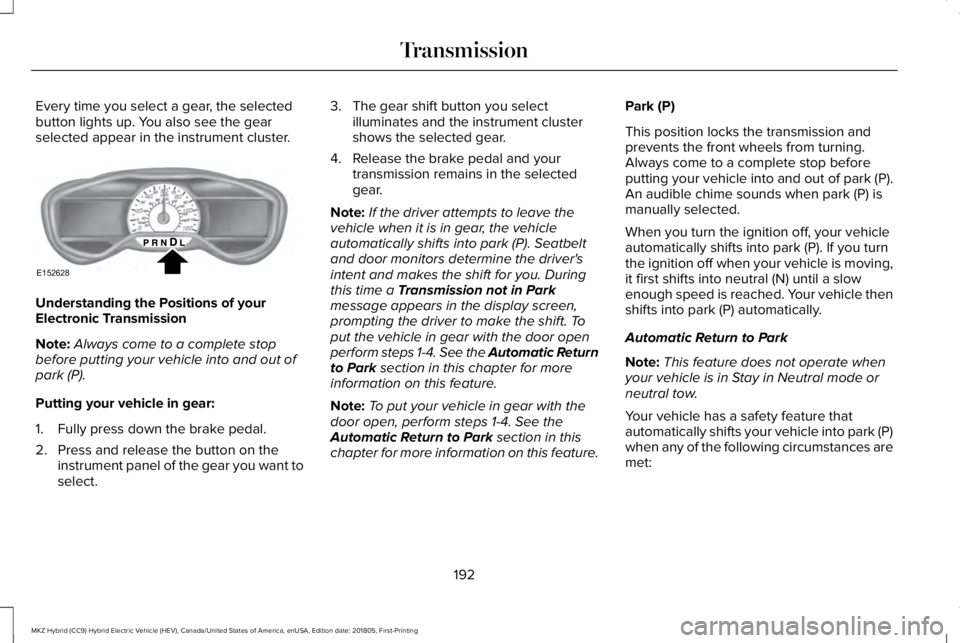
Every time you select a gear, the selectedbutton lights up. You also see the gearselected appear in the instrument cluster.
Understanding the Positions of yourElectronic Transmission
Note:Always come to a complete stopbefore putting your vehicle into and out ofpark (P).
Putting your vehicle in gear:
1. Fully press down the brake pedal.
2. Press and release the button on theinstrument panel of the gear you want toselect.
3. The gear shift button you selectilluminates and the instrument clustershows the selected gear.
4. Release the brake pedal and yourtransmission remains in the selectedgear.
Note:If the driver attempts to leave thevehicle when it is in gear, the vehicleautomatically shifts into park (P). Seatbeltand door monitors determine the driver'sintent and makes the shift for you. Duringthis time a Transmission not in Parkmessage appears in the display screen,prompting the driver to make the shift. Toput the vehicle in gear with the door openperform steps 1-4. See the Automatic Returnto Park section in this chapter for moreinformation on this feature.
Note:To put your vehicle in gear with thedoor open, perform steps 1-4. See theAutomatic Return to Park section in thischapter for more information on this feature.
Park (P)
This position locks the transmission andprevents the front wheels from turning.Always come to a complete stop beforeputting your vehicle into and out of park (P).An audible chime sounds when park (P) ismanually selected.
When you turn the ignition off, your vehicleautomatically shifts into park (P). If you turnthe ignition off when your vehicle is moving,it first shifts into neutral (N) until a slowenough speed is reached. Your vehicle thenshifts into park (P) automatically.
Automatic Return to Park
Note:This feature does not operate whenyour vehicle is in Stay in Neutral mode orneutral tow.
Your vehicle has a safety feature thatautomatically shifts your vehicle into park (P)when any of the following circumstances aremet:
192
MKZ Hybrid (CC9) Hybrid Electric Vehicle (HEV), Canada/United States of America, enUSA, Edition date: 201805, First-Printing
TransmissionE152628
Page 198 of 575
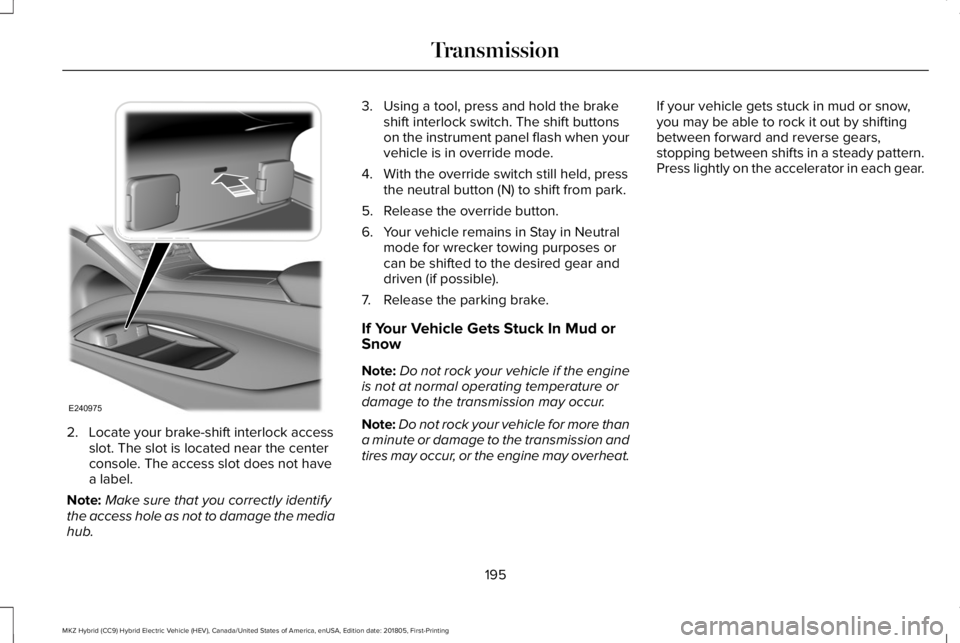
2. Locate your brake-shift interlock accessslot. The slot is located near the centerconsole. The access slot does not havea label.
Note:Make sure that you correctly identifythe access hole as not to damage the mediahub.
3. Using a tool, press and hold the brakeshift interlock switch. The shift buttonson the instrument panel flash when yourvehicle is in override mode.
4. With the override switch still held, pressthe neutral button (N) to shift from park.
5. Release the override button.
6. Your vehicle remains in Stay in Neutralmode for wrecker towing purposes orcan be shifted to the desired gear anddriven (if possible).
7. Release the parking brake.
If Your Vehicle Gets Stuck In Mud orSnow
Note:Do not rock your vehicle if the engineis not at normal operating temperature ordamage to the transmission may occur.
Note:Do not rock your vehicle for more thana minute or damage to the transmission andtires may occur, or the engine may overheat.
If your vehicle gets stuck in mud or snow,you may be able to rock it out by shiftingbetween forward and reverse gears,stopping between shifts in a steady pattern.Press lightly on the accelerator in each gear.
195
MKZ Hybrid (CC9) Hybrid Electric Vehicle (HEV), Canada/United States of America, enUSA, Edition date: 201805, First-Printing
TransmissionE240975