Engine type LINCOLN NAUTILUS 2021 Owners Manual
[x] Cancel search | Manufacturer: LINCOLN, Model Year: 2021, Model line: NAUTILUS, Model: LINCOLN NAUTILUS 2021Pages: 579, PDF Size: 6.9 MB
Page 15 of 579
Recreationally Towing Your Vehicle - 2.0L,
FWD .............................................................314
Recreationally Towing Your Vehicle - 2.7L .......................................................................
314
Emergency Towing ......................................
315
Fuses
Fuse Precautions ..........................................
316
Under Hood Fuse Box ................................
316
Body Control Module Fuse Box ..............
326
Identifying Fuse Types ................................
331
Fuses – Troubleshooting ...........................
331
Maintenance
Maintenance Precautions .........................
332
Opening and Closing the Hood ..............
332
Under Hood Overview - 2.0L ...................
334
Under Hood Overview - 2.7L ...................
336
Engine Oil ......................................................
338
Checking the Coolant ................................
340
Changing the Engine Air Filter .................
344
Changing the Fuel Filter ............................
344
Drive Belt Routing Overview - 2.0L ........
345Drive Belt Routing Overview - 2.7L
.........
345
Changing the 12V Battery .........................
345
Adjusting the Headlamps ..........................
348
Exterior Bulbs ...............................................
350
Interior Bulbs ................................................
353
Vehicle Care
Cleaning Products .......................................
354
Cleaning the Exterior .................................
355
Waxing ............................................................
357
Cleaning the Interior ...................................
357
Repairing Minor Paint Damage ................
359
Body Styling Kits
Body Styling Kit Precautions ....................
360
Storing Your Vehicle
Preparing Your Vehicle for Storage .........
361
Removing Your Vehicle From Storage ......................................................................
362
Wheel and Tire Information
Locating the Tire label ...............................
363Department of Transportation Uniform Tire
Quality Grades .........................................
363
Information on the Tire Sidewall .............
364
Glossary of Tire Terminology ...................
369
Tire Replacement Requirements ............
369
Using Snow Chains .....................................
372
Tire Care
Checking the Tire Pressures ....................
374
Inflating the Tires .........................................
374
Inspecting the Tire for Wear .....................
375
Inspecting the Tire for Damage ...............
375
Inspecting the Wheel Valve Stems .........
376
Tire Rotation .................................................
376
Tire Sealant and Inflator Kit
What Is the Tire Sealant and Inflator Kit ......................................................................
378
Tire Sealant and Inflator Kit Precautions ......................................................................
378
Locating the Tire Sealant and Inflator Kit ......................................................................
378
Tire Sealant and Inflator Kit Components ......................................................................
379
11
2021 Nautilus (CD9) Canada/United States of America, enUSA, Edition date: 202011, First-Printing Table of Contents
Page 23 of 579
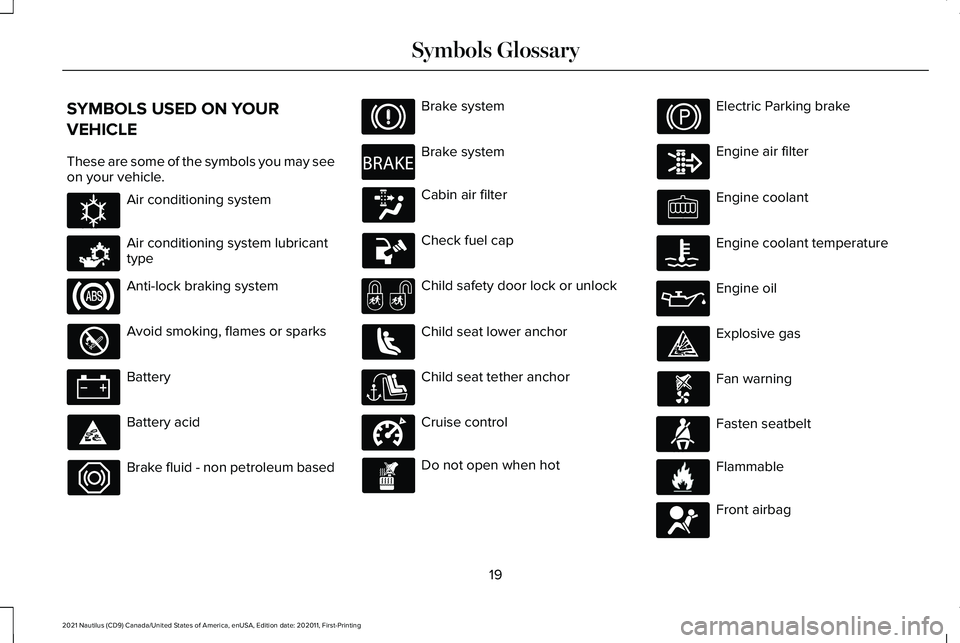
SYMBOLS USED ON YOUR
VEHICLE
These are some of the symbols you may see
on your vehicle.
Air conditioning system
Air conditioning system lubricant
type
Anti-lock braking system
Avoid smoking, flames or sparks
Battery
Battery acid
Brake fluid - non petroleum based Brake system
Brake system
Cabin air filter
Check fuel cap
Child safety door lock or unlock
Child seat lower anchor
Child seat tether anchor
Cruise control
Do not open when hot Electric Parking brake
Engine air filter
Engine coolant
Engine coolant temperature
Engine oil
Explosive gas
Fan warning
Fasten seatbelt
Flammable
Front airbag
19
2021 Nautilus (CD9) Canada/United States of America, enUSA, Edition date: 202011, First-Printing Symbols GlossaryE162384 E231157 E270480 E332905 E71880 E231160 E67017
Page 303 of 579
TOWING A TRAILER PRECAUTIONS
WARNING: Do not exceed the
GVWR or the GAWR specified on the
certification label. WARNING:
Towing trailers
beyond the maximum recommended
gross trailer weight exceeds the limit
of your vehicle and could result in
engine damage, transmission damage,
structural damage, loss of vehicle
control, vehicle rollover and personal
injury. WARNING:
Do not exceed the
lowest rating capacity for your vehicle
or trailer hitch. Overloading your
vehicle or trailer hitch can impair your
vehicle stability and handling. Failure
to follow this instruction could result
in the loss of control of your vehicle,
personal injury or death. WARNING: Do not cut, drill, weld
or modify the trailer hitch. Modifying
the trailer hitch could reduce the hitch
rating. WARNING:
The anti-lock brake
system does not control the trailer
brakes.
TRAILER BRAKE PRECAUTIONS WARNING:
Do not connect a trailer's
hydraulic brake system directly to your
vehicle's brake system. Your vehicle may
not have enough braking power and your
chances of having a collision greatly
increase. WARNING:
Do not tow a trailer fitted
with electric trailer brakes unless your
vehicle is fitted with a compatible
aftermarket electronic trailer brake
controller. Failure to follow this instruction
could result in the loss of control of your
vehicle, personal injury or death. For
additional information and assistance, we
recommend that you contact an authorized
dealer.
Electric brakes and manual, automatic or
surge-type trailer brakes are safe if you install
them properly and adjust them to the
manufacturer's specifications. The trailer
brakes must meet local and federal
regulations.
The rating for the tow vehicle's braking
system operation is at the gross vehicle
weight rating, not the gross combined weight
rating.
Certain states require functioning trailer
brakes for trailers over a specified weight.
Be sure to check state regulations for this
specified weight.
299
2021 Nautilus (CD9) Canada/United States of America, enUSA, Edition date: 202011, First-Printing Towing a Trailer
Page 304 of 579
Ford Motor Company recommends separate
functioning brake systems for trailers
weighing more than 1,500 lb (680 kg) when
loaded.
TOWING A TRAILER LIMITATIONS
The vehicle's load capacity designation
is by weight, not by volume, so you
cannot necessarily use all available
space when loading a vehicle or trailer.
Note: Your vehicle could have reduced
performance when operating at high
altitudes and when heavily loaded or
towing a trailer. When driving at
elevation, to match driving performance
as perceived at sea level, reduce gross
vehicle weight and gross combination
weight by 2% per
1,000 ft (300 m)
elevation. LOADING YOUR TRAILER
To help minimize how trailer movement
affects your vehicle when driving:
•
Load the heaviest items closest to
the trailer floor.
• Load the heaviest items centered
between the left and right side trailer
tires.
• Load the heaviest items above the
trailer axles or just slightly forward
toward the trailer tongue. Do not
allow the final trailer tongue weight
to go above or below 10-15% of the
loaded trailer weight. The trailer
tongue weight should never exceed
10% of the maximum towing capacity.
• Select a ball mount with the correct
rise or drop. When both the loaded
vehicle and trailer are connected, the
trailer frame should be level, or
slightly angled down toward your
vehicle, when viewed from the side. TRAILER TOWING HINTS
Towing a trailer places an extra load on your
vehicle's engine, transmission, axle, brakes,
tires and suspension. Periodically inspect
these components during and after any
towing operation.
When driving with a trailer or payload, a slight
takeoff vibration or shudder may be present
due to the increased payload weight.
Your vehicle may have a temporary or
conventional spare tire. A temporary spare
tire is different in diameter or width,
tread-type, or is from a different manufacturer
than the road tires on your vehicle. Consult
information on the tire label or Safety
Compliance label for limitations when using.
When towing a trailer:
•
Obey country specific regulations for
towing a trailer.
• Do not drive faster than
70 mph
(113 km/h) during the first 500 mi
(800 km).
• Do not make full-throttle starts.
300
2021 Nautilus (CD9) Canada/United States of America, enUSA, Edition date: 202011, First-Printing Towing a Trailer
Page 344 of 579
CHECKING THE COOLANT
When the engine is cold, check the
concentration and level of the coolant at the
intervals listed in the scheduled maintenance
information. See Scheduled Maintenance
(page 459).
Note: Make sure that the coolant level is
between the minimum and maximum marks
on the coolant reservoir.
Note: Coolant expands when it is hot. The
level may extend beyond the
MAX mark.
If the coolant level is at or below the
minimum mark, add prediluted coolant
immediately.
Maintain coolant concentration within 48%
to 50%, which equates to a freeze point
between
-29°F (-34°C) and -35°F (-37°C).
Coolant concentration should be checked
using a refractometer. We do not recommend
the use of hydrometers or coolant test strips
for measuring coolant concentration. Adding Coolant WARNING:
Do not remove the
coolant reservoir cap when the engine is
on or the cooling system is hot. Wait 10
minutes for the cooling system to cool
down. Cover the coolant reservoir cap with
a thick cloth to prevent the possibility of
scalding and slowly remove the cap.
Failure to follow this instruction could result
in personal injury. WARNING:
Do not add engine
coolant when the engine is on or the
cooling system is hot. Failure to follow this
instruction could result in personal injury. WARNING:
Do not add coolant
further than the MAX mark. WARNING: Do not put coolant in the
windshield washer reservoir. If sprayed on
the windshield, coolant could make it
difficult to see through the windshield. Note:
Do not use stop leak pellets, cooling
system sealants, or non-specified additives
as they can cause damage to the engine
cooling or heating systems. Resulting
component damage may not be covered by
the vehicle Warranty.
Note: Automotive fluids are not
interchangeable.
It is very important to use prediluted coolant
approved to the correct specification in order
to avoid plugging the small passageways in
the engine cooling system.
See Capacities
and Specifications (page 407). Do not mix
different colors or types of coolant in your
vehicle. Mixing of engine coolants or using
an incorrect coolant may harm the engine or
cooling system components and could void
the vehicle Warranty.
Note: If prediluted coolant is not available,
use the approved concentrated coolant
diluting it to 50/50 with distilled water.
See
Capacities and Specifications (page 407).
Using water that has not been deionized
may contribute to deposit formation,
corrosion and plugging of the small cooling
system passageways.
340
2021 Nautilus (CD9) Canada/United States of America, enUSA, Edition date: 202011, First-Printing Maintenance
Page 420 of 579
VEHICLE IDENTIFICATION NUMBER
Locating the Vehicle Identification
Number
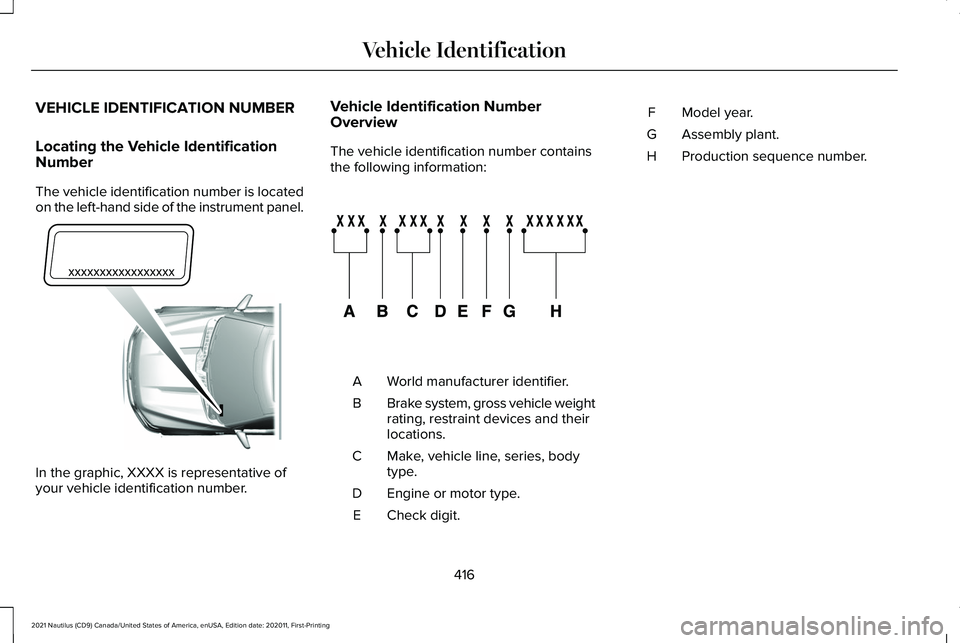
The vehicle identification number is located
on the left-hand side of the instrument panel.
In the graphic, XXXX is representative of
your vehicle identification number. Vehicle Identification Number
Overview
The vehicle identification number contains
the following information:
World manufacturer identifier.
A
Brake system, gross vehicle weight
rating, restraint devices and their
locations.
B
Make, vehicle line, series, body
type.
C
Engine or motor type.
D
Check digit.
E Model year.
F
Assembly plant.
G
Production sequence number.
H
416
2021 Nautilus (CD9) Canada/United States of America, enUSA, Edition date: 202011, First-Printing Vehicle IdentificationE311767 E142477
Page 567 of 579
How Do the Knee Airbags Work.................64
How Do the Side Airbags Work..................63
I
Identifying Fuse Types
.................................331
Identifying the Audio Unit..........................429
Identifying the Climate Control Unit.........154
Inflating the Tires
..........................................374
Information and Entertainment Display Limitations....................................................431
Speed-restricted Features................................431
Information and Entertainment Display Overview.......................................................431
Information and Entertainment Display Precautions..................................................431
Information On Demand Screen..............433
Information on the Tire Sidewall..............364 Information on P Type Tires............................364
Inspecting the Tire for Damage................375 Safety Practices..................................................375
Inspecting the Tire for Wear......................375
Inspecting the Wheel Valve Stems..........376
Installing and Removing the Luggage Compartment Cargo Net.........................295
Installing and Removing the Luggage Compartment Cover
.................................295
Installing the Luggage Cover..........................296 Removing the Luggage Cover........................296
Installing Child Restraints..............................44 Combining the Seatbelt and Lower Anchors
for Attaching Child Restraints........................
47
Installing a Child Restraint in a Center Seat......................................................................47
Using Lower Anchors and Tethers for Children..............................................................46
Using Seatbelts.....................................................44
Using Tether Straps..............................................48
Instrument Cluster Display..........................143 Personalized Settings.........................................148
Trip Computer......................................................145
Instrument Cluster Display Main Menu..............................................................144
Instrument Cluster Indicators
......................141
Adaptive Cruise Control.....................................141
Adaptive Steering.................................................141
Airbag......................................................................141
Auto Hold...............................................................141
Automatic High Beam.........................................141
Auto Start-Stop......................................................141
Blind Spot Information System.........................141
Cruise Control.......................................................141
Front Fog Lamp....................................................142
Headlamp High Beam........................................142
Hill Start Assist.....................................................142
Parking Lamps......................................................142 Stability and Traction Control...........................
142
Turn Signal............................................................142
Instrument Cluster
.........................................137
Fuel Gauge............................................................138
Instrument Cluster Overview......................137
Instrument Cluster Warning Lamps
..........139
Anti-Lock Brake System....................................139
Battery....................................................................139
Brake System.......................................................140
Door Ajar...............................................................140
Electric Parking Brake........................................140
Engine Coolant Temperature...........................140
Fasten Seatbelt....................................................140
Hood Ajar..............................................................140
Liftgate Ajar...........................................................140
Low Beam Warning.............................................140
Low Fuel Level.....................................................140
Low Tire Pressure...............................................140
Low Washer Fluid Level.....................................140
Malfunction Indicator Lamp...............................141
Oil Pressure...........................................................141
Powertrain Fault....................................................141
Instrument Panel
.............................................29
Interior Air Quality.........................................158
Interior Bulbs.................................................353
Interior Bulb Specification Chart....................353
563
2021 Nautilus (CD9) Canada/United States of America, enUSA, Edition date: 202011, First-Printing Index