brakes LINCOLN NAUTILUS 2021 Owners Manual
[x] Cancel search | Manufacturer: LINCOLN, Model Year: 2021, Model line: NAUTILUS, Model: LINCOLN NAUTILUS 2021Pages: 579, PDF Size: 6.9 MB
Page 11 of 579
Automatic Transmission Position Indicators
......................................................................207
Manually Shifting Gears .............................
207
Temporary Neutral Mode ..........................
208
Automatic Return to Park (P) ....................
209
Manual Park Release ..................................
210
Automatic Transmission Audible Warnings .......................................................................
212
Automatic Transmission – Troubleshooting .......................................................................
212
All-Wheel Drive
How Does All-Wheel Drive Work .............
214
All-Wheel Drive Precautions ......................
214
All-Wheel Drive Limitations ........................
214
All-Wheel Drive Driving Hints ....................
214
All-Wheel Drive – Troubleshooting ..........
217
Brakes
Brake Precautions ........................................
218
Anti-Lock Braking System ..........................
218
Brake Over Accelerator ..............................
218
Locating the Brake Fluid Reservoir .........
218
Checking the Brake Fluid ..........................
218Brake Fluid Specification
...........................
219
Brakes – Troubleshooting .........................
219
Electric Parking Brake
What Is the Electric Parking Brake ..........
221
Applying the Electric Parking Brake .......
221
Applying the Electric Parking Brake in an Emergency ................................................
221
Manually Releasing the Electric Parking Brake ...........................................................
221
Automatically Releasing the Electric Parking Brake ..........................................
222
Electric Parking Brake Audible Warning ......................................................................
222
Releasing the Electric Parking Brake if the Vehicle Battery Has Run Out of Charge
......................................................................
222
Electric Parking Brake – Troubleshooting ......................................................................
222
Hill Start Assist
What Is Hill Start Assist ..............................
225
How Does Hill Start Assist Work .............
225
Hill Start Assist Precautions .....................
225
Hill Start Assist – Troubleshooting .........
225Auto Hold
How Does Auto Hold Work
......................
226
Switching Auto Hold On and Off ............
226
Using Auto Hold ..........................................
226
Auto Hold Indicators ...................................
227
Traction Control
How Does Traction Control Work ...........
228
Switching Traction Control On and Off ......................................................................
228
Traction Control Indicator .........................
228
Traction Control – Troubleshooting .......
228
Stability Control
How Does Stability Control Work ...........
229
Switching Stability Control On and Off ......................................................................
230
Stability Control Indicator .........................
230
Stability Control – Troubleshooting .........
231
Steering
Electric Power Steering .............................
232
Steering – Troubleshooting ......................
233
7
2021 Nautilus (CD9) Canada/United States of America, enUSA, Edition date: 202011, First-Printing Table of Contents
Page 26 of 579
WARNING: Do not connect wireless
plug-in devices to the data link connector.
Unauthorized third parties could gain
access to vehicle data and impair the
performance of safety related systems.
Only allow repair facilities that follow our
service and repair instructions to connect
their equipment to the data link connector.
We respect your privacy and are committed
to protecting it. The information contained
in this manual was correct at the time of
publication but as technology rapidly
changes, we recommend that you visit the
local Lincoln website for the latest
information.
Your vehicle has electronic control units that
have data recording functionality and the
ability to permanently or temporarily store
data. This data could include information on
the condition and status of your vehicle,
vehicle maintenance requirements, events
and malfunctions. The types of data that can
be recorded are described in this section.
Some of the data recorded is stored in event
logs or error logs. Note:
Error logs are reset following a service
or repair.
Note: We may provide information in
response to requests from law enforcement,
other government authorities and third
parties acting with lawful authority or through
a legal process. Such information could be
used by them in legal proceedings.
Data recorded includes, for example:
• Operating states of system components,
for example fuel level, tire pressure and
battery charge level.
• Vehicle and component status, for
example wheel speed, deceleration,
lateral acceleration and seatbelt status.
• Events or errors in essential systems, for
example headlamps and brakes.
• System responses to driving situations,
for example airbag deployment and
stability control.
• Environmental conditions, for example
temperature. Some of this data, when used in combination
with other information, for example an
accident report, damage to a vehicle or
eyewitness statements, could be associated
with a specific person.
Services That We Provide
If you use our services, we collect and use
data, for example account information,
vehicle location and driving characteristics,
that could identify you. We transmit this data
through a dedicated, protected connection.
We only collect and use data to enable your
use of our services to which you have
subscribed, with your consent or where
permitted by law. For additional information,
see the terms and conditions of the services
to which you have subscribed.
For additional information about our privacy
policy, refer to the local Lincoln website.
22
2021 Nautilus (CD9) Canada/United States of America, enUSA, Edition date: 202011, First-Printing Data Privacy
Page 59 of 579
3. Pull the seatbelt tight to remove any
slack.
Unfastening the Seatbelts
1. Press the red button on the buckle to release the seatbelt.
2. Hold the seatbelt tongue and let it retract
completely and smoothly to its stowed
position.
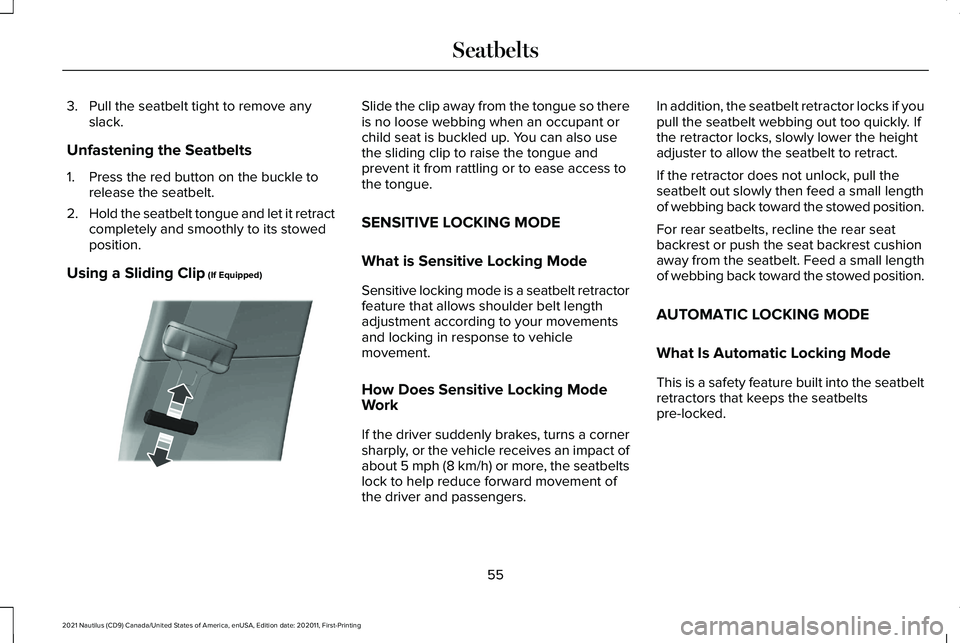
Using a Sliding Clip (If Equipped) Slide the clip away from the tongue so there
is no loose webbing when an occupant or
child seat is buckled up. You can also use
the sliding clip to raise the tongue and
prevent it from rattling or to ease access to
the tongue.
SENSITIVE LOCKING MODE
What is Sensitive Locking Mode
Sensitive locking mode is a seatbelt retractor
feature that allows shoulder belt length
adjustment according to your movements
and locking in response to vehicle
movement.
How Does Sensitive Locking Mode
Work
If the driver suddenly brakes, turns a corner
sharply, or the vehicle receives an impact of
about
5 mph (8 km/h) or more, the seatbelts
lock to help reduce forward movement of
the driver and passengers. In addition, the seatbelt retractor locks if you
pull the seatbelt webbing out too quickly. If
the retractor locks, slowly lower the height
adjuster to allow the seatbelt to retract.
If the retractor does not unlock, pull the
seatbelt out slowly then feed a small length
of webbing back toward the stowed position.
For rear seatbelts, recline the rear seat
backrest or push the seat backrest cushion
away from the seatbelt. Feed a small length
of webbing back toward the stowed position.
AUTOMATIC LOCKING MODE
What Is Automatic Locking Mode
This is a safety feature built into the seatbelt
retractors that keeps the seatbelts
pre-locked.
55
2021 Nautilus (CD9) Canada/United States of America, enUSA, Edition date: 202011, First-Printing SeatbeltsE200788
Page 193 of 579
Note:
The engine block heater is most
effective when outdoor temperatures are
below 0°F (-18°C).
Using the Engine Block Heater
Make sure the receptacle terminals are clean
and dry prior to use. Clean them with a dry
cloth if necessary.
The heater uses 0.4 to 1.0 kilowatt-hours of
energy per hour of use. The system does not
have a thermostat. It achieves maximum
temperature after approximately three hours
of operation. Using the engine block heater
longer than three hours does not improve
system performance and unnecessarily uses
electricity.
STOPPING THE ENGINE
Stopping the Engine When Your
Vehicle is Stationary
1. Shift into park (P).
2. Apply the parking brake.
3. Wait until the engine reaches idle speed. 4. Press the push button ignition switch.
Stopping the Engine When Your
Vehicle is Moving
WARNING:
Switching off the engine
when your vehicle is still moving results in
a significant decrease in braking
assistance. Higher effort is required to
apply the brakes and to stop your vehicle.
A significant decrease in steering
assistance could also occur. The steering
does not lock, but higher effort could be
required to steer your vehicle. When you
switch the ignition off, some electrical
circuits, for example airbags, also turn off.
If you unintentionally switch the ignition
off, shift into neutral (N) and restart the
engine. 1. Press and hold the push button ignition
switch until the engine stops, or press it
three times within two seconds.
2. Shift into neutral and use the brakes to bring your vehicle to a safe stop.
3. Shift into park (P).
4. Apply the parking brake.
AUTOMATIC ENGINE STOP
What Is Automatic Engine Stop
Automatic engine stop is a feature that
switches the engine off if it has been idling
for an extended period to help you save fuel.
189
2021 Nautilus (CD9) Canada/United States of America, enUSA, Edition date: 202011, First-Printing Starting and Stopping the EngineE321258 E321258
Page 214 of 579
MANUAL PARK RELEASE
What Is Manual Park Release
Manual park release allows you to move your
transmission out of the park (P) position in
the event of an electrical malfunction or
emergency.
Manual Park Release Precautions
WARNING: When doing this
procedure, you need to take the
transmission out of park (P) which means
your vehicle can roll freely. To avoid
unwanted vehicle movement, always fully
apply the parking brake prior to doing this
procedure. Use wheels chocks if
appropriate. WARNING:
If the parking brake is
fully released, but the brake warning lamp
remains illuminated, the brakes may not
be working properly. Have your vehicle
checked as soon as possible. WARNING: Do not drive your vehicle
until you verify that the stoplamps are
working.
Using Manual Park Release
Activating Manual Park Release Cable
Use this procedure to move your
transmission out of park (P) for towing.
1. Apply the parking brake.
See Electric
Parking Brake (page 221).
Note: If the vehicle battery has no charge,
use an external power source to apply the
parking brake.
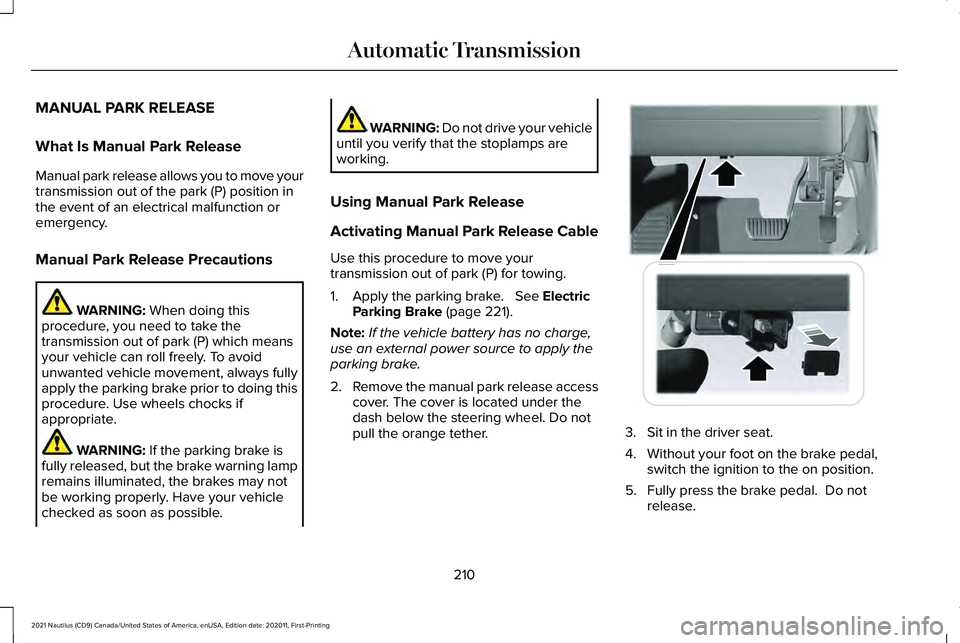
2. Remove the manual park release access
cover. The cover is located under the
dash below the steering wheel. Do not
pull the orange tether. 3. Sit in the driver seat.
4. Without your foot on the brake pedal,
switch the ignition to the on position.
5. Fully press the brake pedal. Do not release.
210
2021 Nautilus (CD9) Canada/United States of America, enUSA, Edition date: 202011, First-Printing Automatic TransmissionE272552
Page 220 of 579
Once through water, always try the brakes.
Wet brakes will not stop your vehicle as
quickly as dry brakes. Apply light pressure
to the brake pedal while slowly moving the
vehicle to dry the brakes.
Note:
Driving through deep water could
cause damage to the transmission. If the
front or rear axle is submerged in water, the
axle lubricant and power transfer unit
lubricant should be checked and changed
if necessary.
Driving on Hilly or Sloping Terrain
Although natural obstacles could make it
necessary to travel diagonally up or down a
hill or steep incline, you should try to drive
straight up or straight down.
Note: Avoid turning on steep slopes or hills.
A danger lies in losing traction, slipping
sideways and possible vehicle roll over.
Whenever driving on a hill, determine
beforehand the route you can use. Do not
drive over the crest of a hill without seeing
what conditions are on the other side. Do
not drive in reverse over a hill without the
aid of an observer. Apply just enough power to the wheels to
climb the hill. Too much power will cause the
tires to slip, spin or lose traction, and you
could lose control of your vehicle.
When descending a steep hill, do not
descend the hill in neutral. Avoid sudden
hard braking to keep the front wheels rolling
and to maintain your vehicle's steering.
Note:
If your vehicle has anti-lock brakes,
apply the brakes steadily. Do not pump the
brakes.
Note: If your vehicle gets stuck driving on
hilly or sloping terrain, it may be rocked out
by shifting between forward and reverse
gears, stopping between shifts in a steady
pattern. Press lightly on the accelerator in
each gear.
Note: Do not rock your vehicle if the engine
is not at normal operating temperature, as
damage to the transmission may occur.
Note: Do not rock your vehicle for more than
a minute, as damage to the transmission
and tires may occur or the engine may
overheat. Driving on Snow and Ice WARNING: If you are driving in
slippery conditions that require tire chains
or cables, then it is critical that you drive
cautiously. Keep speeds down, allow for
longer stopping distances and avoid
aggressive steering to reduce the chances
of a loss of vehicle control which can lead
to serious injury or death. If the rear end
of your vehicle slides while cornering, steer
in the direction of the slide until you regain
control of your vehicle.
Avoid sudden applications of power and
quick changes of direction on snow and ice.
Apply the accelerator slowly and steadily
when starting from a full stop.
Avoid sudden braking. Although an all-wheel
drive vehicle accelerates better than a
two-wheel drive vehicle in snow and ice, it
cannot stop any faster as braking occurs at
all four wheels. Do not become
overconfident of the road conditions.
216
2021 Nautilus (CD9) Canada/United States of America, enUSA, Edition date: 202011, First-Printing All-Wheel Drive
(If Equipped)
Page 222 of 579

BRAKE PRECAUTIONS
WARNING: Driving your vehicle with
the warning lamp on is dangerous. A
significant decrease in braking
performance may occur. It may take you
longer to stop your vehicle. Have your
vehicle checked as soon as possible.
Driving extended distances with the
parking brake engaged can cause brake
failure and the risk of personal injury.
Wet brakes result in reduced braking
efficiency. Gently press the brake pedal a
few times when driving from a car wash or
standing water to dry the brakes. ANTI-LOCK BRAKING SYSTEM
Anti-Lock Braking System Limitations
The anti-lock braking system does not
eliminate the risk of crash when:
•
You drive too closely to the vehicle in
front of you.
• Your vehicle is hydroplaning.
• You take corners too fast.
• The road surface is poor.
Note: If the system activates, the brake
pedal could pulse and could travel further.
Maintain pressure on the brake pedal.
BRAKE OVER ACCELERATOR
In the event the accelerator pedal becomes
stuck or entrapped, apply steady and firm
pressure to the brake pedal to slow the
vehicle and reduce engine power. If you
experience this condition, apply the brakes
and bring your vehicle to a safe stop. Move the transmission to park (P), switch the
engine off and apply the parking brake.
Inspect the accelerator pedal for any
interference. If none are found and the
condition persists, have your vehicle towed
to the nearest authorized dealer.
LOCATING THE BRAKE FLUID
RESERVOIR
See
Under Hood Overview (page 334).
CHECKING THE BRAKE FLUID WARNING: Do not use any fluid other
than the recommended brake fluid as this
will reduce brake efficiency. Use of
incorrect fluid could result in the loss of
vehicle control, serious personal injury or
death.
218
2021 Nautilus (CD9) Canada/United States of America, enUSA, Edition date: 202011, First-Printing Brakes
Page 223 of 579
WARNING: Only use brake fluid from
a sealed container. Contamination with dirt,
water, petroleum products or other
materials may result in brake system
damage or failure. Failure to adhere to this
warning could result in the loss of vehicle
control, serious personal injury or death. WARNING:
Do not allow the fluid to
touch your skin or eyes. If this happens,
rinse the affected areas immediately with
plenty of water and contact your physician. WARNING:
The brake system could
be affected if the brake fluid level is below
the
MIN mark or above the MAX mark on
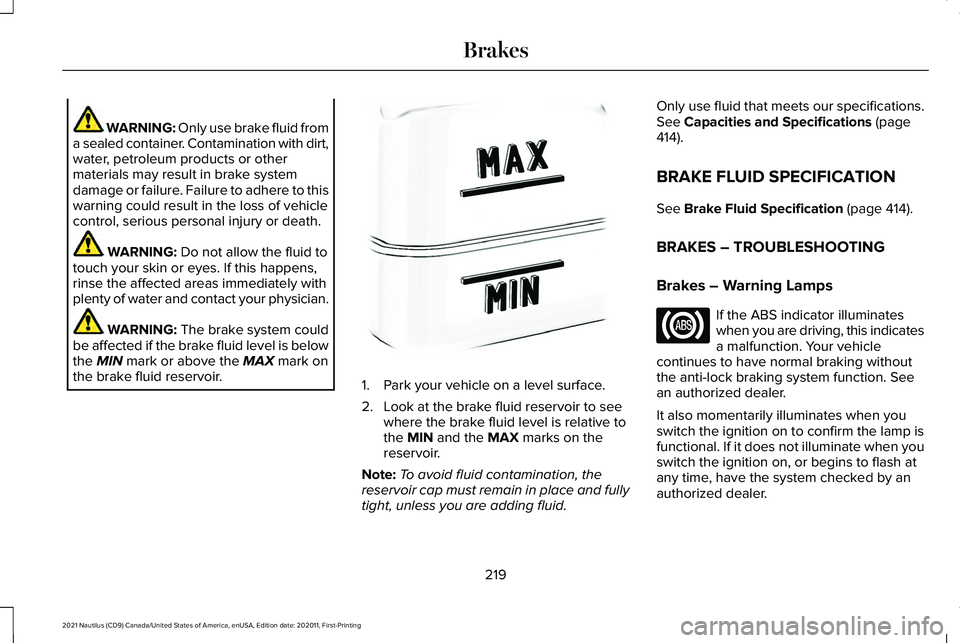
the brake fluid reservoir. 1. Park your vehicle on a level surface.
2. Look at the brake fluid reservoir to see
where the brake fluid level is relative to
the
MIN and the MAX marks on the
reservoir.
Note: To avoid fluid contamination, the
reservoir cap must remain in place and fully
tight, unless you are adding fluid. Only use fluid that meets our specifications.
See
Capacities and Specifications (page
414).
BRAKE FLUID SPECIFICATION
See
Brake Fluid Specification (page 414).
BRAKES – TROUBLESHOOTING
Brakes – Warning Lamps If the ABS indicator illuminates
when you are driving, this indicates
a malfunction. Your vehicle
continues to have normal braking without
the anti-lock braking system function. See
an authorized dealer.
It also momentarily illuminates when you
switch the ignition on to confirm the lamp is
functional. If it does not illuminate when you
switch the ignition on, or begins to flash at
any time, have the system checked by an
authorized dealer.
219
2021 Nautilus (CD9) Canada/United States of America, enUSA, Edition date: 202011, First-Printing BrakesE170684
Page 224 of 579
The brake indicator momentarily
illuminates when you switch the
ignition on to confirm the lamp is
functional. It may also illuminate when you
apply the parking brake and the ignition is
on. If it illuminates when your vehicle is
moving, make sure the parking brake is
disengaged. If the parking brake is
disengaged, this indicates low brake fluid
level or a brake system fault. See an
authorized dealer. Brakes – Information Messages The brake fluid level
is low and the brake
system should be
inspected immedi-
ately. See Checking the Brake Fluid (page 218).
Brake Fluid Level
Low
The brake systemneeds servicing.
Stop the vehicle in a safe place. Contact an authorized dealer.
Check Brake System
Brakes – Frequently Asked Questions
Is brake dust on the wheels normal? Brake dust could accumulate on the
wheels, even under normal driving
conditions. Some dust is inevitable as
the brakes wear and does not contribute
to brake noise.
See Cleaning Wheels
(page 356). Will wet driving conditions effect my
braking abilities?
Wet brakes result in reduced braking
efficiency. Gently press the brake pedal
a few times when driving from a car
wash or standing water to dry the
brakes.
Is brake noise considered normal? Occasional brake noise is normal. If a
metal-to-metal, continuous grinding or
continuous squeal sound is present, the
brake linings may be worn-out and an
authorized dealer should check them.
If the vehicle has continuous vibration
or shudder in the steering wheel while
braking, an authorized dealer should
check your vehicle.
When should you replace the brake fluid? Brake fluid absorbs water over time
which degrades the effectiveness of the
brake fluid. Change the brake fluid at
the specified intervals to prevent
degraded braking performance.
See
Normal Scheduled Maintenance (page
463
).
220
2021 Nautilus (CD9) Canada/United States of America, enUSA, Edition date: 202011, First-Printing BrakesE270480
Page 227 of 579
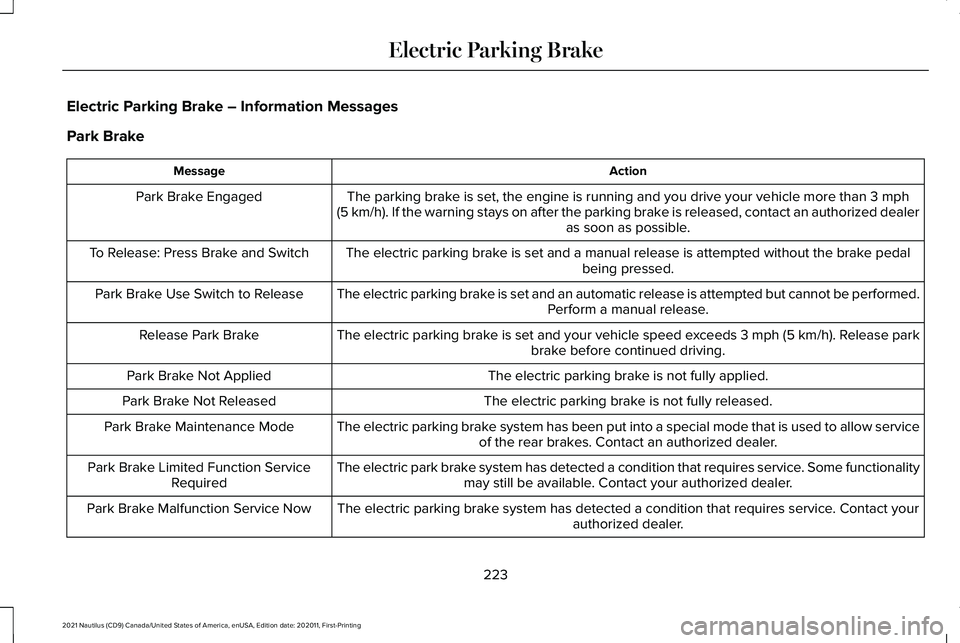
Electric Parking Brake – Information Messages
Park Brake
Action
Message
The parking brake is set, the engine is running and you drive your vehicle more than 3 mph
(5 km/h). If the warning stays on after the parking brake is released, contact an authorized dealer as soon as possible.
Park Brake Engaged
The electric parking brake is set and a manual release is attempted without the brake pedal being pressed.
To Release: Press Brake and Switch
The electric parking brake is set and an automatic release is attempted but cannot be performed.Perform a manual release.
Park Brake Use Switch to Release
The electric parking brake is set and your vehicle speed exceeds 3 mph (5 km/h)
. Release park
brake before continued driving.
Release Park Brake
The electric parking brake is not fully applied.
Park Brake Not Applied
The electric parking brake is not fully released.
Park Brake Not Released
The electric parking brake system has been put into a special mode that is used to allow serviceof the rear brakes. Contact an authorized dealer.
Park Brake Maintenance Mode
The electric park brake system has detected a condition that requires service. Some functionalitymay still be available. Contact your authorized dealer.
Park Brake Limited Function Service
Required
The electric parking brake system has detected a condition that requires service. Contact your authorized dealer.
Park Brake Malfunction Service Now
223
2021 Nautilus (CD9) Canada/United States of America, enUSA, Edition date: 202011, First-Printing Electric Parking Brake