fuel cap LINCOLN NAUTILUS 2021 Owners Manual
[x] Cancel search | Manufacturer: LINCOLN, Model Year: 2021, Model line: NAUTILUS, Model: LINCOLN NAUTILUS 2021Pages: 579, PDF Size: 6.9 MB
Page 10 of 579
Power Outlet - Vehicles With:
110V Power Outlet
What Is the Power Outlet ...........................180
Power Outlet Precautions ..........................
180
Locating the Power Outlet .........................
180
Power Outlet Indicators ..............................
180
Power Outlet - Vehicles With: 12V Power Outlet
What Is the Power Outlet ............................
181
Power Outlet Precautions ...........................
181
Locating the Power Outlet ..........................
181
Wireless Accessory Charger
What Is the Wireless Accessory Charger .......................................................................
182
Wireless Accessory Charger Precautions .......................................................................
182
Locating the Wireless Accessory Charger .......................................................................
183
Charging a Wireless Device ......................
183
Storage
Cup Holders ..................................................
184Under Floor Storage
....................................
184
Glasses Holder .............................................
185
Starting and Stopping the Engine
Starting and Stopping the Engine – Precautions ...............................................
186
Push Button Ignition Switch ......................
186
Starting the Engine ......................................
187
Engine Block Heater ...................................
188
Stopping the Engine ....................................
189
Automatic Engine Stop ...............................
189
Accessing the Passive Key Backup Position .......................................................
190
Starting and Stopping the Engine – Troubleshooting ........................................
191
Auto-Start-Stop
What Is Auto-Start-Stop ..............................
194
Auto-Start-Stop Precautions ......................
194
Switching Auto-Start-Stop On and Off .......................................................................
194
Stopping the Engine ....................................
194
Restarting the Engine ..................................
194Auto-Start-Stop Indicators
..........................
194
Auto-Start-Stop – Troubleshooting .........
195
Fuel and Refueling
Fuel and Refueling Precautions ...............
197
Fuel Quality ....................................................
198
Locating the Fuel Filler Funnel .................
198
Running Out of Fuel ....................................
199
Refueling .......................................................
200
Fuel Tank Capacity .....................................
202
Fuel and Refueling – Troubleshooting ......................................................................
203
Catalytic Converter
What Is the Catalytic Converter ..............
204
Catalytic Converter Precautions .............
204
Catalytic Converter – Troubleshooting ......................................................................
204
Automatic Transmission
Automatic Transmission Precautions .....
206
Automatic Transmission Positions ..........
206
Shifting Your Vehicle Into Gear ................
207
6
2021 Nautilus (CD9) Canada/United States of America, enUSA, Edition date: 202011, First-Printing Table of Contents
Page 16 of 579
Using the Tire Sealant and Inflator Kit
......................................................................379
Tire Pressure Monitoring System
What Is the Tire Pressure Monitoring System .......................................................
385
Tire Pressure Monitoring System Overview ......................................................................
385
Tire Pressure Monitoring System Precautions ..............................................
386
Tire Pressure Monitoring System Limitations .................................................
387
Viewing the Tire Pressures .......................
387
Resetting Tire Pressure Monitoring System ......................................................................
387
Tire Pressure Monitoring System – Troubleshooting ......................................
388
Changing a Road Wheel
Changing a Flat Tire ....................................
391
Wheel Nuts ...................................................
396
Capacities and Specifications
Engine Specifications - 2.0L .....................
398Engine Specifications - 2.7L
.....................
399
Motorcraft Parts - 2.0L ...............................
400
Motorcraft Parts - 2.7L .................................
401
Engine Oil Capacity and Specification - 2.0L .............................................................
402
Engine Oil Capacity and Specification - 2.7L .............................................................
404
Cooling System Capacity and Specification - 2.0L ..........................................................
407
Cooling System Capacity and Specification - 2.7L ...........................................................
408
Fuel Tank Capacity .....................................
409
Air Conditioning System Capacity and Specification - 2.0L ..................................
410
Air Conditioning System Capacity and Specification - 2.7L ..................................
412
Washer Fluid Specification ........................
413
Brake Fluid Specification ...........................
414
Vehicle Identification
Vehicle Identification Number ..................
416
Connected Vehicle
What Is a Connected Vehicle ....................
417Connected Vehicle Requirements
...........
417
Connected Vehicle Limitations .................
417
Connecting the Vehicle to a Mobile Network ......................................................
417
Connecting the Vehicle to a Wi-Fi Network .......................................................................
417
Connected Vehicle – Troubleshooting .......................................................................
418
Vehicle Wi-Fi Hotspot
Creating a Vehicle Wi-Fi Hotspot .............
421
Changing the Vehicle Wi-Fi Hotspot Name or Password ...............................................
421
Audio System
Audio System Precautions ........................
423
Switching the Audio Unit On and Off ......
423
Selecting the Audio Source .....................
423
Playing or Pausing the Audio Source .....
423
Adjusting the Volume .................................
423
Switching Shuffle Mode On and Off ......
424
Switching Repeat Mode On and Off ......
424
Setting a Memory Preset ...........................
424
Muting the Audio .........................................
424
12
2021 Nautilus (CD9) Canada/United States of America, enUSA, Edition date: 202011, First-Printing Table of Contents
Page 23 of 579
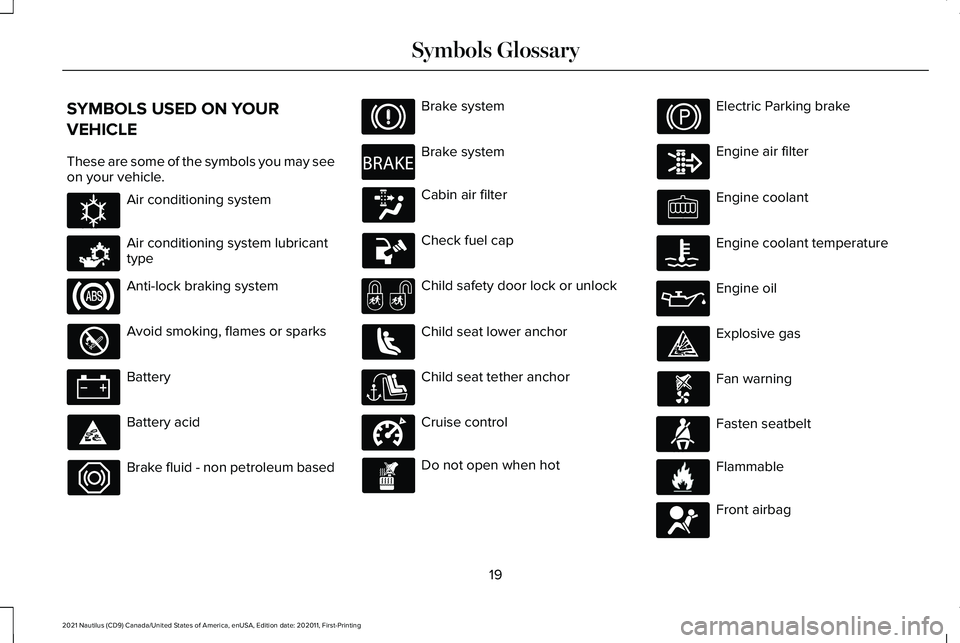
SYMBOLS USED ON YOUR
VEHICLE
These are some of the symbols you may see
on your vehicle.
Air conditioning system
Air conditioning system lubricant
type
Anti-lock braking system
Avoid smoking, flames or sparks
Battery
Battery acid
Brake fluid - non petroleum based Brake system
Brake system
Cabin air filter
Check fuel cap
Child safety door lock or unlock
Child seat lower anchor
Child seat tether anchor
Cruise control
Do not open when hot Electric Parking brake
Engine air filter
Engine coolant
Engine coolant temperature
Engine oil
Explosive gas
Fan warning
Fasten seatbelt
Flammable
Front airbag
19
2021 Nautilus (CD9) Canada/United States of America, enUSA, Edition date: 202011, First-Printing Symbols GlossaryE162384 E231157 E270480 E332905 E71880 E231160 E67017
Page 30 of 579
System data cannot be accessed without
special equipment and access to your
vehicle's module.
For additional information about our privacy
policy, refer to the local Lincoln website.
Note:
To find out if your vehicle has
connectivity technology, visit
www.ConnectedLincoln.com.
EMERGENCY CALL SYSTEM DATA
When the emergency call system is active,
it may disclose to emergency services that
your vehicle has been in a crash involving
the deployment of an airbag or activation of
the fuel pump shut-off. Certain versions or
updates to the emergency call system may
also be capable of electronically or verbally
disclosing to emergency services operators
your vehicle location or other details about
your vehicle or crash to assist emergency
services operators to provide the most
appropriate emergency services. If you do
not want to disclose this information, do not
activate the emergency call system. Note:
You cannot deactivate emergency call
systems that are required by law.
26
2021 Nautilus (CD9) Canada/United States of America, enUSA, Edition date: 202011, First-Printing Data Privacy
Page 77 of 579
HOW DOES 911 ASSIST WORK
If a crash deploys an airbag, excluding knee
airbags and rear inflatable seatbelts, or
activates the fuel pump shut-off, your vehicle
may be able to contact emergency services
by dialing 911 through a paired and
connected Bluetooth-enabled phone.
Not all crashes will deploy an airbag or
activate the fuel pump shut-off. If a
connected cell phone sustains damage or
loses its connection to SYNC during a crash,
SYNC will search for and try to connect to a
previously paired cell phone. SYNC will then
attempt to call the emergency services.
Before making the call:
•
SYNC provides about 10 seconds to
cancel the call. If you fail to cancel the
call, SYNC attempts to dial 911.
• SYNC says the following, or a similar
message: "SYNC will attempt to call 911,
to cancel the call, press Cancel on your
screen or press and hold the phone
button on your steering wheel." If you do not cancel the call and SYNC makes
a successful call a pre-recorded message
plays for the 911 operator. The occupants in
your vehicle are able to talk with the
operator. Be prepared to provide your name,
phone number and location immediately
because not all 911 systems are capable of
receiving this information electronically.
During an emergency call the system
transmits vehicle data to the emergency
service.
EMERGENCY CALL
REQUIREMENTS
WARNING: Do not wait for 911 Assist
to make an emergency call if you can do
it yourself. Dial emergency services
immediately to avoid delayed response
time which could increase the risk of
serious injury or death after a crash. If you
do not hear 911 Assist within five seconds
of the crash, the system or phone may be
damaged or non-functional. WARNING: Always place your phone
in a secure location in your vehicle so it
does not become a projectile or get
damaged in a crash. Failure to do so may
cause serious injury to someone or
damage the phone which could prevent
911 Assist from working properly. WARNING: Unless the 911 Assist
setting is set on before a crash, the system
will not dial for help which could delay
response time, potentially increasing the
risk of serious injury or death after a crash.
• SYNC must be powered and working
properly at the time of the incident and
throughout feature activation and use.
• The 911 Assist feature must be set on
before the incident.
• You must pair and connect a Bluetooth
enabled and compatible cell phone to
SYNC.
• A connected Bluetooth enabled phone
must have the ability to make and
maintain an outgoing call at the time of
the incident.
73
2021 Nautilus (CD9) Canada/United States of America, enUSA, Edition date: 202011, First-Printing 911 Assist
Page 202 of 579
FUEL QUALITY
Selecting the Correct Fuel
Your vehicle operates on regular unleaded
gasoline with a minimum pump (R+M)/2
octane rating of 87.
Some fuel stations, particularly those in high
altitude areas, offer fuels posted as regular
unleaded gasoline with an octane rating
below 87. The use of these fuels could result
in engine damage that will not be covered
by the vehicle Warranty. For best overall vehicle and engine
performance, premium fuel with an octane
rating of 91 or higher is recommended. The
performance gained by using premium fuel
is most noticeable in hot weather as well as
other conditions, for example when towing
a trailer. See Towing a Trailer (page 299).
Do not be concerned if the engine
sometimes knocks lightly. However, if the
engine knocks heavily while using fuel with
the recommended octane rating, contact an
authorized dealer to prevent any engine
damage.
We recommend Top Tier detergent
gasolines, where available to help minimize
engine deposits and maintain optimal vehicle
and engine performance.
For additional information, visit
www . toptiergas. com .
Note: Use of any fuel for which the vehicle
was not designed can impair the emission
control system, cause loss of vehicle
performance, and cause damage to the
engine which may not be covered by the
vehicle Warranty. Do not use:
•
Diesel fuel.
• Fuels containing kerosene or paraffin.
• Fuel containing more than 15% ethanol
or E85 fuel.
• Fuels containing methanol.
• Fuels containing metallic-based additives,
including manganese-based compounds.
• Fuels containing the octane booster
additive, methylcyclopentadienyl
manganese tricarbonyl (MMT).
• Leaded fuel, using leaded fuel is
prohibited by law.
The use of fuels with metallic compounds
such as methylcyclopentadienyl manganese
tricarbonyl, which is a manganese-based fuel
additive, will impair engine performance and
affect the emission control system.
LOCATING THE FUEL FILLER
FUNNEL
Easy Fuel Capless Filler 198
2021 Nautilus (CD9) Canada/United States of America, enUSA, Edition date: 202011, First-Printing Fuel and RefuelingE161513
Page 203 of 579
The fuel filler funnel is under the luggage
compartment floor covering.
RUNNING OUT OF FUEL
Filling a Portable Fuel Container
WARNING: Flow of fuel through a
fuel pump nozzle can produce static
electricity. This can cause a fire if you are
filling an ungrounded fuel container.
Use the following guidelines to avoid
electrostatic charge build-up, which can
produce a spark, when filling an ungrounded
fuel container:
• Only use an approved fuel container to
transfer fuel to your vehicle. Place the
container on the ground when filling it.
• Do not fill a fuel container when it is
inside your vehicle (including the cargo
area). •
Keep the fuel pump nozzle in contact
with the fuel container when filling it.
• Do not use a device that holds the fuel
pump nozzle lever in the fill position.
Adding Fuel From a Portable Fuel
Container WARNING: Do not insert the nozzle
of a fuel container or an aftermarket funnel
into the fuel filler neck. This may damage
the fuel system filler neck or its seal and
cause fuel to run onto the ground. WARNING:
Do not pry open the fuel
tank filler valve. This could damage the fuel
system. Failure to follow this instruction
could result in fire, personal injury or death. WARNING: Do not dispose of fuel in
the household refuse or the public sewage
system. Use an authorized waste disposal
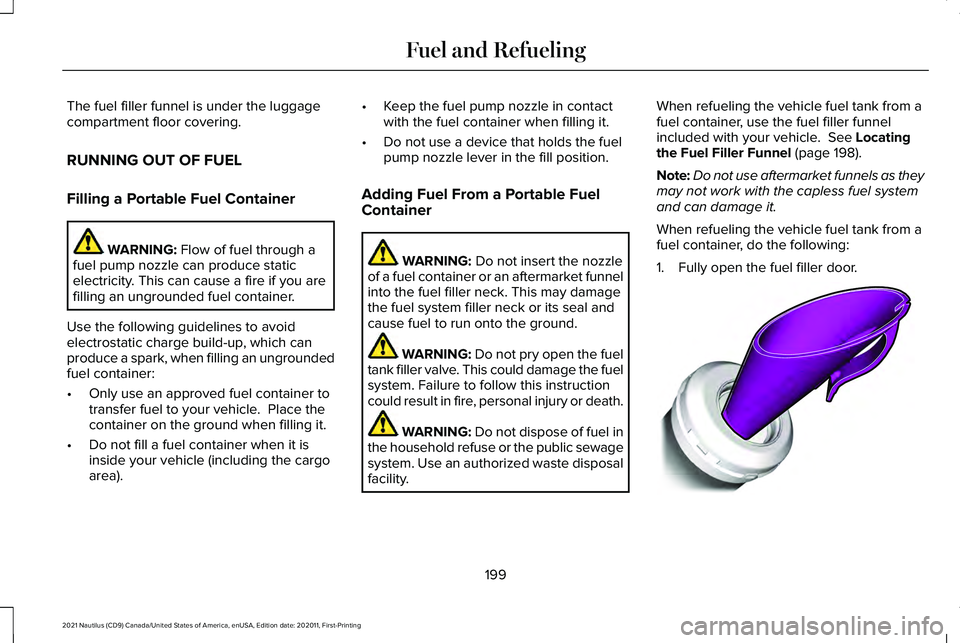
facility. When refueling the vehicle fuel tank from a
fuel container, use the fuel filler funnel
included with your vehicle.
See Locating
the Fuel Filler Funnel (page 198).
Note: Do not use aftermarket funnels as they
may not work with the capless fuel system
and can damage it.
When refueling the vehicle fuel tank from a
fuel container, do the following:
1. Fully open the fuel filler door. 199
2021 Nautilus (CD9) Canada/United States of America, enUSA, Edition date: 202011, First-Printing Fuel and RefuelingE157452
Page 206 of 579
5.
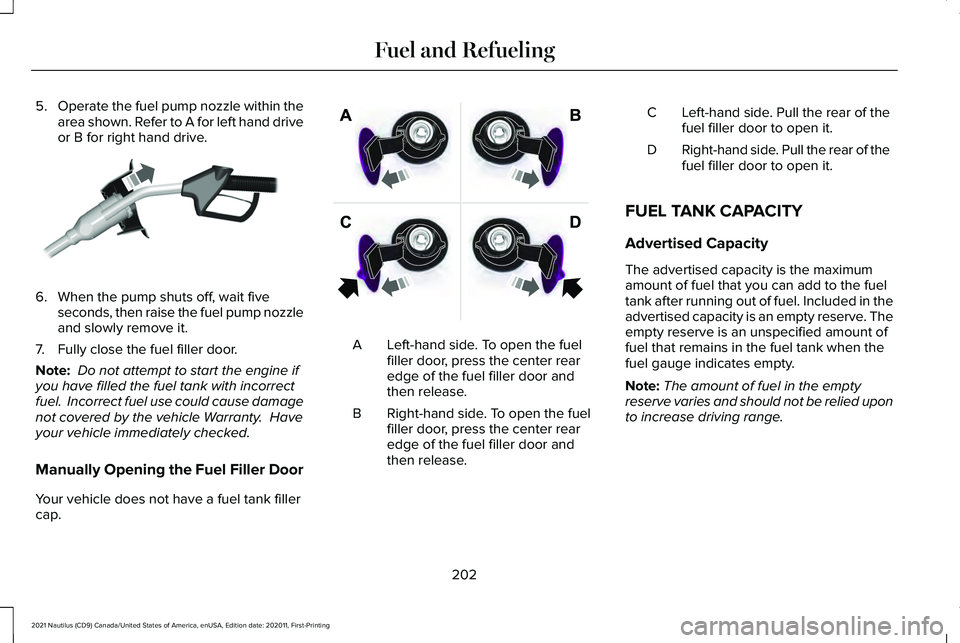
Operate the fuel pump nozzle within the
area shown. Refer to A for left hand drive
or B for right hand drive. 6. When the pump shuts off, wait five
seconds, then raise the fuel pump nozzle
and slowly remove it.
7. Fully close the fuel filler door.
Note: Do not attempt to start the engine if
you have filled the fuel tank with incorrect
fuel. Incorrect fuel use could cause damage
not covered by the vehicle Warranty. Have
your vehicle immediately checked.
Manually Opening the Fuel Filler Door
Your vehicle does not have a fuel tank filler
cap. Left-hand side. To open the fuel
filler door, press the center rear
edge of the fuel filler door and
then release.
A
Right-hand side. To open the fuel
filler door, press the center rear
edge of the fuel filler door and
then release.
B Left-hand side. Pull the rear of the
fuel filler door to open it.
C
Right-hand side. Pull the rear of the
fuel filler door to open it.
D
FUEL TANK CAPACITY
Advertised Capacity
The advertised capacity is the maximum
amount of fuel that you can add to the fuel
tank after running out of fuel. Included in the
advertised capacity is an empty reserve. The
empty reserve is an unspecified amount of
fuel that remains in the fuel tank when the
fuel gauge indicates empty.
Note: The amount of fuel in the empty
reserve varies and should not be relied upon
to increase driving range.
202
2021 Nautilus (CD9) Canada/United States of America, enUSA, Edition date: 202011, First-Printing Fuel and RefuelingE119081 E206911
Page 297 of 579
ROOF RACK (If Equipped)
Roof Rack Precautions
WARNING: Read and follow the
manufacturer's instructions when you are
fitting a roof rack. WARNING:
When loading the roof
racks, we recommend you evenly distribute
the load, as well as maintain a low center
of gravity. Loaded vehicles, with higher
centers of gravity, may handle differently
than unloaded vehicles. Take extra
precautions, such as slower speeds and
increased stopping distance, when driving
a heavily loaded vehicle.
Note: If you use a roof rack, the fuel
consumption of your vehicle will be higher
and you may experience different driving
characteristics. You must place loads directly on the
crossbars fitted to the roof rack side rails.
When using the roof rack system, we
recommend that you use genuine Ford Motor
Company accessory crossbars specifically
designed for your vehicle.
Make sure that you securely fasten the load.
Check the tightness of the load before
driving and at each fuel stop.
Roof Rack Load Capacities
Do not install crossbars if your vehicle has a
moonroof. Do not place any load on your
vehicle if it has a moonroof. Using crossbars
or loading the vehicle roof may void your
vehicle's warranty.
Maximum Recommended Load
Description
0 lb (0 kg)
Vehicles with a moonroof
100 lb (45 kg)
Vehicles without a moonroof
Note: The maximum roof load is based on
the load being evenly distributed on the
crossbars.
293
2021 Nautilus (CD9) Canada/United States of America, enUSA, Edition date: 202011, First-Printing Load Carrying
Page 336 of 579
MAINTENANCE PRECAUTIONS
Service your vehicle regularly to help
maintain its roadworthiness and resale value.
There is a large network of authorized
dealers that are there to help you with their
professional servicing expertise. We believe
that their specially trained technicians are
best qualified to service your vehicle properly
and expertly. They are supported by a wide
range of highly specialized tools developed
specifically for servicing your vehicle.
If your vehicle requires professional service,
an authorized dealer can provide the
necessary parts and service. Check your
warranty information to find out which parts
and services are covered.
Use only recommended fuels, lubricants,
fluids and service parts conforming to
specifications. See Capacities and
Specifications (page 398).
• Do not work on a hot engine.
• Make sure that nothing gets caught in
moving parts. •
Do not work on a vehicle with the engine
running in an enclosed space, unless you
are sure you have enough ventilation.
• Keep all open flames and other burning
material, such as cigarettes, away from
the battery and all fuel related parts.
• Set the parking brake, shift the
transmission to park (P) and block the
wheels.
OPENING AND CLOSING THE
HOOD
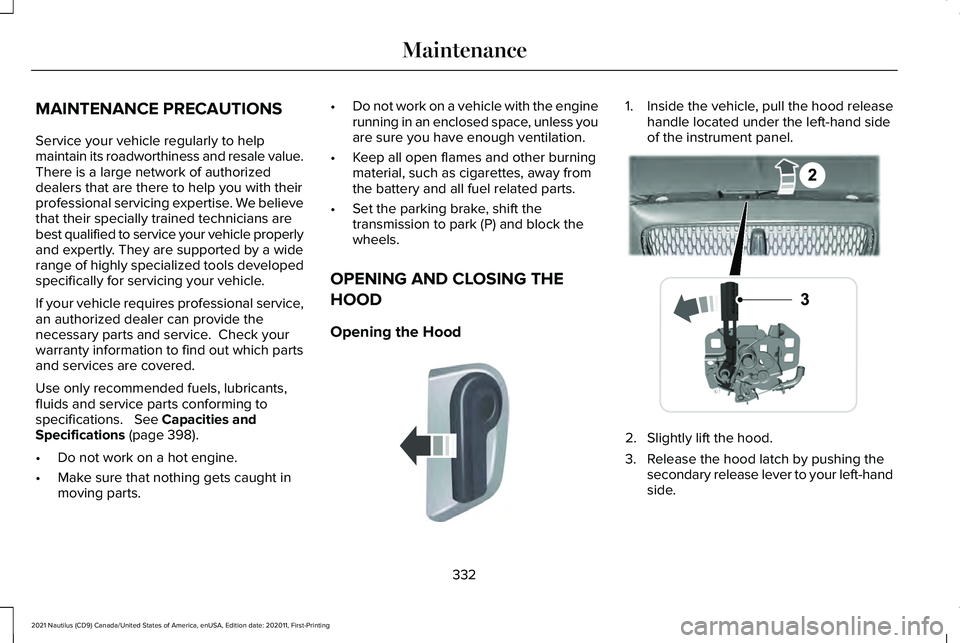
Opening the Hood 1. Inside the vehicle, pull the hood release
handle located under the left-hand side
of the instrument panel. 2. Slightly lift the hood.
3. Release the hood latch by pushing the
secondary release lever to your left-hand
side.
332
2021 Nautilus (CD9) Canada/United States of America, enUSA, Edition date: 202011, First-Printing MaintenanceE142457 E267365