seats LINCOLN NAVIGATOR 2011 User Guide
[x] Cancel search | Manufacturer: LINCOLN, Model Year: 2011, Model line: NAVIGATOR, Model: LINCOLN NAVIGATOR 2011Pages: 370, PDF Size: 2.6 MB
Page 127 of 370
Climate controlled seats air filter replacement (if equipped)
The climate controlled seat system includes air filters that must be
replaced periodically. Refer to thescheduled maintenance information
for more information.
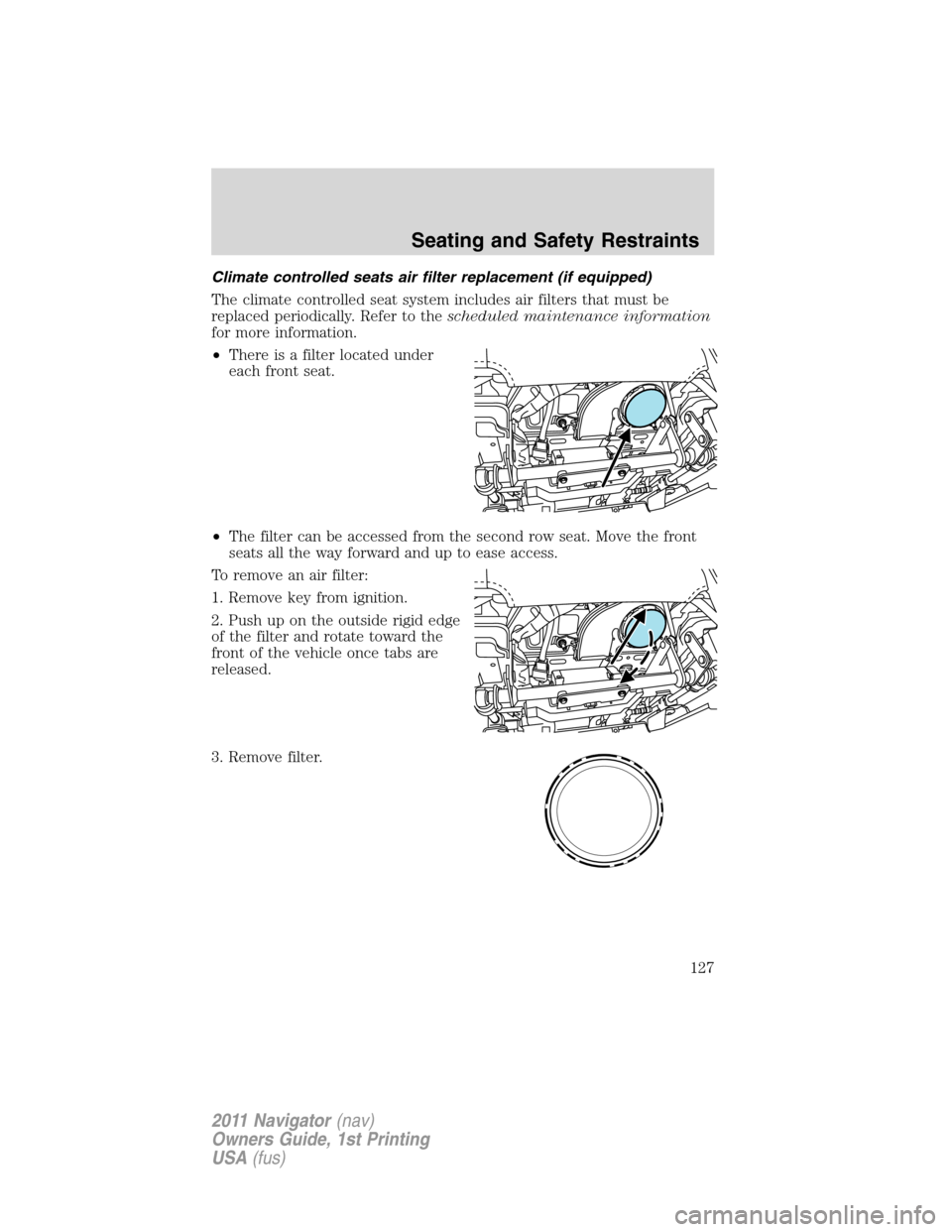
•There is a filter located under
each front seat.
•The filter can be accessed from the second row seat. Move the front
seats all the way forward and up to ease access.
To remove an air filter:
1. Remove key from ignition.
2. Push up on the outside rigid edge
of the filter and rotate toward the
front of the vehicle once tabs are
released.
3. Remove filter.
Seating and Safety Restraints
127
2011 Navigator(nav)
Owners Guide, 1st Printing
USA(fus)
Page 128 of 370
To install a filter:
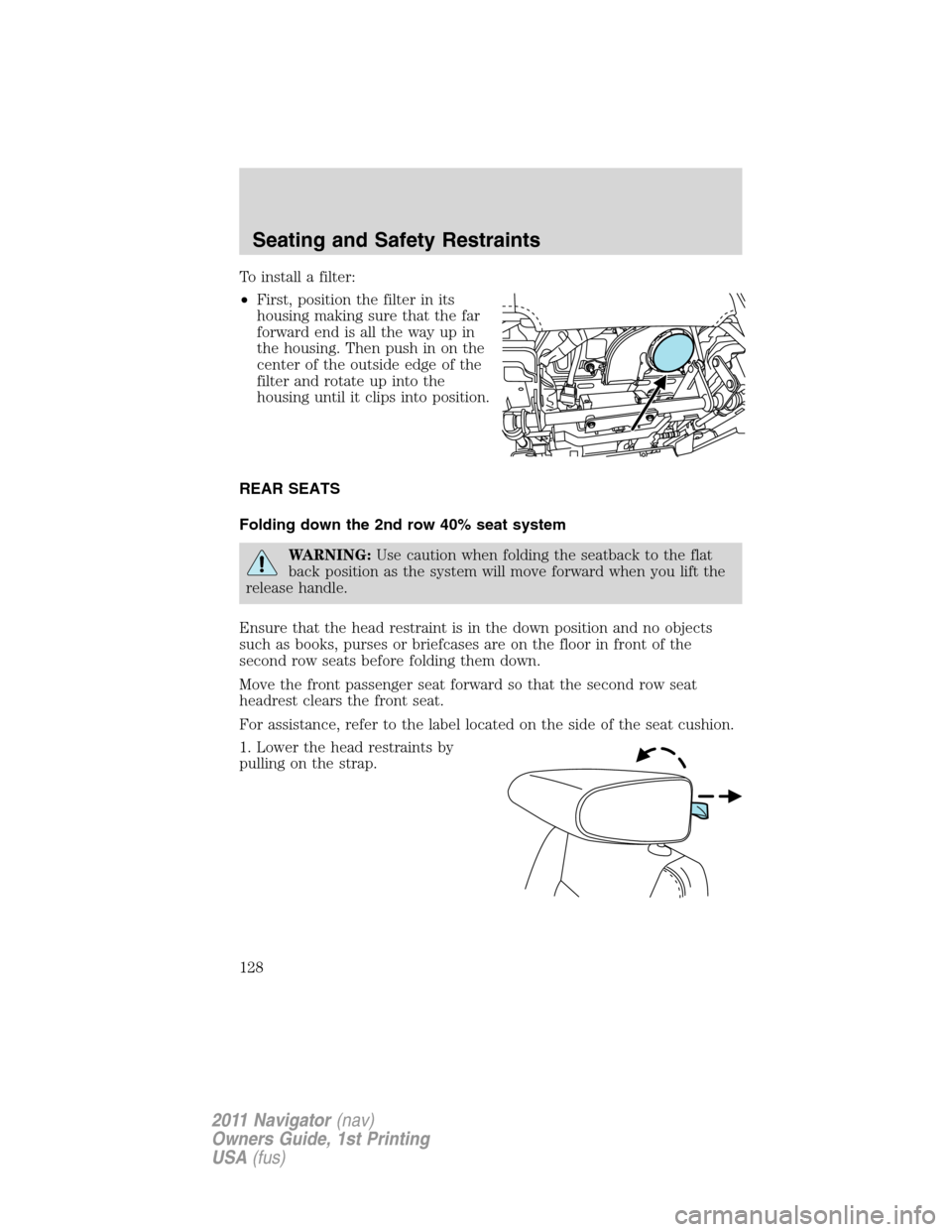
•First, position the filter in its
housing making sure that the far
forward end is all the way up in
the housing. Then push in on the
center of the outside edge of the
filter and rotate up into the
housing until it clips into position.
REAR SEATS
Folding down the 2nd row 40% seat system
WARNING:Use caution when folding the seatback to the flat
back position as the system will move forward when you lift the
release handle.
Ensure that the head restraint is in the down position and no objects
such as books, purses or briefcases are on the floor in front of the
second row seats before folding them down.
Move the front passenger seat forward so that the second row seat
headrest clears the front seat.
For assistance, refer to the label located on the side of the seat cushion.
1. Lower the head restraints by
pulling on the strap.
Seating and Safety Restraints
128
2011 Navigator(nav)
Owners Guide, 1st Printing
USA(fus)
Page 130 of 370
Placing the 2nd row outboard 40% seats in cargo mode
WARNING:Use caution when folding the seatback to the flat
back position as the system will move forward when you lift the
release handle.
The 2nd row seats can be placed in a kneel down load floor position to
allow more cargo space.
WARNING:Always return the seat from the kneel position prior to
raising the seatback. Failure to do so could result in personal injury.
To place the seats in the cargo mode:
1. Fold down the 2nd row seat.
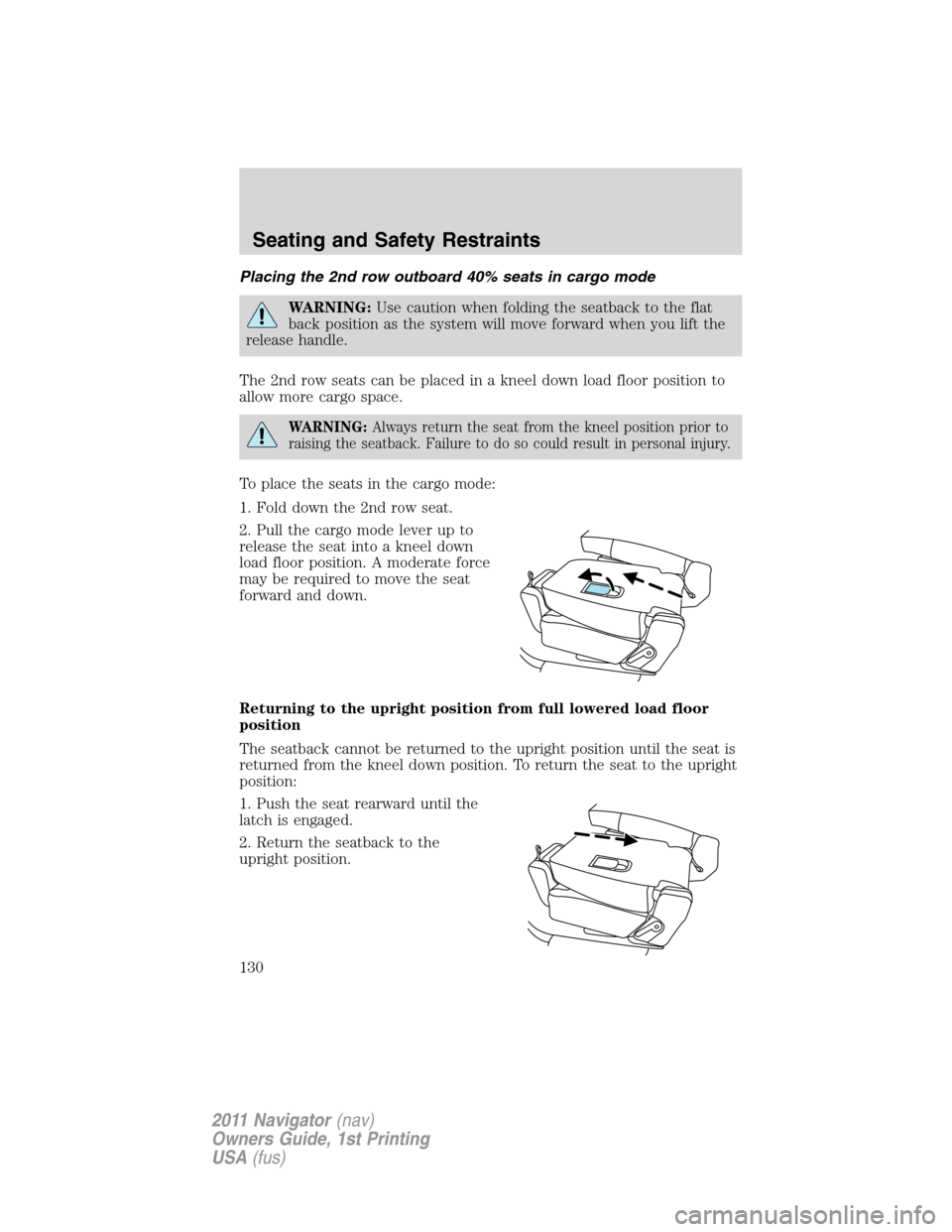
2. Pull the cargo mode lever up to
release the seat into a kneel down
load floor position. A moderate force
may be required to move the seat
forward and down.
Returning to the upright position from full lowered load floor
position
The seatback cannot be returned to the upright position until the seat is
returned from the kneel down position. To return the seat to the upright
position:
1. Push the seat rearward until the
latch is engaged.
2. Return the seatback to the
upright position.
Seating and Safety Restraints
130
2011 Navigator(nav)
Owners Guide, 1st Printing
USA(fus)
Page 134 of 370
2. With the latch released the
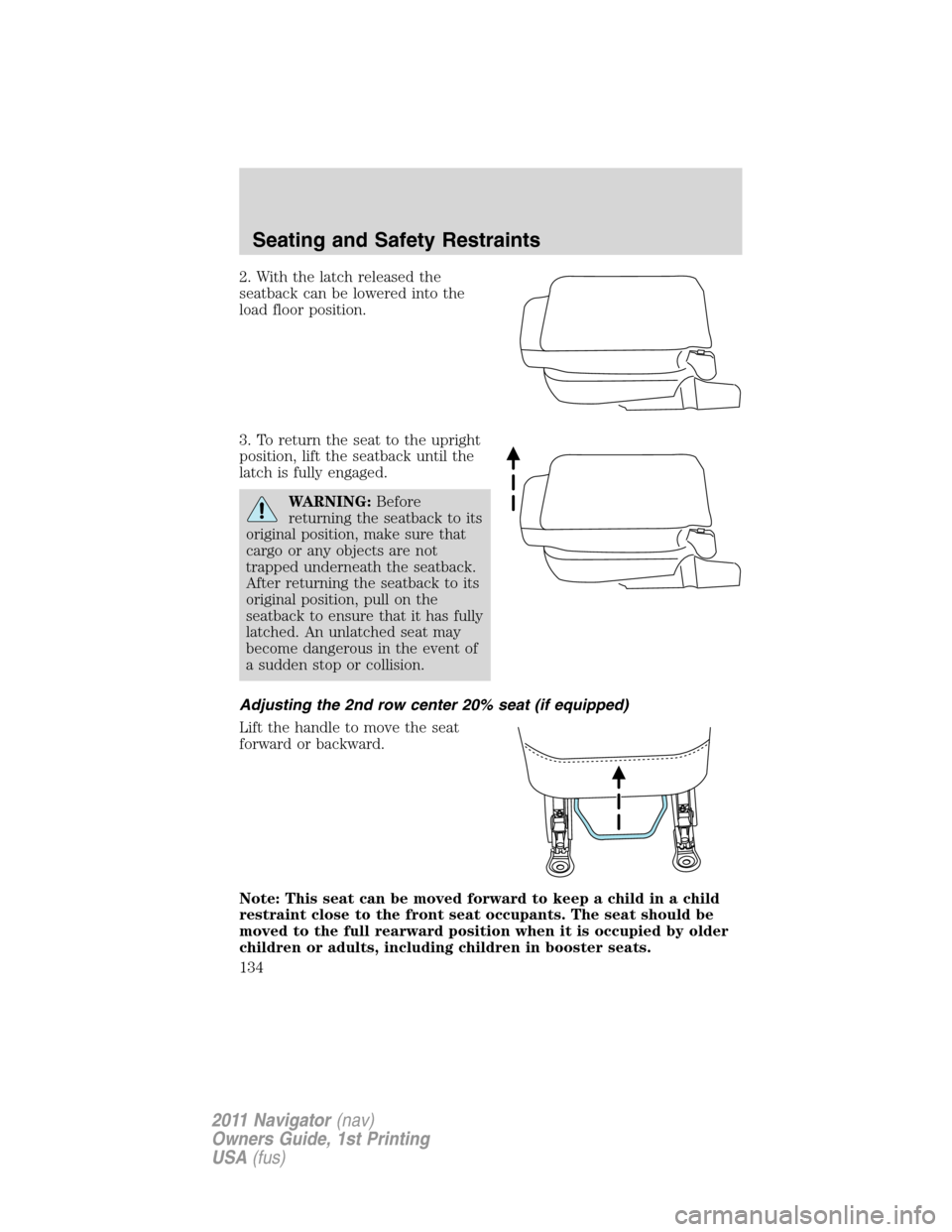
seatback can be lowered into the
load floor position.
3. To return the seat to the upright
position, lift the seatback until the
latch is fully engaged.
WARNING:Before
returning the seatback to its
original position, make sure that
cargo or any objects are not
trapped underneath the seatback.
After returning the seatback to its
original position, pull on the
seatback to ensure that it has fully
latched. An unlatched seat may
become dangerous in the event of
a sudden stop or collision.
Adjusting the 2nd row center 20% seat (if equipped)
Lift the handle to move the seat
forward or backward.
Note: This seat can be moved forward to keep a child in a child
restraint close to the front seat occupants. The seat should be
moved to the full rearward position when it is occupied by older
children or adults, including children in booster seats.
Seating and Safety Restraints
134
2011 Navigator(nav)
Owners Guide, 1st Printing
USA(fus)
Page 135 of 370
Rear heated seats
WARNING:Persons who are unable to feel pain to the skin because
of advanced age, chronic illness, diabetes, spinal cord injury,
medication, alcohol use, exhaustion, or other physical conditions, must
exercise care when using the seat heater. The seat heater may cause burns
even at low temperatures, especially if used for long periods of time. Do
not place anything on the seat that insulates against heat, such as a
blanket or cushion, because this may cause the seat heater to overheat. Do
not puncture the seat with pins, needles, or other pointed objects because
this may damage the heating element which may cause the seat heater to
overheat. An overheated seat may cause serious personal injury.
Note:Do not do the following:
•Place heavy objects on the seat
•Operate the seat heater if water or any other liquid is spilled on the
seat. Allow the seat to dry thoroughly.
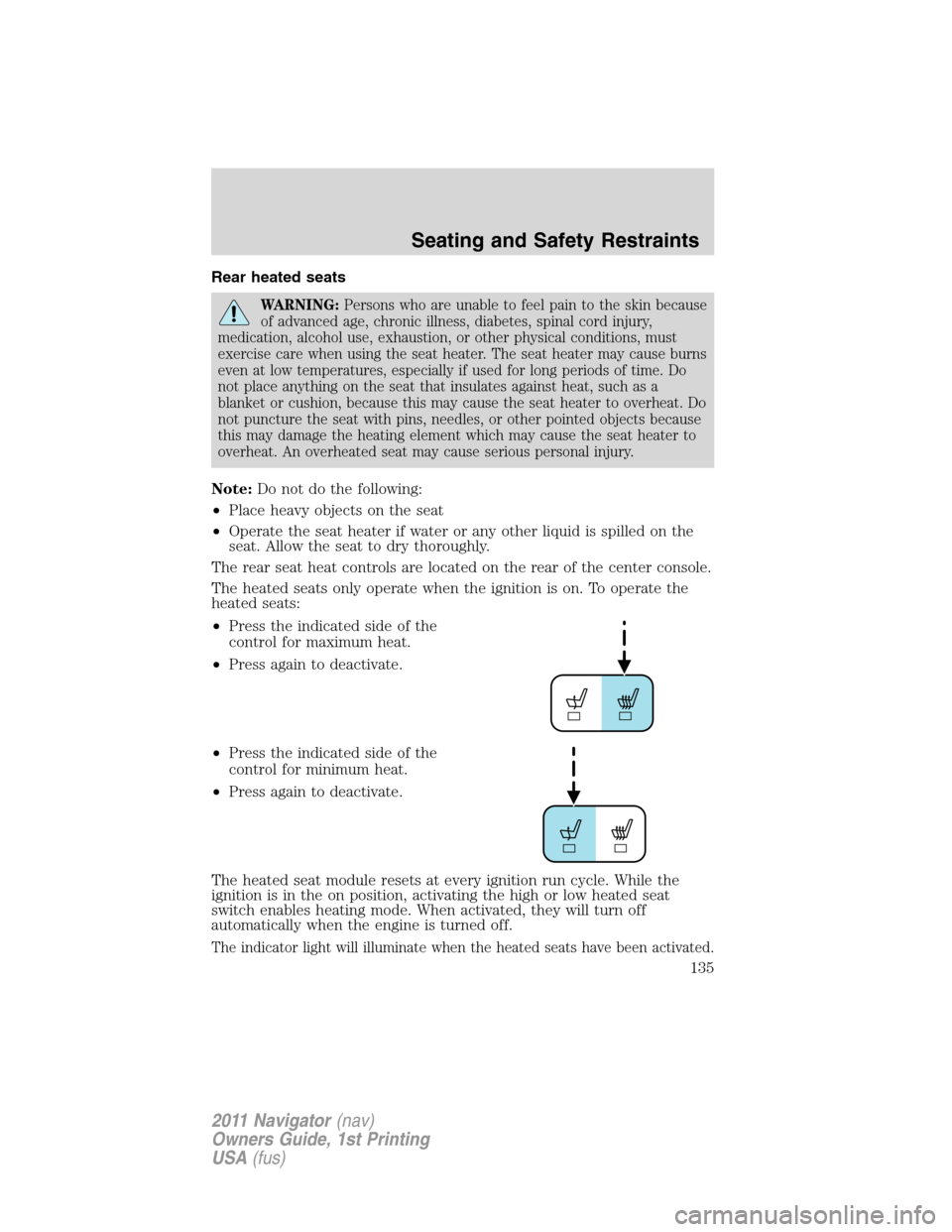
The rear seat heat controls are located on the rear of the center console.
The heated seats only operate when the ignition is on. To operate the
heated seats:
•Press the indicated side of the
control for maximum heat.
•Press again to deactivate.
•Press the indicated side of the
control for minimum heat.
•Press again to deactivate.
The heated seat module resets at every ignition run cycle. While the
ignition is in the on position, activating the high or low heated seat
switch enables heating mode. When activated, they will turn off
automatically when the engine is turned off.
The indicator light will illuminate when the heated seats have been activated.
Seating and Safety Restraints
135
2011 Navigator(nav)
Owners Guide, 1st Printing
USA(fus)
Page 136 of 370
3rd row seats
Ensure that no objects such as books, purses or briefcases are on the
floor in front of the third row seats or on the seat cushion before
lowering them. Ensure that the head restraints are lowered. Ensure that
the second row seats are not reclined.
Folding down the 3rd row seats to the load floor
WARNING:To prevent possible damage to the seat or safety
belts, ensure that the safety belts are not buckled when moving
the seat to the load floor position.
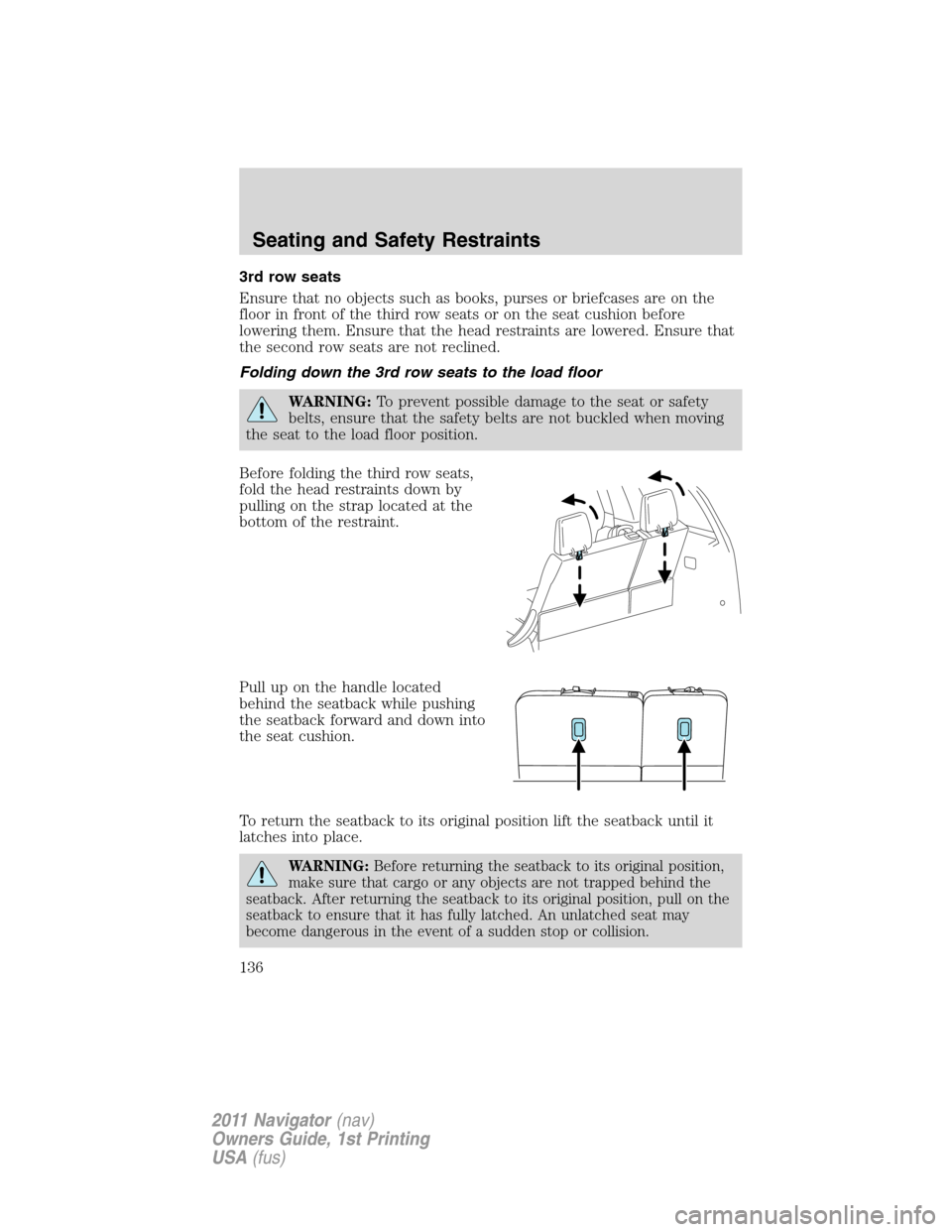
Before folding the third row seats,
fold the head restraints down by
pulling on the strap located at the
bottom of the restraint.
Pull up on the handle located
behind the seatback while pushing
the seatback forward and down into
the seat cushion.
To return the seatback to its original position lift the seatback until it
latches into place.
WARNING:Before returning the seatback to its original position,
make sure that cargo or any objects are not trapped behind the
seatback. After returning the seatback to its original position, pull on the
seatback to ensure that it has fully latched. An unlatched seat may
become dangerous in the event of a sudden stop or collision.
Seating and Safety Restraints
136
2011 Navigator(nav)
Owners Guide, 1st Printing
USA(fus)
Page 137 of 370
Third row power folding seat (if equipped)
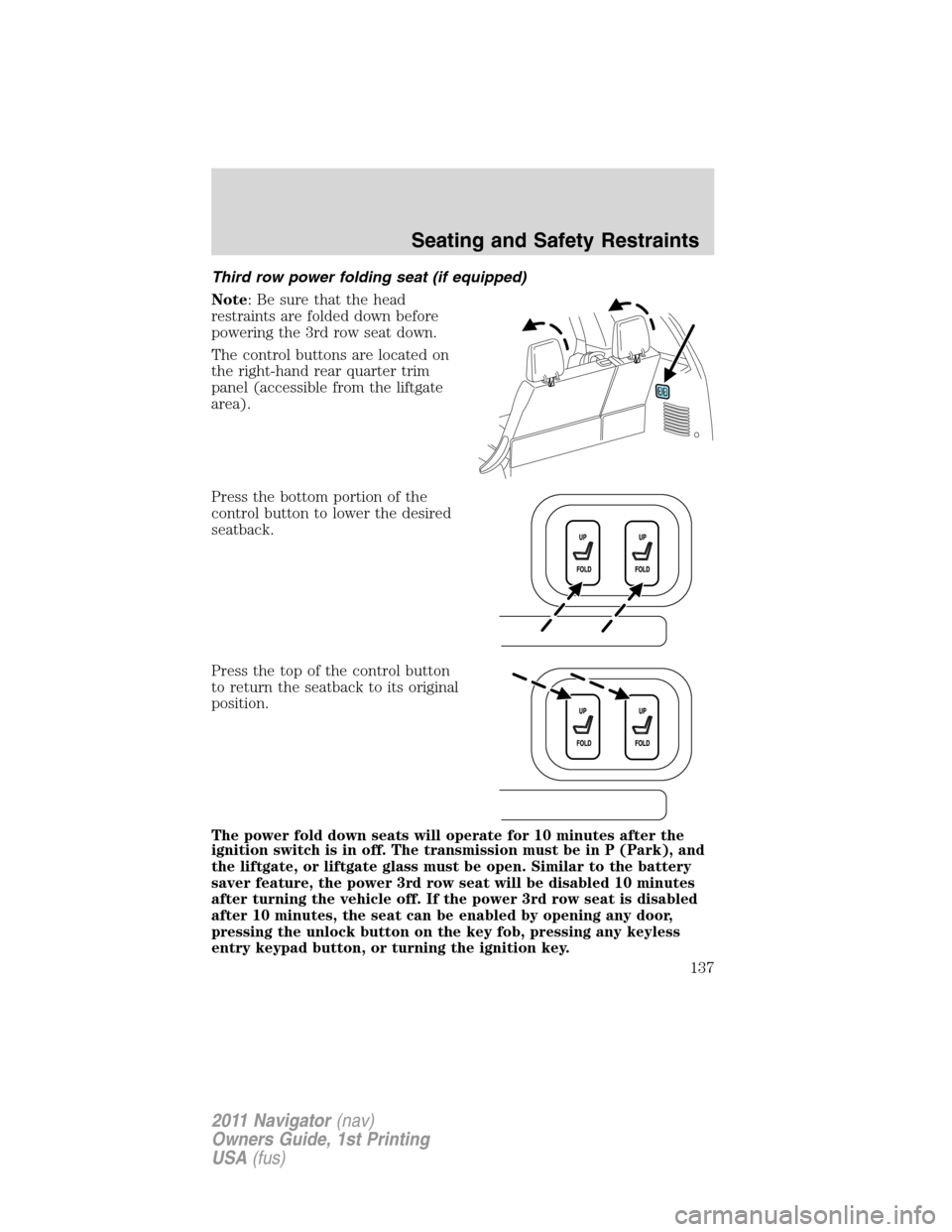
Note: Be sure that the head
restraints are folded down before
powering the 3rd row seat down.
The control buttons are located on
the right-hand rear quarter trim
panel (accessible from the liftgate
area).
Press the bottom portion of the
control button to lower the desired
seatback.
Press the top of the control button
to return the seatback to its original
position.
The power fold down seats will operate for 10 minutes after the
ignition switch is in off. The transmission must be in P (Park), and
the liftgate, or liftgate glass must be open. Similar to the battery
saver feature, the power 3rd row seat will be disabled 10 minutes
after turning the vehicle off. If the power 3rd row seat is disabled
after 10 minutes, the seat can be enabled by opening any door,
pressing the unlock button on the key fob, pressing any keyless
entry keypad button, or turning the ignition key.
Seating and Safety Restraints
137
2011 Navigator(nav)
Owners Guide, 1st Printing
USA(fus)
Page 141 of 370
WARNING:It is extremely dangerous to ride in a cargo area,
inside or outside of a vehicle. In a collision, people riding in
these areas are more likely to be seriously injured or killed. Do not
allow people to ride in any area of your vehicle that is not equipped
with seats and safety belts. Be sure everyone in your vehicle is in a
seat and using a safety belt properly.
WARNING:In a rollover crash, an unbelted person is
significantly more likely to die than a person wearing a safety
belt.
WARNING:Each seating position in your vehicle has a specific
safety belt assembly which is made up of one buckle and one
tongue that are designed to be used as a pair. 1) Use the shoulder belt
on the outside shoulder only. Never wear the shoulder belt under the
arm. 2) Never swing the safety belt around your neck over the inside
shoulder. 3) Never use a single belt for more than one person.
WARNING:When possible, all children 12 years old and under
should be properly restrained in a rear seating position.
WARNING:Safety belts and seats can become hot in a vehicle
that has been closed up in sunny weather; they could burn a
small child. Check seat covers and buckles before you place a child
anywhere near them.
WARNING:Front and rear seat occupants, including pregnant
women, should wear safety belts for optimum protection in an
accident.
Seating and Safety Restraints
141
2011 Navigator(nav)
Owners Guide, 1st Printing
USA(fus)
Page 142 of 370
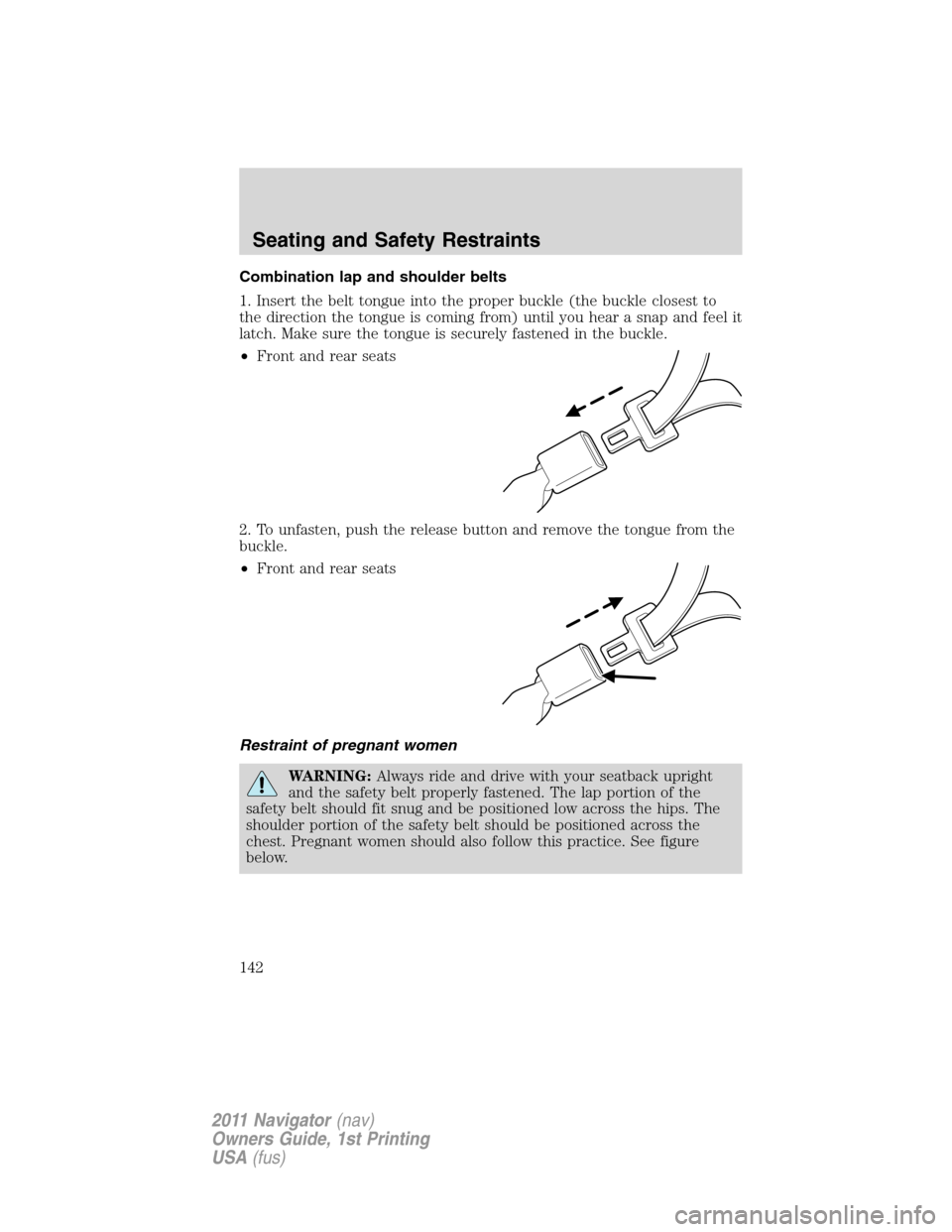
Combination lap and shoulder belts
1. Insert the belt tongue into the proper buckle (the buckle closest to
the direction the tongue is coming from) until you hear a snap and feel it
latch. Make sure the tongue is securely fastened in the buckle.
•Front and rear seats
2. To unfasten, push the release button and remove the tongue from the
buckle.
•Front and rear seats
Restraint of pregnant women
WARNING:Always ride and drive with your seatback upright
and the safety belt properly fastened. The lap portion of the
safety belt should fit snug and be positioned low across the hips. The
shoulder portion of the safety belt should be positioned across the
chest. Pregnant women should also follow this practice. See figure
below.
Seating and Safety Restraints
142
2011 Navigator(nav)
Owners Guide, 1st Printing
USA(fus)
Page 143 of 370
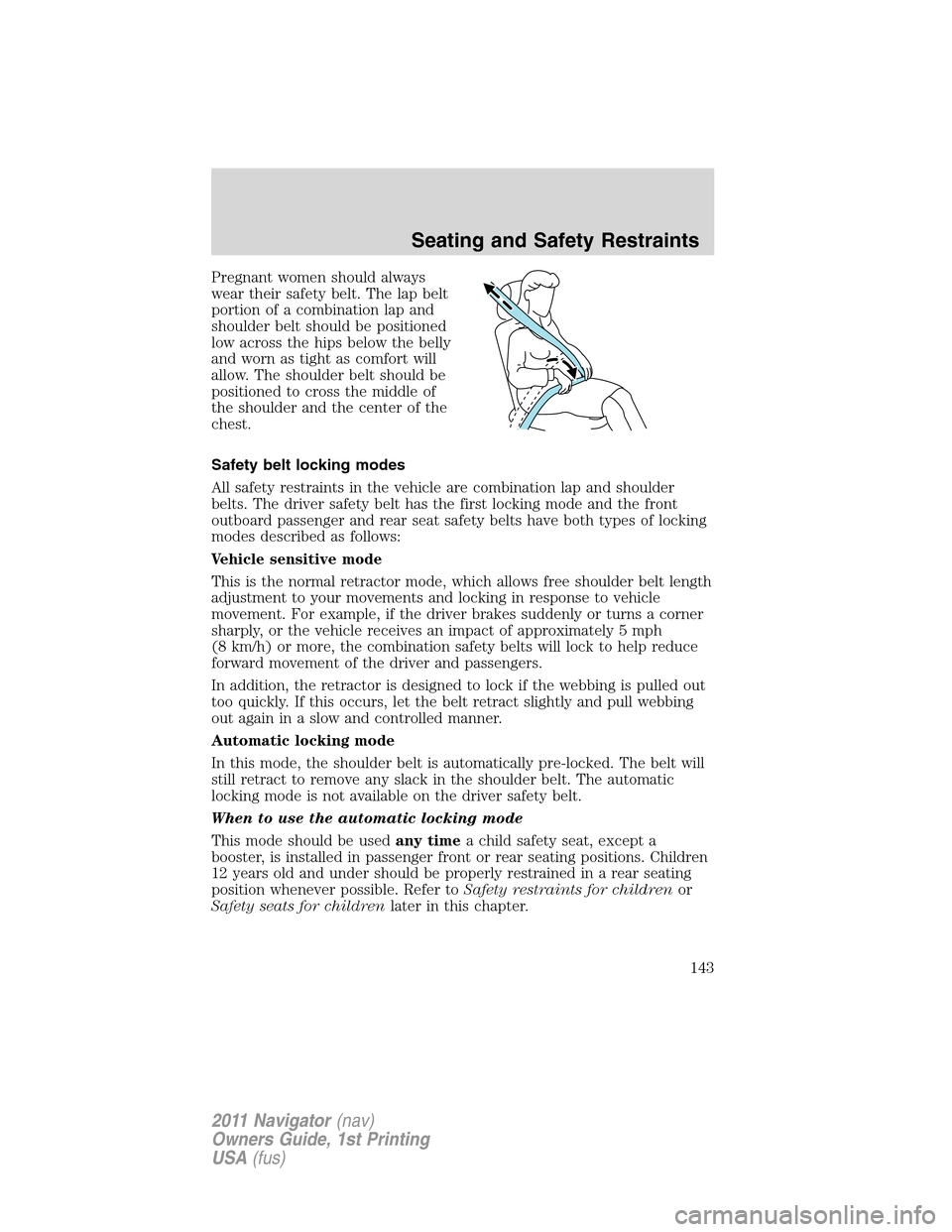
Pregnant women should always
wear their safety belt. The lap belt
portion of a combination lap and
shoulder belt should be positioned
low across the hips below the belly
and worn as tight as comfort will
allow. The shoulder belt should be
positioned to cross the middle of
the shoulder and the center of the
chest.
Safety belt locking modes
All safety restraints in the vehicle are combination lap and shoulder
belts. The driver safety belt has the first locking mode and the front
outboard passenger and rear seat safety belts have both types of locking
modes described as follows:
Vehicle sensitive mode
This is the normal retractor mode, which allows free shoulder belt length
adjustment to your movements and locking in response to vehicle
movement. For example, if the driver brakes suddenly or turns a corner
sharply, or the vehicle receives an impact of approximately 5 mph
(8 km/h) or more, the combination safety belts will lock to help reduce
forward movement of the driver and passengers.
In addition, the retractor is designed to lock if the webbing is pulled out
too quickly. If this occurs, let the belt retract slightly and pull webbing
out again in a slow and controlled manner.
Automatic locking mode
In this mode, the shoulder belt is automatically pre-locked. The belt will
still retract to remove any slack in the shoulder belt. The automatic
locking mode is not available on the driver safety belt.
When to use the automatic locking mode
This mode should be usedany timea child safety seat, except a
booster, is installed in passenger front or rear seating positions. Children
12 years old and under should be properly restrained in a rear seating
position whenever possible. Refer toSafety restraints for childrenor
Safety seats for childrenlater in this chapter.
Seating and Safety Restraints
143
2011 Navigator(nav)
Owners Guide, 1st Printing
USA(fus)