child restraint LINCOLN NAVIGATOR 2023 User Guide
[x] Cancel search | Manufacturer: LINCOLN, Model Year: 2023, Model line: NAVIGATOR, Model: LINCOLN NAVIGATOR 2023Pages: 660, PDF Size: 14.04 MB
Page 52 of 660
Attach the tether strap only to theappropriate tether anchor. The tether strapmay not work properly if attachedsomewhere other than the correct tetheranchor.
If you install a child restraint with rigid LATCHattachments, do not tighten the tether strapenough to lift the child restraint off thevehicle seat cushion when the child is seatedin it. Keep the tether strap just snug withoutlifting the front of the child restraint. Keepingthe child restraint just touching the vehicleseat gives the best protection in a severecrash.
Once you have installed the child restraintusing either the seatbelt, the lower anchorsof the LATCH system, or both, you can attachthe top tether strap.
BOOSTER SEATS
Use a belt-positioning booster seat forchildren who have outgrown or no longerproperly fit in a child restraint and meet thefollowing criteria.
•Generally children who are less than57 in (1.45 m) tall.
•Are greater than age four (4) and lessthan age twelve (12).
•Are between 40 lb (18 kg) and 80 lb(36 kg) and upward to 100 lb (45 kg).
Many state and provincial laws require thatchildren use approved booster seats untilthey reach age eight, a height of 57 in(1.45 m) tall, or 80 lb (36 kg).
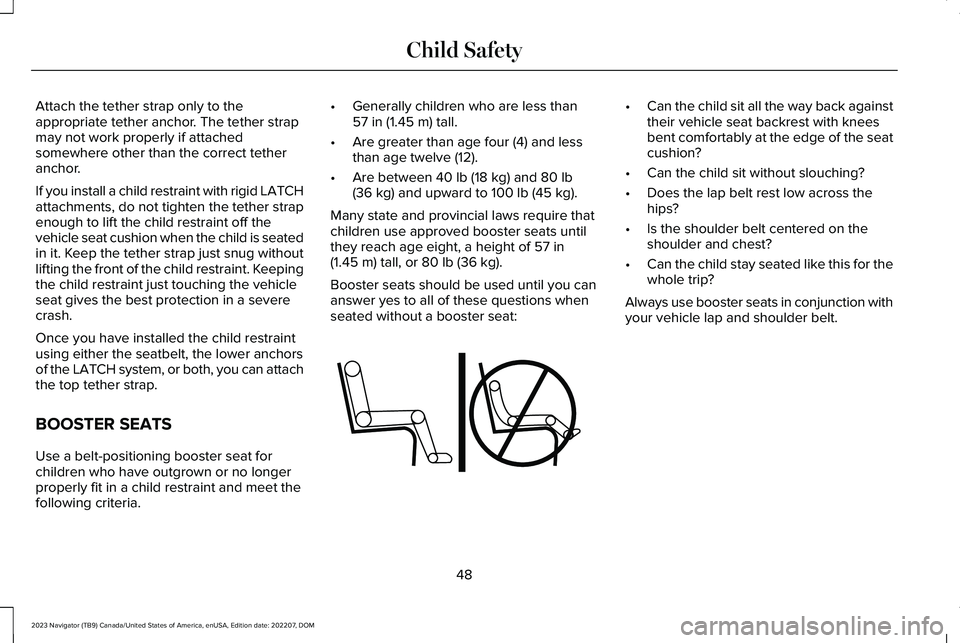
Booster seats should be used until you cananswer yes to all of these questions whenseated without a booster seat:
•Can the child sit all the way back againsttheir vehicle seat backrest with kneesbent comfortably at the edge of the seatcushion?
•Can the child sit without slouching?
•Does the lap belt rest low across thehips?
•Is the shoulder belt centered on theshoulder and chest?
•Can the child stay seated like this for thewhole trip?
Always use booster seats in conjunction withyour vehicle lap and shoulder belt.
48
2023 Navigator (TB9) Canada/United States of America, enUSA, Edition date: 202207, DOMChild SafetyE142595
Page 53 of 660
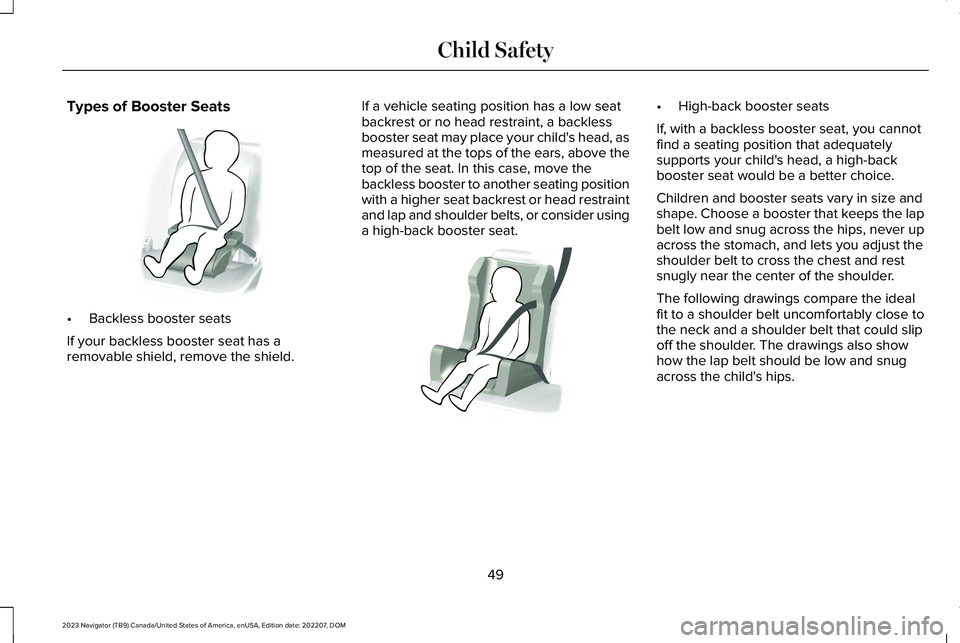
Types of Booster Seats
•Backless booster seats
If your backless booster seat has aremovable shield, remove the shield.
If a vehicle seating position has a low seatbackrest or no head restraint, a backlessbooster seat may place your child's head, asmeasured at the tops of the ears, above thetop of the seat. In this case, move thebackless booster to another seating positionwith a higher seat backrest or head restraintand lap and shoulder belts, or consider usinga high-back booster seat.
•High-back booster seats
If, with a backless booster seat, you cannotfind a seating position that adequatelysupports your child's head, a high-backbooster seat would be a better choice.
Children and booster seats vary in size andshape. Choose a booster that keeps the lapbelt low and snug across the hips, never upacross the stomach, and lets you adjust theshoulder belt to cross the chest and restsnugly near the center of the shoulder.
The following drawings compare the idealfit to a shoulder belt uncomfortably close tothe neck and a shoulder belt that could slipoff the shoulder. The drawings also showhow the lap belt should be low and snugacross the child's hips.
49
2023 Navigator (TB9) Canada/United States of America, enUSA, Edition date: 202207, DOMChild SafetyE68924 E70710
Page 56 of 660
SEATBELT PRECAUTIONS
WARNING: Always drive and ridewith your seatback upright and the lap beltsnug and low across the hips.
WARNING: Children must always beproperly restrained.
WARNING: Do not allow a passengerto hold a child on their lap when yourvehicle is moving. Failure to follow thisinstruction could result in personal injuryor death in the event of a sudden stop orcrash.
WARNING: All occupants of yourvehicle, including the driver, should alwaysproperly wear their seatbelts, even whenan airbag supplemental restraint system isprovided. Failure to properly wear yourseatbelt could seriously increase the riskof injury or death.
WARNING: It is extremely dangerousto ride in a cargo area, inside or outside ofa vehicle. In a crash, people riding in theseareas are more likely to be seriouslyinjured or killed. Do not allow people toride in any area of your vehicle that is notequipped with seats and seatbelts. Makesure everyone in your vehicle is in a seatand properly using a seatbelt. Failure tofollow this warning could result in seriouspersonal injury or death.
WARNING: In a rollover crash, anunbelted person is significantly more likelyto die than a person wearing a seatbelt.
WARNING: Each seating position inyour vehicle has a specific seatbeltassembly made up of one buckle and onetongue designed to be used as a pair. Usethe shoulder belt on the outside shoulderonly. Never wear the shoulder belt underthe arm. Never use a single seatbelt formore than one person.
WARNING: Even with advancedrestraints systems, properly restrainchildren 12 and under in a rear seatingposition. Failure to follow this couldseriously increase the risk of injury ordeath.
WARNING: Seatbelts and seats maybe hot in a vehicle that is in the sunshine.The hot seatbelts or seats may burn a smallchild. Check seat covers and bucklesbefore you place a child anywhere nearthem.
WARNING: If your vehicle is involvedin a crash, have the seatbelts andassociated components inspected as soonas possible. Failure to follow this instructioncould result in personal injury or death.
All seating positions in this vehicle haveseatbelts. All occupants of the vehicle shouldproperly wear their seatbelts, even when anairbag supplemental restraint system isprovided.
52
2023 Navigator (TB9) Canada/United States of America, enUSA, Edition date: 202207, DOMSeatbelts
Page 58 of 660
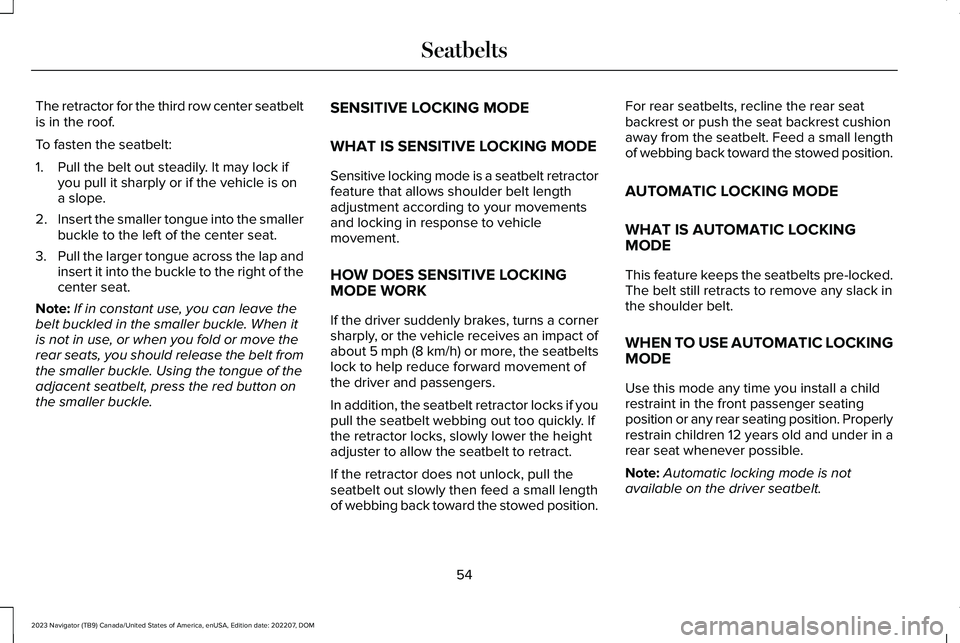
The retractor for the third row center seatbeltis in the roof.
To fasten the seatbelt:
1.Pull the belt out steadily. It may lock ifyou pull it sharply or if the vehicle is ona slope.
2.Insert the smaller tongue into the smallerbuckle to the left of the center seat.
3.Pull the larger tongue across the lap andinsert it into the buckle to the right of thecenter seat.
Note:If in constant use, you can leave thebelt buckled in the smaller buckle. When itis not in use, or when you fold or move therear seats, you should release the belt fromthe smaller buckle. Using the tongue of theadjacent seatbelt, press the red button onthe smaller buckle.
SENSITIVE LOCKING MODE
WHAT IS SENSITIVE LOCKING MODE
Sensitive locking mode is a seatbelt retractorfeature that allows shoulder belt lengthadjustment according to your movementsand locking in response to vehiclemovement.
HOW DOES SENSITIVE LOCKINGMODE WORK
If the driver suddenly brakes, turns a cornersharply, or the vehicle receives an impact ofabout 5 mph (8 km/h) or more, the seatbeltslock to help reduce forward movement ofthe driver and passengers.
In addition, the seatbelt retractor locks if youpull the seatbelt webbing out too quickly. Ifthe retractor locks, slowly lower the heightadjuster to allow the seatbelt to retract.
If the retractor does not unlock, pull theseatbelt out slowly then feed a small lengthof webbing back toward the stowed position.
For rear seatbelts, recline the rear seatbackrest or push the seat backrest cushionaway from the seatbelt. Feed a small lengthof webbing back toward the stowed position.
AUTOMATIC LOCKING MODE
WHAT IS AUTOMATIC LOCKINGMODE
This feature keeps the seatbelts pre-locked.The belt still retracts to remove any slack inthe shoulder belt.
WHEN TO USE AUTOMATIC LOCKINGMODE
Use this mode any time you install a childrestraint in the front passenger seatingposition or any rear seating position. Properlyrestrain children 12 years old and under in arear seat whenever possible.
Note:Automatic locking mode is notavailable on the driver seatbelt.
54
2023 Navigator (TB9) Canada/United States of America, enUSA, Edition date: 202207, DOMSeatbelts
Page 62 of 660
Read Steps 1-4 before proceeding with theprogramming procedure.
Make sure that:
•You set the parking brake.
•The transmission is in park (P).
•The ignition is off.
•You close all vehicle doors.
•You unfasten the driver and frontpassenger seatbelts.
1.Switch the ignition on. Do not start theengine.
2.Immediately start the deactivation orreactivation procedure in Step 3. Onceyou start Step 3, you must complete theprocedure within 30 seconds.
3.For the seating position you are switchingoff or on, fasten then unfasten theseatbelt four times at a moderate speed,ending in the unfastened state. Theseatbelt warning light flashes forconfirmation.
This switches the feature off for that seatingposition if it is currently on.
This switches the feature on for that seatingposition if it is currently off.
CHECKING THE SEATBELTS
Check the seatbelts and child restraintsperiodically to make sure they work properlyand are not damaged. Make sure there areno nicks, tears or cuts. Replace if necessary.
Check the following seatbelt assemblies aftera crash.
•Retractors.
•Buckles.
•Front seatbelt buckle assemblies.
•Shoulder belt height adjusters.
•Shoulder belt guide on seat backrest.
•Child restraint LATCH and tether anchors.
•Attaching hardware.
Read the child restraint manufacturer'sinstructions for additional inspection andmaintenance information specific to the childrestraint.
We recommend that all seatbelt assembliesin use in vehicles involved in a crash bereplaced. However, if the crash was minorand an authorized dealer finds that the beltsdo not show damage and continue tooperate properly, they do not need to bereplaced. Seatbelt assemblies not in useduring a crash should also be checked andreplaced if either damage or improperoperation is noted.
Properly care for seatbelts. See CleaningSeatbelts (page 434).
SEATBELT EXTENSIONS
WARNING: Persons who fit into thevehicle's seatbelt should not use anextension. Unnecessary use could resultin serious personal injury in the event of acrash.
58
2023 Navigator (TB9) Canada/United States of America, enUSA, Edition date: 202207, DOMSeatbelts
Page 63 of 660
WARNING: Only use extensionsprovided free of charge by our dealers.The dealer will provide an extensiondesigned specifically for this vehicle, modelyear and seating position. The use of anextension intended for another vehicle,model year or seating position may notoffer you the full protection of yourvehicle's seatbelt restraint system.
WARNING: Never use seatbeltextensions to install child restraints.
WARNING: Do not use extensionsto change the way the seatbelt fits acrossthe torso, over the lap or to make theseatbelt buckle easier to reach.
If, because of body size or driving position,it is not possible to properly fasten theseatbelt over your lap and shoulder, anextension that is compatible with theseatbelts is available free of charge from ourdealers. Only use our seatbelt extensionsmade by the original equipment seatbeltmanufacturer with our seatbelts. Ask yourauthorized dealer if your extension iscompatible with your vehicle restraint system.
59
2023 Navigator (TB9) Canada/United States of America, enUSA, Edition date: 202207, DOMSeatbelts
Page 67 of 660
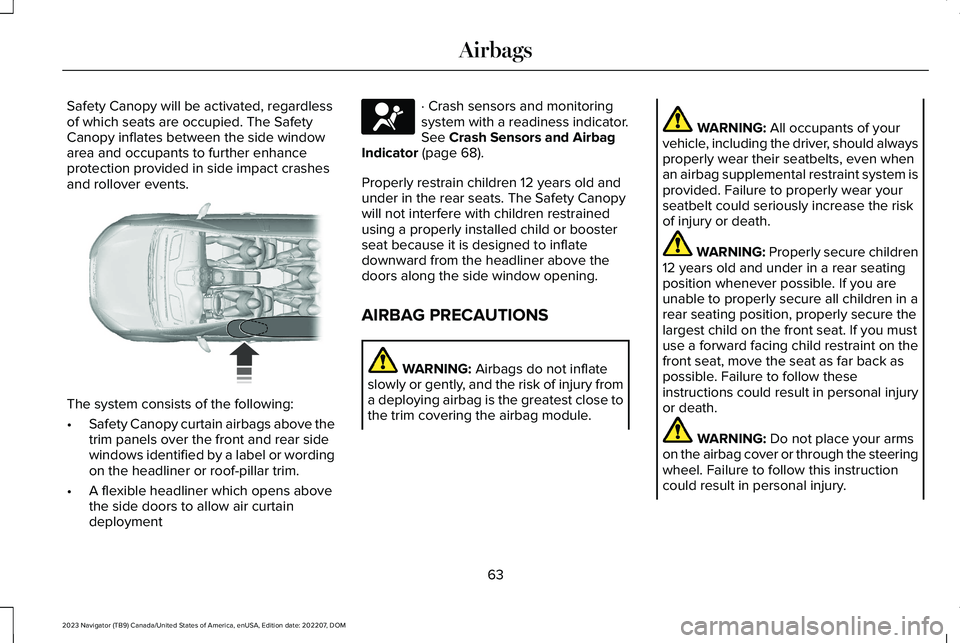
Safety Canopy will be activated, regardlessof which seats are occupied. The SafetyCanopy inflates between the side windowarea and occupants to further enhanceprotection provided in side impact crashesand rollover events.
The system consists of the following:
•Safety Canopy curtain airbags above thetrim panels over the front and rear sidewindows identified by a label or wordingon the headliner or roof-pillar trim.
•A flexible headliner which opens abovethe side doors to allow air curtaindeployment
· Crash sensors and monitoringsystem with a readiness indicator.See Crash Sensors and AirbagIndicator (page 68).
Properly restrain children 12 years old andunder in the rear seats. The Safety Canopywill not interfere with children restrainedusing a properly installed child or boosterseat because it is designed to inflatedownward from the headliner above thedoors along the side window opening.
AIRBAG PRECAUTIONS
WARNING: Airbags do not inflateslowly or gently, and the risk of injury froma deploying airbag is the greatest close tothe trim covering the airbag module.
WARNING: All occupants of yourvehicle, including the driver, should alwaysproperly wear their seatbelts, even whenan airbag supplemental restraint system isprovided. Failure to properly wear yourseatbelt could seriously increase the riskof injury or death.
WARNING: Properly secure children12 years old and under in a rear seatingposition whenever possible. If you areunable to properly secure all children in arear seating position, properly secure thelargest child on the front seat. If you mustuse a forward facing child restraint on thefront seat, move the seat as far back aspossible. Failure to follow theseinstructions could result in personal injuryor death.
WARNING: Do not place your armson the airbag cover or through the steeringwheel. Failure to follow this instructioncould result in personal injury.
63
2023 Navigator (TB9) Canada/United States of America, enUSA, Edition date: 202207, DOMAirbags E75004 E67017
Page 68 of 660
WARNING: Keep the areas in frontof the airbags free from obstruction. Donot affix anything to or over the airbagcovers. Objects could become projectilesduring airbag deployment. Failure to followthis instruction could result in personalinjury or death.
WARNING: To reduce risk of injury,do not obstruct or place objects in thedeployment path of the airbag.
WARNING: Do not place a rearwardfacing child restraint in front of an activeairbag. Failure to follow this instructioncould result in personal injury or death.
WARNING: Do not attempt to service,repair, or modify the supplementaryrestraint system or associated components.Failure to follow this instruction could resultin personal injury or death.
WARNING: Several airbag systemcomponents get hot after inflation. Toreduce the risk of injury, do not touch themafter inflation.
WARNING: If a supplementaryrestraint system component has deployed,it will not function again. Have the systemand associated components inspected assoon as possible. Failure to follow thisinstruction could result in personal injuryor death.
PROPERLY ADJUSTING THE
DRIVER AND FRONT PASSENGER
SEATS
WARNING: National Highway TrafficSafety Administration (NHTSA)recommends a minimum distance of atleast 10 in (25 cm) between an occupant'schest and the driver airbag module.
To properly position yourself away from theairbag:
•Move your seat to the rear as far as youcan while still reaching the pedalscomfortably.
•Recline the seat slightly one or twodegrees from the upright position.
After all occupants have adjusted their seatsand put on seatbelts, it is very important thatthey continue to sit properly. Properly seatedoccupants sit upright, lean against the seatbackrest, and center themselves on the seatcushion, with their feet comfortably extendedon the floor. Sitting improperly can increasethe chance of injury in a crash event. Forexample, if an occupant slouches, lies down,turns sideways, sits forward, leans forwardor sideways, or puts one or both feet up, thechance of injury during a crash greatlyincreases.
64
2023 Navigator (TB9) Canada/United States of America, enUSA, Edition date: 202207, DOMAirbags
Page 69 of 660
CHILDREN AND AIRBAGS
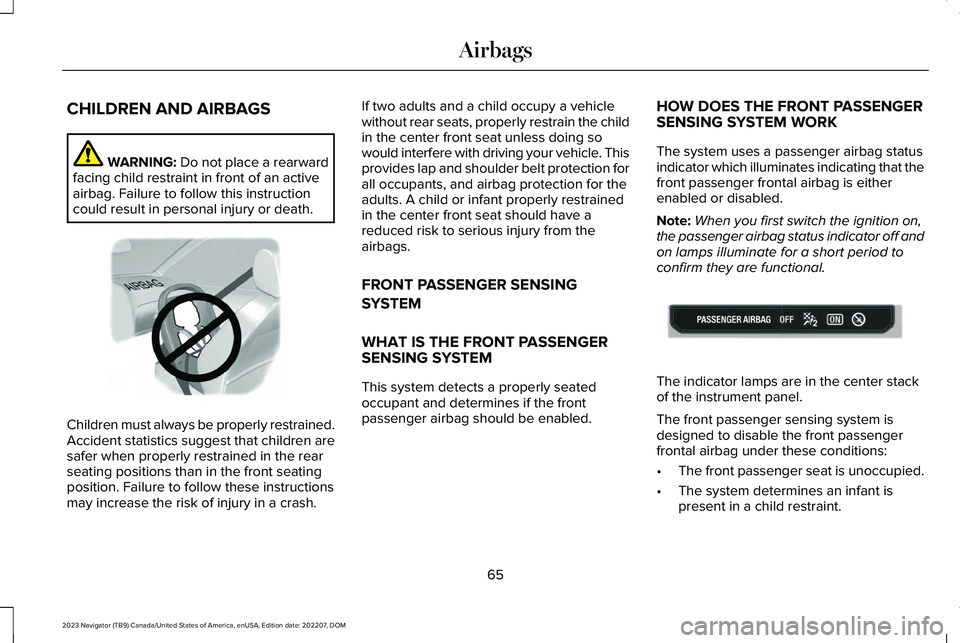
WARNING: Do not place a rearwardfacing child restraint in front of an activeairbag. Failure to follow this instructioncould result in personal injury or death.
Children must always be properly restrained.Accident statistics suggest that children aresafer when properly restrained in the rearseating positions than in the front seatingposition. Failure to follow these instructionsmay increase the risk of injury in a crash.
If two adults and a child occupy a vehiclewithout rear seats, properly restrain the childin the center front seat unless doing sowould interfere with driving your vehicle. Thisprovides lap and shoulder belt protection forall occupants, and airbag protection for theadults. A child or infant properly restrainedin the center front seat should have areduced risk to serious injury from theairbags.
FRONT PASSENGER SENSING
SYSTEM
WHAT IS THE FRONT PASSENGERSENSING SYSTEM
This system detects a properly seatedoccupant and determines if the frontpassenger airbag should be enabled.
HOW DOES THE FRONT PASSENGERSENSING SYSTEM WORK
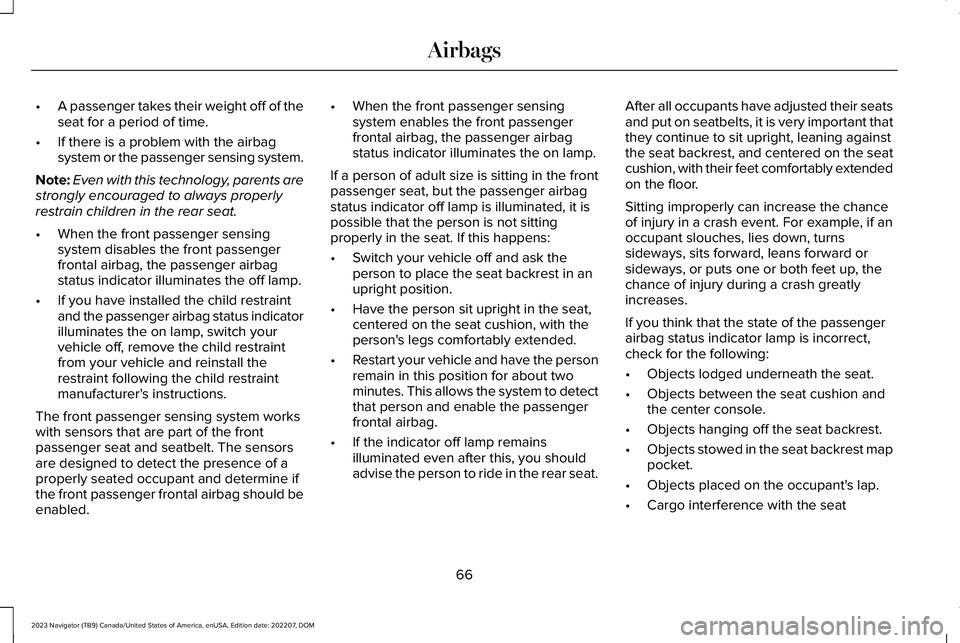
The system uses a passenger airbag statusindicator which illuminates indicating that thefront passenger frontal airbag is eitherenabled or disabled.
Note:When you first switch the ignition on,the passenger airbag status indicator off andon lamps illuminate for a short period toconfirm they are functional.
The indicator lamps are in the center stackof the instrument panel.
The front passenger sensing system isdesigned to disable the front passengerfrontal airbag under these conditions:
•The front passenger seat is unoccupied.
•The system determines an infant ispresent in a child restraint.
65
2023 Navigator (TB9) Canada/United States of America, enUSA, Edition date: 202207, DOMAirbagsE142846 E181984
Page 70 of 660
•A passenger takes their weight off of theseat for a period of time.
•If there is a problem with the airbagsystem or the passenger sensing system.
Note:Even with this technology, parents arestrongly encouraged to always properlyrestrain children in the rear seat.
•When the front passenger sensingsystem disables the front passengerfrontal airbag, the passenger airbagstatus indicator illuminates the off lamp.
•If you have installed the child restraintand the passenger airbag status indicatorilluminates the on lamp, switch yourvehicle off, remove the child restraintfrom your vehicle and reinstall therestraint following the child restraintmanufacturer's instructions.
The front passenger sensing system workswith sensors that are part of the frontpassenger seat and seatbelt. The sensorsare designed to detect the presence of aproperly seated occupant and determine ifthe front passenger frontal airbag should beenabled.
•When the front passenger sensingsystem enables the front passengerfrontal airbag, the passenger airbagstatus indicator illuminates the on lamp.
If a person of adult size is sitting in the frontpassenger seat, but the passenger airbagstatus indicator off lamp is illuminated, it ispossible that the person is not sittingproperly in the seat. If this happens:
•Switch your vehicle off and ask theperson to place the seat backrest in anupright position.
•Have the person sit upright in the seat,centered on the seat cushion, with theperson's legs comfortably extended.
•Restart your vehicle and have the personremain in this position for about twominutes. This allows the system to detectthat person and enable the passengerfrontal airbag.
•If the indicator off lamp remainsilluminated even after this, you shouldadvise the person to ride in the rear seat.
After all occupants have adjusted their seatsand put on seatbelts, it is very important thatthey continue to sit upright, leaning againstthe seat backrest, and centered on the seatcushion, with their feet comfortably extendedon the floor.
Sitting improperly can increase the chanceof injury in a crash event. For example, if anoccupant slouches, lies down, turnssideways, sits forward, leans forward orsideways, or puts one or both feet up, thechance of injury during a crash greatlyincreases.
If you think that the state of the passengerairbag status indicator lamp is incorrect,check for the following:
•Objects lodged underneath the seat.
•Objects between the seat cushion andthe center console.
•Objects hanging off the seat backrest.
•Objects stowed in the seat backrest mappocket.
•Objects placed on the occupant's lap.
•Cargo interference with the seat
66
2023 Navigator (TB9) Canada/United States of America, enUSA, Edition date: 202207, DOMAirbags