ECU LINCOLN TOWN CAR 1997 User Guide
[x] Cancel search | Manufacturer: LINCOLN, Model Year: 1997, Model line: TOWN CAR, Model: LINCOLN TOWN CAR 1997Pages: 305, PDF Size: 2.68 MB
Page 157 of 305
153
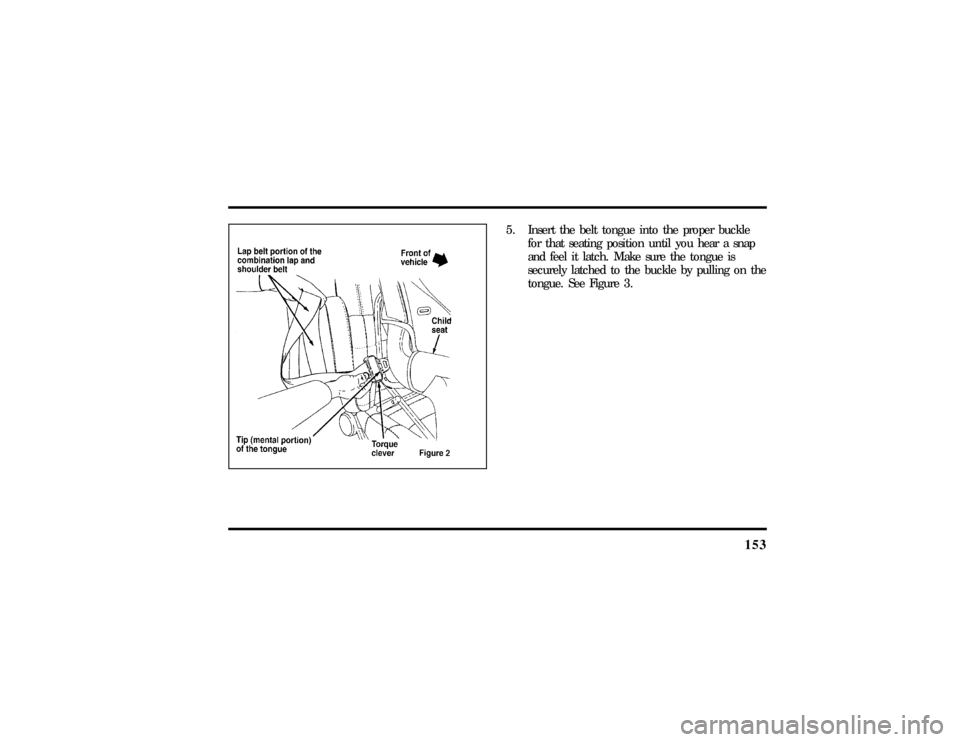
5. Insert the belt tongue into the proper buckle
for that seating position until you hear a snap
and feel it latch. Make sure the tongue is
securely latched to the buckle by pulling on the
tongue. See Figure 3.
File:06fnsst.ex
Update:Fri Jun 21 08:57:53 1996
Page 159 of 305
155
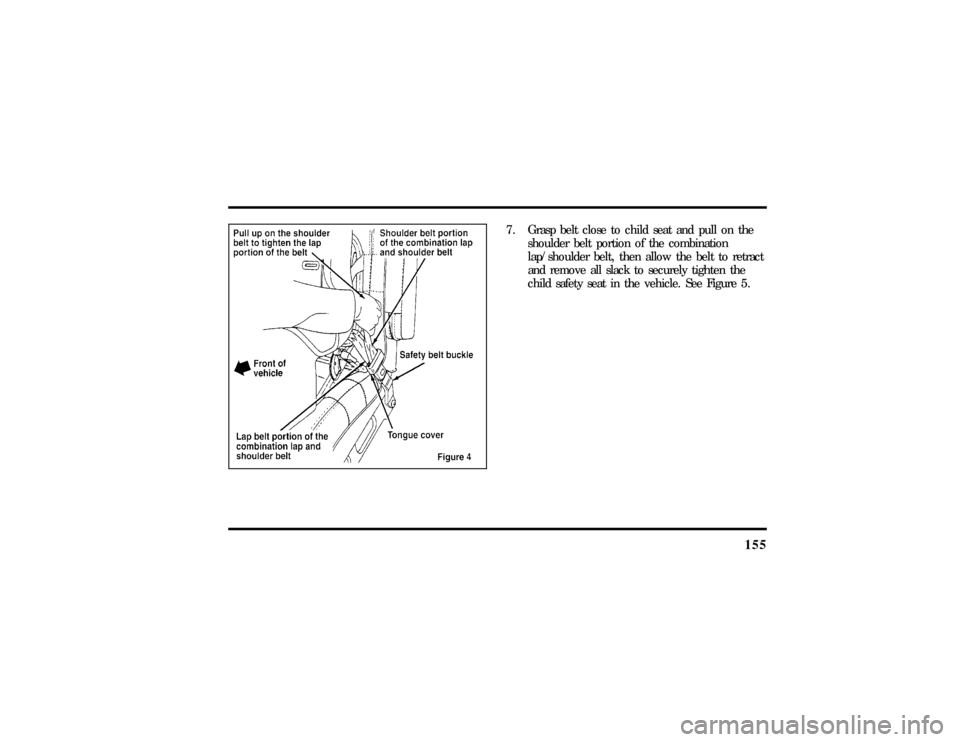
7. Grasp belt close to child seat and pull on the
shoulder belt portion of the combination
lap/shoulder belt, then allow the belt to retract
and remove all slack to securely tighten the
child safety seat in the vehicle. See Figure 5.
File:06fnsst.ex
Update:Fri Jun 21 08:57:53 1996
Page 160 of 305
156
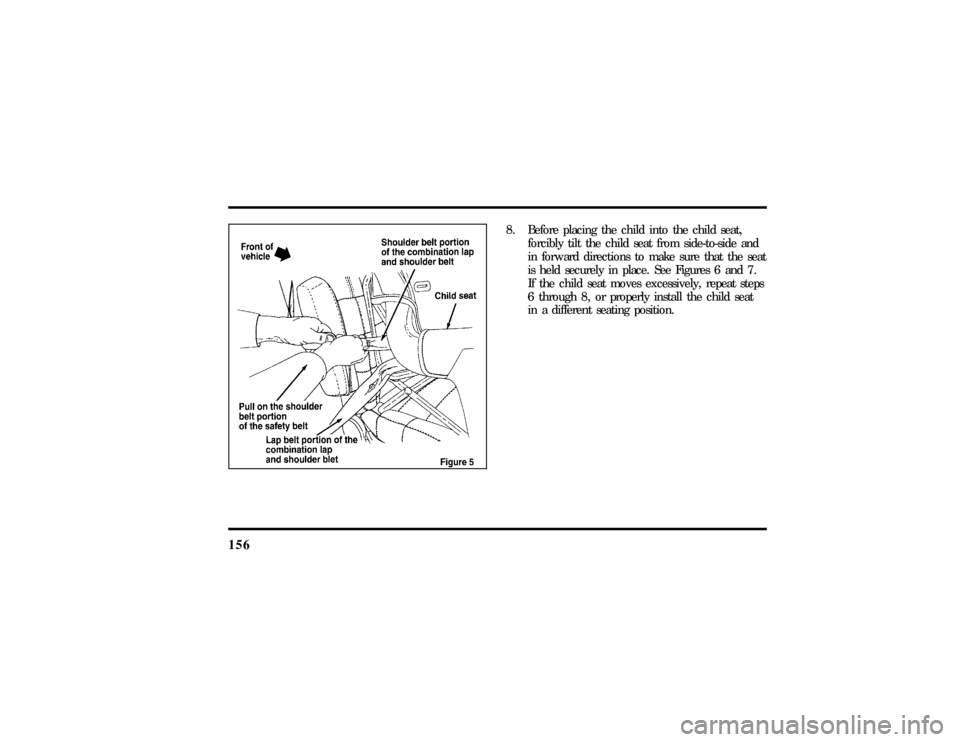
8. Before placing the child into the child seat,
forcibly tilt the child seat from side-to-side and
in forward directions to make sure that the seat
is held securely in place. See Figures 6 and 7.
If the child seat moves excessively, repeat steps
6 through 8, or properly install the child seat
in a different seating position.
File:06fnsst.ex
Update:Fri Jun 21 08:57:53 1996
Page 179 of 305

176Overdrive is the usual driving position for an
automatic overdrive transmission. It works the same
way Drive works, automatically upshifting or
downshifting as the vehicle speeds or slows.
However, Overdrive also shifts into a fourth gear Ð
an overdrive gear Ð when your vehicle cruises at
an appropriate consistent speed for any length of
time. This fourth gear will increase your fuel
economy when you travel at cruising speeds.When to use Drive (jÐ with
Transmission Control Switch activated)Overdrive may not be appropriate for certain
terrain. If the transmission shifts back and forth
between Third and Fourth gears while you are
driving on hilly roads or if your vehicle does not
have adequate power for climbing hills, depress the
TCS.
You can depress the TCS at any speed.
When to use 2 (Second)Use 2 (Second) for start-up on slippery roads or to
give you more engine braking to slow your vehicle
on downgrades.When to use 1 (Low)Use 1 (Low) when driving down steep grades. It
gives more engine braking to slow your vehicle than
2 (Second) on the downgrades. You can upshift
from 1 (Low) to 2 (Second) or from 1 (Low) to
Overdrive at any speed.P (Park)Always come to a complete stop before you shift
into P (Park). Make sure that the gearshift is
securely latched in P (Park). This locks the
transmission and prevents the rear wheels from
rotating.
File:09fngft.ex
Update:Mon Jun 17 13:52:03 1996
Page 201 of 305
199
6. Lower the vehicle by turning the jack handle
counterclockwise.
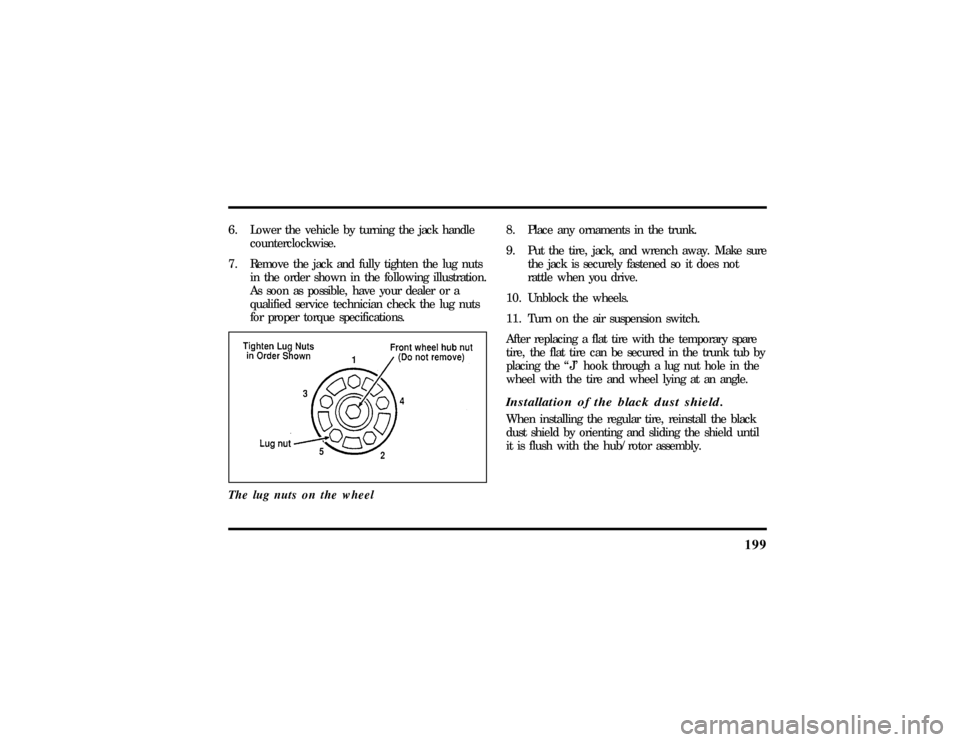
7. Remove the jack and fully tighten the lug nuts
in the order shown in the following illustration.
As soon as possible, have your dealer or a
qualified service technician check the lug nuts
for proper torque specifications.
The lug nuts on the wheel
8. Place any ornaments in the trunk.
9. Put the tire, jack, and wrench away. Make sure
the jack is securely fastened so it does not
rattle when you drive.
10. Unblock the wheels.
11. Turn on the air suspension switch.
After replacing a flat tire with the temporary spare
tire, the flat tire can be secured in the trunk tub by
placing the ªJº hook through a lug nut hole in the
wheel with the tire and wheel lying at an angle.Installation of the black dust shield.When installing the regular tire, reinstall the black
dust shield by orienting and sliding the shield until
it is flush with the hub/rotor assembly.
File:10fnert.ex
Update:Thu Jun 20 15:16:36 1996
Page 213 of 305

211
Maintenance and CareService Made EasyFord has two goals for servicing your vehicle.
1. When we can, we design parts that do not
need to be serviced.
2. We want to make servicing your vehicle as
easy as possible. To help you:q
We highlight do-it-yourself items in yellow in
the engine compartment so that you can find
them easily.
q
When possible, we design parts that can be
replaced without tools.
q
We give you a Maintenance Schedule that
makes tracking routine service for your vehicle
easy. The maintenance schedule is located in
theMaintenance Schedulebooklet.This chapter tells you about the basic parts that you
need to check and service regularly.
If your vehicle needs professional servicing, your
dealership can provide the parts and service
required. Check yourWarranty Information Booklet
to find out which parts and services are covered.
Also see theCustomer Assistancechapter of this
Owner Guide.
Ford Motor Company recommends that the Owner
Maintenance Checks listed in theMaintenance
Schedulebooklet be performed for the proper
operation of your vehicle. In addition to the
conditions listed in theOwner Maintenance
Checklist, be alert for any unusual noise, vibration,
or other indication that your vehicle may need
service. If you do notice something unusual, see
that your vehicle is serviced promptly.
File:11fnmct.ex
Update:Mon Jun 17 13:54:56 1996
Page 215 of 305

213
Precautions When Servicing Your
VehicleBe especially careful when inspecting or servicing
your vehicle. Here are some general precautions for
your safety:q
Do not work on a hot engine. The engine
cooling fan may come on unexpectedly. Always
turn the engine off and let it cool.
q
If you must work with the engine running,
avoid wearing loose clothing or jewelry that
could get caught in moving parts. Take
appropriate precautions with long hair.
q
Do not work on a vehicle in an enclosed space
with the engine running, unless you are sure
you have enough ventilation.
q
Never get under a vehicle while it is supported
by a jack only. If you must work under a
vehicle, use safety stands.
q
Keep all lit cigarettes and other smoking
materials away from the battery and all
fuel-related parts.
If you disconnect the battery, the engine must
ªrelearnº its idle conditions before your vehicle will
drive properly. To find out how the engine does
this, seeBatteryin this chapter.
Working with the engine off:1. Set the parking brake fully and make sure that
the gearshift is securely latched in P (Park).
2. Remove the key from the ignition after you
turn the engine off.
3. Block the wheels. This will prevent your
vehicle from moving unexpectedly.
File:11fnmct.ex
Update:Mon Jun 17 13:54:56 1996
Page 218 of 305

2163. Lift the hood until the lift cylinders hold it
open.
Whenever you close the hood, latch it securely.
NOTE:Apply lubricant to the hood latch at
six-month intervals to maintain smooth and
trouble-free operation.
NOTE:Read and understandPrecautions When
Servicing Your Vehicleat the beginning of this
chapter before opening the hood.
Engine CompartmentYour vehicle has a 4.6 liter engine. The following
page shows a diagram of where to find items that
you should regularly service.
File:11fnmct.ex
Update:Mon Jun 17 13:54:56 1996
Page 221 of 305
219
Checking and Adding Engine OilSince the proper amount of engine oil is important
for safe engine operation, check the oil using the
dipstick each time you put fuel in your vehicle.
Remember the engine must be off, the oil must be
warm and the vehicle must be parked on level
ground.
Checking the engine oil level:
1. Turn the engine off after it has warmed up and
allow a few minutes for the engine oil to drain
back into the oil pan.
2. Set the parking brake, making sure the gearshift
is securely latched in P (Park).
3. Open the hood. Protect yourself from engine
heat.
4. Locate the engine oil dipstick (highlighted in
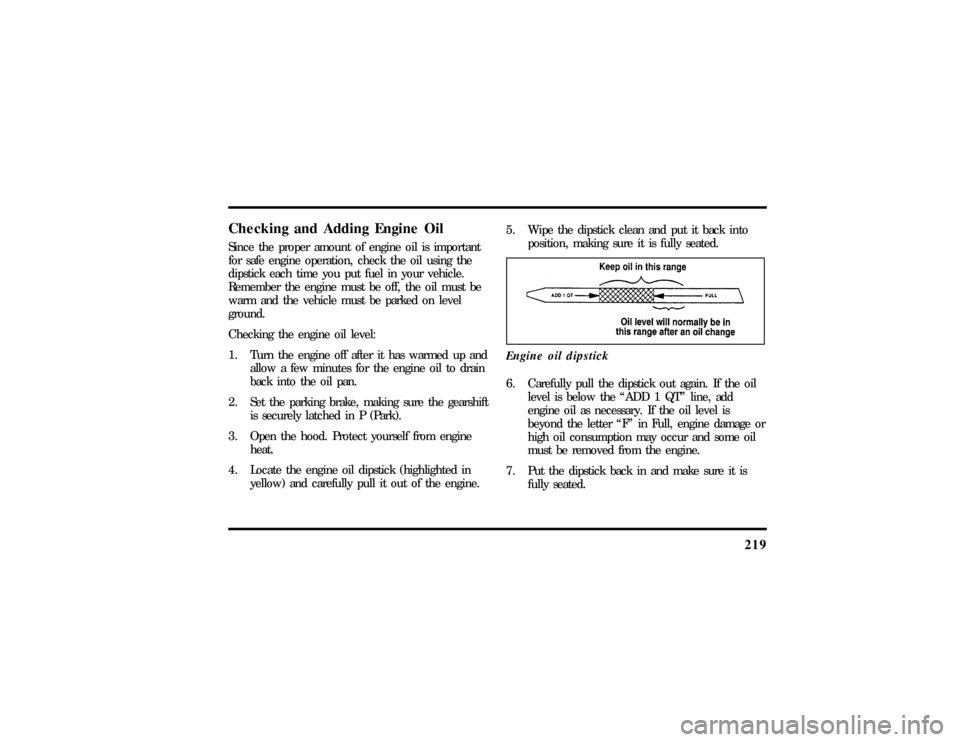
yellow) and carefully pull it out of the engine.5. Wipe the dipstick clean and put it back into
position, making sure it is fully seated.
Engine oil dipstick
6. Carefully pull the dipstick out again. If the oil
level is below the ªADD 1 QTº line, add
engine oil as necessary. If the oil level is
beyond the letter ªFº in Full, engine damage or
high oil consumption may occur and some oil
must be removed from the engine.
7. Put the dipstick back in and make sure it is
fully seated.
File:11fnmct.ex
Update:Mon Jun 17 13:54:56 1996
Page 230 of 305

228q
With the engine OFF and cool, remove the
pressure cap, located on the coolant reservoir.
Remove the heater hose and clamp, located on
the rear of the intake manifold.
q
Add a 50/50 mixture of specified coolant and
water to the coolant reservoir. Refer toRefill
Capacitieslater in this chapter for the correct
amount. Add coolant to the reservoir until the
coolant continuously flows out of the tube in
the rear of engine. Reattach hose and secure
clamp.
q
Reinstall the pressure cap to the fully installed
position.
q
Start and idle the engine until the radiator
upper hose is warm (this indicates the
thermostat is open and coolant is flowing
through the entire system).
q
Immediately shut off the engine and let cool.
Cautiously remove the pressure relief cap and
add a 50/50 mixture of specified coolant and
water until the coolant is at the COLD FILL
level in the coolant reservoir.
q
Reinstall the pressure cap securely.
q
Check for leaks at the draincock.
q
Recheck the engine coolant level, using the
recommended procedure, after one or two
occasions of vehicle use.
File:11fnmct.ex
Update:Mon Jun 17 13:54:56 1996