trunk LINCOLN TOWN CAR 1997 User Guide
[x] Cancel search | Manufacturer: LINCOLN, Model Year: 1997, Model line: TOWN CAR, Model: LINCOLN TOWN CAR 1997Pages: 305, PDF Size: 2.68 MB
Page 116 of 305

112The door lock Horn Chirp is a programmable
feature. To deactivate the Horn Chirp feature:
1. Enter your permanent five-digit code (not the
user code you may have set).
2. Within five seconds, press and hold the 7/8
button.
3. Within five more seconds, press and release the
1/2 button.
4. Release the 7/8 button.
To reactivate the Horn Chirp feature, simply repeat
the instruction for deactivating the feature.Activating the remote personal alarmIf you wish to activate the remote personal alarm,
press the PANIC control. This will honk the horn
and flash the parking lamps and tail lamps for
approximately two minutes and forty-five seconds.You can turn it OFF by pressing the PANIC control
again or by turning the ignition key to the RUN
position.
Arming and Disarming the Alarm
SystemYour vehicle is equipped with the factory installed
anti-theft system. The remote entry system will
automatically arm it when the doors are locked
with the remote entry LOCK button. The remote
entry UNLOCK button will disarm or reset a
triggered anti-theft alarm.
The remote entry system is designed to work with
the factory installed anti-theft system. It may not
work with other anti-theft systems.
When you use the remote entry UNLOCK, TRUNK
or PANIC buttons, the illuminated entry system
turns on the interior lights for 25 seconds. You can
turn these lights off with the LOCK button or by
turning the ignition to the RUN position.
File:05fncft.ex
Update:Mon Jun 17 13:49:49 1996
Page 119 of 305

115
3. Press one button on each of the transmitters to
be programmed. Each transmitter button must
be pressed within seven (7) seconds of the
prior one. Each time a transmitter is
successfully programmed, all of the vehicle
doors will lock and then unlock to verify
programming. If the doors did not lock/unlock,
your transmitter was not programmed.
THIS DEVICE COMPLIES WITH PART 15 OF
THE FCC RULES. OPERATION IS SUBJECT TO
THE FOLLOWING TWO CONDITIONS: (1)
THIS DEVICE MAY NOT CAUSE HARMFUL
INTERFERENCE, AND (2) THIS DEVICE MUST
ACCEPT ANY INTERFERENCE RECEIVED,
INCLUDING INTERFERENCE THAT MAY
CAUSE UNDESIRED OPERATION.
NOTE:All transmitters to be used on your vehicle
must be programmed/reprogrammed at the same
time.
Battery SaverWhen the ignition is turned off, the vehicle will
turn off battery voltage to the vehicle lamps as
follows:q
Courtesy lights (lights which come on when a
door is opened): after 10 minutes.
q
Map/Glove compartment/Trunk/Hook lamps:
after 30 minutes.
q
Headlamps and park lamps (only if headlamp
switch is left in the headlamp position): after 10
minutes.
This will prevent draining of the battery if those
lights have been left on inadvertently or if a door is
not completely closed. Battery voltage to these
lamps will be restored when the keyless entry
keypad is used, the remote entry transmitter is
used, any door is opened, the trunk is opened, or
the ignition key is turned to the ON position.
File:05fncft.ex
Update:Mon Jun 17 13:49:49 1996
Page 120 of 305

116Anti-theft SystemWhen armed, this system helps protect your vehicle
against break-ins or theft by monitoring all doors,
the hood, and the trunk lock cylinder.
When an unauthorized entry occurs, the system
triggers and will:q
flash the headlamps, parking lamps, interior
lamps, and alarm indicator light
q
honk the horn
q
prevent the engine from starting
NOTE:The factory installed Remote Entry System
has a PANIC feature that also chirps the vehicle
horn and flashes the interior/exterior lamps when
the PANIC button on the remote entry transmitter
is pushed.The PANIC alarm and the Anti-Theft
alarm are two separate features.Both the
anti-theft alarm and the PANIC feature can be
active at the same time.To tell the difference between a PANIC alarm and
a triggered Anti-Theft alarm:
q
only the Anti-Theft alarm will cause the alarm
indicator light (located in the center of the
instrument cluster) to flash on and off.
q
only the Anti-Theft alarm will prevent the
engine from starting.
For more information on the PANIC alarm, see
Remote Entry Systemin the Index.
Arming the SystemTo arm the system, do the following four steps in
sequence.
1. Remove the key from the ignition.
2. Open any door. The alarm indicator light will
start flashing to remind you to arm the system.
File:05fncft.ex
Update:Mon Jun 17 13:49:49 1996
Page 122 of 305

118Disarming an Untriggered Anti-Theft
SystemYou can disarm the system by:q
unlocking a front door with the key (turn the
key all the way to the end of travel or the
system will not disarm).
q
using the keyless entry unlock code.
q
using the UNLOCK button of the remote entry
transmitter.
If you armed the system while inside your vehicle,
you can disarm it by turning the ignition to the ON
or ACC position. This allows you to open the door
and exit without triggering the system.
Triggering the Alarm SystemThe armed system will be triggered if:q
any door is opened without disarming the
system (see previous paragraphs), or
q
there is an attempt to remove the trunk lock
cylinder (simply pulling on the lock cylinder will
trigger a switch), or
NOTE:You can open the trunk with your key
without setting off the alarm.
q
the hood is opened.
Disarming a Triggered SystemThe alarm can be disarmed by:q
unlocking a front door with the key
q
using the keyless entry unlock code
q
using the UNLOCK control on the remote entry
transmitter
NOTE:The flashing lights and honking horn will
shut off automatically approximately three minutes
after the system is triggered. It will trigger again if
another intrusion occurs. However, the engine will
not be allowed to start until the system is disarmed.
File:05fncft.ex
Update:Mon Jun 17 13:49:49 1996
Page 174 of 305
171
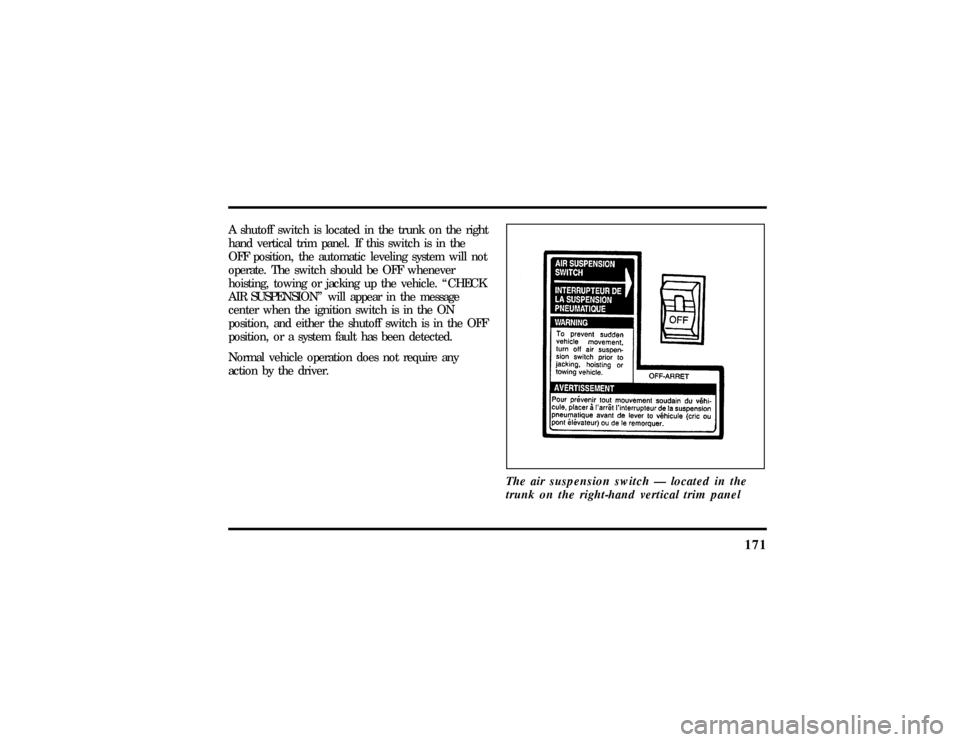
A shutoff switch is located in the trunk on the right
hand vertical trim panel. If this switch is in the
OFF position, the automatic leveling system will not
operate. The switch should be OFF whenever
hoisting, towing or jacking up the vehicle. ªCHECK
AIR SUSPENSIONº will appear in the message
center when the ignition switch is in the ON
position, and either the shutoff switch is in the OFF
position, or a system fault has been detected.
Normal vehicle operation does not require any
action by the driver.
The air suspension switch Ð located in the
trunk on the right-hand vertical trim panel
File:09fngft.ex
Update:Mon Jun 17 13:52:03 1996
Page 183 of 305

181
Roadside EmergenciesThe flashers work whether your vehicle is running
or not. The flashers work for up to two hours
when the battery is fully charged and in good
condition without draining the battery excessively. If
the flashers run for longer than two hours or if the
battery is not fully charged, the battery can be
drained.
If the Engine Cranks but Does
Not Start or Does Not Start After
a CollisionFuel Pump Shut-off SwitchIf the engine cranks but does not start even after a
small collision, the fuel pump shut-off switch may
have been actuated. The shut-off switch is a device
intended to stop the fuel pump when your vehicle
has been involved in a substantial jolt.
Once the shut-off switch is actuated, you must reset
the switch by hand before you can start your
vehicle. The switch is on the left side of the trunk.
File:10fnert.ex
Update:Thu Jun 20 15:16:36 1996
Page 195 of 305

193
When you drive with the temporary spare tire,
DO NOT:q
exceed 50 mph (80 km/h) under any
circumstances.
q
load your vehicle so that it is heavier than the
maximum vehicle load rating listed on the tire
decal.
q
tow a trailer.
q
use tire chains on this tire.
q
try to repair the temporary spare tire or remove
it from its wheel.
q
use the wheel for any other type of vehicle.
q
drive through an automatic car wash with this
tire. Because the temporary spare tire is smaller
than a conventional tire, it reduces the ground
clearance. Your vehicle may get caught in the
rails and it could be damaged.
The Conventional Spare TireIf you have the conventional spare tire, you can use
it as a spare or as a regular tire. This spare tire is
identical to the other tires that come with your
vehicle, although the wheel may not match.Spare Tire LocationThe spare tire is stored under the carpet on the
floor of the trunk.
You will find additional instructions for the spare
tire on the warning label located on the wheel and
the jacking instructions located on the spare tire
cover.
File:10fnert.ex
Update:Thu Jun 20 15:16:36 1996
Page 201 of 305
199
6. Lower the vehicle by turning the jack handle
counterclockwise.
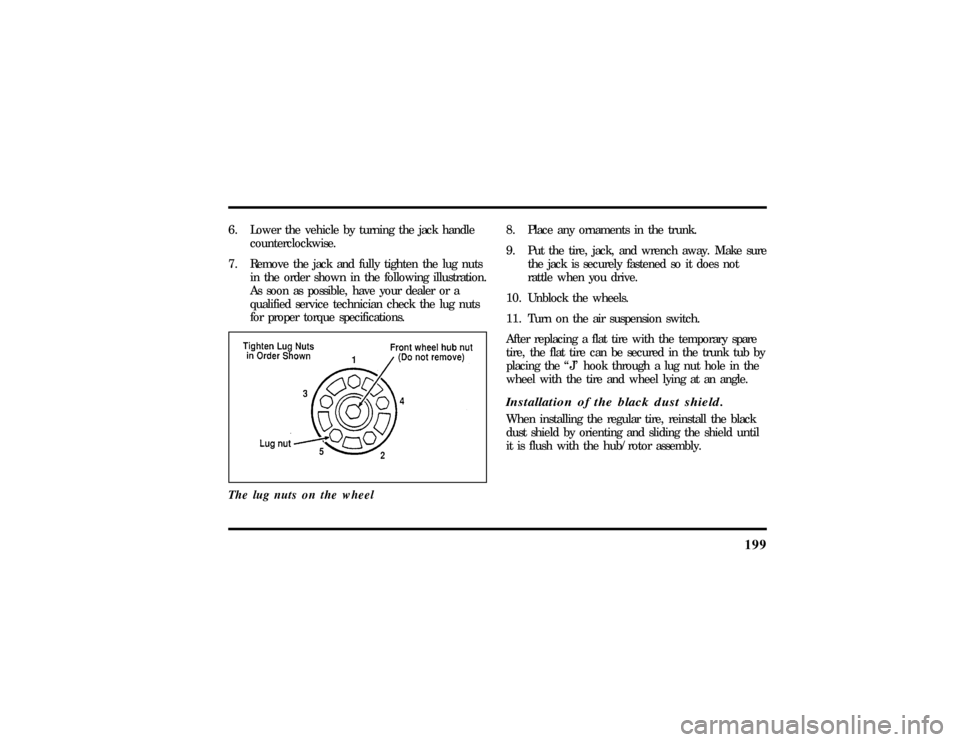
7. Remove the jack and fully tighten the lug nuts
in the order shown in the following illustration.
As soon as possible, have your dealer or a
qualified service technician check the lug nuts
for proper torque specifications.
The lug nuts on the wheel
8. Place any ornaments in the trunk.
9. Put the tire, jack, and wrench away. Make sure
the jack is securely fastened so it does not
rattle when you drive.
10. Unblock the wheels.
11. Turn on the air suspension switch.
After replacing a flat tire with the temporary spare
tire, the flat tire can be secured in the trunk tub by
placing the ªJº hook through a lug nut hole in the
wheel with the tire and wheel lying at an angle.Installation of the black dust shield.When installing the regular tire, reinstall the black
dust shield by orienting and sliding the shield until
it is flush with the hub/rotor assembly.
File:10fnert.ex
Update:Thu Jun 20 15:16:36 1996
Page 241 of 305
239
WARNING
Snowtire smus tbe th esam esiz eand
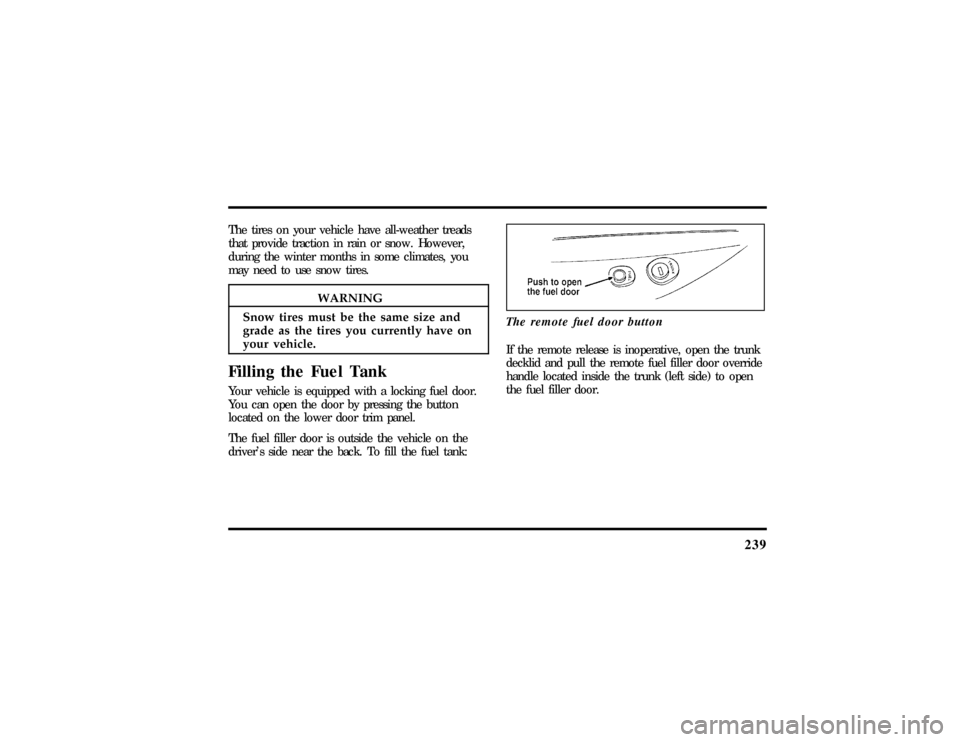
If th e remot ereleas eis inoperative ,ope nthe trunk
Page 261 of 305

260NOTE:Rear axle lube quantities must be replaced
every 100,000 miles (160,000 km) or if the axle
has been submerged in water. Otherwise, the lube
should not be checked or changed unless a leak is
suspected or repair required.Vehicle StorageMaintenance TipsIf you plan on storing your vehicle for an extended
period of time (60 days or more), refer to the
following maintenance recommendations to ensure
your vehicle stays in good operating condition.Generalq
Store all vehicles in a dry, ventilated place.
q
Protect from sunlight, if possible.
q
If vehicles are stored outside, they require
regular maintenance to protect against rust and
damage.
Bodyq
Wash vehicle thoroughly to remove dirt, grease,
oil, tar or mud from exterior surfaces, rear
wheel housing and underside of front fenders.
q
Periodically wash vehicles stored in exposed
locations.
q
Touch-up raw or primed metal to prevent rust.
q
Cover chrome and stainless steel parts with a
thick coat of auto wax to prevent discoloration.
Re-wax as necessary when the vehicle is
washed.
q
Lubricate all hood, door and trunk lid hinges
and latches with a light grade oil.
q
Cover interior soft trim to prevent fading.
q
Keep all rubber parts free from oil and solvents.
File:12fncst.ex
Update:Thu Jun 20 15:16:56 1996