length LINCOLN TOWN CAR 1997 Owners Manual
[x] Cancel search | Manufacturer: LINCOLN, Model Year: 1997, Model line: TOWN CAR, Model: LINCOLN TOWN CAR 1997Pages: 305, PDF Size: 2.68 MB
Page 136 of 305
132combination seat belt is latched into the buckle, the
cinch tongue will allow the lap portion to become
shorter, but locks the webbing in place to restrict it
from becoming longer.
Before you can reach and latch a combination lap
and shoulder belt having a cinch tongue into the
buckle, you may have to lengthen the lap belt
portion of it. To lengthen the lap belt, pull some
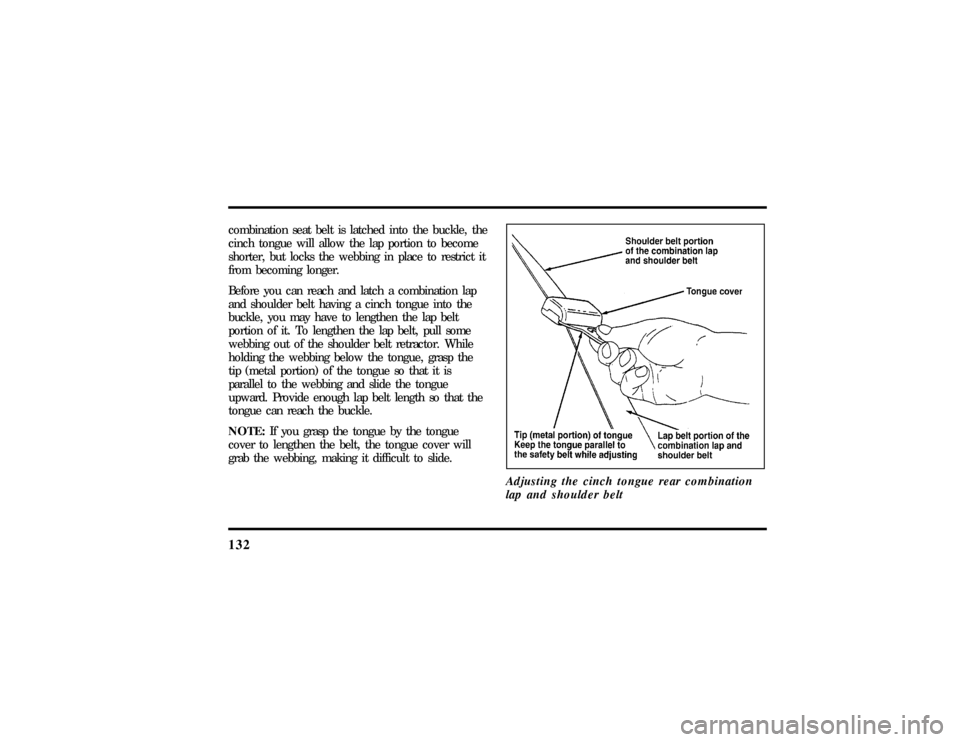
webbing out of the shoulder belt retractor. While
holding the webbing below the tongue, grasp the
tip (metal portion) of the tongue so that it is
parallel to the webbing and slide the tongue
upward. Provide enough lap belt length so that the
tongue can reach the buckle.
NOTE:If you grasp the tongue by the tongue
cover to lengthen the belt, the tongue cover will
grab the webbing, making it difficult to slide.
Adjusting the cinch tongue rear combination
lap and shoulder belt
File:06fnsst.ex
Update:Fri Jun 21 08:57:53 1996
Page 138 of 305
134Lap BeltsThe lap belts in the center of the front and rear
seats do not adjust automatically. You must adjust
them to fit snugly and as low as possible around
your hips. Do not wear them around your waist.
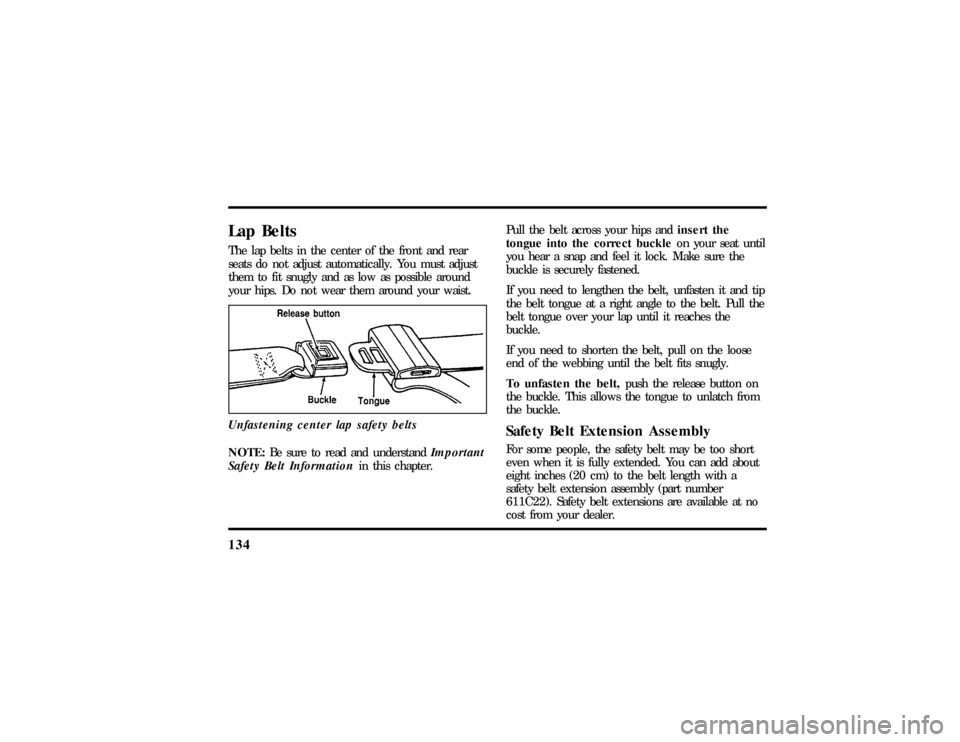
Unfastening center lap safety beltsNOTE:Be sure to read and understandImportant
Safety Belt Informationin this chapter.Pull the belt across your hips andinsert the
tongue into the correct buckleon your seat until
you hear a snap and feel it lock. Make sure the
buckle is securely fastened.
If you need to lengthen the belt, unfasten it and tip
the belt tongue at a right angle to the belt. Pull the
belt tongue over your lap until it reaches the
buckle.
If you need to shorten the belt, pull on the loose
end of the webbing until the belt fits snugly.
To unfasten the belt,push the release button on
the buckle. This allows the tongue to unlatch from
the buckle.
Safety Belt Extension AssemblyFor some people, the safety belt may be too short
even when it is fully extended. You can add about
eight inches (20 cm) to the belt length with a
safety belt extension assembly (part number
611C22). Safety belt extensions are available at no
cost from your dealer.
File:06fnsst.ex
Update:Fri Jun 21 08:57:53 1996
Page 179 of 305

176Overdrive is the usual driving position for an
automatic overdrive transmission. It works the same
way Drive works, automatically upshifting or
downshifting as the vehicle speeds or slows.
However, Overdrive also shifts into a fourth gear Ð
an overdrive gear Ð when your vehicle cruises at
an appropriate consistent speed for any length of
time. This fourth gear will increase your fuel
economy when you travel at cruising speeds.When to use Drive (jÐ with
Transmission Control Switch activated)Overdrive may not be appropriate for certain
terrain. If the transmission shifts back and forth
between Third and Fourth gears while you are
driving on hilly roads or if your vehicle does not
have adequate power for climbing hills, depress the
TCS.
You can depress the TCS at any speed.
When to use 2 (Second)Use 2 (Second) for start-up on slippery roads or to
give you more engine braking to slow your vehicle
on downgrades.When to use 1 (Low)Use 1 (Low) when driving down steep grades. It
gives more engine braking to slow your vehicle than
2 (Second) on the downgrades. You can upshift
from 1 (Low) to 2 (Second) or from 1 (Low) to
Overdrive at any speed.P (Park)Always come to a complete stop before you shift
into P (Park). Make sure that the gearshift is
securely latched in P (Park). This locks the
transmission and prevents the rear wheels from
rotating.
File:09fngft.ex
Update:Mon Jun 17 13:52:03 1996
Page 271 of 305
271
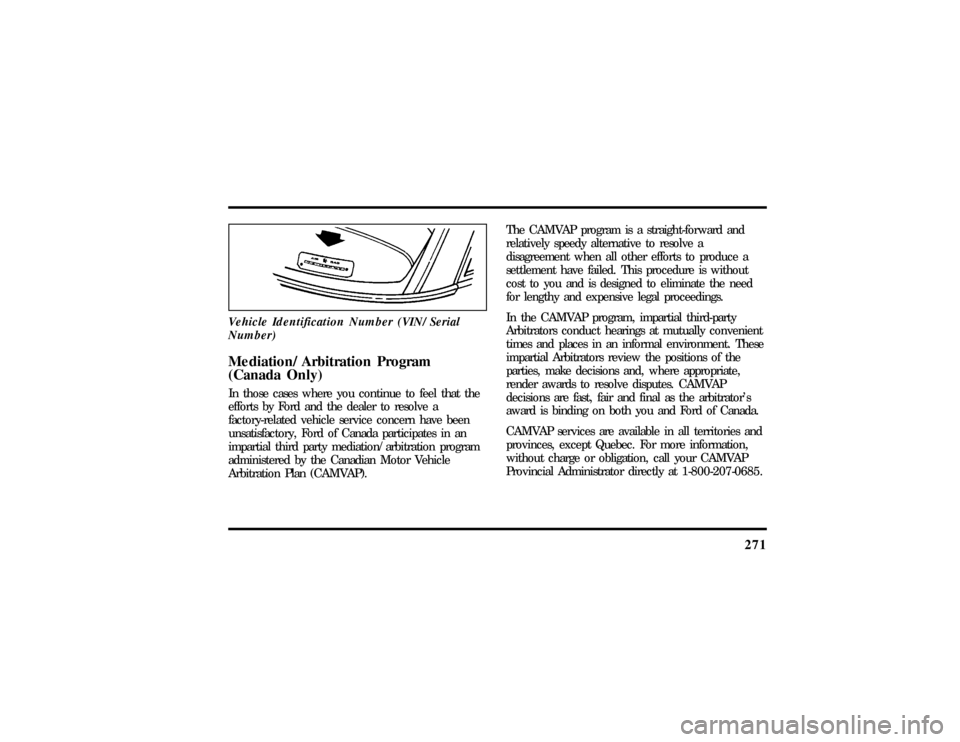
Vehicle Identification Number (VIN/Serial
Number)Mediation/Arbitration Program
(Canada Only)In those cases where you continue to feel that the
efforts by Ford and the dealer to resolve a
factory-related vehicle service concern have been
unsatisfactory, Ford of Canada participates in an
impartial third party mediation/arbitration program
administered by the Canadian Motor Vehicle
Arbitration Plan (CAMVAP).The CAMVAP program is a straight-forward and
relatively speedy alternative to resolve a
disagreement when all other efforts to produce a
settlement have failed. This procedure is without
cost to you and is designed to eliminate the need
for lengthy and expensive legal proceedings.
In the CAMVAP program, impartial third-party
Arbitrators conduct hearings at mutually convenient
times and places in an informal environment. These
impartial Arbitrators review the positions of the
parties, make decisions and, where appropriate,
render awards to resolve disputes. CAMVAP
decisions are fast, fair and final as the arbitrator's
award is binding on both you and Ford of Canada.
CAMVAP services are available in all territories and
provinces, except Quebec. For more information,
without charge or obligation, call your CAMVAP
Provincial Administrator directly at 1-800-207-0685.
File:14fnhst.ex
Update:Mon Jun 17 13:55:31 1996