ECU LINCOLN TOWN CAR 1998 User Guide
[x] Cancel search | Manufacturer: LINCOLN, Model Year: 1998, Model line: TOWN CAR, Model: LINCOLN TOWN CAR 1998Pages: 188, PDF Size: 1.29 MB
Page 87 of 188

able to pull more belt out). If the
retractor is not locked, unbuckle
the belt and repeat steps two
through nine.
Check to make sure the child seat
is properly secured before each
use.
Installing a child safety seat in
the center seating position with
adjustable lap belt
1. Lengthen the lap belt. To
lengthen the belt, hold the tongue
so that its bottom is perpendicular
to the direction of webbing while
sliding the tongue up the webbing.
2. Place the child safety seat in the
center seating position.
3. Route the tongue and webbing
through the child seat according to
the child seat manufacturer's
instructions.
4. Insert the belt tongue into the
proper buckle for the center
seating position until you hear a
snap and feel it latch. Make sure
the tongue is securely fastened to
the buckle by pulling on tongue.
5. Push down on the child seat
while pulling on the loose end of
the lap belt webbing to tighten the
belt.
6. Before placing the child into the
child seat, forcibly tilt the child
seat from side to side and in
forward direction to make sure
that the seat is held securely in
place. If the child seat moves
Seating and safety restraints
88
Page 88 of 188
excessively, repeat steps 5 through
6, or properly install the child seat
in a different position.
Attaching safety seats with
tether straps
Some manufacturers make safety
seats that include a tether strap
that goes over the back of the
vehicle seat and attaches to an
anchoring point. Other
manufacturers offer the tether
strap as an accessory. Contact the
manufacturer of your child safety
seat for information about ordering
a tether strap.
Tether anchorage hardware
Attachment holes (at each rear
seating position) have been
provided in your vehicle to attach
anchor hardware, if required.
Tether anchorage hardware kits
(part number 613D74) including
instructions, may be obtained at no
charge from any Ford or
Lincoln-Mercury dealer. All
vehicles built for sale in Canada
include a tether anchor hardware
kit.
Be sure to follow the child safety
seat manufacturer's instructions.
Tighten the anchor
according to specifications.
Otherwise, the safety seat may
not be properly secured and the
child may be injured in a sudden
stop or collision.
Seating and safety restraints
89
Page 104 of 188
Hold the brake pedal down
while you move the
gearshift lever from position to
position. If you do not hold the
brake pedal down, your vehicle
may move unexpectedly and
injure someone.
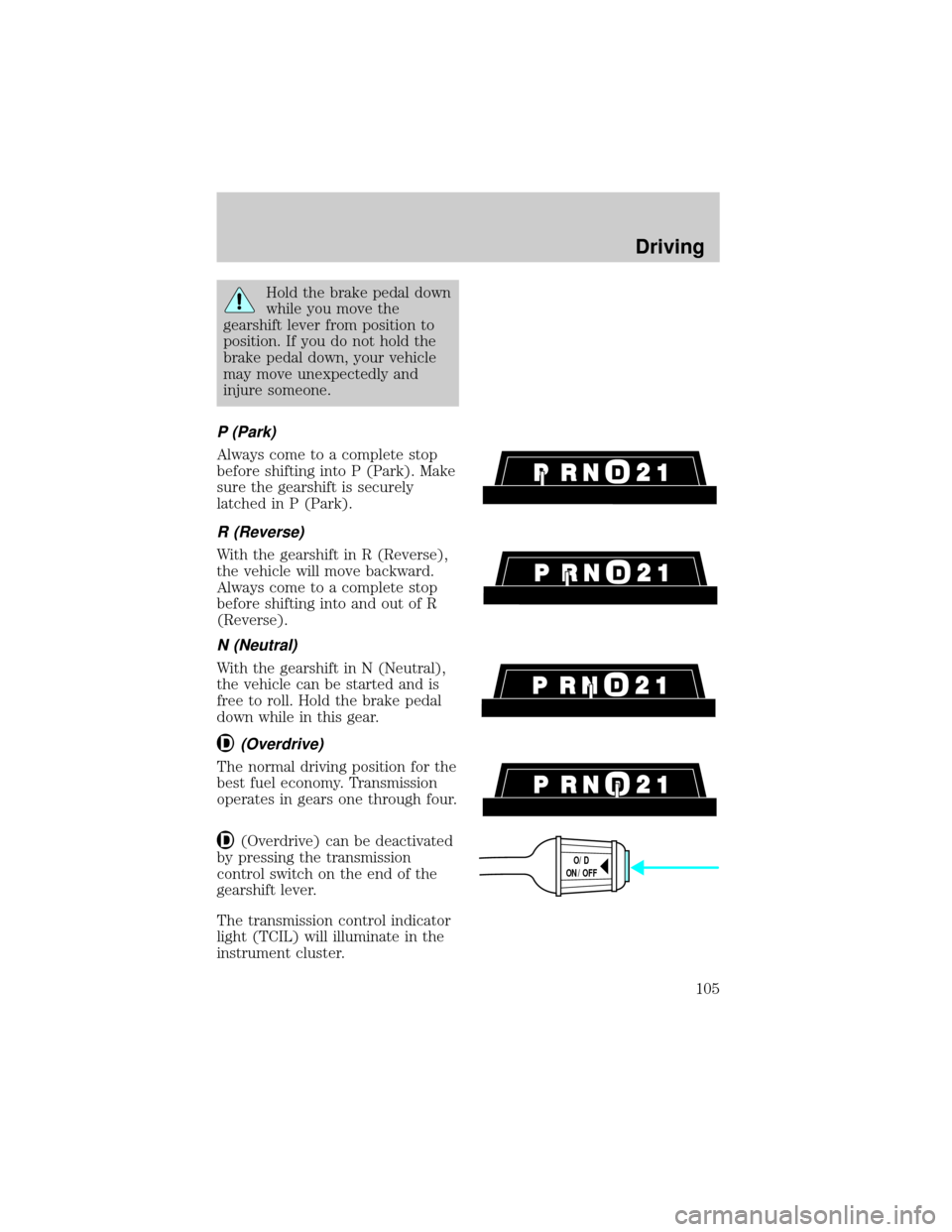
P (Park)
Always come to a complete stop
before shifting into P (Park). Make
sure the gearshift is securely
latched in P (Park).
R (Reverse)
With the gearshift in R (Reverse),
the vehicle will move backward.
Always come to a complete stop
before shifting into and out of R
(Reverse).
N (Neutral)
With the gearshift in N (Neutral),
the vehicle can be started and is
free to roll. Hold the brake pedal
down while in this gear.
(Overdrive)
The normal driving position for the
best fuel economy. Transmission
operates in gears one through four.
(Overdrive) can be deactivated
by pressing the transmission
control switch on the end of the
gearshift lever.
The transmission control indicator
light (TCIL) will illuminate in the
instrument cluster.
O/D
ON/OFF
Driving
105
Page 131 of 188

²Do not work on a vehicle with
the engine running in an
enclosed space, unless you are
sure you have enough
ventilation.
²Keep all lit cigarettes, open
flames and other lit material
away from the battery and all
fuel related parts.
If you disconnect the battery, the
engine must ªrelearnº its idle
conditions before your vehicle will
drive properly, as explained in the
Batterysection in this chapter.
Working with the engine off
1. Set the parking brake and
ensure the gearshift is securely
latched in P (Park).
2. Turn off the engine and remove
the key.
3. Block the wheels to prevent the
vehicle from moving unexpectedly.
Maintenance and care
132
Page 132 of 188
Working with the engine on
1. Set the parking brake and
ensure the gearshift is securely
latched in P (Park).
2. Block the wheels to prevent the
vehicle from moving unexpectedly.
Do not start your engine
with the air cleaner
removed and do not remove it
while the engine is running.
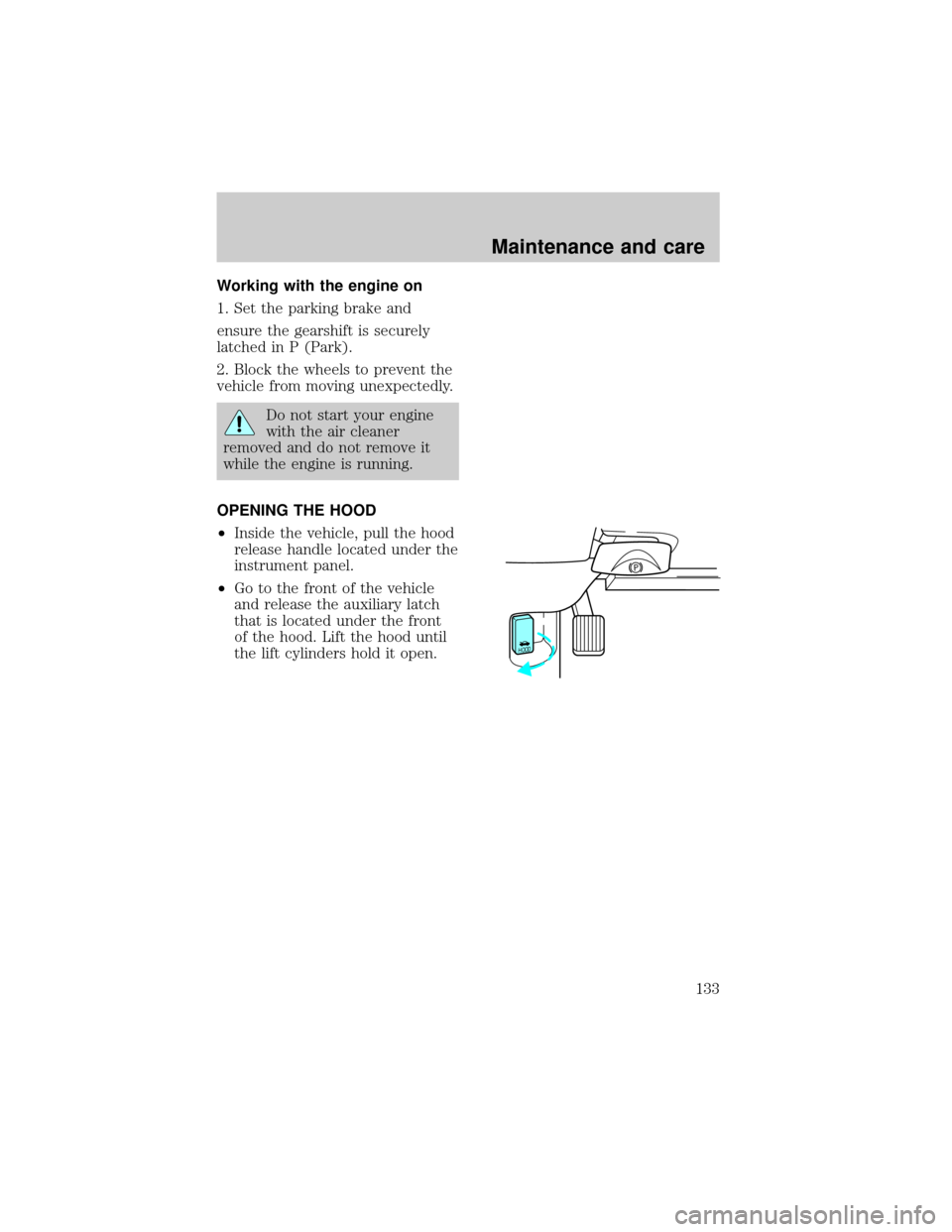
OPENING THE HOOD
²Inside the vehicle, pull the hood
release handle located under the
instrument panel.
²Go to the front of the vehicle
and release the auxiliary latch
that is located under the front
of the hood. Lift the hood until
the lift cylinders hold it open.
HOOD
Maintenance and care
133
Page 134 of 188

ENGINE OIL
Checking the engine oil
Check the engine oil each time you
fuel your vehicle.
1. Make sure the vehicle is on level
ground.
2. Turn the engine off and wait a
few minutes for the oil to drain
into the oil pan.
3. Set the parking brake and
ensure the gearshift is securely
latched in P (Park).
4. Open the hood. Protect yourself
from engine heat.
5. Locate and carefully remove the
engine oil level indicator
(dipstick).
6. Wipe the indicator clean. Insert
the indicator fully, then remove it
again.
MAX MIN
Maintenance and care
135
Page 157 of 188
Follow these guidelines when using
snow tires and chains:
²Use only SAE Class S chains.
²Install chains securely, verifying
that the chains do not touch any
wiring, brake lines or fuel lines.
²Drive cautiously. If you hear the
chains rub or bang against your
vehicle, stop and re-tighten the
chains. If this does not work,
remove the chains to prevent
damage to your vehicle.
²If possible, avoid fully loading
your vehicle.
²Do not use tire chains on
aluminum wheels. Chains may
chip the wheels.
²Remove the tire chains when
they are no longer needed. Do
not use tire chains on dry roads.
²The suspension insulation and
bumpers will help prevent
vehicle damage. Do not remove
these components from your
vehicle when using snow tires
and chains.
WHAT YOU SHOULD KNOW
ABOUT AUTOMOTIVE FUELS
Important safety precautions
Do not overfill the fuel
tank. The pressure in an
overfilled tank may cause
leakage and lead to fuel spray
and fire.
Maintenance and care
158