light LINCOLN TOWN CAR 1998 Owner's Guide
[x] Cancel search | Manufacturer: LINCOLN, Model Year: 1998, Model line: TOWN CAR, Model: LINCOLN TOWN CAR 1998Pages: 188, PDF Size: 1.29 MB
Page 103 of 188
is possible that a fuse has blown
and the vehicle's brakelamps may
not be operating properly. Refer to
Fuses and relaysin theRoadside
emergencieschapter.
Do not drive your vehicle
until you verify that the
brakelamps are working.
If your vehicle gets stuck in mud
or snow it may be rocked out by
shifting from forward and reverse
gears in a steady pattern. Press
lightly on the accelerator in each
gear.
Do not rock the vehicle for
more than a few minutes. The
transmission and tires may be
damaged or the engine may
overheat.
Always set the parking
brake fully and make sure
the gearshift is latched in P
(Park). Turn off the ignition
whenever you leave your vehicle.
Driving with a 4±speed
automatic transmission
Understanding gearshift
positions
Pull the gearshift lever towards
you and downward to move the
automatic gearshift.
Driving
104
Page 104 of 188
Hold the brake pedal down
while you move the
gearshift lever from position to
position. If you do not hold the
brake pedal down, your vehicle
may move unexpectedly and
injure someone.
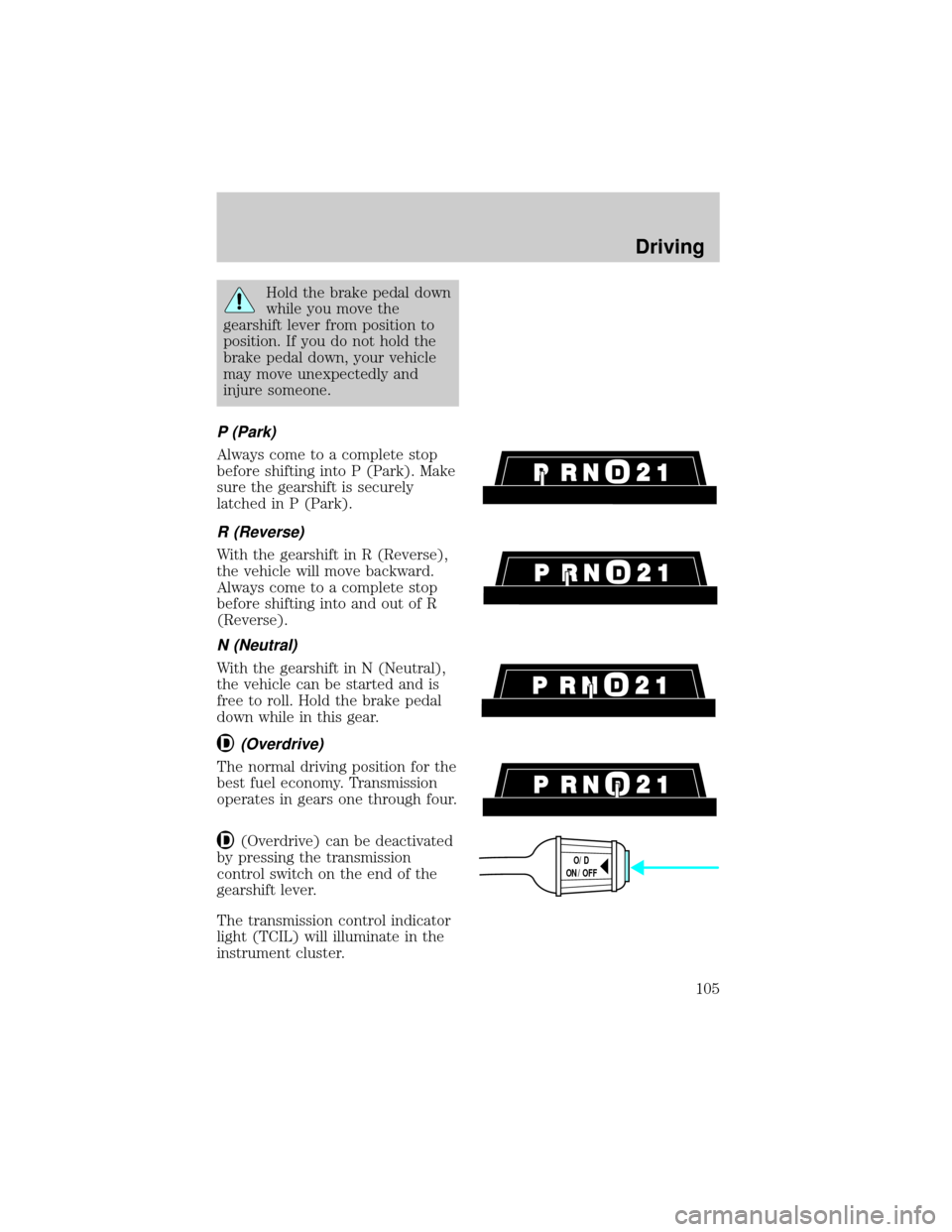
P (Park)
Always come to a complete stop
before shifting into P (Park). Make
sure the gearshift is securely
latched in P (Park).
R (Reverse)
With the gearshift in R (Reverse),
the vehicle will move backward.
Always come to a complete stop
before shifting into and out of R
(Reverse).
N (Neutral)
With the gearshift in N (Neutral),
the vehicle can be started and is
free to roll. Hold the brake pedal
down while in this gear.
(Overdrive)
The normal driving position for the
best fuel economy. Transmission
operates in gears one through four.
(Overdrive) can be deactivated
by pressing the transmission
control switch on the end of the
gearshift lever.
The transmission control indicator
light (TCIL) will illuminate in the
instrument cluster.
O/D
ON/OFF
Driving
105
Page 107 of 188
²GAWR (Gross Axle Weight
Rating): Carrying capacity for
each axle system. The GAWR is
specific to each vehicle and is
listed on the Safety Compliance
Label on the driver's door pillar.
Do not exceed the GVWR
or the GAWR specified on
the Safety Compliance
Certification Label.
Do not use replacement tires with
lower weight capacities than the
originals because they may lower
the vehicle's GVWR and GAWR
limitations. Replacement tires with
a higher weight limit than the
originals do not increase the
GVWR and GAWR limitations.
Your vehicle is classified as a light
duty towing vehicle. It does not
come from the factory fully
equipped to tow. No towing
packages are available through
Ford or Mercury/Lincoln dealers.
Do not tow a trailer until your
vehicle has been driven at least
3 200 km (2 000 miles).
Towing a trailer places an
additional load on your vehicle's
engine, transmission, brakes, tires
and suspension. Inspect these
components carefully after towing.
The amount of weight your loaded
trailer should be no more than
907 kg (2 000 lbs.).
Driving
108
Page 112 of 188

If driving through deep or standing
water is unavoidable, proceed very
slowly. Never drive through water
that is higher than the bottom of
the hubs (truck)/wheel rims (car).
Once through the water, always try
the brakes. Wet brakes do not stop
the vehicle as effectively as dry
brakes. Drying can be improved by
moving your vehicle slowly while
applying light pressure on the
brake pedal.
FUEL CONSUMPTION
Fuel economy can be improved by
avoiding:
²lack of regular, scheduled
maintenance.
²excessive speed.
²rapid acceleration.
²extended idle.
Driving
113
Page 115 of 188

Standard fuse amperage rating
and color
Fuse rating Color
5 amp Tan
7.5 amp Brown
10 amp Red
15 amp Light blue
20 amp Yellow
20 amp fuse link Light blue
25 amp Natural
30 amp Light green
30 amp fuse link Pink
40 amp fuse link Green
50 amp fuse link Red
60 amp fuse link Yellow
80 amp fuse link Black
100 amp fuse link Dark blue
Roadside emergencies
116
Page 117 of 188

The fuses are coded as follows.
Fuse/Relay
LocationFuse Amp
RatingDescription
1 10A Lighting Control Module (LCM)
2 30A EATC Blower Motor
3 10A Lighting Control Module (LCM)
4 7.5A Instrument Cluster
5 7.5A Lighting Control Module (LCM)
6 15A EATC, Heated Seats
7 15A Lighting Control Module (LCM),
Day/Night Sensor/Amplifier
8 10A Shift Lock, Speed Control, Air
Suspension, Steering Wheel Rotation
Sensor
9 20A Lighting Control Module (LCM),
Multi-Function Switch
10 20A Brake Pedal Position (BPP) Switch,
Brake Pressure Switch
11 10A Electronic Crash Sensor
12 15A Instrument Cluster, Anti-Theft, Ignition
Switch
13 10A Anti-Lock Brake Module, Traction
Control Switch
14 7.5A Transmission Control Switch, Lighting
Control Module (LCM)
15 20A Multi-Function Switch
16 30A Wiper Control Module (WCM),
Windshield Wiper Motor
17 10A Digital Transmission Range (DTR)
Sensor
18 7.5A Lighting Control Module (LCM), Front
Radio Control Unit, Cellular Telephone
Transceiver, Electronic Day/Night Mirror,
Compass Module
Roadside emergencies
118
Page 118 of 188

Fuse/Relay
LocationFuse Amp
RatingDescription
19 10A EATC, Clock, Instrument Cluster, PCM
20 7.5A Lighting Control Module (LCM), ABS,
Shift Lock
21 20A Multi-Function Switch
22 20A Multi-Function Switch, High Mounted
Stop Lamps
23 20A Datalink Connector, I/P Cigar Lighter
24 5A Front Radio Control Unit
25 15A Lighting Control Module (LCM)
26 5A Digital Transmission Range (DTR)
Sensor
27 20A Fuel Filler Door Release Switch
28 10A Heated Mirrors
29 20A LF Door Module
30 7.5A LF Seat Module, Trunk Lid Release
Switch, Door Lock Switches, LF Seat
Control Switch, LF Door Module, Power
Mirror Switch
31 7.5A Main Light Switch, Lighting Control
Module (LCM)
32 15A Not Used
33 15A Front Radio Control Unit, Digital
Compact Disk Changer, Cellular
Telephone Transceiver
Relay 1 - Accessory Delay Relay
Roadside emergencies
119
Page 130 of 188
SERVICE RECOMMENDATIONS
To help you service your vehicle:
²We highlight do-it-yourself items
in the engine compartment for
easy location.
²We provide a ªService Guideº
which makes tracking routine
service easy.
If your vehicle requires
professional service, your
dealership can provide necessary
parts and service. Check your
ªWarranty Guideº to find out which
parts and services are covered.
Use only recommended fuels,
lubricants, fluids and service parts
conforming to specifications.
Motorcraft parts are designed and
built to provide the best
performance in your vehicle.
PRECAUTIONS WHEN
SERVICING YOUR VEHICLE
Be especially careful when
inspecting or servicing your
vehicle.
²Do not work on a hot engine.
The cooling fan is
automatic and may come
on at any time. Always
disconnect the negative terminal
of the battery before working
near the fan.
²When the engine is running,
avoid wearing loose clothing,
jewelry or long hair that could
get caught up in moving parts.
Maintenance and care
131
Page 143 of 188

How fail-safe cooling works
If the engine overheats, the engine
will automatically switch from
eight to alternating four cylinder
operation. Each disabled cylinder
acts as an air pump and cools the
engine.
When this occurs:
²the engine coolant temperature
gauge will move to the H (hot)
area
²the
symbol will illuminate
²a tone will sound 3 times
²the service engine soon light will
illuminate
If the engine coolant temperature
exceeds 166ÉC (330ÉF):
²the
symbol will begin to
flash
²a tone will sound 5 times
²the service engine soon light will
remain on
²the coolant temperature gauge
remains on H (hot)
²the engine will shut down.
As the engine temperature cools,
the engine may be re-started. Take
your vehicle to a service facility as
soon as possible to minimize
engine damage.
When fail-safe mode is
activated
²Pull off the road as soon as
possible.
H
Maintenance and care
144
Page 160 of 188
Repair of damage caused by using
a fuel that your vehicle was not
designed for may not be covered
by your warranty.
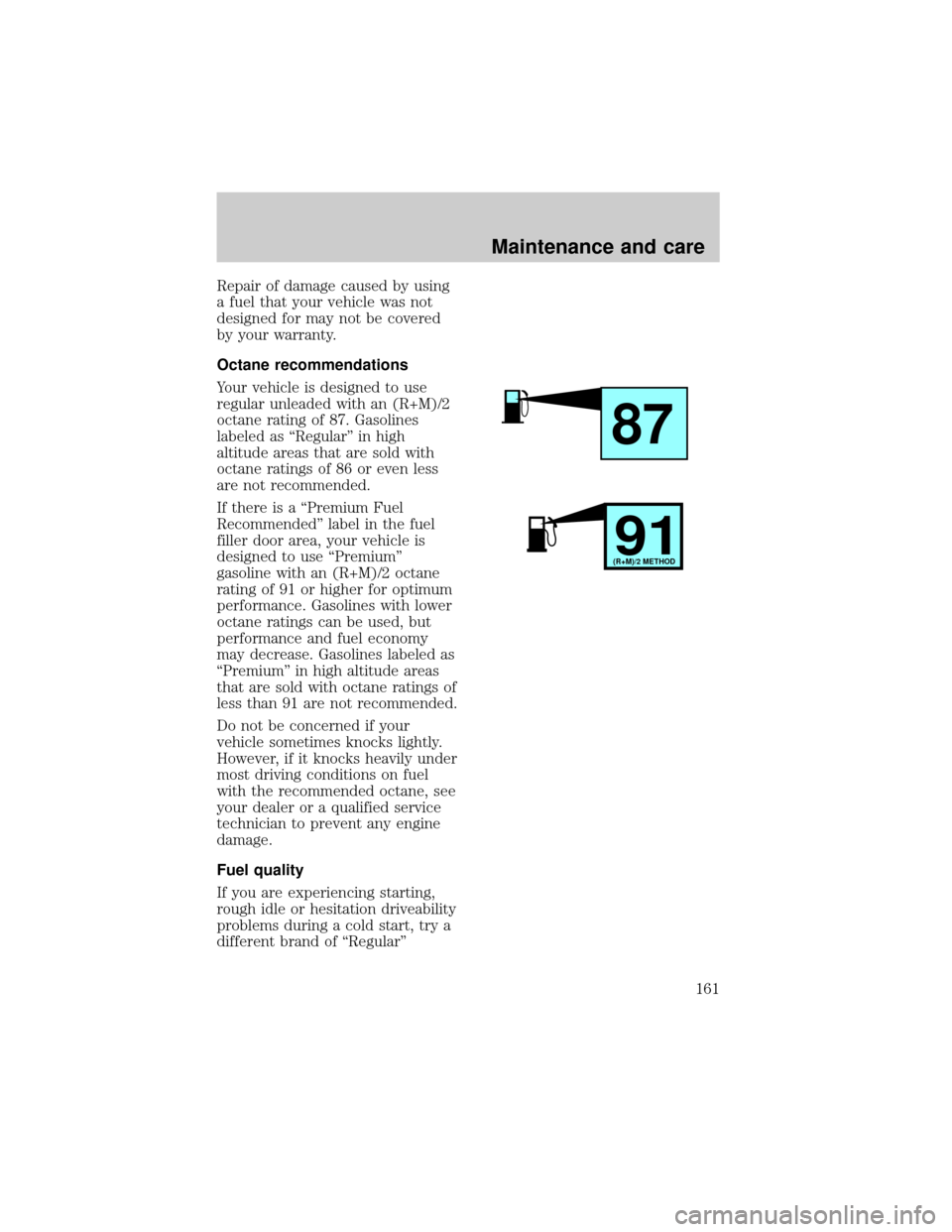
Octane recommendations
Your vehicle is designed to use
regular unleaded with an (R+M)/2
octane rating of 87. Gasolines
labeled as ªRegularº in high
altitude areas that are sold with
octane ratings of 86 or even less
are not recommended.
If there is a ªPremium Fuel
Recommendedº label in the fuel
filler door area, your vehicle is
designed to use ªPremiumº
gasoline with an (R+M)/2 octane
rating of 91 or higher for optimum
performance. Gasolines with lower
octane ratings can be used, but
performance and fuel economy
may decrease. Gasolines labeled as
ªPremiumº in high altitude areas
that are sold with octane ratings of
less than 91 are not recommended.
Do not be concerned if your
vehicle sometimes knocks lightly.
However, if it knocks heavily under
most driving conditions on fuel
with the recommended octane, see
your dealer or a qualified service
technician to prevent any engine
damage.
Fuel quality
If you are experiencing starting,
rough idle or hesitation driveability
problems during a cold start, try a
different brand of ªRegularº
87
91(R+M)/2 METHOD
Maintenance and care
161