coolant temperature LINCOLN TOWN CAR 1998 Owners Manual
[x] Cancel search | Manufacturer: LINCOLN, Model Year: 1998, Model line: TOWN CAR, Model: LINCOLN TOWN CAR 1998Pages: 188, PDF Size: 1.29 MB
Page 9 of 188
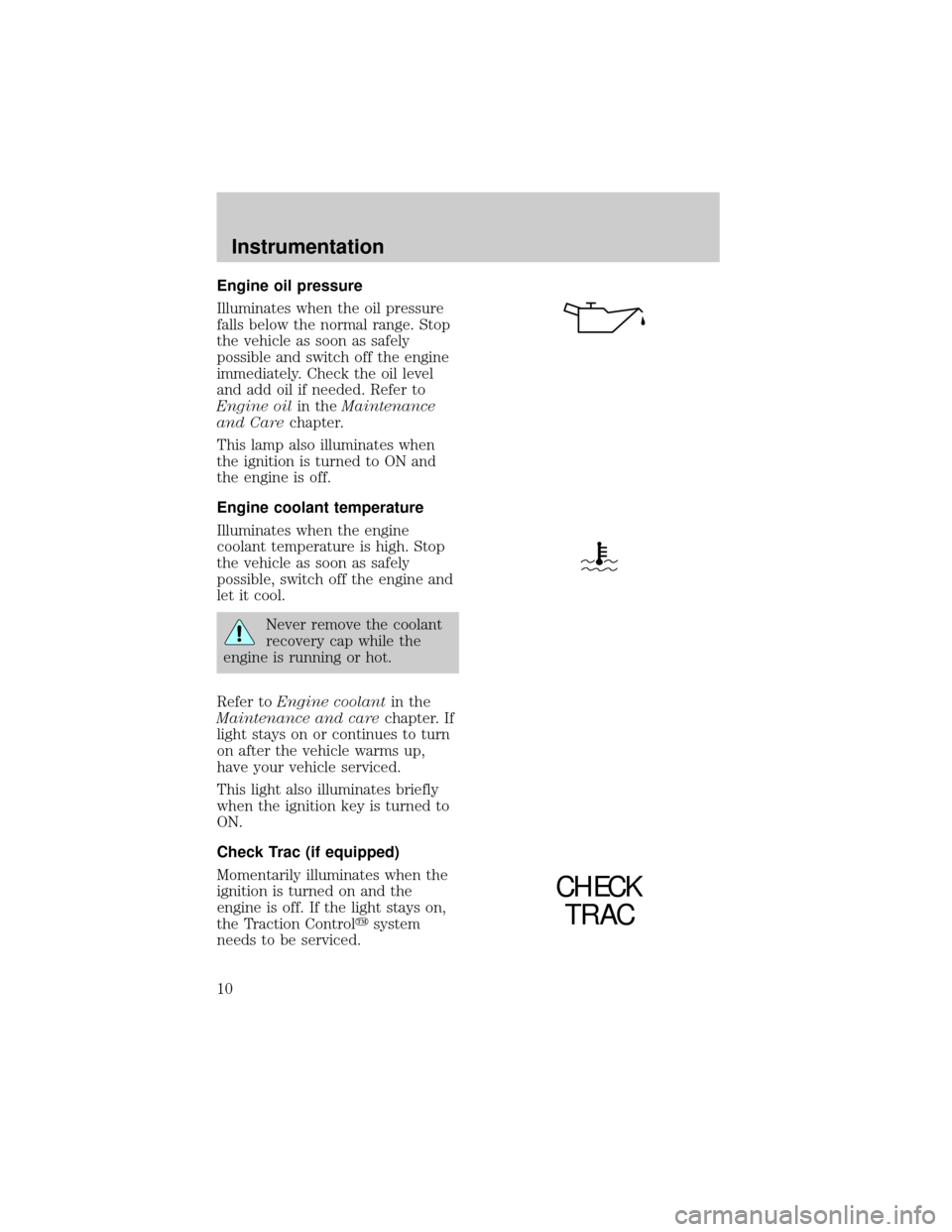
Engine oil pressure
Illuminates when the oil pressure
falls below the normal range. Stop
the vehicle as soon as safely
possible and switch off the engine
immediately. Check the oil level
and add oil if needed. Refer to
Engine oilin theMaintenance
and Carechapter.
This lamp also illuminates when
the ignition is turned to ON and
the engine is off.
Engine coolant temperature
Illuminates when the engine
coolant temperature is high. Stop
the vehicle as soon as safely
possible, switch off the engine and
let it cool.
Never remove the coolant
recovery cap while the
engine is running or hot.
Refer toEngine coolantin the
Maintenance and carechapter. If
light stays on or continues to turn
on after the vehicle warms up,
have your vehicle serviced.
This light also illuminates briefly
when the ignition key is turned to
ON.
Check Trac (if equipped)
Momentarily illuminates when the
ignition is turned on and the
engine is off. If the light stays on,
the Traction Controlysystem
needs to be serviced.
CHECK
TRAC
Instrumentation
10
Page 14 of 188
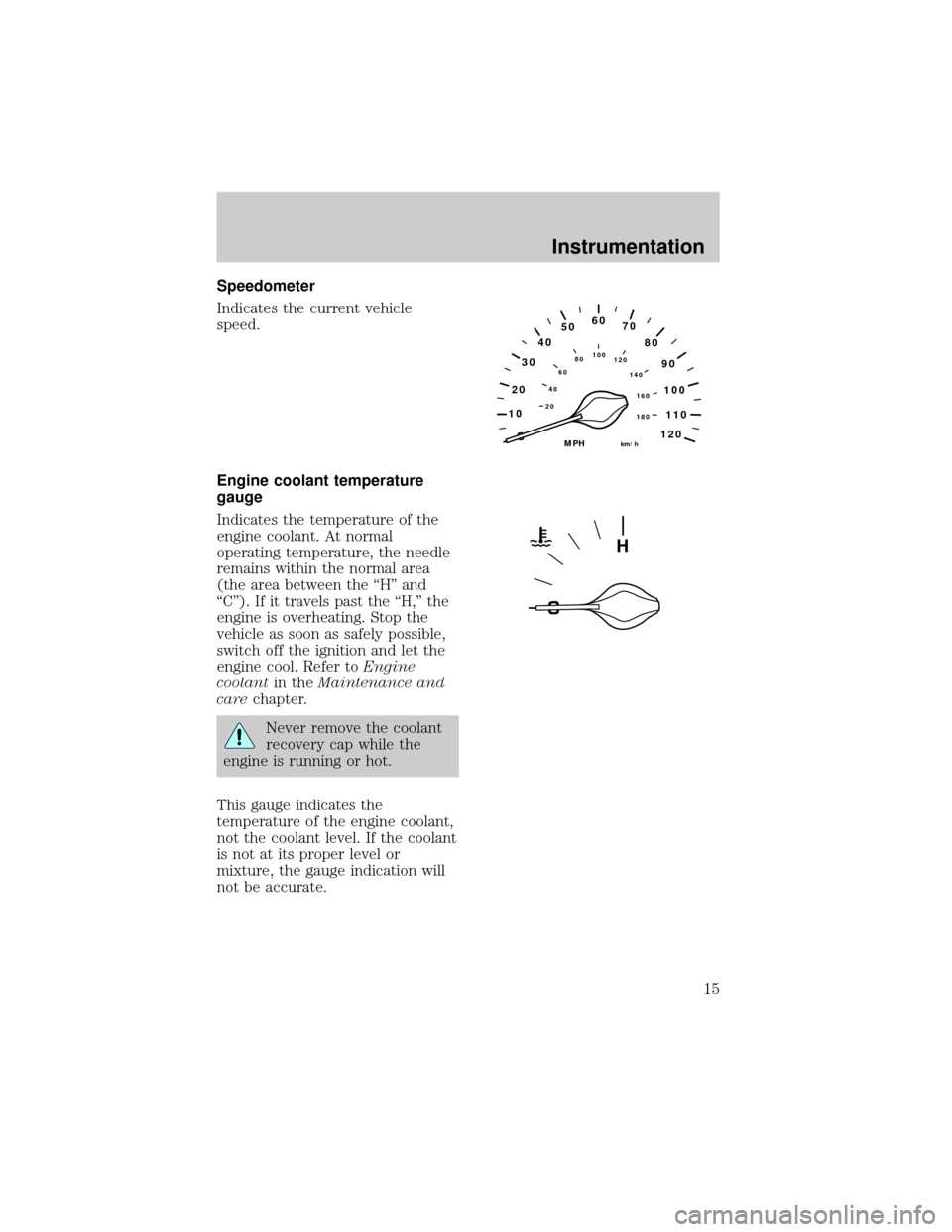
Speedometer
Indicates the current vehicle
speed.
Engine coolant temperature
gauge
Indicates the temperature of the
engine coolant. At normal
operating temperature, the needle
remains within the normal area
(the area between the ªHº and
ªCº). If it travels past the ªH,º the
engine is overheating. Stop the
vehicle as soon as safely possible,
switch off the ignition and let the
engine cool. Refer toEngine
coolantin theMaintenance and
carechapter.
Never remove the coolant
recovery cap while the
engine is running or hot.
This gauge indicates the
temperature of the engine coolant,
not the coolant level. If the coolant
is not at its proper level or
mixture, the gauge indication will
not be accurate.
10
2030405060
70
80
90
100
120206080
40100
120
160 140
180
MPHkm/h
110
H
Instrumentation
15
Page 92 of 188
Make sure the corresponding lights
illuminate briefly. If a light fails to
illuminate, have the vehicle
serviced.
²If the driver's safety belt is
fastened, the light (
) will not
illuminate.
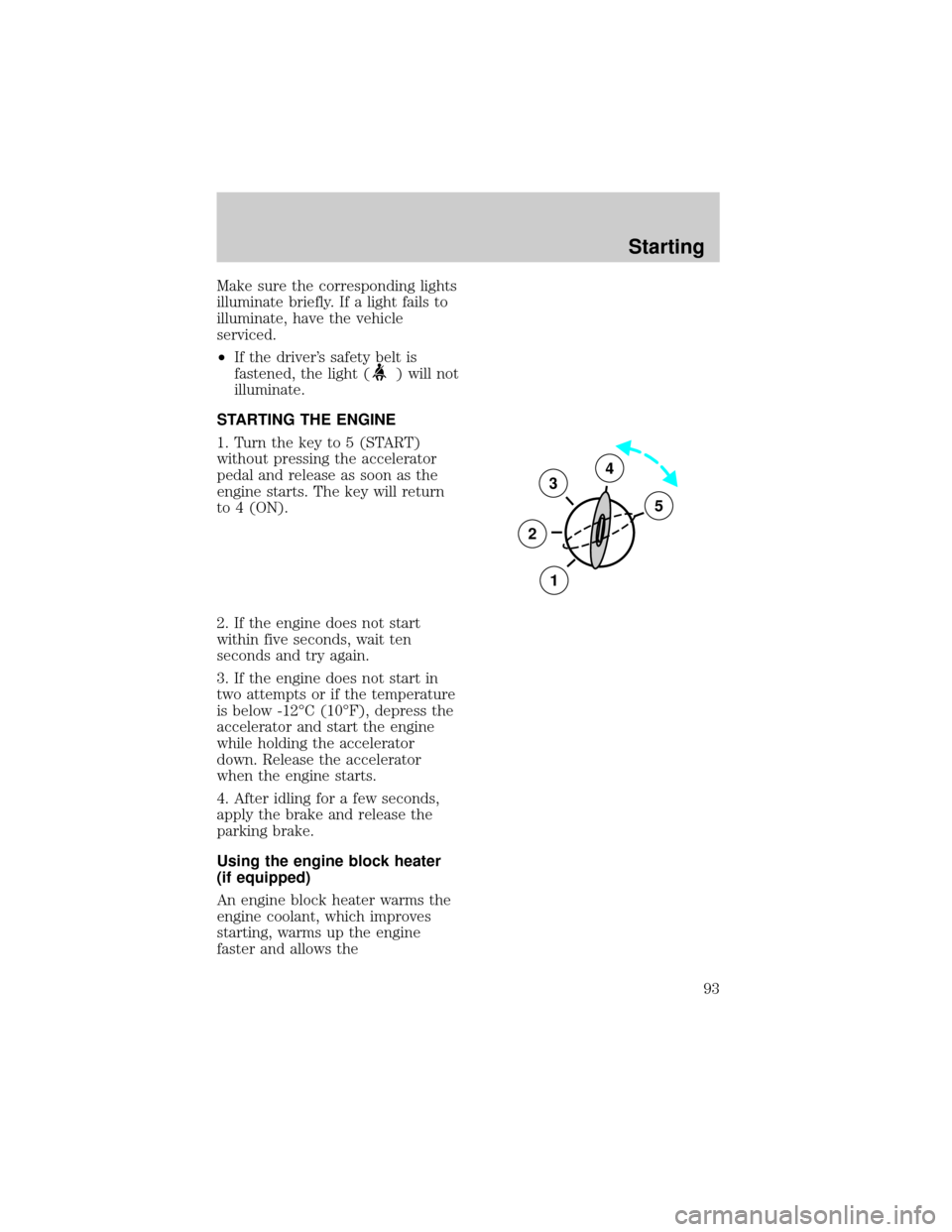
STARTING THE ENGINE
1. Turn the key to 5 (START)
without pressing the accelerator
pedal and release as soon as the
engine starts. The key will return
to 4 (ON).
2. If the engine does not start
within five seconds, wait ten
seconds and try again.
3. If the engine does not start in
two attempts or if the temperature
is below -12ÉC (10ÉF), depress the
accelerator and start the engine
while holding the accelerator
down. Release the accelerator
when the engine starts.
4. After idling for a few seconds,
apply the brake and release the
parking brake.
Using the engine block heater
(if equipped)
An engine block heater warms the
engine coolant, which improves
starting, warms up the engine
faster and allows the
3
2
1
5
4
Starting
93
Page 100 of 188

portion of the system will shut
down to prevent the rear brakes
from overheating. A limited
Traction Controlyfunction using
only engine torque reduction will
still control wheels from
over-spinning. When the rear
brakes have cooled down, the
system will again function
normally. Anti-lock braking is not
affected by this condition and will
function normally during the cool
down period.
If the engine coolant temperature
is below þ23ÉC (þ10ÉF) the engine
torque reduction portion of the
Traction Controlysystem isNOT
active. The system will operate
normally when the engine coolant
warms up.
Traction control switch
The traction control switch is
located on the left side of the
glove compartment. The traction
control system defaults to ON
when the ignition key is turned
from OFF to RUN.
The traction control must be
turned off if you are using a
mini-spare tire in a rear wheel
position.
STEERING
Your vehicle is equipped with
power steering. Power steering
uses energy from the engine to
help steer the vehicle.
Never hold the steering wheel to
the extreme right or the extreme
Driving
101
Page 142 of 188

refer toRefill capacitiesin the
Capacities and specifications
chapter.
Have your dealer check the engine
cooling system for leaks if you
have to add more than a liter
(quart) of engine coolant per
month.
Severe winter climate
If you drive in extremely cold
climates (less than ±36ÉC [±34ÉF]),
it may be necessary to increase the
coolant concentration above 50%.
Refer to the chart on the coolant
container to ensure the coolant
concentration in your vehicle is
such that the coolant will not
freeze at the temperature level in
which you drive during winter
months. Never increase the engine
coolant concentration above 60%.
Leave a 50/50 mixture of engine
coolant and water in your vehicle
year-round in non-extreme
climates.
What you should know about
fail-safe cooling
If the engine coolant supply is
depleted, this feature allows the
vehicle to be driven temporarily
before incremental component
damage is incurred. The ªfail safeº
distance depends on ambient
temperatures, vehicle load and
terrain.
Maintenance and care
143
Page 143 of 188

How fail-safe cooling works
If the engine overheats, the engine
will automatically switch from
eight to alternating four cylinder
operation. Each disabled cylinder
acts as an air pump and cools the
engine.
When this occurs:
²the engine coolant temperature
gauge will move to the H (hot)
area
²the
symbol will illuminate
²a tone will sound 3 times
²the service engine soon light will
illuminate
If the engine coolant temperature
exceeds 166ÉC (330ÉF):
²the
symbol will begin to
flash
²a tone will sound 5 times
²the service engine soon light will
remain on
²the coolant temperature gauge
remains on H (hot)
²the engine will shut down.
As the engine temperature cools,
the engine may be re-started. Take
your vehicle to a service facility as
soon as possible to minimize
engine damage.
When fail-safe mode is
activated
²Pull off the road as soon as
possible.
H
Maintenance and care
144
Page 144 of 188
²Immediately turn the engine off
to prevent severe engine
damage.
²Wait for the engine to cool.
²Check the coolant level.
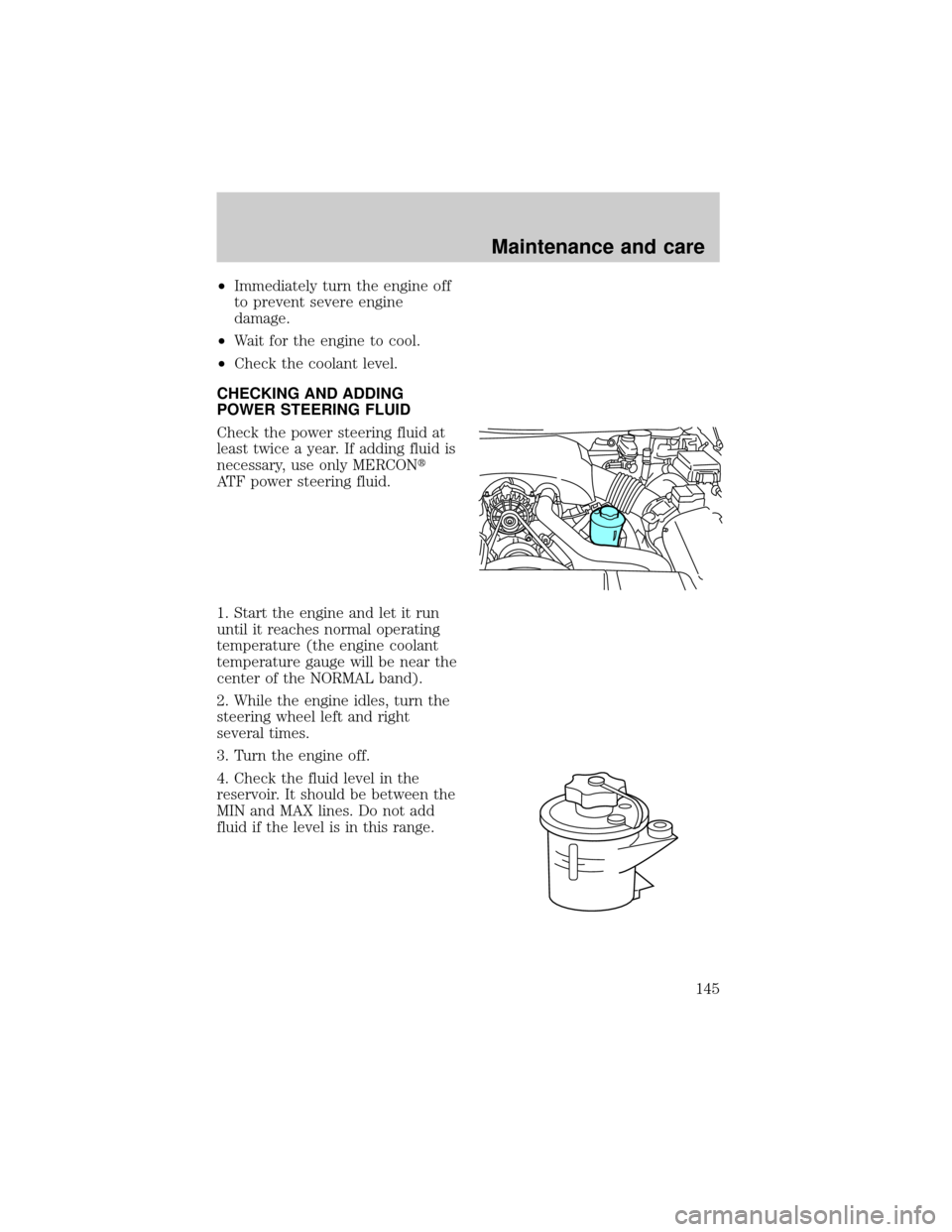
CHECKING AND ADDING
POWER STEERING FLUID
Check the power steering fluid at
least twice a year. If adding fluid is
necessary, use only MERCONt
ATF power steering fluid.
1. Start the engine and let it run
until it reaches normal operating
temperature (the engine coolant
temperature gauge will be near the
center of the NORMAL band).
2. While the engine idles, turn the
steering wheel left and right
several times.
3. Turn the engine off.
4. Check the fluid level in the
reservoir. It should be between the
MIN and MAX lines. Do not add
fluid if the level is in this range.
Maintenance and care
145
Page 185 of 188

Aiming headlamps ....................169
Air bag supplemental restraint
system ..........................................76
and child safety seats ..............78
description ................................77
disposal ......................................81
indicator light ...........................80
passenger air bag .....................79
Air suspension
description ..............................102
Anti-lock brake system
(ABS)#$description
Battery .......................................149
Brake fluid
checking and adding ..............138
Brakes ..........................................96
anti-lock .....................................96
anti-lock brake system (ABS)
warning light .............................97
fluid, checking and adding ....138
traction control .........................99
Brake-shift interlock .................103
Break-in period .............................2
Bulbs, replacing ........................166
headlamps ...............................167
specifications ..........................171
Changing a tire .........................122
Child safety seats ........................84
Childproof locks ..........................51
Chime
headlamps on ............................13
Cleaning your vehicle ...............172
engine compartment ..............173
fabric ........................................175
instrument panel ....................175
plastic parts ............................174
safety belts ..............................176
tail lamps .................................175
washing ....................................172
waxing .....................................172
wheels ......................................173
windows ..................................178Climate control system
automatic temperature
control ..............26,27,28,29,32,33
Clock ............................................34
Compass, electronic
calibration .................................19
set zone adjustment .................18
Controls .......................................52
Daytime running light system ...25
Defrost
rear window ..............................34
Emission control system ..........163
Engine
service points ..........................134
Engine block heater ...................93
Engine coolant
checking and adding ..............140
disposal ....................................142
refill capacities ........................142
Engine oil ...........................135,137
changing oil and oil filter .......137
checking and adding .......135,136
Exhaust fumes ............................94
Fail safe cooling ........................143
Floor mats ...................................53
Fuel
calculating fuel economy .......162
improving fuel economy ........113
octane rating ...........................161
quality ......................................161
safety information relating to
automotive fuels .....................158
Fuel gauge ...................................14
Fuel pump shut-off switch .......114
Fuse panels
instrument panel ....................117
power distribution box ...........120
Fuses ...................................115,116
Gauges, Mechanical ....................14
engine coolant temperature
gauge .........................................15
Hazard flashers .........................114
Index
186