check oil LINCOLN TOWN CAR 2000 Owners Manual
[x] Cancel search | Manufacturer: LINCOLN, Model Year: 2000, Model line: TOWN CAR, Model: LINCOLN TOWN CAR 2000Pages: 224, PDF Size: 1.73 MB
Page 11 of 224
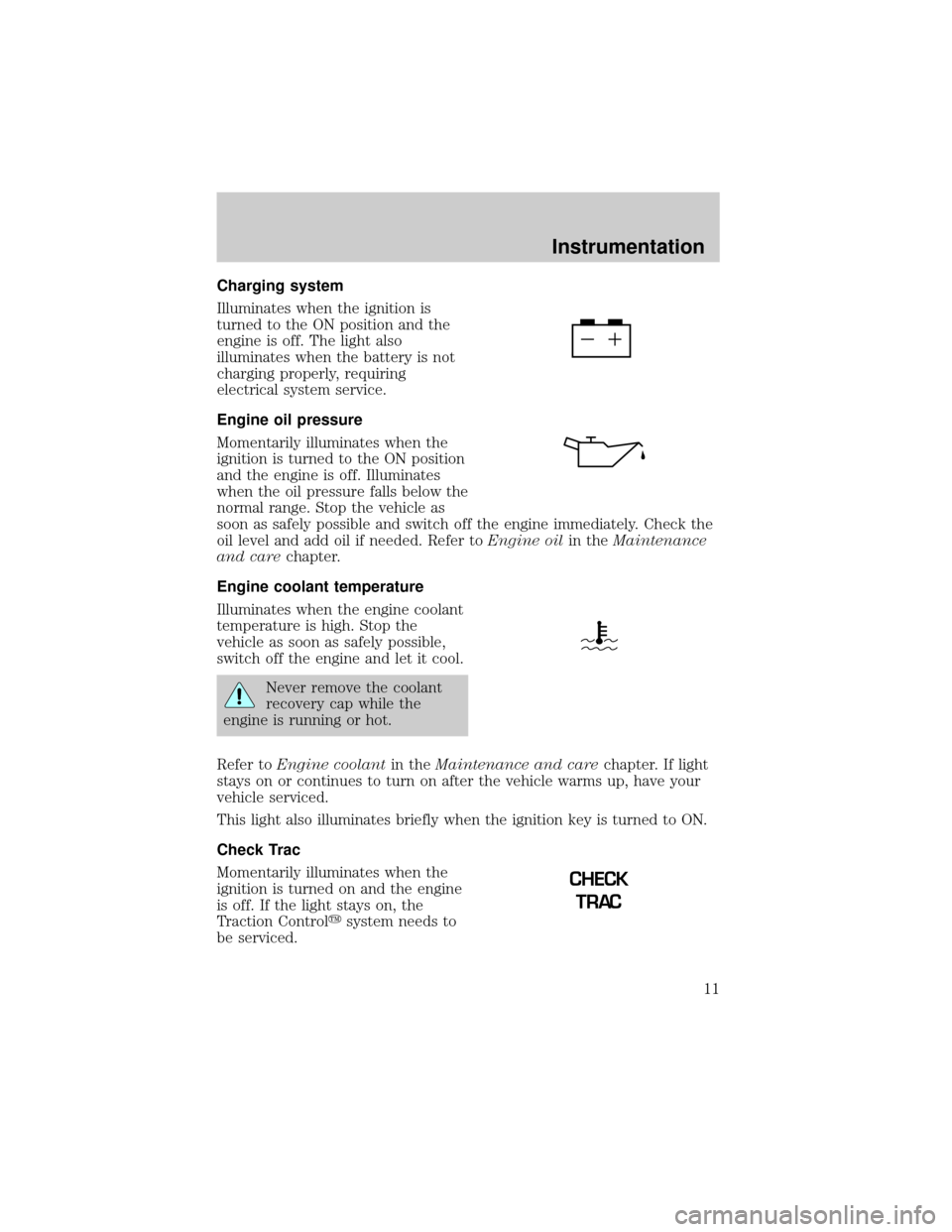
Charging system
Illuminates when the ignition is
turned to the ON position and the
engine is off. The light also
illuminates when the battery is not
charging properly, requiring
electrical system service.
Engine oil pressure
Momentarily illuminates when the
ignition is turned to the ON position
and the engine is off. Illuminates
when the oil pressure falls below the
normal range. Stop the vehicle as
soon as safely possible and switch off the engine immediately. Check the
oil level and add oil if needed. Refer toEngine oilin theMaintenance
and carechapter.
Engine coolant temperature
Illuminates when the engine coolant
temperature is high. Stop the
vehicle as soon as safely possible,
switch off the engine and let it cool.
Never remove the coolant
recovery cap while the
engine is running or hot.
Refer toEngine coolantin theMaintenance and carechapter. If light
stays on or continues to turn on after the vehicle warms up, have your
vehicle serviced.
This light also illuminates briefly when the ignition key is turned to ON.
Check Trac
Momentarily illuminates when the
ignition is turned on and the engine
is off. If the light stays on, the
Traction Controlysystem needs to
be serviced.
CHECK
TRAC
Instrumentation
11
Page 16 of 224
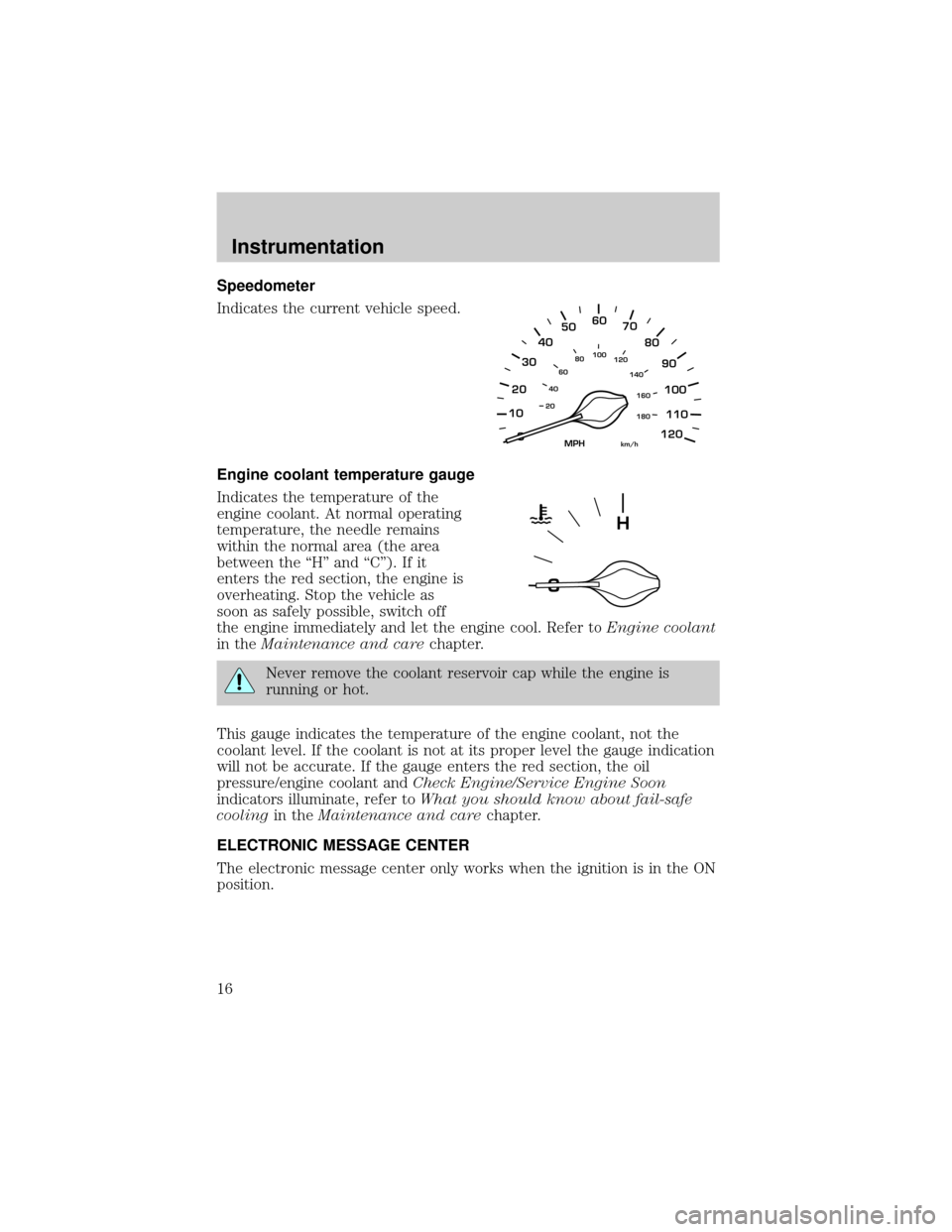
Speedometer
Indicates the current vehicle speed.
Engine coolant temperature gauge
Indicates the temperature of the
engine coolant. At normal operating
temperature, the needle remains
within the normal area (the area
between the ªHº and ªCº). If it
enters the red section, the engine is
overheating. Stop the vehicle as
soon as safely possible, switch off
the engine immediately and let the engine cool. Refer toEngine coolant
in theMaintenance and carechapter.
Never remove the coolant reservoir cap while the engine is
running or hot.
This gauge indicates the temperature of the engine coolant, not the
coolant level. If the coolant is not at its proper level the gauge indication
will not be accurate. If the gauge enters the red section, the oil
pressure/engine coolant andCheck Engine/Service Engine Soon
indicators illuminate, refer toWhat you should know about fail-safe
coolingin theMaintenance and carechapter.
ELECTRONIC MESSAGE CENTER
The electronic message center only works when the ignition is in the ON
position.
10
2030405060
70
80
90
100
120206080
40100
120
160 140
180
MPHkm/h
110
H
Instrumentation
16
Page 153 of 224
ENGINE OIL
Checking the engine oil
Refer to the Scheduled Maintenance Guide for the appropriate intervals
for checking the engine oil.
1. Make sure the vehicle is on level ground.
2. Turn the engine off and wait a few minutes for the oil to drain into the
oil pan.
3. Set the parking brake and ensure the gearshift is securely latched in P
(Park).
4. Open the hood. Protect yourself from engine heat.
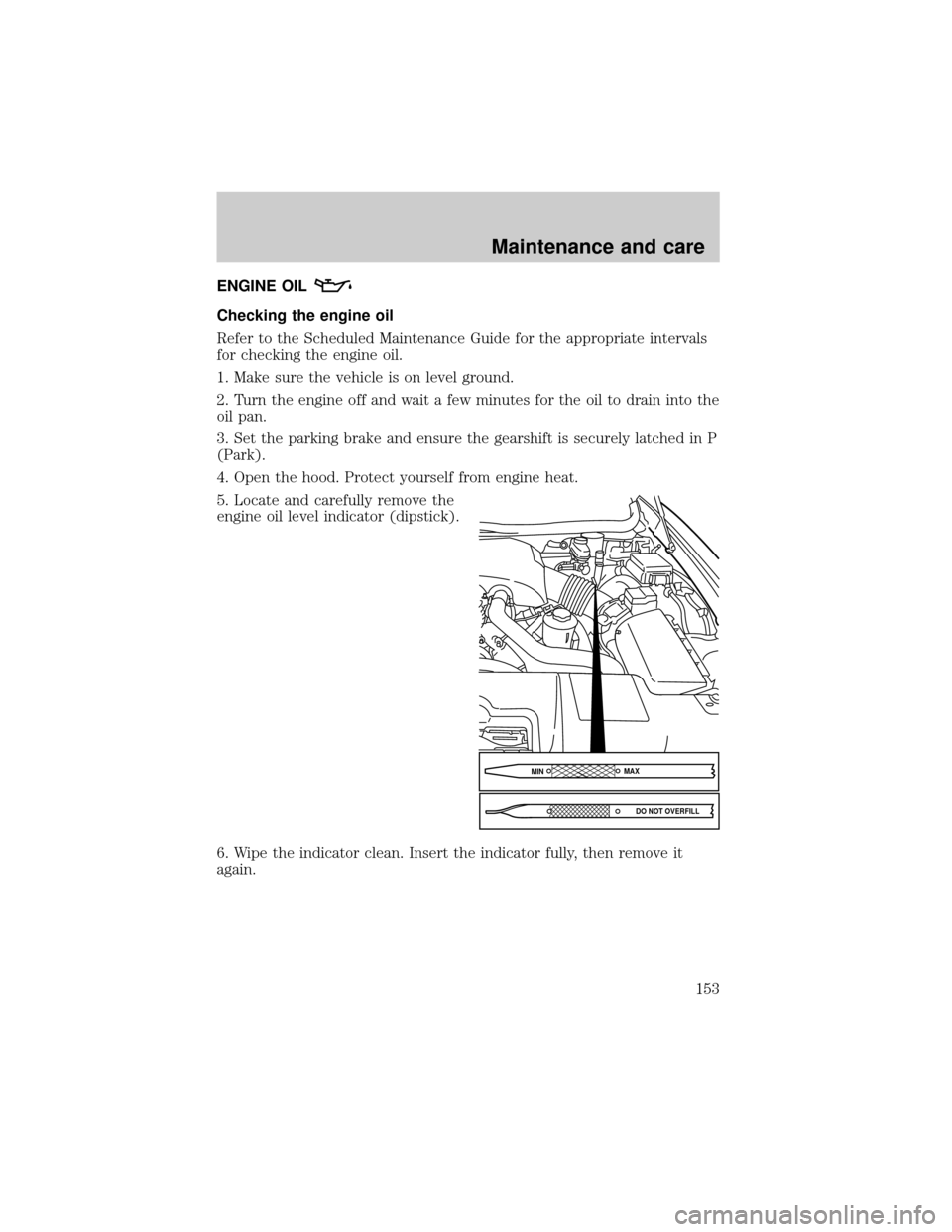
5. Locate and carefully remove the
engine oil level indicator (dipstick).
6. Wipe the indicator clean. Insert the indicator fully, then remove it
again.
DO NOT OVERFILL MIN
MAX
Maintenance and care
153
Page 154 of 224
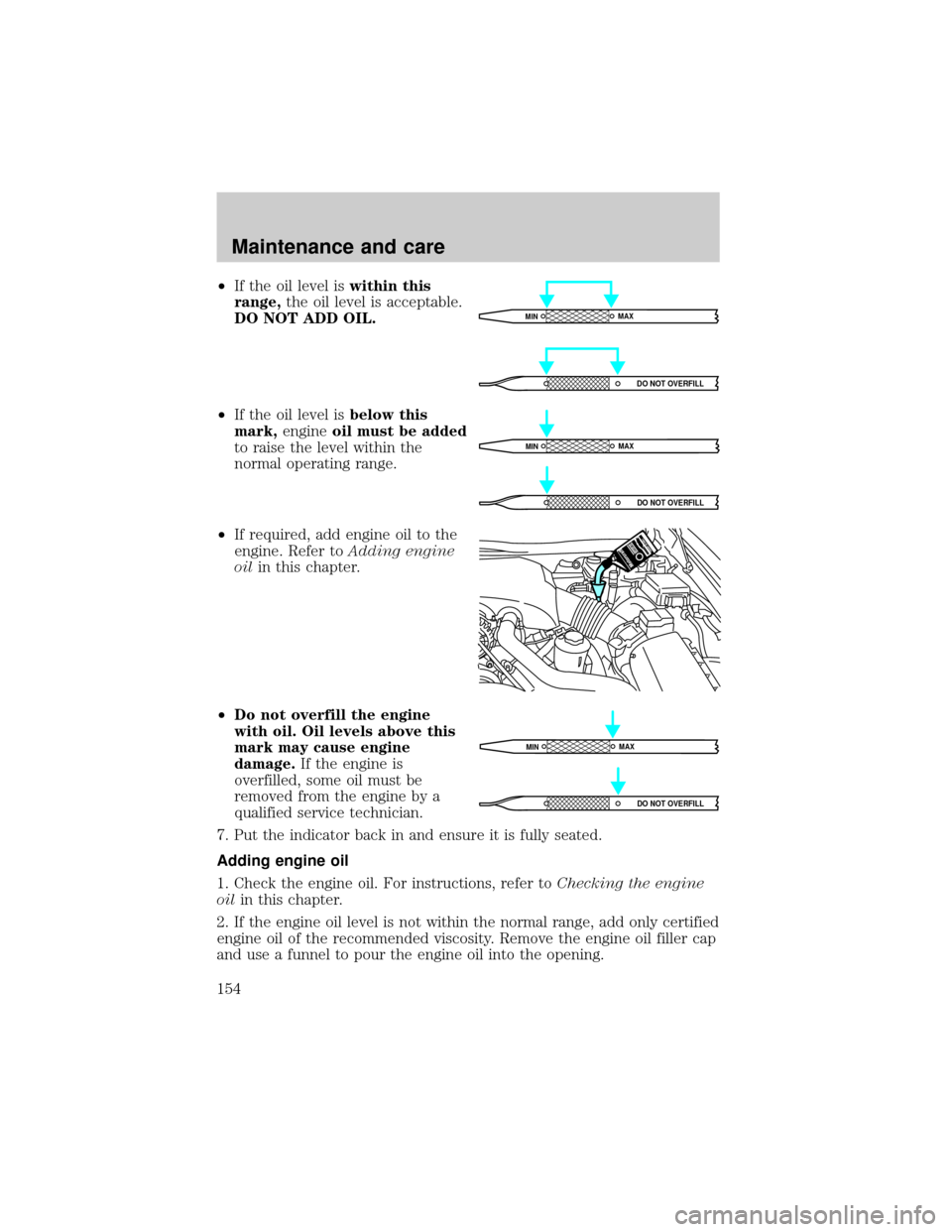
²If the oil level iswithin this
range,the oil level is acceptable.
DO NOT ADD OIL.
²If the oil level isbelow this
mark,engineoil must be added
to raise the level within the
normal operating range.
²If required, add engine oil to the
engine. Refer toAdding engine
oilin this chapter.
²Do not overfill the engine
with oil. Oil levels above this
mark may cause engine
damage.If the engine is
overfilled, some oil must be
removed from the engine by a
qualified service technician.
7. Put the indicator back in and ensure it is fully seated.
Adding engine oil
1. Check the engine oil. For instructions, refer toChecking the engine
oilin this chapter.
2. If the engine oil level is not within the normal range, add only certified
engine oil of the recommended viscosity. Remove the engine oil filler cap
and use a funnel to pour the engine oil into the opening.
DO NOT OVERFILL
MINMAX
DO NOT OVERFILL
MINMAX
MINMAX
DO NOT OVERFILL
Maintenance and care
154
Page 155 of 224
3. Recheck the engine oil level. Make sure the oil level is not above the
MAX mark on the engine oil level indicator (dipstick).
4. Install the indicator and ensure it is fully seated.
5. Fully install the engine oil filler cap by turning the filler cap clockwise
until three clicks can be heard.
To avoid possible oil loss, DO NOT operate the vehicle with the
engine oil level indicator and/or the engine oil filler cap removed.
Engine oil and filter recommendations
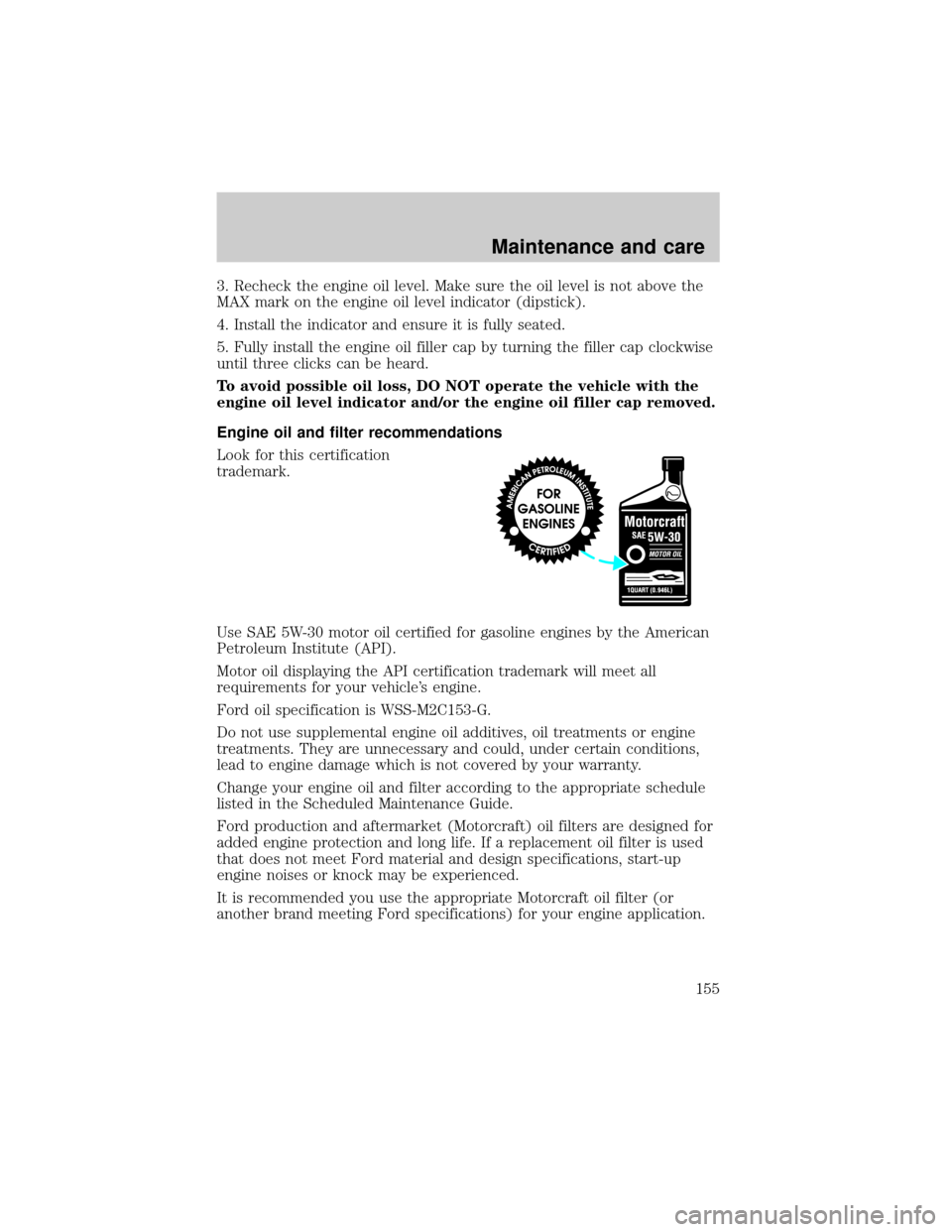
Look for this certification
trademark.
Use SAE 5W-30 motor oil certified for gasoline engines by the American
Petroleum Institute (API).
Motor oil displaying the API certification trademark will meet all
requirements for your vehicle's engine.
Ford oil specification is WSS-M2C153-G.
Do not use supplemental engine oil additives, oil treatments or engine
treatments. They are unnecessary and could, under certain conditions,
lead to engine damage which is not covered by your warranty.
Change your engine oil and filter according to the appropriate schedule
listed in the Scheduled Maintenance Guide.
Ford production and aftermarket (Motorcraft) oil filters are designed for
added engine protection and long life. If a replacement oil filter is used
that does not meet Ford material and design specifications, start-up
engine noises or knock may be experienced.
It is recommended you use the appropriate Motorcraft oil filter (or
another brand meeting Ford specifications) for your engine application.
Maintenance and care
155
Page 157 of 224
WINDSHIELD WASHER FLUID
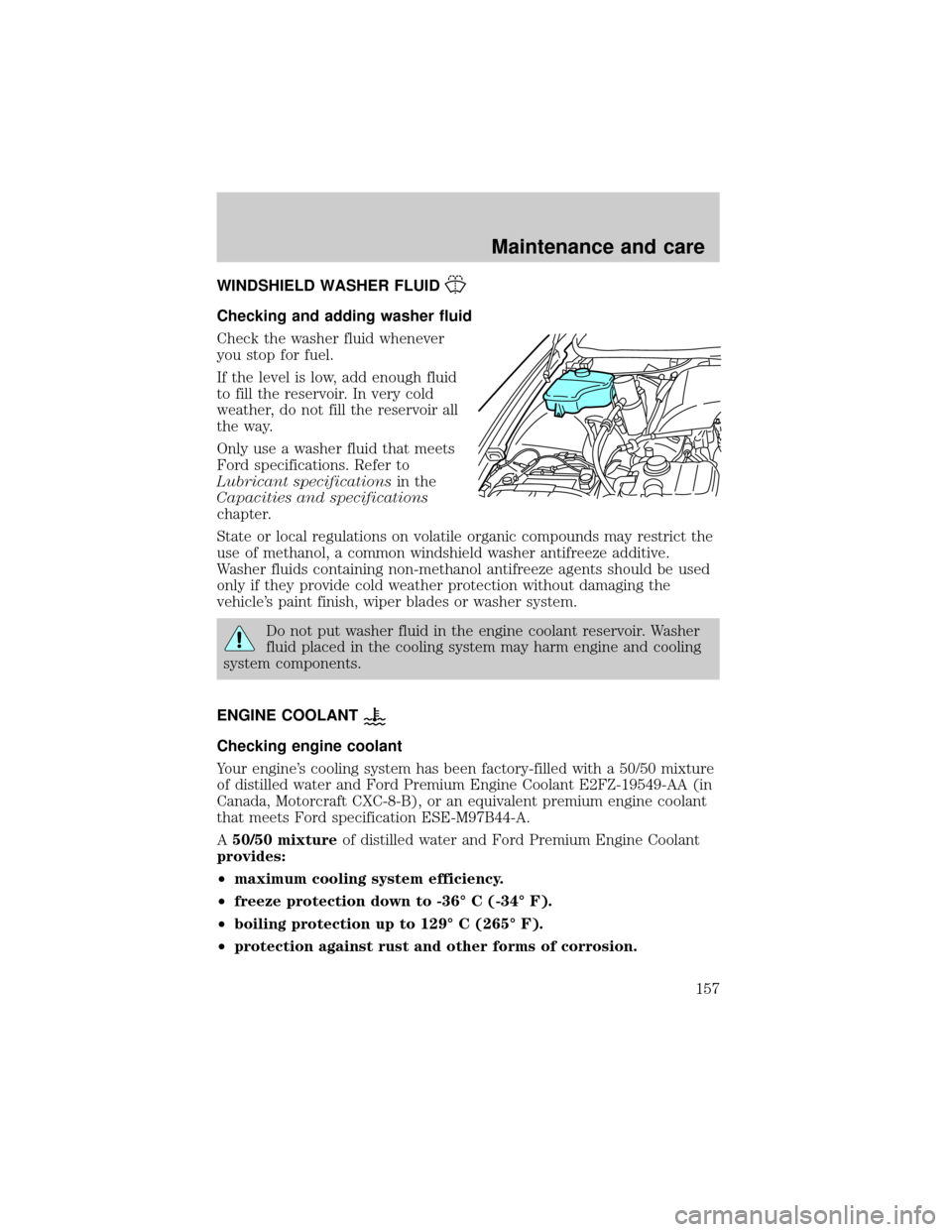
Checking and adding washer fluid
Check the washer fluid whenever
you stop for fuel.
If the level is low, add enough fluid
to fill the reservoir. In very cold
weather, do not fill the reservoir all
the way.
Only use a washer fluid that meets
Ford specifications. Refer to
Lubricant specificationsin the
Capacities and specifications
chapter.
State or local regulations on volatile organic compounds may restrict the
use of methanol, a common windshield washer antifreeze additive.
Washer fluids containing non-methanol antifreeze agents should be used
only if they provide cold weather protection without damaging the
vehicle's paint finish, wiper blades or washer system.
Do not put washer fluid in the engine coolant reservoir. Washer
fluid placed in the cooling system may harm engine and cooling
system components.
ENGINE COOLANT
Checking engine coolant
Your engine's cooling system has been factory-filled with a 50/50 mixture
of distilled water and Ford Premium Engine Coolant E2FZ-19549-AA (in
Canada, Motorcraft CXC-8-B), or an equivalent premium engine coolant
that meets Ford specification ESE-M97B44-A.
A50/50 mixtureof distilled water and Ford Premium Engine Coolant
provides:
²maximum cooling system efficiency.
²freeze protection down to -36É C (-34É F).
²boiling protection up to 129É C (265É F).
²protection against rust and other forms of corrosion.
Maintenance and care
157
Page 181 of 224

²Using the air conditioner or defroster may reduce fuel economy.
²You may want to turn off the speed control in hilly terrain if
unnecessary shifting between third and fourth gear occurs.
Unnecessary shifting of this type could result in reduced fuel
economy.
²Warming up a vehicle on cold mornings is not required and may
reduce fuel economy.
²Resting your foot on the brake pedal while driving may reduce fuel
economy.
²Combine errands and minimize stop-and-go driving.
Maintenance
²Keep tires properly inflated and use only recommended size.
²Operating a vehicle with the wheels out of alignment will reduce fuel
economy.
²Use recommended engine oil. Refer toLubricant Specifications.
²Perform all regularly scheduled maintenance items. Follow the
recommended maintenance schedule and owner maintenance checks
found in your vehicle Scheduled Maintenance Guide.
Conditions
²Heavily loading a vehicle or towing a trailer may reduce fuel economy
at any speed.
²Carrying unnecessary weight may reduce fuel economy (approximately
0.4 km/L [1 mpg] is lost for every 180 kg [400 lb] of weight carried).
²Adding certain accessories to your vehicle (for example bug
deflectors, rollover/light bars, running boards, ski/luggage racks) may
reduce fuel economy.
²Using fuel blended with alcohol may lower fuel economy.
²Fuel economy may decrease with lower temperatures during the first
12±16 km (8±10 miles) of driving.
²Driving on flat terrain offers improved fuel economy as compared to
driving on hilly terrain.
²Transmissions give their best fuel economy when operated in the top
cruise gear and with steady pressure on the gas pedal.
²Close windows for high speed driving.
Maintenance and care
181
Page 194 of 224
Avoid cleaner or polish that increases the gloss of the upper portion of
the instrument panel. The dull finish in this area helps protect the driver
from undesirable windshield reflection.
Cleaning seats equipped with side air bags
Remove dust and loose dirt with a whisk broom or a vacuum cleaner.
Remove fresh spots immediately. Follow the directions that come with
the cleaner. Do not saturate the seat cover with upholstery cleaner.
Do not use chemical solvents or strong detergents when cleaning
the seat mounted side air bag. Such products could contaminate
the side air bag system and affect performance of the side air bag in a
collision.
Woodtone trim
Wipe stains with a soft cloth and a multi-purpose cleaning solution.
Inside windows
Use Ultra-Clear Spray Glass Cleaner (E4AZ-19C507±AA) for the inside
windows if they become fogged.
Cleaning and maintaining the safety belts
Clean the safety belts with a mild soap solution recommended for
cleaning upholstery or carpets. Do not bleach or dye the belts, because
these actions may weaken the belt webbing.
Check the safety belt system periodically to make sure there are no
nicks, wear or cuts. If your vehicle has been involved in an accident,
refer to theSafety belt maintenancesection in theSeating and safety
restraintschapter.
Cleaning leather seats (if equipped)
To clean, simply use a soft cloth dampened with water and a mild soap.
Wipe the leather again with a damp cloth to remove soap residue. Dry
with a soft cloth. For tougher soiling concerns, Ford recommends using
the Deluxe Leather Care Kit F8AZ-19G253±AA, which is available from
your Ford Dealer. This mild cleaner and special pad, cleans the leather
and maintains its natural beauty. Follow the instructions on the cleaner
label. Regular cleaning of your leather upholstery helps maintain its
resiliency and color.
Maintenance and care
194
Page 215 of 224

Compass, electronic
calibration .................................19
set zone adjustment ............18,19
Console
rear ............................................70
Controls
power seat ............................84,86
steering column ........................60
Coolant
checking and adding ..............157
coolant temperature light ........11
refill capacities .................160,195
specifications ...................197,198
Cruise control
(see Speed control) ....................56
Customer Assistance ................132
Ford accessories
for your vehicle ......................209
Ford Extended
Service Plan ............................202
Getting assistance outside
the U.S. and Canada ..............208
Getting roadside assistance ...132
Getting the
service you need ....................203
Ordering additional
owner's literature ...................212
The Dispute
Settlement Board ...................205
Utilizing the Mediation/
Arbitration Program ...............208
Daytime running lamps
(see Lamps) ................................23
Defrost
rear window ..............................53
Dipstick
automatic
transmission fluid ...................164
engine oil .................................153
Doors
door ajar warning .....................12
lubricant specifications ..........197Driving under special
conditions
through water .........................131
Emergencies, roadside
jump-starting ..........................144
Emission control system ..........182
Engine ........................................198
check engine/service engine
soon light ....................................8
cleaning ...................................193
coolant .....................................157
fail-safe coolant ......................161
idle speed control ...................166
lubrication
specifications ...................197,198
refill capacities ........................195
service points ..........................152
starting after a collision .........133
Engine block heater .................116
Engine oil ..................................153
change oil soon warning,
message center .......................153
checking and adding ..............153
dipstick ....................................153
filter, specifications .........155,195
recommendations ...................155
refill capacities ........................195
specifications ...................197,198
Exhaust fumes ..........................117
Fail safe cooling ........................161
Floor mats ...................................71
Fluid capacities .........................195
Fuel ............................................174
calculating fuel economy ..20,179
cap ...........................................176
capacity ...................................195
choosing the right fuel ...........177
comparisons with EPA fuel
economy estimates .................182
detergent in fuel .....................178
filling your
vehicle with fuel .......174,176,179
Index
215
Page 217 of 224

air bag ..........................................9
air suspension ...........................12
anti-lock brakes (ABS) .....10,119
brake ..........................................10
charging system ........................11
cruise indicator .........................13
door ajar ....................................12
high beam .................................10
liftgate ajar ................................12
low coolant ................................11
low washer fluid .......................14
oil pressure ...............................11
safety belt ...................................9
service engine soon ....................8
speed control ............................59
traction control system .......11,13
turn signal indicator .................10
Load limits .................................127
GAWR ......................................127
GVWR ......................................127
trailer towing ..........................127
Locks
autolock .....................................75
childproof ..................................69
doors ..........................................68
Lubricant specifications ....197,198
Lug nuts, anti-theft ...................144
Lumbar support, seats ...............87
Message center ...........................16
english/metric button ...............22
reset button ..............................18
Mirrors
automatic dimming
rearview mirror .........................65
cleaning ...................................192
heated ........................................69
programmable memory ............76
side view mirrors (power) .......68
Moon roof ....................................65
Motorcraft parts .................178,195
Octane rating ............................177
Odometer .....................................15Oil (see Engine oil) ..................153
Overdrive ..............................60,125
Panic alarm feature,
remote entry system ..................73
Parking brake ............................119
Parts (see Motorcraft parts) ....195
Power distribution box
(see Fuses) ...............................138
Power door locks ........................68
Power steering ..........................122
fluid, checking and adding ....163
fluid, refill capacity ................195
fluid, specifications ..........197,198
Radio ............................................30
Relays ........................................134
Remote entry system ............72,73
illuminated entry ......................75
locking/unlocking doors ...........72
opening the trunk .....................73
panic alarm ...............................73
replacement/additional
transmitters ...............................75
replacing the batteries .............74
Safety belts (see Safety
restraints) ................14,89,90,91,92
Safety defects, reporting ..........213
Safety restraints ...........89,90,91,92
belt minder ...............................94
cleaning the safety belts ...98,194
extension assembly ..................94
for adults .........................90,91,92
for children .............................106
lap belt ......................................93
warning light and chime ..9,14,94
Safety seats for children ..........107
Seat belts
(see Safety restraints) ...............89
Seats ............................................84
child safety seats ....................107
cleaning ...................................194
easy access/easyout feature ....88
heated ........................................86
Index
217