brake LOTUS ELISE 2005 User Guide
[x] Cancel search | Manufacturer: LOTUS, Model Year: 2005, Model line: ELISE, Model: LOTUS ELISE 2005Pages: 205, PDF Size: 4.51 MB
Page 72 of 205
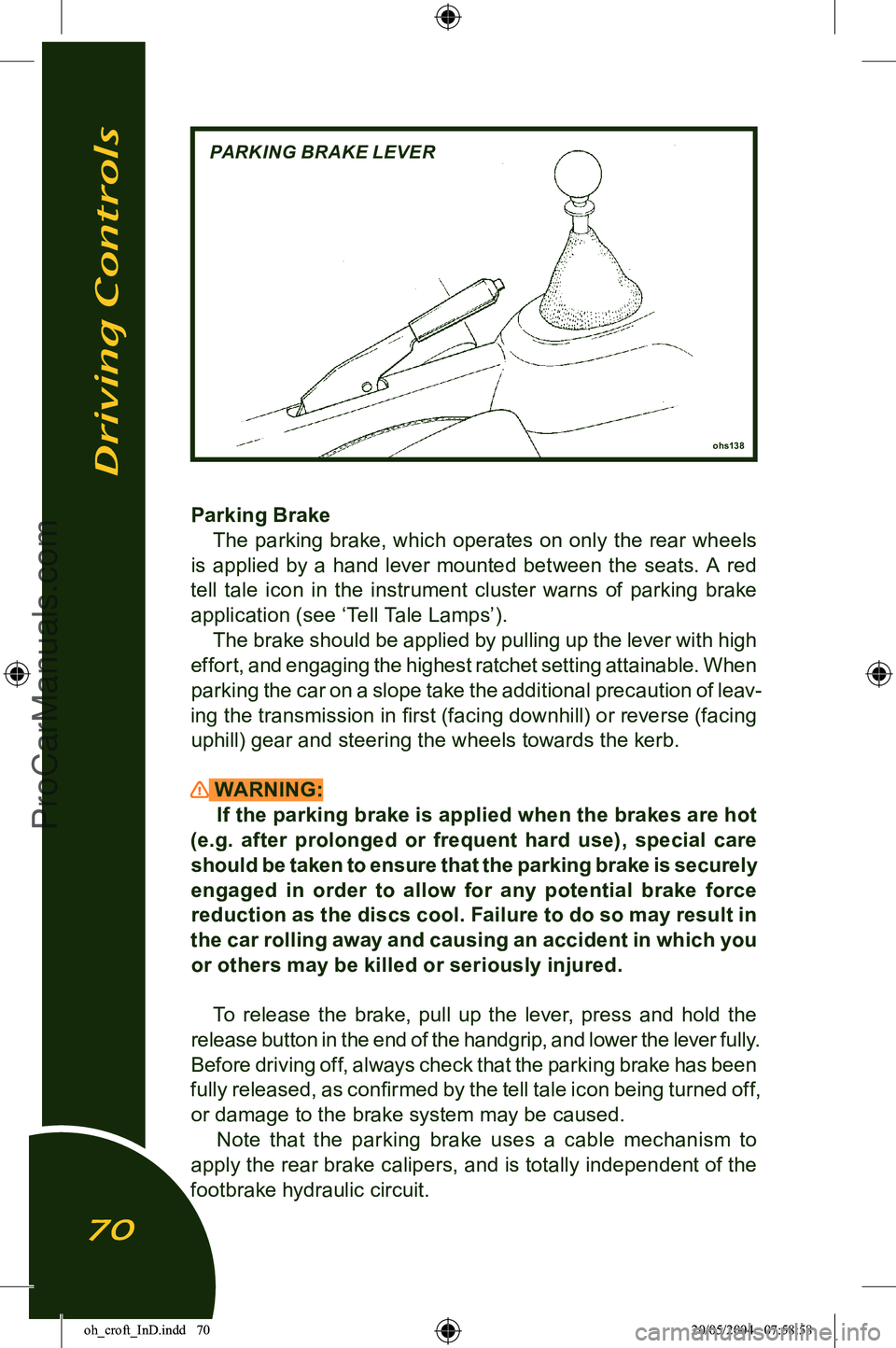
Parking BrakeThe parking brake, which operates on only the rear wheels
is applied by a hand lever mounted between the seats. A red
tell tale icon in the instrument cluster warns of parking brake application (see ‘Tell Tale Lamps’). The brake should be applied by pulling up the lever with high
effort, and engaging the highest ratchet setting attainable. When
parking the car on a slope take the additional precaution of leav
-
ing the transmission in first (facing downhill) or reverse (facing uphill) gear and steering the wheels towards the kerb.
WARNING: If the parking brake is applied when the brakes are hot
(e.g. after prolonged or frequent hard use), special care
should be taken to ensure that the parking brake is securely engaged in order to allow for any potential brake force
reduction as the discs cool. Failure to do so may result in
the car rolling away and causing an accident in which you
or others may be killed or seriously injured.
To release the brake, pull up the lever, press and hold the
release button in the end of the handgrip, and lower the lever fully.
Before driving off, always check that the parking brake has been
fully released, as confirmed by the tell tale icon being turned off,
or damage to the brake system may be caused. Note that the parking brake uses a cable mechanism to
apply the rear brake calipers, and is totally independent of the
footbrake hydraulic circuit.
Driving Controls
70
ohs138
PARKING BRAKE LEVER
oh_croft_InD.indd 7020/05/2004 07:58:58ProCarManuals.com
Page 74 of 205
STARTING PROCEDURE & ENGINE BREAK-IN
WARNING:CARBON MONOXIDE - Be aware of the danger of carbon
monoxide! Never run the engine in an enclosed space. The
exhaust gases contain carbon monoxide, a deadly gas
which is particularly dangerous, as being colourless odour
-
less and tasteless, its presence is very difficult to detect.
Before starting the engine, always check that the parking
brake is firmly applied, the transmission is in neutral, and as
an extra precaution, depress the clutch pedal. Switch off any
unnecessary electrical loads.
Starting a Cold or Warm Engine
The fuel injection and engine management system controls fuel delivery and engine settings under all normal operating conditions.
i) Insert the key into the steering lock/ignition switch and turn to
position ‘l’ to unlock the column. Before turning on the igni
-
tion; if the security tell tale in the tachometer face is flashing, mobilise the engine by pressing once, and for a full second,
the larger of the two buttons on the transmitter fob.
ii) Turn the key to position ‘II’ to switch on the ignition, and pause
for a moment to allow the fuel system to prime.
iii) Depress the clutch pedal as a precaution, and without moving
the accelerator, press the ‘Start’ button at the left hand end of
the dashboard to engage the starter motor. Release the button
as soon as the engine starts. Allow a cold engine to idle for
10 seconds before driving off, but if ambient temperatures are below freezing, allow the engine and screen heating systems
to warm up for a few minutes before driving.
iv) If the engine fails to start within 15 seconds, stop cranking
and pause for 10 seconds before a second attempt.
v) If further efforts are unsuccessful, contact your dealer or seek
other expert help.
WARNING:
An unattended car with a running engine is potentially
hazardous. Turn off the engine before leaving the car.
Starting & Engine Break-In
72
oh_croft_InD.indd 7220/05/2004 07:58:58ProCarManuals.com
Page 75 of 205
NOTICE: The use of wide throttle openings and/or high rpm before the engine has reached normal running temperature will
result in premature wear, and should be avoided.
Idle Speed Engine idle speed is controlled electronically by the engine
management computer, and is normally about 850 rpm. A
raised idle speed is required under certain operating conditions
including the engine warm up phase, when the increased speed helps the catalytic converter to reach operating temperature, as
well as inhibiting engine stall. Idle speed will return to normal automatically when the engine has warmed sufficiently.
Engine Break-In Although the Elise powertrain is built to close tolerances
using modern technology, the progressive and sympathetic
breaking-in (or bedding-in) of a new engine and transmission
remains a major factor in attaining ef ficient operation with
smooth, durable and economic performance to last throughout
the life of the car.
NOTICE: Failure to comply with the following break-in provi
-
sions could invalidate the terms of the car warranty:
It is important during the car’s early life to limit the workload on
the engine and thus control the heat generated within it, which is primarily a function of throttle opening and rpm. However, being
too sympathetic on the car will not allow the piston rings to bed in
satisfactorily, so a balance of spirited and gentle use is required.
For the first 600 miles (1,000 km), use no more than moderate
throttle openings (about half of the available accelerator pedal
travel) and do not run the engine continuously at engine speeds over 4,500 rpm. Occasional short bursts at wider throttle and
higher rpm will be beneficial, as will a constantly changing cruis
-
ing speed and making full use of the gearbox. Do not allow the
engine to labour in too high a gear ratio, but change down and
let the engine operate in its natural power band. When changing gear, use only a light touch on the gear lever.
Forcing the change will cause unnecessary wear on the system components and result in higher shift efforts being required. Al
-
low the brakes to bed-in by avoiding needless heavy braking for
the first 100 miles (160 km). Both gearchange and brake pedal
Starting & Engine Break-In
73
oh_croft_InD.indd 7320/05/2004 07:58:59ProCarManuals.com
Page 80 of 205
ohs93
REMOVING ACCESS PANEL
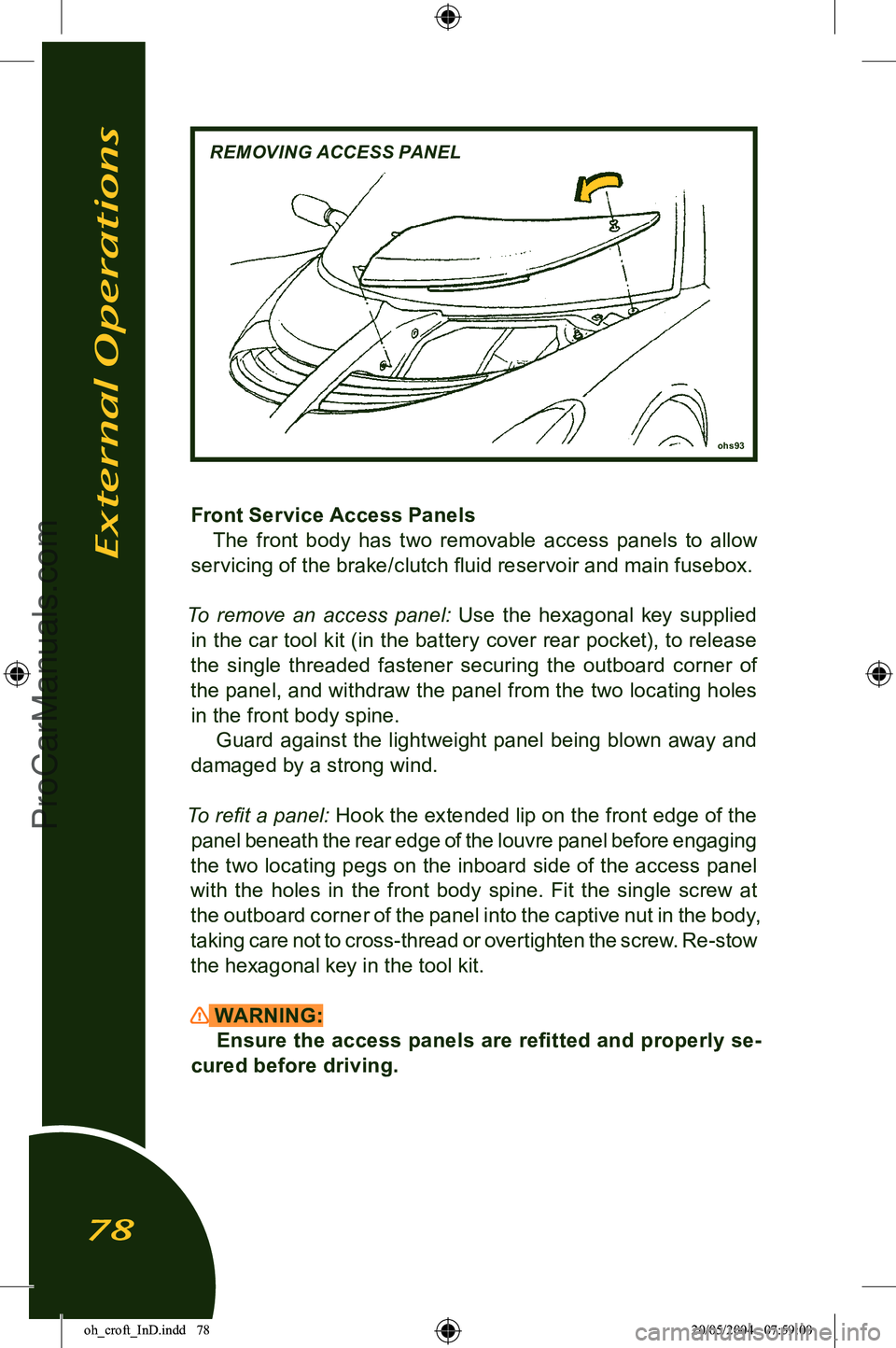
Front Service Access PanelsThe front body has two removable access panels to allow
servicing of the brake/clutch fluid reservoir and main fusebox.
To remove an access panel:
Use the hexagonal key supplied
in the car tool kit (in the battery cover rear pocket), to release
the single threaded fastener securing the outboard corner of
the panel, and withdraw the panel from the two locating holes in the front body spine. Guard against the lightweight panel being blown away and
damaged by a strong wind.
To refit a panel: Hook the extended lip on the front edge of the panel beneath the rear edge of the louvre panel before engaging
the two locating pegs on the inboard side of the access panel
with the holes in the front body spine. Fit the single screw at
the outboard corner of the panel into the captive nut in the body,
taking care not to cross-thread or overtighten the screw. Re-stow
the hexagonal key in the tool kit.
WARNING: Ensure the access panels are refitted and properly se
-
cured before driving.
External Operations
78
oh_croft_InD.indd 7820/05/2004 07:59:00ProCarManuals.com
Page 112 of 205
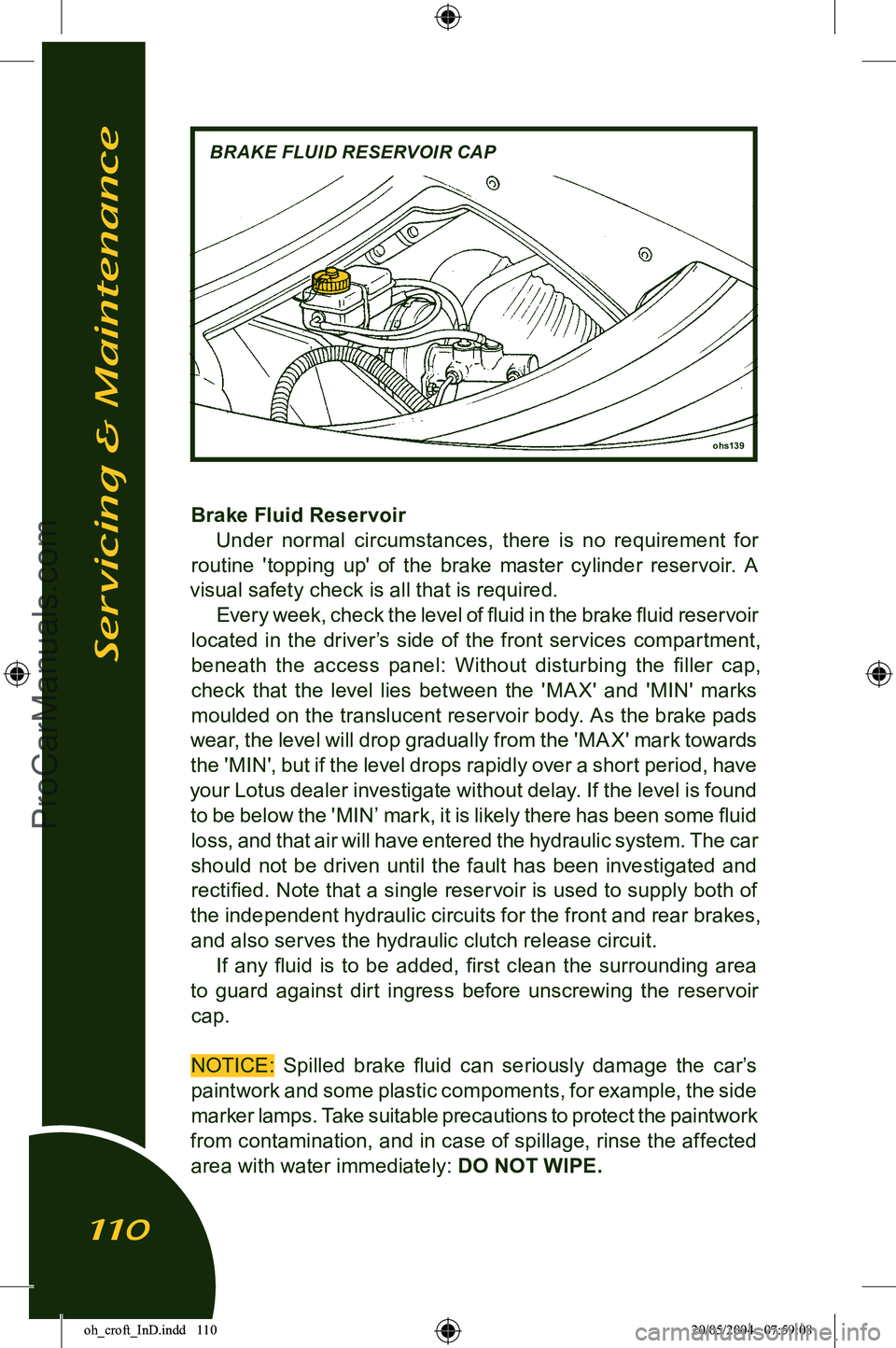
Brake Fluid ReservoirUnder normal circumstances, there is no requirement for
routine 'topping up' of the brake master cylinder reservoir. A
visual safety check is all that is required. Every week, check the level of fluid in the brake fluid reservoir
located in the driver’s side of the front services compartment, beneath the access panel: Without disturbing the filler cap,
check that the level lies between the 'MA X' and 'MIN' marks moulded on the translucent reservoir body. As the brake pads
wear, the level will drop gradually from the 'MA X' mark towards the 'MIN', but if the level drops rapidly over a short period, have
your Lotus dealer investigate without delay. If the level is found
to be below the 'MIN’ mark, it is likely there has been some fluid loss, and that air will have entered the hydraulic system. The car
should not be driven until the fault has been investigated and rectified. Note that a single reservoir is used to supply both of
the independent hydraulic circuits for the front and rear brakes, and also serves the hydraulic clutch release circuit. If any fluid is to be added, first clean the surrounding area
to guard against dirt ingress before unscrewing the reservoir cap.
NOTICE: Spilled brake fluid can seriously damage the car’s paintwork and some plastic compoments, for example, the side
marker lamps. Take suitable precautions to protect the paintwork
from contamination, and in case of spillage, rinse the affected area with water immediately: DO NOT WIPE.
ohs139
BRAKE FLUID RESERVOIR CAP
Servicing & Maintenance
110
oh_croft_InD.indd 11020/05/2004 07:59:08ProCarManuals.com
Page 113 of 205
Use only a non-mineral type DOT 4 brake fluid from a sealed
container marked with a yellow and black (non-mineral) symbol.
Do not use DOT 5 silicone fluid, or any fluid which has been
exposed to the atmosphere for more than a brief period, or
any fluid suspected of being wet, dirty or contaminated. Do not over fill, and replace the cap securely. Brake fluid, being hygroscopic, absorbs water from the atmos
-
phere over a period of time, resulting in a lowering of the boiling
point of the fluid, and corrosion of the hydraulic system. For
optimum safety and brake performance, the brake fluid should be renewed every twelve months by your Lotus Dealer.
WARNING:
• Brake fluid is hazardous to health and may be fatal if swallowed. Keep out of children’s reach.
• Using the wrong type of brake fluid can damage brake system components and result in brake failure causing a
crash in which you and others could be killed or seriously
injured. See ‘Recommended Lubricants’.
Brake Pads The thickness of the brake pad lining material should be
checked at every service, and under no circumstances be al
-
lowed to fall below 0.1 inch (2.5 mm). If the brakes are in very frequent or arduous use, as when driving in mountainous terrain,
or on race circuits, it is recommended that they be examined
more frequently. The pads should be renewed if of insufficient
thickness to ensure safe braking until the next scheduled service.
Note that in order to ensure that brake pads with the correct
material specification are used, only genuine Lotus replacement parts should be fitted, and in the interests of safety, pad renewal
should be entrusted to your Lotus dealer.
WARNING: Using incorrect brake pads, or pads below 0.1 inch
(2.5mm) thickness, may cause a crash in which you or
others could be killed or seriously injured. With a new car, or new brake system components, maxi
-
mum braking efficiency will be achieved if, for the first few
hundred miles, needless heavy braking is avoided, and the
brake pads and discs are allowed to ‘bed in’ fully before
being used to their full potential (see also ‘Footbrake’).
Servicing & Maintenance
111
oh_croft_InD.indd 11120/05/2004 07:59:08ProCarManuals.com
Page 114 of 205

Brake Pipes & HosesAt the recommended service intervals, the brake pipes and
flexible hoses should be carefully examined for signs of dam
-
age, corrosion or perishing, especially in territories where salt is used on the road surface in the winter months.
Servicing & Maintenance
112
oh_croft_InD.indd 11220/05/2004 07:59:08ProCarManuals.com
Page 130 of 205
NOTICE: Using incorrect wheel/tire equipment can also cause problems with wheel bearing life, brake cooling, speedo and
odometer calibration, headlamp aim, ground clearance and tire
clearance to the body.
WARNING: Dirt or corrosion on a wheel or hub mounting flange or
wheel bolts, can result in the wheel bolts coming loose.
The wheel could come off and cause a crash in which you and others could be killed or seriously injured. Thoroughly
clean these components or fit new Lotus approved replace
-
ments before fitting a wheel. Never use oil or grease on the wheel bolts or hub threads.
If you do, the bolts could come loose and the wheel could
come off, causing a crash in which you and others could be killed or seriously injured. Using incorrect wheel bolts, or the wrong tightening
torque could cause the bolts to come loose and the wheel to come off, resulting in a crash in which you and others could be killed or seriously injured. Use only the correct Lotus
approved wheel bolts tightened to 77 lbf.ft (105 Nm).
NOTICE: Improperly tightened wheel bolts, or dirt on the wheel
to hub mounting face can cause brake pulsation and judder, and damage the brake discs. To avoid expensive brake repairs,
ensure complete cleanliness on assembly and tighten the wheel
bolts in a diagonal sequence to the correct torque.
For advice and information on lifting the Elise, refer to ‘Lifting
Points’ on page 148Tires & Wheels
128
oh_croft_InD.indd 12820/05/2004 07:59:12ProCarManuals.com
Page 148 of 205
LIFTING AND TOWING
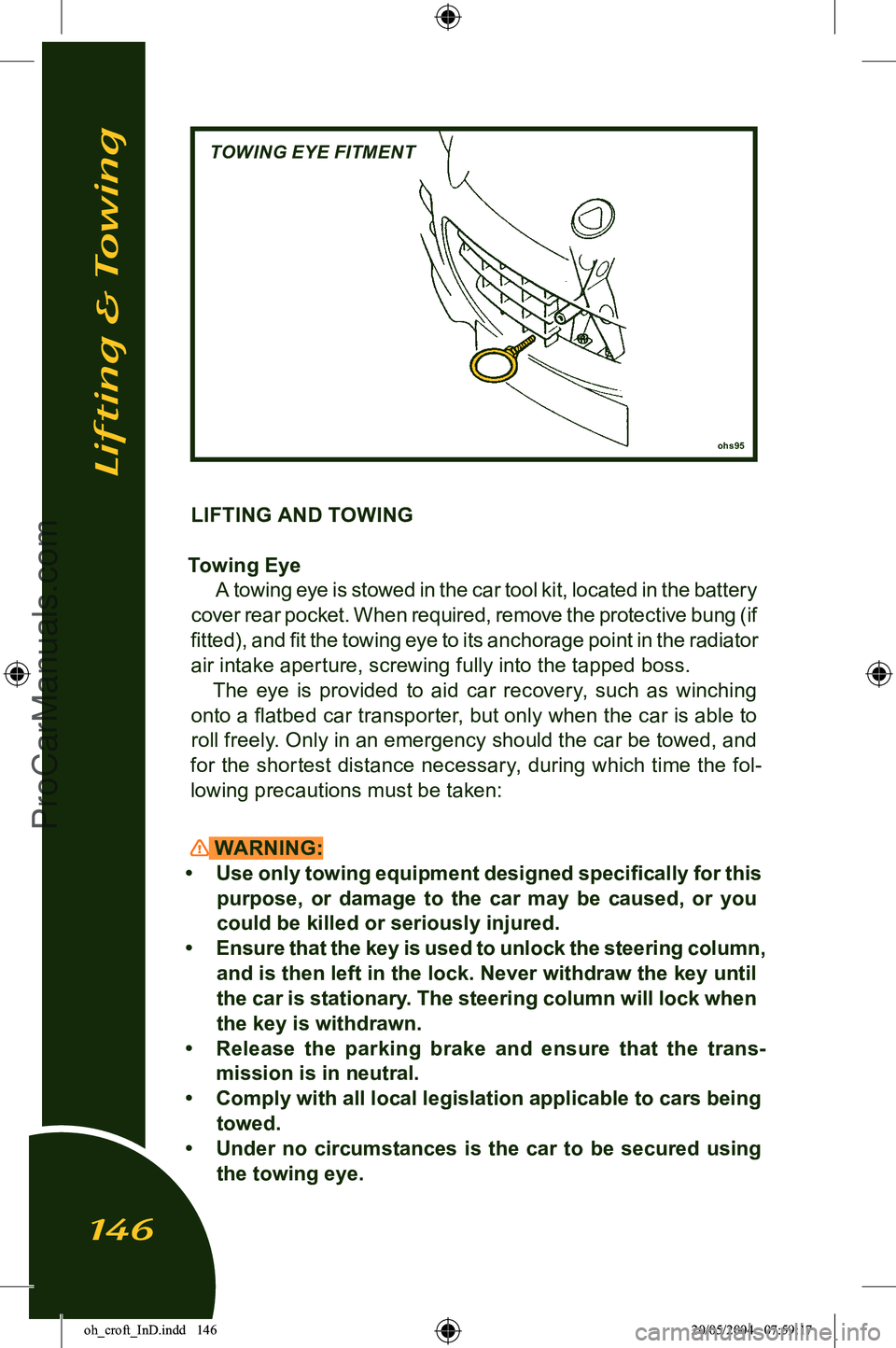
Towing Eye A towing eye is stowed in the car tool kit, located in the battery
cover rear pocket. When required, remove the protective bung (if
fitted), and fit the towing eye to its anchorage point in the radiator air intake aperture, screwing fully into the tapped boss.
The eye is provided to aid car recovery, such as winching
onto a flatbed car transporter, but only when the car is able to roll freely. Only in an emergency should the car be towed, and
for the shortest distance necessary, during which time the fol
-
lowing precautions must be taken:
WARNING:
• Use only towing equipment designed specifically for this purpose, or damage to the car may be caused, or you
could be killed or seriously injured.
• Ensure that the key is used to unlock the steering column, and is then left in the lock. Never withdraw the key until
the car is stationary. The steering column will lock when
the key is withdrawn.
• Release the parking brake and ensure that the trans
-
mission is in neutral.
• Comply with all local legislation applicable to cars being
towed.
• Under no circumstances is the car to be secured using
the towing eye.
ohs95
TOWING EYE FITMENT
Lifting & Towing
146
oh_croft_InD.indd 14620/05/2004 07:59:17ProCarManuals.com
Page 150 of 205
Lifting Your Car
WARNING:
• Using a lifting jack can be dangerous. If the car falls off the jack, you or others could be seriously injured or killed.
NEVER get under a car when it is supported only by a
jack.
• Before raising the car with a jack: - Turn off the engine;
- Firmly apply the parking brake;
- Engage first or reverse gear;
- Securely chock all wheels not to be lifted.
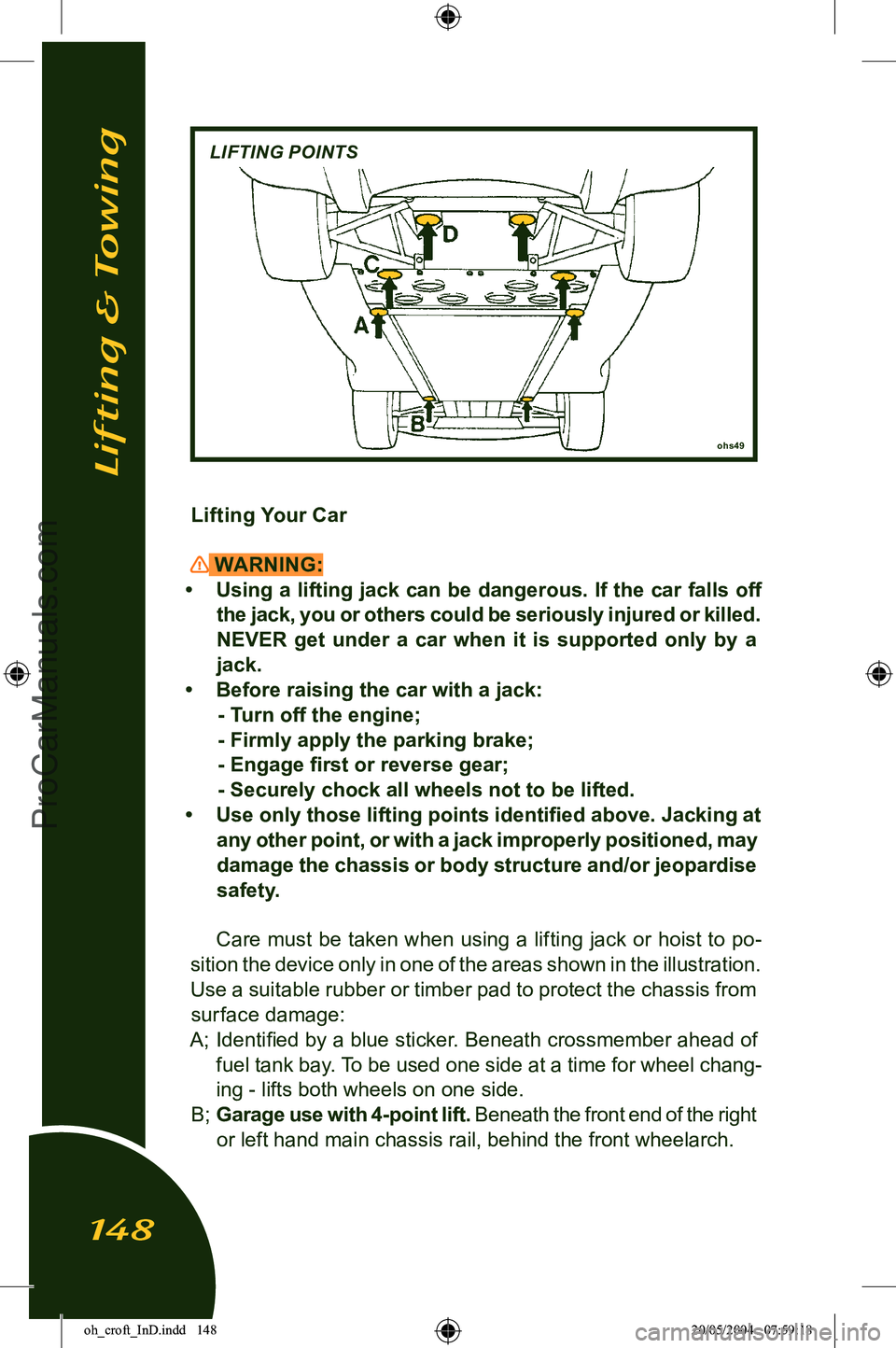
• Use only those lifting points identified above. Jacking at any other point, or with a jack improperly positioned, may
damage the chassis or body structure and/or jeopardise safety.
Care must be taken when using a lifting jack or hoist to po
-
sition the device only in one of the areas shown in the illustration.
Use a suitable rubber or timber pad to protect the chassis from
surface damage:
A; Identified by a blue sticker. Beneath crossmember ahead of fuel tank bay. To be used one side at a time for wheel chang
-
ing - lifts both wheels on one side.
B; Garage use with 4-point lift. Beneath the front end of the right
or left hand main chassis rail, behind the front wheelarch.
ohs49
LIFTING POINTS
Lifting & Towing
148
oh_croft_InD.indd 14820/05/2004 07:59:18ProCarManuals.com